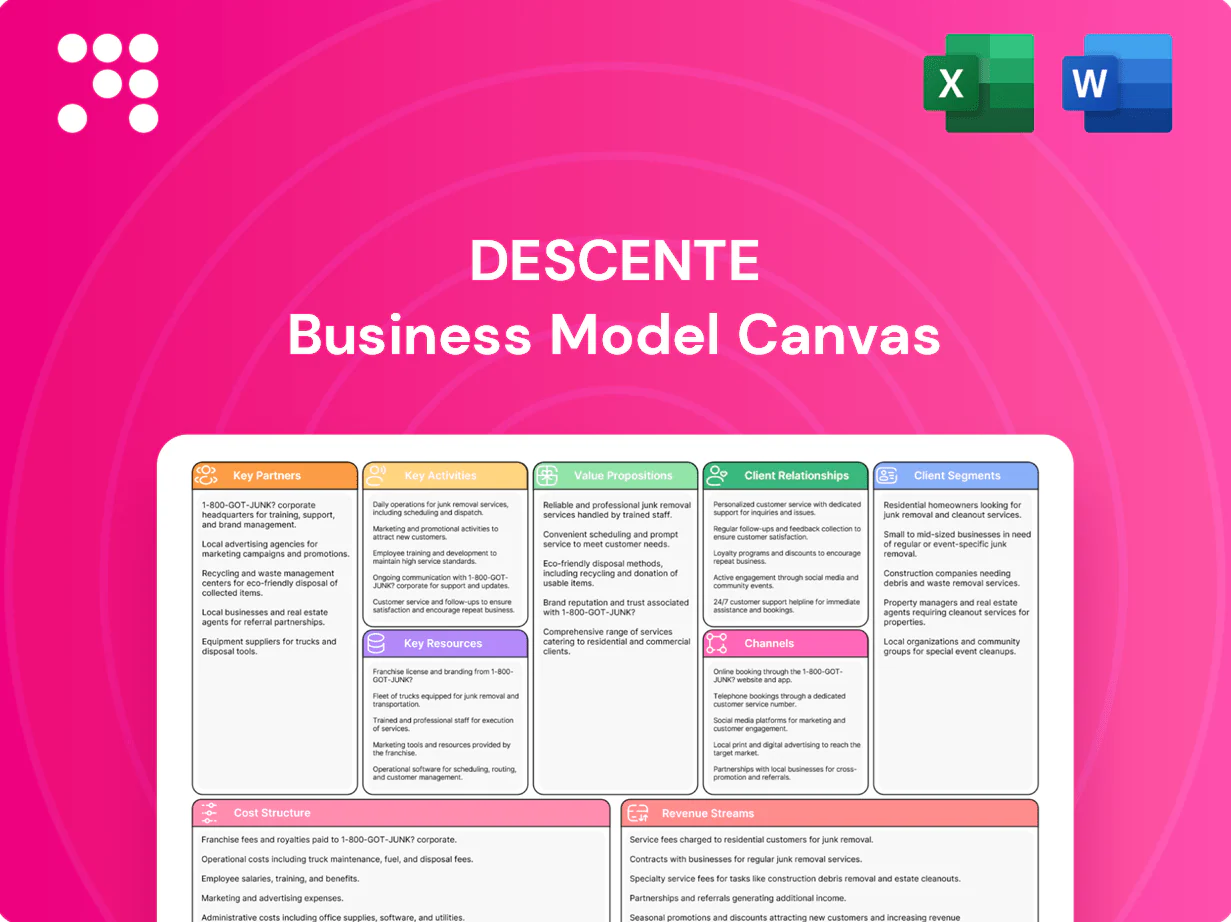
Descente Business Model Canvas

Explore a concise Business Model Canvas preview: core value, customer segments, growth levers
Explore Descente’s strategic engine with a concise Business Model Canvas preview—see its core value propositions, customer segments, and growth levers. Ready to dig deeper? Purchase the full, editable Canvas for a complete nine-block analysis, financial implications, and actionable strategies to replicate or compete.
Partnerships

Advanced textile suppliers
Partnerships with high-performance fabric innovators secure breathable, waterproof and thermo-regulating materials, supporting rapid material trials and exclusive allocations for flagship launches. These ties underpin supply continuity during peak seasons, aligning with a global performance textiles market valued at $45.2 billion in 2024 and rising demand for technical apparel.
Specialist manufacturing partners
Trusted OEM/ODM factories supply technical sewing, bonding and lamination for complex Descente garments, enabling co-development that improves yield, consistency and shortens time-to-market. Close collaboration has reduced development cycles by up to 30% for comparable technical apparel programs. Flexible supplier capacity manages seasonal and regional swings amid the $412 billion global sportswear market in 2024.

Athletes, teams, and coaches
Athletes, teams, and coaches validate performance in real conditions, with Descente leveraging elite testing to refine iterations and claims supported by its FY2024 consolidated revenue of ¥89.8 billion, underscoring commercial scale.
High-profile endorsements in skiing, running, and training boost brand credibility and channel conversion; sponsored athletes drive social reach and product desirability.
Continuous feedback loops from pro partners convert rider and runner insights into measurable gains in lap times, thermal efficiency, and injury-reduction metrics used across R&D and marketing.

Retail and distribution partners
- Global wholesale accounts
- Specialty ski shops
- Sporting chains
- Local distributors: compliance & forecasting
- Joint planning: higher sell-through & faster turns
Digital and technology partners
Digital and technology partners—e-commerce platforms, analytics providers and PLM tools—streamline Descente’s design-to-delivery workflows, reducing time-to-market and supporting omnichannel assortments; global e-commerce reached about 23% of retail sales in 2024. CRM and CDP partners enable personalized lifecycle marketing and higher repeat purchase rates. Payment, logistics and last-mile partners underpin seamless DTC fulfillment and returns handling.
- e-commerce platforms: omnichannel storefronts
- analytics/PLM: faster design-to-delivery
- CRM/CDP: personalization & lifecycle marketing
- payments/logistics: reliable DTC fulfillment
Performance textiles and OEM co-development cut dev cycles 30%, scaling to ¥89.8B
Partnerships with performance textile innovators secure breathable, waterproof and thermo-regulating materials, supporting exclusive allocations and trials (performance textiles market $45.2B in 2024). OEM/ODM factories enable technical assembly and co-development, cutting dev cycles up to 30% and supporting scale (sportswear market $412B in 2024). Athlete endorsements validate claims and boost marketing; retail, e‑commerce and logistics partners expand reach around Descente’s FY2024 revenue ¥89.8B.
| Partner Type | Key Metric (2024) |
|---|---|
| Performance textiles | $45.2B market |
| Sportswear supply | $412B market |
| Descente revenue | ¥89.8B |
| Global sporting goods | >$500B |
What is included in the product
 Detailed Word Document
A comprehensive Business Model Canvas tailored to Descente’s strategy, detailing customer segments, channels, value propositions and revenue streams across the 9 BMC blocks; includes competitive advantages, SWOT-linked insights and presentation-ready narratives for investor or internal use.

 Customizable Excel Spreadsheet
High-level, editable one-page Descente Business Model Canvas that quickly pinpoints value props, channels and cost drivers to relieve strategy ambiguity and save hours of structuring—ideal for team alignment, board prep, and side-by-side comparisons.
Activities

Performance R&D and testing
Performance R&D blends advanced material science, ergonomic patterning and rigorous lab/field testing to drive product breakthroughs; in 2024 over 50 athlete trials validated designs under extreme conditions. Iterative prototyping cut early-stage failure rates by ~25% in pilot programs and trimmed warranty costs proportionally. Athlete feedback loops ensure function and durability meet elite-sport demands.
Design and product development
Collection planning aligns with sport calendars and climate needs through four seasonal drops per year, timed to key event windows and regional weather patterns; this coordination targets demand in a global sportswear market estimated at about 400 billion USD in 2024. Technical design converts athlete and market insights into manufacturable specs and tech packs for scalable production. Consistent color palettes, trims, and fit blocks preserve Descente brand DNA across lines and regions.

Sourcing and quality assurance
Global sourcing balances cost, lead time, and compliance by leveraging Asia, which accounted for roughly 70% of global apparel manufacturing in 2024, to optimize margins and 8–12 week lead times. QA protocols target durability, water resistance, and fit consistency through lab testing and in-line inspections, reducing returns and warranty claims. Vendor scorecards, tracking quality, delivery and labor compliance, drive supplier improvements and elevate ethical standards.

Brand marketing and community
Storytelling around Descente technology and performance creates clear differentiation, driving higher-brand recall and premium positioning; athlete partnerships and event-driven content raised engagement in 2024 across the sportswear sector. Seasonal campaigns that align wholesale and DTC calendars boost synchronized traffic and inventory turnover, improving sell-through during peak seasons.
- 2024 global sportswear market ~ $410B (industry estimate)
- Event-driven engagement lifts campaign performance
- Seasonal sync improves wholesale + DTC sell-through
Omnichannel sales and fulfillment
Omnichannel sales and fulfillment use demand forecasting, allocation, and replenishment to minimize stockouts and overstocks; DTC, wholesale, and marketplace channels are synchronized for unified availability and pricing. Reverse logistics handles returns and refurb where feasible—apparel e‑commerce return rates averaged about 30% in 2024, driving refurbished resale and cost recovery efforts.
- Forecasting: centralized demand signals
- Allocation: dynamic inventory routing
- Replenishment: automated replen cycles
- Channels: DTC, wholesale, marketplace in lockstep
- Reverse logistics: returns → refurb/resale (addresses ~30% return rate)
R&D 50+; proto fail ~25%; market $410B
Performance R&D: 50+ athlete trials in 2024, iterative prototyping cut early failures ~25%. Four seasonal drops align with events; global sportswear market ~$410B (2024). Global sourcing: Asia ~70% manufacturing, 8–12 week lead times; apparel e‑commerce return rate ~30%.
| Metric | 2024 |
|---|---|
| Athlete trials | 50+ |
| Proto failure↓ | ~25% |
| Market size | $410B |
| Asia share | ~70% |
| Return rate | ~30% |
What You See Is What You Get
Business Model Canvas
The Descente Business Model Canvas you’re previewing is the actual deliverable, not a mockup. When you purchase, you’ll receive this same complete document ready to edit and present. The file is provided in the formats shown, with all sections and content included exactly as previewed. No surprises—what you see is what you’ll download.

Explore a concise Business Model Canvas preview: core value, customer segments, growth levers
Explore Descente’s strategic engine with a concise Business Model Canvas preview—see its core value propositions, customer segments, and growth levers. Ready to dig deeper? Purchase the full, editable Canvas for a complete nine-block analysis, financial implications, and actionable strategies to replicate or compete.
Partnerships
Advanced textile suppliers
Partnerships with high-performance fabric innovators secure breathable, waterproof and thermo-regulating materials, supporting rapid material trials and exclusive allocations for flagship launches. These ties underpin supply continuity during peak seasons, aligning with a global performance textiles market valued at $45.2 billion in 2024 and rising demand for technical apparel.
Specialist manufacturing partners
Trusted OEM/ODM factories supply technical sewing, bonding and lamination for complex Descente garments, enabling co-development that improves yield, consistency and shortens time-to-market. Close collaboration has reduced development cycles by up to 30% for comparable technical apparel programs. Flexible supplier capacity manages seasonal and regional swings amid the $412 billion global sportswear market in 2024.
Athletes, teams, and coaches
Athletes, teams, and coaches validate performance in real conditions, with Descente leveraging elite testing to refine iterations and claims supported by its FY2024 consolidated revenue of ¥89.8 billion, underscoring commercial scale.
High-profile endorsements in skiing, running, and training boost brand credibility and channel conversion; sponsored athletes drive social reach and product desirability.
Continuous feedback loops from pro partners convert rider and runner insights into measurable gains in lap times, thermal efficiency, and injury-reduction metrics used across R&D and marketing.
Retail and distribution partners
- Global wholesale accounts
- Specialty ski shops
- Sporting chains
- Local distributors: compliance & forecasting
- Joint planning: higher sell-through & faster turns
Digital and technology partners
Digital and technology partners—e-commerce platforms, analytics providers and PLM tools—streamline Descente’s design-to-delivery workflows, reducing time-to-market and supporting omnichannel assortments; global e-commerce reached about 23% of retail sales in 2024. CRM and CDP partners enable personalized lifecycle marketing and higher repeat purchase rates. Payment, logistics and last-mile partners underpin seamless DTC fulfillment and returns handling.
- e-commerce platforms: omnichannel storefronts
- analytics/PLM: faster design-to-delivery
- CRM/CDP: personalization & lifecycle marketing
- payments/logistics: reliable DTC fulfillment
Performance textiles and OEM co-development cut dev cycles 30%, scaling to ¥89.8B
Partnerships with performance textile innovators secure breathable, waterproof and thermo-regulating materials, supporting exclusive allocations and trials (performance textiles market $45.2B in 2024). OEM/ODM factories enable technical assembly and co-development, cutting dev cycles up to 30% and supporting scale (sportswear market $412B in 2024). Athlete endorsements validate claims and boost marketing; retail, e‑commerce and logistics partners expand reach around Descente’s FY2024 revenue ¥89.8B.
| Partner Type | Key Metric (2024) |
|---|---|
| Performance textiles | $45.2B market |
| Sportswear supply | $412B market |
| Descente revenue | ¥89.8B |
| Global sporting goods | >$500B |
What is included in the product
Detailed Word Document
A comprehensive Business Model Canvas tailored to Descente’s strategy, detailing customer segments, channels, value propositions and revenue streams across the 9 BMC blocks; includes competitive advantages, SWOT-linked insights and presentation-ready narratives for investor or internal use.
Customizable Excel Spreadsheet
High-level, editable one-page Descente Business Model Canvas that quickly pinpoints value props, channels and cost drivers to relieve strategy ambiguity and save hours of structuring—ideal for team alignment, board prep, and side-by-side comparisons.
Activities
Performance R&D and testing
Performance R&D blends advanced material science, ergonomic patterning and rigorous lab/field testing to drive product breakthroughs; in 2024 over 50 athlete trials validated designs under extreme conditions. Iterative prototyping cut early-stage failure rates by ~25% in pilot programs and trimmed warranty costs proportionally. Athlete feedback loops ensure function and durability meet elite-sport demands.
Design and product development
Collection planning aligns with sport calendars and climate needs through four seasonal drops per year, timed to key event windows and regional weather patterns; this coordination targets demand in a global sportswear market estimated at about 400 billion USD in 2024. Technical design converts athlete and market insights into manufacturable specs and tech packs for scalable production. Consistent color palettes, trims, and fit blocks preserve Descente brand DNA across lines and regions.
Sourcing and quality assurance
Global sourcing balances cost, lead time, and compliance by leveraging Asia, which accounted for roughly 70% of global apparel manufacturing in 2024, to optimize margins and 8–12 week lead times. QA protocols target durability, water resistance, and fit consistency through lab testing and in-line inspections, reducing returns and warranty claims. Vendor scorecards, tracking quality, delivery and labor compliance, drive supplier improvements and elevate ethical standards.
Brand marketing and community
Storytelling around Descente technology and performance creates clear differentiation, driving higher-brand recall and premium positioning; athlete partnerships and event-driven content raised engagement in 2024 across the sportswear sector. Seasonal campaigns that align wholesale and DTC calendars boost synchronized traffic and inventory turnover, improving sell-through during peak seasons.
- 2024 global sportswear market ~ $410B (industry estimate)
- Event-driven engagement lifts campaign performance
- Seasonal sync improves wholesale + DTC sell-through
Omnichannel sales and fulfillment
Omnichannel sales and fulfillment use demand forecasting, allocation, and replenishment to minimize stockouts and overstocks; DTC, wholesale, and marketplace channels are synchronized for unified availability and pricing. Reverse logistics handles returns and refurb where feasible—apparel e‑commerce return rates averaged about 30% in 2024, driving refurbished resale and cost recovery efforts.
- Forecasting: centralized demand signals
- Allocation: dynamic inventory routing
- Replenishment: automated replen cycles
- Channels: DTC, wholesale, marketplace in lockstep
- Reverse logistics: returns → refurb/resale (addresses ~30% return rate)
R&D 50+; proto fail ~25%; market $410B
Performance R&D: 50+ athlete trials in 2024, iterative prototyping cut early failures ~25%. Four seasonal drops align with events; global sportswear market ~$410B (2024). Global sourcing: Asia ~70% manufacturing, 8–12 week lead times; apparel e‑commerce return rate ~30%.
| Metric | 2024 |
|---|---|
| Athlete trials | 50+ |
| Proto failure↓ | ~25% |
| Market size | $410B |
| Asia share | ~70% |
| Return rate | ~30% |
What You See Is What You Get
Business Model Canvas
The Descente Business Model Canvas you’re previewing is the actual deliverable, not a mockup. When you purchase, you’ll receive this same complete document ready to edit and present. The file is provided in the formats shown, with all sections and content included exactly as previewed. No surprises—what you see is what you’ll download.
Original: $10.00
-65%$10.00
$3.50Description
Explore a concise Business Model Canvas preview: core value, customer segments, growth levers
Explore Descente’s strategic engine with a concise Business Model Canvas preview—see its core value propositions, customer segments, and growth levers. Ready to dig deeper? Purchase the full, editable Canvas for a complete nine-block analysis, financial implications, and actionable strategies to replicate or compete.
Partnerships
Advanced textile suppliers
Partnerships with high-performance fabric innovators secure breathable, waterproof and thermo-regulating materials, supporting rapid material trials and exclusive allocations for flagship launches. These ties underpin supply continuity during peak seasons, aligning with a global performance textiles market valued at $45.2 billion in 2024 and rising demand for technical apparel.
Specialist manufacturing partners
Trusted OEM/ODM factories supply technical sewing, bonding and lamination for complex Descente garments, enabling co-development that improves yield, consistency and shortens time-to-market. Close collaboration has reduced development cycles by up to 30% for comparable technical apparel programs. Flexible supplier capacity manages seasonal and regional swings amid the $412 billion global sportswear market in 2024.
Athletes, teams, and coaches
Athletes, teams, and coaches validate performance in real conditions, with Descente leveraging elite testing to refine iterations and claims supported by its FY2024 consolidated revenue of ¥89.8 billion, underscoring commercial scale.
High-profile endorsements in skiing, running, and training boost brand credibility and channel conversion; sponsored athletes drive social reach and product desirability.
Continuous feedback loops from pro partners convert rider and runner insights into measurable gains in lap times, thermal efficiency, and injury-reduction metrics used across R&D and marketing.
Retail and distribution partners
- Global wholesale accounts
- Specialty ski shops
- Sporting chains
- Local distributors: compliance & forecasting
- Joint planning: higher sell-through & faster turns
Digital and technology partners
Digital and technology partners—e-commerce platforms, analytics providers and PLM tools—streamline Descente’s design-to-delivery workflows, reducing time-to-market and supporting omnichannel assortments; global e-commerce reached about 23% of retail sales in 2024. CRM and CDP partners enable personalized lifecycle marketing and higher repeat purchase rates. Payment, logistics and last-mile partners underpin seamless DTC fulfillment and returns handling.
- e-commerce platforms: omnichannel storefronts
- analytics/PLM: faster design-to-delivery
- CRM/CDP: personalization & lifecycle marketing
- payments/logistics: reliable DTC fulfillment
Performance textiles and OEM co-development cut dev cycles 30%, scaling to ¥89.8B
Partnerships with performance textile innovators secure breathable, waterproof and thermo-regulating materials, supporting exclusive allocations and trials (performance textiles market $45.2B in 2024). OEM/ODM factories enable technical assembly and co-development, cutting dev cycles up to 30% and supporting scale (sportswear market $412B in 2024). Athlete endorsements validate claims and boost marketing; retail, e‑commerce and logistics partners expand reach around Descente’s FY2024 revenue ¥89.8B.
| Partner Type | Key Metric (2024) |
|---|---|
| Performance textiles | $45.2B market |
| Sportswear supply | $412B market |
| Descente revenue | ¥89.8B |
| Global sporting goods | >$500B |
What is included in the product
Detailed Word Document
A comprehensive Business Model Canvas tailored to Descente’s strategy, detailing customer segments, channels, value propositions and revenue streams across the 9 BMC blocks; includes competitive advantages, SWOT-linked insights and presentation-ready narratives for investor or internal use.
Customizable Excel Spreadsheet
High-level, editable one-page Descente Business Model Canvas that quickly pinpoints value props, channels and cost drivers to relieve strategy ambiguity and save hours of structuring—ideal for team alignment, board prep, and side-by-side comparisons.
Activities
Performance R&D and testing
Performance R&D blends advanced material science, ergonomic patterning and rigorous lab/field testing to drive product breakthroughs; in 2024 over 50 athlete trials validated designs under extreme conditions. Iterative prototyping cut early-stage failure rates by ~25% in pilot programs and trimmed warranty costs proportionally. Athlete feedback loops ensure function and durability meet elite-sport demands.
Design and product development
Collection planning aligns with sport calendars and climate needs through four seasonal drops per year, timed to key event windows and regional weather patterns; this coordination targets demand in a global sportswear market estimated at about 400 billion USD in 2024. Technical design converts athlete and market insights into manufacturable specs and tech packs for scalable production. Consistent color palettes, trims, and fit blocks preserve Descente brand DNA across lines and regions.
Sourcing and quality assurance
Global sourcing balances cost, lead time, and compliance by leveraging Asia, which accounted for roughly 70% of global apparel manufacturing in 2024, to optimize margins and 8–12 week lead times. QA protocols target durability, water resistance, and fit consistency through lab testing and in-line inspections, reducing returns and warranty claims. Vendor scorecards, tracking quality, delivery and labor compliance, drive supplier improvements and elevate ethical standards.
Brand marketing and community
Storytelling around Descente technology and performance creates clear differentiation, driving higher-brand recall and premium positioning; athlete partnerships and event-driven content raised engagement in 2024 across the sportswear sector. Seasonal campaigns that align wholesale and DTC calendars boost synchronized traffic and inventory turnover, improving sell-through during peak seasons.
- 2024 global sportswear market ~ $410B (industry estimate)
- Event-driven engagement lifts campaign performance
- Seasonal sync improves wholesale + DTC sell-through
Omnichannel sales and fulfillment
Omnichannel sales and fulfillment use demand forecasting, allocation, and replenishment to minimize stockouts and overstocks; DTC, wholesale, and marketplace channels are synchronized for unified availability and pricing. Reverse logistics handles returns and refurb where feasible—apparel e‑commerce return rates averaged about 30% in 2024, driving refurbished resale and cost recovery efforts.
- Forecasting: centralized demand signals
- Allocation: dynamic inventory routing
- Replenishment: automated replen cycles
- Channels: DTC, wholesale, marketplace in lockstep
- Reverse logistics: returns → refurb/resale (addresses ~30% return rate)
R&D 50+; proto fail ~25%; market $410B
Performance R&D: 50+ athlete trials in 2024, iterative prototyping cut early failures ~25%. Four seasonal drops align with events; global sportswear market ~$410B (2024). Global sourcing: Asia ~70% manufacturing, 8–12 week lead times; apparel e‑commerce return rate ~30%.
| Metric | 2024 |
|---|---|
| Athlete trials | 50+ |
| Proto failure↓ | ~25% |
| Market size | $410B |
| Asia share | ~70% |
| Return rate | ~30% |
What You See Is What You Get
Business Model Canvas
The Descente Business Model Canvas you’re previewing is the actual deliverable, not a mockup. When you purchase, you’ll receive this same complete document ready to edit and present. The file is provided in the formats shown, with all sections and content included exactly as previewed. No surprises—what you see is what you’ll download.











