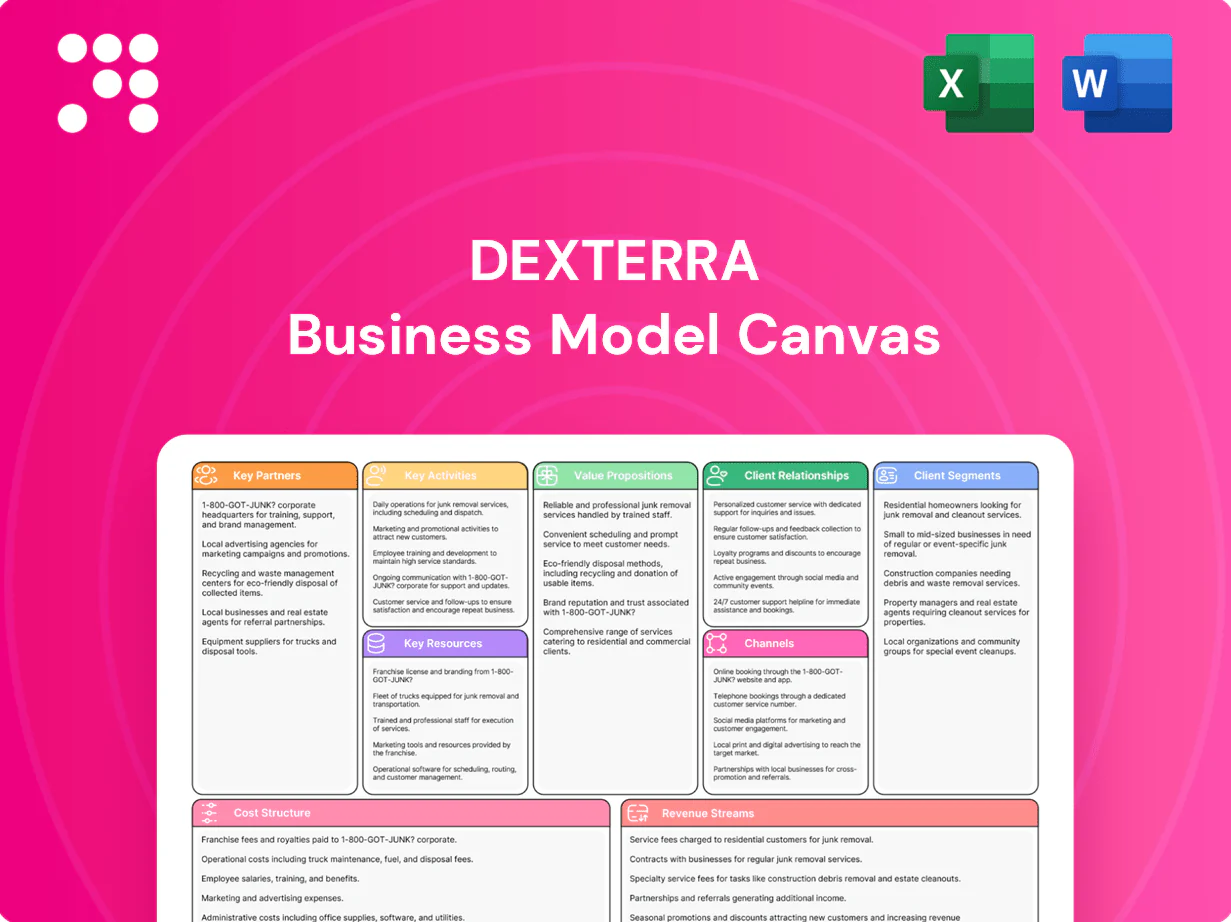
Dexterra Business Model Canvas

Unlock the strategic blueprint: concise Business Model Canvas for scalable services
Unlock the strategic blueprint behind Dexterra with our concise Business Model Canvas—three to five key sentences revealing how the company creates value, scales operations, and secures recurring revenue. This downloadable canvas (Word & Excel) is perfect for investors, consultants, and founders seeking actionable insights. Purchase the full version to access all nine blocks, company-specific analysis, and ready-to-use templates for immediate benchmarking.
Partnerships

Strategic suppliers network
OEMs and national distributors supply cleaning, HVAC and building-maintenance consumables at scale, and in 2024 Dexterra leverages preferred pricing and assured availability to reduce service downtime across its sites. Joint forecasting with suppliers aligns inventory to seasonal and project demand, improving fill rates and project continuity. Vendor-managed inventory programs shorten lead times and improve working capital and fulfillment speed.
Technology and data partners
CMMS, IoT sensors and analytics platforms enable predictive maintenance and real-time dashboards—with 14.4 billion IoT devices online in 2024 and predictive maintenance cutting unplanned downtime by up to 50%. Integrations streamline work orders, asset tracking and SLA reporting. Cybersecure cloud hosting (99.99% uptime, SOC 2) protects client data, while co-development accelerates sector-tailored features.

Modular manufacturing and trades
Fabricators, engineers and qualified trades enable Dexterra to scale design-build-deliver cycles, leveraging offsite lines that in 2024 showed up to 50% schedule compression versus stick-built projects.
Standardized components improve quality and speed to site while reducing on-site labor variability and defects by as much as 60% in industry case studies.
Partner capacity expands peak throughput without heavy fixed costs and joint QA programs ensure consistent code compliance across jurisdictions.

Workforce and training alliances
Workforce and training alliances with recruiters, colleges and safety institutes secure steady skilled-labor pipelines; 2024 industry reporting shows structured partnerships raised placement rates and helped firms cut onboarding time by about 22%. Continuous upskilling keeps certifications current and, according to 2024 safety program analyses, can reduce incidents roughly 18%. Apprenticeships align with regional employment targets while flexible staffing models support remote sites and surge demand.
- Recruiters: accelerate placements, cut onboarding ~22%
- Colleges/safety institutes: maintain certifications, −18% incidents
- Apprenticeships: support regional employment goals
- Flexible staffing: covers remote sites and surge capacity
Public sector and community ties
Framework agreements with federal, provincial, and municipal governments streamline procurement and shorten delivery cycles, enabling faster mobilization for infrastructure and maintenance projects.
Partnerships with Indigenous and local organizations reinforce social value commitments and improve access to community suppliers, which enhances operational resilience in remote and northern regions.
Close collaboration with public stakeholders supports permitting, regulatory compliance, and stakeholder acceptance, reducing project delays and reputational risk.
- framework agreements
- indigenous partnerships
- community suppliers
- permits & compliance
14.4B IoT devices and supplier partnerships cut unplanned downtime up to 50%
OEMs and national distributors deliver preferred pricing and assured supply, reducing service downtime across sites. CMMS/IoT (14.4 billion devices in 2024) enables predictive maintenance cutting unplanned downtime up to 50%. Fabrication partners compress schedules ~50% and workforce alliances cut onboarding ~22% and incidents ~18%.
| Partnership | 2024 metric | Impact |
|---|---|---|
| Suppliers | Preferred pricing | Lower downtime |
| IoT/CMMS | 14.4B devices | −50% unplanned downtime |
| Fabricators | Offsite build | −50% schedule |
| Workforce | Placement ↑22% | −18% incidents |
What is included in the product
 Detailed Word Document
A comprehensive, pre-written Business Model Canvas for Dexterra detailing customer segments, value propositions, channels, revenue streams and key resources, with SWOT-linked insights and polished narratives for investor presentations.

 Customizable Excel Spreadsheet
High-level view of Dexterra’s business model with editable cells, condensing complex service operations into a one-page snapshot for quick review. Shareable and editable for team collaboration, saving hours of formatting while enabling fast deliverables and side-by-side comparisons.
Activities

Integrated facilities operations
Integrated facilities operations combine planned and reactive maintenance to maximize uptime—predictive approaches can cut unplanned downtime by up to 70%—while soft services cover cleaning, landscaping and waste. Energy management lowers costs and carbon (buildings ~40% of global CO2), and KPI tracking ensures SLA delivery across portfolios.
Remote accommodations management
Operate, maintain and cater workforce camps with 24/7 housekeeping, food services and utilities to ensure safe, reliable remote accommodations. Resident experience programs drive retention and productivity through tailored services and onsite engagement. Emergency readiness and compliant response plans protect people and continuity, supporting Dexterra (TSX: DXT) service delivery across remote sites.

Modular design and delivery
Dexterra designs, manufactures and installs standardized modular buildings for healthcare, education and resource sites, cutting on-site construction time by up to 50% and enabling deployment in weeks rather than months. Turnkey site works—foundations, utilities and finishes—accelerate occupancy while reducing coordination delays. Structured commissioning verifies compliance with building codes and performance targets before handover.

HSE and regulatory compliance
Dexterra enforces rigorous safety systems that lower incidents and claims through proactive hazard controls and incident investigations. Regular audits and targeted training preserve ISO and regulatory certifications and ensure contractor compliance. Environmental practices are integrated to support client ESG targets while documentation meets public-sector and industry standards.
- Safety systems: incident reduction focus
- Audits & training: certification maintenance
- Environmental practices: ESG alignment
- Documentation: public-sector compliance
Account management and CI
Stakeholder engagement aligns scope, budgets and KPIs across Dexterra contracts, ensuring deliverables meet client expectations and commercial targets; in 2024 this alignment supported contract renewals and scope adjustments across service lines.
Continuous improvement programs unlock savings and quality gains, data reviews inform lifecycle strategies, and targeted expansion and renewals grow share of wallet.
- Stakeholder alignment: scope, budgets, KPIs
- CI programs: savings and quality uplift
- Data reviews: lifecycle strategy
- Expansion: renewals increase share of wallet
Predictive maintenance cuts downtime 70%; modular builds halve site time
Integrated facilities and soft services use predictive maintenance to cut unplanned downtime by up to 70% while energy management targets building sector emissions (~40% of global CO2). 24/7 remote camp operations provide housekeeping, catering and utilities with emergency response and compliance. Standardized modular builds cut on-site construction time by up to 50% and turnkey commissioning ensures code compliance.
| Activity | Metric |
|---|---|
| Predictive maintenance | Unplanned downtime −70% |
| Energy focus | Buildings ≈40% global CO2 |
| Modular construction | On-site time −50% |
| Remote camps | 24/7 services & emergency readiness |
Preview Before You Purchase
Business Model Canvas
The Dexterra Business Model Canvas preview shown here is the exact document you'll receive—it's not a mockup or sample. Upon purchase you'll get the full, complete file ready for editing, presenting, and sharing, formatted in Word and Excel. No hidden pages or surprises: what you see is what you own.

Unlock the strategic blueprint: concise Business Model Canvas for scalable services
Unlock the strategic blueprint behind Dexterra with our concise Business Model Canvas—three to five key sentences revealing how the company creates value, scales operations, and secures recurring revenue. This downloadable canvas (Word & Excel) is perfect for investors, consultants, and founders seeking actionable insights. Purchase the full version to access all nine blocks, company-specific analysis, and ready-to-use templates for immediate benchmarking.
Partnerships
Strategic suppliers network
OEMs and national distributors supply cleaning, HVAC and building-maintenance consumables at scale, and in 2024 Dexterra leverages preferred pricing and assured availability to reduce service downtime across its sites. Joint forecasting with suppliers aligns inventory to seasonal and project demand, improving fill rates and project continuity. Vendor-managed inventory programs shorten lead times and improve working capital and fulfillment speed.
Technology and data partners
CMMS, IoT sensors and analytics platforms enable predictive maintenance and real-time dashboards—with 14.4 billion IoT devices online in 2024 and predictive maintenance cutting unplanned downtime by up to 50%. Integrations streamline work orders, asset tracking and SLA reporting. Cybersecure cloud hosting (99.99% uptime, SOC 2) protects client data, while co-development accelerates sector-tailored features.
Modular manufacturing and trades
Fabricators, engineers and qualified trades enable Dexterra to scale design-build-deliver cycles, leveraging offsite lines that in 2024 showed up to 50% schedule compression versus stick-built projects.
Standardized components improve quality and speed to site while reducing on-site labor variability and defects by as much as 60% in industry case studies.
Partner capacity expands peak throughput without heavy fixed costs and joint QA programs ensure consistent code compliance across jurisdictions.
Workforce and training alliances
Workforce and training alliances with recruiters, colleges and safety institutes secure steady skilled-labor pipelines; 2024 industry reporting shows structured partnerships raised placement rates and helped firms cut onboarding time by about 22%. Continuous upskilling keeps certifications current and, according to 2024 safety program analyses, can reduce incidents roughly 18%. Apprenticeships align with regional employment targets while flexible staffing models support remote sites and surge demand.
- Recruiters: accelerate placements, cut onboarding ~22%
- Colleges/safety institutes: maintain certifications, −18% incidents
- Apprenticeships: support regional employment goals
- Flexible staffing: covers remote sites and surge capacity
Public sector and community ties
Framework agreements with federal, provincial, and municipal governments streamline procurement and shorten delivery cycles, enabling faster mobilization for infrastructure and maintenance projects.
Partnerships with Indigenous and local organizations reinforce social value commitments and improve access to community suppliers, which enhances operational resilience in remote and northern regions.
Close collaboration with public stakeholders supports permitting, regulatory compliance, and stakeholder acceptance, reducing project delays and reputational risk.
- framework agreements
- indigenous partnerships
- community suppliers
- permits & compliance
14.4B IoT devices and supplier partnerships cut unplanned downtime up to 50%
OEMs and national distributors deliver preferred pricing and assured supply, reducing service downtime across sites. CMMS/IoT (14.4 billion devices in 2024) enables predictive maintenance cutting unplanned downtime up to 50%. Fabrication partners compress schedules ~50% and workforce alliances cut onboarding ~22% and incidents ~18%.
| Partnership | 2024 metric | Impact |
|---|---|---|
| Suppliers | Preferred pricing | Lower downtime |
| IoT/CMMS | 14.4B devices | −50% unplanned downtime |
| Fabricators | Offsite build | −50% schedule |
| Workforce | Placement ↑22% | −18% incidents |
What is included in the product
Detailed Word Document
A comprehensive, pre-written Business Model Canvas for Dexterra detailing customer segments, value propositions, channels, revenue streams and key resources, with SWOT-linked insights and polished narratives for investor presentations.
Customizable Excel Spreadsheet
High-level view of Dexterra’s business model with editable cells, condensing complex service operations into a one-page snapshot for quick review. Shareable and editable for team collaboration, saving hours of formatting while enabling fast deliverables and side-by-side comparisons.
Activities
Integrated facilities operations
Integrated facilities operations combine planned and reactive maintenance to maximize uptime—predictive approaches can cut unplanned downtime by up to 70%—while soft services cover cleaning, landscaping and waste. Energy management lowers costs and carbon (buildings ~40% of global CO2), and KPI tracking ensures SLA delivery across portfolios.
Remote accommodations management
Operate, maintain and cater workforce camps with 24/7 housekeeping, food services and utilities to ensure safe, reliable remote accommodations. Resident experience programs drive retention and productivity through tailored services and onsite engagement. Emergency readiness and compliant response plans protect people and continuity, supporting Dexterra (TSX: DXT) service delivery across remote sites.
Modular design and delivery
Dexterra designs, manufactures and installs standardized modular buildings for healthcare, education and resource sites, cutting on-site construction time by up to 50% and enabling deployment in weeks rather than months. Turnkey site works—foundations, utilities and finishes—accelerate occupancy while reducing coordination delays. Structured commissioning verifies compliance with building codes and performance targets before handover.
HSE and regulatory compliance
Dexterra enforces rigorous safety systems that lower incidents and claims through proactive hazard controls and incident investigations. Regular audits and targeted training preserve ISO and regulatory certifications and ensure contractor compliance. Environmental practices are integrated to support client ESG targets while documentation meets public-sector and industry standards.
- Safety systems: incident reduction focus
- Audits & training: certification maintenance
- Environmental practices: ESG alignment
- Documentation: public-sector compliance
Account management and CI
Stakeholder engagement aligns scope, budgets and KPIs across Dexterra contracts, ensuring deliverables meet client expectations and commercial targets; in 2024 this alignment supported contract renewals and scope adjustments across service lines.
Continuous improvement programs unlock savings and quality gains, data reviews inform lifecycle strategies, and targeted expansion and renewals grow share of wallet.
- Stakeholder alignment: scope, budgets, KPIs
- CI programs: savings and quality uplift
- Data reviews: lifecycle strategy
- Expansion: renewals increase share of wallet
Predictive maintenance cuts downtime 70%; modular builds halve site time
Integrated facilities and soft services use predictive maintenance to cut unplanned downtime by up to 70% while energy management targets building sector emissions (~40% of global CO2). 24/7 remote camp operations provide housekeeping, catering and utilities with emergency response and compliance. Standardized modular builds cut on-site construction time by up to 50% and turnkey commissioning ensures code compliance.
| Activity | Metric |
|---|---|
| Predictive maintenance | Unplanned downtime −70% |
| Energy focus | Buildings ≈40% global CO2 |
| Modular construction | On-site time −50% |
| Remote camps | 24/7 services & emergency readiness |
Preview Before You Purchase
Business Model Canvas
The Dexterra Business Model Canvas preview shown here is the exact document you'll receive—it's not a mockup or sample. Upon purchase you'll get the full, complete file ready for editing, presenting, and sharing, formatted in Word and Excel. No hidden pages or surprises: what you see is what you own.
Description
Unlock the strategic blueprint: concise Business Model Canvas for scalable services
Unlock the strategic blueprint behind Dexterra with our concise Business Model Canvas—three to five key sentences revealing how the company creates value, scales operations, and secures recurring revenue. This downloadable canvas (Word & Excel) is perfect for investors, consultants, and founders seeking actionable insights. Purchase the full version to access all nine blocks, company-specific analysis, and ready-to-use templates for immediate benchmarking.
Partnerships
Strategic suppliers network
OEMs and national distributors supply cleaning, HVAC and building-maintenance consumables at scale, and in 2024 Dexterra leverages preferred pricing and assured availability to reduce service downtime across its sites. Joint forecasting with suppliers aligns inventory to seasonal and project demand, improving fill rates and project continuity. Vendor-managed inventory programs shorten lead times and improve working capital and fulfillment speed.
Technology and data partners
CMMS, IoT sensors and analytics platforms enable predictive maintenance and real-time dashboards—with 14.4 billion IoT devices online in 2024 and predictive maintenance cutting unplanned downtime by up to 50%. Integrations streamline work orders, asset tracking and SLA reporting. Cybersecure cloud hosting (99.99% uptime, SOC 2) protects client data, while co-development accelerates sector-tailored features.
Modular manufacturing and trades
Fabricators, engineers and qualified trades enable Dexterra to scale design-build-deliver cycles, leveraging offsite lines that in 2024 showed up to 50% schedule compression versus stick-built projects.
Standardized components improve quality and speed to site while reducing on-site labor variability and defects by as much as 60% in industry case studies.
Partner capacity expands peak throughput without heavy fixed costs and joint QA programs ensure consistent code compliance across jurisdictions.
Workforce and training alliances
Workforce and training alliances with recruiters, colleges and safety institutes secure steady skilled-labor pipelines; 2024 industry reporting shows structured partnerships raised placement rates and helped firms cut onboarding time by about 22%. Continuous upskilling keeps certifications current and, according to 2024 safety program analyses, can reduce incidents roughly 18%. Apprenticeships align with regional employment targets while flexible staffing models support remote sites and surge demand.
- Recruiters: accelerate placements, cut onboarding ~22%
- Colleges/safety institutes: maintain certifications, −18% incidents
- Apprenticeships: support regional employment goals
- Flexible staffing: covers remote sites and surge capacity
Public sector and community ties
Framework agreements with federal, provincial, and municipal governments streamline procurement and shorten delivery cycles, enabling faster mobilization for infrastructure and maintenance projects.
Partnerships with Indigenous and local organizations reinforce social value commitments and improve access to community suppliers, which enhances operational resilience in remote and northern regions.
Close collaboration with public stakeholders supports permitting, regulatory compliance, and stakeholder acceptance, reducing project delays and reputational risk.
- framework agreements
- indigenous partnerships
- community suppliers
- permits & compliance
14.4B IoT devices and supplier partnerships cut unplanned downtime up to 50%
OEMs and national distributors deliver preferred pricing and assured supply, reducing service downtime across sites. CMMS/IoT (14.4 billion devices in 2024) enables predictive maintenance cutting unplanned downtime up to 50%. Fabrication partners compress schedules ~50% and workforce alliances cut onboarding ~22% and incidents ~18%.
| Partnership | 2024 metric | Impact |
|---|---|---|
| Suppliers | Preferred pricing | Lower downtime |
| IoT/CMMS | 14.4B devices | −50% unplanned downtime |
| Fabricators | Offsite build | −50% schedule |
| Workforce | Placement ↑22% | −18% incidents |
What is included in the product
Detailed Word Document
A comprehensive, pre-written Business Model Canvas for Dexterra detailing customer segments, value propositions, channels, revenue streams and key resources, with SWOT-linked insights and polished narratives for investor presentations.
Customizable Excel Spreadsheet
High-level view of Dexterra’s business model with editable cells, condensing complex service operations into a one-page snapshot for quick review. Shareable and editable for team collaboration, saving hours of formatting while enabling fast deliverables and side-by-side comparisons.
Activities
Integrated facilities operations
Integrated facilities operations combine planned and reactive maintenance to maximize uptime—predictive approaches can cut unplanned downtime by up to 70%—while soft services cover cleaning, landscaping and waste. Energy management lowers costs and carbon (buildings ~40% of global CO2), and KPI tracking ensures SLA delivery across portfolios.
Remote accommodations management
Operate, maintain and cater workforce camps with 24/7 housekeeping, food services and utilities to ensure safe, reliable remote accommodations. Resident experience programs drive retention and productivity through tailored services and onsite engagement. Emergency readiness and compliant response plans protect people and continuity, supporting Dexterra (TSX: DXT) service delivery across remote sites.
Modular design and delivery
Dexterra designs, manufactures and installs standardized modular buildings for healthcare, education and resource sites, cutting on-site construction time by up to 50% and enabling deployment in weeks rather than months. Turnkey site works—foundations, utilities and finishes—accelerate occupancy while reducing coordination delays. Structured commissioning verifies compliance with building codes and performance targets before handover.
HSE and regulatory compliance
Dexterra enforces rigorous safety systems that lower incidents and claims through proactive hazard controls and incident investigations. Regular audits and targeted training preserve ISO and regulatory certifications and ensure contractor compliance. Environmental practices are integrated to support client ESG targets while documentation meets public-sector and industry standards.
- Safety systems: incident reduction focus
- Audits & training: certification maintenance
- Environmental practices: ESG alignment
- Documentation: public-sector compliance
Account management and CI
Stakeholder engagement aligns scope, budgets and KPIs across Dexterra contracts, ensuring deliverables meet client expectations and commercial targets; in 2024 this alignment supported contract renewals and scope adjustments across service lines.
Continuous improvement programs unlock savings and quality gains, data reviews inform lifecycle strategies, and targeted expansion and renewals grow share of wallet.
- Stakeholder alignment: scope, budgets, KPIs
- CI programs: savings and quality uplift
- Data reviews: lifecycle strategy
- Expansion: renewals increase share of wallet
Predictive maintenance cuts downtime 70%; modular builds halve site time
Integrated facilities and soft services use predictive maintenance to cut unplanned downtime by up to 70% while energy management targets building sector emissions (~40% of global CO2). 24/7 remote camp operations provide housekeeping, catering and utilities with emergency response and compliance. Standardized modular builds cut on-site construction time by up to 50% and turnkey commissioning ensures code compliance.
| Activity | Metric |
|---|---|
| Predictive maintenance | Unplanned downtime −70% |
| Energy focus | Buildings ≈40% global CO2 |
| Modular construction | On-site time −50% |
| Remote camps | 24/7 services & emergency readiness |
Preview Before You Purchase
Business Model Canvas
The Dexterra Business Model Canvas preview shown here is the exact document you'll receive—it's not a mockup or sample. Upon purchase you'll get the full, complete file ready for editing, presenting, and sharing, formatted in Word and Excel. No hidden pages or surprises: what you see is what you own.











