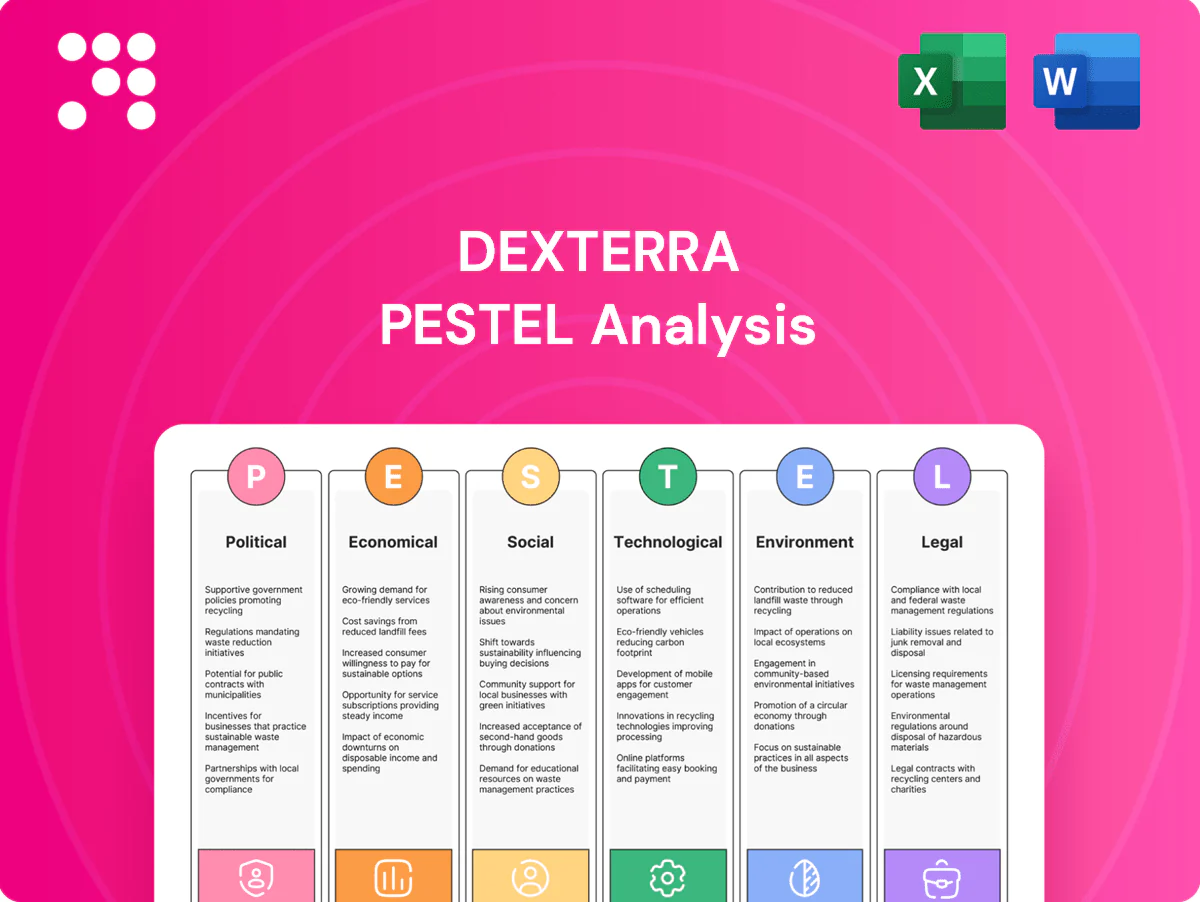
Dexterra PESTLE Analysis

Plan Smarter. Present Sharper. Compete Stronger.
Our Dexterra PESTLE Analysis distills political, economic, social, technological, legal, and environmental drivers shaping the company today, with clear implications for strategy and risk. Ideal for investors, consultants, and executives, it highlights opportunities and vulnerabilities you can act on immediately. Purchase the full report to access the complete, editable analysis and make informed decisions fast.
Political factors

Government outsourcing dynamics
Public sector clients drive Dexterra facilities and accommodation contracts, with the global facilities management market estimated at about US$1.2 trillion in 2024 and public spending cycles shaping bid pipelines. Shifts between insourcing and privatization at federal, provincial and municipal levels can rapidly expand or contract opportunities, requiring agile resource planning. Dexterra must align proposals to policy priorities—service quality, cost containment and local job creation—while strong vendor metrics and transparency increase renewal odds.
Infrastructure and housing spend
Federal and provincial capital programs, such as the Investing in Canada Plan (CAD 180 billion through 2028) and the CAD 4 billion Housing Accelerator Fund, materially shape demand for modular and support services. Targeted stimulus for healthcare, education and affordable housing accelerates modular deployments, while budget constraints or election-driven reprioritization can postpone awards. Early positioning on shovel-ready projects mitigates timing risk and preserves revenue visibility.

Indigenous partnerships and reconciliation
Government policies increasingly mandate Indigenous participation in resource and public projects; Indigenous peoples comprised 5.0% of Canada’s population in the 2021 Census. Procurement commonly evaluates joint ventures and local hiring, affecting technical scoring and award decisions. Dexterra’s community engagement directly influences social licence and bid success. Long-term Indigenous partnerships de-risk remote operations and improve workforce stability.

Regulatory fragmentation across provinces
Regulatory fragmentation across Canada’s 10 provinces and 3 territories means provincial variations in labour, health and building standards complicate multi-jurisdiction delivery and force rapid operating adjustments when policies change. Harmonized internal playbooks reduce compliance friction, while systematic local policy intelligence improves pricing and scheduling accuracy.
- Scope: 10 provinces + 3 territories
- Risk: varying labour/health/building rules
- Mitigation: harmonized playbooks
- Benefit: better pricing & scheduling via local intelligence
Geopolitics and supply security
Geopolitical tensions and trade restrictions, including national procurement preferences and measures like the US CHIPS Act (roughly $52 billion in incentives), are reshaping sourcing for Dexterra’s modular builds and can interrupt flows of materials and specialist equipment.
Extended lead times for critical items compress margins and delay deliveries; routine scenario planning and validated alternative suppliers are therefore essential to preserve project reliability and cost targets.
- trade barriers: raise input cost volatility
- buy-local: alters vendor mix and compliance needs
- lead times: pressure margins and schedules
- scenario planning: mitigates single‑source risk
Public contracts and CAD180B capex spur modular demand; supply risks rise
Public-sector contracts dominate Dexterra’s pipeline; global FM market ≈ US$1.2T (2024) and Canadian capital plans (Investing in Canada CAD180B to 2028; Housing Accelerator CAD4B) drive modular demand. Procurement favours local/Indigenous participation (Indigenous 5.0% in 2021), while trade measures (eg US CHIPS ≈ US$52B) and longer lead times raise input risk.
| Metric | Value |
|---|---|
| Global FM market (2024) | US$1.2T |
| Investing in Canada | CAD180B (to 2028) |
| Housing Accelerator | CAD4B |
| Indigenous pop (Canada) | 5.0% (2021) |
| US CHIPS incentives | ≈US$52B |
What is included in the product
 Detailed Word Document
Explores how macro-environmental factors—Political, Economic, Social, Technological, Environmental and Legal—specifically affect Dexterra, with data-backed trends and region- and industry-relevant insights to identify risks and opportunities. Designed for executives and investors, it offers clean, forward-looking analysis ready for plans, decks, or reports.

 Customizable Excel Spreadsheet
A concise, visually segmented PESTLE summary of Dexterra that’s easily inserted into presentations or shared across teams, allowing users to add region- or business-line-specific notes to streamline planning, risk discussions, and client deliverables.
Economic factors

Commodity and resource cycles
Workforce accommodations closely track mining and energy investment cycles, with project deferrals in downturns lowering occupancy and catering volumes and pressuring regional revenue. Upswings tighten local labour markets and pushed input costs higher after WTI averaged about USD 80/bbl in 2024, raising wage and procurement pressure on service providers. Dexterra's flexible cost structures and scalable staffing help protect margins across these cycles.
Inflation and wage pressures
Service contracts face rising labor, food and utilities costs as inflation ran about 3–4% in 2024 and average wage growth approached 4%, putting margin pressure on Dexterra’s facilities and camp services.
Indexation clauses and tightly managed change orders are essential to preserve profitability, with contract escalators directly tied to CPI movements.
Tight labor markets in remote regions amplify wage escalation and turnover, while strategic procurement timing and fuel/commodity hedging can smooth short-term cost volatility.

Interest rates and capex affordability
Higher rates (US federal funds 5.25–5.50% mid‑2025) raise financing costs for Dexterra’s modular manufacturing and clients, squeezing margins on projects. Clients often delay capital programs when borrowing costs climb, reducing near‑term order intake. Lease‑versus‑buy decisions shift toward leasing as capex becomes costlier. Providing in‑house or partner financing can sustain demand and win competitive bids.

Currency fluctuations (CAD)
Currency fluctuations in CAD materially affect Dexterra: imports of equipment and materials expose project costs to FX swings, and a strong USD (USD/CAD ~1.36 as of June 2025) raises input prices for modular components, squeezing margins. FX clauses or hedging strategies are used to protect project margins while cross-border clients may prefer CAD-stable pricing.
- USD/CAD ~1.36 (Jun 2025)
- Imports expose input-cost volatility
- Hedges/FX clauses protect margins
- Clients may request CAD-priced contracts
Macro growth and public budgets
Slower GDP growth (IMF global growth 2024 estimate 3.0%) tightens tax revenues and can lengthen public procurement cycles, pressuring Dexterra’s public-sector pipelines. Healthcare and education spending is relatively resilient (OECD average public health spending ~8.8% of GDP), though programs face fiscal scrutiny. Counter-cyclical maintenance and lifecycle services often offset new-build softness, and balanced sector exposure reduces revenue volatility.
- GDP: IMF 2024 global growth 3.0%
- Health spend: OECD ~8.8% of GDP
- Offset: maintenance demand counter-cyclical
- Risk mitigant: diversified sector exposure
Public contracts and CAD180B capex spur modular demand; supply risks rise
Economic cycles drive Dexterra’s occupancy and margins as mining/energy project deferrals cut volumes while upswings raise wages and input costs (WTI ~USD80/bbl 2024). Inflation ~3–4% (2024) and avg wage growth ~4% compress service margins; indexation and change‑order discipline are critical. Higher rates (US fed funds 5.25–5.50% mid‑2025) and USD/CAD ~1.36 (Jun 2025) elevate financing and import costs.
| Metric | Value |
|---|---|
| USD/CAD | ~1.36 (Jun 2025) |
| Inflation | 3–4% (2024) |
| Fed funds | 5.25–5.50% (mid‑2025) |
| Global GDP | 3.0% (IMF 2024) |
What You See Is What You Get
Dexterra PESTLE Analysis
The preview shown here is the exact Dexterra PESTLE Analysis you’ll receive after purchase—fully formatted and ready to use. The layout, content, and structure visible are the final version with no placeholders or teasers. After checkout you’ll instantly download this identical, professionally structured file.

Plan Smarter. Present Sharper. Compete Stronger.
Our Dexterra PESTLE Analysis distills political, economic, social, technological, legal, and environmental drivers shaping the company today, with clear implications for strategy and risk. Ideal for investors, consultants, and executives, it highlights opportunities and vulnerabilities you can act on immediately. Purchase the full report to access the complete, editable analysis and make informed decisions fast.
Political factors
Government outsourcing dynamics
Public sector clients drive Dexterra facilities and accommodation contracts, with the global facilities management market estimated at about US$1.2 trillion in 2024 and public spending cycles shaping bid pipelines. Shifts between insourcing and privatization at federal, provincial and municipal levels can rapidly expand or contract opportunities, requiring agile resource planning. Dexterra must align proposals to policy priorities—service quality, cost containment and local job creation—while strong vendor metrics and transparency increase renewal odds.
Infrastructure and housing spend
Federal and provincial capital programs, such as the Investing in Canada Plan (CAD 180 billion through 2028) and the CAD 4 billion Housing Accelerator Fund, materially shape demand for modular and support services. Targeted stimulus for healthcare, education and affordable housing accelerates modular deployments, while budget constraints or election-driven reprioritization can postpone awards. Early positioning on shovel-ready projects mitigates timing risk and preserves revenue visibility.
Indigenous partnerships and reconciliation
Government policies increasingly mandate Indigenous participation in resource and public projects; Indigenous peoples comprised 5.0% of Canada’s population in the 2021 Census. Procurement commonly evaluates joint ventures and local hiring, affecting technical scoring and award decisions. Dexterra’s community engagement directly influences social licence and bid success. Long-term Indigenous partnerships de-risk remote operations and improve workforce stability.
Regulatory fragmentation across provinces
Regulatory fragmentation across Canada’s 10 provinces and 3 territories means provincial variations in labour, health and building standards complicate multi-jurisdiction delivery and force rapid operating adjustments when policies change. Harmonized internal playbooks reduce compliance friction, while systematic local policy intelligence improves pricing and scheduling accuracy.
- Scope: 10 provinces + 3 territories
- Risk: varying labour/health/building rules
- Mitigation: harmonized playbooks
- Benefit: better pricing & scheduling via local intelligence
Geopolitics and supply security
Geopolitical tensions and trade restrictions, including national procurement preferences and measures like the US CHIPS Act (roughly $52 billion in incentives), are reshaping sourcing for Dexterra’s modular builds and can interrupt flows of materials and specialist equipment.
Extended lead times for critical items compress margins and delay deliveries; routine scenario planning and validated alternative suppliers are therefore essential to preserve project reliability and cost targets.
- trade barriers: raise input cost volatility
- buy-local: alters vendor mix and compliance needs
- lead times: pressure margins and schedules
- scenario planning: mitigates single‑source risk
Public contracts and CAD180B capex spur modular demand; supply risks rise
Public-sector contracts dominate Dexterra’s pipeline; global FM market ≈ US$1.2T (2024) and Canadian capital plans (Investing in Canada CAD180B to 2028; Housing Accelerator CAD4B) drive modular demand. Procurement favours local/Indigenous participation (Indigenous 5.0% in 2021), while trade measures (eg US CHIPS ≈ US$52B) and longer lead times raise input risk.
| Metric | Value |
|---|---|
| Global FM market (2024) | US$1.2T |
| Investing in Canada | CAD180B (to 2028) |
| Housing Accelerator | CAD4B |
| Indigenous pop (Canada) | 5.0% (2021) |
| US CHIPS incentives | ≈US$52B |
What is included in the product
Detailed Word Document
Explores how macro-environmental factors—Political, Economic, Social, Technological, Environmental and Legal—specifically affect Dexterra, with data-backed trends and region- and industry-relevant insights to identify risks and opportunities. Designed for executives and investors, it offers clean, forward-looking analysis ready for plans, decks, or reports.
Customizable Excel Spreadsheet
A concise, visually segmented PESTLE summary of Dexterra that’s easily inserted into presentations or shared across teams, allowing users to add region- or business-line-specific notes to streamline planning, risk discussions, and client deliverables.
Economic factors
Commodity and resource cycles
Workforce accommodations closely track mining and energy investment cycles, with project deferrals in downturns lowering occupancy and catering volumes and pressuring regional revenue. Upswings tighten local labour markets and pushed input costs higher after WTI averaged about USD 80/bbl in 2024, raising wage and procurement pressure on service providers. Dexterra's flexible cost structures and scalable staffing help protect margins across these cycles.
Inflation and wage pressures
Service contracts face rising labor, food and utilities costs as inflation ran about 3–4% in 2024 and average wage growth approached 4%, putting margin pressure on Dexterra’s facilities and camp services.
Indexation clauses and tightly managed change orders are essential to preserve profitability, with contract escalators directly tied to CPI movements.
Tight labor markets in remote regions amplify wage escalation and turnover, while strategic procurement timing and fuel/commodity hedging can smooth short-term cost volatility.
Interest rates and capex affordability
Higher rates (US federal funds 5.25–5.50% mid‑2025) raise financing costs for Dexterra’s modular manufacturing and clients, squeezing margins on projects. Clients often delay capital programs when borrowing costs climb, reducing near‑term order intake. Lease‑versus‑buy decisions shift toward leasing as capex becomes costlier. Providing in‑house or partner financing can sustain demand and win competitive bids.
Currency fluctuations (CAD)
Currency fluctuations in CAD materially affect Dexterra: imports of equipment and materials expose project costs to FX swings, and a strong USD (USD/CAD ~1.36 as of June 2025) raises input prices for modular components, squeezing margins. FX clauses or hedging strategies are used to protect project margins while cross-border clients may prefer CAD-stable pricing.
- USD/CAD ~1.36 (Jun 2025)
- Imports expose input-cost volatility
- Hedges/FX clauses protect margins
- Clients may request CAD-priced contracts
Macro growth and public budgets
Slower GDP growth (IMF global growth 2024 estimate 3.0%) tightens tax revenues and can lengthen public procurement cycles, pressuring Dexterra’s public-sector pipelines. Healthcare and education spending is relatively resilient (OECD average public health spending ~8.8% of GDP), though programs face fiscal scrutiny. Counter-cyclical maintenance and lifecycle services often offset new-build softness, and balanced sector exposure reduces revenue volatility.
- GDP: IMF 2024 global growth 3.0%
- Health spend: OECD ~8.8% of GDP
- Offset: maintenance demand counter-cyclical
- Risk mitigant: diversified sector exposure
Public contracts and CAD180B capex spur modular demand; supply risks rise
Economic cycles drive Dexterra’s occupancy and margins as mining/energy project deferrals cut volumes while upswings raise wages and input costs (WTI ~USD80/bbl 2024). Inflation ~3–4% (2024) and avg wage growth ~4% compress service margins; indexation and change‑order discipline are critical. Higher rates (US fed funds 5.25–5.50% mid‑2025) and USD/CAD ~1.36 (Jun 2025) elevate financing and import costs.
| Metric | Value |
|---|---|
| USD/CAD | ~1.36 (Jun 2025) |
| Inflation | 3–4% (2024) |
| Fed funds | 5.25–5.50% (mid‑2025) |
| Global GDP | 3.0% (IMF 2024) |
What You See Is What You Get
Dexterra PESTLE Analysis
The preview shown here is the exact Dexterra PESTLE Analysis you’ll receive after purchase—fully formatted and ready to use. The layout, content, and structure visible are the final version with no placeholders or teasers. After checkout you’ll instantly download this identical, professionally structured file.
Original: $10.00
-65%$10.00
$3.50Description
Plan Smarter. Present Sharper. Compete Stronger.
Our Dexterra PESTLE Analysis distills political, economic, social, technological, legal, and environmental drivers shaping the company today, with clear implications for strategy and risk. Ideal for investors, consultants, and executives, it highlights opportunities and vulnerabilities you can act on immediately. Purchase the full report to access the complete, editable analysis and make informed decisions fast.
Political factors
Government outsourcing dynamics
Public sector clients drive Dexterra facilities and accommodation contracts, with the global facilities management market estimated at about US$1.2 trillion in 2024 and public spending cycles shaping bid pipelines. Shifts between insourcing and privatization at federal, provincial and municipal levels can rapidly expand or contract opportunities, requiring agile resource planning. Dexterra must align proposals to policy priorities—service quality, cost containment and local job creation—while strong vendor metrics and transparency increase renewal odds.
Infrastructure and housing spend
Federal and provincial capital programs, such as the Investing in Canada Plan (CAD 180 billion through 2028) and the CAD 4 billion Housing Accelerator Fund, materially shape demand for modular and support services. Targeted stimulus for healthcare, education and affordable housing accelerates modular deployments, while budget constraints or election-driven reprioritization can postpone awards. Early positioning on shovel-ready projects mitigates timing risk and preserves revenue visibility.
Indigenous partnerships and reconciliation
Government policies increasingly mandate Indigenous participation in resource and public projects; Indigenous peoples comprised 5.0% of Canada’s population in the 2021 Census. Procurement commonly evaluates joint ventures and local hiring, affecting technical scoring and award decisions. Dexterra’s community engagement directly influences social licence and bid success. Long-term Indigenous partnerships de-risk remote operations and improve workforce stability.
Regulatory fragmentation across provinces
Regulatory fragmentation across Canada’s 10 provinces and 3 territories means provincial variations in labour, health and building standards complicate multi-jurisdiction delivery and force rapid operating adjustments when policies change. Harmonized internal playbooks reduce compliance friction, while systematic local policy intelligence improves pricing and scheduling accuracy.
- Scope: 10 provinces + 3 territories
- Risk: varying labour/health/building rules
- Mitigation: harmonized playbooks
- Benefit: better pricing & scheduling via local intelligence
Geopolitics and supply security
Geopolitical tensions and trade restrictions, including national procurement preferences and measures like the US CHIPS Act (roughly $52 billion in incentives), are reshaping sourcing for Dexterra’s modular builds and can interrupt flows of materials and specialist equipment.
Extended lead times for critical items compress margins and delay deliveries; routine scenario planning and validated alternative suppliers are therefore essential to preserve project reliability and cost targets.
- trade barriers: raise input cost volatility
- buy-local: alters vendor mix and compliance needs
- lead times: pressure margins and schedules
- scenario planning: mitigates single‑source risk
Public contracts and CAD180B capex spur modular demand; supply risks rise
Public-sector contracts dominate Dexterra’s pipeline; global FM market ≈ US$1.2T (2024) and Canadian capital plans (Investing in Canada CAD180B to 2028; Housing Accelerator CAD4B) drive modular demand. Procurement favours local/Indigenous participation (Indigenous 5.0% in 2021), while trade measures (eg US CHIPS ≈ US$52B) and longer lead times raise input risk.
| Metric | Value |
|---|---|
| Global FM market (2024) | US$1.2T |
| Investing in Canada | CAD180B (to 2028) |
| Housing Accelerator | CAD4B |
| Indigenous pop (Canada) | 5.0% (2021) |
| US CHIPS incentives | ≈US$52B |
What is included in the product
Detailed Word Document
Explores how macro-environmental factors—Political, Economic, Social, Technological, Environmental and Legal—specifically affect Dexterra, with data-backed trends and region- and industry-relevant insights to identify risks and opportunities. Designed for executives and investors, it offers clean, forward-looking analysis ready for plans, decks, or reports.
Customizable Excel Spreadsheet
A concise, visually segmented PESTLE summary of Dexterra that’s easily inserted into presentations or shared across teams, allowing users to add region- or business-line-specific notes to streamline planning, risk discussions, and client deliverables.
Economic factors
Commodity and resource cycles
Workforce accommodations closely track mining and energy investment cycles, with project deferrals in downturns lowering occupancy and catering volumes and pressuring regional revenue. Upswings tighten local labour markets and pushed input costs higher after WTI averaged about USD 80/bbl in 2024, raising wage and procurement pressure on service providers. Dexterra's flexible cost structures and scalable staffing help protect margins across these cycles.
Inflation and wage pressures
Service contracts face rising labor, food and utilities costs as inflation ran about 3–4% in 2024 and average wage growth approached 4%, putting margin pressure on Dexterra’s facilities and camp services.
Indexation clauses and tightly managed change orders are essential to preserve profitability, with contract escalators directly tied to CPI movements.
Tight labor markets in remote regions amplify wage escalation and turnover, while strategic procurement timing and fuel/commodity hedging can smooth short-term cost volatility.
Interest rates and capex affordability
Higher rates (US federal funds 5.25–5.50% mid‑2025) raise financing costs for Dexterra’s modular manufacturing and clients, squeezing margins on projects. Clients often delay capital programs when borrowing costs climb, reducing near‑term order intake. Lease‑versus‑buy decisions shift toward leasing as capex becomes costlier. Providing in‑house or partner financing can sustain demand and win competitive bids.
Currency fluctuations (CAD)
Currency fluctuations in CAD materially affect Dexterra: imports of equipment and materials expose project costs to FX swings, and a strong USD (USD/CAD ~1.36 as of June 2025) raises input prices for modular components, squeezing margins. FX clauses or hedging strategies are used to protect project margins while cross-border clients may prefer CAD-stable pricing.
- USD/CAD ~1.36 (Jun 2025)
- Imports expose input-cost volatility
- Hedges/FX clauses protect margins
- Clients may request CAD-priced contracts
Macro growth and public budgets
Slower GDP growth (IMF global growth 2024 estimate 3.0%) tightens tax revenues and can lengthen public procurement cycles, pressuring Dexterra’s public-sector pipelines. Healthcare and education spending is relatively resilient (OECD average public health spending ~8.8% of GDP), though programs face fiscal scrutiny. Counter-cyclical maintenance and lifecycle services often offset new-build softness, and balanced sector exposure reduces revenue volatility.
- GDP: IMF 2024 global growth 3.0%
- Health spend: OECD ~8.8% of GDP
- Offset: maintenance demand counter-cyclical
- Risk mitigant: diversified sector exposure
Public contracts and CAD180B capex spur modular demand; supply risks rise
Economic cycles drive Dexterra’s occupancy and margins as mining/energy project deferrals cut volumes while upswings raise wages and input costs (WTI ~USD80/bbl 2024). Inflation ~3–4% (2024) and avg wage growth ~4% compress service margins; indexation and change‑order discipline are critical. Higher rates (US fed funds 5.25–5.50% mid‑2025) and USD/CAD ~1.36 (Jun 2025) elevate financing and import costs.
| Metric | Value |
|---|---|
| USD/CAD | ~1.36 (Jun 2025) |
| Inflation | 3–4% (2024) |
| Fed funds | 5.25–5.50% (mid‑2025) |
| Global GDP | 3.0% (IMF 2024) |
What You See Is What You Get
Dexterra PESTLE Analysis
The preview shown here is the exact Dexterra PESTLE Analysis you’ll receive after purchase—fully formatted and ready to use. The layout, content, and structure visible are the final version with no placeholders or teasers. After checkout you’ll instantly download this identical, professionally structured file.











