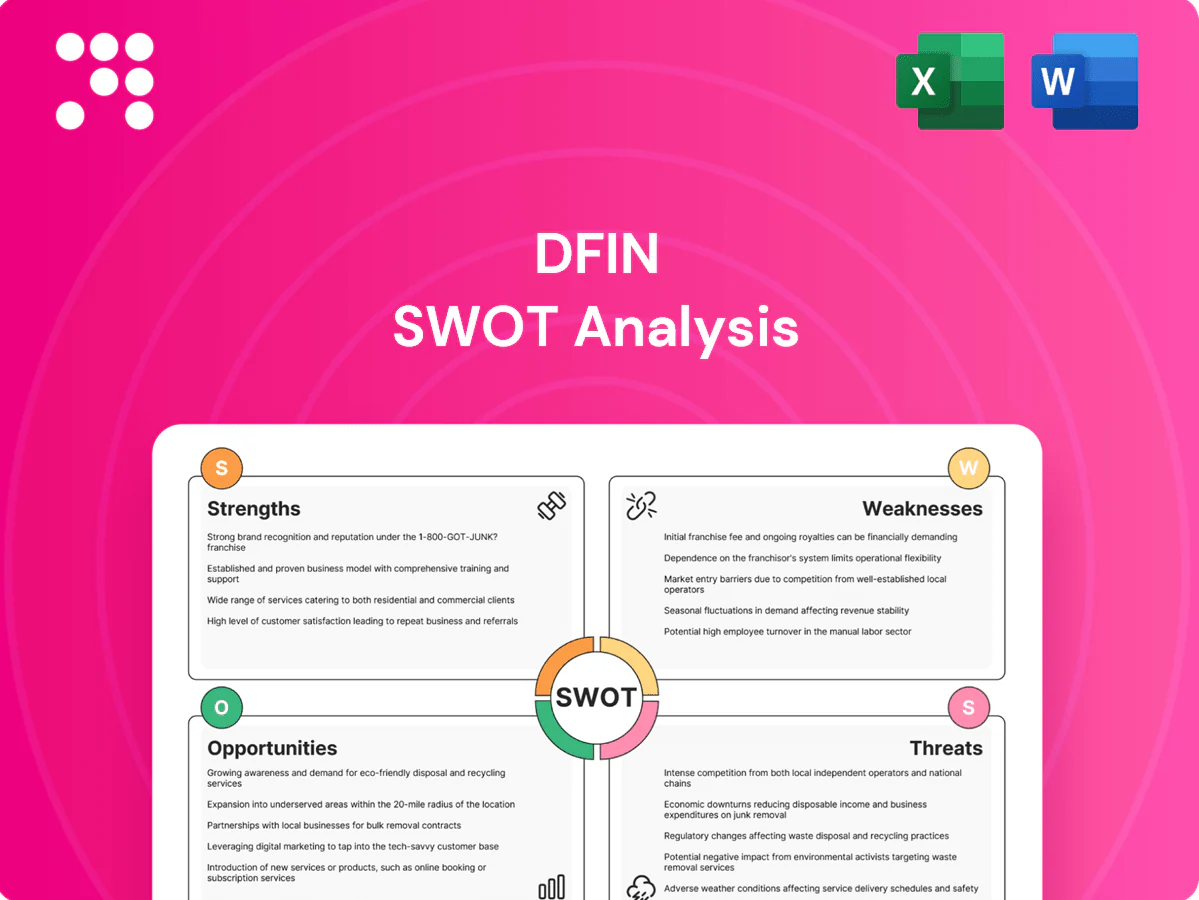
DFIN SWOT Analysis

Your Strategic Toolkit Starts Here
Explore DFIN's strategic strengths, market risks, and growth levers with a concise SWOT preview. For a deep, research-backed breakdown, purchase the full SWOT analysis—includes editable Word and Excel deliverables, expert commentary, and actionable recommendations. Make informed decisions with investor-ready insights.
Strengths

Deep regulatory domain expertise
DFIN (NYSE:DFIN) leverages decades of specialization in financial reporting and compliance, building strong credibility with regulators and large clients. That deep domain knowledge accelerates product updates as rules evolve, reducing client risk and shortening compliance cycles. It differentiates DFIN from generalist vendors and supports premium pricing and sticky client relationships.
Mission‑critical, sticky workflows
DFIN’s filing and disclosure tools are embedded in mission‑critical workflows with high switching costs—embedded templates, tags and controls create daily operational dependence. Reported recurring revenue accounted for roughly 74% of FY2024 revenue, and renewal rates hover near 90%, reflecting strong process lock‑in and user familiarity. This stability provides predictable recurring revenue visibility.

Software + services combination
DFINs integrated software + services model lets expert service benches handle peak workloads and complex filings, supporting scalability while clients avoid building internal teams; this model fed into FY2024 revenue of $1.08 billion. Services feedback directly informs product roadmaps, accelerating adoption and driving cross-sell that widens wallet share. The blend creates recurring, high-margin engagements that defend against pure‑play software rivals.

Reputation for accuracy and security
High-stakes SEC and regulatory filings demand precision, auditability and robust data protection, and DFIN's platform is built to meet that need. Strong controls and certifications (SOC 1, SOC 2, ISO 27001 as of 2024) materially reduce compliance risk for clients. A consistent quality track record lowers rework and regulatory inquiry exposure, making trust a durable competitive moat.
- SOC 1, SOC 2, ISO 27001 (2024)
- Reduced compliance and rework risk
- Trusted provider for high‑stakes filings
Global reach and rule coverage
DFINs global reach spans 90+ markets, enabling cross-border transactions and multi-jurisdiction filings with local regulatory fluency that reduces complexity for multinational clients. Centralized tooling, adapted regionally, improves consistency across workflows while the companys scale supports faster implementation of new mandates and regulatory updates.
- 90+ markets covered
- 50+ supported filing jurisdictions
- 3,500+ institutional clients
- 150,000+ filings processed annually
Global financial compliance leader — $1.08B, ~74% recurring
DFIN (NYSE:DFIN) specializes in financial reporting and compliance with FY2024 revenue of $1.08B, ~74% recurring revenue and ~90% renewal rates. SOC 1, SOC 2, ISO 27001 (2024) certifications and 150,000+ filings/year reduce client risk and support premium pricing. Global footprint: 90+ markets, 50+ filing jurisdictions, 3,500+ institutional clients.
| Metric | Value |
|---|---|
| FY2024 Revenue | $1.08B |
| Recurring Rev | ~74% |
| Renewal Rate | ~90% |
| Certifications | SOC1, SOC2, ISO27001 (2024) |
| Markets / Jurisdictions | 90+ / 50+ |
| Clients / Filings | 3,500+ / 150,000+ |
What is included in the product
 Detailed Word Document
Delivers a strategic overview of DFIN’s internal and external business factors, outlining strengths, weaknesses, opportunities and threats to assess its competitive position and guide strategic decisions for future growth and risk management.

 Customizable Excel Spreadsheet
Provides a DFIN-focused SWOT matrix that condenses regulatory, technology, and market risks into actionable items for faster decision-making; editable format enables quick updates to reflect filings, compliance shifts, and stakeholder priorities.
Weaknesses

Exposure to deal cycle volatility
DFIN's heavy reliance on capital-markets activity (IPOs, M&A, debt) makes revenue highly volume-sensitive; management noted deal slowdowns compressed transactional utilization in 2024 when reported revenue was $1.43B. Macro shocks make forecasting harder as quarter-to-quarter deal flow swings rapidly, and the current revenue mix—higher proportion from transactional services—can amplify cyclicality and margin pressure.
Services intensity pressures margins
Human‑capital heavy projects dilute DFIN’s software economics: SaaS gross margins often exceed 70% while professional services typically sit in the 20–40% range, compressing blended margins.
Tight labor markets (US unemployment ~3.7% in late 2024) raise delivery costs and turnover risk, and 5 percentage‑point utilization swings can shift operating margins roughly 200–400 bps, while scaling services remains far harder than scaling code.

Legacy process and tech debt
Older workflows and heavy custom client setups slow DFIN's product innovation and time‑to‑market, keeping parts of its stack on legacy architectures. Migration to fully cloud‑native platforms requires multi‑year investment and resources, driving higher upfront costs and operational disruption. Fragmentation from bespoke integrations raises maintenance spend and quality risk, while Gartner projects 85% of enterprises will be cloud‑first by 2025, letting born‑cloud rivals iterate faster.

Concentration in financial verticals
DFIN’s heavy focus on financial services — with over 60% of revenue tied to capital markets and related clients — limits diversification and makes the firm vulnerable to sector‑specific shocks; 2023–24 market disruptions showed demand swings for IPO and compliance services. Cross‑industry expansion will require new capabilities and credibility, constraining near‑term revenue resilience.
- Concentration risk: >60% revenue exposure to financial verticals
- Shock sensitivity: demand down when capital markets slow
- Expansion cost: significant investment needed for nonfinancial credibility
- Resilience constraint: limited revenue diversity
Complex onboarding and integration
Embedding DFIN into clients’ governance and reporting stacks can be lengthy, with ERP, GRC and data lake integrations often requiring specialized implementation teams. Typical enterprise integrations take 6–12 months, delaying time‑to‑value and increasing cost exposure; McKinsey estimates ~70% of digital transformations underdeliver. For a firm of DFIN’s scale (≈$1B revenue in 2024) these delays materially raise project risk.
- Lengthy embed: governance/reporting stacks
- Specialized support: ERP, GRC, data lakes
- Implementation time: commonly 6–12 months
- Risk: ~70% transformation underdelivery
2024 revenue $1.43B, >60% cap-markets exposure compresses margins
DFIN is revenue‑cyclical—2024 revenue $1.43B and >60% tied to capital markets—so deal slowdowns compress utilization and margins. Heavy services mix (SaaS >70% gross vs services 20–40%) and tight labor (US unemployment ~3.7% late 2024) raise costs and turnover risk. Legacy stacks and 6–12 month integrations (McKinsey: ~70% transformations underdeliver) slow innovation versus cloud‑first rivals.
| Metric | Value |
|---|---|
| 2024 revenue | $1.43B |
| Financial exposure | >60% |
| Margin gap | SaaS 70%+ vs services 20–40% |
| Integration time | 6–12 months |
Same Document Delivered
DFIN SWOT Analysis
This is the actual SWOT analysis document you’ll receive upon purchase—no surprises, just professional quality. The preview below is taken directly from the full SWOT report you'll get, and purchasing unlocks the complete, editable version. You’re viewing a live preview of the real file; the full, detailed report becomes available after checkout.

Your Strategic Toolkit Starts Here
Explore DFIN's strategic strengths, market risks, and growth levers with a concise SWOT preview. For a deep, research-backed breakdown, purchase the full SWOT analysis—includes editable Word and Excel deliverables, expert commentary, and actionable recommendations. Make informed decisions with investor-ready insights.
Strengths
Deep regulatory domain expertise
DFIN (NYSE:DFIN) leverages decades of specialization in financial reporting and compliance, building strong credibility with regulators and large clients. That deep domain knowledge accelerates product updates as rules evolve, reducing client risk and shortening compliance cycles. It differentiates DFIN from generalist vendors and supports premium pricing and sticky client relationships.
Mission‑critical, sticky workflows
DFIN’s filing and disclosure tools are embedded in mission‑critical workflows with high switching costs—embedded templates, tags and controls create daily operational dependence. Reported recurring revenue accounted for roughly 74% of FY2024 revenue, and renewal rates hover near 90%, reflecting strong process lock‑in and user familiarity. This stability provides predictable recurring revenue visibility.
Software + services combination
DFINs integrated software + services model lets expert service benches handle peak workloads and complex filings, supporting scalability while clients avoid building internal teams; this model fed into FY2024 revenue of $1.08 billion. Services feedback directly informs product roadmaps, accelerating adoption and driving cross-sell that widens wallet share. The blend creates recurring, high-margin engagements that defend against pure‑play software rivals.
Reputation for accuracy and security
High-stakes SEC and regulatory filings demand precision, auditability and robust data protection, and DFIN's platform is built to meet that need. Strong controls and certifications (SOC 1, SOC 2, ISO 27001 as of 2024) materially reduce compliance risk for clients. A consistent quality track record lowers rework and regulatory inquiry exposure, making trust a durable competitive moat.
- SOC 1, SOC 2, ISO 27001 (2024)
- Reduced compliance and rework risk
- Trusted provider for high‑stakes filings
Global reach and rule coverage
DFINs global reach spans 90+ markets, enabling cross-border transactions and multi-jurisdiction filings with local regulatory fluency that reduces complexity for multinational clients. Centralized tooling, adapted regionally, improves consistency across workflows while the companys scale supports faster implementation of new mandates and regulatory updates.
- 90+ markets covered
- 50+ supported filing jurisdictions
- 3,500+ institutional clients
- 150,000+ filings processed annually
Global financial compliance leader — $1.08B, ~74% recurring
DFIN (NYSE:DFIN) specializes in financial reporting and compliance with FY2024 revenue of $1.08B, ~74% recurring revenue and ~90% renewal rates. SOC 1, SOC 2, ISO 27001 (2024) certifications and 150,000+ filings/year reduce client risk and support premium pricing. Global footprint: 90+ markets, 50+ filing jurisdictions, 3,500+ institutional clients.
| Metric | Value |
|---|---|
| FY2024 Revenue | $1.08B |
| Recurring Rev | ~74% |
| Renewal Rate | ~90% |
| Certifications | SOC1, SOC2, ISO27001 (2024) |
| Markets / Jurisdictions | 90+ / 50+ |
| Clients / Filings | 3,500+ / 150,000+ |
What is included in the product
Detailed Word Document
Delivers a strategic overview of DFIN’s internal and external business factors, outlining strengths, weaknesses, opportunities and threats to assess its competitive position and guide strategic decisions for future growth and risk management.
Customizable Excel Spreadsheet
Provides a DFIN-focused SWOT matrix that condenses regulatory, technology, and market risks into actionable items for faster decision-making; editable format enables quick updates to reflect filings, compliance shifts, and stakeholder priorities.
Weaknesses
Exposure to deal cycle volatility
DFIN's heavy reliance on capital-markets activity (IPOs, M&A, debt) makes revenue highly volume-sensitive; management noted deal slowdowns compressed transactional utilization in 2024 when reported revenue was $1.43B. Macro shocks make forecasting harder as quarter-to-quarter deal flow swings rapidly, and the current revenue mix—higher proportion from transactional services—can amplify cyclicality and margin pressure.
Services intensity pressures margins
Human‑capital heavy projects dilute DFIN’s software economics: SaaS gross margins often exceed 70% while professional services typically sit in the 20–40% range, compressing blended margins.
Tight labor markets (US unemployment ~3.7% in late 2024) raise delivery costs and turnover risk, and 5 percentage‑point utilization swings can shift operating margins roughly 200–400 bps, while scaling services remains far harder than scaling code.
Legacy process and tech debt
Older workflows and heavy custom client setups slow DFIN's product innovation and time‑to‑market, keeping parts of its stack on legacy architectures. Migration to fully cloud‑native platforms requires multi‑year investment and resources, driving higher upfront costs and operational disruption. Fragmentation from bespoke integrations raises maintenance spend and quality risk, while Gartner projects 85% of enterprises will be cloud‑first by 2025, letting born‑cloud rivals iterate faster.
Concentration in financial verticals
DFIN’s heavy focus on financial services — with over 60% of revenue tied to capital markets and related clients — limits diversification and makes the firm vulnerable to sector‑specific shocks; 2023–24 market disruptions showed demand swings for IPO and compliance services. Cross‑industry expansion will require new capabilities and credibility, constraining near‑term revenue resilience.
- Concentration risk: >60% revenue exposure to financial verticals
- Shock sensitivity: demand down when capital markets slow
- Expansion cost: significant investment needed for nonfinancial credibility
- Resilience constraint: limited revenue diversity
Complex onboarding and integration
Embedding DFIN into clients’ governance and reporting stacks can be lengthy, with ERP, GRC and data lake integrations often requiring specialized implementation teams. Typical enterprise integrations take 6–12 months, delaying time‑to‑value and increasing cost exposure; McKinsey estimates ~70% of digital transformations underdeliver. For a firm of DFIN’s scale (≈$1B revenue in 2024) these delays materially raise project risk.
- Lengthy embed: governance/reporting stacks
- Specialized support: ERP, GRC, data lakes
- Implementation time: commonly 6–12 months
- Risk: ~70% transformation underdelivery
2024 revenue $1.43B, >60% cap-markets exposure compresses margins
DFIN is revenue‑cyclical—2024 revenue $1.43B and >60% tied to capital markets—so deal slowdowns compress utilization and margins. Heavy services mix (SaaS >70% gross vs services 20–40%) and tight labor (US unemployment ~3.7% late 2024) raise costs and turnover risk. Legacy stacks and 6–12 month integrations (McKinsey: ~70% transformations underdeliver) slow innovation versus cloud‑first rivals.
| Metric | Value |
|---|---|
| 2024 revenue | $1.43B |
| Financial exposure | >60% |
| Margin gap | SaaS 70%+ vs services 20–40% |
| Integration time | 6–12 months |
Same Document Delivered
DFIN SWOT Analysis
This is the actual SWOT analysis document you’ll receive upon purchase—no surprises, just professional quality. The preview below is taken directly from the full SWOT report you'll get, and purchasing unlocks the complete, editable version. You’re viewing a live preview of the real file; the full, detailed report becomes available after checkout.
Original: $10.00
-65%$10.00
$3.50Description
Your Strategic Toolkit Starts Here
Explore DFIN's strategic strengths, market risks, and growth levers with a concise SWOT preview. For a deep, research-backed breakdown, purchase the full SWOT analysis—includes editable Word and Excel deliverables, expert commentary, and actionable recommendations. Make informed decisions with investor-ready insights.
Strengths
Deep regulatory domain expertise
DFIN (NYSE:DFIN) leverages decades of specialization in financial reporting and compliance, building strong credibility with regulators and large clients. That deep domain knowledge accelerates product updates as rules evolve, reducing client risk and shortening compliance cycles. It differentiates DFIN from generalist vendors and supports premium pricing and sticky client relationships.
Mission‑critical, sticky workflows
DFIN’s filing and disclosure tools are embedded in mission‑critical workflows with high switching costs—embedded templates, tags and controls create daily operational dependence. Reported recurring revenue accounted for roughly 74% of FY2024 revenue, and renewal rates hover near 90%, reflecting strong process lock‑in and user familiarity. This stability provides predictable recurring revenue visibility.
Software + services combination
DFINs integrated software + services model lets expert service benches handle peak workloads and complex filings, supporting scalability while clients avoid building internal teams; this model fed into FY2024 revenue of $1.08 billion. Services feedback directly informs product roadmaps, accelerating adoption and driving cross-sell that widens wallet share. The blend creates recurring, high-margin engagements that defend against pure‑play software rivals.
Reputation for accuracy and security
High-stakes SEC and regulatory filings demand precision, auditability and robust data protection, and DFIN's platform is built to meet that need. Strong controls and certifications (SOC 1, SOC 2, ISO 27001 as of 2024) materially reduce compliance risk for clients. A consistent quality track record lowers rework and regulatory inquiry exposure, making trust a durable competitive moat.
- SOC 1, SOC 2, ISO 27001 (2024)
- Reduced compliance and rework risk
- Trusted provider for high‑stakes filings
Global reach and rule coverage
DFINs global reach spans 90+ markets, enabling cross-border transactions and multi-jurisdiction filings with local regulatory fluency that reduces complexity for multinational clients. Centralized tooling, adapted regionally, improves consistency across workflows while the companys scale supports faster implementation of new mandates and regulatory updates.
- 90+ markets covered
- 50+ supported filing jurisdictions
- 3,500+ institutional clients
- 150,000+ filings processed annually
Global financial compliance leader — $1.08B, ~74% recurring
DFIN (NYSE:DFIN) specializes in financial reporting and compliance with FY2024 revenue of $1.08B, ~74% recurring revenue and ~90% renewal rates. SOC 1, SOC 2, ISO 27001 (2024) certifications and 150,000+ filings/year reduce client risk and support premium pricing. Global footprint: 90+ markets, 50+ filing jurisdictions, 3,500+ institutional clients.
| Metric | Value |
|---|---|
| FY2024 Revenue | $1.08B |
| Recurring Rev | ~74% |
| Renewal Rate | ~90% |
| Certifications | SOC1, SOC2, ISO27001 (2024) |
| Markets / Jurisdictions | 90+ / 50+ |
| Clients / Filings | 3,500+ / 150,000+ |
What is included in the product
Detailed Word Document
Delivers a strategic overview of DFIN’s internal and external business factors, outlining strengths, weaknesses, opportunities and threats to assess its competitive position and guide strategic decisions for future growth and risk management.
Customizable Excel Spreadsheet
Provides a DFIN-focused SWOT matrix that condenses regulatory, technology, and market risks into actionable items for faster decision-making; editable format enables quick updates to reflect filings, compliance shifts, and stakeholder priorities.
Weaknesses
Exposure to deal cycle volatility
DFIN's heavy reliance on capital-markets activity (IPOs, M&A, debt) makes revenue highly volume-sensitive; management noted deal slowdowns compressed transactional utilization in 2024 when reported revenue was $1.43B. Macro shocks make forecasting harder as quarter-to-quarter deal flow swings rapidly, and the current revenue mix—higher proportion from transactional services—can amplify cyclicality and margin pressure.
Services intensity pressures margins
Human‑capital heavy projects dilute DFIN’s software economics: SaaS gross margins often exceed 70% while professional services typically sit in the 20–40% range, compressing blended margins.
Tight labor markets (US unemployment ~3.7% in late 2024) raise delivery costs and turnover risk, and 5 percentage‑point utilization swings can shift operating margins roughly 200–400 bps, while scaling services remains far harder than scaling code.
Legacy process and tech debt
Older workflows and heavy custom client setups slow DFIN's product innovation and time‑to‑market, keeping parts of its stack on legacy architectures. Migration to fully cloud‑native platforms requires multi‑year investment and resources, driving higher upfront costs and operational disruption. Fragmentation from bespoke integrations raises maintenance spend and quality risk, while Gartner projects 85% of enterprises will be cloud‑first by 2025, letting born‑cloud rivals iterate faster.
Concentration in financial verticals
DFIN’s heavy focus on financial services — with over 60% of revenue tied to capital markets and related clients — limits diversification and makes the firm vulnerable to sector‑specific shocks; 2023–24 market disruptions showed demand swings for IPO and compliance services. Cross‑industry expansion will require new capabilities and credibility, constraining near‑term revenue resilience.
- Concentration risk: >60% revenue exposure to financial verticals
- Shock sensitivity: demand down when capital markets slow
- Expansion cost: significant investment needed for nonfinancial credibility
- Resilience constraint: limited revenue diversity
Complex onboarding and integration
Embedding DFIN into clients’ governance and reporting stacks can be lengthy, with ERP, GRC and data lake integrations often requiring specialized implementation teams. Typical enterprise integrations take 6–12 months, delaying time‑to‑value and increasing cost exposure; McKinsey estimates ~70% of digital transformations underdeliver. For a firm of DFIN’s scale (≈$1B revenue in 2024) these delays materially raise project risk.
- Lengthy embed: governance/reporting stacks
- Specialized support: ERP, GRC, data lakes
- Implementation time: commonly 6–12 months
- Risk: ~70% transformation underdelivery
2024 revenue $1.43B, >60% cap-markets exposure compresses margins
DFIN is revenue‑cyclical—2024 revenue $1.43B and >60% tied to capital markets—so deal slowdowns compress utilization and margins. Heavy services mix (SaaS >70% gross vs services 20–40%) and tight labor (US unemployment ~3.7% late 2024) raise costs and turnover risk. Legacy stacks and 6–12 month integrations (McKinsey: ~70% transformations underdeliver) slow innovation versus cloud‑first rivals.
| Metric | Value |
|---|---|
| 2024 revenue | $1.43B |
| Financial exposure | >60% |
| Margin gap | SaaS 70%+ vs services 20–40% |
| Integration time | 6–12 months |
Same Document Delivered
DFIN SWOT Analysis
This is the actual SWOT analysis document you’ll receive upon purchase—no surprises, just professional quality. The preview below is taken directly from the full SWOT report you'll get, and purchasing unlocks the complete, editable version. You’re viewing a live preview of the real file; the full, detailed report becomes available after checkout.











