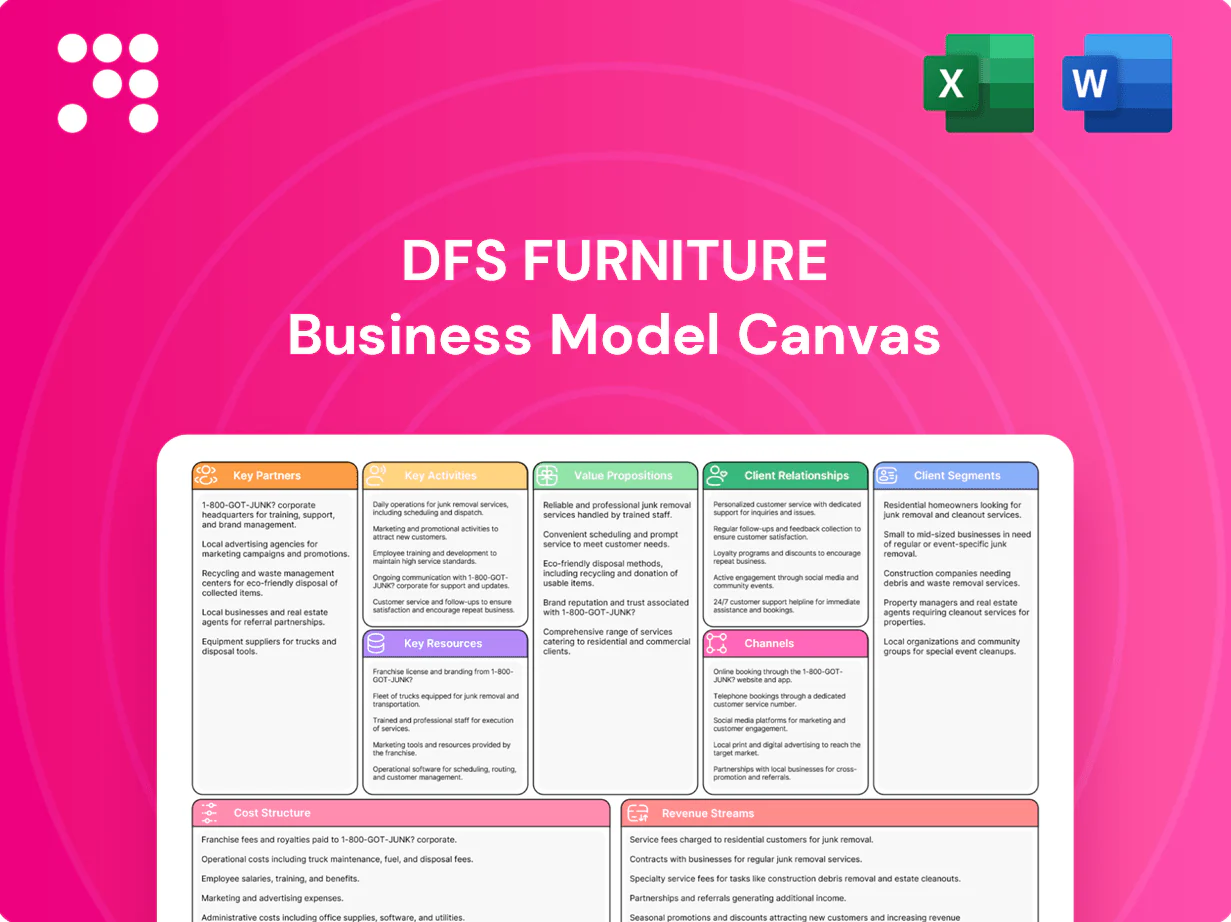
DFS Furniture Business Model Canvas

Business Model Canvas: Furniture Retail Growth & Monetization Playbook
Unlock the strategic blueprint behind DFS Furniture with our Business Model Canvas summary. This concise, actionable snapshot explains how DFS creates value, scales channels, and monetizes customer relationships. Ideal for investors, consultants, and founders seeking proven retail furniture strategies. Download the full, editable Canvas for a section-by-section playbook and ready-to-use templates.
Partnerships

Upholstery Materials Suppliers
Strategic sourcing relationships for fabrics, leathers, foams and frames secure consistent quality inputs at scale and support DFS retail channels across the UK, Spain and the Netherlands. Long-term contracts stabilize pricing and lead times, reducing procurement volatility for seasonal peaks. Collaborative development with suppliers yields exclusive textures and stain-resistant finishes. Compliance partners ensure adherence to REACH, which covered over 22,000 registered substances by 2024 (ECHA).
Logistics & Last-Mile Delivery
White-glove partners deliver bulky items with room-of-choice placement and removals, reducing in-home damage and complaints; last-mile now represents about 53% of delivery costs so outsourcing limits capex. Regional carriers and optimized UK-EU lanes cut transit friction and damage rates; slot-booking tech boosts ETA accuracy and can lift on-time performance and NPS by ~20%. Reverse logistics partners handle returns, testing and refurbishment to recover value and support resale channels.

Consumer Finance Providers
Credit partners offering 0% APR and flexible terms boost conversion by 20–40% and AOV by 15–50% in 2024 merchant data (Klarna, PayPal), lifting ticket sizes and close rates. Integrated checkout enables instant online and in-store approvals, reducing friction. Outsourced risk/compliance shifts credit exposure to providers, cutting DFS’s capital-at-risk. Co-marketing drives promotional traffic in peak events.

Aftercare & Protection Service Vendors
- Insurers & repair partners
- National technician network
- Claims automation (~30% faster, 2024)
- Data-sharing → durability insights (↓ returns ~12%, 2024)
Technology & Real Estate Partners
- e-commerce ~30% of UK furniture sales (2024)
- AR improves conversion up to 40%
- Payment/fraud tools reduce abandonment and chargebacks
- Retail parks provide high-footfall, favorable lease terms
- Energy/recycling partners cut costs and support circular initiatives
Partnerships expand REACH >22,000, reduce last-mile costs and lift conversion & AOV
Key partnerships secure scaled inputs (REACH >22,000 substances, 2024), stabilise pricing via long-term contracts and co-develop exclusive finishes. White‑glove and regional carriers cut damage and outsource ~53% last‑mile cost exposure; reverse logistics recover value and cut returns. Credit, e‑commerce, AR and claims partners lift conversion/AOV (credit +20–40% conv, +15–50% AOV; e‑commerce ~30% UK sales, AR +40%).
| Partnership | Metric (2024) |
|---|---|
| Suppliers/Compliance | REACH >22,000 substances |
| Delivery/Reverse | Last‑mile ~53% cost; returns ↓12% |
| Payments/Tech | Credit +20–40% conv; e‑commerce ~30% UK; AR +40% |
What is included in the product
 Detailed Word Document
A concise, pre-written Business Model Canvas for DFS Furniture mapping all 9 blocks—customer segments, value propositions, channels, customer relationships, revenue streams, key resources, key activities, key partners, and cost structure—aligned with real-world operations and strategic goals. Ideal for presentations, investor discussions, and SWOT-linked insights to support decision-making and validation.

 Customizable Excel Spreadsheet
High-level one-page snapshot of DFS’s business model that quickly identifies core components, relieving pain by aligning teams, exposing operational bottlenecks and saving hours on structuring strategy for faster decision-making.
Activities

Design & Product Development
Trend research and CAD design translate market insights into proprietary sofa ranges and modular upholstery options tailored for targeted SKUs and rapid seasonal updates.
Prototyping cycles validate comfort, durability and manufacturability using tests such as Martindale abrasion (eg 20,000+ cycles) and load/fatigue rigs to meet expected lifecycle performance.
Supplier co-creation secures exclusive fabrics and finishes through joint development agreements while compliance testing verifies fire and safety standards (eg CFR 1633, BS 5852) before production.
Manufacturing & Quality Control
In-house and partner factories build frames, cut/sew upholstery and assemble units, supporting DFS Group PLC’s multi-channel supply chain which handled circa £1.2bn in UK sales in 2024. Lean workflows manage batch complexity and customization, reducing lead variability by ~25% year-over-year. Multi-point inspections aim to keep defects under 1.5% and returns below 2%. Capacity planning scales production up to 40% in peak months to match seasonal demand.

Omnichannel Merchandising & Pricing
Curating showroom and online assortments to prioritize sofas with ottoman options and care kits increases attachment rates and can lift average order value by around 10%. Dynamic pricing and targeted promotions—aligned with peak online furniture demand (online penetration ~37% in the UK in 2024)—drive faster sell-through and lower markdowns. High-impact visual merchandising and rich content elevate perceived value and conversion. Range rationalization trimming low-productivity SKUs improves SKU productivity and margin performance.

Fulfillment & White-Glove Delivery
Warehousing, picking and staging sequence orders into timed routes to meet customer slots; last-mile partners deliver room-of-choice and remove packaging, with last-mile representing ~40% of delivery cost. Robust returns, repair and refurbishment workflows can recover up to ~60% of item value, protecting margin. Scheduling systems cut failed deliveries by ~20% by matching capacity to customer availability.
- Warehousing: staged for timed routes
- Last-mile: room-of-choice + packaging removal (~40% cost)
- Returns/repairs: recovery up to ~60%
- Scheduling: ~20% fewer failed deliveries
Customer Service & Lifecycle Marketing
Contact centres and in-store teams deliver consultative support and post-sale care, lowering returns and boosting lifetime value; proactive order tracking and notifications cut customer anxiety and inbound calls. CRM lifecycle campaigns in 2024 drove higher repeat purchase rates and referral activity, while review management strengthened brand reputation—88% of consumers consult reviews before buying.
- Consultative support: contact centres + stores
- Proactive tracking: fewer calls, faster resolution
- CRM campaigns: repeat purchases & referrals
- Review management: reputation & conversion
Modular sofas: lead variability down 25%, defects under 1.5%, online ~37%
Design, prototyping and supplier co-creation deliver modular sofa ranges and compliant materials; DFS Group PLC UK sales ~£1.2bn in 2024. Manufacturing and lean workflows cut lead variability ~25% and target defects <1.5%, returns <2%. Warehousing, timed routes and last‑mile (≈40% delivery cost) plus repairs recover ~60% value; online penetration ~37% (UK 2024).
| Metric | 2024 |
|---|---|
| UK sales | £1.2bn |
| Online penetration | 37% |
| Defect rate | <1.5% |
| Returns | <2% |
| Last-mile cost | ≈40% |
| Recovery (repairs) | ≈60% |
| Lead variability reduction | ≈25% |
| Peak capacity uplift | ≈40% |
Full Version Awaits
Business Model Canvas
The DFS Furniture Business Model Canvas shown here is the actual deliverable, not a mockup, and contains the same content and structure you’ll receive after purchase. When you complete your order you’ll instantly access this exact file, ready to edit, present, and implement. No placeholders, no surprises—what you preview is what you own.

Business Model Canvas: Furniture Retail Growth & Monetization Playbook
Unlock the strategic blueprint behind DFS Furniture with our Business Model Canvas summary. This concise, actionable snapshot explains how DFS creates value, scales channels, and monetizes customer relationships. Ideal for investors, consultants, and founders seeking proven retail furniture strategies. Download the full, editable Canvas for a section-by-section playbook and ready-to-use templates.
Partnerships
Upholstery Materials Suppliers
Strategic sourcing relationships for fabrics, leathers, foams and frames secure consistent quality inputs at scale and support DFS retail channels across the UK, Spain and the Netherlands. Long-term contracts stabilize pricing and lead times, reducing procurement volatility for seasonal peaks. Collaborative development with suppliers yields exclusive textures and stain-resistant finishes. Compliance partners ensure adherence to REACH, which covered over 22,000 registered substances by 2024 (ECHA).
Logistics & Last-Mile Delivery
White-glove partners deliver bulky items with room-of-choice placement and removals, reducing in-home damage and complaints; last-mile now represents about 53% of delivery costs so outsourcing limits capex. Regional carriers and optimized UK-EU lanes cut transit friction and damage rates; slot-booking tech boosts ETA accuracy and can lift on-time performance and NPS by ~20%. Reverse logistics partners handle returns, testing and refurbishment to recover value and support resale channels.
Consumer Finance Providers
Credit partners offering 0% APR and flexible terms boost conversion by 20–40% and AOV by 15–50% in 2024 merchant data (Klarna, PayPal), lifting ticket sizes and close rates. Integrated checkout enables instant online and in-store approvals, reducing friction. Outsourced risk/compliance shifts credit exposure to providers, cutting DFS’s capital-at-risk. Co-marketing drives promotional traffic in peak events.
Aftercare & Protection Service Vendors
- Insurers & repair partners
- National technician network
- Claims automation (~30% faster, 2024)
- Data-sharing → durability insights (↓ returns ~12%, 2024)
Technology & Real Estate Partners
- e-commerce ~30% of UK furniture sales (2024)
- AR improves conversion up to 40%
- Payment/fraud tools reduce abandonment and chargebacks
- Retail parks provide high-footfall, favorable lease terms
- Energy/recycling partners cut costs and support circular initiatives
Partnerships expand REACH >22,000, reduce last-mile costs and lift conversion & AOV
Key partnerships secure scaled inputs (REACH >22,000 substances, 2024), stabilise pricing via long-term contracts and co-develop exclusive finishes. White‑glove and regional carriers cut damage and outsource ~53% last‑mile cost exposure; reverse logistics recover value and cut returns. Credit, e‑commerce, AR and claims partners lift conversion/AOV (credit +20–40% conv, +15–50% AOV; e‑commerce ~30% UK sales, AR +40%).
| Partnership | Metric (2024) |
|---|---|
| Suppliers/Compliance | REACH >22,000 substances |
| Delivery/Reverse | Last‑mile ~53% cost; returns ↓12% |
| Payments/Tech | Credit +20–40% conv; e‑commerce ~30% UK; AR +40% |
What is included in the product
Detailed Word Document
A concise, pre-written Business Model Canvas for DFS Furniture mapping all 9 blocks—customer segments, value propositions, channels, customer relationships, revenue streams, key resources, key activities, key partners, and cost structure—aligned with real-world operations and strategic goals. Ideal for presentations, investor discussions, and SWOT-linked insights to support decision-making and validation.
Customizable Excel Spreadsheet
High-level one-page snapshot of DFS’s business model that quickly identifies core components, relieving pain by aligning teams, exposing operational bottlenecks and saving hours on structuring strategy for faster decision-making.
Activities
Design & Product Development
Trend research and CAD design translate market insights into proprietary sofa ranges and modular upholstery options tailored for targeted SKUs and rapid seasonal updates.
Prototyping cycles validate comfort, durability and manufacturability using tests such as Martindale abrasion (eg 20,000+ cycles) and load/fatigue rigs to meet expected lifecycle performance.
Supplier co-creation secures exclusive fabrics and finishes through joint development agreements while compliance testing verifies fire and safety standards (eg CFR 1633, BS 5852) before production.
Manufacturing & Quality Control
In-house and partner factories build frames, cut/sew upholstery and assemble units, supporting DFS Group PLC’s multi-channel supply chain which handled circa £1.2bn in UK sales in 2024. Lean workflows manage batch complexity and customization, reducing lead variability by ~25% year-over-year. Multi-point inspections aim to keep defects under 1.5% and returns below 2%. Capacity planning scales production up to 40% in peak months to match seasonal demand.
Omnichannel Merchandising & Pricing
Curating showroom and online assortments to prioritize sofas with ottoman options and care kits increases attachment rates and can lift average order value by around 10%. Dynamic pricing and targeted promotions—aligned with peak online furniture demand (online penetration ~37% in the UK in 2024)—drive faster sell-through and lower markdowns. High-impact visual merchandising and rich content elevate perceived value and conversion. Range rationalization trimming low-productivity SKUs improves SKU productivity and margin performance.
Fulfillment & White-Glove Delivery
Warehousing, picking and staging sequence orders into timed routes to meet customer slots; last-mile partners deliver room-of-choice and remove packaging, with last-mile representing ~40% of delivery cost. Robust returns, repair and refurbishment workflows can recover up to ~60% of item value, protecting margin. Scheduling systems cut failed deliveries by ~20% by matching capacity to customer availability.
- Warehousing: staged for timed routes
- Last-mile: room-of-choice + packaging removal (~40% cost)
- Returns/repairs: recovery up to ~60%
- Scheduling: ~20% fewer failed deliveries
Customer Service & Lifecycle Marketing
Contact centres and in-store teams deliver consultative support and post-sale care, lowering returns and boosting lifetime value; proactive order tracking and notifications cut customer anxiety and inbound calls. CRM lifecycle campaigns in 2024 drove higher repeat purchase rates and referral activity, while review management strengthened brand reputation—88% of consumers consult reviews before buying.
- Consultative support: contact centres + stores
- Proactive tracking: fewer calls, faster resolution
- CRM campaigns: repeat purchases & referrals
- Review management: reputation & conversion
Modular sofas: lead variability down 25%, defects under 1.5%, online ~37%
Design, prototyping and supplier co-creation deliver modular sofa ranges and compliant materials; DFS Group PLC UK sales ~£1.2bn in 2024. Manufacturing and lean workflows cut lead variability ~25% and target defects <1.5%, returns <2%. Warehousing, timed routes and last‑mile (≈40% delivery cost) plus repairs recover ~60% value; online penetration ~37% (UK 2024).
| Metric | 2024 |
|---|---|
| UK sales | £1.2bn |
| Online penetration | 37% |
| Defect rate | <1.5% |
| Returns | <2% |
| Last-mile cost | ≈40% |
| Recovery (repairs) | ≈60% |
| Lead variability reduction | ≈25% |
| Peak capacity uplift | ≈40% |
Full Version Awaits
Business Model Canvas
The DFS Furniture Business Model Canvas shown here is the actual deliverable, not a mockup, and contains the same content and structure you’ll receive after purchase. When you complete your order you’ll instantly access this exact file, ready to edit, present, and implement. No placeholders, no surprises—what you preview is what you own.
Description
Business Model Canvas: Furniture Retail Growth & Monetization Playbook
Unlock the strategic blueprint behind DFS Furniture with our Business Model Canvas summary. This concise, actionable snapshot explains how DFS creates value, scales channels, and monetizes customer relationships. Ideal for investors, consultants, and founders seeking proven retail furniture strategies. Download the full, editable Canvas for a section-by-section playbook and ready-to-use templates.
Partnerships
Upholstery Materials Suppliers
Strategic sourcing relationships for fabrics, leathers, foams and frames secure consistent quality inputs at scale and support DFS retail channels across the UK, Spain and the Netherlands. Long-term contracts stabilize pricing and lead times, reducing procurement volatility for seasonal peaks. Collaborative development with suppliers yields exclusive textures and stain-resistant finishes. Compliance partners ensure adherence to REACH, which covered over 22,000 registered substances by 2024 (ECHA).
Logistics & Last-Mile Delivery
White-glove partners deliver bulky items with room-of-choice placement and removals, reducing in-home damage and complaints; last-mile now represents about 53% of delivery costs so outsourcing limits capex. Regional carriers and optimized UK-EU lanes cut transit friction and damage rates; slot-booking tech boosts ETA accuracy and can lift on-time performance and NPS by ~20%. Reverse logistics partners handle returns, testing and refurbishment to recover value and support resale channels.
Consumer Finance Providers
Credit partners offering 0% APR and flexible terms boost conversion by 20–40% and AOV by 15–50% in 2024 merchant data (Klarna, PayPal), lifting ticket sizes and close rates. Integrated checkout enables instant online and in-store approvals, reducing friction. Outsourced risk/compliance shifts credit exposure to providers, cutting DFS’s capital-at-risk. Co-marketing drives promotional traffic in peak events.
Aftercare & Protection Service Vendors
- Insurers & repair partners
- National technician network
- Claims automation (~30% faster, 2024)
- Data-sharing → durability insights (↓ returns ~12%, 2024)
Technology & Real Estate Partners
- e-commerce ~30% of UK furniture sales (2024)
- AR improves conversion up to 40%
- Payment/fraud tools reduce abandonment and chargebacks
- Retail parks provide high-footfall, favorable lease terms
- Energy/recycling partners cut costs and support circular initiatives
Partnerships expand REACH >22,000, reduce last-mile costs and lift conversion & AOV
Key partnerships secure scaled inputs (REACH >22,000 substances, 2024), stabilise pricing via long-term contracts and co-develop exclusive finishes. White‑glove and regional carriers cut damage and outsource ~53% last‑mile cost exposure; reverse logistics recover value and cut returns. Credit, e‑commerce, AR and claims partners lift conversion/AOV (credit +20–40% conv, +15–50% AOV; e‑commerce ~30% UK sales, AR +40%).
| Partnership | Metric (2024) |
|---|---|
| Suppliers/Compliance | REACH >22,000 substances |
| Delivery/Reverse | Last‑mile ~53% cost; returns ↓12% |
| Payments/Tech | Credit +20–40% conv; e‑commerce ~30% UK; AR +40% |
What is included in the product
Detailed Word Document
A concise, pre-written Business Model Canvas for DFS Furniture mapping all 9 blocks—customer segments, value propositions, channels, customer relationships, revenue streams, key resources, key activities, key partners, and cost structure—aligned with real-world operations and strategic goals. Ideal for presentations, investor discussions, and SWOT-linked insights to support decision-making and validation.
Customizable Excel Spreadsheet
High-level one-page snapshot of DFS’s business model that quickly identifies core components, relieving pain by aligning teams, exposing operational bottlenecks and saving hours on structuring strategy for faster decision-making.
Activities
Design & Product Development
Trend research and CAD design translate market insights into proprietary sofa ranges and modular upholstery options tailored for targeted SKUs and rapid seasonal updates.
Prototyping cycles validate comfort, durability and manufacturability using tests such as Martindale abrasion (eg 20,000+ cycles) and load/fatigue rigs to meet expected lifecycle performance.
Supplier co-creation secures exclusive fabrics and finishes through joint development agreements while compliance testing verifies fire and safety standards (eg CFR 1633, BS 5852) before production.
Manufacturing & Quality Control
In-house and partner factories build frames, cut/sew upholstery and assemble units, supporting DFS Group PLC’s multi-channel supply chain which handled circa £1.2bn in UK sales in 2024. Lean workflows manage batch complexity and customization, reducing lead variability by ~25% year-over-year. Multi-point inspections aim to keep defects under 1.5% and returns below 2%. Capacity planning scales production up to 40% in peak months to match seasonal demand.
Omnichannel Merchandising & Pricing
Curating showroom and online assortments to prioritize sofas with ottoman options and care kits increases attachment rates and can lift average order value by around 10%. Dynamic pricing and targeted promotions—aligned with peak online furniture demand (online penetration ~37% in the UK in 2024)—drive faster sell-through and lower markdowns. High-impact visual merchandising and rich content elevate perceived value and conversion. Range rationalization trimming low-productivity SKUs improves SKU productivity and margin performance.
Fulfillment & White-Glove Delivery
Warehousing, picking and staging sequence orders into timed routes to meet customer slots; last-mile partners deliver room-of-choice and remove packaging, with last-mile representing ~40% of delivery cost. Robust returns, repair and refurbishment workflows can recover up to ~60% of item value, protecting margin. Scheduling systems cut failed deliveries by ~20% by matching capacity to customer availability.
- Warehousing: staged for timed routes
- Last-mile: room-of-choice + packaging removal (~40% cost)
- Returns/repairs: recovery up to ~60%
- Scheduling: ~20% fewer failed deliveries
Customer Service & Lifecycle Marketing
Contact centres and in-store teams deliver consultative support and post-sale care, lowering returns and boosting lifetime value; proactive order tracking and notifications cut customer anxiety and inbound calls. CRM lifecycle campaigns in 2024 drove higher repeat purchase rates and referral activity, while review management strengthened brand reputation—88% of consumers consult reviews before buying.
- Consultative support: contact centres + stores
- Proactive tracking: fewer calls, faster resolution
- CRM campaigns: repeat purchases & referrals
- Review management: reputation & conversion
Modular sofas: lead variability down 25%, defects under 1.5%, online ~37%
Design, prototyping and supplier co-creation deliver modular sofa ranges and compliant materials; DFS Group PLC UK sales ~£1.2bn in 2024. Manufacturing and lean workflows cut lead variability ~25% and target defects <1.5%, returns <2%. Warehousing, timed routes and last‑mile (≈40% delivery cost) plus repairs recover ~60% value; online penetration ~37% (UK 2024).
| Metric | 2024 |
|---|---|
| UK sales | £1.2bn |
| Online penetration | 37% |
| Defect rate | <1.5% |
| Returns | <2% |
| Last-mile cost | ≈40% |
| Recovery (repairs) | ≈60% |
| Lead variability reduction | ≈25% |
| Peak capacity uplift | ≈40% |
Full Version Awaits
Business Model Canvas
The DFS Furniture Business Model Canvas shown here is the actual deliverable, not a mockup, and contains the same content and structure you’ll receive after purchase. When you complete your order you’ll instantly access this exact file, ready to edit, present, and implement. No placeholders, no surprises—what you preview is what you own.











