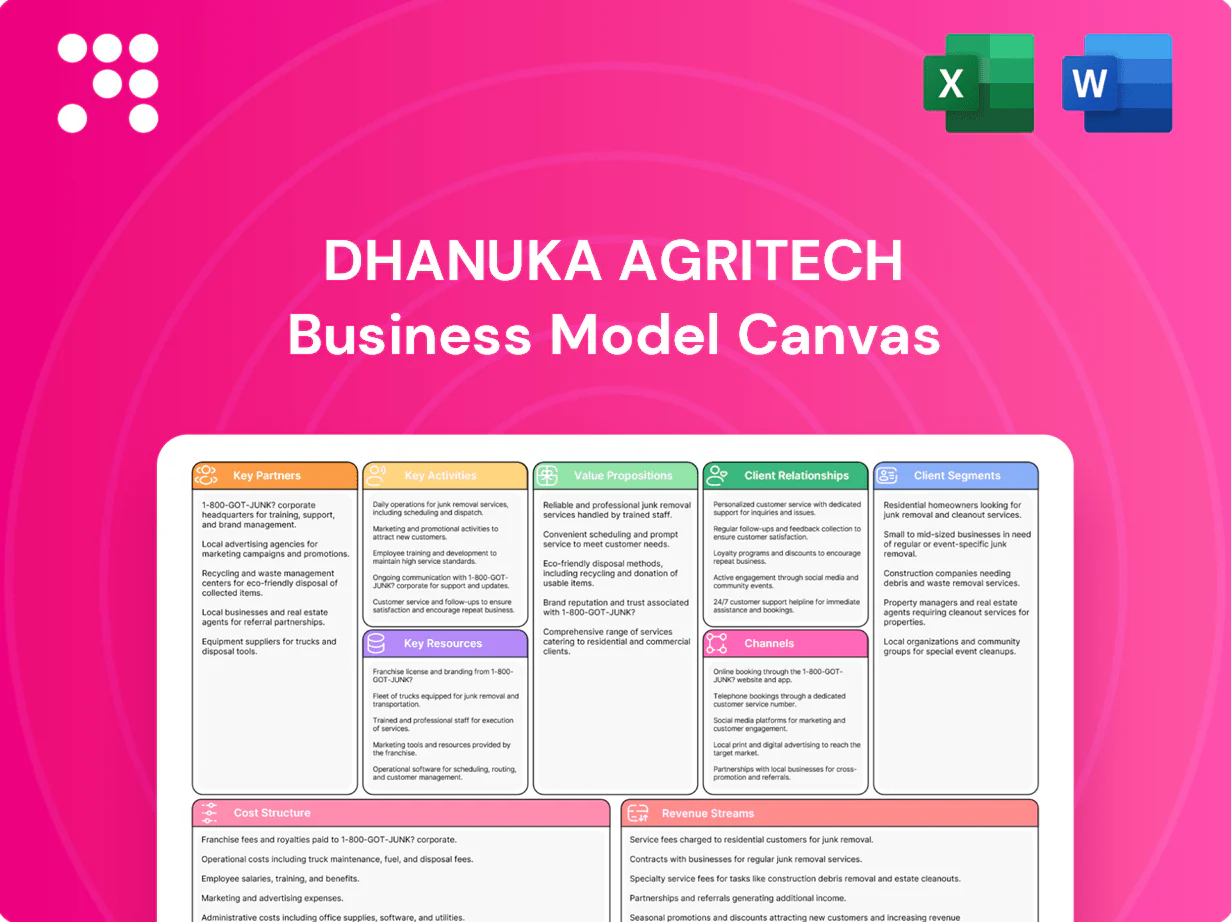
Dhanuka Agritech Business Model Canvas

Unlock a concise, actionable Agritech Business Model Canvas for investors and founders
Unlock the full strategic blueprint behind Dhanuka Agritech’s business model in a concise, actionable Business Model Canvas that maps value propositions, revenue streams, channels and partnerships. Ideal for investors, consultants, and founders seeking proven agritech insights. Purchase the complete, downloadable Canvas (Word & Excel) to apply these tactics to your strategy or pitch.
Partnerships

Global agrochemical innovators
Collaborations with global agrochemical innovators enable co-formulations and in-licensing that widen Dhanuka Agritech’s pipeline and shorten development timelines. These partners supply novel active ingredients and full technical dossiers while leading multinationals invest >$1bn/year in crop-science R&D. Dhanuka leverages these ties to accelerate launches and mitigate regulatory risk. Joint stewardship programs raise adoption and compliance.
Raw material and API suppliers
Strategic sourcing from domestic and international intermediates and API suppliers stabilizes input quality and cost, with India importing about 65% of agrochemical technicals in recent years, underscoring dependence on global intermediates. Long-term contracts mitigate volatility in key chemistries and lock favorable pricing. Regular supplier audits enforce REACH/ISO compliance and sustainability, while dual-sourcing reduces disruption risk.

Distribution and retail networks
Alliances with agri-dealers, distributors and input chains extend Dhanuka Agritech’s last-mile reach through multi-tier distribution networks, enabling wider rural penetration. Co-marketing and dealer credit programs boost sell-through by aligning promotions and cash-flow support with seasonal demand. Data-sharing with partners improves demand forecasting and inventory turns via shared POS and sales telemetry. Preferred partnerships secure prioritized shelf space and merchandising during peak cropping seasons.

Research institutes and universities
Field trials with research institutes validate product efficacy and local adaptability, leveraging 700+ Krishi Vigyan Kendras in 2024 to reach diverse agro-climates; joint studies with universities support label expansions and integrated pest management programs; agronomy insights refine product positioning and dosing; collaboration strengthens credibility with regulators and increases farmer adoption.
- 700+ KVKs 2024
- 100+ academic collaborations
- Label expansions via joint trials
- Stronger regulator/farmer trust
Regulatory and stewardship bodies
Engagement with central and state regulators, including the Central Insecticide Board and Registration Committee, secures compliant registrations and market access for Dhanuka Agritech.
Industry associations support advocacy and stewardship; India crop protection market was about USD 4.5 billion in 2024, underscoring regulatory importance.
Participation in resistance-management initiatives and training partnerships promotes safe usage and prolongs product life cycles.
- Regulatory partner: Central Insecticide Board and Registration Committee
- Market size 2024: USD 4.5 billion
- Focus: resistance-management, farmer training, state-level registrations
Co-formulation accelerates launches; India imports ~65%, 700+ KVKs extend reach
Global co-formulation and in-licensing partnerships shorten time-to-market and supply novel AIs; India imports ~65% of agrochemical technicals. Strong distributor/dealer alliances and 700+ KVKs in 2024 extend last-mile reach and field validation. Regulatory ties (CIB&RC) and stewardship programs support registrations and resistance-management within a USD 4.5bn India crop protection market (2024).
| Partnership | Role | 2024 metric |
|---|---|---|
| Global innovators | Co-formulation/licensing | — |
| Suppliers | APIs/intermediates | ~65% imports |
| KVKs | Field trials | 700+ |
| Regulators | Registrations/stewardship | CIB&RC |
| Market | Context | USD 4.5bn |
What is included in the product
 Detailed Word Document
A comprehensive Business Model Canvas for Dhanuka Agritech detailing customer segments, channels, key partners, value propositions and revenue streams across the 9 classic BMC blocks; reflects real-world operations, competitive advantages and linked SWOT insights. Ideal for presentations, investor discussions and strategic decision-making with clear narratives for validation and growth planning.

 Customizable Excel Spreadsheet
High-level, editable Business Model Canvas that condenses Dhanuka Agritech’s distribution, R&D, and dealer-network strategy into a one-page snapshot—quickly identifying gaps and aligning teams to solve fragmented supply-chain and go-to-market pain points.
Activities

Formulation and manufacturing
Producing herbicides, insecticides, fungicides and PGRs at ISO-certified plants is core to Dhanuka Agritech, with batch optimization practices maintaining consistency and reducing variability in active ingredient concentration. Rigorous EHS controls (waste treatment, emission monitoring) keep operations compliant and safe. Capacity planning is synchronized to Kharif/Rabi cycles, supporting peak-season scale-up; India’s agrochemical market was about USD 5.2 billion in 2024.
Regulatory registrations
Preparing dossiers, conducting field and GLP trials, and securing state/national approvals (typically a 12–36 month process under India’s CIB&RC framework) enable timely market entry. Vigilant label and compliance updates manage evolving rules and pesticide MRLs. Residue and toxicology studies provide safety proof for regulators and buyers. Export registrations and MRL alignment open new geographies and trade lanes.

R&D and product localization
R&D at Dhanuka focuses on new formulations and dose/pack localization to drive adoption across diverse Indian cropping zones; India’s crop protection market was ~USD 4.5 billion in 2024, underscoring scale. Bioefficacy and compatibility testing refine field recommendations, while resistance management protocols protect long‑term performance. Pipeline prioritization balances margin targets with farmer needs to optimize SKU rollout.

Sales, marketing, and agronomy extension
Sales, marketing, and agronomy extension focus on dealer activation, farmer meetings and demonstration plots to create pull; seasonality-based campaigns peak at Kharif and Rabi sowing and key pest windows in 2024. Field agronomists deliver advisory to boost outcomes and conversion. Digital content and messaging sustain continuous engagement year-round.
- Dealer activation: targeted outreach during sowing
- Farmer meetings & demos: drive trials to purchase
- Agronomists: on-field advisory to improve yields
- Digital: continuous content, alerts and follow-ups (2024)
Supply chain and logistics
Forecast-driven procurement and nationwide distribution keep Dhanuka products stocked across India, cutting stockouts via forecasting (up to 30% reduction in similar agri supply chains in 2024 studies) and enabling timely deliveries.
Compliant warehousing with temperature- and hazard-controlled storage preserves product integrity and shelf-life; route optimization trims logistics costs by roughly 10–20% while lowering delays.
Structured returns management for expired or damaged goods reduces waste and recall costs, targeting single-digit percentage return rates.
- Forecasting: up to 30% fewer stockouts (2024 studies)
- Procurement & distribution: national coverage
- Warehousing: compliant hazard/temperature control
- Route optimization: 10–20% cost savings
- Returns management: controls expired/damaged stock
ISO agrochemicals: stockouts ~30%, logistics 10–20%
Core activities: ISO-grade manufacturing of herbicides/insecticides/PGRs with batch optimization; regulatory dossiers and GLP trials (CIB&RC approvals 12–36 months) enable market entry; R&D localizes formulations and resistance management; sales/agronomy, dealer/demos and digital drive adoption; forecasted procurement and route optimization cut stockouts ~30% and logistics costs 10–20% (2024).
| Metric | 2024 |
|---|---|
| Agrochemical market (INR/USD) | ~USD 5.2B |
| Crop protection | ~USD 4.5B |
| Stockout reduction | ~30% |
| Logistics savings | 10–20% |
Delivered as Displayed
Business Model Canvas
The document you're previewing is the actual Dhanuka Agritech Business Model Canvas, not a mockup. It’s a direct extract from the exact file you’ll receive after purchase. On completion, you’ll download the full, ready-to-edit document in Word and Excel formats. No surprises—what you see is what you get.

Unlock a concise, actionable Agritech Business Model Canvas for investors and founders
Unlock the full strategic blueprint behind Dhanuka Agritech’s business model in a concise, actionable Business Model Canvas that maps value propositions, revenue streams, channels and partnerships. Ideal for investors, consultants, and founders seeking proven agritech insights. Purchase the complete, downloadable Canvas (Word & Excel) to apply these tactics to your strategy or pitch.
Partnerships
Global agrochemical innovators
Collaborations with global agrochemical innovators enable co-formulations and in-licensing that widen Dhanuka Agritech’s pipeline and shorten development timelines. These partners supply novel active ingredients and full technical dossiers while leading multinationals invest >$1bn/year in crop-science R&D. Dhanuka leverages these ties to accelerate launches and mitigate regulatory risk. Joint stewardship programs raise adoption and compliance.
Raw material and API suppliers
Strategic sourcing from domestic and international intermediates and API suppliers stabilizes input quality and cost, with India importing about 65% of agrochemical technicals in recent years, underscoring dependence on global intermediates. Long-term contracts mitigate volatility in key chemistries and lock favorable pricing. Regular supplier audits enforce REACH/ISO compliance and sustainability, while dual-sourcing reduces disruption risk.
Distribution and retail networks
Alliances with agri-dealers, distributors and input chains extend Dhanuka Agritech’s last-mile reach through multi-tier distribution networks, enabling wider rural penetration. Co-marketing and dealer credit programs boost sell-through by aligning promotions and cash-flow support with seasonal demand. Data-sharing with partners improves demand forecasting and inventory turns via shared POS and sales telemetry. Preferred partnerships secure prioritized shelf space and merchandising during peak cropping seasons.
Research institutes and universities
Field trials with research institutes validate product efficacy and local adaptability, leveraging 700+ Krishi Vigyan Kendras in 2024 to reach diverse agro-climates; joint studies with universities support label expansions and integrated pest management programs; agronomy insights refine product positioning and dosing; collaboration strengthens credibility with regulators and increases farmer adoption.
- 700+ KVKs 2024
- 100+ academic collaborations
- Label expansions via joint trials
- Stronger regulator/farmer trust
Regulatory and stewardship bodies
Engagement with central and state regulators, including the Central Insecticide Board and Registration Committee, secures compliant registrations and market access for Dhanuka Agritech.
Industry associations support advocacy and stewardship; India crop protection market was about USD 4.5 billion in 2024, underscoring regulatory importance.
Participation in resistance-management initiatives and training partnerships promotes safe usage and prolongs product life cycles.
- Regulatory partner: Central Insecticide Board and Registration Committee
- Market size 2024: USD 4.5 billion
- Focus: resistance-management, farmer training, state-level registrations
Co-formulation accelerates launches; India imports ~65%, 700+ KVKs extend reach
Global co-formulation and in-licensing partnerships shorten time-to-market and supply novel AIs; India imports ~65% of agrochemical technicals. Strong distributor/dealer alliances and 700+ KVKs in 2024 extend last-mile reach and field validation. Regulatory ties (CIB&RC) and stewardship programs support registrations and resistance-management within a USD 4.5bn India crop protection market (2024).
| Partnership | Role | 2024 metric |
|---|---|---|
| Global innovators | Co-formulation/licensing | — |
| Suppliers | APIs/intermediates | ~65% imports |
| KVKs | Field trials | 700+ |
| Regulators | Registrations/stewardship | CIB&RC |
| Market | Context | USD 4.5bn |
What is included in the product
Detailed Word Document
A comprehensive Business Model Canvas for Dhanuka Agritech detailing customer segments, channels, key partners, value propositions and revenue streams across the 9 classic BMC blocks; reflects real-world operations, competitive advantages and linked SWOT insights. Ideal for presentations, investor discussions and strategic decision-making with clear narratives for validation and growth planning.
Customizable Excel Spreadsheet
High-level, editable Business Model Canvas that condenses Dhanuka Agritech’s distribution, R&D, and dealer-network strategy into a one-page snapshot—quickly identifying gaps and aligning teams to solve fragmented supply-chain and go-to-market pain points.
Activities
Formulation and manufacturing
Producing herbicides, insecticides, fungicides and PGRs at ISO-certified plants is core to Dhanuka Agritech, with batch optimization practices maintaining consistency and reducing variability in active ingredient concentration. Rigorous EHS controls (waste treatment, emission monitoring) keep operations compliant and safe. Capacity planning is synchronized to Kharif/Rabi cycles, supporting peak-season scale-up; India’s agrochemical market was about USD 5.2 billion in 2024.
Regulatory registrations
Preparing dossiers, conducting field and GLP trials, and securing state/national approvals (typically a 12–36 month process under India’s CIB&RC framework) enable timely market entry. Vigilant label and compliance updates manage evolving rules and pesticide MRLs. Residue and toxicology studies provide safety proof for regulators and buyers. Export registrations and MRL alignment open new geographies and trade lanes.
R&D and product localization
R&D at Dhanuka focuses on new formulations and dose/pack localization to drive adoption across diverse Indian cropping zones; India’s crop protection market was ~USD 4.5 billion in 2024, underscoring scale. Bioefficacy and compatibility testing refine field recommendations, while resistance management protocols protect long‑term performance. Pipeline prioritization balances margin targets with farmer needs to optimize SKU rollout.
Sales, marketing, and agronomy extension
Sales, marketing, and agronomy extension focus on dealer activation, farmer meetings and demonstration plots to create pull; seasonality-based campaigns peak at Kharif and Rabi sowing and key pest windows in 2024. Field agronomists deliver advisory to boost outcomes and conversion. Digital content and messaging sustain continuous engagement year-round.
- Dealer activation: targeted outreach during sowing
- Farmer meetings & demos: drive trials to purchase
- Agronomists: on-field advisory to improve yields
- Digital: continuous content, alerts and follow-ups (2024)
Supply chain and logistics
Forecast-driven procurement and nationwide distribution keep Dhanuka products stocked across India, cutting stockouts via forecasting (up to 30% reduction in similar agri supply chains in 2024 studies) and enabling timely deliveries.
Compliant warehousing with temperature- and hazard-controlled storage preserves product integrity and shelf-life; route optimization trims logistics costs by roughly 10–20% while lowering delays.
Structured returns management for expired or damaged goods reduces waste and recall costs, targeting single-digit percentage return rates.
- Forecasting: up to 30% fewer stockouts (2024 studies)
- Procurement & distribution: national coverage
- Warehousing: compliant hazard/temperature control
- Route optimization: 10–20% cost savings
- Returns management: controls expired/damaged stock
ISO agrochemicals: stockouts ~30%, logistics 10–20%
Core activities: ISO-grade manufacturing of herbicides/insecticides/PGRs with batch optimization; regulatory dossiers and GLP trials (CIB&RC approvals 12–36 months) enable market entry; R&D localizes formulations and resistance management; sales/agronomy, dealer/demos and digital drive adoption; forecasted procurement and route optimization cut stockouts ~30% and logistics costs 10–20% (2024).
| Metric | 2024 |
|---|---|
| Agrochemical market (INR/USD) | ~USD 5.2B |
| Crop protection | ~USD 4.5B |
| Stockout reduction | ~30% |
| Logistics savings | 10–20% |
Delivered as Displayed
Business Model Canvas
The document you're previewing is the actual Dhanuka Agritech Business Model Canvas, not a mockup. It’s a direct extract from the exact file you’ll receive after purchase. On completion, you’ll download the full, ready-to-edit document in Word and Excel formats. No surprises—what you see is what you get.
Original: $10.00
-65%$10.00
$3.50Description
Unlock a concise, actionable Agritech Business Model Canvas for investors and founders
Unlock the full strategic blueprint behind Dhanuka Agritech’s business model in a concise, actionable Business Model Canvas that maps value propositions, revenue streams, channels and partnerships. Ideal for investors, consultants, and founders seeking proven agritech insights. Purchase the complete, downloadable Canvas (Word & Excel) to apply these tactics to your strategy or pitch.
Partnerships
Global agrochemical innovators
Collaborations with global agrochemical innovators enable co-formulations and in-licensing that widen Dhanuka Agritech’s pipeline and shorten development timelines. These partners supply novel active ingredients and full technical dossiers while leading multinationals invest >$1bn/year in crop-science R&D. Dhanuka leverages these ties to accelerate launches and mitigate regulatory risk. Joint stewardship programs raise adoption and compliance.
Raw material and API suppliers
Strategic sourcing from domestic and international intermediates and API suppliers stabilizes input quality and cost, with India importing about 65% of agrochemical technicals in recent years, underscoring dependence on global intermediates. Long-term contracts mitigate volatility in key chemistries and lock favorable pricing. Regular supplier audits enforce REACH/ISO compliance and sustainability, while dual-sourcing reduces disruption risk.
Distribution and retail networks
Alliances with agri-dealers, distributors and input chains extend Dhanuka Agritech’s last-mile reach through multi-tier distribution networks, enabling wider rural penetration. Co-marketing and dealer credit programs boost sell-through by aligning promotions and cash-flow support with seasonal demand. Data-sharing with partners improves demand forecasting and inventory turns via shared POS and sales telemetry. Preferred partnerships secure prioritized shelf space and merchandising during peak cropping seasons.
Research institutes and universities
Field trials with research institutes validate product efficacy and local adaptability, leveraging 700+ Krishi Vigyan Kendras in 2024 to reach diverse agro-climates; joint studies with universities support label expansions and integrated pest management programs; agronomy insights refine product positioning and dosing; collaboration strengthens credibility with regulators and increases farmer adoption.
- 700+ KVKs 2024
- 100+ academic collaborations
- Label expansions via joint trials
- Stronger regulator/farmer trust
Regulatory and stewardship bodies
Engagement with central and state regulators, including the Central Insecticide Board and Registration Committee, secures compliant registrations and market access for Dhanuka Agritech.
Industry associations support advocacy and stewardship; India crop protection market was about USD 4.5 billion in 2024, underscoring regulatory importance.
Participation in resistance-management initiatives and training partnerships promotes safe usage and prolongs product life cycles.
- Regulatory partner: Central Insecticide Board and Registration Committee
- Market size 2024: USD 4.5 billion
- Focus: resistance-management, farmer training, state-level registrations
Co-formulation accelerates launches; India imports ~65%, 700+ KVKs extend reach
Global co-formulation and in-licensing partnerships shorten time-to-market and supply novel AIs; India imports ~65% of agrochemical technicals. Strong distributor/dealer alliances and 700+ KVKs in 2024 extend last-mile reach and field validation. Regulatory ties (CIB&RC) and stewardship programs support registrations and resistance-management within a USD 4.5bn India crop protection market (2024).
| Partnership | Role | 2024 metric |
|---|---|---|
| Global innovators | Co-formulation/licensing | — |
| Suppliers | APIs/intermediates | ~65% imports |
| KVKs | Field trials | 700+ |
| Regulators | Registrations/stewardship | CIB&RC |
| Market | Context | USD 4.5bn |
What is included in the product
Detailed Word Document
A comprehensive Business Model Canvas for Dhanuka Agritech detailing customer segments, channels, key partners, value propositions and revenue streams across the 9 classic BMC blocks; reflects real-world operations, competitive advantages and linked SWOT insights. Ideal for presentations, investor discussions and strategic decision-making with clear narratives for validation and growth planning.
Customizable Excel Spreadsheet
High-level, editable Business Model Canvas that condenses Dhanuka Agritech’s distribution, R&D, and dealer-network strategy into a one-page snapshot—quickly identifying gaps and aligning teams to solve fragmented supply-chain and go-to-market pain points.
Activities
Formulation and manufacturing
Producing herbicides, insecticides, fungicides and PGRs at ISO-certified plants is core to Dhanuka Agritech, with batch optimization practices maintaining consistency and reducing variability in active ingredient concentration. Rigorous EHS controls (waste treatment, emission monitoring) keep operations compliant and safe. Capacity planning is synchronized to Kharif/Rabi cycles, supporting peak-season scale-up; India’s agrochemical market was about USD 5.2 billion in 2024.
Regulatory registrations
Preparing dossiers, conducting field and GLP trials, and securing state/national approvals (typically a 12–36 month process under India’s CIB&RC framework) enable timely market entry. Vigilant label and compliance updates manage evolving rules and pesticide MRLs. Residue and toxicology studies provide safety proof for regulators and buyers. Export registrations and MRL alignment open new geographies and trade lanes.
R&D and product localization
R&D at Dhanuka focuses on new formulations and dose/pack localization to drive adoption across diverse Indian cropping zones; India’s crop protection market was ~USD 4.5 billion in 2024, underscoring scale. Bioefficacy and compatibility testing refine field recommendations, while resistance management protocols protect long‑term performance. Pipeline prioritization balances margin targets with farmer needs to optimize SKU rollout.
Sales, marketing, and agronomy extension
Sales, marketing, and agronomy extension focus on dealer activation, farmer meetings and demonstration plots to create pull; seasonality-based campaigns peak at Kharif and Rabi sowing and key pest windows in 2024. Field agronomists deliver advisory to boost outcomes and conversion. Digital content and messaging sustain continuous engagement year-round.
- Dealer activation: targeted outreach during sowing
- Farmer meetings & demos: drive trials to purchase
- Agronomists: on-field advisory to improve yields
- Digital: continuous content, alerts and follow-ups (2024)
Supply chain and logistics
Forecast-driven procurement and nationwide distribution keep Dhanuka products stocked across India, cutting stockouts via forecasting (up to 30% reduction in similar agri supply chains in 2024 studies) and enabling timely deliveries.
Compliant warehousing with temperature- and hazard-controlled storage preserves product integrity and shelf-life; route optimization trims logistics costs by roughly 10–20% while lowering delays.
Structured returns management for expired or damaged goods reduces waste and recall costs, targeting single-digit percentage return rates.
- Forecasting: up to 30% fewer stockouts (2024 studies)
- Procurement & distribution: national coverage
- Warehousing: compliant hazard/temperature control
- Route optimization: 10–20% cost savings
- Returns management: controls expired/damaged stock
ISO agrochemicals: stockouts ~30%, logistics 10–20%
Core activities: ISO-grade manufacturing of herbicides/insecticides/PGRs with batch optimization; regulatory dossiers and GLP trials (CIB&RC approvals 12–36 months) enable market entry; R&D localizes formulations and resistance management; sales/agronomy, dealer/demos and digital drive adoption; forecasted procurement and route optimization cut stockouts ~30% and logistics costs 10–20% (2024).
| Metric | 2024 |
|---|---|
| Agrochemical market (INR/USD) | ~USD 5.2B |
| Crop protection | ~USD 4.5B |
| Stockout reduction | ~30% |
| Logistics savings | 10–20% |
Delivered as Displayed
Business Model Canvas
The document you're previewing is the actual Dhanuka Agritech Business Model Canvas, not a mockup. It’s a direct extract from the exact file you’ll receive after purchase. On completion, you’ll download the full, ready-to-edit document in Word and Excel formats. No surprises—what you see is what you get.











