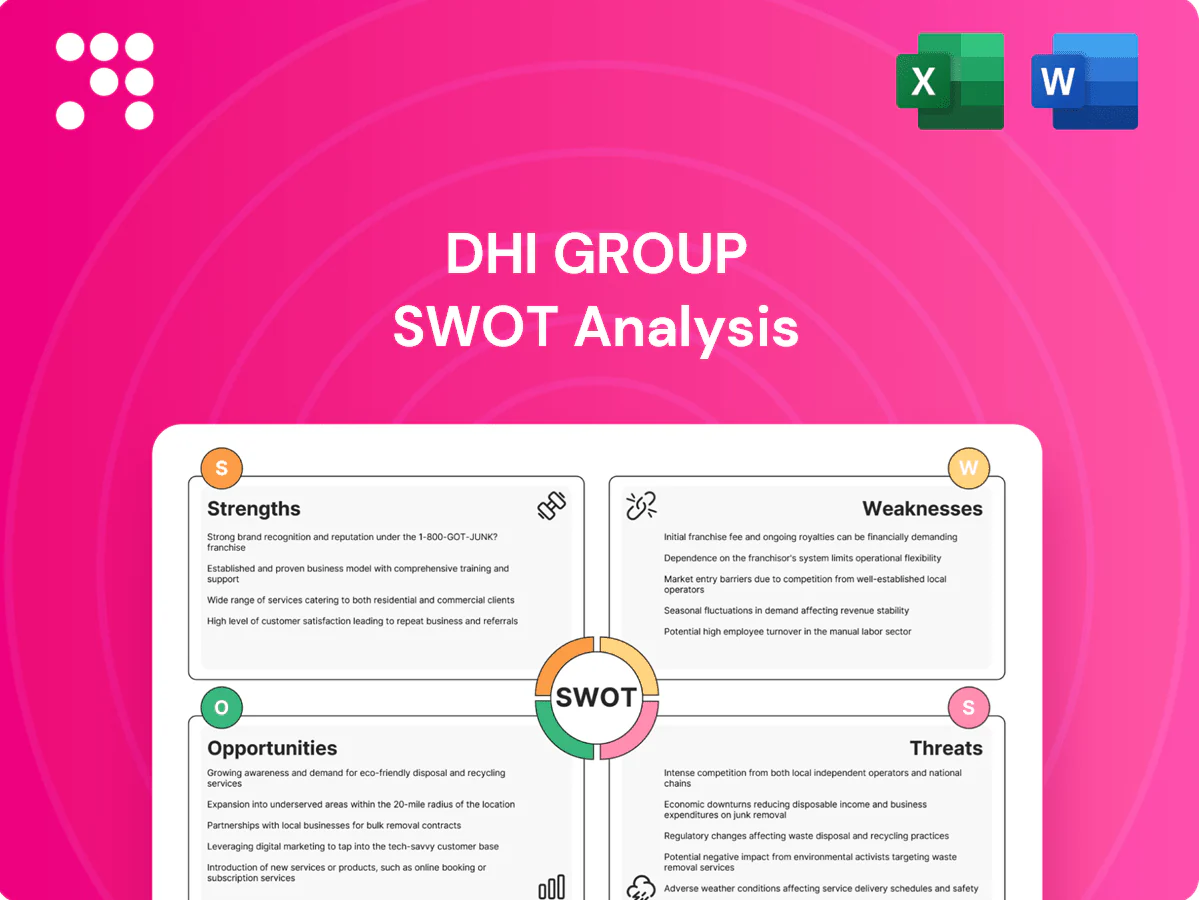
DHI Group SWOT Analysis

Your Strategic Toolkit Starts Here
DHI Group’s SWOT analysis highlights strengths in niche professional marketplaces, talent data assets, and recurring revenue, while flagging competitive pressure, technology migration risks, and market concentration. Want the full strategic picture? Purchase the complete SWOT for a research-backed, editable report and Excel tools to plan, pitch, or invest with confidence.
Strengths

Niche tech-talent focus
Specialization in technology roles sharpens matching quality and user relevance, leveraging Dice's network of over 3 million tech professionals to surface more precise candidate-job fits. Tailored content, skills tagging, and community resources increase engagement and repeat visits among active tech talent. This focus differentiates DHI Group from generalist job boards by concentrating signal over noise. It also enables premium pricing for hard-to-fill engineering and data science roles.
Data-driven marketplace insights
Rich datasets from Dice and ClearanceJobs (platforms under DHI Group) power superior search, matching, and benchmarking, leveraging a user base of over 5 million registered tech and cleared professionals to refine algorithms. Employers access actionable insights on skills gaps, compensation bands, and demand shifts, with platform analytics supporting hiring decisions. Data moats strengthen as scale and engagement grow, improving retention for both candidates and employers and driving repeat revenue.

Recognized brands in tech hiring
Dice and related platforms carry strong brand equity with recruiters and millions of tech candidates, lowering paid acquisition as organic recall rises; this brand trust shortens time-to-fill and improves response quality, and in 2024 helped DHI deepen enterprise partnerships and accelerate penetration into corporate hiring programs.

Two-sided network effects
Two-sided network effects: DHI’s Dice platform attracts over 5 million tech professionals, which draws employers seeking qualified candidates and boosts job density and candidate responsiveness through reinforcing feedback loops; this raises switching costs for users and solidifies a defensible position in tech hiring niches.
- More candidates → more employers
- Feedback loops → higher job density
- Increased switching costs
- Defensible niche position
Tools tailored to recruiters
- Advanced search & alerts
- Integrated messaging & screening
- API/ATS integrations
- 3.6M tech professionals (2024)
Specialized tech recruiting: data-driven matching, network effects and premium pricing
Deep specialization in tech hiring sharpens candidate-job matching and justifies premium pricing for hard-to-fill engineering and data roles. Rich datasets from Dice and ClearanceJobs create a growing data moat that improves search, benchmarking, and employer retention. Two-sided network effects and recruiter tools (advanced search, ATS/API integrations) increase stickiness and reduce acquisition costs.
| Metric | Value | Year/Source |
|---|---|---|
| Dice tech professionals | 3.6M | 2024 |
| Platforms combined registered users | 5M+ | 2024 |
What is included in the product
 Detailed Word Document
Delivers a strategic overview of DHI Group’s internal and external business factors, outlining strengths, weaknesses, opportunities, and threats to map competitive position, growth drivers, operational gaps, and market risks.

 Customizable Excel Spreadsheet
Provides a concise SWOT matrix pinpointing DHI Group’s talent-market strengths and platform vulnerabilities for fast strategic alignment, enabling quick stakeholder briefings and decision-making.
Weaknesses

Exposure to tech hiring cycles
Revenue is highly sensitive to swings in technology headcount demand; during the 2022–2023 downturn tech firms announced roughly 200,000 layoffs, which quickly suppressed postings and renewals on platforms like Dice. Budget freezes and hiring slowdowns rapidly reduce recurring listings, compressing short-term revenue and weakening pricing power. This volatility complicates forecasting and, because DHI depends on cyclical tech hiring, amplifies quarter-to-quarter earnings variability.
Limited diversification
DHI Group’s core Dice platform remains heavily concentrated in technology roles, narrowing its addressable market compared with broader job boards and limiting penetration into adjacent verticals where competitors have gained share. This specialization constrains cross-sell opportunities across nontech hiring and recruiting services. The focus also heightens exposure to sector-specific downturns and tech hiring cycles, increasing revenue volatility.

Scale disadvantage vs giants
DHI Group faces a scale disadvantage competing with LinkedIn (930 million members as of 2024) and Indeed (≈250 million monthly visitors), limiting marketing reach and product velocity compared with those giants.
Network effects strongly favor incumbents with broader user bases, making it harder for Dice and specialist talent clouds to grow engagement and data-driven features.
Intense competition drives pricing pressure on job-posting and subscription services, compressing margins for smaller operators.

Legacy perception and UX gaps
Some users view DHI Group platforms as dated versus modern apps, which erodes trust and brand appeal; UX friction has measurable impact on engagement and conversion, with industry surveys in 2024 reporting user abandonment increases of roughly 40–50% after poor UX experiences.
- Legacy UI perceived as outdated
- UX friction lowers conversion ~40–50% (2024 industry data)
- Platform upgrades often cost millions and take 12–24 months
- Perception lag hinders new-customer acquisition
Dependence on paid employer demand
DHI Groups monetization heavily relies on employer subscriptions and paid job postings, leaving topline growth vulnerable if clients shift to direct sourcing or free platforms; limited consumer-facing revenue streams constrain diversification and margin expansion. This concentration raises sensitivity to corporate hiring freezes and procurement cuts, which can materially impact recurring revenue.
- Concentration: employer-driven revenue
- Channel risk: direct sourcing/free platforms
- Revenue mix: weak consumer monetization
- Sensitivity: exposed to procurement/hiring cuts
Tech-hiring revenue vulnerable to layoffs, UX friction and scale gaps suppress growth
Revenue tied to tech hiring makes Dice vulnerable to cycles—~200,000 tech layoffs in 2022–23 cut postings and renewals, increasing quarter-to-quarter volatility. Heavy tech concentration limits addressable market and cross-sell; platform perception and UX friction (40–50% abandonment, 2024) depress conversion. Scale disadvantage vs LinkedIn (930M, 2024) and Indeed (~250M monthly) pressures pricing and growth.
| Metric | Value |
|---|---|
| Tech layoffs (2022–23) | ~200,000 |
| LinkedIn users (2024) | 930M |
| Indeed monthly (2024) | ~250M |
| UX abandonment (2024) | 40–50% |
Same Document Delivered
DHI Group SWOT Analysis
This is the actual SWOT analysis document you’ll receive upon purchase—no surprises, just professional quality. The preview below is taken directly from the full SWOT report you'll get, covering DHI Group's strengths, weaknesses, opportunities and threats. Buy now to unlock the complete, editable report ready for immediate download.

Your Strategic Toolkit Starts Here
DHI Group’s SWOT analysis highlights strengths in niche professional marketplaces, talent data assets, and recurring revenue, while flagging competitive pressure, technology migration risks, and market concentration. Want the full strategic picture? Purchase the complete SWOT for a research-backed, editable report and Excel tools to plan, pitch, or invest with confidence.
Strengths
Niche tech-talent focus
Specialization in technology roles sharpens matching quality and user relevance, leveraging Dice's network of over 3 million tech professionals to surface more precise candidate-job fits. Tailored content, skills tagging, and community resources increase engagement and repeat visits among active tech talent. This focus differentiates DHI Group from generalist job boards by concentrating signal over noise. It also enables premium pricing for hard-to-fill engineering and data science roles.
Data-driven marketplace insights
Rich datasets from Dice and ClearanceJobs (platforms under DHI Group) power superior search, matching, and benchmarking, leveraging a user base of over 5 million registered tech and cleared professionals to refine algorithms. Employers access actionable insights on skills gaps, compensation bands, and demand shifts, with platform analytics supporting hiring decisions. Data moats strengthen as scale and engagement grow, improving retention for both candidates and employers and driving repeat revenue.
Recognized brands in tech hiring
Dice and related platforms carry strong brand equity with recruiters and millions of tech candidates, lowering paid acquisition as organic recall rises; this brand trust shortens time-to-fill and improves response quality, and in 2024 helped DHI deepen enterprise partnerships and accelerate penetration into corporate hiring programs.
Two-sided network effects
Two-sided network effects: DHI’s Dice platform attracts over 5 million tech professionals, which draws employers seeking qualified candidates and boosts job density and candidate responsiveness through reinforcing feedback loops; this raises switching costs for users and solidifies a defensible position in tech hiring niches.
- More candidates → more employers
- Feedback loops → higher job density
- Increased switching costs
- Defensible niche position
Tools tailored to recruiters
- Advanced search & alerts
- Integrated messaging & screening
- API/ATS integrations
- 3.6M tech professionals (2024)
Specialized tech recruiting: data-driven matching, network effects and premium pricing
Deep specialization in tech hiring sharpens candidate-job matching and justifies premium pricing for hard-to-fill engineering and data roles. Rich datasets from Dice and ClearanceJobs create a growing data moat that improves search, benchmarking, and employer retention. Two-sided network effects and recruiter tools (advanced search, ATS/API integrations) increase stickiness and reduce acquisition costs.
| Metric | Value | Year/Source |
|---|---|---|
| Dice tech professionals | 3.6M | 2024 |
| Platforms combined registered users | 5M+ | 2024 |
What is included in the product
Detailed Word Document
Delivers a strategic overview of DHI Group’s internal and external business factors, outlining strengths, weaknesses, opportunities, and threats to map competitive position, growth drivers, operational gaps, and market risks.
Customizable Excel Spreadsheet
Provides a concise SWOT matrix pinpointing DHI Group’s talent-market strengths and platform vulnerabilities for fast strategic alignment, enabling quick stakeholder briefings and decision-making.
Weaknesses
Exposure to tech hiring cycles
Revenue is highly sensitive to swings in technology headcount demand; during the 2022–2023 downturn tech firms announced roughly 200,000 layoffs, which quickly suppressed postings and renewals on platforms like Dice. Budget freezes and hiring slowdowns rapidly reduce recurring listings, compressing short-term revenue and weakening pricing power. This volatility complicates forecasting and, because DHI depends on cyclical tech hiring, amplifies quarter-to-quarter earnings variability.
Limited diversification
DHI Group’s core Dice platform remains heavily concentrated in technology roles, narrowing its addressable market compared with broader job boards and limiting penetration into adjacent verticals where competitors have gained share. This specialization constrains cross-sell opportunities across nontech hiring and recruiting services. The focus also heightens exposure to sector-specific downturns and tech hiring cycles, increasing revenue volatility.
Scale disadvantage vs giants
DHI Group faces a scale disadvantage competing with LinkedIn (930 million members as of 2024) and Indeed (≈250 million monthly visitors), limiting marketing reach and product velocity compared with those giants.
Network effects strongly favor incumbents with broader user bases, making it harder for Dice and specialist talent clouds to grow engagement and data-driven features.
Intense competition drives pricing pressure on job-posting and subscription services, compressing margins for smaller operators.
Legacy perception and UX gaps
Some users view DHI Group platforms as dated versus modern apps, which erodes trust and brand appeal; UX friction has measurable impact on engagement and conversion, with industry surveys in 2024 reporting user abandonment increases of roughly 40–50% after poor UX experiences.
- Legacy UI perceived as outdated
- UX friction lowers conversion ~40–50% (2024 industry data)
- Platform upgrades often cost millions and take 12–24 months
- Perception lag hinders new-customer acquisition
Dependence on paid employer demand
DHI Groups monetization heavily relies on employer subscriptions and paid job postings, leaving topline growth vulnerable if clients shift to direct sourcing or free platforms; limited consumer-facing revenue streams constrain diversification and margin expansion. This concentration raises sensitivity to corporate hiring freezes and procurement cuts, which can materially impact recurring revenue.
- Concentration: employer-driven revenue
- Channel risk: direct sourcing/free platforms
- Revenue mix: weak consumer monetization
- Sensitivity: exposed to procurement/hiring cuts
Tech-hiring revenue vulnerable to layoffs, UX friction and scale gaps suppress growth
Revenue tied to tech hiring makes Dice vulnerable to cycles—~200,000 tech layoffs in 2022–23 cut postings and renewals, increasing quarter-to-quarter volatility. Heavy tech concentration limits addressable market and cross-sell; platform perception and UX friction (40–50% abandonment, 2024) depress conversion. Scale disadvantage vs LinkedIn (930M, 2024) and Indeed (~250M monthly) pressures pricing and growth.
| Metric | Value |
|---|---|
| Tech layoffs (2022–23) | ~200,000 |
| LinkedIn users (2024) | 930M |
| Indeed monthly (2024) | ~250M |
| UX abandonment (2024) | 40–50% |
Same Document Delivered
DHI Group SWOT Analysis
This is the actual SWOT analysis document you’ll receive upon purchase—no surprises, just professional quality. The preview below is taken directly from the full SWOT report you'll get, covering DHI Group's strengths, weaknesses, opportunities and threats. Buy now to unlock the complete, editable report ready for immediate download.
Original: $10.00
-65%$10.00
$3.50Description
Your Strategic Toolkit Starts Here
DHI Group’s SWOT analysis highlights strengths in niche professional marketplaces, talent data assets, and recurring revenue, while flagging competitive pressure, technology migration risks, and market concentration. Want the full strategic picture? Purchase the complete SWOT for a research-backed, editable report and Excel tools to plan, pitch, or invest with confidence.
Strengths
Niche tech-talent focus
Specialization in technology roles sharpens matching quality and user relevance, leveraging Dice's network of over 3 million tech professionals to surface more precise candidate-job fits. Tailored content, skills tagging, and community resources increase engagement and repeat visits among active tech talent. This focus differentiates DHI Group from generalist job boards by concentrating signal over noise. It also enables premium pricing for hard-to-fill engineering and data science roles.
Data-driven marketplace insights
Rich datasets from Dice and ClearanceJobs (platforms under DHI Group) power superior search, matching, and benchmarking, leveraging a user base of over 5 million registered tech and cleared professionals to refine algorithms. Employers access actionable insights on skills gaps, compensation bands, and demand shifts, with platform analytics supporting hiring decisions. Data moats strengthen as scale and engagement grow, improving retention for both candidates and employers and driving repeat revenue.
Recognized brands in tech hiring
Dice and related platforms carry strong brand equity with recruiters and millions of tech candidates, lowering paid acquisition as organic recall rises; this brand trust shortens time-to-fill and improves response quality, and in 2024 helped DHI deepen enterprise partnerships and accelerate penetration into corporate hiring programs.
Two-sided network effects
Two-sided network effects: DHI’s Dice platform attracts over 5 million tech professionals, which draws employers seeking qualified candidates and boosts job density and candidate responsiveness through reinforcing feedback loops; this raises switching costs for users and solidifies a defensible position in tech hiring niches.
- More candidates → more employers
- Feedback loops → higher job density
- Increased switching costs
- Defensible niche position
Tools tailored to recruiters
- Advanced search & alerts
- Integrated messaging & screening
- API/ATS integrations
- 3.6M tech professionals (2024)
Specialized tech recruiting: data-driven matching, network effects and premium pricing
Deep specialization in tech hiring sharpens candidate-job matching and justifies premium pricing for hard-to-fill engineering and data roles. Rich datasets from Dice and ClearanceJobs create a growing data moat that improves search, benchmarking, and employer retention. Two-sided network effects and recruiter tools (advanced search, ATS/API integrations) increase stickiness and reduce acquisition costs.
| Metric | Value | Year/Source |
|---|---|---|
| Dice tech professionals | 3.6M | 2024 |
| Platforms combined registered users | 5M+ | 2024 |
What is included in the product
Detailed Word Document
Delivers a strategic overview of DHI Group’s internal and external business factors, outlining strengths, weaknesses, opportunities, and threats to map competitive position, growth drivers, operational gaps, and market risks.
Customizable Excel Spreadsheet
Provides a concise SWOT matrix pinpointing DHI Group’s talent-market strengths and platform vulnerabilities for fast strategic alignment, enabling quick stakeholder briefings and decision-making.
Weaknesses
Exposure to tech hiring cycles
Revenue is highly sensitive to swings in technology headcount demand; during the 2022–2023 downturn tech firms announced roughly 200,000 layoffs, which quickly suppressed postings and renewals on platforms like Dice. Budget freezes and hiring slowdowns rapidly reduce recurring listings, compressing short-term revenue and weakening pricing power. This volatility complicates forecasting and, because DHI depends on cyclical tech hiring, amplifies quarter-to-quarter earnings variability.
Limited diversification
DHI Group’s core Dice platform remains heavily concentrated in technology roles, narrowing its addressable market compared with broader job boards and limiting penetration into adjacent verticals where competitors have gained share. This specialization constrains cross-sell opportunities across nontech hiring and recruiting services. The focus also heightens exposure to sector-specific downturns and tech hiring cycles, increasing revenue volatility.
Scale disadvantage vs giants
DHI Group faces a scale disadvantage competing with LinkedIn (930 million members as of 2024) and Indeed (≈250 million monthly visitors), limiting marketing reach and product velocity compared with those giants.
Network effects strongly favor incumbents with broader user bases, making it harder for Dice and specialist talent clouds to grow engagement and data-driven features.
Intense competition drives pricing pressure on job-posting and subscription services, compressing margins for smaller operators.
Legacy perception and UX gaps
Some users view DHI Group platforms as dated versus modern apps, which erodes trust and brand appeal; UX friction has measurable impact on engagement and conversion, with industry surveys in 2024 reporting user abandonment increases of roughly 40–50% after poor UX experiences.
- Legacy UI perceived as outdated
- UX friction lowers conversion ~40–50% (2024 industry data)
- Platform upgrades often cost millions and take 12–24 months
- Perception lag hinders new-customer acquisition
Dependence on paid employer demand
DHI Groups monetization heavily relies on employer subscriptions and paid job postings, leaving topline growth vulnerable if clients shift to direct sourcing or free platforms; limited consumer-facing revenue streams constrain diversification and margin expansion. This concentration raises sensitivity to corporate hiring freezes and procurement cuts, which can materially impact recurring revenue.
- Concentration: employer-driven revenue
- Channel risk: direct sourcing/free platforms
- Revenue mix: weak consumer monetization
- Sensitivity: exposed to procurement/hiring cuts
Tech-hiring revenue vulnerable to layoffs, UX friction and scale gaps suppress growth
Revenue tied to tech hiring makes Dice vulnerable to cycles—~200,000 tech layoffs in 2022–23 cut postings and renewals, increasing quarter-to-quarter volatility. Heavy tech concentration limits addressable market and cross-sell; platform perception and UX friction (40–50% abandonment, 2024) depress conversion. Scale disadvantage vs LinkedIn (930M, 2024) and Indeed (~250M monthly) pressures pricing and growth.
| Metric | Value |
|---|---|
| Tech layoffs (2022–23) | ~200,000 |
| LinkedIn users (2024) | 930M |
| Indeed monthly (2024) | ~250M |
| UX abandonment (2024) | 40–50% |
Same Document Delivered
DHI Group SWOT Analysis
This is the actual SWOT analysis document you’ll receive upon purchase—no surprises, just professional quality. The preview below is taken directly from the full SWOT report you'll get, covering DHI Group's strengths, weaknesses, opportunities and threats. Buy now to unlock the complete, editable report ready for immediate download.











