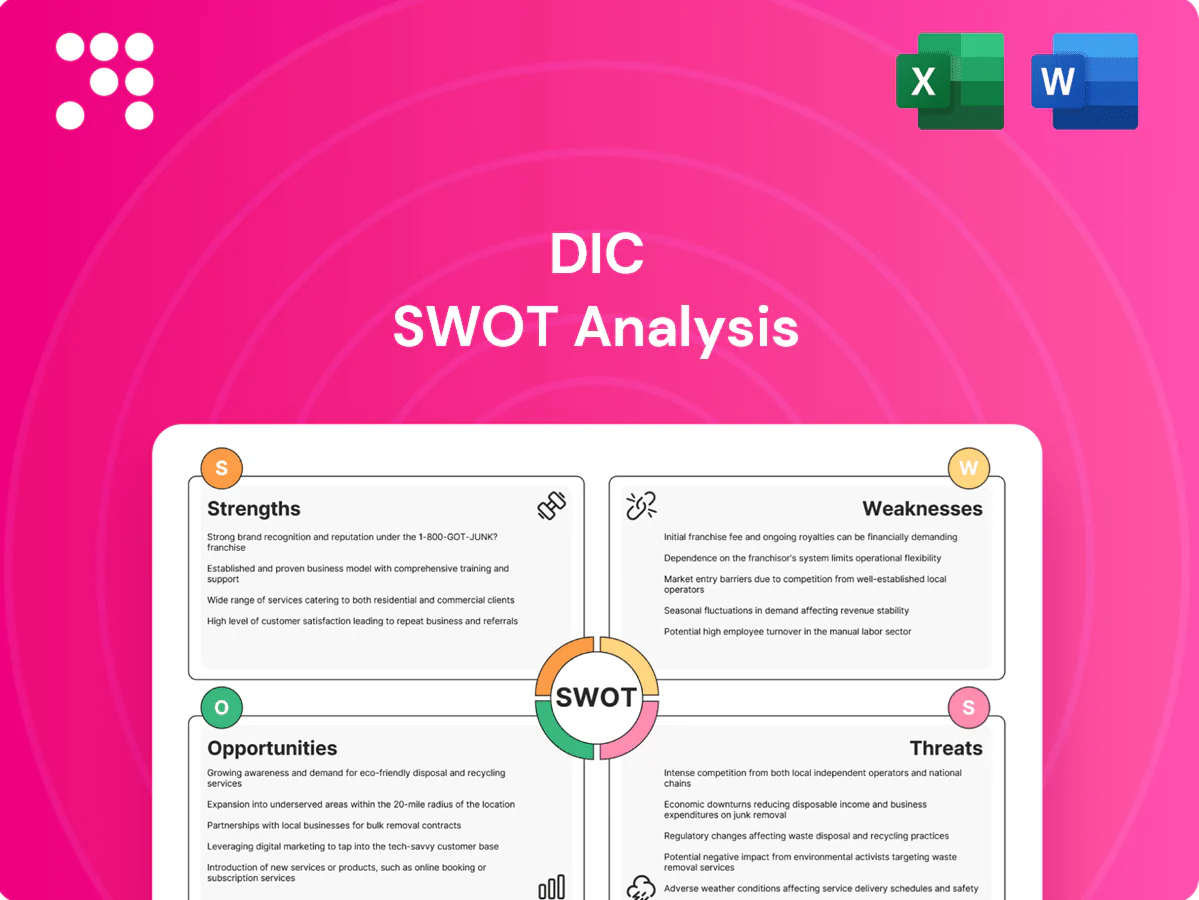
DIC SWOT Analysis

Elevate Your Analysis with the Complete SWOT Report
Explore DIC’s competitive strengths, operational risks, and growth levers in a concise SWOT snapshot that highlights where the company excels and where strategic action is needed. Want deeper, actionable insights? Purchase the full SWOT analysis for a research-backed, editable report and Excel tools to plan, pitch, and invest with confidence.
Strengths

Diversified specialty chemicals portfolio
DICs balanced exposure across printing inks, organic pigments, synthetic resins and fine chemicals helps stabilize revenues across cycles, supported by operations in over 60 countries and roughly 20,000 employees. The broad portfolio enables cross-selling and solution bundling for packaging, electronics and automotive customers, increasing wallet share. Diversification boosts resilience to demand shocks in any single end-market and spreads R&D risk across multiple technology platforms.
Global manufacturing and customer reach
Established footprint across Asia, Europe and the Americas—operating in over 40 countries with more than 60 manufacturing sites—enables reliable supply and local technical service. Proximity to converters and OEMs shortens lead times and co-development cycles, supporting faster product launches. Scale drives cost efficiencies in sourcing and production, while global reach enhances resilience to regional disruptions.

Strong R&D and application engineering
Deep formulation expertise in inks, pigments and resins delivers differentiated performance across print quality, durability and regulatory compliance. Dedicated application labs tailor solutions to substrates, processes and regional rules, reducing customer development cycles. R&D emphasis on advanced functional materials targets higher-margin niches such as specialty coatings and electronic inks. Robust technical service increases customer stickiness and switching costs.

Leadership in packaging solutions
Leadership in packaging solutions positions DIC to capture growth in flexible packaging and labels; the flexible packaging market was about USD 160bn in 2023 with ~4.5% CAGR to 2030, supporting recurring FMCG demand. Compliance-ready, low-VOC and food-contact systems meet brand-owner specs and simplify converter qualification through end-to-end offerings.
- Market: flexible packaging ~USD 160bn (2023), ~4.5% CAGR
- Compliance: low-VOC, food-contact systems
- Value: end-to-end, faster converter qualification
- Demand: recurring FMCG-driven packaging
Commitment to sustainability
DIC's push into water-based, energy-curable and bio-based chemistries (water-based cuts VOCs by >90%) aligns with its announced net-zero by 2050 commitment and eases compliance with tightening regulations.
Lifecycle-thinking and recyclability-enabling inks/resins bolster circular packaging, helping secure global brand programs and lowering projected carbon and compliance costs.
- VOC reduction: >90%
- Net-zero target: 2050
- Circular-packaging enablement: supports brand procurement
Diversified inks-to-chemicals group; 20,000 staff, packaging and low-VOC growth
DIC’s diversified portfolio across inks, pigments, resins and fine chemicals stabilizes revenue and enables cross-selling; ~20,000 employees in over 60 countries support global supply and technical service. Strength in packaging (flexible packaging market USD 160bn 2023, ~4.5% CAGR) and low-VOC (>90% reduction) chemistries align with net-zero 2050 and circular-packaging demand.
| Metric | Value |
|---|---|
| Employees | ~20,000 |
| Countries | >60 |
| Flexible packaging | USD 160bn (2023) |
| CAGR | ~4.5% |
| VOC reduction | >90% |
| Net-zero target | 2050 |
What is included in the product
 Detailed Word Document
Provides a concise SWOT overview of DIC, highlighting internal strengths and weaknesses alongside external opportunities and threats to inform strategic decision-making.

 Customizable Excel Spreadsheet
Provides a focused DIC SWOT matrix that quickly identifies strategic pain points and actionable responses. Editable format enables rapid updates to reflect shifting risks and opportunities.
Weaknesses

Exposure to declining print segments
Legacy dependence on publishing and commercial print leaves DIC exposed as commercial print volumes trend mid-single-digit annual declines and publisher print runs shrink; mix shift to digital media reduces traditional ink demand, squeezing sales. Fixed capacity and legacy cost structures are slow to realign, creating lingering margin drag; without accelerated portfolio shift to specialty pigments/coatings, profitability risks persist.
Raw material price sensitivity
Petrochemical feedstocks, pigments and solvents DIC uses track volatile petrochemical cycles—Brent crude averaged about $86/barrel in 2024—driving raw-material swings that erode predictability. Pass-through clauses often lag spot spikes, compressing margins during rapid price jumps. Tight supply of key intermediates intermittently disrupts formulations and delivery. Hedging mitigates but cannot eliminate timing and basis mismatch risks.

Complex portfolio and integration needs
Multiple product lines and past acquisitions raise operational complexity; industry data show roughly 70% of M&A fail to hit projected synergies, prolonging integration. Harmonizing systems, quality standards and product platforms typically requires 12–24 months, elevating overhead and IT/SG&A spend. This complexity slows decision-making and clouds capital-allocation discipline, increasing the risk of suboptimal capex and ROI outcomes.

High compliance and capex requirements
Environmental, safety and food-contact standards force continuous investment in monitoring, materials and certification, raising operating costs for DIC. Transitioning to low-emission processes increases capital intensity and payback periods. Regulatory complexity across regions adds compliance management burden, while smaller plants risk subscale economics under stricter rules.
- Ongoing certification & equipment spend
- Higher capex for low-emission tech
- Regional compliance heterogeneity
- Subscale risk for smaller plants
Foreign exchange and regional demand risks
Global footprint exposes DIC earnings to currency swings, with translation and transaction effects moving reported margins quarter-to-quarter. Mismatches between sourcing currencies and end-market sales can compress gross margins when local currencies weaken. Regional slowdowns in electronics or auto demand transmit quickly through volumes, and hedging cannot fully neutralize the resulting revenue and margin swings.
- FX exposure: translation and transaction risk
- Currency-sourcing mismatch: margin pressure
- Regional auto/electronics slowdown: volume risk
- Hedging limits: cannot offset volume-driven losses
Print industry margin squeeze from mid-single-digit volume declines and $86/bbl oil volatility
Legacy print exposure amid mid-single-digit annual declines and shift to digital compresses volumes and ink demand. Brent crude averaged about $86/barrel in 2024, fueling raw-material volatility that squeezes margins. Complex M&A integration and rising compliance/capex for low-emission tech prolong margin drag and operational risk.
| Metric | 2024 |
|---|---|
| Brent (avg) | $86/bbl |
| Print volume trend | mid-single-digit decline |
Same Document Delivered
DIC SWOT Analysis
This is the actual DIC SWOT analysis document you’ll receive upon purchase—no surprises, just professional quality. The preview below is taken directly from the full report and reflects the same structured, editable file you'll download after payment. Buy now to unlock the complete, detailed version.

Elevate Your Analysis with the Complete SWOT Report
Explore DIC’s competitive strengths, operational risks, and growth levers in a concise SWOT snapshot that highlights where the company excels and where strategic action is needed. Want deeper, actionable insights? Purchase the full SWOT analysis for a research-backed, editable report and Excel tools to plan, pitch, and invest with confidence.
Strengths
Diversified specialty chemicals portfolio
DICs balanced exposure across printing inks, organic pigments, synthetic resins and fine chemicals helps stabilize revenues across cycles, supported by operations in over 60 countries and roughly 20,000 employees. The broad portfolio enables cross-selling and solution bundling for packaging, electronics and automotive customers, increasing wallet share. Diversification boosts resilience to demand shocks in any single end-market and spreads R&D risk across multiple technology platforms.
Global manufacturing and customer reach
Established footprint across Asia, Europe and the Americas—operating in over 40 countries with more than 60 manufacturing sites—enables reliable supply and local technical service. Proximity to converters and OEMs shortens lead times and co-development cycles, supporting faster product launches. Scale drives cost efficiencies in sourcing and production, while global reach enhances resilience to regional disruptions.
Strong R&D and application engineering
Deep formulation expertise in inks, pigments and resins delivers differentiated performance across print quality, durability and regulatory compliance. Dedicated application labs tailor solutions to substrates, processes and regional rules, reducing customer development cycles. R&D emphasis on advanced functional materials targets higher-margin niches such as specialty coatings and electronic inks. Robust technical service increases customer stickiness and switching costs.
Leadership in packaging solutions
Leadership in packaging solutions positions DIC to capture growth in flexible packaging and labels; the flexible packaging market was about USD 160bn in 2023 with ~4.5% CAGR to 2030, supporting recurring FMCG demand. Compliance-ready, low-VOC and food-contact systems meet brand-owner specs and simplify converter qualification through end-to-end offerings.
- Market: flexible packaging ~USD 160bn (2023), ~4.5% CAGR
- Compliance: low-VOC, food-contact systems
- Value: end-to-end, faster converter qualification
- Demand: recurring FMCG-driven packaging
Commitment to sustainability
DIC's push into water-based, energy-curable and bio-based chemistries (water-based cuts VOCs by >90%) aligns with its announced net-zero by 2050 commitment and eases compliance with tightening regulations.
Lifecycle-thinking and recyclability-enabling inks/resins bolster circular packaging, helping secure global brand programs and lowering projected carbon and compliance costs.
- VOC reduction: >90%
- Net-zero target: 2050
- Circular-packaging enablement: supports brand procurement
Diversified inks-to-chemicals group; 20,000 staff, packaging and low-VOC growth
DIC’s diversified portfolio across inks, pigments, resins and fine chemicals stabilizes revenue and enables cross-selling; ~20,000 employees in over 60 countries support global supply and technical service. Strength in packaging (flexible packaging market USD 160bn 2023, ~4.5% CAGR) and low-VOC (>90% reduction) chemistries align with net-zero 2050 and circular-packaging demand.
| Metric | Value |
|---|---|
| Employees | ~20,000 |
| Countries | >60 |
| Flexible packaging | USD 160bn (2023) |
| CAGR | ~4.5% |
| VOC reduction | >90% |
| Net-zero target | 2050 |
What is included in the product
Detailed Word Document
Provides a concise SWOT overview of DIC, highlighting internal strengths and weaknesses alongside external opportunities and threats to inform strategic decision-making.
Customizable Excel Spreadsheet
Provides a focused DIC SWOT matrix that quickly identifies strategic pain points and actionable responses. Editable format enables rapid updates to reflect shifting risks and opportunities.
Weaknesses
Exposure to declining print segments
Legacy dependence on publishing and commercial print leaves DIC exposed as commercial print volumes trend mid-single-digit annual declines and publisher print runs shrink; mix shift to digital media reduces traditional ink demand, squeezing sales. Fixed capacity and legacy cost structures are slow to realign, creating lingering margin drag; without accelerated portfolio shift to specialty pigments/coatings, profitability risks persist.
Raw material price sensitivity
Petrochemical feedstocks, pigments and solvents DIC uses track volatile petrochemical cycles—Brent crude averaged about $86/barrel in 2024—driving raw-material swings that erode predictability. Pass-through clauses often lag spot spikes, compressing margins during rapid price jumps. Tight supply of key intermediates intermittently disrupts formulations and delivery. Hedging mitigates but cannot eliminate timing and basis mismatch risks.
Complex portfolio and integration needs
Multiple product lines and past acquisitions raise operational complexity; industry data show roughly 70% of M&A fail to hit projected synergies, prolonging integration. Harmonizing systems, quality standards and product platforms typically requires 12–24 months, elevating overhead and IT/SG&A spend. This complexity slows decision-making and clouds capital-allocation discipline, increasing the risk of suboptimal capex and ROI outcomes.
High compliance and capex requirements
Environmental, safety and food-contact standards force continuous investment in monitoring, materials and certification, raising operating costs for DIC. Transitioning to low-emission processes increases capital intensity and payback periods. Regulatory complexity across regions adds compliance management burden, while smaller plants risk subscale economics under stricter rules.
- Ongoing certification & equipment spend
- Higher capex for low-emission tech
- Regional compliance heterogeneity
- Subscale risk for smaller plants
Foreign exchange and regional demand risks
Global footprint exposes DIC earnings to currency swings, with translation and transaction effects moving reported margins quarter-to-quarter. Mismatches between sourcing currencies and end-market sales can compress gross margins when local currencies weaken. Regional slowdowns in electronics or auto demand transmit quickly through volumes, and hedging cannot fully neutralize the resulting revenue and margin swings.
- FX exposure: translation and transaction risk
- Currency-sourcing mismatch: margin pressure
- Regional auto/electronics slowdown: volume risk
- Hedging limits: cannot offset volume-driven losses
Print industry margin squeeze from mid-single-digit volume declines and $86/bbl oil volatility
Legacy print exposure amid mid-single-digit annual declines and shift to digital compresses volumes and ink demand. Brent crude averaged about $86/barrel in 2024, fueling raw-material volatility that squeezes margins. Complex M&A integration and rising compliance/capex for low-emission tech prolong margin drag and operational risk.
| Metric | 2024 |
|---|---|
| Brent (avg) | $86/bbl |
| Print volume trend | mid-single-digit decline |
Same Document Delivered
DIC SWOT Analysis
This is the actual DIC SWOT analysis document you’ll receive upon purchase—no surprises, just professional quality. The preview below is taken directly from the full report and reflects the same structured, editable file you'll download after payment. Buy now to unlock the complete, detailed version.
Original: $10.00
-65%$10.00
$3.50Description
Elevate Your Analysis with the Complete SWOT Report
Explore DIC’s competitive strengths, operational risks, and growth levers in a concise SWOT snapshot that highlights where the company excels and where strategic action is needed. Want deeper, actionable insights? Purchase the full SWOT analysis for a research-backed, editable report and Excel tools to plan, pitch, and invest with confidence.
Strengths
Diversified specialty chemicals portfolio
DICs balanced exposure across printing inks, organic pigments, synthetic resins and fine chemicals helps stabilize revenues across cycles, supported by operations in over 60 countries and roughly 20,000 employees. The broad portfolio enables cross-selling and solution bundling for packaging, electronics and automotive customers, increasing wallet share. Diversification boosts resilience to demand shocks in any single end-market and spreads R&D risk across multiple technology platforms.
Global manufacturing and customer reach
Established footprint across Asia, Europe and the Americas—operating in over 40 countries with more than 60 manufacturing sites—enables reliable supply and local technical service. Proximity to converters and OEMs shortens lead times and co-development cycles, supporting faster product launches. Scale drives cost efficiencies in sourcing and production, while global reach enhances resilience to regional disruptions.
Strong R&D and application engineering
Deep formulation expertise in inks, pigments and resins delivers differentiated performance across print quality, durability and regulatory compliance. Dedicated application labs tailor solutions to substrates, processes and regional rules, reducing customer development cycles. R&D emphasis on advanced functional materials targets higher-margin niches such as specialty coatings and electronic inks. Robust technical service increases customer stickiness and switching costs.
Leadership in packaging solutions
Leadership in packaging solutions positions DIC to capture growth in flexible packaging and labels; the flexible packaging market was about USD 160bn in 2023 with ~4.5% CAGR to 2030, supporting recurring FMCG demand. Compliance-ready, low-VOC and food-contact systems meet brand-owner specs and simplify converter qualification through end-to-end offerings.
- Market: flexible packaging ~USD 160bn (2023), ~4.5% CAGR
- Compliance: low-VOC, food-contact systems
- Value: end-to-end, faster converter qualification
- Demand: recurring FMCG-driven packaging
Commitment to sustainability
DIC's push into water-based, energy-curable and bio-based chemistries (water-based cuts VOCs by >90%) aligns with its announced net-zero by 2050 commitment and eases compliance with tightening regulations.
Lifecycle-thinking and recyclability-enabling inks/resins bolster circular packaging, helping secure global brand programs and lowering projected carbon and compliance costs.
- VOC reduction: >90%
- Net-zero target: 2050
- Circular-packaging enablement: supports brand procurement
Diversified inks-to-chemicals group; 20,000 staff, packaging and low-VOC growth
DIC’s diversified portfolio across inks, pigments, resins and fine chemicals stabilizes revenue and enables cross-selling; ~20,000 employees in over 60 countries support global supply and technical service. Strength in packaging (flexible packaging market USD 160bn 2023, ~4.5% CAGR) and low-VOC (>90% reduction) chemistries align with net-zero 2050 and circular-packaging demand.
| Metric | Value |
|---|---|
| Employees | ~20,000 |
| Countries | >60 |
| Flexible packaging | USD 160bn (2023) |
| CAGR | ~4.5% |
| VOC reduction | >90% |
| Net-zero target | 2050 |
What is included in the product
Detailed Word Document
Provides a concise SWOT overview of DIC, highlighting internal strengths and weaknesses alongside external opportunities and threats to inform strategic decision-making.
Customizable Excel Spreadsheet
Provides a focused DIC SWOT matrix that quickly identifies strategic pain points and actionable responses. Editable format enables rapid updates to reflect shifting risks and opportunities.
Weaknesses
Exposure to declining print segments
Legacy dependence on publishing and commercial print leaves DIC exposed as commercial print volumes trend mid-single-digit annual declines and publisher print runs shrink; mix shift to digital media reduces traditional ink demand, squeezing sales. Fixed capacity and legacy cost structures are slow to realign, creating lingering margin drag; without accelerated portfolio shift to specialty pigments/coatings, profitability risks persist.
Raw material price sensitivity
Petrochemical feedstocks, pigments and solvents DIC uses track volatile petrochemical cycles—Brent crude averaged about $86/barrel in 2024—driving raw-material swings that erode predictability. Pass-through clauses often lag spot spikes, compressing margins during rapid price jumps. Tight supply of key intermediates intermittently disrupts formulations and delivery. Hedging mitigates but cannot eliminate timing and basis mismatch risks.
Complex portfolio and integration needs
Multiple product lines and past acquisitions raise operational complexity; industry data show roughly 70% of M&A fail to hit projected synergies, prolonging integration. Harmonizing systems, quality standards and product platforms typically requires 12–24 months, elevating overhead and IT/SG&A spend. This complexity slows decision-making and clouds capital-allocation discipline, increasing the risk of suboptimal capex and ROI outcomes.
High compliance and capex requirements
Environmental, safety and food-contact standards force continuous investment in monitoring, materials and certification, raising operating costs for DIC. Transitioning to low-emission processes increases capital intensity and payback periods. Regulatory complexity across regions adds compliance management burden, while smaller plants risk subscale economics under stricter rules.
- Ongoing certification & equipment spend
- Higher capex for low-emission tech
- Regional compliance heterogeneity
- Subscale risk for smaller plants
Foreign exchange and regional demand risks
Global footprint exposes DIC earnings to currency swings, with translation and transaction effects moving reported margins quarter-to-quarter. Mismatches between sourcing currencies and end-market sales can compress gross margins when local currencies weaken. Regional slowdowns in electronics or auto demand transmit quickly through volumes, and hedging cannot fully neutralize the resulting revenue and margin swings.
- FX exposure: translation and transaction risk
- Currency-sourcing mismatch: margin pressure
- Regional auto/electronics slowdown: volume risk
- Hedging limits: cannot offset volume-driven losses
Print industry margin squeeze from mid-single-digit volume declines and $86/bbl oil volatility
Legacy print exposure amid mid-single-digit annual declines and shift to digital compresses volumes and ink demand. Brent crude averaged about $86/barrel in 2024, fueling raw-material volatility that squeezes margins. Complex M&A integration and rising compliance/capex for low-emission tech prolong margin drag and operational risk.
| Metric | 2024 |
|---|---|
| Brent (avg) | $86/bbl |
| Print volume trend | mid-single-digit decline |
Same Document Delivered
DIC SWOT Analysis
This is the actual DIC SWOT analysis document you’ll receive upon purchase—no surprises, just professional quality. The preview below is taken directly from the full report and reflects the same structured, editable file you'll download after payment. Buy now to unlock the complete, detailed version.











