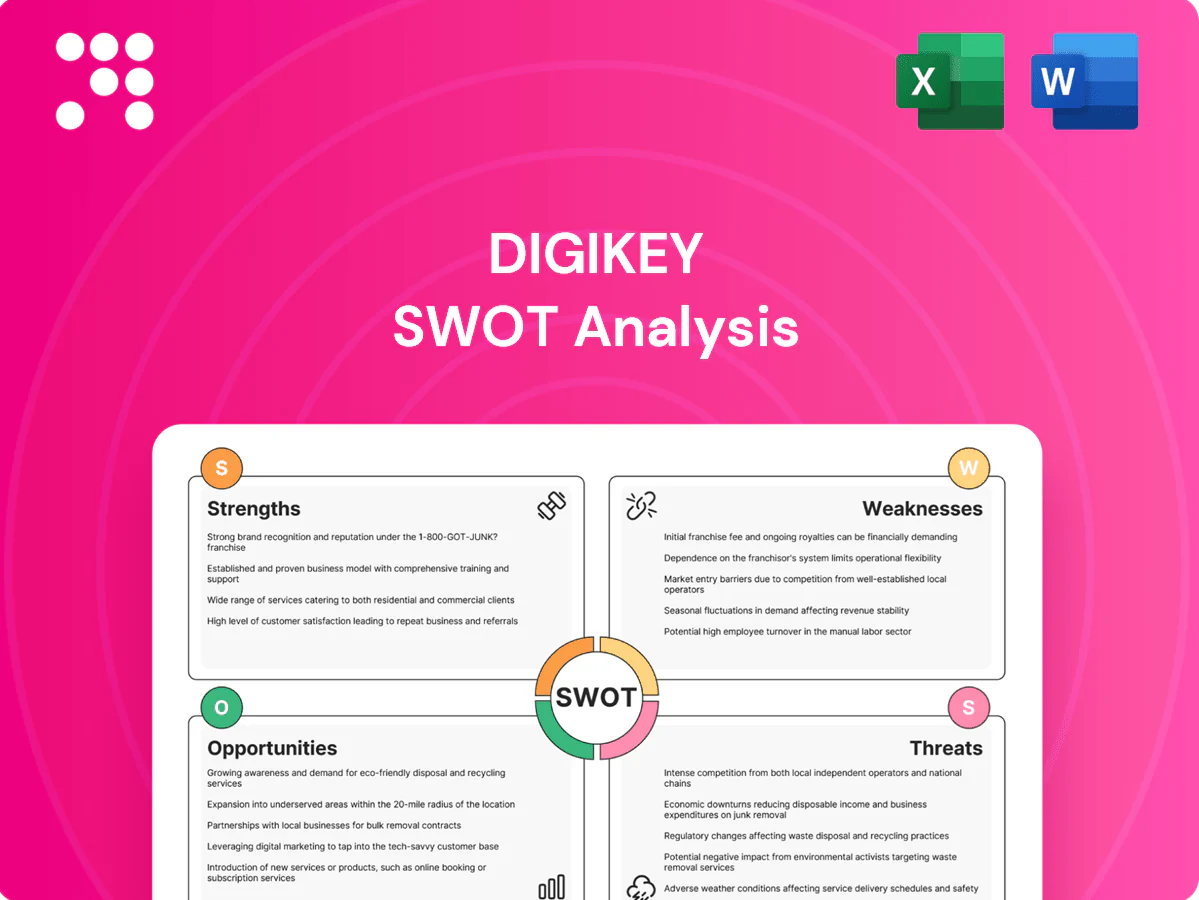
DigiKey SWOT Analysis

Elevate Your Analysis with the Complete SWOT Report
DigiKey’s SWOT snapshot highlights strengths in global distribution, extensive SKU depth, and strong supplier relationships, while flagging supply-chain exposure and competitive margin pressure; it’s essential for stakeholders assessing growth potential. Want the full strategic picture? Purchase the complete SWOT analysis for a research-backed, editable Word report plus an Excel matrix to inform investment, strategy, or pitch decisions.
Strengths

Vast authorized inventory
Massive authorized inventory—over 12 million SKUs from thousands of OEMs—gives customers one-stop access to prototype and production parts, reducing multi-vendor procurement friction. Authorized sourcing assures traceability and mitigates counterfeit risk, supporting compliance. This depth drives rapid design wins and sustains high service levels during demand spikes, enabling extensive same-day/next-day fulfillment and tens of millions of parts shipped annually.
Fast, reliable fulfillment
DigiKey's highly automated warehouses and carrier partnerships enable same-day shipping for orders placed by 5 PM CT and support predictable delivery across markets; the distributor lists over 14 million SKUs in stock. Consistent lead times reduce project risk for engineers and buyers and small-quantity availability accelerates prototyping. Scalable fulfillment handles both low-mix/low-volume runs and full production orders.

Powerful digital platform
Digi-Key's powerful digital platform lists over 14 million products with robust search, parametric filters, BOM tools and REST APIs that streamline component discovery and purchasing. Self-service workflows and automated BOM processing cut procurement cycle time and overhead for many customers. Real-time stock and pricing feeds support accurate planning, while integrations with PLM/ERP enable frictionless enterprise purchasing and engineering collaboration.

Strong supplier partnerships
Deep supplier partnerships expanded Digi-Key's line card and secured early access to new product launches in 2024; co-marketing and demand-creation programs improved supplier sell-through. Priority allocations during 2020–24 supply disruptions cushioned inventory shocks, while quality assurance and compliance frameworks strengthened brand trust with global OEMs.
- line-card expansion — early product access (2024)
- co-marketing — higher sell-through for suppliers
- priority allocations — supply-shock resilience (2020–24)
- QA/compliance — stronger OEM brand trust
Technical resources and support
Datasheets, reference designs, application notes and community content accelerate design decisions, while Digi‑Key’s technical support aids cross‑references and substitutions to keep projects on schedule. Educational resources foster loyalty among engineers and students, and integrated tools reduce bill‑of‑materials risk and time‑to‑prototype.
- Datasheets & reference designs
- Cross‑reference & substitution support
- Educational engagement
- Tools cut BOM risk & prototyping time
Authorized catalog of over 14 million SKUs with 5 PM CT same-day shipping
One-stop authorized inventory of over 14 million SKUs and authorized sourcing reduces counterfeit risk and speeds design wins. Highly automated warehouses enable same-day shipping for orders placed by 5 PM CT and sustain tens of millions of parts shipped annually. Robust digital platform (BOM tools, REST APIs) and supplier partnerships (priority allocations 2020–24) drive predictable fulfillment and rapid prototyping.
| Metric | Value |
|---|---|
| SKUs listed | >14 million |
| Shipping cutoff | 5 PM CT (same-day) |
| Parts shipped/year | tens of millions |
What is included in the product
 Detailed Word Document
Provides a concise SWOT analysis of DigiKey, highlighting internal strengths and weaknesses while evaluating external opportunities and threats that shape its competitive position and future growth prospects.

 Customizable Excel Spreadsheet
Provides a concise, visual SWOT matrix tailored to DigiKey that highlights strengths, weaknesses, opportunities and threats for rapid strategy alignment and decision-making; editable format lets teams quickly update priorities and integrate insights into reports and presentations.
Weaknesses

Supplier lead-time dependence
Inventory availability at Digi-Key still hinges on upstream manufacturing cycles; during 2020–2023 industry disruptions semiconductor lead times often exceeded 26 weeks, causing fill rates to drop despite strong logistics. Vendor-extended lead times force substitutions that may not meet spec-critical designs. Customer experience suffers during broad shortages, reflected in higher backlogs and increased expedited-shipping volumes in peak periods.
Premium small-quantity pricing
Unit economics for low-volume and expedited fulfillment can be 10–30% higher versus bulk orders, driven by per-item handling and express shipping; brokers or gray-market sources often undercut by 5–20% on unit price. Price-sensitive buyers will switch for those savings, especially when discounts require negotiated or volume tiers. This constrains DigiKey’s wallet share in cost-driven segments.

Limited physical presence
DigiKey's primarily online model limits in-person consultative sales and on-site design support, a drawback when some enterprise customers in 170+ countries demand local branches for urgent parts and services. Demonstrations and tailored, hands-on solutions can be harder without deep field engineering presence, slowing complex design wins. Relationship selling is constrained in regions that prioritize face-to-face account management, risking lost opportunities to local distributors.

Catalog complexity and choice overload
DigiKey's catalog spans millions of SKUs, which can overwhelm less-experienced users and increase mis-selections that generate BOM errors and returns, often adding days to procurement cycles; maintaining effective search demands continuous taxonomy and data stewardship while training and UI optimization must be ongoing investments.
- Catalog size: millions of SKUs — choice overload risk
- Impact: BOM errors/returns lengthen procurement timelines
- Mitigation: continuous taxonomy, data stewardship, training, UI optimization
Exposure to electronics cyclicality
Digi-Key revenue closely tracks semiconductor and hardware demand cycles, so downturns compress margins and raise inventory carry risk; FX and macro swings amplify volatility in global sales, and forecasting becomes harder around technology inflection points.
- Revenue sensitivity to semiconductors
- Downturns compress margins
- Higher inventory carry risk
- FX and macro amplify volatility
- Forecasting difficulty at inflection points
Supply risk: >26-week lead times, low-volume costs +10–30%, >10M SKUs
Inventory tied to upstream cycles; 2020–23 semiconductor lead times often exceeded 26 weeks, lowering fill rates and increasing expedited shipments. Low-volume/expedited unit costs run 10–30% higher, while gray-market undercuts 5–20%. Catalog >10M SKUs causes choice overload and BOM errors; global sales exposed to semiconductor cyclical swings (FY2023 revenue ~5.8B USD).
| Metric | Value |
|---|---|
| SKUs | >10M |
| FY2023 revenue | ~5.8B USD |
| Lead times (2020–23) | >26 weeks |
Full Version Awaits
DigiKey SWOT Analysis
This is the actual SWOT analysis document you’ll receive upon purchase—no surprises, just professional quality. The preview below is taken directly from the full DigiKey SWOT report you'll get, covering strengths, weaknesses, opportunities and threats. Purchase unlocks the complete, editable file ready for immediate download and use.

Elevate Your Analysis with the Complete SWOT Report
DigiKey’s SWOT snapshot highlights strengths in global distribution, extensive SKU depth, and strong supplier relationships, while flagging supply-chain exposure and competitive margin pressure; it’s essential for stakeholders assessing growth potential. Want the full strategic picture? Purchase the complete SWOT analysis for a research-backed, editable Word report plus an Excel matrix to inform investment, strategy, or pitch decisions.
Strengths
Vast authorized inventory
Massive authorized inventory—over 12 million SKUs from thousands of OEMs—gives customers one-stop access to prototype and production parts, reducing multi-vendor procurement friction. Authorized sourcing assures traceability and mitigates counterfeit risk, supporting compliance. This depth drives rapid design wins and sustains high service levels during demand spikes, enabling extensive same-day/next-day fulfillment and tens of millions of parts shipped annually.
Fast, reliable fulfillment
DigiKey's highly automated warehouses and carrier partnerships enable same-day shipping for orders placed by 5 PM CT and support predictable delivery across markets; the distributor lists over 14 million SKUs in stock. Consistent lead times reduce project risk for engineers and buyers and small-quantity availability accelerates prototyping. Scalable fulfillment handles both low-mix/low-volume runs and full production orders.
Powerful digital platform
Digi-Key's powerful digital platform lists over 14 million products with robust search, parametric filters, BOM tools and REST APIs that streamline component discovery and purchasing. Self-service workflows and automated BOM processing cut procurement cycle time and overhead for many customers. Real-time stock and pricing feeds support accurate planning, while integrations with PLM/ERP enable frictionless enterprise purchasing and engineering collaboration.
Strong supplier partnerships
Deep supplier partnerships expanded Digi-Key's line card and secured early access to new product launches in 2024; co-marketing and demand-creation programs improved supplier sell-through. Priority allocations during 2020–24 supply disruptions cushioned inventory shocks, while quality assurance and compliance frameworks strengthened brand trust with global OEMs.
- line-card expansion — early product access (2024)
- co-marketing — higher sell-through for suppliers
- priority allocations — supply-shock resilience (2020–24)
- QA/compliance — stronger OEM brand trust
Technical resources and support
Datasheets, reference designs, application notes and community content accelerate design decisions, while Digi‑Key’s technical support aids cross‑references and substitutions to keep projects on schedule. Educational resources foster loyalty among engineers and students, and integrated tools reduce bill‑of‑materials risk and time‑to‑prototype.
- Datasheets & reference designs
- Cross‑reference & substitution support
- Educational engagement
- Tools cut BOM risk & prototyping time
Authorized catalog of over 14 million SKUs with 5 PM CT same-day shipping
One-stop authorized inventory of over 14 million SKUs and authorized sourcing reduces counterfeit risk and speeds design wins. Highly automated warehouses enable same-day shipping for orders placed by 5 PM CT and sustain tens of millions of parts shipped annually. Robust digital platform (BOM tools, REST APIs) and supplier partnerships (priority allocations 2020–24) drive predictable fulfillment and rapid prototyping.
| Metric | Value |
|---|---|
| SKUs listed | >14 million |
| Shipping cutoff | 5 PM CT (same-day) |
| Parts shipped/year | tens of millions |
What is included in the product
Detailed Word Document
Provides a concise SWOT analysis of DigiKey, highlighting internal strengths and weaknesses while evaluating external opportunities and threats that shape its competitive position and future growth prospects.
Customizable Excel Spreadsheet
Provides a concise, visual SWOT matrix tailored to DigiKey that highlights strengths, weaknesses, opportunities and threats for rapid strategy alignment and decision-making; editable format lets teams quickly update priorities and integrate insights into reports and presentations.
Weaknesses
Supplier lead-time dependence
Inventory availability at Digi-Key still hinges on upstream manufacturing cycles; during 2020–2023 industry disruptions semiconductor lead times often exceeded 26 weeks, causing fill rates to drop despite strong logistics. Vendor-extended lead times force substitutions that may not meet spec-critical designs. Customer experience suffers during broad shortages, reflected in higher backlogs and increased expedited-shipping volumes in peak periods.
Premium small-quantity pricing
Unit economics for low-volume and expedited fulfillment can be 10–30% higher versus bulk orders, driven by per-item handling and express shipping; brokers or gray-market sources often undercut by 5–20% on unit price. Price-sensitive buyers will switch for those savings, especially when discounts require negotiated or volume tiers. This constrains DigiKey’s wallet share in cost-driven segments.
Limited physical presence
DigiKey's primarily online model limits in-person consultative sales and on-site design support, a drawback when some enterprise customers in 170+ countries demand local branches for urgent parts and services. Demonstrations and tailored, hands-on solutions can be harder without deep field engineering presence, slowing complex design wins. Relationship selling is constrained in regions that prioritize face-to-face account management, risking lost opportunities to local distributors.
Catalog complexity and choice overload
DigiKey's catalog spans millions of SKUs, which can overwhelm less-experienced users and increase mis-selections that generate BOM errors and returns, often adding days to procurement cycles; maintaining effective search demands continuous taxonomy and data stewardship while training and UI optimization must be ongoing investments.
- Catalog size: millions of SKUs — choice overload risk
- Impact: BOM errors/returns lengthen procurement timelines
- Mitigation: continuous taxonomy, data stewardship, training, UI optimization
Exposure to electronics cyclicality
Digi-Key revenue closely tracks semiconductor and hardware demand cycles, so downturns compress margins and raise inventory carry risk; FX and macro swings amplify volatility in global sales, and forecasting becomes harder around technology inflection points.
- Revenue sensitivity to semiconductors
- Downturns compress margins
- Higher inventory carry risk
- FX and macro amplify volatility
- Forecasting difficulty at inflection points
Supply risk: >26-week lead times, low-volume costs +10–30%, >10M SKUs
Inventory tied to upstream cycles; 2020–23 semiconductor lead times often exceeded 26 weeks, lowering fill rates and increasing expedited shipments. Low-volume/expedited unit costs run 10–30% higher, while gray-market undercuts 5–20%. Catalog >10M SKUs causes choice overload and BOM errors; global sales exposed to semiconductor cyclical swings (FY2023 revenue ~5.8B USD).
| Metric | Value |
|---|---|
| SKUs | >10M |
| FY2023 revenue | ~5.8B USD |
| Lead times (2020–23) | >26 weeks |
Full Version Awaits
DigiKey SWOT Analysis
This is the actual SWOT analysis document you’ll receive upon purchase—no surprises, just professional quality. The preview below is taken directly from the full DigiKey SWOT report you'll get, covering strengths, weaknesses, opportunities and threats. Purchase unlocks the complete, editable file ready for immediate download and use.
Original: $10.00
-65%$10.00
$3.50Description
Elevate Your Analysis with the Complete SWOT Report
DigiKey’s SWOT snapshot highlights strengths in global distribution, extensive SKU depth, and strong supplier relationships, while flagging supply-chain exposure and competitive margin pressure; it’s essential for stakeholders assessing growth potential. Want the full strategic picture? Purchase the complete SWOT analysis for a research-backed, editable Word report plus an Excel matrix to inform investment, strategy, or pitch decisions.
Strengths
Vast authorized inventory
Massive authorized inventory—over 12 million SKUs from thousands of OEMs—gives customers one-stop access to prototype and production parts, reducing multi-vendor procurement friction. Authorized sourcing assures traceability and mitigates counterfeit risk, supporting compliance. This depth drives rapid design wins and sustains high service levels during demand spikes, enabling extensive same-day/next-day fulfillment and tens of millions of parts shipped annually.
Fast, reliable fulfillment
DigiKey's highly automated warehouses and carrier partnerships enable same-day shipping for orders placed by 5 PM CT and support predictable delivery across markets; the distributor lists over 14 million SKUs in stock. Consistent lead times reduce project risk for engineers and buyers and small-quantity availability accelerates prototyping. Scalable fulfillment handles both low-mix/low-volume runs and full production orders.
Powerful digital platform
Digi-Key's powerful digital platform lists over 14 million products with robust search, parametric filters, BOM tools and REST APIs that streamline component discovery and purchasing. Self-service workflows and automated BOM processing cut procurement cycle time and overhead for many customers. Real-time stock and pricing feeds support accurate planning, while integrations with PLM/ERP enable frictionless enterprise purchasing and engineering collaboration.
Strong supplier partnerships
Deep supplier partnerships expanded Digi-Key's line card and secured early access to new product launches in 2024; co-marketing and demand-creation programs improved supplier sell-through. Priority allocations during 2020–24 supply disruptions cushioned inventory shocks, while quality assurance and compliance frameworks strengthened brand trust with global OEMs.
- line-card expansion — early product access (2024)
- co-marketing — higher sell-through for suppliers
- priority allocations — supply-shock resilience (2020–24)
- QA/compliance — stronger OEM brand trust
Technical resources and support
Datasheets, reference designs, application notes and community content accelerate design decisions, while Digi‑Key’s technical support aids cross‑references and substitutions to keep projects on schedule. Educational resources foster loyalty among engineers and students, and integrated tools reduce bill‑of‑materials risk and time‑to‑prototype.
- Datasheets & reference designs
- Cross‑reference & substitution support
- Educational engagement
- Tools cut BOM risk & prototyping time
Authorized catalog of over 14 million SKUs with 5 PM CT same-day shipping
One-stop authorized inventory of over 14 million SKUs and authorized sourcing reduces counterfeit risk and speeds design wins. Highly automated warehouses enable same-day shipping for orders placed by 5 PM CT and sustain tens of millions of parts shipped annually. Robust digital platform (BOM tools, REST APIs) and supplier partnerships (priority allocations 2020–24) drive predictable fulfillment and rapid prototyping.
| Metric | Value |
|---|---|
| SKUs listed | >14 million |
| Shipping cutoff | 5 PM CT (same-day) |
| Parts shipped/year | tens of millions |
What is included in the product
Detailed Word Document
Provides a concise SWOT analysis of DigiKey, highlighting internal strengths and weaknesses while evaluating external opportunities and threats that shape its competitive position and future growth prospects.
Customizable Excel Spreadsheet
Provides a concise, visual SWOT matrix tailored to DigiKey that highlights strengths, weaknesses, opportunities and threats for rapid strategy alignment and decision-making; editable format lets teams quickly update priorities and integrate insights into reports and presentations.
Weaknesses
Supplier lead-time dependence
Inventory availability at Digi-Key still hinges on upstream manufacturing cycles; during 2020–2023 industry disruptions semiconductor lead times often exceeded 26 weeks, causing fill rates to drop despite strong logistics. Vendor-extended lead times force substitutions that may not meet spec-critical designs. Customer experience suffers during broad shortages, reflected in higher backlogs and increased expedited-shipping volumes in peak periods.
Premium small-quantity pricing
Unit economics for low-volume and expedited fulfillment can be 10–30% higher versus bulk orders, driven by per-item handling and express shipping; brokers or gray-market sources often undercut by 5–20% on unit price. Price-sensitive buyers will switch for those savings, especially when discounts require negotiated or volume tiers. This constrains DigiKey’s wallet share in cost-driven segments.
Limited physical presence
DigiKey's primarily online model limits in-person consultative sales and on-site design support, a drawback when some enterprise customers in 170+ countries demand local branches for urgent parts and services. Demonstrations and tailored, hands-on solutions can be harder without deep field engineering presence, slowing complex design wins. Relationship selling is constrained in regions that prioritize face-to-face account management, risking lost opportunities to local distributors.
Catalog complexity and choice overload
DigiKey's catalog spans millions of SKUs, which can overwhelm less-experienced users and increase mis-selections that generate BOM errors and returns, often adding days to procurement cycles; maintaining effective search demands continuous taxonomy and data stewardship while training and UI optimization must be ongoing investments.
- Catalog size: millions of SKUs — choice overload risk
- Impact: BOM errors/returns lengthen procurement timelines
- Mitigation: continuous taxonomy, data stewardship, training, UI optimization
Exposure to electronics cyclicality
Digi-Key revenue closely tracks semiconductor and hardware demand cycles, so downturns compress margins and raise inventory carry risk; FX and macro swings amplify volatility in global sales, and forecasting becomes harder around technology inflection points.
- Revenue sensitivity to semiconductors
- Downturns compress margins
- Higher inventory carry risk
- FX and macro amplify volatility
- Forecasting difficulty at inflection points
Supply risk: >26-week lead times, low-volume costs +10–30%, >10M SKUs
Inventory tied to upstream cycles; 2020–23 semiconductor lead times often exceeded 26 weeks, lowering fill rates and increasing expedited shipments. Low-volume/expedited unit costs run 10–30% higher, while gray-market undercuts 5–20%. Catalog >10M SKUs causes choice overload and BOM errors; global sales exposed to semiconductor cyclical swings (FY2023 revenue ~5.8B USD).
| Metric | Value |
|---|---|
| SKUs | >10M |
| FY2023 revenue | ~5.8B USD |
| Lead times (2020–23) | >26 weeks |
Full Version Awaits
DigiKey SWOT Analysis
This is the actual SWOT analysis document you’ll receive upon purchase—no surprises, just professional quality. The preview below is taken directly from the full DigiKey SWOT report you'll get, covering strengths, weaknesses, opportunities and threats. Purchase unlocks the complete, editable file ready for immediate download and use.











