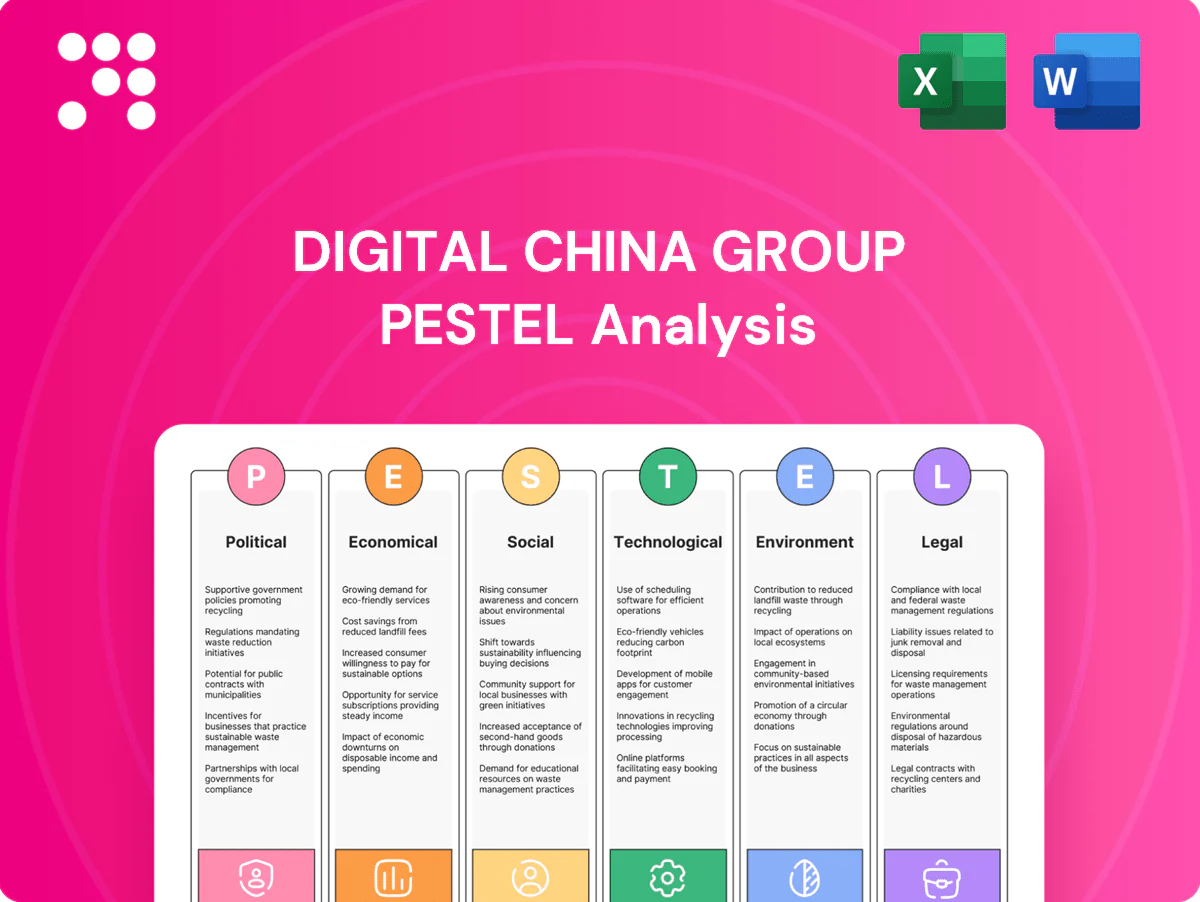
Digital China Group PESTLE Analysis

Your Shortcut to Market Insight Starts Here
Discover how political, economic, social, technological, legal and environmental forces shape Digital China Group's strategy and risk profile. Our PESTLE highlights regulatory risks, tech opportunities and market trends. Ideal for investors and strategists. Buy the full analysis for actionable, downloadable insights.
Political factors

State-led digitalization and procurement
China’s prioritization of e-government and digital infrastructure drives demand for cloud, big data and systems integration as public-sector projects scale (over 1.07 billion internet users by mid-2024). Winning tenders requires alignment with policy goals and security accreditations such as MLPS, while preferential procurement for indigenous-innovation firms benefits local vendors; shifting budgets and policy adjustments can delay or reroute timelines.
Cyber sovereignty and data localization
China's Data Security Law and PIPL (both 2021) and subsequent sector rules emphasize local data processing and control, driving mandates for onshore storage and certified facilities in government and regulated projects. The domestic cloud market, which grew roughly 28–30% in 2023, and these mandates raise barriers to foreign competitors and increase compliance workloads for integrators. Digital China can tailor sovereign-cloud offerings to capture a larger share of mandated public-sector and regulated contracts.

US–China tech decoupling pressures
US export controls since October 2022 on advanced chips and certain enterprise technologies force redesigns and alternative sourcing, with China representing roughly 35% of global semiconductor demand in 2023. Clients increasingly demand secure, controllable stacks and shift toward domestic ecosystems, prompting vendor qualification requirements for local hardware and software. Supply assurance now distinguishes vendors in public and critical sectors.

Digital economy industrial plans
China's 14th Five-Year Plan (2021–2025) and provincial digital economy programs prioritize cloud migration, industrial internet, and AI pilot zones, creating subsidized channels for vendors.
Accessing these funds can speed client adoption and lower total cost of ownership; participation requires ecosystem partnerships and standards compliance; regional disparities force localized go-to-market strategies to capture grants.
- Policy: 14th Five-Year Plan focus
- Benefit: faster adoption, lower TCO
- Reqs: partnerships, standards, local GTM
Geopolitical and local government risk
Cross-border sanctions and export controls since 2022 have constrained imports of advanced semiconductors and components, causing delivery delays and higher sourcing costs for IT integrators. Local government financing stress—China issued RMB 3.96 trillion in special local government bonds in 2023—can slow payments and project approvals. Prioritizing fiscally stronger provinces reduces receivables risk; milestone billing mitigates cash-flow shocks.
- Cross-border exposure: export controls since 2022 → import delays
- Sanctions risk: higher component costs, supply-chain disruption
- Local govt stress: RMB 3.96 trillion special bonds (2023) → payment/project delays
- Mitigation: prioritize fiscally strong provinces; milestone billing
Policy-driven cloud surge: onshore data, MLPS security and fiscally strong provinces prioritized
Policy priority on e‑government and AI boosts public cloud, big‑data and integration demand (1.07B internet users mid‑2024); winning contracts needs MLPS/security accreditations and local‑innovation preference.
Data Security Law and PIPL force onshore processing and certified sovereign‑clouds; domestic cloud grew ~29% in 2023, raising compliance costs.
US export controls and 2023 semiconductor share (~35% global demand) plus RMB 3.96T local bonds strain supply and payments; prioritize fiscally strong provinces.
| Indicator | Value |
|---|---|
| Internet users (mid‑2024) | 1.07B |
| Domestic cloud growth (2023) | ~29% |
| China share of global semiconductor demand (2023) | ~35% |
| Local govt special bonds (2023) | RMB 3.96T |
What is included in the product
 Detailed Word Document
Explores how political, economic, social, technological, environmental, and legal forces uniquely shape Digital China Group’s strategic risks and opportunities, with each section supported by current data and regional industry trends. Designed for executives and investors, the analysis offers actionable, forward-looking insights and detailed sub-points ready for business plans, decks, or scenario planning.

 Customizable Excel Spreadsheet
A concise, visually segmented PESTLE summary for Digital China Group that can be dropped into presentations, edited with region- or business-specific notes, and easily shared to speed alignment and support external risk discussions during planning sessions.
Economic factors

Macro growth and IT spend cycles
Slower GDP growth (China 2024 GDP +5.2% official) is pressuring discretionary IT budgets, yet efficiency-focused digital transformation projects remain resilient as firms prioritize cost automation. Counter-cyclical stimulus and manufacturing/infrastructure digitalization provide offsetting demand. Public sector IT spend is relatively stable, and a diversified sector mix limits overall cyclical volatility.
RMB volatility and import costs
RMB volatility drives imported hardware and software pricing, squeezing margins when onshore yuan weakens against the dollar; FX swings hit multi-year highs in 2023–24, raising procurement costs for Digital China’s supply chain.
Passing costs to clients is hard under fixed-bid contracts, forcing margin compression unless contracts include explicit FX escalation clauses.
Active FX hedging and multi-sourcing suppliers have cut realized margin volatility; expanding domestic substitution—using local servers and software—further insulates exposure.

SOE and finance vertical demand
SOEs and financial institutions in China maintain steady spend on security, compliance, and IT modernization, driving predictable demand for Digital China Group's offerings.
Long sales cycles—often over a year—require strong account coverage, local certifications, and relationship management to secure deals.
High switching costs from legacy integrations favor incumbents, while value-added services and managed operations expand wallet share through recurring revenue.

SME digital adoption and pricing
SMEs account for roughly 98% of Chinese enterprises and contribute about 60% of GDP; by 2024 over 50% had adopted cloud/SaaS, expanding Digital China Group’s addressable market. High price sensitivity pushes standardized bundles and marketplace distribution to scale sales. Financing and pay-as-you-go models materially improve conversion rates, while channel partners extend reach into lower-tier cities.
- SME share: 98% of firms, ~60% GDP
- Cloud/SaaS adoption: >50% by 2024
- Sales levers: standardized bundles, marketplace
- Conversion: financing/pay-as-you-go
- Distribution: channel partners into lower-tier cities
Product distribution margin pressure
Hardware distribution in China faces commoditization with low single-digit gross margins for devices, so Digital China boosts profitability by bundling higher-margin services and lifecycle management, where service gross margins commonly run 20–40% (2023–24 industry norms). Inventory turns of about 6–8x and vendor rebates (often 1–5% of revenue) are critical to return on capital; data-driven demand planning can cut working capital needs by ~10–15%.
- commodity_margin: low single-digits
- service_margin: 20–40%
- inventory_turns: 6–8x
- vendor_rebates: 1–5% rev
- working_capital_savings: ~10–15%
Policy-driven cloud surge: onshore data, MLPS security and fiscally strong provinces prioritized
China GDP growth 2024 +5.2% tightens discretionary IT spend but automation-led DX stays resilient. RMB volatility in 2023–24 raised import costs; active hedging and domestic substitution cut realized FX impact. SME cloud adoption >50% by 2024 expands TAM; hardware margins low single-digits while service margins run 20–40%.
| Metric | Value |
|---|---|
| GDP growth (2024) | +5.2% |
| SME share | 98% firms; ~60% GDP |
| Cloud/SaaS adoption (2024) | >50% |
| Service margin | 20–40% |
| Hardware margin | Low single-digits |
| Inventory turns | 6–8x |
Full Version Awaits
Digital China Group PESTLE Analysis
The preview shown here is the exact Digital China Group PESTLE Analysis you’ll receive after purchase—fully formatted and ready to use. It presents complete political, economic, social, technological, legal and environmental insights with structured findings and actionable implications. No placeholders or surprises; download the final file immediately after payment.

Your Shortcut to Market Insight Starts Here
Discover how political, economic, social, technological, legal and environmental forces shape Digital China Group's strategy and risk profile. Our PESTLE highlights regulatory risks, tech opportunities and market trends. Ideal for investors and strategists. Buy the full analysis for actionable, downloadable insights.
Political factors
State-led digitalization and procurement
China’s prioritization of e-government and digital infrastructure drives demand for cloud, big data and systems integration as public-sector projects scale (over 1.07 billion internet users by mid-2024). Winning tenders requires alignment with policy goals and security accreditations such as MLPS, while preferential procurement for indigenous-innovation firms benefits local vendors; shifting budgets and policy adjustments can delay or reroute timelines.
Cyber sovereignty and data localization
China's Data Security Law and PIPL (both 2021) and subsequent sector rules emphasize local data processing and control, driving mandates for onshore storage and certified facilities in government and regulated projects. The domestic cloud market, which grew roughly 28–30% in 2023, and these mandates raise barriers to foreign competitors and increase compliance workloads for integrators. Digital China can tailor sovereign-cloud offerings to capture a larger share of mandated public-sector and regulated contracts.
US–China tech decoupling pressures
US export controls since October 2022 on advanced chips and certain enterprise technologies force redesigns and alternative sourcing, with China representing roughly 35% of global semiconductor demand in 2023. Clients increasingly demand secure, controllable stacks and shift toward domestic ecosystems, prompting vendor qualification requirements for local hardware and software. Supply assurance now distinguishes vendors in public and critical sectors.
Digital economy industrial plans
China's 14th Five-Year Plan (2021–2025) and provincial digital economy programs prioritize cloud migration, industrial internet, and AI pilot zones, creating subsidized channels for vendors.
Accessing these funds can speed client adoption and lower total cost of ownership; participation requires ecosystem partnerships and standards compliance; regional disparities force localized go-to-market strategies to capture grants.
- Policy: 14th Five-Year Plan focus
- Benefit: faster adoption, lower TCO
- Reqs: partnerships, standards, local GTM
Geopolitical and local government risk
Cross-border sanctions and export controls since 2022 have constrained imports of advanced semiconductors and components, causing delivery delays and higher sourcing costs for IT integrators. Local government financing stress—China issued RMB 3.96 trillion in special local government bonds in 2023—can slow payments and project approvals. Prioritizing fiscally stronger provinces reduces receivables risk; milestone billing mitigates cash-flow shocks.
- Cross-border exposure: export controls since 2022 → import delays
- Sanctions risk: higher component costs, supply-chain disruption
- Local govt stress: RMB 3.96 trillion special bonds (2023) → payment/project delays
- Mitigation: prioritize fiscally strong provinces; milestone billing
Policy-driven cloud surge: onshore data, MLPS security and fiscally strong provinces prioritized
Policy priority on e‑government and AI boosts public cloud, big‑data and integration demand (1.07B internet users mid‑2024); winning contracts needs MLPS/security accreditations and local‑innovation preference.
Data Security Law and PIPL force onshore processing and certified sovereign‑clouds; domestic cloud grew ~29% in 2023, raising compliance costs.
US export controls and 2023 semiconductor share (~35% global demand) plus RMB 3.96T local bonds strain supply and payments; prioritize fiscally strong provinces.
| Indicator | Value |
|---|---|
| Internet users (mid‑2024) | 1.07B |
| Domestic cloud growth (2023) | ~29% |
| China share of global semiconductor demand (2023) | ~35% |
| Local govt special bonds (2023) | RMB 3.96T |
What is included in the product
Detailed Word Document
Explores how political, economic, social, technological, environmental, and legal forces uniquely shape Digital China Group’s strategic risks and opportunities, with each section supported by current data and regional industry trends. Designed for executives and investors, the analysis offers actionable, forward-looking insights and detailed sub-points ready for business plans, decks, or scenario planning.
Customizable Excel Spreadsheet
A concise, visually segmented PESTLE summary for Digital China Group that can be dropped into presentations, edited with region- or business-specific notes, and easily shared to speed alignment and support external risk discussions during planning sessions.
Economic factors
Macro growth and IT spend cycles
Slower GDP growth (China 2024 GDP +5.2% official) is pressuring discretionary IT budgets, yet efficiency-focused digital transformation projects remain resilient as firms prioritize cost automation. Counter-cyclical stimulus and manufacturing/infrastructure digitalization provide offsetting demand. Public sector IT spend is relatively stable, and a diversified sector mix limits overall cyclical volatility.
RMB volatility and import costs
RMB volatility drives imported hardware and software pricing, squeezing margins when onshore yuan weakens against the dollar; FX swings hit multi-year highs in 2023–24, raising procurement costs for Digital China’s supply chain.
Passing costs to clients is hard under fixed-bid contracts, forcing margin compression unless contracts include explicit FX escalation clauses.
Active FX hedging and multi-sourcing suppliers have cut realized margin volatility; expanding domestic substitution—using local servers and software—further insulates exposure.
SOE and finance vertical demand
SOEs and financial institutions in China maintain steady spend on security, compliance, and IT modernization, driving predictable demand for Digital China Group's offerings.
Long sales cycles—often over a year—require strong account coverage, local certifications, and relationship management to secure deals.
High switching costs from legacy integrations favor incumbents, while value-added services and managed operations expand wallet share through recurring revenue.
SME digital adoption and pricing
SMEs account for roughly 98% of Chinese enterprises and contribute about 60% of GDP; by 2024 over 50% had adopted cloud/SaaS, expanding Digital China Group’s addressable market. High price sensitivity pushes standardized bundles and marketplace distribution to scale sales. Financing and pay-as-you-go models materially improve conversion rates, while channel partners extend reach into lower-tier cities.
- SME share: 98% of firms, ~60% GDP
- Cloud/SaaS adoption: >50% by 2024
- Sales levers: standardized bundles, marketplace
- Conversion: financing/pay-as-you-go
- Distribution: channel partners into lower-tier cities
Product distribution margin pressure
Hardware distribution in China faces commoditization with low single-digit gross margins for devices, so Digital China boosts profitability by bundling higher-margin services and lifecycle management, where service gross margins commonly run 20–40% (2023–24 industry norms). Inventory turns of about 6–8x and vendor rebates (often 1–5% of revenue) are critical to return on capital; data-driven demand planning can cut working capital needs by ~10–15%.
- commodity_margin: low single-digits
- service_margin: 20–40%
- inventory_turns: 6–8x
- vendor_rebates: 1–5% rev
- working_capital_savings: ~10–15%
Policy-driven cloud surge: onshore data, MLPS security and fiscally strong provinces prioritized
China GDP growth 2024 +5.2% tightens discretionary IT spend but automation-led DX stays resilient. RMB volatility in 2023–24 raised import costs; active hedging and domestic substitution cut realized FX impact. SME cloud adoption >50% by 2024 expands TAM; hardware margins low single-digits while service margins run 20–40%.
| Metric | Value |
|---|---|
| GDP growth (2024) | +5.2% |
| SME share | 98% firms; ~60% GDP |
| Cloud/SaaS adoption (2024) | >50% |
| Service margin | 20–40% |
| Hardware margin | Low single-digits |
| Inventory turns | 6–8x |
Full Version Awaits
Digital China Group PESTLE Analysis
The preview shown here is the exact Digital China Group PESTLE Analysis you’ll receive after purchase—fully formatted and ready to use. It presents complete political, economic, social, technological, legal and environmental insights with structured findings and actionable implications. No placeholders or surprises; download the final file immediately after payment.
Description
Your Shortcut to Market Insight Starts Here
Discover how political, economic, social, technological, legal and environmental forces shape Digital China Group's strategy and risk profile. Our PESTLE highlights regulatory risks, tech opportunities and market trends. Ideal for investors and strategists. Buy the full analysis for actionable, downloadable insights.
Political factors
State-led digitalization and procurement
China’s prioritization of e-government and digital infrastructure drives demand for cloud, big data and systems integration as public-sector projects scale (over 1.07 billion internet users by mid-2024). Winning tenders requires alignment with policy goals and security accreditations such as MLPS, while preferential procurement for indigenous-innovation firms benefits local vendors; shifting budgets and policy adjustments can delay or reroute timelines.
Cyber sovereignty and data localization
China's Data Security Law and PIPL (both 2021) and subsequent sector rules emphasize local data processing and control, driving mandates for onshore storage and certified facilities in government and regulated projects. The domestic cloud market, which grew roughly 28–30% in 2023, and these mandates raise barriers to foreign competitors and increase compliance workloads for integrators. Digital China can tailor sovereign-cloud offerings to capture a larger share of mandated public-sector and regulated contracts.
US–China tech decoupling pressures
US export controls since October 2022 on advanced chips and certain enterprise technologies force redesigns and alternative sourcing, with China representing roughly 35% of global semiconductor demand in 2023. Clients increasingly demand secure, controllable stacks and shift toward domestic ecosystems, prompting vendor qualification requirements for local hardware and software. Supply assurance now distinguishes vendors in public and critical sectors.
Digital economy industrial plans
China's 14th Five-Year Plan (2021–2025) and provincial digital economy programs prioritize cloud migration, industrial internet, and AI pilot zones, creating subsidized channels for vendors.
Accessing these funds can speed client adoption and lower total cost of ownership; participation requires ecosystem partnerships and standards compliance; regional disparities force localized go-to-market strategies to capture grants.
- Policy: 14th Five-Year Plan focus
- Benefit: faster adoption, lower TCO
- Reqs: partnerships, standards, local GTM
Geopolitical and local government risk
Cross-border sanctions and export controls since 2022 have constrained imports of advanced semiconductors and components, causing delivery delays and higher sourcing costs for IT integrators. Local government financing stress—China issued RMB 3.96 trillion in special local government bonds in 2023—can slow payments and project approvals. Prioritizing fiscally stronger provinces reduces receivables risk; milestone billing mitigates cash-flow shocks.
- Cross-border exposure: export controls since 2022 → import delays
- Sanctions risk: higher component costs, supply-chain disruption
- Local govt stress: RMB 3.96 trillion special bonds (2023) → payment/project delays
- Mitigation: prioritize fiscally strong provinces; milestone billing
Policy-driven cloud surge: onshore data, MLPS security and fiscally strong provinces prioritized
Policy priority on e‑government and AI boosts public cloud, big‑data and integration demand (1.07B internet users mid‑2024); winning contracts needs MLPS/security accreditations and local‑innovation preference.
Data Security Law and PIPL force onshore processing and certified sovereign‑clouds; domestic cloud grew ~29% in 2023, raising compliance costs.
US export controls and 2023 semiconductor share (~35% global demand) plus RMB 3.96T local bonds strain supply and payments; prioritize fiscally strong provinces.
| Indicator | Value |
|---|---|
| Internet users (mid‑2024) | 1.07B |
| Domestic cloud growth (2023) | ~29% |
| China share of global semiconductor demand (2023) | ~35% |
| Local govt special bonds (2023) | RMB 3.96T |
What is included in the product
Detailed Word Document
Explores how political, economic, social, technological, environmental, and legal forces uniquely shape Digital China Group’s strategic risks and opportunities, with each section supported by current data and regional industry trends. Designed for executives and investors, the analysis offers actionable, forward-looking insights and detailed sub-points ready for business plans, decks, or scenario planning.
Customizable Excel Spreadsheet
A concise, visually segmented PESTLE summary for Digital China Group that can be dropped into presentations, edited with region- or business-specific notes, and easily shared to speed alignment and support external risk discussions during planning sessions.
Economic factors
Macro growth and IT spend cycles
Slower GDP growth (China 2024 GDP +5.2% official) is pressuring discretionary IT budgets, yet efficiency-focused digital transformation projects remain resilient as firms prioritize cost automation. Counter-cyclical stimulus and manufacturing/infrastructure digitalization provide offsetting demand. Public sector IT spend is relatively stable, and a diversified sector mix limits overall cyclical volatility.
RMB volatility and import costs
RMB volatility drives imported hardware and software pricing, squeezing margins when onshore yuan weakens against the dollar; FX swings hit multi-year highs in 2023–24, raising procurement costs for Digital China’s supply chain.
Passing costs to clients is hard under fixed-bid contracts, forcing margin compression unless contracts include explicit FX escalation clauses.
Active FX hedging and multi-sourcing suppliers have cut realized margin volatility; expanding domestic substitution—using local servers and software—further insulates exposure.
SOE and finance vertical demand
SOEs and financial institutions in China maintain steady spend on security, compliance, and IT modernization, driving predictable demand for Digital China Group's offerings.
Long sales cycles—often over a year—require strong account coverage, local certifications, and relationship management to secure deals.
High switching costs from legacy integrations favor incumbents, while value-added services and managed operations expand wallet share through recurring revenue.
SME digital adoption and pricing
SMEs account for roughly 98% of Chinese enterprises and contribute about 60% of GDP; by 2024 over 50% had adopted cloud/SaaS, expanding Digital China Group’s addressable market. High price sensitivity pushes standardized bundles and marketplace distribution to scale sales. Financing and pay-as-you-go models materially improve conversion rates, while channel partners extend reach into lower-tier cities.
- SME share: 98% of firms, ~60% GDP
- Cloud/SaaS adoption: >50% by 2024
- Sales levers: standardized bundles, marketplace
- Conversion: financing/pay-as-you-go
- Distribution: channel partners into lower-tier cities
Product distribution margin pressure
Hardware distribution in China faces commoditization with low single-digit gross margins for devices, so Digital China boosts profitability by bundling higher-margin services and lifecycle management, where service gross margins commonly run 20–40% (2023–24 industry norms). Inventory turns of about 6–8x and vendor rebates (often 1–5% of revenue) are critical to return on capital; data-driven demand planning can cut working capital needs by ~10–15%.
- commodity_margin: low single-digits
- service_margin: 20–40%
- inventory_turns: 6–8x
- vendor_rebates: 1–5% rev
- working_capital_savings: ~10–15%
Policy-driven cloud surge: onshore data, MLPS security and fiscally strong provinces prioritized
China GDP growth 2024 +5.2% tightens discretionary IT spend but automation-led DX stays resilient. RMB volatility in 2023–24 raised import costs; active hedging and domestic substitution cut realized FX impact. SME cloud adoption >50% by 2024 expands TAM; hardware margins low single-digits while service margins run 20–40%.
| Metric | Value |
|---|---|
| GDP growth (2024) | +5.2% |
| SME share | 98% firms; ~60% GDP |
| Cloud/SaaS adoption (2024) | >50% |
| Service margin | 20–40% |
| Hardware margin | Low single-digits |
| Inventory turns | 6–8x |
Full Version Awaits
Digital China Group PESTLE Analysis
The preview shown here is the exact Digital China Group PESTLE Analysis you’ll receive after purchase—fully formatted and ready to use. It presents complete political, economic, social, technological, legal and environmental insights with structured findings and actionable implications. No placeholders or surprises; download the final file immediately after payment.











