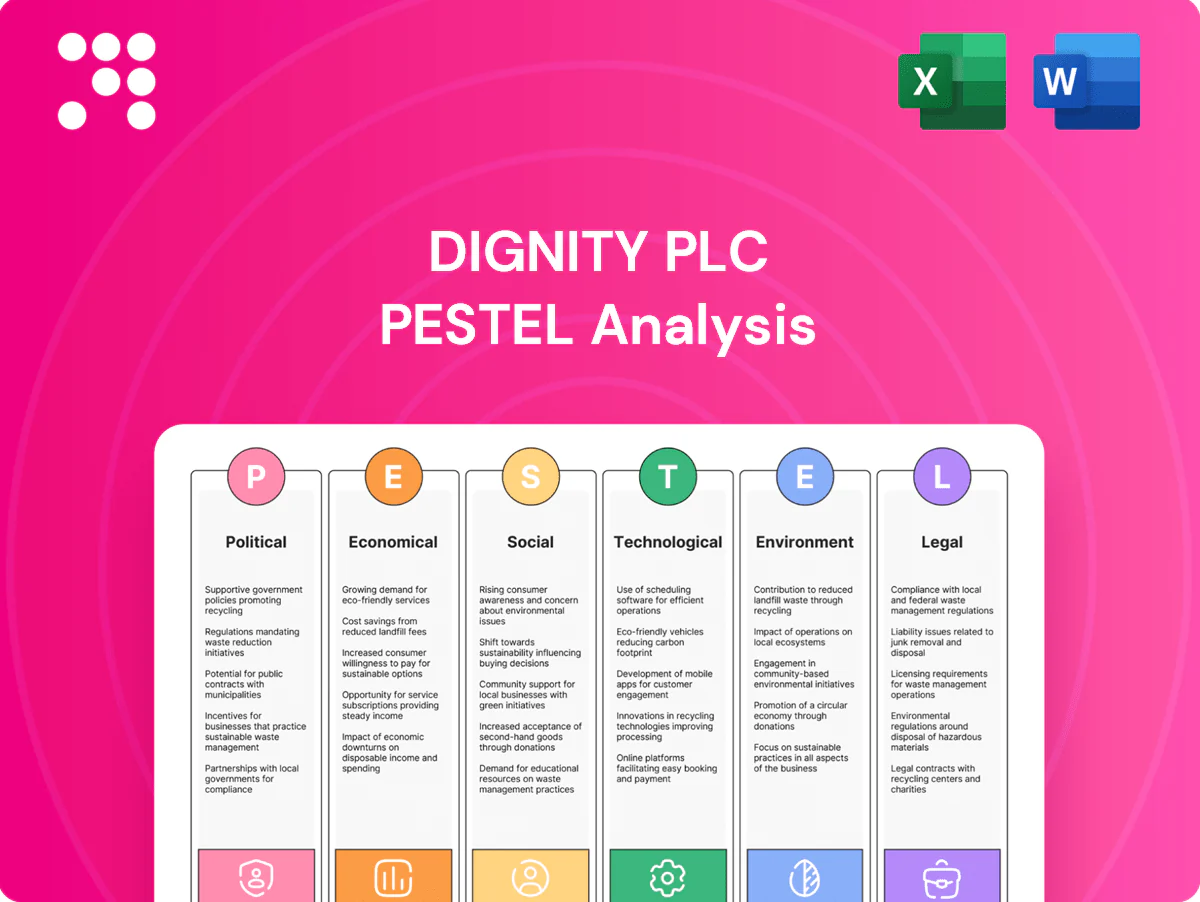
Dignity PLC PESTLE Analysis

Plan Smarter. Present Sharper. Compete Stronger.
Understand how political, economic, social, technological, legal and environmental forces are reshaping Dignity PLC’s prospects and risks in an uncertain market. This concise PESTLE snapshot highlights the trends that matter to investors and strategists. Purchase the full, editable PESTLE analysis for detailed insights, forecasts and actionable recommendations—available for immediate download.
Political factors

Government oversight of funeral markets
CMA market investigation and ongoing UK policy scrutiny continue to pressure the £2.5bn funeral sector, with regulators pushing price transparency and fair consumer outcomes. Political momentum favors stronger remedies and possible new interventions that could affect Dignity’s c.£360m annual revenue and market positioning. Dignity must adapt operationally and engage proactively with policymakers and industry bodies to influence implementation and compliance.
Local authority planning and licensing
Planning permissions for new crematoria and funeral homes are decided by local councils, with standard statutory determination periods of 8 weeks for minor and 13 weeks for major applications in England. Council priorities, community sentiment and local land‑use policies materially affect approvals and timelines, especially given c.600,000 UK deaths per year and pressure on facilities. Political turnover at council level can quickly change development stance. Strong stakeholder consultation statistically lowers refusal and appeal risk.

Public health policy and crisis response
Public health policy and crisis response shape death-management logistics for Dignity PLC (LSE: DIGN), as national and local pandemic/flu preparedness drives changes in routing, storage and capacity. Government directives can rapidly alter operating procedures, capacity allocation and cost bases, while emergency procurement or prioritization may trigger short-term volume spikes as occurred in COVID-19. Resilience planning remains politically salient and influences regulatory scrutiny and funding priorities.

Devolution and regional policy divergence
Devolution creates regulatory nuance across England (56.5m), Scotland (5.5m), Wales (3.1m) and Northern Ireland (1.9m), affecting fees, environmental rules and public service coordination for Dignity. Variations in burial/cremation regulations and waste/environmental standards force region-specific compliance and lobbying. Regional grants or restrictions, including the UK Levelling Up Fund (£4.8bn+), influence local investment choices.
- Regulatory divergence: regional licensing, fee caps
- Compliance: differing environmental/health rules
- Lobbying: devolved parliaments require tailored approaches
- Investment: affected by regional grants/restrictions
Energy and carbon policy direction
UK and devolved net-zero commitments (2050) are driving tighter cremation emissions standards and monitoring; stronger rules raise compliance capex but reduce transition risk as regulators tighten air permits. Carbon pricing around £60/tonne in 2024 and energy price volatility materially affect Dignity PLC operating margins and fuel-led OPEX. Policy grants for greener fleets and facility upgrades can offset part of capex.
- net-zero 2050
- carbon price ~£60/t (2024)
- higher cremation emissions standards
- fleet/facility grants reduce capex
Regulatory probe in £2.5bn funerals market may cut ~£360m revenue
Dignity faces regulatory pressure after CMA probe in a £2.5bn market; price-transparency remedies could hit its ~£360m revenue. Local planning and devolution affect crematoria supply amid ~600,000 UK deaths/yr and variable council approvals. Net-zero policy (2050) and ~£60/t carbon price (2024) raise compliance capex but open grant funding.
| Metric | Value |
|---|---|
| Market size | £2.5bn |
| Dignity revenue | ~£360m |
| UK deaths/yr | ~600,000 |
| Carbon price (2024) | ~£60/t |
What is included in the product
 Detailed Word Document
Explores how external macro-environmental factors uniquely affect Dignity PLC across Political, Economic, Social, Technological, Environmental and Legal dimensions, with data-backed insights and forward-looking implications; designed to help executives, consultants and investors identify risks and opportunities aligned to the UK funerals and crematoria market and regulatory landscape.

 Customizable Excel Spreadsheet
Visually segmented by PESTLE categories for Dignity PLC, allowing quick interpretation at a glance and easy insertion into presentations or planning sessions to streamline risk discussions and decision-making.
Economic factors

Inflation and cost pressures
Rising wages, property costs and energy prices are squeezing Dignity PLC margins as operational cost base grows across funeral homes and crematoria.
Crematoria are energy-intensive, making utility price volatility a key sensitivity for operating margins and cash flow.
Pricing power is moderated by CMA-imposed remedies and strong local competition, so productivity gains and disciplined procurement are critical to protect profitability.
Interest rates and plan asset returns
Pre-paid funeral plans depend on trust investment performance; higher market yields in 2024 (UK 10-year gilt around 3.7% on average) improved asset returns but also raised discount rates used to value plan liabilities, tightening funded positions. Market volatility in 2023–24 produced valuation mismatches between growth assets and fixed liabilities. Active asset-liability management remains a core economic lever for Dignity PLC.

Consumer incomes and affordability
Rising cost-of-living pressures have pushed more UK consumers toward lower-cost options such as direct cremation, with ONS inflation averaging 3.2% in 2024 and persistent household budget strain. Funerals remain non-discretionary but spend per service is price-elastic, so Dignity’s transparent packages and financing options improve conversion. A clear value-tier strategy preserves market share across income segments.

Demographic trends and mortality
The UK recorded roughly 600,000 deaths annually pre-2024 and ONS projects the 65+ population to rise to about 23% by 2043, supporting long-run volumes for Dignity PLC while short-term mortality still fluctuates.
Seasonal winter peaks and past epidemics (notably COVID-19) create operational variability requiring flexible capacity and staffing.
Geographic population shifts force network optimization and pre-need sales, which tend to rise with demographic awareness and aging penetration.
- 600,000 annual deaths (approx)
- 65+ → ~23% by 2043 (ONS projection)
- Winter/epidemic spikes drive short-term variability
- Pre-need sales track demographic awareness
Competitive dynamics and consolidation
Independent funeral directors and low-cost entrants intensify price competition in a UK funeral market serving around 600,000 deaths annually and valued at roughly £2bn, pressuring margins. M&A delivers scale efficiencies and network density, lowering per-funeral costs and expanding geographic reach. Economic cycles shift seller valuations and create selective integration opportunities, while strong brand and service differentiation allow sustained premium pricing.
- Competition: independent, low-cost entrants
- Market: ~600,000 deaths/yr; ≈£2bn
- M&A: scale & network density
- Cycles: affect valuations & integration
- Pricing: sustained by brand/service
Regulatory probe in £2.5bn funerals market may cut ~£360m revenue
Rising wages, property and energy costs squeeze margins across funeral homes and crematoria; utility-price volatility is a key sensitivity.
Pre-paid plan funding improved as UK 10y gilt averaged ~3.7% in 2024 but higher discount rates tightened reserves; CMA remedies and strong local competition limit pricing power.
Market ~600,000 deaths/yr, ≈£2bn value, 65+ → ~23% by 2043 supports volumes while ONS 2024 inflation (3.2%) shifts demand to lower-cost options.
| Metric | Value |
|---|---|
| Annual deaths | ~600,000 |
| Market size | ≈£2bn |
| UK 10y gilt (2024 avg) | ~3.7% |
| Inflation (2024 avg) | 3.2% |
| 65+ population (2043) | ~23% |
Full Version Awaits
Dignity PLC PESTLE Analysis
The Dignity PLC PESTLE Analysis preview shown here is the exact document you’ll receive after purchase—fully formatted, professionally structured and ready to use. No placeholders or teasers; the content, layout and structure visible now are what you’ll download immediately after checkout.

Plan Smarter. Present Sharper. Compete Stronger.
Understand how political, economic, social, technological, legal and environmental forces are reshaping Dignity PLC’s prospects and risks in an uncertain market. This concise PESTLE snapshot highlights the trends that matter to investors and strategists. Purchase the full, editable PESTLE analysis for detailed insights, forecasts and actionable recommendations—available for immediate download.
Political factors
Government oversight of funeral markets
CMA market investigation and ongoing UK policy scrutiny continue to pressure the £2.5bn funeral sector, with regulators pushing price transparency and fair consumer outcomes. Political momentum favors stronger remedies and possible new interventions that could affect Dignity’s c.£360m annual revenue and market positioning. Dignity must adapt operationally and engage proactively with policymakers and industry bodies to influence implementation and compliance.
Local authority planning and licensing
Planning permissions for new crematoria and funeral homes are decided by local councils, with standard statutory determination periods of 8 weeks for minor and 13 weeks for major applications in England. Council priorities, community sentiment and local land‑use policies materially affect approvals and timelines, especially given c.600,000 UK deaths per year and pressure on facilities. Political turnover at council level can quickly change development stance. Strong stakeholder consultation statistically lowers refusal and appeal risk.
Public health policy and crisis response
Public health policy and crisis response shape death-management logistics for Dignity PLC (LSE: DIGN), as national and local pandemic/flu preparedness drives changes in routing, storage and capacity. Government directives can rapidly alter operating procedures, capacity allocation and cost bases, while emergency procurement or prioritization may trigger short-term volume spikes as occurred in COVID-19. Resilience planning remains politically salient and influences regulatory scrutiny and funding priorities.
Devolution and regional policy divergence
Devolution creates regulatory nuance across England (56.5m), Scotland (5.5m), Wales (3.1m) and Northern Ireland (1.9m), affecting fees, environmental rules and public service coordination for Dignity. Variations in burial/cremation regulations and waste/environmental standards force region-specific compliance and lobbying. Regional grants or restrictions, including the UK Levelling Up Fund (£4.8bn+), influence local investment choices.
- Regulatory divergence: regional licensing, fee caps
- Compliance: differing environmental/health rules
- Lobbying: devolved parliaments require tailored approaches
- Investment: affected by regional grants/restrictions
Energy and carbon policy direction
UK and devolved net-zero commitments (2050) are driving tighter cremation emissions standards and monitoring; stronger rules raise compliance capex but reduce transition risk as regulators tighten air permits. Carbon pricing around £60/tonne in 2024 and energy price volatility materially affect Dignity PLC operating margins and fuel-led OPEX. Policy grants for greener fleets and facility upgrades can offset part of capex.
- net-zero 2050
- carbon price ~£60/t (2024)
- higher cremation emissions standards
- fleet/facility grants reduce capex
Regulatory probe in £2.5bn funerals market may cut ~£360m revenue
Dignity faces regulatory pressure after CMA probe in a £2.5bn market; price-transparency remedies could hit its ~£360m revenue. Local planning and devolution affect crematoria supply amid ~600,000 UK deaths/yr and variable council approvals. Net-zero policy (2050) and ~£60/t carbon price (2024) raise compliance capex but open grant funding.
| Metric | Value |
|---|---|
| Market size | £2.5bn |
| Dignity revenue | ~£360m |
| UK deaths/yr | ~600,000 |
| Carbon price (2024) | ~£60/t |
What is included in the product
Detailed Word Document
Explores how external macro-environmental factors uniquely affect Dignity PLC across Political, Economic, Social, Technological, Environmental and Legal dimensions, with data-backed insights and forward-looking implications; designed to help executives, consultants and investors identify risks and opportunities aligned to the UK funerals and crematoria market and regulatory landscape.
Customizable Excel Spreadsheet
Visually segmented by PESTLE categories for Dignity PLC, allowing quick interpretation at a glance and easy insertion into presentations or planning sessions to streamline risk discussions and decision-making.
Economic factors
Inflation and cost pressures
Rising wages, property costs and energy prices are squeezing Dignity PLC margins as operational cost base grows across funeral homes and crematoria.
Crematoria are energy-intensive, making utility price volatility a key sensitivity for operating margins and cash flow.
Pricing power is moderated by CMA-imposed remedies and strong local competition, so productivity gains and disciplined procurement are critical to protect profitability.
Interest rates and plan asset returns
Pre-paid funeral plans depend on trust investment performance; higher market yields in 2024 (UK 10-year gilt around 3.7% on average) improved asset returns but also raised discount rates used to value plan liabilities, tightening funded positions. Market volatility in 2023–24 produced valuation mismatches between growth assets and fixed liabilities. Active asset-liability management remains a core economic lever for Dignity PLC.
Consumer incomes and affordability
Rising cost-of-living pressures have pushed more UK consumers toward lower-cost options such as direct cremation, with ONS inflation averaging 3.2% in 2024 and persistent household budget strain. Funerals remain non-discretionary but spend per service is price-elastic, so Dignity’s transparent packages and financing options improve conversion. A clear value-tier strategy preserves market share across income segments.
Demographic trends and mortality
The UK recorded roughly 600,000 deaths annually pre-2024 and ONS projects the 65+ population to rise to about 23% by 2043, supporting long-run volumes for Dignity PLC while short-term mortality still fluctuates.
Seasonal winter peaks and past epidemics (notably COVID-19) create operational variability requiring flexible capacity and staffing.
Geographic population shifts force network optimization and pre-need sales, which tend to rise with demographic awareness and aging penetration.
- 600,000 annual deaths (approx)
- 65+ → ~23% by 2043 (ONS projection)
- Winter/epidemic spikes drive short-term variability
- Pre-need sales track demographic awareness
Competitive dynamics and consolidation
Independent funeral directors and low-cost entrants intensify price competition in a UK funeral market serving around 600,000 deaths annually and valued at roughly £2bn, pressuring margins. M&A delivers scale efficiencies and network density, lowering per-funeral costs and expanding geographic reach. Economic cycles shift seller valuations and create selective integration opportunities, while strong brand and service differentiation allow sustained premium pricing.
- Competition: independent, low-cost entrants
- Market: ~600,000 deaths/yr; ≈£2bn
- M&A: scale & network density
- Cycles: affect valuations & integration
- Pricing: sustained by brand/service
Regulatory probe in £2.5bn funerals market may cut ~£360m revenue
Rising wages, property and energy costs squeeze margins across funeral homes and crematoria; utility-price volatility is a key sensitivity.
Pre-paid plan funding improved as UK 10y gilt averaged ~3.7% in 2024 but higher discount rates tightened reserves; CMA remedies and strong local competition limit pricing power.
Market ~600,000 deaths/yr, ≈£2bn value, 65+ → ~23% by 2043 supports volumes while ONS 2024 inflation (3.2%) shifts demand to lower-cost options.
| Metric | Value |
|---|---|
| Annual deaths | ~600,000 |
| Market size | ≈£2bn |
| UK 10y gilt (2024 avg) | ~3.7% |
| Inflation (2024 avg) | 3.2% |
| 65+ population (2043) | ~23% |
Full Version Awaits
Dignity PLC PESTLE Analysis
The Dignity PLC PESTLE Analysis preview shown here is the exact document you’ll receive after purchase—fully formatted, professionally structured and ready to use. No placeholders or teasers; the content, layout and structure visible now are what you’ll download immediately after checkout.
Description
Plan Smarter. Present Sharper. Compete Stronger.
Understand how political, economic, social, technological, legal and environmental forces are reshaping Dignity PLC’s prospects and risks in an uncertain market. This concise PESTLE snapshot highlights the trends that matter to investors and strategists. Purchase the full, editable PESTLE analysis for detailed insights, forecasts and actionable recommendations—available for immediate download.
Political factors
Government oversight of funeral markets
CMA market investigation and ongoing UK policy scrutiny continue to pressure the £2.5bn funeral sector, with regulators pushing price transparency and fair consumer outcomes. Political momentum favors stronger remedies and possible new interventions that could affect Dignity’s c.£360m annual revenue and market positioning. Dignity must adapt operationally and engage proactively with policymakers and industry bodies to influence implementation and compliance.
Local authority planning and licensing
Planning permissions for new crematoria and funeral homes are decided by local councils, with standard statutory determination periods of 8 weeks for minor and 13 weeks for major applications in England. Council priorities, community sentiment and local land‑use policies materially affect approvals and timelines, especially given c.600,000 UK deaths per year and pressure on facilities. Political turnover at council level can quickly change development stance. Strong stakeholder consultation statistically lowers refusal and appeal risk.
Public health policy and crisis response
Public health policy and crisis response shape death-management logistics for Dignity PLC (LSE: DIGN), as national and local pandemic/flu preparedness drives changes in routing, storage and capacity. Government directives can rapidly alter operating procedures, capacity allocation and cost bases, while emergency procurement or prioritization may trigger short-term volume spikes as occurred in COVID-19. Resilience planning remains politically salient and influences regulatory scrutiny and funding priorities.
Devolution and regional policy divergence
Devolution creates regulatory nuance across England (56.5m), Scotland (5.5m), Wales (3.1m) and Northern Ireland (1.9m), affecting fees, environmental rules and public service coordination for Dignity. Variations in burial/cremation regulations and waste/environmental standards force region-specific compliance and lobbying. Regional grants or restrictions, including the UK Levelling Up Fund (£4.8bn+), influence local investment choices.
- Regulatory divergence: regional licensing, fee caps
- Compliance: differing environmental/health rules
- Lobbying: devolved parliaments require tailored approaches
- Investment: affected by regional grants/restrictions
Energy and carbon policy direction
UK and devolved net-zero commitments (2050) are driving tighter cremation emissions standards and monitoring; stronger rules raise compliance capex but reduce transition risk as regulators tighten air permits. Carbon pricing around £60/tonne in 2024 and energy price volatility materially affect Dignity PLC operating margins and fuel-led OPEX. Policy grants for greener fleets and facility upgrades can offset part of capex.
- net-zero 2050
- carbon price ~£60/t (2024)
- higher cremation emissions standards
- fleet/facility grants reduce capex
Regulatory probe in £2.5bn funerals market may cut ~£360m revenue
Dignity faces regulatory pressure after CMA probe in a £2.5bn market; price-transparency remedies could hit its ~£360m revenue. Local planning and devolution affect crematoria supply amid ~600,000 UK deaths/yr and variable council approvals. Net-zero policy (2050) and ~£60/t carbon price (2024) raise compliance capex but open grant funding.
| Metric | Value |
|---|---|
| Market size | £2.5bn |
| Dignity revenue | ~£360m |
| UK deaths/yr | ~600,000 |
| Carbon price (2024) | ~£60/t |
What is included in the product
Detailed Word Document
Explores how external macro-environmental factors uniquely affect Dignity PLC across Political, Economic, Social, Technological, Environmental and Legal dimensions, with data-backed insights and forward-looking implications; designed to help executives, consultants and investors identify risks and opportunities aligned to the UK funerals and crematoria market and regulatory landscape.
Customizable Excel Spreadsheet
Visually segmented by PESTLE categories for Dignity PLC, allowing quick interpretation at a glance and easy insertion into presentations or planning sessions to streamline risk discussions and decision-making.
Economic factors
Inflation and cost pressures
Rising wages, property costs and energy prices are squeezing Dignity PLC margins as operational cost base grows across funeral homes and crematoria.
Crematoria are energy-intensive, making utility price volatility a key sensitivity for operating margins and cash flow.
Pricing power is moderated by CMA-imposed remedies and strong local competition, so productivity gains and disciplined procurement are critical to protect profitability.
Interest rates and plan asset returns
Pre-paid funeral plans depend on trust investment performance; higher market yields in 2024 (UK 10-year gilt around 3.7% on average) improved asset returns but also raised discount rates used to value plan liabilities, tightening funded positions. Market volatility in 2023–24 produced valuation mismatches between growth assets and fixed liabilities. Active asset-liability management remains a core economic lever for Dignity PLC.
Consumer incomes and affordability
Rising cost-of-living pressures have pushed more UK consumers toward lower-cost options such as direct cremation, with ONS inflation averaging 3.2% in 2024 and persistent household budget strain. Funerals remain non-discretionary but spend per service is price-elastic, so Dignity’s transparent packages and financing options improve conversion. A clear value-tier strategy preserves market share across income segments.
Demographic trends and mortality
The UK recorded roughly 600,000 deaths annually pre-2024 and ONS projects the 65+ population to rise to about 23% by 2043, supporting long-run volumes for Dignity PLC while short-term mortality still fluctuates.
Seasonal winter peaks and past epidemics (notably COVID-19) create operational variability requiring flexible capacity and staffing.
Geographic population shifts force network optimization and pre-need sales, which tend to rise with demographic awareness and aging penetration.
- 600,000 annual deaths (approx)
- 65+ → ~23% by 2043 (ONS projection)
- Winter/epidemic spikes drive short-term variability
- Pre-need sales track demographic awareness
Competitive dynamics and consolidation
Independent funeral directors and low-cost entrants intensify price competition in a UK funeral market serving around 600,000 deaths annually and valued at roughly £2bn, pressuring margins. M&A delivers scale efficiencies and network density, lowering per-funeral costs and expanding geographic reach. Economic cycles shift seller valuations and create selective integration opportunities, while strong brand and service differentiation allow sustained premium pricing.
- Competition: independent, low-cost entrants
- Market: ~600,000 deaths/yr; ≈£2bn
- M&A: scale & network density
- Cycles: affect valuations & integration
- Pricing: sustained by brand/service
Regulatory probe in £2.5bn funerals market may cut ~£360m revenue
Rising wages, property and energy costs squeeze margins across funeral homes and crematoria; utility-price volatility is a key sensitivity.
Pre-paid plan funding improved as UK 10y gilt averaged ~3.7% in 2024 but higher discount rates tightened reserves; CMA remedies and strong local competition limit pricing power.
Market ~600,000 deaths/yr, ≈£2bn value, 65+ → ~23% by 2043 supports volumes while ONS 2024 inflation (3.2%) shifts demand to lower-cost options.
| Metric | Value |
|---|---|
| Annual deaths | ~600,000 |
| Market size | ≈£2bn |
| UK 10y gilt (2024 avg) | ~3.7% |
| Inflation (2024 avg) | 3.2% |
| 65+ population (2043) | ~23% |
Full Version Awaits
Dignity PLC PESTLE Analysis
The Dignity PLC PESTLE Analysis preview shown here is the exact document you’ll receive after purchase—fully formatted, professionally structured and ready to use. No placeholders or teasers; the content, layout and structure visible now are what you’ll download immediately after checkout.











