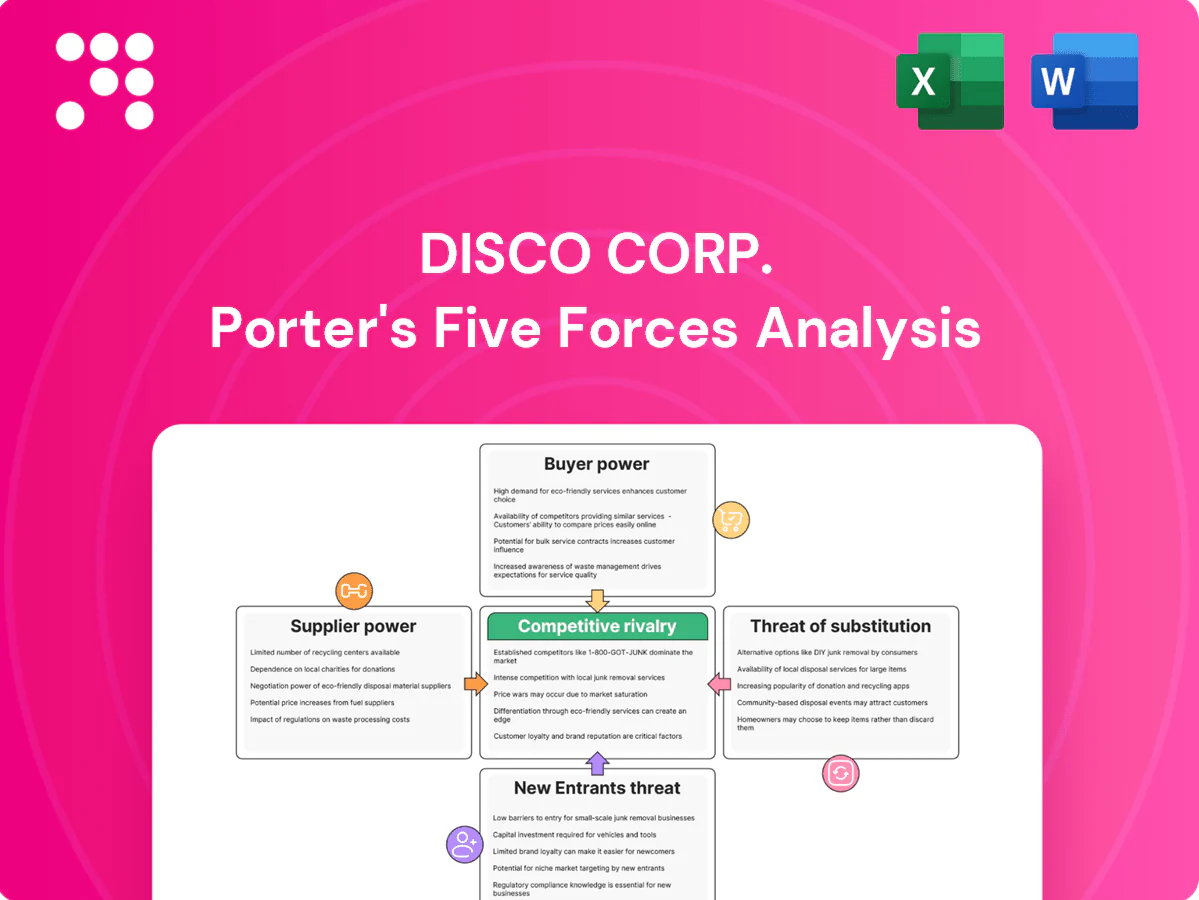
DISCO Corp. Porter's Five Forces Analysis

Elevate Your Analysis with the Complete Porter's Five Forces Analysis
DISCO Corp. operates in a high-tech, capital-intensive market where supplier specialization and regulatory barriers shape competitive dynamics, while customer concentration and emerging substitutes put pressure on pricing and innovation. This brief snapshot only scratches the surface. Unlock the full Porter's Five Forces Analysis to explore DISCO Corp.’s competitive dynamics, market pressures, and strategic advantages in detail.
Suppliers Bargaining Power

Concentration in specialty materials
DISCO relies on concentrated suppliers of industrial diamonds, CBN abrasives, specialty steels and advanced ceramics, giving vendors high leverage as these niches demand tight tolerances and certified quality. Supplier qualification cycles and strict performance specs—often taking months—limit switching, and 2024 estimates value the synthetic diamond market at about USD 18.2B, amplifying disruption risk across equipment and consumables.
Precision components and controls
Key subsystems such as high‑speed spindles, linear stages, controllers and vision systems are concentrated among a few high‑end providers, with top vendors supplying >60% of precision modules in 2024. Their performance is mission‑critical for DISCO’s yield and throughput, where component faults can cut output rates by several percentage points. Co‑development contracts create lock‑in and dependency, while 12–24 week lead times and bespoke customization materially raise switching costs.

Consumables input volatility
Blade and wheel performance depends on resin/metal bonds, diamonds and specialty powders, and 2024 saw notable raw-material volatility that compressed margins on recurring consumables; tight-spec sourcing for synthetic diamonds and bond powders limits substitution, making suppliers relatively powerful. Long-term contracts and inventory buffers provided only partial protection against price swings and supply disruptions in 2024.

Geopolitical and logistics risk
Globalized supply chains expose DISCO to 2024 export controls, shipping delays and currency swings, while a global semiconductor market exceeding $500B in 2024 tightened component availability during upcycles.
Reliance on Japan-centric suppliers (around 10% of global specialized tool/capacity) lowers long-haul risk but concentrates geopolitical and single-country disruption exposure.
Highly specialized inputs make dual-sourcing difficult, so capacity strain in upcycles materially raises supplier bargaining power.
- Export controls: rising regulatory risk in 2024
- Market size: >$500B semiconductor market (2024)
- Japan share: ~10% specialized capacity
- Dual-sourcing: limited for niche inputs
Supplier bargaining via co-innovation
Joint R&D with three key suppliers on next‑gen dicing/grinding modules gives those partners outsized influence over product roadmaps; proprietary interfaces and firmware further entrench their bargaining power. DISCO counters with roughly 70% forward volume visibility and 10+ year supplier relationships, using strategic stocking and design‑for‑multi‑sourcing to rebalance leverage.
- co-innovation: 3 suppliers
- proprietary IP: locked interfaces/firmware
- DISCO mitigants: ~70% volume visibility, strategic stock, multi-sourcing
Concentrated suppliers, 12-24 week lead times, Japan-focused capacity tighten precision supply
DISCO faces strong supplier power from concentrated suppliers of synthetic diamonds, CBN and precision modules (top vendors >60%) and Japan‑centric capacity (~10%), with 12–24 week lead times and co‑innovation with 3 key partners. 2024 synthetic diamond market ~$18.2B; semiconductor market >$500B tightened components. DISCO uses ~70% forward volume visibility, long contracts and strategic stock to mitigate risk.
| Metric | Value (2024) |
|---|---|
| Synthetic diamond market | ~USD 18.2B |
| Semiconductor market | >USD 500B |
| Top vendors share (precision) | >60% |
| Japan specialized capacity | ~10% |
| Lead times | 12–24 weeks |
| DISCO volume visibility | ~70% |
What is included in the product
 Detailed Word Document
Tailored Porter's Five Forces analysis for DISCO Corp. uncovers competitive intensity, supplier and buyer power, threat of substitutes and new entrants, and identifies disruptive forces and strategic levers shaping its profitability.

 Customizable Excel Spreadsheet
A concise, one-sheet Porter's Five Forces for DISCO Corp.—ready to drop into decks or board packs—showing supplier, buyer, entrant, substitute, and rivalry pressures at a glance; customize scores, swap in current data, or toggle scenarios (pre/post regulation, new entrant) and export to Excel/Word without macros for instant strategic clarity.
Customers Bargaining Power

Highly concentrated customers
Major buyers for DISCO include IDMs, foundries, OSATs and advanced packaging houses; in 2024 TSMC alone held roughly 55–56% of the global foundry market, concentrating buying power. Large accounts command pricing leverage and strict service-level commitments, and their qualification determines vendor inclusion on global tool lists. Losing a top account can materially reduce DISCOs market share and order book.
High switching costs and qualifications
Process integration, proprietary recipes and yield risk make swapping DISCO tools costly, with multi-month qualifications and material-specific matching (Si, SiC, GaN, sapphire) deterring moves; buyers nonetheless push dual-sourcing to reduce single-supplier risk. Proven field performance on target nodes and packages often locks customers to DISCO, reinforcing high customer bargaining costs despite buyer preference for redundancy.

TCO and uptime focus
Buyers increasingly evaluate total cost of ownership—throughput, yield, consumable spend and service—rather than list price alone. As of 2024, uptime SLAs of 99.9%+ and rapid field support (often targeted within 24 hours) are pivotal for purchasing decisions. Demonstrable cost-per-die advantages by DISCO can offset list-price pressure. Advanced analytics and remote diagnostics further reduce buyer bargaining power by lowering downtime and service costs.

Recurring consumables leverage
DISCO Corp's large installed base drives steady blade and wheel replacement demand; buyers leverage multi-site volume rebates and bundling to press margins while private-label and third-party blades pose viable low-cost alternatives, though performance-sensitive lines typically stick with OEM-qualified consumables.
- Installed base -> recurring demand
- Volume rebates and bundling common
- Private-label/3rd-party as alternatives
- High-performance lines prefer OEM consumables
Cyclical capex bargaining
During downturns fabs defer purchases, demand discounts and extend financing, pressuring DISCOs margins; SEMI cited a cyclical trough with fab-equipment spending down ~20% in 2023 and rebounding toward ~$72B in 2024, tightening negotiations. In upcycles, lead-time scarcity (12–18 month equipment backlogs) softens buyer power; framework agreements stabilize pricing but large tenders still spark aggressive bids. Demo data and reference wins shift leverage, often converting price pressure into service/upgrade premiums.
Foundry dominance (55-56%) and $72B cycles shift power
Large buyers (IDMs, foundries, OSATs) concentrate purchase power—TSMC held ~55–56% of foundry share in 2024—letting top accounts demand pricing, SLAs and qualifications. High switching costs from process integration, long qualifications and node-specific tooling limit buyer mobility despite push for dual-sourcing. Cyclical demand shifts (fab‑equipment spend ~72B in 2024) swing leverage between buyers and DISCO.
| Metric | 2024 Value |
|---|---|
| TSMC foundry share | 55–56% |
| Global fab‑equipment spend | $72B |
| Typical equipment lead time | 12–18 months |
| Target uptime SLA | ≥99.9% |
Preview Before You Purchase
DISCO Corp. Porter's Five Forces Analysis
This preview shows the exact document you'll receive immediately after purchase—no surprises, no placeholders. The Porter's Five Forces analysis for DISCO Corp. finds supplier power moderate, buyer power moderate–high, rivalry intense amid large incumbents and rapid innovation, threat of new entrants low due to regulatory and tech barriers, and substitutes moderate from alternative legal tech. The report includes concise implications for strategy and competitive positioning.

Elevate Your Analysis with the Complete Porter's Five Forces Analysis
DISCO Corp. operates in a high-tech, capital-intensive market where supplier specialization and regulatory barriers shape competitive dynamics, while customer concentration and emerging substitutes put pressure on pricing and innovation. This brief snapshot only scratches the surface. Unlock the full Porter's Five Forces Analysis to explore DISCO Corp.’s competitive dynamics, market pressures, and strategic advantages in detail.
Suppliers Bargaining Power
Concentration in specialty materials
DISCO relies on concentrated suppliers of industrial diamonds, CBN abrasives, specialty steels and advanced ceramics, giving vendors high leverage as these niches demand tight tolerances and certified quality. Supplier qualification cycles and strict performance specs—often taking months—limit switching, and 2024 estimates value the synthetic diamond market at about USD 18.2B, amplifying disruption risk across equipment and consumables.
Precision components and controls
Key subsystems such as high‑speed spindles, linear stages, controllers and vision systems are concentrated among a few high‑end providers, with top vendors supplying >60% of precision modules in 2024. Their performance is mission‑critical for DISCO’s yield and throughput, where component faults can cut output rates by several percentage points. Co‑development contracts create lock‑in and dependency, while 12–24 week lead times and bespoke customization materially raise switching costs.
Consumables input volatility
Blade and wheel performance depends on resin/metal bonds, diamonds and specialty powders, and 2024 saw notable raw-material volatility that compressed margins on recurring consumables; tight-spec sourcing for synthetic diamonds and bond powders limits substitution, making suppliers relatively powerful. Long-term contracts and inventory buffers provided only partial protection against price swings and supply disruptions in 2024.
Geopolitical and logistics risk
Globalized supply chains expose DISCO to 2024 export controls, shipping delays and currency swings, while a global semiconductor market exceeding $500B in 2024 tightened component availability during upcycles.
Reliance on Japan-centric suppliers (around 10% of global specialized tool/capacity) lowers long-haul risk but concentrates geopolitical and single-country disruption exposure.
Highly specialized inputs make dual-sourcing difficult, so capacity strain in upcycles materially raises supplier bargaining power.
- Export controls: rising regulatory risk in 2024
- Market size: >$500B semiconductor market (2024)
- Japan share: ~10% specialized capacity
- Dual-sourcing: limited for niche inputs
Supplier bargaining via co-innovation
Joint R&D with three key suppliers on next‑gen dicing/grinding modules gives those partners outsized influence over product roadmaps; proprietary interfaces and firmware further entrench their bargaining power. DISCO counters with roughly 70% forward volume visibility and 10+ year supplier relationships, using strategic stocking and design‑for‑multi‑sourcing to rebalance leverage.
- co-innovation: 3 suppliers
- proprietary IP: locked interfaces/firmware
- DISCO mitigants: ~70% volume visibility, strategic stock, multi-sourcing
Concentrated suppliers, 12-24 week lead times, Japan-focused capacity tighten precision supply
DISCO faces strong supplier power from concentrated suppliers of synthetic diamonds, CBN and precision modules (top vendors >60%) and Japan‑centric capacity (~10%), with 12–24 week lead times and co‑innovation with 3 key partners. 2024 synthetic diamond market ~$18.2B; semiconductor market >$500B tightened components. DISCO uses ~70% forward volume visibility, long contracts and strategic stock to mitigate risk.
| Metric | Value (2024) |
|---|---|
| Synthetic diamond market | ~USD 18.2B |
| Semiconductor market | >USD 500B |
| Top vendors share (precision) | >60% |
| Japan specialized capacity | ~10% |
| Lead times | 12–24 weeks |
| DISCO volume visibility | ~70% |
What is included in the product
Detailed Word Document
Tailored Porter's Five Forces analysis for DISCO Corp. uncovers competitive intensity, supplier and buyer power, threat of substitutes and new entrants, and identifies disruptive forces and strategic levers shaping its profitability.
Customizable Excel Spreadsheet
A concise, one-sheet Porter's Five Forces for DISCO Corp.—ready to drop into decks or board packs—showing supplier, buyer, entrant, substitute, and rivalry pressures at a glance; customize scores, swap in current data, or toggle scenarios (pre/post regulation, new entrant) and export to Excel/Word without macros for instant strategic clarity.
Customers Bargaining Power
Highly concentrated customers
Major buyers for DISCO include IDMs, foundries, OSATs and advanced packaging houses; in 2024 TSMC alone held roughly 55–56% of the global foundry market, concentrating buying power. Large accounts command pricing leverage and strict service-level commitments, and their qualification determines vendor inclusion on global tool lists. Losing a top account can materially reduce DISCOs market share and order book.
High switching costs and qualifications
Process integration, proprietary recipes and yield risk make swapping DISCO tools costly, with multi-month qualifications and material-specific matching (Si, SiC, GaN, sapphire) deterring moves; buyers nonetheless push dual-sourcing to reduce single-supplier risk. Proven field performance on target nodes and packages often locks customers to DISCO, reinforcing high customer bargaining costs despite buyer preference for redundancy.
TCO and uptime focus
Buyers increasingly evaluate total cost of ownership—throughput, yield, consumable spend and service—rather than list price alone. As of 2024, uptime SLAs of 99.9%+ and rapid field support (often targeted within 24 hours) are pivotal for purchasing decisions. Demonstrable cost-per-die advantages by DISCO can offset list-price pressure. Advanced analytics and remote diagnostics further reduce buyer bargaining power by lowering downtime and service costs.
Recurring consumables leverage
DISCO Corp's large installed base drives steady blade and wheel replacement demand; buyers leverage multi-site volume rebates and bundling to press margins while private-label and third-party blades pose viable low-cost alternatives, though performance-sensitive lines typically stick with OEM-qualified consumables.
- Installed base -> recurring demand
- Volume rebates and bundling common
- Private-label/3rd-party as alternatives
- High-performance lines prefer OEM consumables
Cyclical capex bargaining
During downturns fabs defer purchases, demand discounts and extend financing, pressuring DISCOs margins; SEMI cited a cyclical trough with fab-equipment spending down ~20% in 2023 and rebounding toward ~$72B in 2024, tightening negotiations. In upcycles, lead-time scarcity (12–18 month equipment backlogs) softens buyer power; framework agreements stabilize pricing but large tenders still spark aggressive bids. Demo data and reference wins shift leverage, often converting price pressure into service/upgrade premiums.
Foundry dominance (55-56%) and $72B cycles shift power
Large buyers (IDMs, foundries, OSATs) concentrate purchase power—TSMC held ~55–56% of foundry share in 2024—letting top accounts demand pricing, SLAs and qualifications. High switching costs from process integration, long qualifications and node-specific tooling limit buyer mobility despite push for dual-sourcing. Cyclical demand shifts (fab‑equipment spend ~72B in 2024) swing leverage between buyers and DISCO.
| Metric | 2024 Value |
|---|---|
| TSMC foundry share | 55–56% |
| Global fab‑equipment spend | $72B |
| Typical equipment lead time | 12–18 months |
| Target uptime SLA | ≥99.9% |
Preview Before You Purchase
DISCO Corp. Porter's Five Forces Analysis
This preview shows the exact document you'll receive immediately after purchase—no surprises, no placeholders. The Porter's Five Forces analysis for DISCO Corp. finds supplier power moderate, buyer power moderate–high, rivalry intense amid large incumbents and rapid innovation, threat of new entrants low due to regulatory and tech barriers, and substitutes moderate from alternative legal tech. The report includes concise implications for strategy and competitive positioning.
Original: $10.00
-65%$10.00
$3.50Description
Elevate Your Analysis with the Complete Porter's Five Forces Analysis
DISCO Corp. operates in a high-tech, capital-intensive market where supplier specialization and regulatory barriers shape competitive dynamics, while customer concentration and emerging substitutes put pressure on pricing and innovation. This brief snapshot only scratches the surface. Unlock the full Porter's Five Forces Analysis to explore DISCO Corp.’s competitive dynamics, market pressures, and strategic advantages in detail.
Suppliers Bargaining Power
Concentration in specialty materials
DISCO relies on concentrated suppliers of industrial diamonds, CBN abrasives, specialty steels and advanced ceramics, giving vendors high leverage as these niches demand tight tolerances and certified quality. Supplier qualification cycles and strict performance specs—often taking months—limit switching, and 2024 estimates value the synthetic diamond market at about USD 18.2B, amplifying disruption risk across equipment and consumables.
Precision components and controls
Key subsystems such as high‑speed spindles, linear stages, controllers and vision systems are concentrated among a few high‑end providers, with top vendors supplying >60% of precision modules in 2024. Their performance is mission‑critical for DISCO’s yield and throughput, where component faults can cut output rates by several percentage points. Co‑development contracts create lock‑in and dependency, while 12–24 week lead times and bespoke customization materially raise switching costs.
Consumables input volatility
Blade and wheel performance depends on resin/metal bonds, diamonds and specialty powders, and 2024 saw notable raw-material volatility that compressed margins on recurring consumables; tight-spec sourcing for synthetic diamonds and bond powders limits substitution, making suppliers relatively powerful. Long-term contracts and inventory buffers provided only partial protection against price swings and supply disruptions in 2024.
Geopolitical and logistics risk
Globalized supply chains expose DISCO to 2024 export controls, shipping delays and currency swings, while a global semiconductor market exceeding $500B in 2024 tightened component availability during upcycles.
Reliance on Japan-centric suppliers (around 10% of global specialized tool/capacity) lowers long-haul risk but concentrates geopolitical and single-country disruption exposure.
Highly specialized inputs make dual-sourcing difficult, so capacity strain in upcycles materially raises supplier bargaining power.
- Export controls: rising regulatory risk in 2024
- Market size: >$500B semiconductor market (2024)
- Japan share: ~10% specialized capacity
- Dual-sourcing: limited for niche inputs
Supplier bargaining via co-innovation
Joint R&D with three key suppliers on next‑gen dicing/grinding modules gives those partners outsized influence over product roadmaps; proprietary interfaces and firmware further entrench their bargaining power. DISCO counters with roughly 70% forward volume visibility and 10+ year supplier relationships, using strategic stocking and design‑for‑multi‑sourcing to rebalance leverage.
- co-innovation: 3 suppliers
- proprietary IP: locked interfaces/firmware
- DISCO mitigants: ~70% volume visibility, strategic stock, multi-sourcing
Concentrated suppliers, 12-24 week lead times, Japan-focused capacity tighten precision supply
DISCO faces strong supplier power from concentrated suppliers of synthetic diamonds, CBN and precision modules (top vendors >60%) and Japan‑centric capacity (~10%), with 12–24 week lead times and co‑innovation with 3 key partners. 2024 synthetic diamond market ~$18.2B; semiconductor market >$500B tightened components. DISCO uses ~70% forward volume visibility, long contracts and strategic stock to mitigate risk.
| Metric | Value (2024) |
|---|---|
| Synthetic diamond market | ~USD 18.2B |
| Semiconductor market | >USD 500B |
| Top vendors share (precision) | >60% |
| Japan specialized capacity | ~10% |
| Lead times | 12–24 weeks |
| DISCO volume visibility | ~70% |
What is included in the product
Detailed Word Document
Tailored Porter's Five Forces analysis for DISCO Corp. uncovers competitive intensity, supplier and buyer power, threat of substitutes and new entrants, and identifies disruptive forces and strategic levers shaping its profitability.
Customizable Excel Spreadsheet
A concise, one-sheet Porter's Five Forces for DISCO Corp.—ready to drop into decks or board packs—showing supplier, buyer, entrant, substitute, and rivalry pressures at a glance; customize scores, swap in current data, or toggle scenarios (pre/post regulation, new entrant) and export to Excel/Word without macros for instant strategic clarity.
Customers Bargaining Power
Highly concentrated customers
Major buyers for DISCO include IDMs, foundries, OSATs and advanced packaging houses; in 2024 TSMC alone held roughly 55–56% of the global foundry market, concentrating buying power. Large accounts command pricing leverage and strict service-level commitments, and their qualification determines vendor inclusion on global tool lists. Losing a top account can materially reduce DISCOs market share and order book.
High switching costs and qualifications
Process integration, proprietary recipes and yield risk make swapping DISCO tools costly, with multi-month qualifications and material-specific matching (Si, SiC, GaN, sapphire) deterring moves; buyers nonetheless push dual-sourcing to reduce single-supplier risk. Proven field performance on target nodes and packages often locks customers to DISCO, reinforcing high customer bargaining costs despite buyer preference for redundancy.
TCO and uptime focus
Buyers increasingly evaluate total cost of ownership—throughput, yield, consumable spend and service—rather than list price alone. As of 2024, uptime SLAs of 99.9%+ and rapid field support (often targeted within 24 hours) are pivotal for purchasing decisions. Demonstrable cost-per-die advantages by DISCO can offset list-price pressure. Advanced analytics and remote diagnostics further reduce buyer bargaining power by lowering downtime and service costs.
Recurring consumables leverage
DISCO Corp's large installed base drives steady blade and wheel replacement demand; buyers leverage multi-site volume rebates and bundling to press margins while private-label and third-party blades pose viable low-cost alternatives, though performance-sensitive lines typically stick with OEM-qualified consumables.
- Installed base -> recurring demand
- Volume rebates and bundling common
- Private-label/3rd-party as alternatives
- High-performance lines prefer OEM consumables
Cyclical capex bargaining
During downturns fabs defer purchases, demand discounts and extend financing, pressuring DISCOs margins; SEMI cited a cyclical trough with fab-equipment spending down ~20% in 2023 and rebounding toward ~$72B in 2024, tightening negotiations. In upcycles, lead-time scarcity (12–18 month equipment backlogs) softens buyer power; framework agreements stabilize pricing but large tenders still spark aggressive bids. Demo data and reference wins shift leverage, often converting price pressure into service/upgrade premiums.
Foundry dominance (55-56%) and $72B cycles shift power
Large buyers (IDMs, foundries, OSATs) concentrate purchase power—TSMC held ~55–56% of foundry share in 2024—letting top accounts demand pricing, SLAs and qualifications. High switching costs from process integration, long qualifications and node-specific tooling limit buyer mobility despite push for dual-sourcing. Cyclical demand shifts (fab‑equipment spend ~72B in 2024) swing leverage between buyers and DISCO.
| Metric | 2024 Value |
|---|---|
| TSMC foundry share | 55–56% |
| Global fab‑equipment spend | $72B |
| Typical equipment lead time | 12–18 months |
| Target uptime SLA | ≥99.9% |
Preview Before You Purchase
DISCO Corp. Porter's Five Forces Analysis
This preview shows the exact document you'll receive immediately after purchase—no surprises, no placeholders. The Porter's Five Forces analysis for DISCO Corp. finds supplier power moderate, buyer power moderate–high, rivalry intense amid large incumbents and rapid innovation, threat of new entrants low due to regulatory and tech barriers, and substitutes moderate from alternative legal tech. The report includes concise implications for strategy and competitive positioning.











