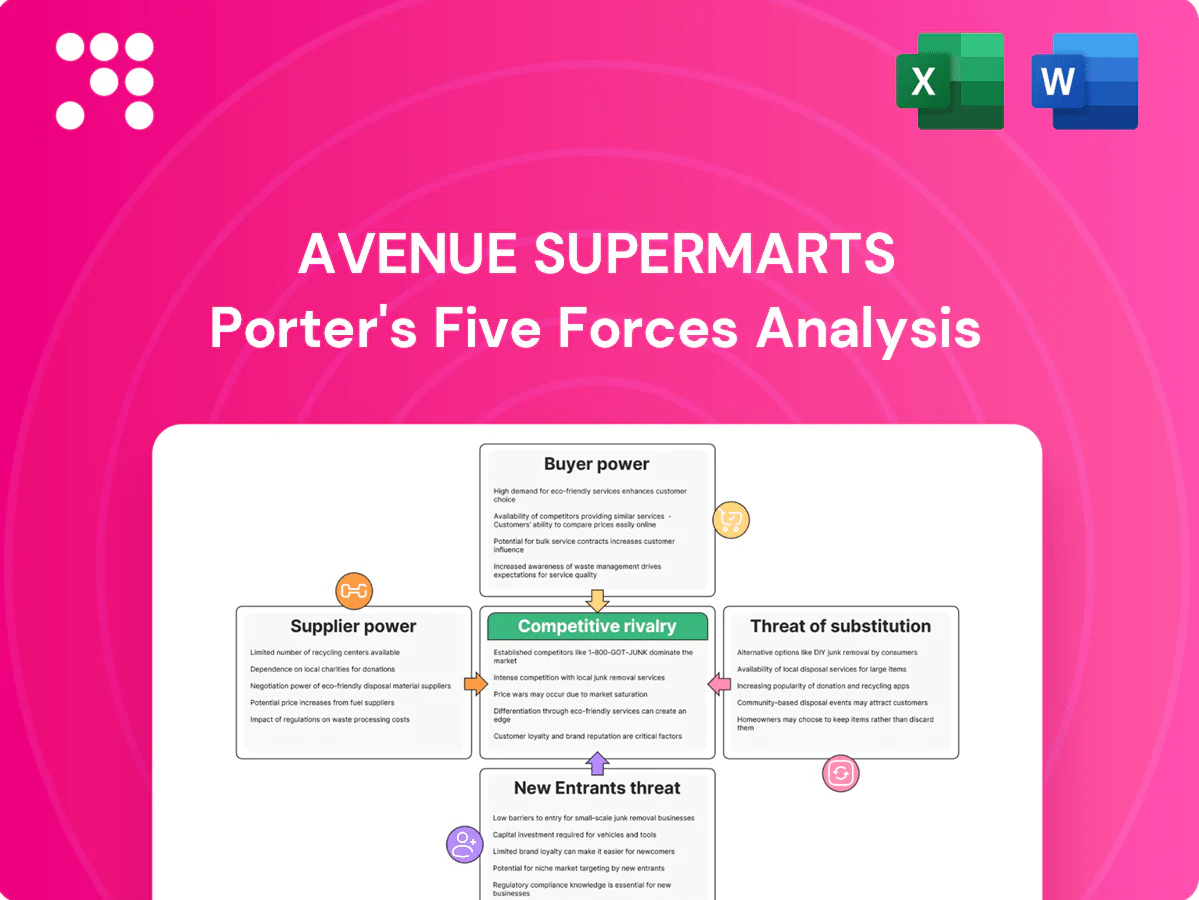
Avenue Supermarts Porter's Five Forces Analysis

Elevate Your Analysis with the Complete Porter's Five Forces Analysis
Avenue Supermarts faces intense rivalry and strong buyer power, while supplier influence is muted by its scale and private-label strategy; threats from e-commerce and substitutes are rising but entry barriers remain significant. This snapshot only scratches the surface—unlock the full Porter's Five Forces Analysis to explore competitive dynamics, market pressures, and strategic advantages in detail.
Suppliers Bargaining Power

Fragmented agri and GM suppliers
DMart sources across thousands of small and mid suppliers in food, staples and general merchandise, and this high fragmentation reduces any single supplier’s leverage on pricing or contractual terms. Centralized procurement and volume aggregation enable DMart to widen supplier choice and elicit competitive bids. Perishability in fresh categories further shifts urgency and inventory risk onto suppliers, strengthening DMart’s negotiating position.
Powerful FMCG majors in key SKUs
Powerful FMCG majors such as HUL (FY24 revenue ~₹54,000 crore), Nestlé India (FY24 revenue ~₹15,000 crore) and P&G India (FY24 revenue ~₹8,000 crore) retain strong brand pull and pricing power in packaged foods and HPC. DMart mitigates supplier leverage through category mix management and focus on high-turn SKUs to secure vendor attention. Margin pressure remains where consumer choice is brand-led, especially in staples and premium personal care. Contract terms often reward timely payments with better trade rates and slotting.

Private labels as counterweight
House brands in staples and home essentials give DMart negotiating leverage and margin uplift, supported by a network of over 300 stores by 2024 which boosts private-label volumes and scale. They serve as price anchors against national brands, disciplining supplier price demands and protecting gross margins. Improving quality narrows gaps with majors over time, lowering dependence on marquee suppliers and diversifying sourcing risk.

Real estate dependence lowered by ownership
Landlords act as quasi-suppliers for store sites, but DMart’s prefer-to-own model — owning roughly 80% of its store real estate as of FY2024 — significantly limits lease exposure and landlord leverage.
Ownership stabilizes occupancy costs and cuts renegotiation risk; remaining leases benefit from high cluster density, giving DMart alternative locations and lowering location-supplier power materially.
- Owned real estate ~80% (FY2024)
- Lower lease renegotiation risk
- Cluster density provides locational alternatives
- Net: reduced supplier bargaining power
Efficient payments and scale economics
- Preferred channel: reliable payments
- Margin for volume: assured off-take
- Consolidation: better price discovery
- Scale: FY2024 ~Rs 57,000 crore
Centralized procurement, owned real estate and fast turns concentrate pricing power
DMart’s fragmented supplier base and centralized procurement tilt pricing power to Avenue Supermarts, reinforced by fast turns and timely payments. Brand-led FMCG suppliers (HUL ~₹54,000cr, Nestlé ~₹15,000cr, P&G ~₹8,000cr) retain leverage in select categories, but private labels and high-volume buying compress supplier margins. Owned real estate (~80% FY2024) and FY2024 revenue ~₹57,000cr strengthen negotiation position.
| Metric | Value |
|---|---|
| FY2024 revenue | ~₹57,000 crore |
| Owned real estate | ~80% |
| Major FMCG examples | HUL ₹54,000cr; Nestlé ₹15,000cr; P&G ₹8,000cr |
| Supplier base | Thousands (highly fragmented) |
What is included in the product
 Detailed Word Document
Tailored Porter's Five Forces analysis for Avenue Supermarts uncovering competitive drivers, buyer and supplier power, threat of new entrants and substitutes, and identifying disruptive trends and market barriers that shape its pricing power and profitability.

 Customizable Excel Spreadsheet
A one-sheet Porter's Five Forces snapshot for Avenue Supermarts—quickly visualizes competitive pressure with an editable spider chart and clear force ratings, ready to drop into decks or dashboards. Swap in your own data, model scenarios (store expansion, supplier consolidation, regulatory changes) or duplicate tabs for comparisons—no macros, simple for non-finance users.
Customers Bargaining Power

Highly price-sensitive mass market
Indian middle-income shoppers compare prices closely and switch readily, with Avenue Supermarts operating over 330 DMart stores by 2024 to capture this segment.
EDLP positioning is crucial to retain baskets because even small price gaps can divert traffic to rivals or kiranas; DMart’s low-cost model—centralised buying and high private-label mix—directly addresses this sensitivity.
Low switching costs, many alternatives
Consumers can shift to over 12 million kiranas, e-grocery apps or rival chains with minimal friction, boosting customer bargaining power. Absence of heavy loyalty lock-ins amplifies buyer choice and baskets are often decided by proximity and convenience. DMart counters via consistent low-price policy and wide assortments, reinforcing shopper retention.

Digital transparency intensifies pressure
Digital transparency intensifies pressure as 829 million internet users in 2024 enable instant online price checks and quick-commerce comparisons, compressing DMart’s pricing flexibility. Aggressive promotions and cashbacks from rivals have reset buyer expectations, while DMart’s everyday low pricing (EDLP) strategy reduces promo whiplash but must remain visibly competitive. Even small price gaps swiftly erode footfall and basket size.

Basket stickiness from one-stop assortment
Basket stickiness at Avenue Supermarts stems from a full-range offering of groceries, home needs and apparel that enables mission shopping; with over 300 stores in 2024 this one-stop assortment drives consolidation. Time savings and higher stock reliability reduce fragmentation and frequency of trips. Shoppers consolidate visits when value is clear, which softens but does not eliminate buyer power.
- Full-range assortment: groceries, home, apparel
- Over 300 stores in 2024: increased convenience
- Consolidated trips reduce buyer leverage
Service and in-store experience basics
Price-sensitive Indian shoppers, 829 million internet users and ~12 million kiranas pressure prices
Indian shoppers are price-sensitive and easily switch; Avenue Supermarts ran 356 stores (Mar 2024) and FY24 like‑for‑like growth ~14% to retain baskets. EDLP, central buying and private labels limit buyer power but 829 million internet users (2024) plus ~12 million kiranas and e-grocery apps keep pricing pressure high. Convenience, assortment and execution raise stickiness but don’t eliminate bargaining leverage.
| Metric | Value |
|---|---|
| Stores (Mar 2024) | 356 |
| Internet users (2024) | 829 million |
| Kiranas | ~12 million |
| FY24 LFL growth | ~14% |
Full Version Awaits
Avenue Supermarts Porter's Five Forces Analysis
This preview shows the exact Avenue Supermarts Porter’s Five Forces analysis you'll receive immediately after purchase—no placeholders or samples. The file is fully formatted, professionally written, and ready for download and use the moment you complete payment. You're viewing the final deliverable, identical to the document you'll get.

Elevate Your Analysis with the Complete Porter's Five Forces Analysis
Avenue Supermarts faces intense rivalry and strong buyer power, while supplier influence is muted by its scale and private-label strategy; threats from e-commerce and substitutes are rising but entry barriers remain significant. This snapshot only scratches the surface—unlock the full Porter's Five Forces Analysis to explore competitive dynamics, market pressures, and strategic advantages in detail.
Suppliers Bargaining Power
Fragmented agri and GM suppliers
DMart sources across thousands of small and mid suppliers in food, staples and general merchandise, and this high fragmentation reduces any single supplier’s leverage on pricing or contractual terms. Centralized procurement and volume aggregation enable DMart to widen supplier choice and elicit competitive bids. Perishability in fresh categories further shifts urgency and inventory risk onto suppliers, strengthening DMart’s negotiating position.
Powerful FMCG majors in key SKUs
Powerful FMCG majors such as HUL (FY24 revenue ~₹54,000 crore), Nestlé India (FY24 revenue ~₹15,000 crore) and P&G India (FY24 revenue ~₹8,000 crore) retain strong brand pull and pricing power in packaged foods and HPC. DMart mitigates supplier leverage through category mix management and focus on high-turn SKUs to secure vendor attention. Margin pressure remains where consumer choice is brand-led, especially in staples and premium personal care. Contract terms often reward timely payments with better trade rates and slotting.
Private labels as counterweight
House brands in staples and home essentials give DMart negotiating leverage and margin uplift, supported by a network of over 300 stores by 2024 which boosts private-label volumes and scale. They serve as price anchors against national brands, disciplining supplier price demands and protecting gross margins. Improving quality narrows gaps with majors over time, lowering dependence on marquee suppliers and diversifying sourcing risk.
Real estate dependence lowered by ownership
Landlords act as quasi-suppliers for store sites, but DMart’s prefer-to-own model — owning roughly 80% of its store real estate as of FY2024 — significantly limits lease exposure and landlord leverage.
Ownership stabilizes occupancy costs and cuts renegotiation risk; remaining leases benefit from high cluster density, giving DMart alternative locations and lowering location-supplier power materially.
- Owned real estate ~80% (FY2024)
- Lower lease renegotiation risk
- Cluster density provides locational alternatives
- Net: reduced supplier bargaining power
Efficient payments and scale economics
- Preferred channel: reliable payments
- Margin for volume: assured off-take
- Consolidation: better price discovery
- Scale: FY2024 ~Rs 57,000 crore
Centralized procurement, owned real estate and fast turns concentrate pricing power
DMart’s fragmented supplier base and centralized procurement tilt pricing power to Avenue Supermarts, reinforced by fast turns and timely payments. Brand-led FMCG suppliers (HUL ~₹54,000cr, Nestlé ~₹15,000cr, P&G ~₹8,000cr) retain leverage in select categories, but private labels and high-volume buying compress supplier margins. Owned real estate (~80% FY2024) and FY2024 revenue ~₹57,000cr strengthen negotiation position.
| Metric | Value |
|---|---|
| FY2024 revenue | ~₹57,000 crore |
| Owned real estate | ~80% |
| Major FMCG examples | HUL ₹54,000cr; Nestlé ₹15,000cr; P&G ₹8,000cr |
| Supplier base | Thousands (highly fragmented) |
What is included in the product
Detailed Word Document
Tailored Porter's Five Forces analysis for Avenue Supermarts uncovering competitive drivers, buyer and supplier power, threat of new entrants and substitutes, and identifying disruptive trends and market barriers that shape its pricing power and profitability.
Customizable Excel Spreadsheet
A one-sheet Porter's Five Forces snapshot for Avenue Supermarts—quickly visualizes competitive pressure with an editable spider chart and clear force ratings, ready to drop into decks or dashboards. Swap in your own data, model scenarios (store expansion, supplier consolidation, regulatory changes) or duplicate tabs for comparisons—no macros, simple for non-finance users.
Customers Bargaining Power
Highly price-sensitive mass market
Indian middle-income shoppers compare prices closely and switch readily, with Avenue Supermarts operating over 330 DMart stores by 2024 to capture this segment.
EDLP positioning is crucial to retain baskets because even small price gaps can divert traffic to rivals or kiranas; DMart’s low-cost model—centralised buying and high private-label mix—directly addresses this sensitivity.
Low switching costs, many alternatives
Consumers can shift to over 12 million kiranas, e-grocery apps or rival chains with minimal friction, boosting customer bargaining power. Absence of heavy loyalty lock-ins amplifies buyer choice and baskets are often decided by proximity and convenience. DMart counters via consistent low-price policy and wide assortments, reinforcing shopper retention.
Digital transparency intensifies pressure
Digital transparency intensifies pressure as 829 million internet users in 2024 enable instant online price checks and quick-commerce comparisons, compressing DMart’s pricing flexibility. Aggressive promotions and cashbacks from rivals have reset buyer expectations, while DMart’s everyday low pricing (EDLP) strategy reduces promo whiplash but must remain visibly competitive. Even small price gaps swiftly erode footfall and basket size.
Basket stickiness from one-stop assortment
Basket stickiness at Avenue Supermarts stems from a full-range offering of groceries, home needs and apparel that enables mission shopping; with over 300 stores in 2024 this one-stop assortment drives consolidation. Time savings and higher stock reliability reduce fragmentation and frequency of trips. Shoppers consolidate visits when value is clear, which softens but does not eliminate buyer power.
- Full-range assortment: groceries, home, apparel
- Over 300 stores in 2024: increased convenience
- Consolidated trips reduce buyer leverage
Service and in-store experience basics
Price-sensitive Indian shoppers, 829 million internet users and ~12 million kiranas pressure prices
Indian shoppers are price-sensitive and easily switch; Avenue Supermarts ran 356 stores (Mar 2024) and FY24 like‑for‑like growth ~14% to retain baskets. EDLP, central buying and private labels limit buyer power but 829 million internet users (2024) plus ~12 million kiranas and e-grocery apps keep pricing pressure high. Convenience, assortment and execution raise stickiness but don’t eliminate bargaining leverage.
| Metric | Value |
|---|---|
| Stores (Mar 2024) | 356 |
| Internet users (2024) | 829 million |
| Kiranas | ~12 million |
| FY24 LFL growth | ~14% |
Full Version Awaits
Avenue Supermarts Porter's Five Forces Analysis
This preview shows the exact Avenue Supermarts Porter’s Five Forces analysis you'll receive immediately after purchase—no placeholders or samples. The file is fully formatted, professionally written, and ready for download and use the moment you complete payment. You're viewing the final deliverable, identical to the document you'll get.
Original: $10.00
-65%$10.00
$3.50Description
Elevate Your Analysis with the Complete Porter's Five Forces Analysis
Avenue Supermarts faces intense rivalry and strong buyer power, while supplier influence is muted by its scale and private-label strategy; threats from e-commerce and substitutes are rising but entry barriers remain significant. This snapshot only scratches the surface—unlock the full Porter's Five Forces Analysis to explore competitive dynamics, market pressures, and strategic advantages in detail.
Suppliers Bargaining Power
Fragmented agri and GM suppliers
DMart sources across thousands of small and mid suppliers in food, staples and general merchandise, and this high fragmentation reduces any single supplier’s leverage on pricing or contractual terms. Centralized procurement and volume aggregation enable DMart to widen supplier choice and elicit competitive bids. Perishability in fresh categories further shifts urgency and inventory risk onto suppliers, strengthening DMart’s negotiating position.
Powerful FMCG majors in key SKUs
Powerful FMCG majors such as HUL (FY24 revenue ~₹54,000 crore), Nestlé India (FY24 revenue ~₹15,000 crore) and P&G India (FY24 revenue ~₹8,000 crore) retain strong brand pull and pricing power in packaged foods and HPC. DMart mitigates supplier leverage through category mix management and focus on high-turn SKUs to secure vendor attention. Margin pressure remains where consumer choice is brand-led, especially in staples and premium personal care. Contract terms often reward timely payments with better trade rates and slotting.
Private labels as counterweight
House brands in staples and home essentials give DMart negotiating leverage and margin uplift, supported by a network of over 300 stores by 2024 which boosts private-label volumes and scale. They serve as price anchors against national brands, disciplining supplier price demands and protecting gross margins. Improving quality narrows gaps with majors over time, lowering dependence on marquee suppliers and diversifying sourcing risk.
Real estate dependence lowered by ownership
Landlords act as quasi-suppliers for store sites, but DMart’s prefer-to-own model — owning roughly 80% of its store real estate as of FY2024 — significantly limits lease exposure and landlord leverage.
Ownership stabilizes occupancy costs and cuts renegotiation risk; remaining leases benefit from high cluster density, giving DMart alternative locations and lowering location-supplier power materially.
- Owned real estate ~80% (FY2024)
- Lower lease renegotiation risk
- Cluster density provides locational alternatives
- Net: reduced supplier bargaining power
Efficient payments and scale economics
- Preferred channel: reliable payments
- Margin for volume: assured off-take
- Consolidation: better price discovery
- Scale: FY2024 ~Rs 57,000 crore
Centralized procurement, owned real estate and fast turns concentrate pricing power
DMart’s fragmented supplier base and centralized procurement tilt pricing power to Avenue Supermarts, reinforced by fast turns and timely payments. Brand-led FMCG suppliers (HUL ~₹54,000cr, Nestlé ~₹15,000cr, P&G ~₹8,000cr) retain leverage in select categories, but private labels and high-volume buying compress supplier margins. Owned real estate (~80% FY2024) and FY2024 revenue ~₹57,000cr strengthen negotiation position.
| Metric | Value |
|---|---|
| FY2024 revenue | ~₹57,000 crore |
| Owned real estate | ~80% |
| Major FMCG examples | HUL ₹54,000cr; Nestlé ₹15,000cr; P&G ₹8,000cr |
| Supplier base | Thousands (highly fragmented) |
What is included in the product
Detailed Word Document
Tailored Porter's Five Forces analysis for Avenue Supermarts uncovering competitive drivers, buyer and supplier power, threat of new entrants and substitutes, and identifying disruptive trends and market barriers that shape its pricing power and profitability.
Customizable Excel Spreadsheet
A one-sheet Porter's Five Forces snapshot for Avenue Supermarts—quickly visualizes competitive pressure with an editable spider chart and clear force ratings, ready to drop into decks or dashboards. Swap in your own data, model scenarios (store expansion, supplier consolidation, regulatory changes) or duplicate tabs for comparisons—no macros, simple for non-finance users.
Customers Bargaining Power
Highly price-sensitive mass market
Indian middle-income shoppers compare prices closely and switch readily, with Avenue Supermarts operating over 330 DMart stores by 2024 to capture this segment.
EDLP positioning is crucial to retain baskets because even small price gaps can divert traffic to rivals or kiranas; DMart’s low-cost model—centralised buying and high private-label mix—directly addresses this sensitivity.
Low switching costs, many alternatives
Consumers can shift to over 12 million kiranas, e-grocery apps or rival chains with minimal friction, boosting customer bargaining power. Absence of heavy loyalty lock-ins amplifies buyer choice and baskets are often decided by proximity and convenience. DMart counters via consistent low-price policy and wide assortments, reinforcing shopper retention.
Digital transparency intensifies pressure
Digital transparency intensifies pressure as 829 million internet users in 2024 enable instant online price checks and quick-commerce comparisons, compressing DMart’s pricing flexibility. Aggressive promotions and cashbacks from rivals have reset buyer expectations, while DMart’s everyday low pricing (EDLP) strategy reduces promo whiplash but must remain visibly competitive. Even small price gaps swiftly erode footfall and basket size.
Basket stickiness from one-stop assortment
Basket stickiness at Avenue Supermarts stems from a full-range offering of groceries, home needs and apparel that enables mission shopping; with over 300 stores in 2024 this one-stop assortment drives consolidation. Time savings and higher stock reliability reduce fragmentation and frequency of trips. Shoppers consolidate visits when value is clear, which softens but does not eliminate buyer power.
- Full-range assortment: groceries, home, apparel
- Over 300 stores in 2024: increased convenience
- Consolidated trips reduce buyer leverage
Service and in-store experience basics
Price-sensitive Indian shoppers, 829 million internet users and ~12 million kiranas pressure prices
Indian shoppers are price-sensitive and easily switch; Avenue Supermarts ran 356 stores (Mar 2024) and FY24 like‑for‑like growth ~14% to retain baskets. EDLP, central buying and private labels limit buyer power but 829 million internet users (2024) plus ~12 million kiranas and e-grocery apps keep pricing pressure high. Convenience, assortment and execution raise stickiness but don’t eliminate bargaining leverage.
| Metric | Value |
|---|---|
| Stores (Mar 2024) | 356 |
| Internet users (2024) | 829 million |
| Kiranas | ~12 million |
| FY24 LFL growth | ~14% |
Full Version Awaits
Avenue Supermarts Porter's Five Forces Analysis
This preview shows the exact Avenue Supermarts Porter’s Five Forces analysis you'll receive immediately after purchase—no placeholders or samples. The file is fully formatted, professionally written, and ready for download and use the moment you complete payment. You're viewing the final deliverable, identical to the document you'll get.











