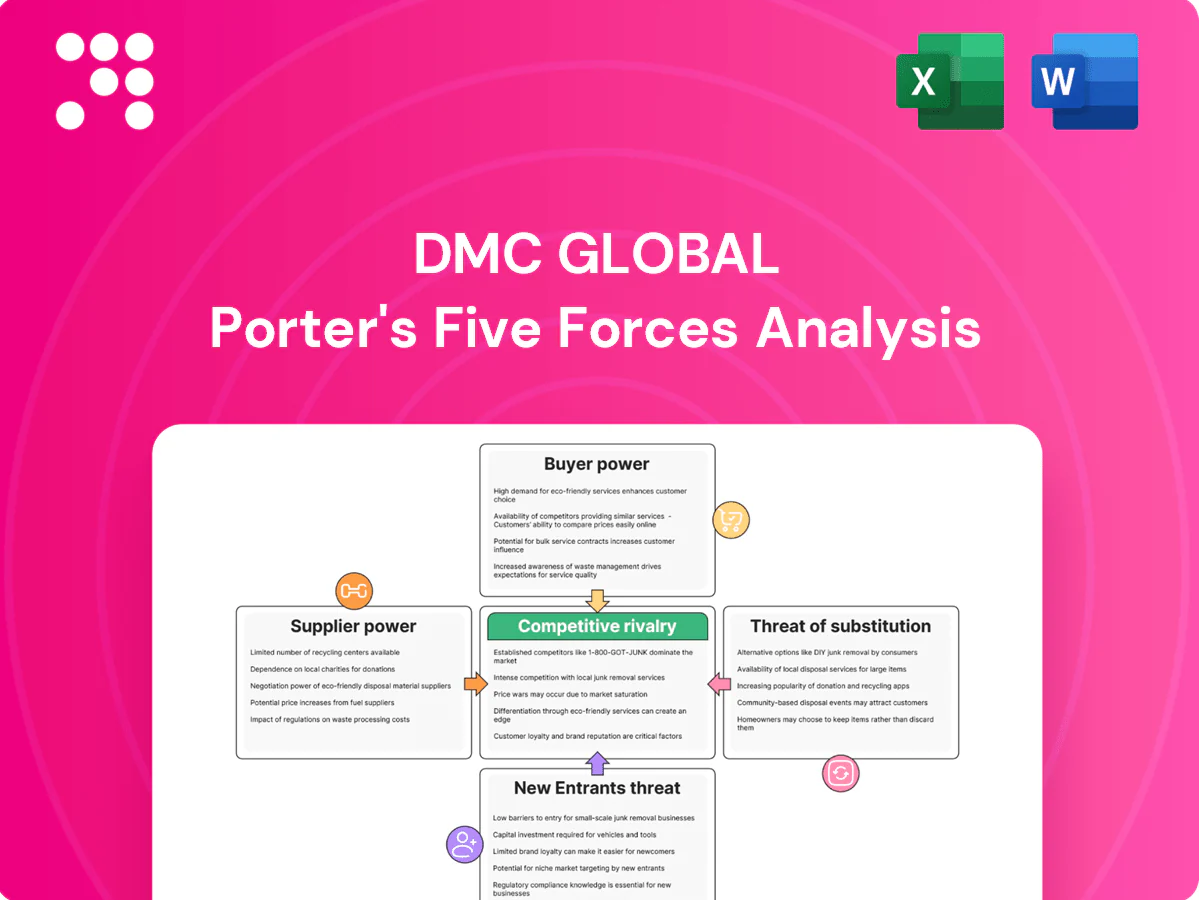
DMC Global Porter's Five Forces Analysis

A Must-Have Tool for Decision-Makers
DMC Global’s Porter's Five Forces snapshot highlights competitive intensity, supplier and buyer power, threat of new entrants and substitutes, and strategic positioning across its niche industrial markets. This brief reveals key pressures but omits detailed ratings, visuals, and implications. Unlock the full Porter's Five Forces Analysis to access force-by-force scores, data-driven insights, and ready-to-use slides for investment or strategy decisions.
Suppliers Bargaining Power

Specialized material inputs
Many DMC products rely on specialty steels, alloys, explosives and engineered components with often fewer than five qualified suppliers, concentrating bargaining power upstream. Qualification cycles are lengthy, typically 9–18 months, which raises switching costs and operational risk. Long-term contracts and dual-sourcing reduce exposure but do not fully eliminate supplier leverage or lead-time vulnerability.
Quality and certification constraints
Energy and infrastructure end-markets require certified inputs and full traceability, allowing vendors meeting API, ISO and project-specific specs to command price premiums and tighter contractual terms. Supplier nonconformance creates downstream warranty, safety and liability exposures that can force costly recalls or rework, increasing buyer risk. During tight capacity cycles this certification-driven scarcity elevates supplier leverage over pricing and lead times.

Logistics and lead-time dependence
Global supply chains for metals, chemicals and custom parts expose DMC to lead-time risk, and in 2024 prolonged ocean and air transit disruptions continue to tighten capacity. When freight or capacity tightens, suppliers have been able to pass through higher costs, forcing DMC to hold greater safety stock or pay expedite premiums that raise working capital. The harder it becomes to run just-in-time, the more supplier influence grows, pressuring margins and procurement flexibility.

Commodity price pass-through
Volatile steel, aluminum and energy inputs shifted supplier bargaining in 2024: US HRC averaged about $900/ton, LME aluminum near $2,300/ton and WTI crude roughly $78/bbl, prompting suppliers to adjust prices faster than many DMC customer contracts reset; hedging and indexing clauses partially offset risk but basis and timing mismatches persist, compressing margins during input upswings.
- rapid supplier repricing
- hedges/indexing reduce but do not eliminate basis risk
- timing mismatch can compress margins in upswings
Technology and tooling lock-in
Proprietary tooling and co-developed parts tie DMC Global operations to specific vendors, making switches costly due to requalification, capital expenditure and downtime; suppliers exploit this embedded friction to secure stronger terms. Collaborative R&D partnerships reduce some risk, but persistent tooling lock-in sustains supplier bargaining power and price resilience into 2024.
- High lock-in: proprietary tooling limits vendor change
- Switch costs: requalification, capex, downtime
- Supplier leverage: negotiate on price and lead times
- Partnerships mitigate but do not eliminate power
Specialty-steel supplier power: 9–18 month quals, $900/t
Specialty steels, alloys and certified components have <5 qualified suppliers, 9–18 month quals and high switching costs, concentrating supplier power. 2024 inputs: US HRC ~900/ton, LME Al ~2,300/ton, WTI ~78/bbl, enabling rapid repricing and margin pressure. Tooling lock-in and certification premiums sustain leverage despite dual-sourcing and hedges.
| Metric | 2024 Value |
|---|---|
| US HRC | $900/ton |
| LME Aluminum | $2,300/ton |
| WTI Crude | $78/bbl |
What is included in the product
 Detailed Word Document
Concise Porter's Five Forces analysis tailored to DMC Global, uncovering competitive rivalry, supplier and buyer power, threat of new entrants and substitutes, plus strategic implications for pricing and profitability; includes actionable insights on disruptive threats and barriers that protect DMC's market position.

 Customizable Excel Spreadsheet
One-sheet Porter's Five Forces for DMC Global that clarifies competitive pressures at a glance, with adjustable force levels and an interactive radar chart to translate analysis directly into pitch decks or strategic reports.
Customers Bargaining Power

Concentrated enterprise customers
Energy operators, EPCs and large fabricators buy at scale—ExxonMobil and Shell set 2024 CAPEX plans above $20B each, concentrating purchasing power and driving competitive bid processes that pressure margins. Multi-year frame agreements commonly include volume discounts and strict SLAs, and aggregated contract volumes give buyers meaningful leverage over suppliers like DMC Global.
High performance expectations
Customers prize uptime, safety, and precision, commonly demanding service levels of 99.9% availability and ISO-certified safety compliance, driving rigorous KPIs. This translates into performance-based negotiations with contractual penalties often tied to missed SLAs. Vendors must provide engineering support and rapid delivery windows to meet these KPIs. Buyers leverage these requirements to extract value-added services at minimal incremental cost.

Availability of alternatives
For several DMC Global product lines multiple qualified providers exist, enabling buyers to run competitive tenders to extract better price and terms. Where DMC demonstrates clear technical differentiation and patented solutions, it can better defend margins. In more commoditized specifications, buyer power increases materially, compressing pricing and contract leverage. This dynamic makes product differentiation central to margin resilience.

Switching costs vary by segment
Engineered solutions with integration and certification create high switching costs through technical lock-in, multi-year service contracts, and installed-base dependencies, while standard components and architectural products remain easily substitutable and price-sensitive. Buyers with low switching barriers use that leverage to negotiate better terms, though niche contracts and certified integrations temper customer power.
- High switching costs: engineered, certified solutions
- Low switching costs: standard components
- Buyer leverage: negotiation on commoditized lines
- Tempered power: contracts, installed base, technical lock-in
Demand cyclicality impacts leverage
Demand cyclicality reduces buyer leverage in upcycles as urgency rises, while downturns in energy and construction shrink order visibility, prompting buyers to delay purchases and demand concessions; DMC’s 2024 backlog composition (instrumentation and engineered products vs. services) moderates these swings and alters negotiation dynamics.
- Buyers delay and push concessions in downturns
- Upcycles reduce price leverage but raise service expectations
- DMC 2024 backlog mix shapes resilience
Concentrated energy buyers with >$20B CAPEX squeeze suppliers; uptime SLAs drive margins
Large energy buyers concentrate purchasing power—ExxonMobil and Shell set 2024 CAPEX above $20B each, driving competitive bids that compress supplier margins.
Buyers demand 99.9% uptime, ISO safety and performance penalties, using service requirements to extract value-added terms.
Where DMC shows patented differentiation switching costs are high; commoditized lines face intense price pressure.
| Metric | 2024 |
|---|---|
| Major buyer CAPEX | Exxon/Shell >$20B |
| Typical SLA | 99.9% availability |
Full Version Awaits
DMC Global Porter's Five Forces Analysis
This preview shows the exact Porter’s Five Forces analysis for DMC Global you'll receive immediately after purchase—no placeholders or samples. The document is fully formatted and professionally written. It is ready for instant download and immediate use the moment you buy. No mockups; this is the actual deliverable.

A Must-Have Tool for Decision-Makers
DMC Global’s Porter's Five Forces snapshot highlights competitive intensity, supplier and buyer power, threat of new entrants and substitutes, and strategic positioning across its niche industrial markets. This brief reveals key pressures but omits detailed ratings, visuals, and implications. Unlock the full Porter's Five Forces Analysis to access force-by-force scores, data-driven insights, and ready-to-use slides for investment or strategy decisions.
Suppliers Bargaining Power
Specialized material inputs
Many DMC products rely on specialty steels, alloys, explosives and engineered components with often fewer than five qualified suppliers, concentrating bargaining power upstream. Qualification cycles are lengthy, typically 9–18 months, which raises switching costs and operational risk. Long-term contracts and dual-sourcing reduce exposure but do not fully eliminate supplier leverage or lead-time vulnerability.
Quality and certification constraints
Energy and infrastructure end-markets require certified inputs and full traceability, allowing vendors meeting API, ISO and project-specific specs to command price premiums and tighter contractual terms. Supplier nonconformance creates downstream warranty, safety and liability exposures that can force costly recalls or rework, increasing buyer risk. During tight capacity cycles this certification-driven scarcity elevates supplier leverage over pricing and lead times.
Logistics and lead-time dependence
Global supply chains for metals, chemicals and custom parts expose DMC to lead-time risk, and in 2024 prolonged ocean and air transit disruptions continue to tighten capacity. When freight or capacity tightens, suppliers have been able to pass through higher costs, forcing DMC to hold greater safety stock or pay expedite premiums that raise working capital. The harder it becomes to run just-in-time, the more supplier influence grows, pressuring margins and procurement flexibility.
Commodity price pass-through
Volatile steel, aluminum and energy inputs shifted supplier bargaining in 2024: US HRC averaged about $900/ton, LME aluminum near $2,300/ton and WTI crude roughly $78/bbl, prompting suppliers to adjust prices faster than many DMC customer contracts reset; hedging and indexing clauses partially offset risk but basis and timing mismatches persist, compressing margins during input upswings.
- rapid supplier repricing
- hedges/indexing reduce but do not eliminate basis risk
- timing mismatch can compress margins in upswings
Technology and tooling lock-in
Proprietary tooling and co-developed parts tie DMC Global operations to specific vendors, making switches costly due to requalification, capital expenditure and downtime; suppliers exploit this embedded friction to secure stronger terms. Collaborative R&D partnerships reduce some risk, but persistent tooling lock-in sustains supplier bargaining power and price resilience into 2024.
- High lock-in: proprietary tooling limits vendor change
- Switch costs: requalification, capex, downtime
- Supplier leverage: negotiate on price and lead times
- Partnerships mitigate but do not eliminate power
Specialty-steel supplier power: 9–18 month quals, $900/t
Specialty steels, alloys and certified components have <5 qualified suppliers, 9–18 month quals and high switching costs, concentrating supplier power. 2024 inputs: US HRC ~900/ton, LME Al ~2,300/ton, WTI ~78/bbl, enabling rapid repricing and margin pressure. Tooling lock-in and certification premiums sustain leverage despite dual-sourcing and hedges.
| Metric | 2024 Value |
|---|---|
| US HRC | $900/ton |
| LME Aluminum | $2,300/ton |
| WTI Crude | $78/bbl |
What is included in the product
Detailed Word Document
Concise Porter's Five Forces analysis tailored to DMC Global, uncovering competitive rivalry, supplier and buyer power, threat of new entrants and substitutes, plus strategic implications for pricing and profitability; includes actionable insights on disruptive threats and barriers that protect DMC's market position.
Customizable Excel Spreadsheet
One-sheet Porter's Five Forces for DMC Global that clarifies competitive pressures at a glance, with adjustable force levels and an interactive radar chart to translate analysis directly into pitch decks or strategic reports.
Customers Bargaining Power
Concentrated enterprise customers
Energy operators, EPCs and large fabricators buy at scale—ExxonMobil and Shell set 2024 CAPEX plans above $20B each, concentrating purchasing power and driving competitive bid processes that pressure margins. Multi-year frame agreements commonly include volume discounts and strict SLAs, and aggregated contract volumes give buyers meaningful leverage over suppliers like DMC Global.
High performance expectations
Customers prize uptime, safety, and precision, commonly demanding service levels of 99.9% availability and ISO-certified safety compliance, driving rigorous KPIs. This translates into performance-based negotiations with contractual penalties often tied to missed SLAs. Vendors must provide engineering support and rapid delivery windows to meet these KPIs. Buyers leverage these requirements to extract value-added services at minimal incremental cost.
Availability of alternatives
For several DMC Global product lines multiple qualified providers exist, enabling buyers to run competitive tenders to extract better price and terms. Where DMC demonstrates clear technical differentiation and patented solutions, it can better defend margins. In more commoditized specifications, buyer power increases materially, compressing pricing and contract leverage. This dynamic makes product differentiation central to margin resilience.
Switching costs vary by segment
Engineered solutions with integration and certification create high switching costs through technical lock-in, multi-year service contracts, and installed-base dependencies, while standard components and architectural products remain easily substitutable and price-sensitive. Buyers with low switching barriers use that leverage to negotiate better terms, though niche contracts and certified integrations temper customer power.
- High switching costs: engineered, certified solutions
- Low switching costs: standard components
- Buyer leverage: negotiation on commoditized lines
- Tempered power: contracts, installed base, technical lock-in
Demand cyclicality impacts leverage
Demand cyclicality reduces buyer leverage in upcycles as urgency rises, while downturns in energy and construction shrink order visibility, prompting buyers to delay purchases and demand concessions; DMC’s 2024 backlog composition (instrumentation and engineered products vs. services) moderates these swings and alters negotiation dynamics.
- Buyers delay and push concessions in downturns
- Upcycles reduce price leverage but raise service expectations
- DMC 2024 backlog mix shapes resilience
Concentrated energy buyers with >$20B CAPEX squeeze suppliers; uptime SLAs drive margins
Large energy buyers concentrate purchasing power—ExxonMobil and Shell set 2024 CAPEX above $20B each, driving competitive bids that compress supplier margins.
Buyers demand 99.9% uptime, ISO safety and performance penalties, using service requirements to extract value-added terms.
Where DMC shows patented differentiation switching costs are high; commoditized lines face intense price pressure.
| Metric | 2024 |
|---|---|
| Major buyer CAPEX | Exxon/Shell >$20B |
| Typical SLA | 99.9% availability |
Full Version Awaits
DMC Global Porter's Five Forces Analysis
This preview shows the exact Porter’s Five Forces analysis for DMC Global you'll receive immediately after purchase—no placeholders or samples. The document is fully formatted and professionally written. It is ready for instant download and immediate use the moment you buy. No mockups; this is the actual deliverable.
Description
A Must-Have Tool for Decision-Makers
DMC Global’s Porter's Five Forces snapshot highlights competitive intensity, supplier and buyer power, threat of new entrants and substitutes, and strategic positioning across its niche industrial markets. This brief reveals key pressures but omits detailed ratings, visuals, and implications. Unlock the full Porter's Five Forces Analysis to access force-by-force scores, data-driven insights, and ready-to-use slides for investment or strategy decisions.
Suppliers Bargaining Power
Specialized material inputs
Many DMC products rely on specialty steels, alloys, explosives and engineered components with often fewer than five qualified suppliers, concentrating bargaining power upstream. Qualification cycles are lengthy, typically 9–18 months, which raises switching costs and operational risk. Long-term contracts and dual-sourcing reduce exposure but do not fully eliminate supplier leverage or lead-time vulnerability.
Quality and certification constraints
Energy and infrastructure end-markets require certified inputs and full traceability, allowing vendors meeting API, ISO and project-specific specs to command price premiums and tighter contractual terms. Supplier nonconformance creates downstream warranty, safety and liability exposures that can force costly recalls or rework, increasing buyer risk. During tight capacity cycles this certification-driven scarcity elevates supplier leverage over pricing and lead times.
Logistics and lead-time dependence
Global supply chains for metals, chemicals and custom parts expose DMC to lead-time risk, and in 2024 prolonged ocean and air transit disruptions continue to tighten capacity. When freight or capacity tightens, suppliers have been able to pass through higher costs, forcing DMC to hold greater safety stock or pay expedite premiums that raise working capital. The harder it becomes to run just-in-time, the more supplier influence grows, pressuring margins and procurement flexibility.
Commodity price pass-through
Volatile steel, aluminum and energy inputs shifted supplier bargaining in 2024: US HRC averaged about $900/ton, LME aluminum near $2,300/ton and WTI crude roughly $78/bbl, prompting suppliers to adjust prices faster than many DMC customer contracts reset; hedging and indexing clauses partially offset risk but basis and timing mismatches persist, compressing margins during input upswings.
- rapid supplier repricing
- hedges/indexing reduce but do not eliminate basis risk
- timing mismatch can compress margins in upswings
Technology and tooling lock-in
Proprietary tooling and co-developed parts tie DMC Global operations to specific vendors, making switches costly due to requalification, capital expenditure and downtime; suppliers exploit this embedded friction to secure stronger terms. Collaborative R&D partnerships reduce some risk, but persistent tooling lock-in sustains supplier bargaining power and price resilience into 2024.
- High lock-in: proprietary tooling limits vendor change
- Switch costs: requalification, capex, downtime
- Supplier leverage: negotiate on price and lead times
- Partnerships mitigate but do not eliminate power
Specialty-steel supplier power: 9–18 month quals, $900/t
Specialty steels, alloys and certified components have <5 qualified suppliers, 9–18 month quals and high switching costs, concentrating supplier power. 2024 inputs: US HRC ~900/ton, LME Al ~2,300/ton, WTI ~78/bbl, enabling rapid repricing and margin pressure. Tooling lock-in and certification premiums sustain leverage despite dual-sourcing and hedges.
| Metric | 2024 Value |
|---|---|
| US HRC | $900/ton |
| LME Aluminum | $2,300/ton |
| WTI Crude | $78/bbl |
What is included in the product
Detailed Word Document
Concise Porter's Five Forces analysis tailored to DMC Global, uncovering competitive rivalry, supplier and buyer power, threat of new entrants and substitutes, plus strategic implications for pricing and profitability; includes actionable insights on disruptive threats and barriers that protect DMC's market position.
Customizable Excel Spreadsheet
One-sheet Porter's Five Forces for DMC Global that clarifies competitive pressures at a glance, with adjustable force levels and an interactive radar chart to translate analysis directly into pitch decks or strategic reports.
Customers Bargaining Power
Concentrated enterprise customers
Energy operators, EPCs and large fabricators buy at scale—ExxonMobil and Shell set 2024 CAPEX plans above $20B each, concentrating purchasing power and driving competitive bid processes that pressure margins. Multi-year frame agreements commonly include volume discounts and strict SLAs, and aggregated contract volumes give buyers meaningful leverage over suppliers like DMC Global.
High performance expectations
Customers prize uptime, safety, and precision, commonly demanding service levels of 99.9% availability and ISO-certified safety compliance, driving rigorous KPIs. This translates into performance-based negotiations with contractual penalties often tied to missed SLAs. Vendors must provide engineering support and rapid delivery windows to meet these KPIs. Buyers leverage these requirements to extract value-added services at minimal incremental cost.
Availability of alternatives
For several DMC Global product lines multiple qualified providers exist, enabling buyers to run competitive tenders to extract better price and terms. Where DMC demonstrates clear technical differentiation and patented solutions, it can better defend margins. In more commoditized specifications, buyer power increases materially, compressing pricing and contract leverage. This dynamic makes product differentiation central to margin resilience.
Switching costs vary by segment
Engineered solutions with integration and certification create high switching costs through technical lock-in, multi-year service contracts, and installed-base dependencies, while standard components and architectural products remain easily substitutable and price-sensitive. Buyers with low switching barriers use that leverage to negotiate better terms, though niche contracts and certified integrations temper customer power.
- High switching costs: engineered, certified solutions
- Low switching costs: standard components
- Buyer leverage: negotiation on commoditized lines
- Tempered power: contracts, installed base, technical lock-in
Demand cyclicality impacts leverage
Demand cyclicality reduces buyer leverage in upcycles as urgency rises, while downturns in energy and construction shrink order visibility, prompting buyers to delay purchases and demand concessions; DMC’s 2024 backlog composition (instrumentation and engineered products vs. services) moderates these swings and alters negotiation dynamics.
- Buyers delay and push concessions in downturns
- Upcycles reduce price leverage but raise service expectations
- DMC 2024 backlog mix shapes resilience
Concentrated energy buyers with >$20B CAPEX squeeze suppliers; uptime SLAs drive margins
Large energy buyers concentrate purchasing power—ExxonMobil and Shell set 2024 CAPEX above $20B each, driving competitive bids that compress supplier margins.
Buyers demand 99.9% uptime, ISO safety and performance penalties, using service requirements to extract value-added terms.
Where DMC shows patented differentiation switching costs are high; commoditized lines face intense price pressure.
| Metric | 2024 |
|---|---|
| Major buyer CAPEX | Exxon/Shell >$20B |
| Typical SLA | 99.9% availability |
Full Version Awaits
DMC Global Porter's Five Forces Analysis
This preview shows the exact Porter’s Five Forces analysis for DMC Global you'll receive immediately after purchase—no placeholders or samples. The document is fully formatted and professionally written. It is ready for instant download and immediate use the moment you buy. No mockups; this is the actual deliverable.











