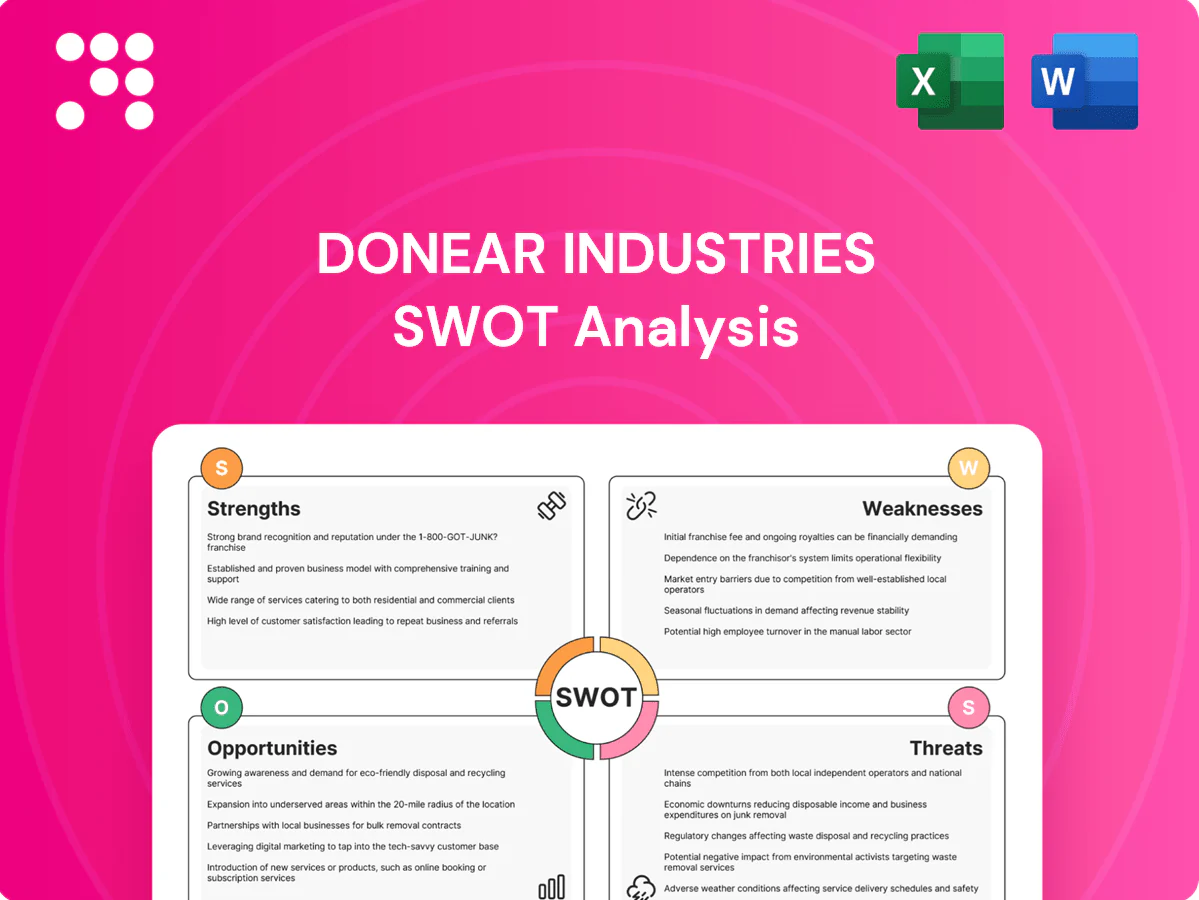
Donear Industries SWOT Analysis

Dive Deeper Into the Company’s Strategic Blueprint
Donear Industries shows strong brand recognition and a diversified textile portfolio, but faces margin pressure from raw material volatility and concentrated domestic dependence. Opportunities in premiumization, branded retail expansion, and exports could fuel growth, while intense competition and supply-chain risks loom. Want the full story behind Donear’s strengths, risks, and growth drivers? Purchase the complete SWOT analysis for a professionally written, editable report and Excel matrix to plan and invest with confidence.
Strengths

Diverse fabric portfolio
Donear Industries’ diversified fabric portfolio across suiting, shirting and denim reduces dependence on a single category, smoothing demand cyclicality and seasonality. A broader catalog facilitates cross-selling to retail and institutional buyers and improves mill utilization. Range across value to premium price points enables entry into adjacent segments, supporting resilient revenues across geographies.
Integrated manufacturing know-how
Integrated manufacturing know-how—backed by 30+ years in suiting and multiple in-house plants—lets Donear control quality and cut costs across yarn-to-finish operations. End-to-end process integration shortens lead times for wholesalers and brands, enabling rapid sampling and customization aligned to fast fashion cycles. Consistent production standards strengthen credibility with distributors and trade partners.

Strong distributor–retailer network
An extensive distributor–retailer network widens Donear Industries reach across India’s fragmented apparel markets, ensuring broader market penetration. Channel partners supply real-time demand signals that speed replenishment and reduce stockouts. Established relationships cut selling costs and improve shelf presence, while the network enables faster, pan‑regional new product rollouts.

Domestic and export presence
Serving both domestic and export markets diversifies Donear Industries exposure to local currency cycles and international macro shifts, while exports help secure higher-margin bulk and premium orders and act as a partial hedge during domestic slowdowns.
Cross-market feedback enhances product design and compliance, raising quality standards and boosting brand recognition among global buyers, widening distribution channels and repeat corporate contracts.
- Diversified currency/macro exposure
- Access to higher-value export orders
- Product and compliance learning across markets
- Stronger global brand recognition
Fabric applications across segments
Supplying formalwear, casualwear and denim lets Donear address multiple consumer occasions, blend high-volume basics with higher-margin specialty finishes, and cut fashion and seasonality risk; India textile and apparel exports were about $44.4 billion in 2023–24 and the sector employs ~45 million, supporting multi-cycle demand stability.
- Multi-segment reach
- Reduces seasonality
- Volume + margin mix
- Stabilizes cash flows
30+ years manufacturing, integrated plants and export access boost margins and lead times
Donear’s diversified suiting, shirting and denim mix, 30+ years manufacturing depth and integrated plants deliver cost control, faster lead times and quality consistency. Extensive distributor network and export access (India apparel exports $44.4bn in 2023–24) broaden reach, stabilize cash flows and capture higher-margin orders.
| Metric | Value |
|---|---|
| Manufacturing vintage | 30+ years |
| India apparel exports | $44.4 bn (2023–24) |
| Sector employment | ~45 million |
What is included in the product
 Detailed Word Document
Delivers a strategic overview of Donear Industries’s internal and external business factors, outlining strengths, weaknesses, opportunities, and threats while highlighting competitive position, growth drivers, operational gaps, and market risks shaping its future.

 Customizable Excel Spreadsheet
Provides a concise SWOT matrix tailored to Donear Industries for fast strategic alignment and competitive textile market clarity; editable format enables quick updates to reflect shifts in demand, raw material costs, and distribution strategies for rapid stakeholder decision-making.
Weaknesses

Commodity cost sensitivity
Yarn, cotton and dyes drive Donear Industries input costs, and sharp spikes—often driven by spot cotton volatility and dye chemical shortages—can materially compress margins when price hikes cannot be passed to buyers. Use of hedging and inventory buffers mitigates risk but raises treasury complexity and working capital intensity. Such input volatility frequently distorts quarterly EBITDA and revenue comparatives.
High working capital intensity
Textile operations force Donear to carry broad inventory across counts, colors and finishes, resulting in inventory days often exceeding 120, which raises carrying costs. Extended credit to distributors further ties up cash, with receivable cycles stretching industry-typical 60–90 days. Slow-moving SKUs increase obsolescence risk and markdowns, pressuring gross margins. High working capital intensity can limit capacity for capex or marketing during downcycles.

Brand pull versus channel push
Reliance on distributors limits Donear Industries' ability to build direct consumer brand equity, leaving consumer perception shaped more by channel partners than the company. Weak end-customer pull constrains pricing power and forces margin erosion during promotions. High dependence on channel push increases promotional spend to clear inventory and reduces control over markdown timing. Limited D2C data restricts insight into rapidly shifting consumer tastes and personalization opportunities.

Exposure to fashion cycles
Exposure to fashion cycles forces Donear to refresh denim and shirting assortments rapidly, raising markdown risk when trends shift and mixing impacts gross margins.
Forecasting errors cause excess inventory or stock-outs, increasing working capital and obsolescence costs when agility is limited.
Faster cycles lift sampling and development expenses and can erode margin if product-development lead times and supply-chain flexibility are insufficient.
- rapid SKU churn raises markdown risk
- forecast misses → excess stock or stock-outs
- higher sampling & development costs
- insufficient agility compresses margins
Environmental compliance burden
Textile processing is highly water-, energy- and chemical-intensive, and tightening environmental norms force Donear Industries to invest in effluent treatment and cleaner technologies; non-compliance can trigger regulatory fines and loss of export orders, while required transition capex and operating changes can compress near-term margins.
- Regulatory capex pressure
- Risk of fines and order cancellations
- Higher OPEX during transition
- Margin compression near term
Input-cost volatility, long inventory cycles and compliance capex squeeze margins
Input-cost volatility (cotton, dyes) compresses margins; hedging raises treasury and working-capital strain. Inventory days often exceed 120 and receivable cycles run 60–90 days, increasing carrying costs and obsolescence risk. Distributor-led sales limit D2C brand control, forcing promotions and margin erosion. Environmental compliance requires capex and higher OPEX, pressuring near-term margins.
| Metric | Value/Status |
|---|---|
| Inventory days | >120 |
| Receivable cycle | 60–90 days |
| Channel mix | Distributor-dependent |
| Regulatory capex | Required (water/effluent) |
Full Version Awaits
Donear Industries SWOT Analysis
This is the actual Donear Industries SWOT analysis document you’ll receive upon purchase—no surprises, just professional quality. The preview below is taken directly from the full report; buying unlocks the complete, editable version. You’re viewing a live excerpt of the real file, ready for download after checkout.

Dive Deeper Into the Company’s Strategic Blueprint
Donear Industries shows strong brand recognition and a diversified textile portfolio, but faces margin pressure from raw material volatility and concentrated domestic dependence. Opportunities in premiumization, branded retail expansion, and exports could fuel growth, while intense competition and supply-chain risks loom. Want the full story behind Donear’s strengths, risks, and growth drivers? Purchase the complete SWOT analysis for a professionally written, editable report and Excel matrix to plan and invest with confidence.
Strengths
Diverse fabric portfolio
Donear Industries’ diversified fabric portfolio across suiting, shirting and denim reduces dependence on a single category, smoothing demand cyclicality and seasonality. A broader catalog facilitates cross-selling to retail and institutional buyers and improves mill utilization. Range across value to premium price points enables entry into adjacent segments, supporting resilient revenues across geographies.
Integrated manufacturing know-how
Integrated manufacturing know-how—backed by 30+ years in suiting and multiple in-house plants—lets Donear control quality and cut costs across yarn-to-finish operations. End-to-end process integration shortens lead times for wholesalers and brands, enabling rapid sampling and customization aligned to fast fashion cycles. Consistent production standards strengthen credibility with distributors and trade partners.
Strong distributor–retailer network
An extensive distributor–retailer network widens Donear Industries reach across India’s fragmented apparel markets, ensuring broader market penetration. Channel partners supply real-time demand signals that speed replenishment and reduce stockouts. Established relationships cut selling costs and improve shelf presence, while the network enables faster, pan‑regional new product rollouts.
Domestic and export presence
Serving both domestic and export markets diversifies Donear Industries exposure to local currency cycles and international macro shifts, while exports help secure higher-margin bulk and premium orders and act as a partial hedge during domestic slowdowns.
Cross-market feedback enhances product design and compliance, raising quality standards and boosting brand recognition among global buyers, widening distribution channels and repeat corporate contracts.
- Diversified currency/macro exposure
- Access to higher-value export orders
- Product and compliance learning across markets
- Stronger global brand recognition
Fabric applications across segments
Supplying formalwear, casualwear and denim lets Donear address multiple consumer occasions, blend high-volume basics with higher-margin specialty finishes, and cut fashion and seasonality risk; India textile and apparel exports were about $44.4 billion in 2023–24 and the sector employs ~45 million, supporting multi-cycle demand stability.
- Multi-segment reach
- Reduces seasonality
- Volume + margin mix
- Stabilizes cash flows
30+ years manufacturing, integrated plants and export access boost margins and lead times
Donear’s diversified suiting, shirting and denim mix, 30+ years manufacturing depth and integrated plants deliver cost control, faster lead times and quality consistency. Extensive distributor network and export access (India apparel exports $44.4bn in 2023–24) broaden reach, stabilize cash flows and capture higher-margin orders.
| Metric | Value |
|---|---|
| Manufacturing vintage | 30+ years |
| India apparel exports | $44.4 bn (2023–24) |
| Sector employment | ~45 million |
What is included in the product
Detailed Word Document
Delivers a strategic overview of Donear Industries’s internal and external business factors, outlining strengths, weaknesses, opportunities, and threats while highlighting competitive position, growth drivers, operational gaps, and market risks shaping its future.
Customizable Excel Spreadsheet
Provides a concise SWOT matrix tailored to Donear Industries for fast strategic alignment and competitive textile market clarity; editable format enables quick updates to reflect shifts in demand, raw material costs, and distribution strategies for rapid stakeholder decision-making.
Weaknesses
Commodity cost sensitivity
Yarn, cotton and dyes drive Donear Industries input costs, and sharp spikes—often driven by spot cotton volatility and dye chemical shortages—can materially compress margins when price hikes cannot be passed to buyers. Use of hedging and inventory buffers mitigates risk but raises treasury complexity and working capital intensity. Such input volatility frequently distorts quarterly EBITDA and revenue comparatives.
High working capital intensity
Textile operations force Donear to carry broad inventory across counts, colors and finishes, resulting in inventory days often exceeding 120, which raises carrying costs. Extended credit to distributors further ties up cash, with receivable cycles stretching industry-typical 60–90 days. Slow-moving SKUs increase obsolescence risk and markdowns, pressuring gross margins. High working capital intensity can limit capacity for capex or marketing during downcycles.
Brand pull versus channel push
Reliance on distributors limits Donear Industries' ability to build direct consumer brand equity, leaving consumer perception shaped more by channel partners than the company. Weak end-customer pull constrains pricing power and forces margin erosion during promotions. High dependence on channel push increases promotional spend to clear inventory and reduces control over markdown timing. Limited D2C data restricts insight into rapidly shifting consumer tastes and personalization opportunities.
Exposure to fashion cycles
Exposure to fashion cycles forces Donear to refresh denim and shirting assortments rapidly, raising markdown risk when trends shift and mixing impacts gross margins.
Forecasting errors cause excess inventory or stock-outs, increasing working capital and obsolescence costs when agility is limited.
Faster cycles lift sampling and development expenses and can erode margin if product-development lead times and supply-chain flexibility are insufficient.
- rapid SKU churn raises markdown risk
- forecast misses → excess stock or stock-outs
- higher sampling & development costs
- insufficient agility compresses margins
Environmental compliance burden
Textile processing is highly water-, energy- and chemical-intensive, and tightening environmental norms force Donear Industries to invest in effluent treatment and cleaner technologies; non-compliance can trigger regulatory fines and loss of export orders, while required transition capex and operating changes can compress near-term margins.
- Regulatory capex pressure
- Risk of fines and order cancellations
- Higher OPEX during transition
- Margin compression near term
Input-cost volatility, long inventory cycles and compliance capex squeeze margins
Input-cost volatility (cotton, dyes) compresses margins; hedging raises treasury and working-capital strain. Inventory days often exceed 120 and receivable cycles run 60–90 days, increasing carrying costs and obsolescence risk. Distributor-led sales limit D2C brand control, forcing promotions and margin erosion. Environmental compliance requires capex and higher OPEX, pressuring near-term margins.
| Metric | Value/Status |
|---|---|
| Inventory days | >120 |
| Receivable cycle | 60–90 days |
| Channel mix | Distributor-dependent |
| Regulatory capex | Required (water/effluent) |
Full Version Awaits
Donear Industries SWOT Analysis
This is the actual Donear Industries SWOT analysis document you’ll receive upon purchase—no surprises, just professional quality. The preview below is taken directly from the full report; buying unlocks the complete, editable version. You’re viewing a live excerpt of the real file, ready for download after checkout.
Original: $10.00
-65%$10.00
$3.50Description
Dive Deeper Into the Company’s Strategic Blueprint
Donear Industries shows strong brand recognition and a diversified textile portfolio, but faces margin pressure from raw material volatility and concentrated domestic dependence. Opportunities in premiumization, branded retail expansion, and exports could fuel growth, while intense competition and supply-chain risks loom. Want the full story behind Donear’s strengths, risks, and growth drivers? Purchase the complete SWOT analysis for a professionally written, editable report and Excel matrix to plan and invest with confidence.
Strengths
Diverse fabric portfolio
Donear Industries’ diversified fabric portfolio across suiting, shirting and denim reduces dependence on a single category, smoothing demand cyclicality and seasonality. A broader catalog facilitates cross-selling to retail and institutional buyers and improves mill utilization. Range across value to premium price points enables entry into adjacent segments, supporting resilient revenues across geographies.
Integrated manufacturing know-how
Integrated manufacturing know-how—backed by 30+ years in suiting and multiple in-house plants—lets Donear control quality and cut costs across yarn-to-finish operations. End-to-end process integration shortens lead times for wholesalers and brands, enabling rapid sampling and customization aligned to fast fashion cycles. Consistent production standards strengthen credibility with distributors and trade partners.
Strong distributor–retailer network
An extensive distributor–retailer network widens Donear Industries reach across India’s fragmented apparel markets, ensuring broader market penetration. Channel partners supply real-time demand signals that speed replenishment and reduce stockouts. Established relationships cut selling costs and improve shelf presence, while the network enables faster, pan‑regional new product rollouts.
Domestic and export presence
Serving both domestic and export markets diversifies Donear Industries exposure to local currency cycles and international macro shifts, while exports help secure higher-margin bulk and premium orders and act as a partial hedge during domestic slowdowns.
Cross-market feedback enhances product design and compliance, raising quality standards and boosting brand recognition among global buyers, widening distribution channels and repeat corporate contracts.
- Diversified currency/macro exposure
- Access to higher-value export orders
- Product and compliance learning across markets
- Stronger global brand recognition
Fabric applications across segments
Supplying formalwear, casualwear and denim lets Donear address multiple consumer occasions, blend high-volume basics with higher-margin specialty finishes, and cut fashion and seasonality risk; India textile and apparel exports were about $44.4 billion in 2023–24 and the sector employs ~45 million, supporting multi-cycle demand stability.
- Multi-segment reach
- Reduces seasonality
- Volume + margin mix
- Stabilizes cash flows
30+ years manufacturing, integrated plants and export access boost margins and lead times
Donear’s diversified suiting, shirting and denim mix, 30+ years manufacturing depth and integrated plants deliver cost control, faster lead times and quality consistency. Extensive distributor network and export access (India apparel exports $44.4bn in 2023–24) broaden reach, stabilize cash flows and capture higher-margin orders.
| Metric | Value |
|---|---|
| Manufacturing vintage | 30+ years |
| India apparel exports | $44.4 bn (2023–24) |
| Sector employment | ~45 million |
What is included in the product
Detailed Word Document
Delivers a strategic overview of Donear Industries’s internal and external business factors, outlining strengths, weaknesses, opportunities, and threats while highlighting competitive position, growth drivers, operational gaps, and market risks shaping its future.
Customizable Excel Spreadsheet
Provides a concise SWOT matrix tailored to Donear Industries for fast strategic alignment and competitive textile market clarity; editable format enables quick updates to reflect shifts in demand, raw material costs, and distribution strategies for rapid stakeholder decision-making.
Weaknesses
Commodity cost sensitivity
Yarn, cotton and dyes drive Donear Industries input costs, and sharp spikes—often driven by spot cotton volatility and dye chemical shortages—can materially compress margins when price hikes cannot be passed to buyers. Use of hedging and inventory buffers mitigates risk but raises treasury complexity and working capital intensity. Such input volatility frequently distorts quarterly EBITDA and revenue comparatives.
High working capital intensity
Textile operations force Donear to carry broad inventory across counts, colors and finishes, resulting in inventory days often exceeding 120, which raises carrying costs. Extended credit to distributors further ties up cash, with receivable cycles stretching industry-typical 60–90 days. Slow-moving SKUs increase obsolescence risk and markdowns, pressuring gross margins. High working capital intensity can limit capacity for capex or marketing during downcycles.
Brand pull versus channel push
Reliance on distributors limits Donear Industries' ability to build direct consumer brand equity, leaving consumer perception shaped more by channel partners than the company. Weak end-customer pull constrains pricing power and forces margin erosion during promotions. High dependence on channel push increases promotional spend to clear inventory and reduces control over markdown timing. Limited D2C data restricts insight into rapidly shifting consumer tastes and personalization opportunities.
Exposure to fashion cycles
Exposure to fashion cycles forces Donear to refresh denim and shirting assortments rapidly, raising markdown risk when trends shift and mixing impacts gross margins.
Forecasting errors cause excess inventory or stock-outs, increasing working capital and obsolescence costs when agility is limited.
Faster cycles lift sampling and development expenses and can erode margin if product-development lead times and supply-chain flexibility are insufficient.
- rapid SKU churn raises markdown risk
- forecast misses → excess stock or stock-outs
- higher sampling & development costs
- insufficient agility compresses margins
Environmental compliance burden
Textile processing is highly water-, energy- and chemical-intensive, and tightening environmental norms force Donear Industries to invest in effluent treatment and cleaner technologies; non-compliance can trigger regulatory fines and loss of export orders, while required transition capex and operating changes can compress near-term margins.
- Regulatory capex pressure
- Risk of fines and order cancellations
- Higher OPEX during transition
- Margin compression near term
Input-cost volatility, long inventory cycles and compliance capex squeeze margins
Input-cost volatility (cotton, dyes) compresses margins; hedging raises treasury and working-capital strain. Inventory days often exceed 120 and receivable cycles run 60–90 days, increasing carrying costs and obsolescence risk. Distributor-led sales limit D2C brand control, forcing promotions and margin erosion. Environmental compliance requires capex and higher OPEX, pressuring near-term margins.
| Metric | Value/Status |
|---|---|
| Inventory days | >120 |
| Receivable cycle | 60–90 days |
| Channel mix | Distributor-dependent |
| Regulatory capex | Required (water/effluent) |
Full Version Awaits
Donear Industries SWOT Analysis
This is the actual Donear Industries SWOT analysis document you’ll receive upon purchase—no surprises, just professional quality. The preview below is taken directly from the full report; buying unlocks the complete, editable version. You’re viewing a live excerpt of the real file, ready for download after checkout.











