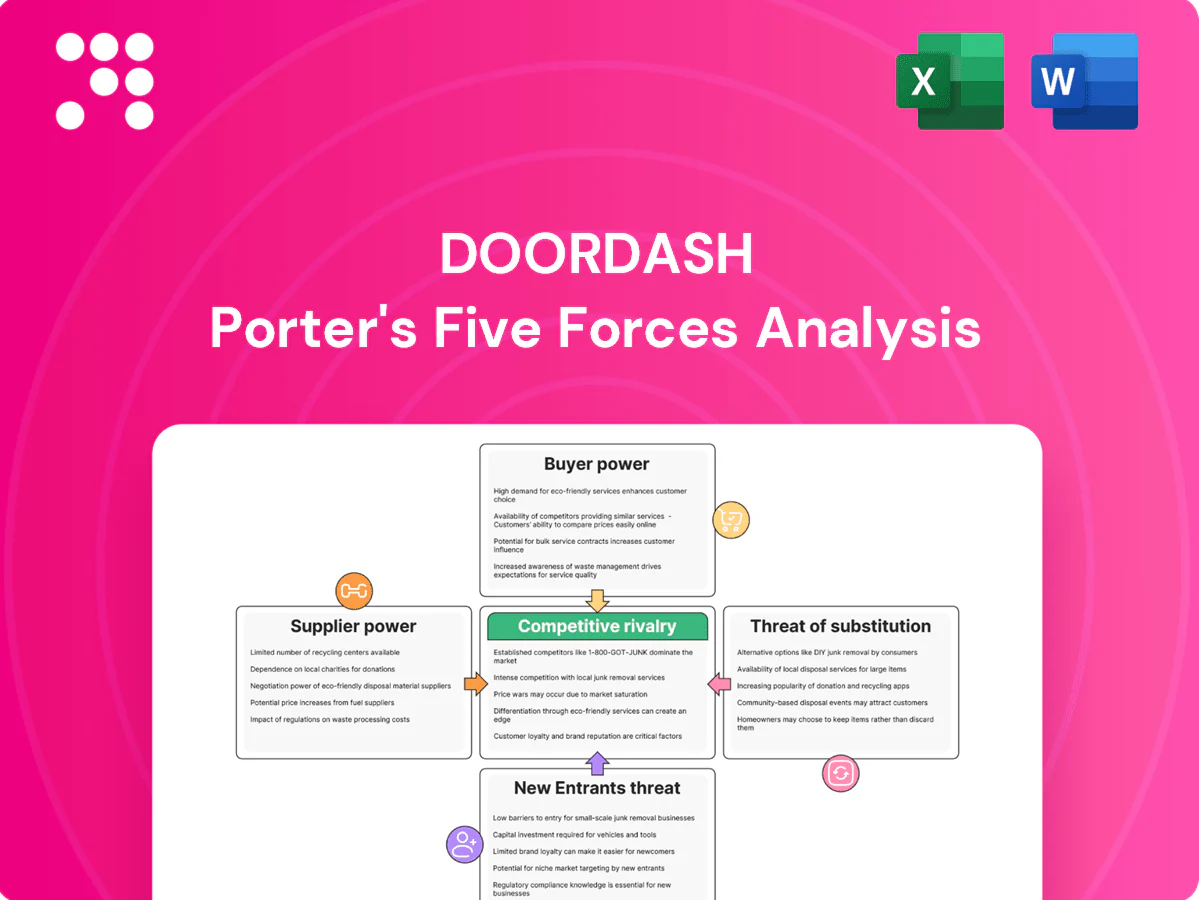
DoorDash Porter's Five Forces Analysis

Don't Miss the Bigger Picture
DoorDash faces intense rivalry and substitute threats, moderate supplier and buyer power, low switching costs, and variable entry barriers shaping its margins and growth opportunities. This brief snapshot only scratches the surface—unlock the full Porter's Five Forces Analysis to explore DoorDash’s competitive dynamics, market pressures, and strategic advantages in detail. Get the consultant-grade report to inform smarter investment and strategy decisions.
Suppliers Bargaining Power

Dasher labor leverage
Dasher labor is critical capacity and in 2024 tight labor markets and city rules (eg minimum per-delivery pay enacted in several US cities including New York and San Francisco) have increased Dasher bargaining power over pay and incentives. Classification and local pay floors shift economics toward drivers, forcing DoorDash to raise per-order guarantees. During supply squeezes (bad weather, holidays) DoorDash boosts promos to sustain fulfillment, raising variable costs and pressuring take rates.
Large chains’ negotiating clout
National chains leverage volume to demand lower commissions, better data access and co-marketing, with top chains accounting for roughly 60% of US third-party delivery GMV in 2024, enabling concessions like exclusive-menu rights and national partnership terms. Losing a marquee brand sharply reduces selection and conversion, amplifying their leverage. DoorDash offsets with paid ad placements and operational tools but unit margins compress.

Merchant multi-homing
Most merchants multi-home—over 70% of restaurants listed on multiple platforms in 2024—letting them play platforms off each other on commission rates and promos. Multi-homing lowers switching costs and dependence, forcing DoorDash to defend share with analytics, POS integrations and ad ROI; this dynamic constrains sustained take-rate expansion (DoorDash take-rate ~25% in 2024).

SMB lock-in via tools
DoorDash’s Storefront, POS integrations, and logistics APIs create workflow stickiness for SMBs by embedding ordering, loyalty, and dispatch into merchants’ daily operations, reducing willingness to switch or renegotiate; over time this tooling can shift bargaining power toward DoorDash, though comparable offerings from Uber Eats, Grubhub, and third-party POS vendors limit absolute leverage.
- Storefront + POS = higher switching costs
- Embedded loyalty/dispatch lowers churn
- Rival parity caps supplier power
Input cost pass-through
Fuel, insurance, and equipment costs borne by Dashers directly reduce expected earnings and influence incentive needs; in 2024 AAA showed U.S. average gasoline near $3.50/gal and DoorDash reported roughly 2 million active Dashers, increasing sensitivity to cost swings. Spikes have forced pay bumps or temporary surcharges, raising COGS while DoorDash's limited ability to fully pass costs to consumers or merchants tightens margins, so suppliers indirectly exert pricing pressure.
- Fuel: AAA 2024 avg ~$3.50/gal
- Dashers: ~2M active (2024)
- Result: higher COGS via pay/surcharges
- Impact: compressed margins, indirect supplier pricing pressure
Labor leverage: ~2M drivers, top chains ~60% GMV, multi-homing 70%+, take-rate ~25%
Supplier power in 2024 is elevated: Dashers (~2M active) and local pay floors raise labor leverage, fueling higher per-order guarantees; top chains drive ~60% of US third-party delivery GMV and extract lower commissions; multi-homing (70%+ restaurants) caps sustained take-rate growth (DoorDash ~25%); fuel ~$3.50/gal widens incentive costs and compresses margins.
| Metric | 2024 |
|---|---|
| Dashers (active) | ~2M |
| Top chains GMV | ~60% |
| Multi-homing | 70%+ |
| DoorDash take-rate | ~25% |
| Avg gas (AAA) | $3.50/gal |
What is included in the product
 Detailed Word Document
Concise Porter’s Five Forces analysis tailored to DoorDash, examining competitive rivalry, buyer and supplier power, threat of new entrants and substitutes, and strategic levers that shape pricing, margins, and market positioning.

 Customizable Excel Spreadsheet
A clear one-sheet Porter's Five Forces for DoorDash that highlights driver bargaining power, platform rivalry, customer price sensitivity, restaurant integration threats and substitutes—ideal for quick strategic decisions and ready to drop into pitch decks.
Customers Bargaining Power

High price sensitivity
Consumers face delivery fees (roughly $3–$6 on average in 2024), platform service fees often 10–15% of the ticket and tips, making total cost salient; demand is elastic outside peak/urgent occasions, with studies showing 30–40% of users delaying orders for promotions. Frequent discounts condition buyers to wait, so small price hikes in 2024 quickly cut order frequency and reduce basket size.
Low switching costs
Low switching costs mean users routinely multi-home across DoorDash, Uber Eats and Grubhub; the top three held roughly 90% of US delivery volume in 2024 and DoorDash’s US share was about 60% in 2024. App switching is minimal and often promo-driven, with frequent discounts eroding loyalty. Feature parity — live tracking and ETAs — keeps differentiation modest and elevates buyer power, forcing ongoing promotional spend.

DashPass trade-offs
DashPass reduces perceived fees and drives loyalty—about 25 million subscribers in 2024—lowering churn by boosting repeat orders. Members expect reliable ETAs and wide selection, raising fulfillment and marketplace requirements. If perceived benefits erode, churn and negative word-of-mouth spike quickly. Pricing DashPass therefore requires careful, data-driven value management to sustain margins and retention.

Category/time elasticity
Category/time elasticity: convenience and late-night food orders show lower price elasticity than everyday meals, while grocery baskets — although larger — are more fee-sensitive; weather and major events temporarily lower elasticity. DoorDash held roughly 55–60% US food-delivery share in 2024 and reported a platform AOV near $28–30 in 2023, so pricing must be tuned by cohort and daypart.
- late-night: higher fee tolerance
- everyday meals: price-sensitive
- grocery: larger AOV, higher elasticity
- events/weather: elasticity drops, demand spikes
Ratings and transparency
Ratings, live tracking and visible refund policies give customers strong leverage over DoorDash; in 2024 DoorDash held roughly 70% US food-delivery market share, so poor delivery experiences trigger immediate switching and churn. Easy refunds reduce complaints but add operational costs (refunds estimated to impact low-single-digit percent of revenue). Visible fee and ETA comparisons further intensify buyer bargaining power.
- Reviews drive switching and conversion
- Live tracking raises service expectations
- Refunds cut dissatisfaction but add ~1%+ cost
- Visible fees/ETAs increase price sensitivity
Customers wield leverage: $3–6; 10–15%; 60% (fees, service, market)
Customers hold strong bargaining power: visible fees ($3–6 delivery, 10–15% service), high switching (top3 ≈90% volume; DoorDash ≈60% US share in 2024) and promo-driven loyalty; DashPass (≈25M subs) reduces churn but margins hinge on pricing; AOV ~$28–30 (2023) and refunds ≈1% revenue raise cost sensitivity.
| Metric | 2023–24 |
|---|---|
| Delivery fee | $3–6 |
| Service fee | 10–15% |
| DoorDash US share | ≈60% |
| DashPass subs | ≈25M |
| AOV | $28–30 |
Full Version Awaits
DoorDash Porter's Five Forces Analysis
This preview shows the exact DoorDash Porter's Five Forces analysis you'll receive immediately after purchase—no placeholders. The file is fully formatted, professionally written, and ready to download and use once you buy. No mockups or samples; this is the actual deliverable.

Don't Miss the Bigger Picture
DoorDash faces intense rivalry and substitute threats, moderate supplier and buyer power, low switching costs, and variable entry barriers shaping its margins and growth opportunities. This brief snapshot only scratches the surface—unlock the full Porter's Five Forces Analysis to explore DoorDash’s competitive dynamics, market pressures, and strategic advantages in detail. Get the consultant-grade report to inform smarter investment and strategy decisions.
Suppliers Bargaining Power
Dasher labor leverage
Dasher labor is critical capacity and in 2024 tight labor markets and city rules (eg minimum per-delivery pay enacted in several US cities including New York and San Francisco) have increased Dasher bargaining power over pay and incentives. Classification and local pay floors shift economics toward drivers, forcing DoorDash to raise per-order guarantees. During supply squeezes (bad weather, holidays) DoorDash boosts promos to sustain fulfillment, raising variable costs and pressuring take rates.
Large chains’ negotiating clout
National chains leverage volume to demand lower commissions, better data access and co-marketing, with top chains accounting for roughly 60% of US third-party delivery GMV in 2024, enabling concessions like exclusive-menu rights and national partnership terms. Losing a marquee brand sharply reduces selection and conversion, amplifying their leverage. DoorDash offsets with paid ad placements and operational tools but unit margins compress.
Merchant multi-homing
Most merchants multi-home—over 70% of restaurants listed on multiple platforms in 2024—letting them play platforms off each other on commission rates and promos. Multi-homing lowers switching costs and dependence, forcing DoorDash to defend share with analytics, POS integrations and ad ROI; this dynamic constrains sustained take-rate expansion (DoorDash take-rate ~25% in 2024).
SMB lock-in via tools
DoorDash’s Storefront, POS integrations, and logistics APIs create workflow stickiness for SMBs by embedding ordering, loyalty, and dispatch into merchants’ daily operations, reducing willingness to switch or renegotiate; over time this tooling can shift bargaining power toward DoorDash, though comparable offerings from Uber Eats, Grubhub, and third-party POS vendors limit absolute leverage.
- Storefront + POS = higher switching costs
- Embedded loyalty/dispatch lowers churn
- Rival parity caps supplier power
Input cost pass-through
Fuel, insurance, and equipment costs borne by Dashers directly reduce expected earnings and influence incentive needs; in 2024 AAA showed U.S. average gasoline near $3.50/gal and DoorDash reported roughly 2 million active Dashers, increasing sensitivity to cost swings. Spikes have forced pay bumps or temporary surcharges, raising COGS while DoorDash's limited ability to fully pass costs to consumers or merchants tightens margins, so suppliers indirectly exert pricing pressure.
- Fuel: AAA 2024 avg ~$3.50/gal
- Dashers: ~2M active (2024)
- Result: higher COGS via pay/surcharges
- Impact: compressed margins, indirect supplier pricing pressure
Labor leverage: ~2M drivers, top chains ~60% GMV, multi-homing 70%+, take-rate ~25%
Supplier power in 2024 is elevated: Dashers (~2M active) and local pay floors raise labor leverage, fueling higher per-order guarantees; top chains drive ~60% of US third-party delivery GMV and extract lower commissions; multi-homing (70%+ restaurants) caps sustained take-rate growth (DoorDash ~25%); fuel ~$3.50/gal widens incentive costs and compresses margins.
| Metric | 2024 |
|---|---|
| Dashers (active) | ~2M |
| Top chains GMV | ~60% |
| Multi-homing | 70%+ |
| DoorDash take-rate | ~25% |
| Avg gas (AAA) | $3.50/gal |
What is included in the product
Detailed Word Document
Concise Porter’s Five Forces analysis tailored to DoorDash, examining competitive rivalry, buyer and supplier power, threat of new entrants and substitutes, and strategic levers that shape pricing, margins, and market positioning.
Customizable Excel Spreadsheet
A clear one-sheet Porter's Five Forces for DoorDash that highlights driver bargaining power, platform rivalry, customer price sensitivity, restaurant integration threats and substitutes—ideal for quick strategic decisions and ready to drop into pitch decks.
Customers Bargaining Power
High price sensitivity
Consumers face delivery fees (roughly $3–$6 on average in 2024), platform service fees often 10–15% of the ticket and tips, making total cost salient; demand is elastic outside peak/urgent occasions, with studies showing 30–40% of users delaying orders for promotions. Frequent discounts condition buyers to wait, so small price hikes in 2024 quickly cut order frequency and reduce basket size.
Low switching costs
Low switching costs mean users routinely multi-home across DoorDash, Uber Eats and Grubhub; the top three held roughly 90% of US delivery volume in 2024 and DoorDash’s US share was about 60% in 2024. App switching is minimal and often promo-driven, with frequent discounts eroding loyalty. Feature parity — live tracking and ETAs — keeps differentiation modest and elevates buyer power, forcing ongoing promotional spend.
DashPass trade-offs
DashPass reduces perceived fees and drives loyalty—about 25 million subscribers in 2024—lowering churn by boosting repeat orders. Members expect reliable ETAs and wide selection, raising fulfillment and marketplace requirements. If perceived benefits erode, churn and negative word-of-mouth spike quickly. Pricing DashPass therefore requires careful, data-driven value management to sustain margins and retention.
Category/time elasticity
Category/time elasticity: convenience and late-night food orders show lower price elasticity than everyday meals, while grocery baskets — although larger — are more fee-sensitive; weather and major events temporarily lower elasticity. DoorDash held roughly 55–60% US food-delivery share in 2024 and reported a platform AOV near $28–30 in 2023, so pricing must be tuned by cohort and daypart.
- late-night: higher fee tolerance
- everyday meals: price-sensitive
- grocery: larger AOV, higher elasticity
- events/weather: elasticity drops, demand spikes
Ratings and transparency
Ratings, live tracking and visible refund policies give customers strong leverage over DoorDash; in 2024 DoorDash held roughly 70% US food-delivery market share, so poor delivery experiences trigger immediate switching and churn. Easy refunds reduce complaints but add operational costs (refunds estimated to impact low-single-digit percent of revenue). Visible fee and ETA comparisons further intensify buyer bargaining power.
- Reviews drive switching and conversion
- Live tracking raises service expectations
- Refunds cut dissatisfaction but add ~1%+ cost
- Visible fees/ETAs increase price sensitivity
Customers wield leverage: $3–6; 10–15%; 60% (fees, service, market)
Customers hold strong bargaining power: visible fees ($3–6 delivery, 10–15% service), high switching (top3 ≈90% volume; DoorDash ≈60% US share in 2024) and promo-driven loyalty; DashPass (≈25M subs) reduces churn but margins hinge on pricing; AOV ~$28–30 (2023) and refunds ≈1% revenue raise cost sensitivity.
| Metric | 2023–24 |
|---|---|
| Delivery fee | $3–6 |
| Service fee | 10–15% |
| DoorDash US share | ≈60% |
| DashPass subs | ≈25M |
| AOV | $28–30 |
Full Version Awaits
DoorDash Porter's Five Forces Analysis
This preview shows the exact DoorDash Porter's Five Forces analysis you'll receive immediately after purchase—no placeholders. The file is fully formatted, professionally written, and ready to download and use once you buy. No mockups or samples; this is the actual deliverable.
Original: $10.00
-65%$10.00
$3.50Description
Don't Miss the Bigger Picture
DoorDash faces intense rivalry and substitute threats, moderate supplier and buyer power, low switching costs, and variable entry barriers shaping its margins and growth opportunities. This brief snapshot only scratches the surface—unlock the full Porter's Five Forces Analysis to explore DoorDash’s competitive dynamics, market pressures, and strategic advantages in detail. Get the consultant-grade report to inform smarter investment and strategy decisions.
Suppliers Bargaining Power
Dasher labor leverage
Dasher labor is critical capacity and in 2024 tight labor markets and city rules (eg minimum per-delivery pay enacted in several US cities including New York and San Francisco) have increased Dasher bargaining power over pay and incentives. Classification and local pay floors shift economics toward drivers, forcing DoorDash to raise per-order guarantees. During supply squeezes (bad weather, holidays) DoorDash boosts promos to sustain fulfillment, raising variable costs and pressuring take rates.
Large chains’ negotiating clout
National chains leverage volume to demand lower commissions, better data access and co-marketing, with top chains accounting for roughly 60% of US third-party delivery GMV in 2024, enabling concessions like exclusive-menu rights and national partnership terms. Losing a marquee brand sharply reduces selection and conversion, amplifying their leverage. DoorDash offsets with paid ad placements and operational tools but unit margins compress.
Merchant multi-homing
Most merchants multi-home—over 70% of restaurants listed on multiple platforms in 2024—letting them play platforms off each other on commission rates and promos. Multi-homing lowers switching costs and dependence, forcing DoorDash to defend share with analytics, POS integrations and ad ROI; this dynamic constrains sustained take-rate expansion (DoorDash take-rate ~25% in 2024).
SMB lock-in via tools
DoorDash’s Storefront, POS integrations, and logistics APIs create workflow stickiness for SMBs by embedding ordering, loyalty, and dispatch into merchants’ daily operations, reducing willingness to switch or renegotiate; over time this tooling can shift bargaining power toward DoorDash, though comparable offerings from Uber Eats, Grubhub, and third-party POS vendors limit absolute leverage.
- Storefront + POS = higher switching costs
- Embedded loyalty/dispatch lowers churn
- Rival parity caps supplier power
Input cost pass-through
Fuel, insurance, and equipment costs borne by Dashers directly reduce expected earnings and influence incentive needs; in 2024 AAA showed U.S. average gasoline near $3.50/gal and DoorDash reported roughly 2 million active Dashers, increasing sensitivity to cost swings. Spikes have forced pay bumps or temporary surcharges, raising COGS while DoorDash's limited ability to fully pass costs to consumers or merchants tightens margins, so suppliers indirectly exert pricing pressure.
- Fuel: AAA 2024 avg ~$3.50/gal
- Dashers: ~2M active (2024)
- Result: higher COGS via pay/surcharges
- Impact: compressed margins, indirect supplier pricing pressure
Labor leverage: ~2M drivers, top chains ~60% GMV, multi-homing 70%+, take-rate ~25%
Supplier power in 2024 is elevated: Dashers (~2M active) and local pay floors raise labor leverage, fueling higher per-order guarantees; top chains drive ~60% of US third-party delivery GMV and extract lower commissions; multi-homing (70%+ restaurants) caps sustained take-rate growth (DoorDash ~25%); fuel ~$3.50/gal widens incentive costs and compresses margins.
| Metric | 2024 |
|---|---|
| Dashers (active) | ~2M |
| Top chains GMV | ~60% |
| Multi-homing | 70%+ |
| DoorDash take-rate | ~25% |
| Avg gas (AAA) | $3.50/gal |
What is included in the product
Detailed Word Document
Concise Porter’s Five Forces analysis tailored to DoorDash, examining competitive rivalry, buyer and supplier power, threat of new entrants and substitutes, and strategic levers that shape pricing, margins, and market positioning.
Customizable Excel Spreadsheet
A clear one-sheet Porter's Five Forces for DoorDash that highlights driver bargaining power, platform rivalry, customer price sensitivity, restaurant integration threats and substitutes—ideal for quick strategic decisions and ready to drop into pitch decks.
Customers Bargaining Power
High price sensitivity
Consumers face delivery fees (roughly $3–$6 on average in 2024), platform service fees often 10–15% of the ticket and tips, making total cost salient; demand is elastic outside peak/urgent occasions, with studies showing 30–40% of users delaying orders for promotions. Frequent discounts condition buyers to wait, so small price hikes in 2024 quickly cut order frequency and reduce basket size.
Low switching costs
Low switching costs mean users routinely multi-home across DoorDash, Uber Eats and Grubhub; the top three held roughly 90% of US delivery volume in 2024 and DoorDash’s US share was about 60% in 2024. App switching is minimal and often promo-driven, with frequent discounts eroding loyalty. Feature parity — live tracking and ETAs — keeps differentiation modest and elevates buyer power, forcing ongoing promotional spend.
DashPass trade-offs
DashPass reduces perceived fees and drives loyalty—about 25 million subscribers in 2024—lowering churn by boosting repeat orders. Members expect reliable ETAs and wide selection, raising fulfillment and marketplace requirements. If perceived benefits erode, churn and negative word-of-mouth spike quickly. Pricing DashPass therefore requires careful, data-driven value management to sustain margins and retention.
Category/time elasticity
Category/time elasticity: convenience and late-night food orders show lower price elasticity than everyday meals, while grocery baskets — although larger — are more fee-sensitive; weather and major events temporarily lower elasticity. DoorDash held roughly 55–60% US food-delivery share in 2024 and reported a platform AOV near $28–30 in 2023, so pricing must be tuned by cohort and daypart.
- late-night: higher fee tolerance
- everyday meals: price-sensitive
- grocery: larger AOV, higher elasticity
- events/weather: elasticity drops, demand spikes
Ratings and transparency
Ratings, live tracking and visible refund policies give customers strong leverage over DoorDash; in 2024 DoorDash held roughly 70% US food-delivery market share, so poor delivery experiences trigger immediate switching and churn. Easy refunds reduce complaints but add operational costs (refunds estimated to impact low-single-digit percent of revenue). Visible fee and ETA comparisons further intensify buyer bargaining power.
- Reviews drive switching and conversion
- Live tracking raises service expectations
- Refunds cut dissatisfaction but add ~1%+ cost
- Visible fees/ETAs increase price sensitivity
Customers wield leverage: $3–6; 10–15%; 60% (fees, service, market)
Customers hold strong bargaining power: visible fees ($3–6 delivery, 10–15% service), high switching (top3 ≈90% volume; DoorDash ≈60% US share in 2024) and promo-driven loyalty; DashPass (≈25M subs) reduces churn but margins hinge on pricing; AOV ~$28–30 (2023) and refunds ≈1% revenue raise cost sensitivity.
| Metric | 2023–24 |
|---|---|
| Delivery fee | $3–6 |
| Service fee | 10–15% |
| DoorDash US share | ≈60% |
| DashPass subs | ≈25M |
| AOV | $28–30 |
Full Version Awaits
DoorDash Porter's Five Forces Analysis
This preview shows the exact DoorDash Porter's Five Forces analysis you'll receive immediately after purchase—no placeholders. The file is fully formatted, professionally written, and ready to download and use once you buy. No mockups or samples; this is the actual deliverable.











