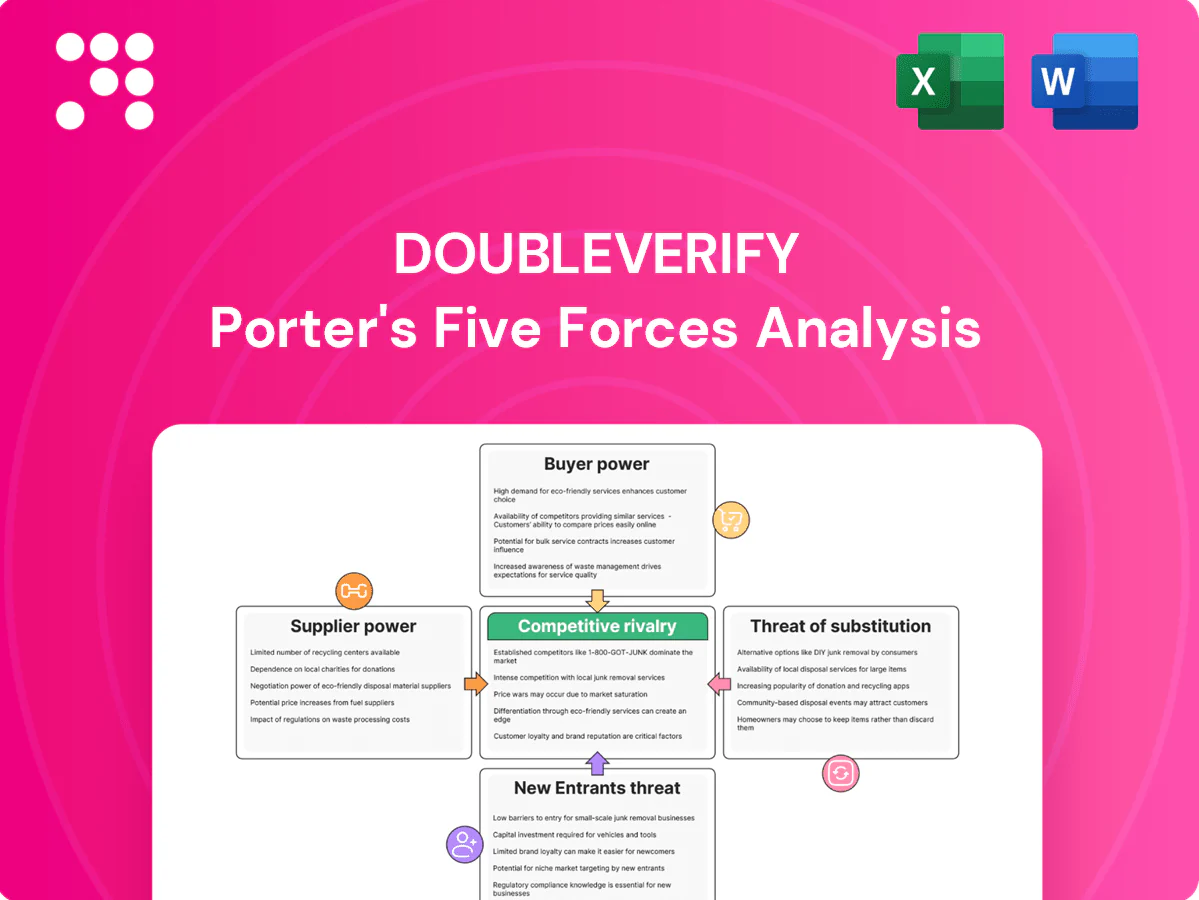
DoubleVerify Porter's Five Forces Analysis

Don't Miss the Bigger Picture
DoubleVerify’s Porter’s Five Forces analysis highlights intense buyer bargaining, moderate supplier power, rising threat of substitutes from integrated ad-tech stacks, and significant competitive rivalry in ad verification. This snapshot reveals key strategic risks and opportunities. Unlock the full report for force-by-force ratings, visuals, and actionable recommendations to inform investment or strategy decisions.
Suppliers Bargaining Power

Platform and API dependence
Access to walled gardens, DSPs, SSPs and CTV/device platforms is essential for tagging, log-level data and enforcement; API or policy changes by Google, Meta, Amazon, Roku or Apple can tighten access and raise costs, with Google+Meta controlling >60% of US digital ad spend in 2024. Renewal terms and rate limits shift bargaining power to platforms; diversifying integrations and maintaining certifications mitigates exposure.
Publisher and exchange inventory
Premium publishers and major SSPs, which control over 50% of premium programmatic inventory, shape data quality, page signals and ad-call priority, directly impacting DoubleVerify coverage. Preferential placement or throttling of verification tags by these partners can degrade coverage and increase latency, risking SLA breaches. Large publishers can negotiate fees or impose proprietary brand-safety standards; long-term integrations and performance guarantees help stabilize terms.

Cloud and data infrastructure
Reliance on hyperscalers (AWS 32%, Azure 23%, GCP 11% of IaaS in 2024) exposes DoubleVerify to pricing and egress fee risk—egress commonly $0.09–$0.12/GB—raising real-time processing costs at peak volumes. Committed-use discounts and multi-region deployments (savings up to ~70% with reserved/commit plans) and cost-optimized pipelines plus proprietary models reduce supplier leverage.

Third-party data and IDs
Contextual taxonomies, device graphs and identity solutions directly drive match rates and suitability accuracy; industry estimates in 2024 show a 30–50% reduction in deterministic match rates after third-party cookie decline, boosting the value and bargaining power of scarce identity/context suppliers who can impose minimums or exclusivity.
- impact: 30–50% drop in deterministic match rates (2024)
- supplier power: higher pricing, bundle minimums, exclusivity
- mitigation: invest in first-party signals and on-device models
Standards and accreditation bodies
Standards bodies MRC, TAG, and IAB act as quasi-suppliers of legitimacy for DoubleVerify; their 2024 guidance and audit criteria directly shape product roadmaps and time-to-market, with audit cycles typically annual and accreditation renewals imposing scheduling and cost dependencies. Maintaining compliance across multiple standards reduces leverage any single body can exert, but raises ongoing certification overhead and planning complexity.
- Annual audit cycles create fixed scheduling windows
- Renewals drive recurring cost and resource allocation
- Multi-standard compliance dilutes single-body bargaining power
Concentrated supply: platforms >60%, SSPs >50%, match 30-50%
Supplier leverage is high: Google+Meta >60% of US ad spend (2024) and premium SSPs control >50% programmatic inventory, enabling access/pricing pressure. Hyperscalers (AWS 32%, Azure 23%, GCP 11%) and egress fees ($0.09–$0.12/GB) raise processing costs. Identity/context suppliers drove a 30–50% drop in deterministic match rates (2024), increasing their bargaining power.
| Metric | Value | Impact |
|---|---|---|
| Google+Meta share | >60% | Access risk |
| Premium SSPs | >50% | Coverage/pricing |
| Hyperscalers | AWS32%/AZ23%/GCP11% | Egress cost |
| Match rate drop | 30–50% | Identity value |
What is included in the product
 Detailed Word Document
Uncovers key drivers of competition, customer influence, and market entry risks tailored to DoubleVerify; evaluates supplier/buyer power, threat of substitutes, rivalry intensity, and barriers protecting incumbents, highlighting disruptive threats and strategic implications for pricing and market share.

 Customizable Excel Spreadsheet
A concise one-sheet Porter's Five Forces for DoubleVerify that visualizes competitive pressures and lets you toggle scenarios (privacy shifts, adtech consolidation) to quickly surface strategic risks and actionable responses for board decks and investor briefs.
Customers Bargaining Power

Concentrated spend by large advertisers
Global brands and holding-company agencies aggregate enormous media budgets—Procter & Gamble spent about $10.7 billion on advertising in 2022 and major holding companies (WPP, Omnicom, Publicis) managed client billings in the low hundreds of billions by 2023. Their scale drives volume discounts, bespoke reporting and SLAs, and multi-year MSAs commonly compress per-impression pricing. Strong ROI proof points and DoubleVerify’s unique coverage limit customers’ ability to force deep discounts.
Multi-vendor strategies
Many buyers run IAS, DoubleVerify, and niche verification tools in parallel to hedge measurement risk, and these side-by-side pilots intensify price and feature competition among vendors. Standardized metrics like viewability and invalid traffic scores increase comparability and amplify switching threats. DoubleVerify’s differentiation in CTV, attention measurement, and outcome verification helps reduce commoditization by offering specialized capabilities buyers value.

Integration with buying platforms
Buyers increasingly prefer solutions embedded in DSPs, social and CTV platforms for simplicity, with ~85% of display buying programmatic in 2024 and US CTV ad spend topping $30B, shifting leverage to platforms when native tools seem good enough. Seamless workflows and sub-second enforcement drive retention, while deeper APIs and automated optimization materially raise integration stickiness.

Outcome-based pricing asks
Advertisers in 2024 increasingly demand outcome-based pricing tied to fraud avoided or attention gains, shifting downside risk to DoubleVerify and compressing vendor margins.
Buyers make causality and measurable uplift the core negotiation points, requiring attribution that links verification to incremental outcomes.
Robust experimentation and randomized control frameworks raise buyer trust, enabling vendors to reclaim pricing power by proving incremental value.
- Outcome-based asks
- Risk shifts to vendor
- Causality & uplift measurement
- Experimentation strengthens pricing
Regulatory and privacy requirements
Enterprise buyers in 2024 intensified demands for GDPR and CPRA compliance plus data minimization, raising expectations for contractual liability, indemnities, and data residency—which increases service complexity and integration costs. Buyers commonly delay or condition spend on verifiable compliance milestones, while proactive governance and certifications reduce procurement friction.
- Regulatory drivers: GDPR, CPRA (2024 enforcement focus)
- Contract risk: indemnities and data residency add service complexity
- Mitigation: SOC 2/ISO 27001 and verifiable governance ease procurement delays
Ad buyers demand outcomes; CTV attention metrics curb commoditization despite advertiser scale
Large advertisers and agencies (eg Procter & Gamble $10.7B ad spend 2022) exert strong price leverage, but DoubleVerify’s CTV, attention and outcome capabilities limit deep commoditization. Buyers run multiple verifiers and demand outcome-based pricing, shifting risk to vendors while standardized metrics and RCTs raise switching threats. Regulatory compliance (GDPR/CPRA) and integration needs increase procurement friction and deal complexity.
| Metric | Value (2024) |
|---|---|
| Programmatic display | ~85% |
| US CTV ad spend | $30B+ |
| Major advertiser scale | P&G $10.7B (2022) |
Preview Before You Purchase
DoubleVerify Porter's Five Forces Analysis
This preview shows the exact DoubleVerify Porter's Five Forces Analysis you'll receive after purchase—no mockups or placeholders. The full, professionally formatted document is ready for immediate download and use the moment you buy. What you see is precisely what will be delivered.

Don't Miss the Bigger Picture
DoubleVerify’s Porter’s Five Forces analysis highlights intense buyer bargaining, moderate supplier power, rising threat of substitutes from integrated ad-tech stacks, and significant competitive rivalry in ad verification. This snapshot reveals key strategic risks and opportunities. Unlock the full report for force-by-force ratings, visuals, and actionable recommendations to inform investment or strategy decisions.
Suppliers Bargaining Power
Platform and API dependence
Access to walled gardens, DSPs, SSPs and CTV/device platforms is essential for tagging, log-level data and enforcement; API or policy changes by Google, Meta, Amazon, Roku or Apple can tighten access and raise costs, with Google+Meta controlling >60% of US digital ad spend in 2024. Renewal terms and rate limits shift bargaining power to platforms; diversifying integrations and maintaining certifications mitigates exposure.
Publisher and exchange inventory
Premium publishers and major SSPs, which control over 50% of premium programmatic inventory, shape data quality, page signals and ad-call priority, directly impacting DoubleVerify coverage. Preferential placement or throttling of verification tags by these partners can degrade coverage and increase latency, risking SLA breaches. Large publishers can negotiate fees or impose proprietary brand-safety standards; long-term integrations and performance guarantees help stabilize terms.
Cloud and data infrastructure
Reliance on hyperscalers (AWS 32%, Azure 23%, GCP 11% of IaaS in 2024) exposes DoubleVerify to pricing and egress fee risk—egress commonly $0.09–$0.12/GB—raising real-time processing costs at peak volumes. Committed-use discounts and multi-region deployments (savings up to ~70% with reserved/commit plans) and cost-optimized pipelines plus proprietary models reduce supplier leverage.
Third-party data and IDs
Contextual taxonomies, device graphs and identity solutions directly drive match rates and suitability accuracy; industry estimates in 2024 show a 30–50% reduction in deterministic match rates after third-party cookie decline, boosting the value and bargaining power of scarce identity/context suppliers who can impose minimums or exclusivity.
- impact: 30–50% drop in deterministic match rates (2024)
- supplier power: higher pricing, bundle minimums, exclusivity
- mitigation: invest in first-party signals and on-device models
Standards and accreditation bodies
Standards bodies MRC, TAG, and IAB act as quasi-suppliers of legitimacy for DoubleVerify; their 2024 guidance and audit criteria directly shape product roadmaps and time-to-market, with audit cycles typically annual and accreditation renewals imposing scheduling and cost dependencies. Maintaining compliance across multiple standards reduces leverage any single body can exert, but raises ongoing certification overhead and planning complexity.
- Annual audit cycles create fixed scheduling windows
- Renewals drive recurring cost and resource allocation
- Multi-standard compliance dilutes single-body bargaining power
Concentrated supply: platforms >60%, SSPs >50%, match 30-50%
Supplier leverage is high: Google+Meta >60% of US ad spend (2024) and premium SSPs control >50% programmatic inventory, enabling access/pricing pressure. Hyperscalers (AWS 32%, Azure 23%, GCP 11%) and egress fees ($0.09–$0.12/GB) raise processing costs. Identity/context suppliers drove a 30–50% drop in deterministic match rates (2024), increasing their bargaining power.
| Metric | Value | Impact |
|---|---|---|
| Google+Meta share | >60% | Access risk |
| Premium SSPs | >50% | Coverage/pricing |
| Hyperscalers | AWS32%/AZ23%/GCP11% | Egress cost |
| Match rate drop | 30–50% | Identity value |
What is included in the product
Detailed Word Document
Uncovers key drivers of competition, customer influence, and market entry risks tailored to DoubleVerify; evaluates supplier/buyer power, threat of substitutes, rivalry intensity, and barriers protecting incumbents, highlighting disruptive threats and strategic implications for pricing and market share.
Customizable Excel Spreadsheet
A concise one-sheet Porter's Five Forces for DoubleVerify that visualizes competitive pressures and lets you toggle scenarios (privacy shifts, adtech consolidation) to quickly surface strategic risks and actionable responses for board decks and investor briefs.
Customers Bargaining Power
Concentrated spend by large advertisers
Global brands and holding-company agencies aggregate enormous media budgets—Procter & Gamble spent about $10.7 billion on advertising in 2022 and major holding companies (WPP, Omnicom, Publicis) managed client billings in the low hundreds of billions by 2023. Their scale drives volume discounts, bespoke reporting and SLAs, and multi-year MSAs commonly compress per-impression pricing. Strong ROI proof points and DoubleVerify’s unique coverage limit customers’ ability to force deep discounts.
Multi-vendor strategies
Many buyers run IAS, DoubleVerify, and niche verification tools in parallel to hedge measurement risk, and these side-by-side pilots intensify price and feature competition among vendors. Standardized metrics like viewability and invalid traffic scores increase comparability and amplify switching threats. DoubleVerify’s differentiation in CTV, attention measurement, and outcome verification helps reduce commoditization by offering specialized capabilities buyers value.
Integration with buying platforms
Buyers increasingly prefer solutions embedded in DSPs, social and CTV platforms for simplicity, with ~85% of display buying programmatic in 2024 and US CTV ad spend topping $30B, shifting leverage to platforms when native tools seem good enough. Seamless workflows and sub-second enforcement drive retention, while deeper APIs and automated optimization materially raise integration stickiness.
Outcome-based pricing asks
Advertisers in 2024 increasingly demand outcome-based pricing tied to fraud avoided or attention gains, shifting downside risk to DoubleVerify and compressing vendor margins.
Buyers make causality and measurable uplift the core negotiation points, requiring attribution that links verification to incremental outcomes.
Robust experimentation and randomized control frameworks raise buyer trust, enabling vendors to reclaim pricing power by proving incremental value.
- Outcome-based asks
- Risk shifts to vendor
- Causality & uplift measurement
- Experimentation strengthens pricing
Regulatory and privacy requirements
Enterprise buyers in 2024 intensified demands for GDPR and CPRA compliance plus data minimization, raising expectations for contractual liability, indemnities, and data residency—which increases service complexity and integration costs. Buyers commonly delay or condition spend on verifiable compliance milestones, while proactive governance and certifications reduce procurement friction.
- Regulatory drivers: GDPR, CPRA (2024 enforcement focus)
- Contract risk: indemnities and data residency add service complexity
- Mitigation: SOC 2/ISO 27001 and verifiable governance ease procurement delays
Ad buyers demand outcomes; CTV attention metrics curb commoditization despite advertiser scale
Large advertisers and agencies (eg Procter & Gamble $10.7B ad spend 2022) exert strong price leverage, but DoubleVerify’s CTV, attention and outcome capabilities limit deep commoditization. Buyers run multiple verifiers and demand outcome-based pricing, shifting risk to vendors while standardized metrics and RCTs raise switching threats. Regulatory compliance (GDPR/CPRA) and integration needs increase procurement friction and deal complexity.
| Metric | Value (2024) |
|---|---|
| Programmatic display | ~85% |
| US CTV ad spend | $30B+ |
| Major advertiser scale | P&G $10.7B (2022) |
Preview Before You Purchase
DoubleVerify Porter's Five Forces Analysis
This preview shows the exact DoubleVerify Porter's Five Forces Analysis you'll receive after purchase—no mockups or placeholders. The full, professionally formatted document is ready for immediate download and use the moment you buy. What you see is precisely what will be delivered.
Original: $10.00
-65%$10.00
$3.50Description
Don't Miss the Bigger Picture
DoubleVerify’s Porter’s Five Forces analysis highlights intense buyer bargaining, moderate supplier power, rising threat of substitutes from integrated ad-tech stacks, and significant competitive rivalry in ad verification. This snapshot reveals key strategic risks and opportunities. Unlock the full report for force-by-force ratings, visuals, and actionable recommendations to inform investment or strategy decisions.
Suppliers Bargaining Power
Platform and API dependence
Access to walled gardens, DSPs, SSPs and CTV/device platforms is essential for tagging, log-level data and enforcement; API or policy changes by Google, Meta, Amazon, Roku or Apple can tighten access and raise costs, with Google+Meta controlling >60% of US digital ad spend in 2024. Renewal terms and rate limits shift bargaining power to platforms; diversifying integrations and maintaining certifications mitigates exposure.
Publisher and exchange inventory
Premium publishers and major SSPs, which control over 50% of premium programmatic inventory, shape data quality, page signals and ad-call priority, directly impacting DoubleVerify coverage. Preferential placement or throttling of verification tags by these partners can degrade coverage and increase latency, risking SLA breaches. Large publishers can negotiate fees or impose proprietary brand-safety standards; long-term integrations and performance guarantees help stabilize terms.
Cloud and data infrastructure
Reliance on hyperscalers (AWS 32%, Azure 23%, GCP 11% of IaaS in 2024) exposes DoubleVerify to pricing and egress fee risk—egress commonly $0.09–$0.12/GB—raising real-time processing costs at peak volumes. Committed-use discounts and multi-region deployments (savings up to ~70% with reserved/commit plans) and cost-optimized pipelines plus proprietary models reduce supplier leverage.
Third-party data and IDs
Contextual taxonomies, device graphs and identity solutions directly drive match rates and suitability accuracy; industry estimates in 2024 show a 30–50% reduction in deterministic match rates after third-party cookie decline, boosting the value and bargaining power of scarce identity/context suppliers who can impose minimums or exclusivity.
- impact: 30–50% drop in deterministic match rates (2024)
- supplier power: higher pricing, bundle minimums, exclusivity
- mitigation: invest in first-party signals and on-device models
Standards and accreditation bodies
Standards bodies MRC, TAG, and IAB act as quasi-suppliers of legitimacy for DoubleVerify; their 2024 guidance and audit criteria directly shape product roadmaps and time-to-market, with audit cycles typically annual and accreditation renewals imposing scheduling and cost dependencies. Maintaining compliance across multiple standards reduces leverage any single body can exert, but raises ongoing certification overhead and planning complexity.
- Annual audit cycles create fixed scheduling windows
- Renewals drive recurring cost and resource allocation
- Multi-standard compliance dilutes single-body bargaining power
Concentrated supply: platforms >60%, SSPs >50%, match 30-50%
Supplier leverage is high: Google+Meta >60% of US ad spend (2024) and premium SSPs control >50% programmatic inventory, enabling access/pricing pressure. Hyperscalers (AWS 32%, Azure 23%, GCP 11%) and egress fees ($0.09–$0.12/GB) raise processing costs. Identity/context suppliers drove a 30–50% drop in deterministic match rates (2024), increasing their bargaining power.
| Metric | Value | Impact |
|---|---|---|
| Google+Meta share | >60% | Access risk |
| Premium SSPs | >50% | Coverage/pricing |
| Hyperscalers | AWS32%/AZ23%/GCP11% | Egress cost |
| Match rate drop | 30–50% | Identity value |
What is included in the product
Detailed Word Document
Uncovers key drivers of competition, customer influence, and market entry risks tailored to DoubleVerify; evaluates supplier/buyer power, threat of substitutes, rivalry intensity, and barriers protecting incumbents, highlighting disruptive threats and strategic implications for pricing and market share.
Customizable Excel Spreadsheet
A concise one-sheet Porter's Five Forces for DoubleVerify that visualizes competitive pressures and lets you toggle scenarios (privacy shifts, adtech consolidation) to quickly surface strategic risks and actionable responses for board decks and investor briefs.
Customers Bargaining Power
Concentrated spend by large advertisers
Global brands and holding-company agencies aggregate enormous media budgets—Procter & Gamble spent about $10.7 billion on advertising in 2022 and major holding companies (WPP, Omnicom, Publicis) managed client billings in the low hundreds of billions by 2023. Their scale drives volume discounts, bespoke reporting and SLAs, and multi-year MSAs commonly compress per-impression pricing. Strong ROI proof points and DoubleVerify’s unique coverage limit customers’ ability to force deep discounts.
Multi-vendor strategies
Many buyers run IAS, DoubleVerify, and niche verification tools in parallel to hedge measurement risk, and these side-by-side pilots intensify price and feature competition among vendors. Standardized metrics like viewability and invalid traffic scores increase comparability and amplify switching threats. DoubleVerify’s differentiation in CTV, attention measurement, and outcome verification helps reduce commoditization by offering specialized capabilities buyers value.
Integration with buying platforms
Buyers increasingly prefer solutions embedded in DSPs, social and CTV platforms for simplicity, with ~85% of display buying programmatic in 2024 and US CTV ad spend topping $30B, shifting leverage to platforms when native tools seem good enough. Seamless workflows and sub-second enforcement drive retention, while deeper APIs and automated optimization materially raise integration stickiness.
Outcome-based pricing asks
Advertisers in 2024 increasingly demand outcome-based pricing tied to fraud avoided or attention gains, shifting downside risk to DoubleVerify and compressing vendor margins.
Buyers make causality and measurable uplift the core negotiation points, requiring attribution that links verification to incremental outcomes.
Robust experimentation and randomized control frameworks raise buyer trust, enabling vendors to reclaim pricing power by proving incremental value.
- Outcome-based asks
- Risk shifts to vendor
- Causality & uplift measurement
- Experimentation strengthens pricing
Regulatory and privacy requirements
Enterprise buyers in 2024 intensified demands for GDPR and CPRA compliance plus data minimization, raising expectations for contractual liability, indemnities, and data residency—which increases service complexity and integration costs. Buyers commonly delay or condition spend on verifiable compliance milestones, while proactive governance and certifications reduce procurement friction.
- Regulatory drivers: GDPR, CPRA (2024 enforcement focus)
- Contract risk: indemnities and data residency add service complexity
- Mitigation: SOC 2/ISO 27001 and verifiable governance ease procurement delays
Ad buyers demand outcomes; CTV attention metrics curb commoditization despite advertiser scale
Large advertisers and agencies (eg Procter & Gamble $10.7B ad spend 2022) exert strong price leverage, but DoubleVerify’s CTV, attention and outcome capabilities limit deep commoditization. Buyers run multiple verifiers and demand outcome-based pricing, shifting risk to vendors while standardized metrics and RCTs raise switching threats. Regulatory compliance (GDPR/CPRA) and integration needs increase procurement friction and deal complexity.
| Metric | Value (2024) |
|---|---|
| Programmatic display | ~85% |
| US CTV ad spend | $30B+ |
| Major advertiser scale | P&G $10.7B (2022) |
Preview Before You Purchase
DoubleVerify Porter's Five Forces Analysis
This preview shows the exact DoubleVerify Porter's Five Forces Analysis you'll receive after purchase—no mockups or placeholders. The full, professionally formatted document is ready for immediate download and use the moment you buy. What you see is precisely what will be delivered.











