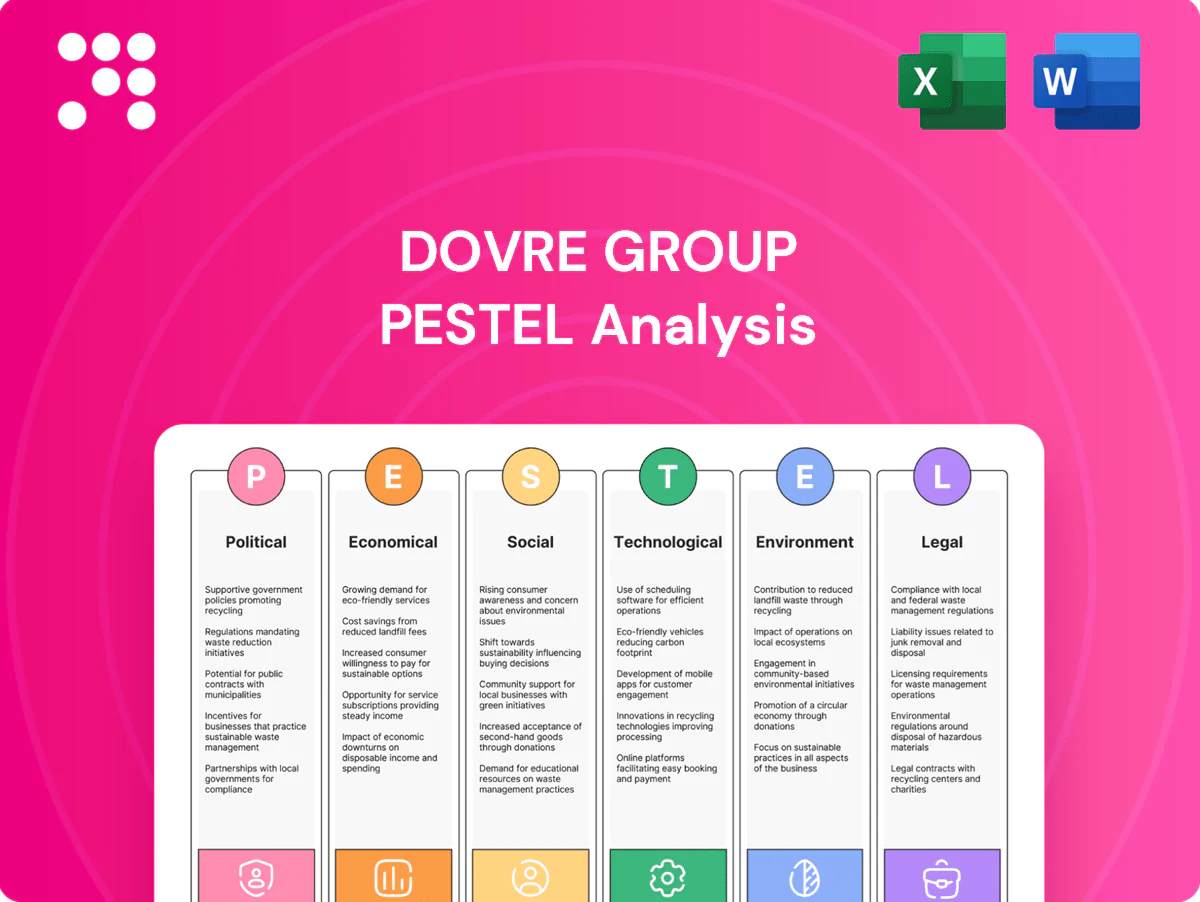
Dovre Group PESTLE Analysis

Plan Smarter. Present Sharper. Compete Stronger.
Unlock how political shifts, economic cycles and tech trends are shaping Dovre Group’s strategic position with our concise PESTLE analysis. Perfect for investors and strategists, it highlights risks and growth levers you can act on today. Purchase the full report to get the deep-dive data, editable charts, and actionable recommendations immediately.
Political factors

Energy and infrastructure policy shifts
Government priorities in the energy transition and EU/ national infrastructure stimulus — e.g., NextGenerationEU €806.9bn and REPowerEU ~€300bn — drive consulting and staffing pipelines, boosting demand for project delivery. Policy reversals or election cycles routinely delay approvals and funding, creating timing risk. Dovre must track national roadmaps to align bids and allocate resources, and proactively engage public-sector stakeholders to mitigate volatility.
Geopolitical tensions and sanctions
Sanctions and trade restrictions disrupt cross-border projects, supplier chains and expert mobility, with seaborne trade carrying roughly 80% of global goods by volume (UNCTAD) increasing exposure for Dovre’s projects. Energy and maritime clients face embargo risks and route disruptions after EU cut Russian gas imports by ~70% in 2023. Dovre requires strict screening, sanctions compliance and contingency planning for sanctioned entities. Scenario planning strengthens schedule and cost resilience.

Public procurement and localization
Large projects in Norway often mandate local content, joint ventures and strict public procurement compliance, with Norwegian public procurement valued at roughly NOK 700 billion annually (2023–24). Tender rules frequently favor domestic firms or specific certifications; Dovre leverages local partnerships and aligned credentials to strengthen bids. Transparent bid governance in Norway lowers protest incidence and contract delays.

Regulatory certainty and permitting timelines
Lengthy permits create schedule risk and cash-flow strain: GAO 2021 found NEPA reviews for major infrastructure averaged about 4.5 years, and rising interest rates in 2022–24 increased carrying costs; regulatory clarity accelerates FIDs and staffing ramps, Dovre adds measurable value in multi-agency coordination, and early regulatory mapping shortens the critical path.
- Permitting delays ≈4.5 years (GAO 2021)
- Delays = schedule risk + cash-flow strain
- Clarity → faster FID and staffing
- Dovre strength: multi-agency coordination
- Early mapping cuts critical-path time
Political stability and security
Civil unrest and security risks constrain site access, raise insurance and contractor safety costs, and have driven global project delays in recent years as geopolitical volatility increased. Stable jurisdictions enable predictable execution, faster talent deployment and lower disruption risk, supporting on-time delivery and margin protection. Dovre should tier markets by risk and adjust contract terms, insurance and mobilization plans; robust security protocols protect personnel and schedules.
- Tier markets by political risk
- Adjust contract/insurance terms
- Invest in security protocols
- Prioritize stable jurisdictions for critical projects
EU push €806.9bn, ~70% gas cut, Norway NOK700bn
Political drivers—EU fiscal stimuli (NextGenerationEU €806.9bn, REPowerEU ~€300bn) and national infrastructure pipelines boost demand, while election cycles and policy reversals create timing risk. Sanctions and a ~70% drop in EU Russian gas imports (2023) raise supply-chain and mobility constraints. Norway public procurement ≈NOK 700bn; permitting delays ≈4.5 years require early regulatory mapping.
| Factor | Metric |
|---|---|
| EU stimulus | €806.9bn / €300bn |
| Gas import cut | ~70% (2023) |
| Norway procurement | NOK 700bn |
| Permitting delay | ≈4.5 yrs |
What is included in the product
 Detailed Word Document
Examines how Political, Economic, Social, Technological, Environmental and Legal forces specifically impact Dovre Group, combining data-driven trends and regional/industry context. Designed for executives and investors, it flags risks and actionable opportunities with forward-looking insights for strategy and financing.

 Customizable Excel Spreadsheet
A concise, visually segmented PESTLE summary for Dovre Group that simplifies external risk assessment and market positioning, is easily shared or dropped into presentations, and allows quick annotations for regional or business-line context.
Economic factors

Commodity and capex cycles
Price swings in oil, gas, metals and power directly drive client capex and project starts; global energy investment reached about $2.4 trillion in 2023 (IEA), underlining scale sensitivity to commodity moves. Upcycles expand demand for front-end consulting and EPC support, while downcycles shift spending to cost optimization and asset integrity. Dovre can balance exposure across sectors and offer countercyclical services to retain utilization and smooth revenues.
Inflation and interest rates
High inflation (headline >3% in major markets) and policy rates at roughly 4–5.5% push project WACC higher and EPC costs up — industry EPC escalation ran around 8–12% in 2023–24, delaying FIDs. Escalation pressures make index-linked contracts and tight cost control essential, while Dovre should explicitly price 6–9% wage and travel inflation for expert personnel. Tighter payment terms and larger cash buffers become critical to manage timing risk.

Currency volatility
Multi-country delivery exposes Dovre Group revenues and payrolls to FX swings, a risk amplified in a global FX market with average daily turnover of about $7.5 trillion (BIS 2022). Mismatched billing and wage currencies can compress margins when exchange rates move unfavorably. Hedging strategies and natural currency offsets materially reduce net exposure. Contract clauses for FX adjustments help protect profitability.

Labor market tightness
- Skilled shortage
- Wage-driven cost pressure
- Global talent mobility
- Upskilling & retention
Client consolidation and procurement pressure
M&A among energy and infrastructure owners in 2024 concentrated buying power, driving larger framework agreements and rate-card procurement that compress margins while providing multi-year volume visibility for suppliers.
Dovre can command premium pricing through schedule certainty and niche technical expertise, turning time performance into a differentiator that supports higher win-rates despite tighter rates.
Embedding measurable performance KPIs into contracts—on-time delivery, safety incidence, and punch-list completion—secures renewals and can shift frameworks toward value-based uplifts.
- 2024: consolidation increased buyer leverage
- Frameworks = lower margins, higher volume visibility
- Dovre differentiation: schedule certainty, niche skills
- KPI-backed renewals drive contract longevity
EU push €806.9bn, ~70% gas cut, Norway NOK700bn
Price swings (IEA: $2.4T global energy investment 2023) drive capex and FIDs; upcycles boost consulting/EPC, downcycles shift spend to cost optimisation. Inflation >3% and policy rates ~4–5.5% raised WACC and EPC escalation ~8–12% (2023–24), forcing index-linked contracts and 6–9% wage/travel uplifts. FX volatility (BIS $7.5T/day) and tight labour (Norway unemployment ~3.2% 2024) require hedging, mobility and retention.
| Metric | 2023–24 |
|---|---|
| Energy investment | $2.4T |
| EPC escalation | 8–12% |
| Policy rates | 4–5.5% |
| FX daily turnover | $7.5T |
| Norway unemployment | 3.2% |
Same Document Delivered
Dovre Group PESTLE Analysis
The Dovre Group PESTLE Analysis shown here is the exact, fully formatted document you’ll receive after purchase — professionally structured and ready to use. This preview is the real file with no placeholders or teasers. After checkout you’ll instantly download this same finished report.

Plan Smarter. Present Sharper. Compete Stronger.
Unlock how political shifts, economic cycles and tech trends are shaping Dovre Group’s strategic position with our concise PESTLE analysis. Perfect for investors and strategists, it highlights risks and growth levers you can act on today. Purchase the full report to get the deep-dive data, editable charts, and actionable recommendations immediately.
Political factors
Energy and infrastructure policy shifts
Government priorities in the energy transition and EU/ national infrastructure stimulus — e.g., NextGenerationEU €806.9bn and REPowerEU ~€300bn — drive consulting and staffing pipelines, boosting demand for project delivery. Policy reversals or election cycles routinely delay approvals and funding, creating timing risk. Dovre must track national roadmaps to align bids and allocate resources, and proactively engage public-sector stakeholders to mitigate volatility.
Geopolitical tensions and sanctions
Sanctions and trade restrictions disrupt cross-border projects, supplier chains and expert mobility, with seaborne trade carrying roughly 80% of global goods by volume (UNCTAD) increasing exposure for Dovre’s projects. Energy and maritime clients face embargo risks and route disruptions after EU cut Russian gas imports by ~70% in 2023. Dovre requires strict screening, sanctions compliance and contingency planning for sanctioned entities. Scenario planning strengthens schedule and cost resilience.
Public procurement and localization
Large projects in Norway often mandate local content, joint ventures and strict public procurement compliance, with Norwegian public procurement valued at roughly NOK 700 billion annually (2023–24). Tender rules frequently favor domestic firms or specific certifications; Dovre leverages local partnerships and aligned credentials to strengthen bids. Transparent bid governance in Norway lowers protest incidence and contract delays.
Regulatory certainty and permitting timelines
Lengthy permits create schedule risk and cash-flow strain: GAO 2021 found NEPA reviews for major infrastructure averaged about 4.5 years, and rising interest rates in 2022–24 increased carrying costs; regulatory clarity accelerates FIDs and staffing ramps, Dovre adds measurable value in multi-agency coordination, and early regulatory mapping shortens the critical path.
- Permitting delays ≈4.5 years (GAO 2021)
- Delays = schedule risk + cash-flow strain
- Clarity → faster FID and staffing
- Dovre strength: multi-agency coordination
- Early mapping cuts critical-path time
Political stability and security
Civil unrest and security risks constrain site access, raise insurance and contractor safety costs, and have driven global project delays in recent years as geopolitical volatility increased. Stable jurisdictions enable predictable execution, faster talent deployment and lower disruption risk, supporting on-time delivery and margin protection. Dovre should tier markets by risk and adjust contract terms, insurance and mobilization plans; robust security protocols protect personnel and schedules.
- Tier markets by political risk
- Adjust contract/insurance terms
- Invest in security protocols
- Prioritize stable jurisdictions for critical projects
EU push €806.9bn, ~70% gas cut, Norway NOK700bn
Political drivers—EU fiscal stimuli (NextGenerationEU €806.9bn, REPowerEU ~€300bn) and national infrastructure pipelines boost demand, while election cycles and policy reversals create timing risk. Sanctions and a ~70% drop in EU Russian gas imports (2023) raise supply-chain and mobility constraints. Norway public procurement ≈NOK 700bn; permitting delays ≈4.5 years require early regulatory mapping.
| Factor | Metric |
|---|---|
| EU stimulus | €806.9bn / €300bn |
| Gas import cut | ~70% (2023) |
| Norway procurement | NOK 700bn |
| Permitting delay | ≈4.5 yrs |
What is included in the product
Detailed Word Document
Examines how Political, Economic, Social, Technological, Environmental and Legal forces specifically impact Dovre Group, combining data-driven trends and regional/industry context. Designed for executives and investors, it flags risks and actionable opportunities with forward-looking insights for strategy and financing.
Customizable Excel Spreadsheet
A concise, visually segmented PESTLE summary for Dovre Group that simplifies external risk assessment and market positioning, is easily shared or dropped into presentations, and allows quick annotations for regional or business-line context.
Economic factors
Commodity and capex cycles
Price swings in oil, gas, metals and power directly drive client capex and project starts; global energy investment reached about $2.4 trillion in 2023 (IEA), underlining scale sensitivity to commodity moves. Upcycles expand demand for front-end consulting and EPC support, while downcycles shift spending to cost optimization and asset integrity. Dovre can balance exposure across sectors and offer countercyclical services to retain utilization and smooth revenues.
Inflation and interest rates
High inflation (headline >3% in major markets) and policy rates at roughly 4–5.5% push project WACC higher and EPC costs up — industry EPC escalation ran around 8–12% in 2023–24, delaying FIDs. Escalation pressures make index-linked contracts and tight cost control essential, while Dovre should explicitly price 6–9% wage and travel inflation for expert personnel. Tighter payment terms and larger cash buffers become critical to manage timing risk.
Currency volatility
Multi-country delivery exposes Dovre Group revenues and payrolls to FX swings, a risk amplified in a global FX market with average daily turnover of about $7.5 trillion (BIS 2022). Mismatched billing and wage currencies can compress margins when exchange rates move unfavorably. Hedging strategies and natural currency offsets materially reduce net exposure. Contract clauses for FX adjustments help protect profitability.
Labor market tightness
- Skilled shortage
- Wage-driven cost pressure
- Global talent mobility
- Upskilling & retention
Client consolidation and procurement pressure
M&A among energy and infrastructure owners in 2024 concentrated buying power, driving larger framework agreements and rate-card procurement that compress margins while providing multi-year volume visibility for suppliers.
Dovre can command premium pricing through schedule certainty and niche technical expertise, turning time performance into a differentiator that supports higher win-rates despite tighter rates.
Embedding measurable performance KPIs into contracts—on-time delivery, safety incidence, and punch-list completion—secures renewals and can shift frameworks toward value-based uplifts.
- 2024: consolidation increased buyer leverage
- Frameworks = lower margins, higher volume visibility
- Dovre differentiation: schedule certainty, niche skills
- KPI-backed renewals drive contract longevity
EU push €806.9bn, ~70% gas cut, Norway NOK700bn
Price swings (IEA: $2.4T global energy investment 2023) drive capex and FIDs; upcycles boost consulting/EPC, downcycles shift spend to cost optimisation. Inflation >3% and policy rates ~4–5.5% raised WACC and EPC escalation ~8–12% (2023–24), forcing index-linked contracts and 6–9% wage/travel uplifts. FX volatility (BIS $7.5T/day) and tight labour (Norway unemployment ~3.2% 2024) require hedging, mobility and retention.
| Metric | 2023–24 |
|---|---|
| Energy investment | $2.4T |
| EPC escalation | 8–12% |
| Policy rates | 4–5.5% |
| FX daily turnover | $7.5T |
| Norway unemployment | 3.2% |
Same Document Delivered
Dovre Group PESTLE Analysis
The Dovre Group PESTLE Analysis shown here is the exact, fully formatted document you’ll receive after purchase — professionally structured and ready to use. This preview is the real file with no placeholders or teasers. After checkout you’ll instantly download this same finished report.
Description
Plan Smarter. Present Sharper. Compete Stronger.
Unlock how political shifts, economic cycles and tech trends are shaping Dovre Group’s strategic position with our concise PESTLE analysis. Perfect for investors and strategists, it highlights risks and growth levers you can act on today. Purchase the full report to get the deep-dive data, editable charts, and actionable recommendations immediately.
Political factors
Energy and infrastructure policy shifts
Government priorities in the energy transition and EU/ national infrastructure stimulus — e.g., NextGenerationEU €806.9bn and REPowerEU ~€300bn — drive consulting and staffing pipelines, boosting demand for project delivery. Policy reversals or election cycles routinely delay approvals and funding, creating timing risk. Dovre must track national roadmaps to align bids and allocate resources, and proactively engage public-sector stakeholders to mitigate volatility.
Geopolitical tensions and sanctions
Sanctions and trade restrictions disrupt cross-border projects, supplier chains and expert mobility, with seaborne trade carrying roughly 80% of global goods by volume (UNCTAD) increasing exposure for Dovre’s projects. Energy and maritime clients face embargo risks and route disruptions after EU cut Russian gas imports by ~70% in 2023. Dovre requires strict screening, sanctions compliance and contingency planning for sanctioned entities. Scenario planning strengthens schedule and cost resilience.
Public procurement and localization
Large projects in Norway often mandate local content, joint ventures and strict public procurement compliance, with Norwegian public procurement valued at roughly NOK 700 billion annually (2023–24). Tender rules frequently favor domestic firms or specific certifications; Dovre leverages local partnerships and aligned credentials to strengthen bids. Transparent bid governance in Norway lowers protest incidence and contract delays.
Regulatory certainty and permitting timelines
Lengthy permits create schedule risk and cash-flow strain: GAO 2021 found NEPA reviews for major infrastructure averaged about 4.5 years, and rising interest rates in 2022–24 increased carrying costs; regulatory clarity accelerates FIDs and staffing ramps, Dovre adds measurable value in multi-agency coordination, and early regulatory mapping shortens the critical path.
- Permitting delays ≈4.5 years (GAO 2021)
- Delays = schedule risk + cash-flow strain
- Clarity → faster FID and staffing
- Dovre strength: multi-agency coordination
- Early mapping cuts critical-path time
Political stability and security
Civil unrest and security risks constrain site access, raise insurance and contractor safety costs, and have driven global project delays in recent years as geopolitical volatility increased. Stable jurisdictions enable predictable execution, faster talent deployment and lower disruption risk, supporting on-time delivery and margin protection. Dovre should tier markets by risk and adjust contract terms, insurance and mobilization plans; robust security protocols protect personnel and schedules.
- Tier markets by political risk
- Adjust contract/insurance terms
- Invest in security protocols
- Prioritize stable jurisdictions for critical projects
EU push €806.9bn, ~70% gas cut, Norway NOK700bn
Political drivers—EU fiscal stimuli (NextGenerationEU €806.9bn, REPowerEU ~€300bn) and national infrastructure pipelines boost demand, while election cycles and policy reversals create timing risk. Sanctions and a ~70% drop in EU Russian gas imports (2023) raise supply-chain and mobility constraints. Norway public procurement ≈NOK 700bn; permitting delays ≈4.5 years require early regulatory mapping.
| Factor | Metric |
|---|---|
| EU stimulus | €806.9bn / €300bn |
| Gas import cut | ~70% (2023) |
| Norway procurement | NOK 700bn |
| Permitting delay | ≈4.5 yrs |
What is included in the product
Detailed Word Document
Examines how Political, Economic, Social, Technological, Environmental and Legal forces specifically impact Dovre Group, combining data-driven trends and regional/industry context. Designed for executives and investors, it flags risks and actionable opportunities with forward-looking insights for strategy and financing.
Customizable Excel Spreadsheet
A concise, visually segmented PESTLE summary for Dovre Group that simplifies external risk assessment and market positioning, is easily shared or dropped into presentations, and allows quick annotations for regional or business-line context.
Economic factors
Commodity and capex cycles
Price swings in oil, gas, metals and power directly drive client capex and project starts; global energy investment reached about $2.4 trillion in 2023 (IEA), underlining scale sensitivity to commodity moves. Upcycles expand demand for front-end consulting and EPC support, while downcycles shift spending to cost optimization and asset integrity. Dovre can balance exposure across sectors and offer countercyclical services to retain utilization and smooth revenues.
Inflation and interest rates
High inflation (headline >3% in major markets) and policy rates at roughly 4–5.5% push project WACC higher and EPC costs up — industry EPC escalation ran around 8–12% in 2023–24, delaying FIDs. Escalation pressures make index-linked contracts and tight cost control essential, while Dovre should explicitly price 6–9% wage and travel inflation for expert personnel. Tighter payment terms and larger cash buffers become critical to manage timing risk.
Currency volatility
Multi-country delivery exposes Dovre Group revenues and payrolls to FX swings, a risk amplified in a global FX market with average daily turnover of about $7.5 trillion (BIS 2022). Mismatched billing and wage currencies can compress margins when exchange rates move unfavorably. Hedging strategies and natural currency offsets materially reduce net exposure. Contract clauses for FX adjustments help protect profitability.
Labor market tightness
- Skilled shortage
- Wage-driven cost pressure
- Global talent mobility
- Upskilling & retention
Client consolidation and procurement pressure
M&A among energy and infrastructure owners in 2024 concentrated buying power, driving larger framework agreements and rate-card procurement that compress margins while providing multi-year volume visibility for suppliers.
Dovre can command premium pricing through schedule certainty and niche technical expertise, turning time performance into a differentiator that supports higher win-rates despite tighter rates.
Embedding measurable performance KPIs into contracts—on-time delivery, safety incidence, and punch-list completion—secures renewals and can shift frameworks toward value-based uplifts.
- 2024: consolidation increased buyer leverage
- Frameworks = lower margins, higher volume visibility
- Dovre differentiation: schedule certainty, niche skills
- KPI-backed renewals drive contract longevity
EU push €806.9bn, ~70% gas cut, Norway NOK700bn
Price swings (IEA: $2.4T global energy investment 2023) drive capex and FIDs; upcycles boost consulting/EPC, downcycles shift spend to cost optimisation. Inflation >3% and policy rates ~4–5.5% raised WACC and EPC escalation ~8–12% (2023–24), forcing index-linked contracts and 6–9% wage/travel uplifts. FX volatility (BIS $7.5T/day) and tight labour (Norway unemployment ~3.2% 2024) require hedging, mobility and retention.
| Metric | 2023–24 |
|---|---|
| Energy investment | $2.4T |
| EPC escalation | 8–12% |
| Policy rates | 4–5.5% |
| FX daily turnover | $7.5T |
| Norway unemployment | 3.2% |
Same Document Delivered
Dovre Group PESTLE Analysis
The Dovre Group PESTLE Analysis shown here is the exact, fully formatted document you’ll receive after purchase — professionally structured and ready to use. This preview is the real file with no placeholders or teasers. After checkout you’ll instantly download this same finished report.











