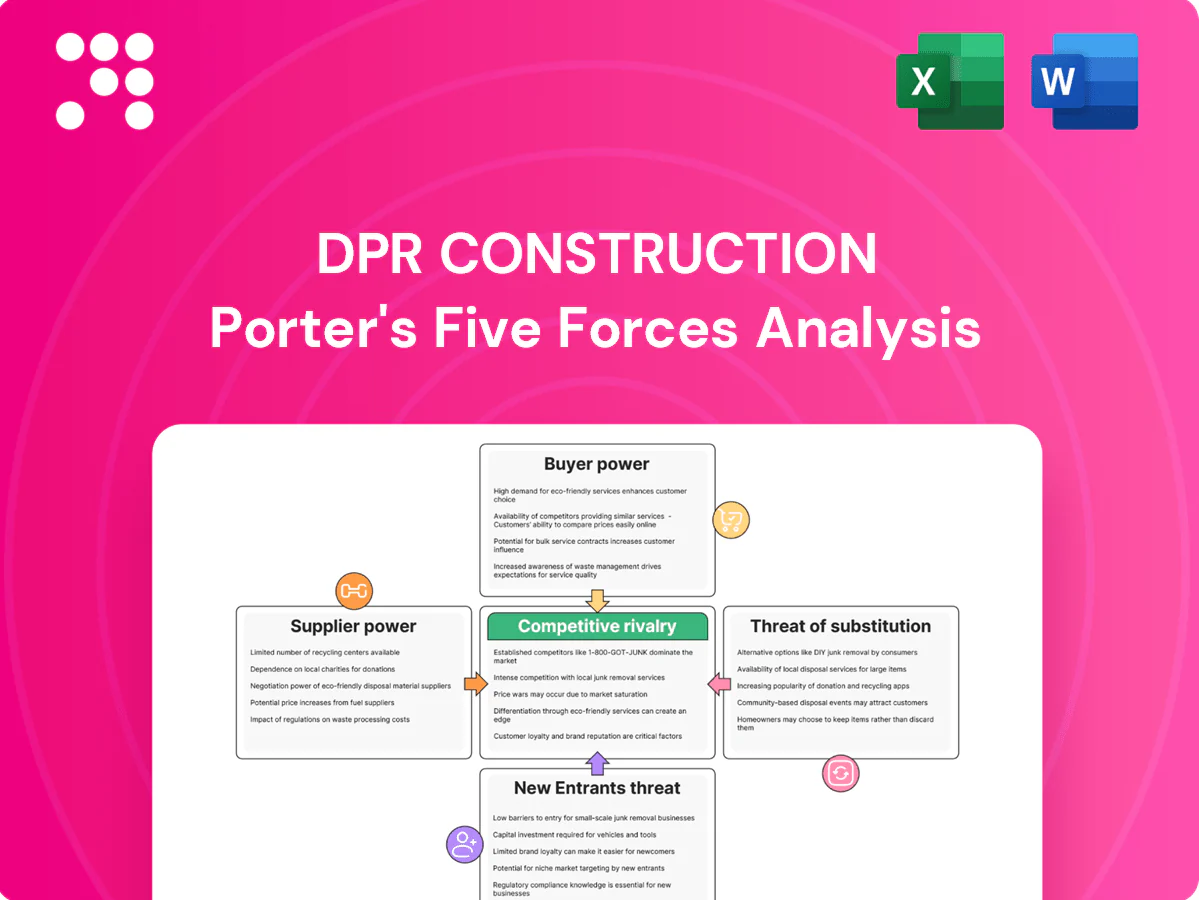
DPR Construction Porter's Five Forces Analysis

A Must-Have Tool for Decision-Makers
DPR Construction faces moderate supplier power, high buyer sophistication on large projects, strong rivalry among national contractors, and evolving threats from tech-enabled substitutes and new entrants; regulatory and labor pressures add complexity. This snapshot only scratches the surface—unlock the full Porter's Five Forces Analysis to get force-by-force ratings, visuals, and actionable strategy tailored to DPR Construction.
Suppliers Bargaining Power

Specialized MEP and trade capacity
For technically complex projects DPR relies on highly skilled MEP, controls, cleanroom, and life-safety trades with limited regional capacity, allowing top subcontractors to command premium pricing and schedule priority; DPR reported roughly $7.6 billion revenue in 2023, highlighting scale and exposure to specialty-sub supply constraints. DPR mitigates through early engagement, rigorous prequalification, and preferred-partner ecosystems, though peak demand windows in 2024 still shifted leverage toward suppliers.
Long-lead critical equipment
Chillers (30–52 weeks), air handlers (20–40 weeks), UPS/switchgear (20–40 weeks), MRI/linac units (52–104 weeks) and specialty filtration saw constrained OEM supply in 2024, with industry reports noting 10–25% price premiums and lead-time-driven schedule risk. Vendors’ delivery windows often dictate project critical paths and pricing power. DPR mitigates via pre-procurement, alternate-approved equals and global sourcing, though spec-driven approvals preserve OEM leverage.

Material volatility and logistics
Steel, cement, copper and semiconductor‑grade materials saw pronounced 2022–24 volatility (copper roughly $8,500–10,500/ton in 2024; US hot‑rolled coil ~ $700–800/ton; cement prices up ~10–15% YoY in some regions), while container freight remained well below 2021 peaks. Suppliers use escalation clauses and short quote windows to gain leverage; DPR counters with early buyouts, indexed contingencies, phased scheduling and JIT logistics, but site constraints keep supplier influence on cost and timing high.

Digital tools and platform vendors
BIM/VDC, CDE and reality-capture platforms create switching frictions via licenses, integrations and data‑ownership constraints; Autodesk reported FY2024 revenue of 5.16 billion and Revit list subs were about 2,545 USD/yr in 2024, illustrating vendor pricing power. Proprietary ecosystems can raise costs or limit interoperability; DPR mitigates with open standards, internal VDC expertise and multi-platform fluency, but entrenched workflows preserve vendor leverage.
- licenses: ongoing cost exposure
- integrations: switching complexity
- data ownership: negotiation point
- DPR: open standards + internal VDC
Skilled labor and union dynamics
Local labor markets and union jurisdictions tightened supply for high-skill trades in 2024, pushing wage rates and premium overtime higher and directly pressuring project margins; DPR counters with targeted workforce planning, selective self-perform scopes, and formal training partnerships to stabilize costs and schedule risk.
- Union jurisdiction limits supply in hot metros
- Wage and overtime premiums reduce margins
- DPR uses self-perform and training to mitigate
- Labor scarcity elevates supplier bargaining power
OEM lead times, commodity swings raise supplier premiums; contractors use early buyouts
Supplier power is high for specialty MEP, cleanroom and OEM equipment—DPR faced $7.6B revenue in 2023 and 2024 OEM lead times (chillers 30–52w, MRI 52–104w) gave vendors 10–25% price premiums and schedule leverage. Commodity volatility (copper ~$9,500/ton in 2024; HRC ~$750/ton) and licensed BIM ecosystems further raise costs; DPR offsets via early buyouts, prequalification and self‑perform.
| Item | 2024 Lead Time | Price Impact |
|---|---|---|
| Chillers | 30–52w | 10–20% |
| MRI/linac | 52–104w | 15–25% |
| Copper | — | $~9,500/ton |
What is included in the product
 Detailed Word Document
Comprehensive Porter's Five Forces analysis tailored to DPR Construction, uncovering competitive intensity, supplier and buyer power, entry barriers, substitutes and disruptive threats; includes strategic commentary on pricing, profitability and market defenses, delivered in fully editable Word format for reports or decks.

 Customizable Excel Spreadsheet
Clear, one-sheet Porter's Five Forces for DPR Construction that instantly highlights competitive pressures, offers editable pressure levels and radar visuals for fast strategic decisions, and drops neatly into pitch decks or broader dashboards—no macros or finance expertise required.
Customers Bargaining Power

Sophisticated owners with scale
Advanced tech, life sciences, and healthcare owners in 2024 are highly data-driven and price-aware, using analytics and benchmarked KPIs to press contractors on cost and performance. Their large-scale, repeat project pipelines and portfolio purchasing concentrate spend—top 10 biopharma firms represent roughly 40% of sector market share—enabling aggressive negotiation and performance demands. DPR differentiates on schedule certainty, quality, and lower total cost of ownership rather than lowest bid, but ongoing buyer consolidation amplifies customer leverage across portfolios.
Competitive bidding and delivery options
Owners can choose CM-at-Risk, design-build, IPD or CM-agent, fostering fee and price competition among contractors. These alternatives compress margins and transfer more risk to contractors, pressuring bids and contract terms. DPR counters with early constructability input, target value design and Lean/IPD practices to protect value. In 2024 buyers increasingly leveraged delivery flexibility to optimize cost and risk, boosting customer bargaining power.

Performance transparency and KPIs
Benchmarking on safety, quality, change orders, and schedule creates clear accountability and lets owners convert poor metrics into fee at risk, liquidated damages, or vendor rotation.
DPR’s data-rich reporting and documented past performance strengthen its ability to defend value when scorecards flag issues.
However, KPI scorecards give buyers structured leverage in negotiations, tying payments and scope to measurable outcomes and creating tangible financial pressure.

Switching costs vs preferred relationships
Prequalification and learning curves raise switching frictions on complex builds, and DPR reported roughly $6.4B revenue in 2023, reflecting strong repeat-client continuity that preserves margins; many owners still maintain panels of qualified GCs to preserve competition and bid pressure.
- Prequalification friction: strengthens DPR client lock-in
- Panels: owners keep competition, limit switching costs
- Repeat work: continuity boosts negotiation leverage
- Bid pressure: buyers balance continuity vs price
Risk transfer via contracts
Owners increasingly push contingencies, escalation risk, and performance guarantees downstream; liquidated damages, indemnities and insurance clauses materially raise bid pricing and shift execution posture. DPR offsets this via collaborative delivery and shared-risk models to align incentives and reduce adversarial change claims. Buyers’ growing legal sophistication, however, preserves meaningful bargaining power over terms despite DPR’s mitigants.
- Risk transfer via contracts
- LDs/indemnities drive pricing
- Collaborative/shared-risk reduces disputes
- Buyer legal sophistication = leverage
2024: KPIs and portfolio buying force price concessions; $6.4B, ~40%
In 2024 sophisticated owners (top 10 biopharma ~40% share) use KPIs and portfolio buying to force price/performance concessions; DPR reported $6.4B revenue in 2023 supporting repeat-client leverage. Delivery alternatives (CM-at-Risk, DB, IPD) and buyer legal sophistication compress margins despite DPR’s Lean/IPD defenses. KPI scorecards and risk-transfer clauses (LDs/indemnities) materially increase customer bargaining power.
| Metric | Value |
|---|---|
| DPR rev (2023) | $6.4B |
| Top10 biopharma share | ~40% |
Preview Before You Purchase
DPR Construction Porter's Five Forces Analysis
This preview displays the DPR Construction Porter's Five Forces Analysis exactly as delivered—no placeholders or mockups. The full, professionally formatted document you see here is the same file you'll receive instantly after purchase. It's ready for download and immediate use, with complete analysis and conclusions included.

A Must-Have Tool for Decision-Makers
DPR Construction faces moderate supplier power, high buyer sophistication on large projects, strong rivalry among national contractors, and evolving threats from tech-enabled substitutes and new entrants; regulatory and labor pressures add complexity. This snapshot only scratches the surface—unlock the full Porter's Five Forces Analysis to get force-by-force ratings, visuals, and actionable strategy tailored to DPR Construction.
Suppliers Bargaining Power
Specialized MEP and trade capacity
For technically complex projects DPR relies on highly skilled MEP, controls, cleanroom, and life-safety trades with limited regional capacity, allowing top subcontractors to command premium pricing and schedule priority; DPR reported roughly $7.6 billion revenue in 2023, highlighting scale and exposure to specialty-sub supply constraints. DPR mitigates through early engagement, rigorous prequalification, and preferred-partner ecosystems, though peak demand windows in 2024 still shifted leverage toward suppliers.
Long-lead critical equipment
Chillers (30–52 weeks), air handlers (20–40 weeks), UPS/switchgear (20–40 weeks), MRI/linac units (52–104 weeks) and specialty filtration saw constrained OEM supply in 2024, with industry reports noting 10–25% price premiums and lead-time-driven schedule risk. Vendors’ delivery windows often dictate project critical paths and pricing power. DPR mitigates via pre-procurement, alternate-approved equals and global sourcing, though spec-driven approvals preserve OEM leverage.
Material volatility and logistics
Steel, cement, copper and semiconductor‑grade materials saw pronounced 2022–24 volatility (copper roughly $8,500–10,500/ton in 2024; US hot‑rolled coil ~ $700–800/ton; cement prices up ~10–15% YoY in some regions), while container freight remained well below 2021 peaks. Suppliers use escalation clauses and short quote windows to gain leverage; DPR counters with early buyouts, indexed contingencies, phased scheduling and JIT logistics, but site constraints keep supplier influence on cost and timing high.
Digital tools and platform vendors
BIM/VDC, CDE and reality-capture platforms create switching frictions via licenses, integrations and data‑ownership constraints; Autodesk reported FY2024 revenue of 5.16 billion and Revit list subs were about 2,545 USD/yr in 2024, illustrating vendor pricing power. Proprietary ecosystems can raise costs or limit interoperability; DPR mitigates with open standards, internal VDC expertise and multi-platform fluency, but entrenched workflows preserve vendor leverage.
- licenses: ongoing cost exposure
- integrations: switching complexity
- data ownership: negotiation point
- DPR: open standards + internal VDC
Skilled labor and union dynamics
Local labor markets and union jurisdictions tightened supply for high-skill trades in 2024, pushing wage rates and premium overtime higher and directly pressuring project margins; DPR counters with targeted workforce planning, selective self-perform scopes, and formal training partnerships to stabilize costs and schedule risk.
- Union jurisdiction limits supply in hot metros
- Wage and overtime premiums reduce margins
- DPR uses self-perform and training to mitigate
- Labor scarcity elevates supplier bargaining power
OEM lead times, commodity swings raise supplier premiums; contractors use early buyouts
Supplier power is high for specialty MEP, cleanroom and OEM equipment—DPR faced $7.6B revenue in 2023 and 2024 OEM lead times (chillers 30–52w, MRI 52–104w) gave vendors 10–25% price premiums and schedule leverage. Commodity volatility (copper ~$9,500/ton in 2024; HRC ~$750/ton) and licensed BIM ecosystems further raise costs; DPR offsets via early buyouts, prequalification and self‑perform.
| Item | 2024 Lead Time | Price Impact |
|---|---|---|
| Chillers | 30–52w | 10–20% |
| MRI/linac | 52–104w | 15–25% |
| Copper | — | $~9,500/ton |
What is included in the product
Detailed Word Document
Comprehensive Porter's Five Forces analysis tailored to DPR Construction, uncovering competitive intensity, supplier and buyer power, entry barriers, substitutes and disruptive threats; includes strategic commentary on pricing, profitability and market defenses, delivered in fully editable Word format for reports or decks.
Customizable Excel Spreadsheet
Clear, one-sheet Porter's Five Forces for DPR Construction that instantly highlights competitive pressures, offers editable pressure levels and radar visuals for fast strategic decisions, and drops neatly into pitch decks or broader dashboards—no macros or finance expertise required.
Customers Bargaining Power
Sophisticated owners with scale
Advanced tech, life sciences, and healthcare owners in 2024 are highly data-driven and price-aware, using analytics and benchmarked KPIs to press contractors on cost and performance. Their large-scale, repeat project pipelines and portfolio purchasing concentrate spend—top 10 biopharma firms represent roughly 40% of sector market share—enabling aggressive negotiation and performance demands. DPR differentiates on schedule certainty, quality, and lower total cost of ownership rather than lowest bid, but ongoing buyer consolidation amplifies customer leverage across portfolios.
Competitive bidding and delivery options
Owners can choose CM-at-Risk, design-build, IPD or CM-agent, fostering fee and price competition among contractors. These alternatives compress margins and transfer more risk to contractors, pressuring bids and contract terms. DPR counters with early constructability input, target value design and Lean/IPD practices to protect value. In 2024 buyers increasingly leveraged delivery flexibility to optimize cost and risk, boosting customer bargaining power.
Performance transparency and KPIs
Benchmarking on safety, quality, change orders, and schedule creates clear accountability and lets owners convert poor metrics into fee at risk, liquidated damages, or vendor rotation.
DPR’s data-rich reporting and documented past performance strengthen its ability to defend value when scorecards flag issues.
However, KPI scorecards give buyers structured leverage in negotiations, tying payments and scope to measurable outcomes and creating tangible financial pressure.
Switching costs vs preferred relationships
Prequalification and learning curves raise switching frictions on complex builds, and DPR reported roughly $6.4B revenue in 2023, reflecting strong repeat-client continuity that preserves margins; many owners still maintain panels of qualified GCs to preserve competition and bid pressure.
- Prequalification friction: strengthens DPR client lock-in
- Panels: owners keep competition, limit switching costs
- Repeat work: continuity boosts negotiation leverage
- Bid pressure: buyers balance continuity vs price
Risk transfer via contracts
Owners increasingly push contingencies, escalation risk, and performance guarantees downstream; liquidated damages, indemnities and insurance clauses materially raise bid pricing and shift execution posture. DPR offsets this via collaborative delivery and shared-risk models to align incentives and reduce adversarial change claims. Buyers’ growing legal sophistication, however, preserves meaningful bargaining power over terms despite DPR’s mitigants.
- Risk transfer via contracts
- LDs/indemnities drive pricing
- Collaborative/shared-risk reduces disputes
- Buyer legal sophistication = leverage
2024: KPIs and portfolio buying force price concessions; $6.4B, ~40%
In 2024 sophisticated owners (top 10 biopharma ~40% share) use KPIs and portfolio buying to force price/performance concessions; DPR reported $6.4B revenue in 2023 supporting repeat-client leverage. Delivery alternatives (CM-at-Risk, DB, IPD) and buyer legal sophistication compress margins despite DPR’s Lean/IPD defenses. KPI scorecards and risk-transfer clauses (LDs/indemnities) materially increase customer bargaining power.
| Metric | Value |
|---|---|
| DPR rev (2023) | $6.4B |
| Top10 biopharma share | ~40% |
Preview Before You Purchase
DPR Construction Porter's Five Forces Analysis
This preview displays the DPR Construction Porter's Five Forces Analysis exactly as delivered—no placeholders or mockups. The full, professionally formatted document you see here is the same file you'll receive instantly after purchase. It's ready for download and immediate use, with complete analysis and conclusions included.
Description
A Must-Have Tool for Decision-Makers
DPR Construction faces moderate supplier power, high buyer sophistication on large projects, strong rivalry among national contractors, and evolving threats from tech-enabled substitutes and new entrants; regulatory and labor pressures add complexity. This snapshot only scratches the surface—unlock the full Porter's Five Forces Analysis to get force-by-force ratings, visuals, and actionable strategy tailored to DPR Construction.
Suppliers Bargaining Power
Specialized MEP and trade capacity
For technically complex projects DPR relies on highly skilled MEP, controls, cleanroom, and life-safety trades with limited regional capacity, allowing top subcontractors to command premium pricing and schedule priority; DPR reported roughly $7.6 billion revenue in 2023, highlighting scale and exposure to specialty-sub supply constraints. DPR mitigates through early engagement, rigorous prequalification, and preferred-partner ecosystems, though peak demand windows in 2024 still shifted leverage toward suppliers.
Long-lead critical equipment
Chillers (30–52 weeks), air handlers (20–40 weeks), UPS/switchgear (20–40 weeks), MRI/linac units (52–104 weeks) and specialty filtration saw constrained OEM supply in 2024, with industry reports noting 10–25% price premiums and lead-time-driven schedule risk. Vendors’ delivery windows often dictate project critical paths and pricing power. DPR mitigates via pre-procurement, alternate-approved equals and global sourcing, though spec-driven approvals preserve OEM leverage.
Material volatility and logistics
Steel, cement, copper and semiconductor‑grade materials saw pronounced 2022–24 volatility (copper roughly $8,500–10,500/ton in 2024; US hot‑rolled coil ~ $700–800/ton; cement prices up ~10–15% YoY in some regions), while container freight remained well below 2021 peaks. Suppliers use escalation clauses and short quote windows to gain leverage; DPR counters with early buyouts, indexed contingencies, phased scheduling and JIT logistics, but site constraints keep supplier influence on cost and timing high.
Digital tools and platform vendors
BIM/VDC, CDE and reality-capture platforms create switching frictions via licenses, integrations and data‑ownership constraints; Autodesk reported FY2024 revenue of 5.16 billion and Revit list subs were about 2,545 USD/yr in 2024, illustrating vendor pricing power. Proprietary ecosystems can raise costs or limit interoperability; DPR mitigates with open standards, internal VDC expertise and multi-platform fluency, but entrenched workflows preserve vendor leverage.
- licenses: ongoing cost exposure
- integrations: switching complexity
- data ownership: negotiation point
- DPR: open standards + internal VDC
Skilled labor and union dynamics
Local labor markets and union jurisdictions tightened supply for high-skill trades in 2024, pushing wage rates and premium overtime higher and directly pressuring project margins; DPR counters with targeted workforce planning, selective self-perform scopes, and formal training partnerships to stabilize costs and schedule risk.
- Union jurisdiction limits supply in hot metros
- Wage and overtime premiums reduce margins
- DPR uses self-perform and training to mitigate
- Labor scarcity elevates supplier bargaining power
OEM lead times, commodity swings raise supplier premiums; contractors use early buyouts
Supplier power is high for specialty MEP, cleanroom and OEM equipment—DPR faced $7.6B revenue in 2023 and 2024 OEM lead times (chillers 30–52w, MRI 52–104w) gave vendors 10–25% price premiums and schedule leverage. Commodity volatility (copper ~$9,500/ton in 2024; HRC ~$750/ton) and licensed BIM ecosystems further raise costs; DPR offsets via early buyouts, prequalification and self‑perform.
| Item | 2024 Lead Time | Price Impact |
|---|---|---|
| Chillers | 30–52w | 10–20% |
| MRI/linac | 52–104w | 15–25% |
| Copper | — | $~9,500/ton |
What is included in the product
Detailed Word Document
Comprehensive Porter's Five Forces analysis tailored to DPR Construction, uncovering competitive intensity, supplier and buyer power, entry barriers, substitutes and disruptive threats; includes strategic commentary on pricing, profitability and market defenses, delivered in fully editable Word format for reports or decks.
Customizable Excel Spreadsheet
Clear, one-sheet Porter's Five Forces for DPR Construction that instantly highlights competitive pressures, offers editable pressure levels and radar visuals for fast strategic decisions, and drops neatly into pitch decks or broader dashboards—no macros or finance expertise required.
Customers Bargaining Power
Sophisticated owners with scale
Advanced tech, life sciences, and healthcare owners in 2024 are highly data-driven and price-aware, using analytics and benchmarked KPIs to press contractors on cost and performance. Their large-scale, repeat project pipelines and portfolio purchasing concentrate spend—top 10 biopharma firms represent roughly 40% of sector market share—enabling aggressive negotiation and performance demands. DPR differentiates on schedule certainty, quality, and lower total cost of ownership rather than lowest bid, but ongoing buyer consolidation amplifies customer leverage across portfolios.
Competitive bidding and delivery options
Owners can choose CM-at-Risk, design-build, IPD or CM-agent, fostering fee and price competition among contractors. These alternatives compress margins and transfer more risk to contractors, pressuring bids and contract terms. DPR counters with early constructability input, target value design and Lean/IPD practices to protect value. In 2024 buyers increasingly leveraged delivery flexibility to optimize cost and risk, boosting customer bargaining power.
Performance transparency and KPIs
Benchmarking on safety, quality, change orders, and schedule creates clear accountability and lets owners convert poor metrics into fee at risk, liquidated damages, or vendor rotation.
DPR’s data-rich reporting and documented past performance strengthen its ability to defend value when scorecards flag issues.
However, KPI scorecards give buyers structured leverage in negotiations, tying payments and scope to measurable outcomes and creating tangible financial pressure.
Switching costs vs preferred relationships
Prequalification and learning curves raise switching frictions on complex builds, and DPR reported roughly $6.4B revenue in 2023, reflecting strong repeat-client continuity that preserves margins; many owners still maintain panels of qualified GCs to preserve competition and bid pressure.
- Prequalification friction: strengthens DPR client lock-in
- Panels: owners keep competition, limit switching costs
- Repeat work: continuity boosts negotiation leverage
- Bid pressure: buyers balance continuity vs price
Risk transfer via contracts
Owners increasingly push contingencies, escalation risk, and performance guarantees downstream; liquidated damages, indemnities and insurance clauses materially raise bid pricing and shift execution posture. DPR offsets this via collaborative delivery and shared-risk models to align incentives and reduce adversarial change claims. Buyers’ growing legal sophistication, however, preserves meaningful bargaining power over terms despite DPR’s mitigants.
- Risk transfer via contracts
- LDs/indemnities drive pricing
- Collaborative/shared-risk reduces disputes
- Buyer legal sophistication = leverage
2024: KPIs and portfolio buying force price concessions; $6.4B, ~40%
In 2024 sophisticated owners (top 10 biopharma ~40% share) use KPIs and portfolio buying to force price/performance concessions; DPR reported $6.4B revenue in 2023 supporting repeat-client leverage. Delivery alternatives (CM-at-Risk, DB, IPD) and buyer legal sophistication compress margins despite DPR’s Lean/IPD defenses. KPI scorecards and risk-transfer clauses (LDs/indemnities) materially increase customer bargaining power.
| Metric | Value |
|---|---|
| DPR rev (2023) | $6.4B |
| Top10 biopharma share | ~40% |
Preview Before You Purchase
DPR Construction Porter's Five Forces Analysis
This preview displays the DPR Construction Porter's Five Forces Analysis exactly as delivered—no placeholders or mockups. The full, professionally formatted document you see here is the same file you'll receive instantly after purchase. It's ready for download and immediate use, with complete analysis and conclusions included.











