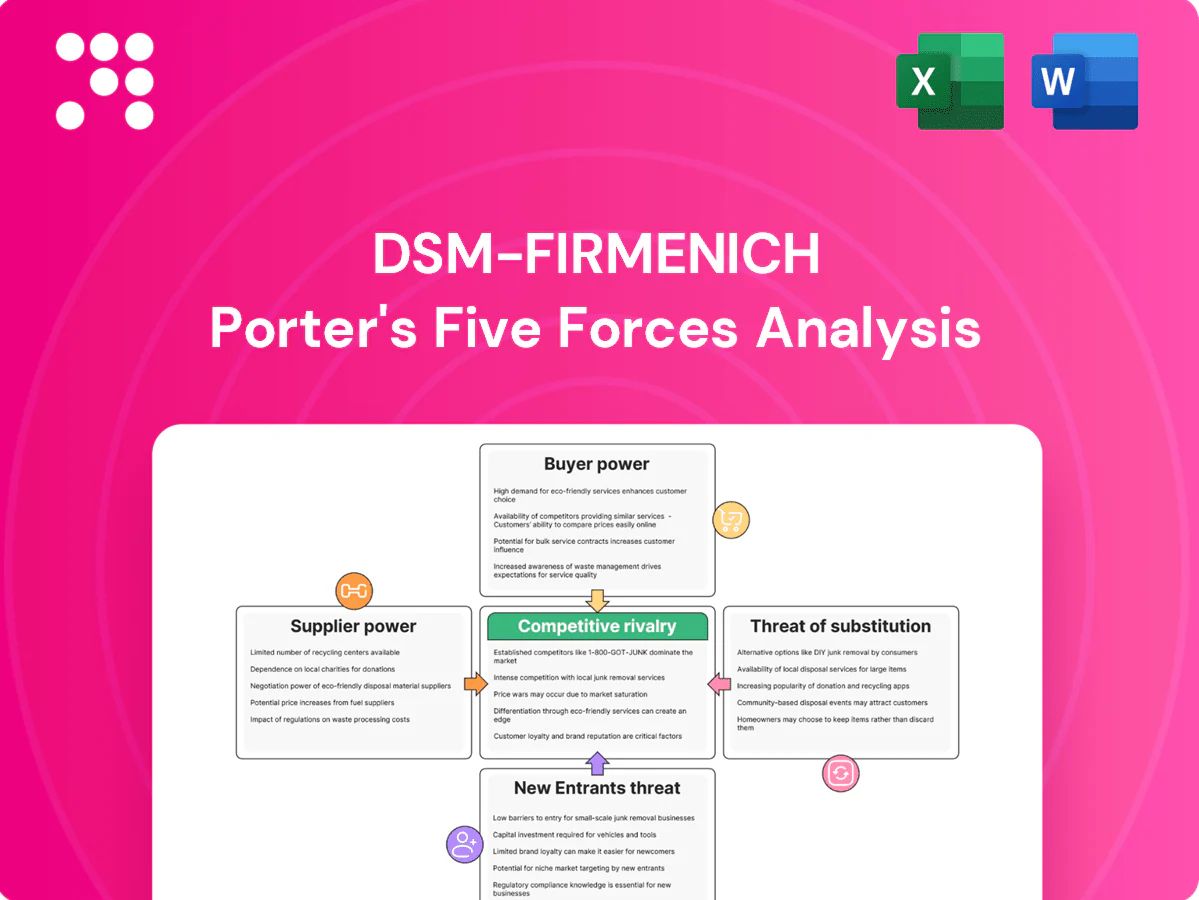
DSM-Firmenich Porter's Five Forces Analysis

From Overview to Strategy Blueprint
DSM‑Firmenich faces moderate supplier power but high buyer expectations and innovation‑driven rivalry, while regulatory and substitute threats vary across segments. This brief snapshot only scratches the surface. Unlock the full Porter's Five Forces Analysis to explore DSM‑Firmenich’s competitive dynamics, market pressures, and strategic advantages in detail.
Suppliers Bargaining Power

Feedstock volatility
DSM-Firmenich relies on sugar, corn, oils and botanicals for fermentation and naturals; commodity swings—ICE sugar up about 12% in 2024 and CBOT corn showing double-digit monthly moves in 2024—can tighten supplier terms and raise input risk. Hedging and multi-sourcing reduce acute shocks but leave basis risk and margin squeeze; long-term contracts dampen volatility impact but do not eliminate it, keeping raw-material exposure material to margins.
Specialty inputs concentration
Certain enzymes, cultures and aroma chemicals for DSM-Firmenich are sourced from a small group of advanced suppliers, a dynamic intensified after the 2023 DSM-Firmenich merger; technical qualification and GMP requirements restrict rapid substitution. This supplier concentration elevates bargaining power and pricing leverage. Dual-qualifying alternative vendors typically requires 6–12 months and incremental qualification costs, reducing but not eliminating exposure.

Sustainability sourcing constraints
Strict ESG, traceability and naturals certifications (RSPO, COSMOS, Fairtrade) narrow eligible suppliers, intensified by 2024 regulatory pressure such as the EU CSRD rollout. Compliance increases switching costs and supplier leverage as verification and audit burdens rise. DSM-Firmenich’s post‑merger scale attracts top compliant suppliers. Collaborative programs trade price concessions for long‑term offtake stability.

Partial backward integration
Partial backward integration through in-house biotech, fermentation and formulation reduces DSM-Firmenich dependence on some upstream suppliers and enables process substitutions for constrained raw materials; this moderates supplier power in selected categories. The combined group reported pro forma 2023 revenue of about €12.6bn, supporting scale-driven sourcing and R&D leverage, but unique naturals and specialty actives remain externally constrained.
- In-house biotech/fermentation: lowers reliance
- Process substitution: mitigates shortages
- Scale (pro forma 2023 ~€12.6bn): strengthens negotiating leverage
- Unique naturals/actives: still supplier-constrained
Logistics and geopolitical risk
Global botanicals remain exposed to weather, phytosanitary and trade disruptions; freight spikes in 2021–22 exceeded 10,000 USD per FEU, strengthening supplier leverage while energy volatility raised input costs. DSM‑Firmenich (post‑2023 merger) offsets risk via regional diversification and 3–6 month inventory buffers. Nearshoring critical inputs shortens lead times from months to weeks, lowering distant suppliers’ bargaining power.
- Freight spike 2021–22: >10,000 USD/FEU
- Inventory buffer: 3–6 months
- Nearshoring: cuts lead times months→weeks
- Regional diversification: reduces single‑source exposure
Moderate‑High Supplier Power: Commodity Volatility, ESG Rules and Inventory Buffers
Supplier power is moderate‑to‑high: commodity swings (ICE sugar +12% YTD 2024; CBOT corn double‑digit monthly moves) and concentrated technical suppliers limit DSM‑Firmenich’s negotiating room. ESG/certification rules (CSRD 2024) and specialty naturals raise switching costs despite scale (pro forma 2023 €12.6bn) and partial backward integration. Inventory buffers (3–6 months) and nearshoring partially mitigate pressure.
| Metric | Value |
|---|---|
| Pro forma revenue 2023 | €12.6bn |
| ICE sugar 2024 YTD | +12% |
| CBOT corn 2024 | double‑digit monthly moves |
| Inventory buffer | 3–6 months |
What is included in the product
 Detailed Word Document
Concise Porter’s Five Forces assessment for DSM‑Firmenich that uncovers competitive drivers, buyer and supplier power, entry barriers, substitutes and disruptive threats, with strategic commentary to inform pricing, profitability and defensive or growth moves.

 Customizable Excel Spreadsheet
One-sheet DSM‑Firmenich Porter's Five Forces—instantly spot competitive pain points, adjust pressure levels for new data, and drop a clean radar chart into decks for fast strategic action.
Customers Bargaining Power

Consolidated global customers
Large CPG, pharma and beauty houses buy at scale and negotiate hard, with DSM‑Firmenich serving customers across sectors after a pro forma 2024 revenue base of about €11.7bn; volume concentration amplifies price pressure on ingredient and formulation margins. Strategic partnerships increasingly shift conversations from unit price to co‑innovation and sustainability value, capturing higher-margin service revenue. Losing a single key account could swing low‑double‑digit percentage points of segment revenue, reinforcing strong buyer power.
High switching frictions
Reformulation, regulatory re-approval and the need to match sensory equivalence create strong lock-in for buyers, raising actual switching costs. In 2024 regulatory re-approval timelines commonly exceed 12 months, so these frictions materially weaken buyer power after adoption. Dual-sourcing policies restore some leverage but add complexity and cost. Strong product performance and enforceable IP further deepen stickiness and limit buyers’ price pressure.

Value-in-use sensitivity
Customers trade off cost against efficacy, speed-to-market and brand impact, so value-in-use sensitivity drives negotiations. Where ingredients represent under 5% of finished-product cost but determine performance, price sensitivity falls markedly. In commoditized bases buyers push harder on price and terms. Demonstrated ROI and joint co-creation lower pricing pressure and raise switching costs.

Clean-label and ESG demands
Buyers now demand traceable, natural and low-carbon solutions, narrowing acceptable suppliers and reducing buyer substitution; DSM-Firmenich, with pro forma sales ~€12.3bn (2023) and expanded clean-ingredient portfolio, can command premiums for certified offerings but faces margin pressure as large retailers push ESG price concessions and may threaten de-listing to enforce terms.
Private label and indie brands
Private label and indie brands intensify price pressure on base ingredients as the global beauty market reached roughly USD 520 billion in 2024, enabling retailers to push lower-cost formulations and faster SKU rotations. Agile indies can switch to cheaper blends quickly, while service, turnkey solutions and speed from suppliers offset pure price competition. DSM-Firmenich’s tiered portfolios help defend share across price points.
- Price tension: retailer brands vs branded
- Agility: rapid reformulation
- Offset: turnkey services and speed
- Defense: tiered portfolios
Concentrated buyers fuel price leverage; reformulation lock‑in and low‑carbon services boost margins
Large CPG, pharma and beauty customers buy at scale from DSM‑Firmenich (pro forma 2024 revenue ~€11.7bn), concentrating volume and exerting strong price leverage; loss of a key account can swing low‑double‑digit percentage points of segment revenue. Lock‑in from reformulation, regulatory re‑approval (>12 months) and sensory matching reduces effective switching, while co‑innovation and certified low‑carbon offerings shift value toward higher‑margin services. Retailer private labels and indies increase price pressure on base ingredients, offset by DSM‑Firmenich’s tiered portfolios and turnkey solutions.
| Metric | 2024 |
|---|---|
| Pro forma revenue | €11.7bn |
| Global beauty market | USD 520bn |
| Regulatory re‑approval | >12 months |
Preview the Actual Deliverable
DSM-Firmenich Porter's Five Forces Analysis
This preview shows the exact DSM‑Firmenich Porter’s Five Forces analysis you'll receive immediately after purchase—no surprises, no placeholders. The document is the full, professionally formatted strategic assessment of competitive rivalry, supplier and buyer power, threats of entry and substitutes, ready for immediate download. Use it as delivered for decision making or reporting.

From Overview to Strategy Blueprint
DSM‑Firmenich faces moderate supplier power but high buyer expectations and innovation‑driven rivalry, while regulatory and substitute threats vary across segments. This brief snapshot only scratches the surface. Unlock the full Porter's Five Forces Analysis to explore DSM‑Firmenich’s competitive dynamics, market pressures, and strategic advantages in detail.
Suppliers Bargaining Power
Feedstock volatility
DSM-Firmenich relies on sugar, corn, oils and botanicals for fermentation and naturals; commodity swings—ICE sugar up about 12% in 2024 and CBOT corn showing double-digit monthly moves in 2024—can tighten supplier terms and raise input risk. Hedging and multi-sourcing reduce acute shocks but leave basis risk and margin squeeze; long-term contracts dampen volatility impact but do not eliminate it, keeping raw-material exposure material to margins.
Specialty inputs concentration
Certain enzymes, cultures and aroma chemicals for DSM-Firmenich are sourced from a small group of advanced suppliers, a dynamic intensified after the 2023 DSM-Firmenich merger; technical qualification and GMP requirements restrict rapid substitution. This supplier concentration elevates bargaining power and pricing leverage. Dual-qualifying alternative vendors typically requires 6–12 months and incremental qualification costs, reducing but not eliminating exposure.
Sustainability sourcing constraints
Strict ESG, traceability and naturals certifications (RSPO, COSMOS, Fairtrade) narrow eligible suppliers, intensified by 2024 regulatory pressure such as the EU CSRD rollout. Compliance increases switching costs and supplier leverage as verification and audit burdens rise. DSM-Firmenich’s post‑merger scale attracts top compliant suppliers. Collaborative programs trade price concessions for long‑term offtake stability.
Partial backward integration
Partial backward integration through in-house biotech, fermentation and formulation reduces DSM-Firmenich dependence on some upstream suppliers and enables process substitutions for constrained raw materials; this moderates supplier power in selected categories. The combined group reported pro forma 2023 revenue of about €12.6bn, supporting scale-driven sourcing and R&D leverage, but unique naturals and specialty actives remain externally constrained.
- In-house biotech/fermentation: lowers reliance
- Process substitution: mitigates shortages
- Scale (pro forma 2023 ~€12.6bn): strengthens negotiating leverage
- Unique naturals/actives: still supplier-constrained
Logistics and geopolitical risk
Global botanicals remain exposed to weather, phytosanitary and trade disruptions; freight spikes in 2021–22 exceeded 10,000 USD per FEU, strengthening supplier leverage while energy volatility raised input costs. DSM‑Firmenich (post‑2023 merger) offsets risk via regional diversification and 3–6 month inventory buffers. Nearshoring critical inputs shortens lead times from months to weeks, lowering distant suppliers’ bargaining power.
- Freight spike 2021–22: >10,000 USD/FEU
- Inventory buffer: 3–6 months
- Nearshoring: cuts lead times months→weeks
- Regional diversification: reduces single‑source exposure
Moderate‑High Supplier Power: Commodity Volatility, ESG Rules and Inventory Buffers
Supplier power is moderate‑to‑high: commodity swings (ICE sugar +12% YTD 2024; CBOT corn double‑digit monthly moves) and concentrated technical suppliers limit DSM‑Firmenich’s negotiating room. ESG/certification rules (CSRD 2024) and specialty naturals raise switching costs despite scale (pro forma 2023 €12.6bn) and partial backward integration. Inventory buffers (3–6 months) and nearshoring partially mitigate pressure.
| Metric | Value |
|---|---|
| Pro forma revenue 2023 | €12.6bn |
| ICE sugar 2024 YTD | +12% |
| CBOT corn 2024 | double‑digit monthly moves |
| Inventory buffer | 3–6 months |
What is included in the product
Detailed Word Document
Concise Porter’s Five Forces assessment for DSM‑Firmenich that uncovers competitive drivers, buyer and supplier power, entry barriers, substitutes and disruptive threats, with strategic commentary to inform pricing, profitability and defensive or growth moves.
Customizable Excel Spreadsheet
One-sheet DSM‑Firmenich Porter's Five Forces—instantly spot competitive pain points, adjust pressure levels for new data, and drop a clean radar chart into decks for fast strategic action.
Customers Bargaining Power
Consolidated global customers
Large CPG, pharma and beauty houses buy at scale and negotiate hard, with DSM‑Firmenich serving customers across sectors after a pro forma 2024 revenue base of about €11.7bn; volume concentration amplifies price pressure on ingredient and formulation margins. Strategic partnerships increasingly shift conversations from unit price to co‑innovation and sustainability value, capturing higher-margin service revenue. Losing a single key account could swing low‑double‑digit percentage points of segment revenue, reinforcing strong buyer power.
High switching frictions
Reformulation, regulatory re-approval and the need to match sensory equivalence create strong lock-in for buyers, raising actual switching costs. In 2024 regulatory re-approval timelines commonly exceed 12 months, so these frictions materially weaken buyer power after adoption. Dual-sourcing policies restore some leverage but add complexity and cost. Strong product performance and enforceable IP further deepen stickiness and limit buyers’ price pressure.
Value-in-use sensitivity
Customers trade off cost against efficacy, speed-to-market and brand impact, so value-in-use sensitivity drives negotiations. Where ingredients represent under 5% of finished-product cost but determine performance, price sensitivity falls markedly. In commoditized bases buyers push harder on price and terms. Demonstrated ROI and joint co-creation lower pricing pressure and raise switching costs.
Clean-label and ESG demands
Buyers now demand traceable, natural and low-carbon solutions, narrowing acceptable suppliers and reducing buyer substitution; DSM-Firmenich, with pro forma sales ~€12.3bn (2023) and expanded clean-ingredient portfolio, can command premiums for certified offerings but faces margin pressure as large retailers push ESG price concessions and may threaten de-listing to enforce terms.
Private label and indie brands
Private label and indie brands intensify price pressure on base ingredients as the global beauty market reached roughly USD 520 billion in 2024, enabling retailers to push lower-cost formulations and faster SKU rotations. Agile indies can switch to cheaper blends quickly, while service, turnkey solutions and speed from suppliers offset pure price competition. DSM-Firmenich’s tiered portfolios help defend share across price points.
- Price tension: retailer brands vs branded
- Agility: rapid reformulation
- Offset: turnkey services and speed
- Defense: tiered portfolios
Concentrated buyers fuel price leverage; reformulation lock‑in and low‑carbon services boost margins
Large CPG, pharma and beauty customers buy at scale from DSM‑Firmenich (pro forma 2024 revenue ~€11.7bn), concentrating volume and exerting strong price leverage; loss of a key account can swing low‑double‑digit percentage points of segment revenue. Lock‑in from reformulation, regulatory re‑approval (>12 months) and sensory matching reduces effective switching, while co‑innovation and certified low‑carbon offerings shift value toward higher‑margin services. Retailer private labels and indies increase price pressure on base ingredients, offset by DSM‑Firmenich’s tiered portfolios and turnkey solutions.
| Metric | 2024 |
|---|---|
| Pro forma revenue | €11.7bn |
| Global beauty market | USD 520bn |
| Regulatory re‑approval | >12 months |
Preview the Actual Deliverable
DSM-Firmenich Porter's Five Forces Analysis
This preview shows the exact DSM‑Firmenich Porter’s Five Forces analysis you'll receive immediately after purchase—no surprises, no placeholders. The document is the full, professionally formatted strategic assessment of competitive rivalry, supplier and buyer power, threats of entry and substitutes, ready for immediate download. Use it as delivered for decision making or reporting.
Description
From Overview to Strategy Blueprint
DSM‑Firmenich faces moderate supplier power but high buyer expectations and innovation‑driven rivalry, while regulatory and substitute threats vary across segments. This brief snapshot only scratches the surface. Unlock the full Porter's Five Forces Analysis to explore DSM‑Firmenich’s competitive dynamics, market pressures, and strategic advantages in detail.
Suppliers Bargaining Power
Feedstock volatility
DSM-Firmenich relies on sugar, corn, oils and botanicals for fermentation and naturals; commodity swings—ICE sugar up about 12% in 2024 and CBOT corn showing double-digit monthly moves in 2024—can tighten supplier terms and raise input risk. Hedging and multi-sourcing reduce acute shocks but leave basis risk and margin squeeze; long-term contracts dampen volatility impact but do not eliminate it, keeping raw-material exposure material to margins.
Specialty inputs concentration
Certain enzymes, cultures and aroma chemicals for DSM-Firmenich are sourced from a small group of advanced suppliers, a dynamic intensified after the 2023 DSM-Firmenich merger; technical qualification and GMP requirements restrict rapid substitution. This supplier concentration elevates bargaining power and pricing leverage. Dual-qualifying alternative vendors typically requires 6–12 months and incremental qualification costs, reducing but not eliminating exposure.
Sustainability sourcing constraints
Strict ESG, traceability and naturals certifications (RSPO, COSMOS, Fairtrade) narrow eligible suppliers, intensified by 2024 regulatory pressure such as the EU CSRD rollout. Compliance increases switching costs and supplier leverage as verification and audit burdens rise. DSM-Firmenich’s post‑merger scale attracts top compliant suppliers. Collaborative programs trade price concessions for long‑term offtake stability.
Partial backward integration
Partial backward integration through in-house biotech, fermentation and formulation reduces DSM-Firmenich dependence on some upstream suppliers and enables process substitutions for constrained raw materials; this moderates supplier power in selected categories. The combined group reported pro forma 2023 revenue of about €12.6bn, supporting scale-driven sourcing and R&D leverage, but unique naturals and specialty actives remain externally constrained.
- In-house biotech/fermentation: lowers reliance
- Process substitution: mitigates shortages
- Scale (pro forma 2023 ~€12.6bn): strengthens negotiating leverage
- Unique naturals/actives: still supplier-constrained
Logistics and geopolitical risk
Global botanicals remain exposed to weather, phytosanitary and trade disruptions; freight spikes in 2021–22 exceeded 10,000 USD per FEU, strengthening supplier leverage while energy volatility raised input costs. DSM‑Firmenich (post‑2023 merger) offsets risk via regional diversification and 3–6 month inventory buffers. Nearshoring critical inputs shortens lead times from months to weeks, lowering distant suppliers’ bargaining power.
- Freight spike 2021–22: >10,000 USD/FEU
- Inventory buffer: 3–6 months
- Nearshoring: cuts lead times months→weeks
- Regional diversification: reduces single‑source exposure
Moderate‑High Supplier Power: Commodity Volatility, ESG Rules and Inventory Buffers
Supplier power is moderate‑to‑high: commodity swings (ICE sugar +12% YTD 2024; CBOT corn double‑digit monthly moves) and concentrated technical suppliers limit DSM‑Firmenich’s negotiating room. ESG/certification rules (CSRD 2024) and specialty naturals raise switching costs despite scale (pro forma 2023 €12.6bn) and partial backward integration. Inventory buffers (3–6 months) and nearshoring partially mitigate pressure.
| Metric | Value |
|---|---|
| Pro forma revenue 2023 | €12.6bn |
| ICE sugar 2024 YTD | +12% |
| CBOT corn 2024 | double‑digit monthly moves |
| Inventory buffer | 3–6 months |
What is included in the product
Detailed Word Document
Concise Porter’s Five Forces assessment for DSM‑Firmenich that uncovers competitive drivers, buyer and supplier power, entry barriers, substitutes and disruptive threats, with strategic commentary to inform pricing, profitability and defensive or growth moves.
Customizable Excel Spreadsheet
One-sheet DSM‑Firmenich Porter's Five Forces—instantly spot competitive pain points, adjust pressure levels for new data, and drop a clean radar chart into decks for fast strategic action.
Customers Bargaining Power
Consolidated global customers
Large CPG, pharma and beauty houses buy at scale and negotiate hard, with DSM‑Firmenich serving customers across sectors after a pro forma 2024 revenue base of about €11.7bn; volume concentration amplifies price pressure on ingredient and formulation margins. Strategic partnerships increasingly shift conversations from unit price to co‑innovation and sustainability value, capturing higher-margin service revenue. Losing a single key account could swing low‑double‑digit percentage points of segment revenue, reinforcing strong buyer power.
High switching frictions
Reformulation, regulatory re-approval and the need to match sensory equivalence create strong lock-in for buyers, raising actual switching costs. In 2024 regulatory re-approval timelines commonly exceed 12 months, so these frictions materially weaken buyer power after adoption. Dual-sourcing policies restore some leverage but add complexity and cost. Strong product performance and enforceable IP further deepen stickiness and limit buyers’ price pressure.
Value-in-use sensitivity
Customers trade off cost against efficacy, speed-to-market and brand impact, so value-in-use sensitivity drives negotiations. Where ingredients represent under 5% of finished-product cost but determine performance, price sensitivity falls markedly. In commoditized bases buyers push harder on price and terms. Demonstrated ROI and joint co-creation lower pricing pressure and raise switching costs.
Clean-label and ESG demands
Buyers now demand traceable, natural and low-carbon solutions, narrowing acceptable suppliers and reducing buyer substitution; DSM-Firmenich, with pro forma sales ~€12.3bn (2023) and expanded clean-ingredient portfolio, can command premiums for certified offerings but faces margin pressure as large retailers push ESG price concessions and may threaten de-listing to enforce terms.
Private label and indie brands
Private label and indie brands intensify price pressure on base ingredients as the global beauty market reached roughly USD 520 billion in 2024, enabling retailers to push lower-cost formulations and faster SKU rotations. Agile indies can switch to cheaper blends quickly, while service, turnkey solutions and speed from suppliers offset pure price competition. DSM-Firmenich’s tiered portfolios help defend share across price points.
- Price tension: retailer brands vs branded
- Agility: rapid reformulation
- Offset: turnkey services and speed
- Defense: tiered portfolios
Concentrated buyers fuel price leverage; reformulation lock‑in and low‑carbon services boost margins
Large CPG, pharma and beauty customers buy at scale from DSM‑Firmenich (pro forma 2024 revenue ~€11.7bn), concentrating volume and exerting strong price leverage; loss of a key account can swing low‑double‑digit percentage points of segment revenue. Lock‑in from reformulation, regulatory re‑approval (>12 months) and sensory matching reduces effective switching, while co‑innovation and certified low‑carbon offerings shift value toward higher‑margin services. Retailer private labels and indies increase price pressure on base ingredients, offset by DSM‑Firmenich’s tiered portfolios and turnkey solutions.
| Metric | 2024 |
|---|---|
| Pro forma revenue | €11.7bn |
| Global beauty market | USD 520bn |
| Regulatory re‑approval | >12 months |
Preview the Actual Deliverable
DSM-Firmenich Porter's Five Forces Analysis
This preview shows the exact DSM‑Firmenich Porter’s Five Forces analysis you'll receive immediately after purchase—no surprises, no placeholders. The document is the full, professionally formatted strategic assessment of competitive rivalry, supplier and buyer power, threats of entry and substitutes, ready for immediate download. Use it as delivered for decision making or reporting.











