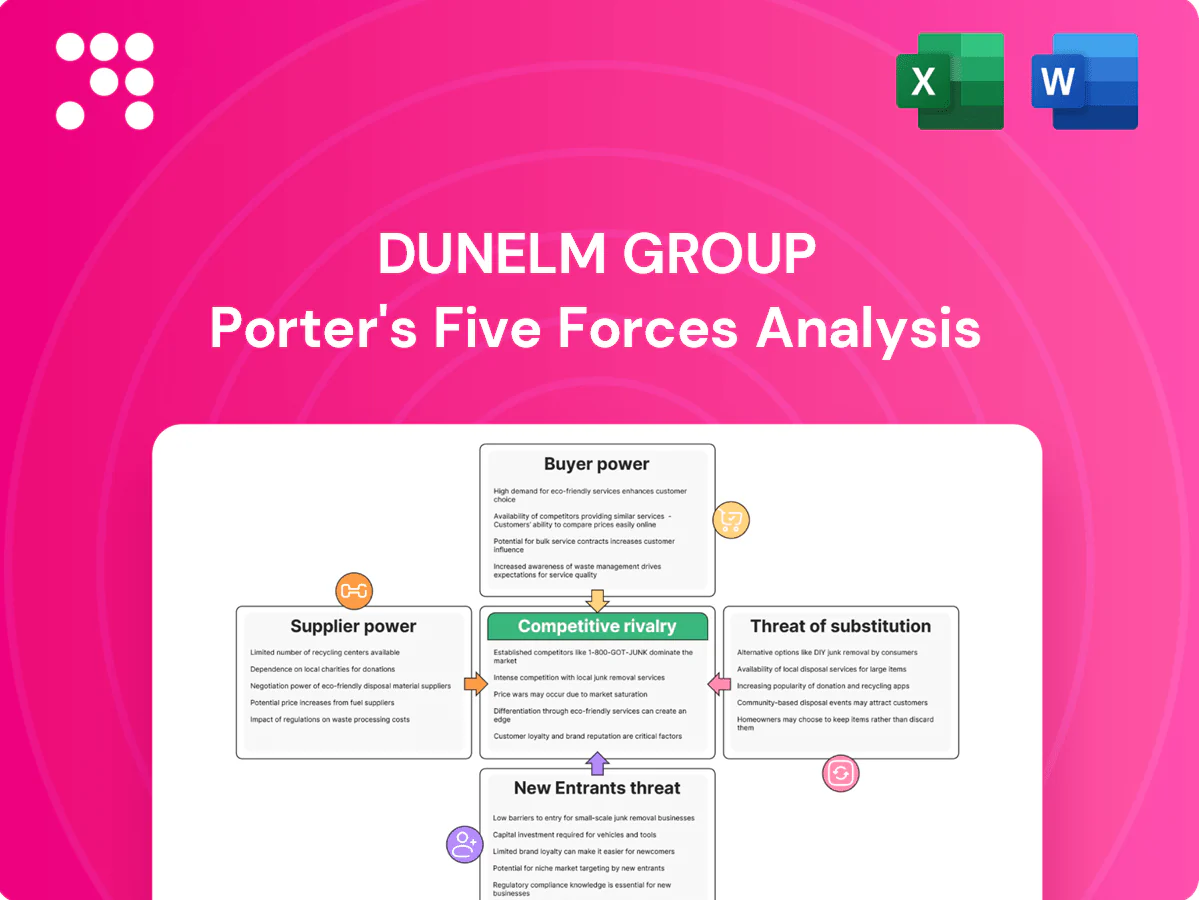
Dunelm Group Porter's Five Forces Analysis

Don't Miss the Bigger Picture
Dunelm faces intense competitive rivalry from national retailers and online marketplaces, with moderate buyer power driven by price sensitivity and brand loyalty. Supplier power is modest but niche suppliers can exert leverage, while threat of new entrants is low and substitutes from online platforms remain a clear pressure. This brief snapshot only scratches the surface. Unlock the full Porter's Five Forces Analysis to explore Dunelm Group’s competitive dynamics in detail.
Suppliers Bargaining Power

Diversified global sourcing
Many Dunelm homeware categories are sourced from a broad international supplier base, limiting any single vendor’s leverage and enabling negotiation flexibility; in 2024 the group continued to rely on multi-country sourcing to protect margins. Dunelm can switch between manufacturers to maintain price and quality continuity, and geographic diversification mitigates regional disruptions. However, elevated 2024 freight costs and geopolitical tensions can still temporarily tighten supply.
Private-label scale advantage
Dunelm's strong private-label penetration—c.60% of merchandise sales in FY2024—reduces reliance on national brands, shifting negotiating leverage away from suppliers. Own-brand control over specifications and captured margins compresses supplier bargaining power on price and terms. Consolidated volumes give Dunelm improved cost, lead-time and exclusivity terms, especially in repeatable, non-branded SKUs where scale drives the greatest advantage.

Input cost volatility pass-through
Suppliers face volatile swings in textiles, timber, metals and oil-linked freight costs, driving intermittent mid-single-digit cost uplifts pushed onto retailers in 2024.
Dunelm’s scale—around 174 UK stores in 2024—and long-term contracting smooths short-term spikes but cannot fully eliminate supplier leverage.
Hedging of freight/timber contracts and multi-sourcing reduced exposure materially in 2024, though residual pass-through remained.

Quality and compliance requirements
Logistics and lead-time dependence
Long-distance, bulky shipments for Dunelm create reliance on freight partners and port capacity, and during 2023–24 UK port congestion episodes carriers gained negotiating leverage that increased landed costs and delays. Dunelm’s demand planning, three DCs and inventory buffers limit exposure but cannot fully negate carrier power. Lead-time sensitivity heightens the need for tight supplier coordination and contingency contracts.
- stores≈170
- DCs=3
- 2023–24 port congestion↑ carrier leverage
Private-label dominance and store scale curb supplier leverage despite mid-single-digit cost shocks
Dunelm's diverse international supplier base and c.60% private-label in FY2024 reduce supplier leverage, with ~174 stores and 3 DCs supporting negotiation and continuity. Elevated 2024 freight/timber costs (mid-single-digit %) and 2023–24 UK port congestion temporarily increased carrier leverage. Regulatory/ESG supplier qualification raises power in lighting and upholstery.
| Metric | 2024 value | Impact |
|---|---|---|
| Private-label | c.60% merchandise sales | Low supplier power |
| Stores | ≈174 | Scale advantage |
| DCs | 3 | Resilience |
| Freight/timber | mid-single-digit %↑ | Temporary cost pressure |
| Port congestion | 2023–24 | Carrier leverage↑ |
| Regulated categories | Lighting, upholstery | Supplier power↑ |
What is included in the product
 Detailed Word Document
Tailored Porter's Five Forces for Dunelm Group, uncovering key competitive drivers, buyer and supplier power, substitutes, and entry threats to assess pricing pressure and profitability; identifies disruptive forces and strategic defenses for incumbency protection.

 Customizable Excel Spreadsheet
A concise Porter's Five Forces one-sheet for Dunelm Group—instantly visualise supplier, buyer and competitive pressure with an editable spider chart to speed strategic decisions. Swap in current sales, competitor or sourcing data and export to decks without macros for rapid boardroom use.
Customers Bargaining Power

High price sensitivity
Homeware shoppers are highly value-driven and promotion-responsive; small price gaps often prompt switching to rivals, pressuring Dunelm (c.170 stores) to balance everyday low pricing with targeted deals.
Low switching costs
Low switching costs mean customers can compare and buy similar items from IKEA, Next Home, Argos, Amazon and grocers, raising churn risk; UK online retail accounted for about 27% of sales in 2024, intensifying price competition. Minimal brand lock-in in commodity categories weakens Dunelm’s customer power, despite its c.170 stores in 2024. Differentiation through design, quality and services reduces switching, but convenience and availability remain decisive.

Online transparency
Digital search, reviews and marketplaces make price and quality comparisons effortless, pushing buyer expectations for value and speed; UK e‑commerce penetration rose to ~31% in 2024, intensifying scrutiny. Dunelm’s omnichannel model—click-and-collect and same/next‑day fulfilment—cuts delivery friction and supported group revenue of c.£1.3bn in 2024. Despite this, comparison friction remains low, sustaining strong customer bargaining power.

Broad assortment expectations
Shoppers expect wide ranges across styles, sizes and price points, and will defect if assortment gaps appear; Dunelm’s breadth—around 174 UK stores and c.30% online sales in FY2024—plus deep private-label ranges helps retain buyers, but maintaining category share requires continual range refresh and fast trend turnover.
- Expectation: wide style/size/price coverage
- Risk: buyers switch if gaps appear
- Dunelm strength: 174 stores, c.30% online (FY2024)
- Need: continuous range refresh to hold attention
Service and returns influence
Flexible returns and reliable delivery are vital in bulky home categories because they lower perceived purchase risk and constrain buyer leverage; weak last-mile or reverse logistics would materially increase customer bargaining power. Dunelm’s network of over 170 UK stores and omnichannel fulfilment supports convenient returns and collections, helping to temper buyer pressure.
- Flexible returns reduce perceived risk
- Reliable delivery limits buyer leverage
- Last-mile/reverse logistics weakness increases bargaining power
- Over 170 stores enable easy returns and collections
Price-sensitive shoppers, low switching costs and omnichannel reach keep buyer power high
Buyers are price-sensitive and easily switch for small savings, pressuring Dunelm despite product breadth; low switching costs with rivals (IKEA, Amazon) sustain strong customer bargaining. Omnichannel reach—c.174 UK stores and c.30% online sales in FY2024—plus reliable returns/fulfilment reduce churn but comparison ease (UK e‑commerce ~31% in 2024) keeps buyer power high.
| Metric | 2024 |
|---|---|
| UK stores | c.174 |
| Group revenue | c.£1.3bn |
| Online sales | c.30% of sales |
| UK e‑commerce penetration | ~31% |
Same Document Delivered
Dunelm Group Porter's Five Forces Analysis
This preview shows the exact Dunelm Group Porter's Five Forces analysis you'll receive—no surprises, no placeholders. It presents a concise evaluation of supplier and buyer power, competitive rivalry, threats of new entrants and substitutes, and strategic implications. The full, professionally formatted document is ready for immediate download after purchase.

Don't Miss the Bigger Picture
Dunelm faces intense competitive rivalry from national retailers and online marketplaces, with moderate buyer power driven by price sensitivity and brand loyalty. Supplier power is modest but niche suppliers can exert leverage, while threat of new entrants is low and substitutes from online platforms remain a clear pressure. This brief snapshot only scratches the surface. Unlock the full Porter's Five Forces Analysis to explore Dunelm Group’s competitive dynamics in detail.
Suppliers Bargaining Power
Diversified global sourcing
Many Dunelm homeware categories are sourced from a broad international supplier base, limiting any single vendor’s leverage and enabling negotiation flexibility; in 2024 the group continued to rely on multi-country sourcing to protect margins. Dunelm can switch between manufacturers to maintain price and quality continuity, and geographic diversification mitigates regional disruptions. However, elevated 2024 freight costs and geopolitical tensions can still temporarily tighten supply.
Private-label scale advantage
Dunelm's strong private-label penetration—c.60% of merchandise sales in FY2024—reduces reliance on national brands, shifting negotiating leverage away from suppliers. Own-brand control over specifications and captured margins compresses supplier bargaining power on price and terms. Consolidated volumes give Dunelm improved cost, lead-time and exclusivity terms, especially in repeatable, non-branded SKUs where scale drives the greatest advantage.
Input cost volatility pass-through
Suppliers face volatile swings in textiles, timber, metals and oil-linked freight costs, driving intermittent mid-single-digit cost uplifts pushed onto retailers in 2024.
Dunelm’s scale—around 174 UK stores in 2024—and long-term contracting smooths short-term spikes but cannot fully eliminate supplier leverage.
Hedging of freight/timber contracts and multi-sourcing reduced exposure materially in 2024, though residual pass-through remained.
Quality and compliance requirements
Logistics and lead-time dependence
Long-distance, bulky shipments for Dunelm create reliance on freight partners and port capacity, and during 2023–24 UK port congestion episodes carriers gained negotiating leverage that increased landed costs and delays. Dunelm’s demand planning, three DCs and inventory buffers limit exposure but cannot fully negate carrier power. Lead-time sensitivity heightens the need for tight supplier coordination and contingency contracts.
- stores≈170
- DCs=3
- 2023–24 port congestion↑ carrier leverage
Private-label dominance and store scale curb supplier leverage despite mid-single-digit cost shocks
Dunelm's diverse international supplier base and c.60% private-label in FY2024 reduce supplier leverage, with ~174 stores and 3 DCs supporting negotiation and continuity. Elevated 2024 freight/timber costs (mid-single-digit %) and 2023–24 UK port congestion temporarily increased carrier leverage. Regulatory/ESG supplier qualification raises power in lighting and upholstery.
| Metric | 2024 value | Impact |
|---|---|---|
| Private-label | c.60% merchandise sales | Low supplier power |
| Stores | ≈174 | Scale advantage |
| DCs | 3 | Resilience |
| Freight/timber | mid-single-digit %↑ | Temporary cost pressure |
| Port congestion | 2023–24 | Carrier leverage↑ |
| Regulated categories | Lighting, upholstery | Supplier power↑ |
What is included in the product
Detailed Word Document
Tailored Porter's Five Forces for Dunelm Group, uncovering key competitive drivers, buyer and supplier power, substitutes, and entry threats to assess pricing pressure and profitability; identifies disruptive forces and strategic defenses for incumbency protection.
Customizable Excel Spreadsheet
A concise Porter's Five Forces one-sheet for Dunelm Group—instantly visualise supplier, buyer and competitive pressure with an editable spider chart to speed strategic decisions. Swap in current sales, competitor or sourcing data and export to decks without macros for rapid boardroom use.
Customers Bargaining Power
High price sensitivity
Homeware shoppers are highly value-driven and promotion-responsive; small price gaps often prompt switching to rivals, pressuring Dunelm (c.170 stores) to balance everyday low pricing with targeted deals.
Low switching costs
Low switching costs mean customers can compare and buy similar items from IKEA, Next Home, Argos, Amazon and grocers, raising churn risk; UK online retail accounted for about 27% of sales in 2024, intensifying price competition. Minimal brand lock-in in commodity categories weakens Dunelm’s customer power, despite its c.170 stores in 2024. Differentiation through design, quality and services reduces switching, but convenience and availability remain decisive.
Online transparency
Digital search, reviews and marketplaces make price and quality comparisons effortless, pushing buyer expectations for value and speed; UK e‑commerce penetration rose to ~31% in 2024, intensifying scrutiny. Dunelm’s omnichannel model—click-and-collect and same/next‑day fulfilment—cuts delivery friction and supported group revenue of c.£1.3bn in 2024. Despite this, comparison friction remains low, sustaining strong customer bargaining power.
Broad assortment expectations
Shoppers expect wide ranges across styles, sizes and price points, and will defect if assortment gaps appear; Dunelm’s breadth—around 174 UK stores and c.30% online sales in FY2024—plus deep private-label ranges helps retain buyers, but maintaining category share requires continual range refresh and fast trend turnover.
- Expectation: wide style/size/price coverage
- Risk: buyers switch if gaps appear
- Dunelm strength: 174 stores, c.30% online (FY2024)
- Need: continuous range refresh to hold attention
Service and returns influence
Flexible returns and reliable delivery are vital in bulky home categories because they lower perceived purchase risk and constrain buyer leverage; weak last-mile or reverse logistics would materially increase customer bargaining power. Dunelm’s network of over 170 UK stores and omnichannel fulfilment supports convenient returns and collections, helping to temper buyer pressure.
- Flexible returns reduce perceived risk
- Reliable delivery limits buyer leverage
- Last-mile/reverse logistics weakness increases bargaining power
- Over 170 stores enable easy returns and collections
Price-sensitive shoppers, low switching costs and omnichannel reach keep buyer power high
Buyers are price-sensitive and easily switch for small savings, pressuring Dunelm despite product breadth; low switching costs with rivals (IKEA, Amazon) sustain strong customer bargaining. Omnichannel reach—c.174 UK stores and c.30% online sales in FY2024—plus reliable returns/fulfilment reduce churn but comparison ease (UK e‑commerce ~31% in 2024) keeps buyer power high.
| Metric | 2024 |
|---|---|
| UK stores | c.174 |
| Group revenue | c.£1.3bn |
| Online sales | c.30% of sales |
| UK e‑commerce penetration | ~31% |
Same Document Delivered
Dunelm Group Porter's Five Forces Analysis
This preview shows the exact Dunelm Group Porter's Five Forces analysis you'll receive—no surprises, no placeholders. It presents a concise evaluation of supplier and buyer power, competitive rivalry, threats of new entrants and substitutes, and strategic implications. The full, professionally formatted document is ready for immediate download after purchase.
Description
Don't Miss the Bigger Picture
Dunelm faces intense competitive rivalry from national retailers and online marketplaces, with moderate buyer power driven by price sensitivity and brand loyalty. Supplier power is modest but niche suppliers can exert leverage, while threat of new entrants is low and substitutes from online platforms remain a clear pressure. This brief snapshot only scratches the surface. Unlock the full Porter's Five Forces Analysis to explore Dunelm Group’s competitive dynamics in detail.
Suppliers Bargaining Power
Diversified global sourcing
Many Dunelm homeware categories are sourced from a broad international supplier base, limiting any single vendor’s leverage and enabling negotiation flexibility; in 2024 the group continued to rely on multi-country sourcing to protect margins. Dunelm can switch between manufacturers to maintain price and quality continuity, and geographic diversification mitigates regional disruptions. However, elevated 2024 freight costs and geopolitical tensions can still temporarily tighten supply.
Private-label scale advantage
Dunelm's strong private-label penetration—c.60% of merchandise sales in FY2024—reduces reliance on national brands, shifting negotiating leverage away from suppliers. Own-brand control over specifications and captured margins compresses supplier bargaining power on price and terms. Consolidated volumes give Dunelm improved cost, lead-time and exclusivity terms, especially in repeatable, non-branded SKUs where scale drives the greatest advantage.
Input cost volatility pass-through
Suppliers face volatile swings in textiles, timber, metals and oil-linked freight costs, driving intermittent mid-single-digit cost uplifts pushed onto retailers in 2024.
Dunelm’s scale—around 174 UK stores in 2024—and long-term contracting smooths short-term spikes but cannot fully eliminate supplier leverage.
Hedging of freight/timber contracts and multi-sourcing reduced exposure materially in 2024, though residual pass-through remained.
Quality and compliance requirements
Logistics and lead-time dependence
Long-distance, bulky shipments for Dunelm create reliance on freight partners and port capacity, and during 2023–24 UK port congestion episodes carriers gained negotiating leverage that increased landed costs and delays. Dunelm’s demand planning, three DCs and inventory buffers limit exposure but cannot fully negate carrier power. Lead-time sensitivity heightens the need for tight supplier coordination and contingency contracts.
- stores≈170
- DCs=3
- 2023–24 port congestion↑ carrier leverage
Private-label dominance and store scale curb supplier leverage despite mid-single-digit cost shocks
Dunelm's diverse international supplier base and c.60% private-label in FY2024 reduce supplier leverage, with ~174 stores and 3 DCs supporting negotiation and continuity. Elevated 2024 freight/timber costs (mid-single-digit %) and 2023–24 UK port congestion temporarily increased carrier leverage. Regulatory/ESG supplier qualification raises power in lighting and upholstery.
| Metric | 2024 value | Impact |
|---|---|---|
| Private-label | c.60% merchandise sales | Low supplier power |
| Stores | ≈174 | Scale advantage |
| DCs | 3 | Resilience |
| Freight/timber | mid-single-digit %↑ | Temporary cost pressure |
| Port congestion | 2023–24 | Carrier leverage↑ |
| Regulated categories | Lighting, upholstery | Supplier power↑ |
What is included in the product
Detailed Word Document
Tailored Porter's Five Forces for Dunelm Group, uncovering key competitive drivers, buyer and supplier power, substitutes, and entry threats to assess pricing pressure and profitability; identifies disruptive forces and strategic defenses for incumbency protection.
Customizable Excel Spreadsheet
A concise Porter's Five Forces one-sheet for Dunelm Group—instantly visualise supplier, buyer and competitive pressure with an editable spider chart to speed strategic decisions. Swap in current sales, competitor or sourcing data and export to decks without macros for rapid boardroom use.
Customers Bargaining Power
High price sensitivity
Homeware shoppers are highly value-driven and promotion-responsive; small price gaps often prompt switching to rivals, pressuring Dunelm (c.170 stores) to balance everyday low pricing with targeted deals.
Low switching costs
Low switching costs mean customers can compare and buy similar items from IKEA, Next Home, Argos, Amazon and grocers, raising churn risk; UK online retail accounted for about 27% of sales in 2024, intensifying price competition. Minimal brand lock-in in commodity categories weakens Dunelm’s customer power, despite its c.170 stores in 2024. Differentiation through design, quality and services reduces switching, but convenience and availability remain decisive.
Online transparency
Digital search, reviews and marketplaces make price and quality comparisons effortless, pushing buyer expectations for value and speed; UK e‑commerce penetration rose to ~31% in 2024, intensifying scrutiny. Dunelm’s omnichannel model—click-and-collect and same/next‑day fulfilment—cuts delivery friction and supported group revenue of c.£1.3bn in 2024. Despite this, comparison friction remains low, sustaining strong customer bargaining power.
Broad assortment expectations
Shoppers expect wide ranges across styles, sizes and price points, and will defect if assortment gaps appear; Dunelm’s breadth—around 174 UK stores and c.30% online sales in FY2024—plus deep private-label ranges helps retain buyers, but maintaining category share requires continual range refresh and fast trend turnover.
- Expectation: wide style/size/price coverage
- Risk: buyers switch if gaps appear
- Dunelm strength: 174 stores, c.30% online (FY2024)
- Need: continuous range refresh to hold attention
Service and returns influence
Flexible returns and reliable delivery are vital in bulky home categories because they lower perceived purchase risk and constrain buyer leverage; weak last-mile or reverse logistics would materially increase customer bargaining power. Dunelm’s network of over 170 UK stores and omnichannel fulfilment supports convenient returns and collections, helping to temper buyer pressure.
- Flexible returns reduce perceived risk
- Reliable delivery limits buyer leverage
- Last-mile/reverse logistics weakness increases bargaining power
- Over 170 stores enable easy returns and collections
Price-sensitive shoppers, low switching costs and omnichannel reach keep buyer power high
Buyers are price-sensitive and easily switch for small savings, pressuring Dunelm despite product breadth; low switching costs with rivals (IKEA, Amazon) sustain strong customer bargaining. Omnichannel reach—c.174 UK stores and c.30% online sales in FY2024—plus reliable returns/fulfilment reduce churn but comparison ease (UK e‑commerce ~31% in 2024) keeps buyer power high.
| Metric | 2024 |
|---|---|
| UK stores | c.174 |
| Group revenue | c.£1.3bn |
| Online sales | c.30% of sales |
| UK e‑commerce penetration | ~31% |
Same Document Delivered
Dunelm Group Porter's Five Forces Analysis
This preview shows the exact Dunelm Group Porter's Five Forces analysis you'll receive—no surprises, no placeholders. It presents a concise evaluation of supplier and buyer power, competitive rivalry, threats of new entrants and substitutes, and strategic implications. The full, professionally formatted document is ready for immediate download after purchase.











