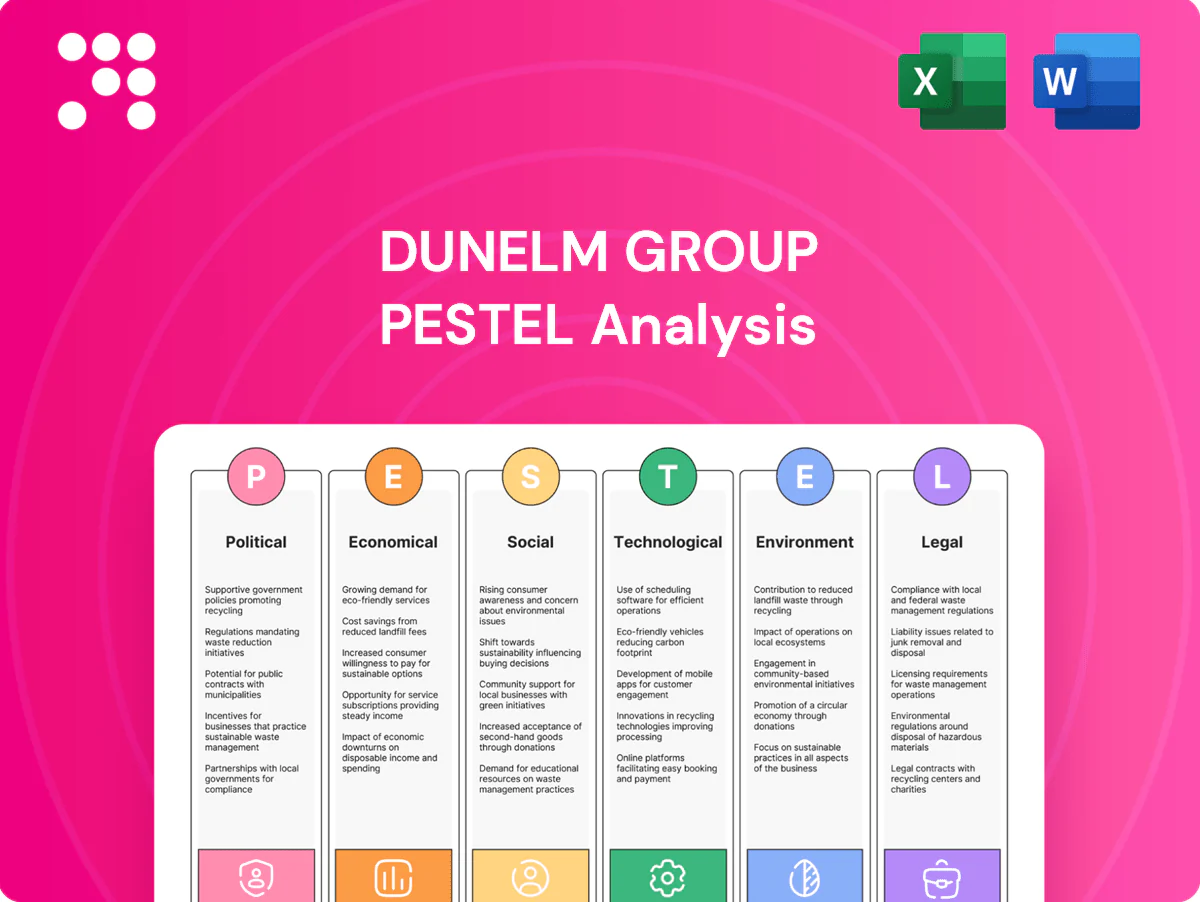
Dunelm Group PESTLE Analysis

Make Smarter Strategic Decisions with a Complete PESTEL View
Gain strategic clarity on Dunelm Group with our concise PESTLE overview — highlighting political, economic, social, technological, legal and environmental forces shaping its retail position. Ideal for investors and strategists, this snapshot reveals key risks and opportunities. Purchase the full PESTLE for actionable, exportable insights to inform your next decision.
Political factors

UK retail policy and business rates
Business rates materially affect store profitability across Dunelm’s large-format estate, which spans around 170 stores, and were highlighted by the 2023 revaluation that reshaped liabilities nationally. Ongoing UK consultations on rates reform and targeted reliefs through 2024–25 could shift cost burdens by region and store type. Proactive engagement with government and footprint optimisation reduce exposure to policy volatility. Any sustained rise in rates would pressure margins and capital allocation.
Post-Brexit trade and import tariffs
Post-Brexit, the UK-EU Trade and Cooperation Agreement permits zero tariffs on qualifying goods if rules of origin are met, but new customs declarations and rules of origin compliance since January 2021 have raised landed costs for homewares through extra paperwork and compliance costs.
Changes to UK-EU or wider UK trade deals could shift supplier mix and unit pricing for Dunelm as tariff exposure or preferential access changes, while border frictions have increased lead times and tied up working capital in inventories and transit.
Practical mitigation seen across retail is strategic nearshoring and diversified sourcing to lower tariff and delay risk, reducing reliance on single-country supply chains and smoothing inventory cycles.

Planning and local authority permissions
Store openings, refurbishments and signage for Dunelm depend on planning approvals, affecting its network of over 160 UK stores. Councils' town-centre revitalization policies can favor compact urban formats or constrain large out-of-town sites, shifting location economics. Transport and parking stipulations materially affect footfall and catchment viability. Early stakeholder engagement consistently speeds development timelines and reduces approval risk.

Government sustainability agenda
UK net-zero by 2050 drives tighter expectations on energy efficiency, waste reduction and climate reporting; packaging Extended Producer Responsibility began in April 2024 and DEFRA ran consultations on expanding EPR to textiles and furniture in 2023. Compliance raises operating and capex costs but can boost brand trust and customer loyalty; government incentives for green upgrades can offset some capex.
- Net-zero target: 2050
- Packaging EPR live: April 2024
- Textiles/furniture EPR: DEFRA consultation 2023
- Effect: higher compliance costs vs improved brand trust; incentives may reduce capex
Logistics and infrastructure investment
Government spending on roads, ports and digital infrastructure in 2024–25 directly affects Dunelm’s supply chain reliability; upgrades reduce travel times and stockouts, while public sector strikes or intensified border checks (post‑2021 regimes) can delay deliveries and increase safety stock. Clear policy on multi‑modal hubs enables better network planning and lowers distribution costs through route and warehouse optimisation.
- 2024–25 policy clarity aids long‑term network planning
- Strikes/border checks = higher lead times
- Infrastructure upgrades lower distribution costs
Store margins hit by 2023 rates revaluation, rising post‑Brexit costs and green compliance
Business rates and the 2023 revaluation materially affect margins across Dunelm’s ~170 stores; continued 2024–25 rates reform could shift local cost burdens. Post‑Brexit customs/friction raised landed costs and working capital needs; nearshoring and supplier diversification are active mitigations. Net‑zero by 2050 and Packaging EPR (Apr 2024) raise compliance and capex but offer incentives and brand benefits.
| Metric | Value |
|---|---|
| Stores | ~170 |
| Business rates reval | 2023 |
| Packaging EPR | Apr 2024 |
| Net‑zero target | 2050 |
What is included in the product
 Detailed Word Document
Explores how Political, Economic, Social, Technological, Environmental and Legal forces uniquely affect Dunelm Group—linking sector-specific data, regulatory trends and consumer habits to identify risks and growth opportunities for executives and investors.

 Customizable Excel Spreadsheet
A concise, visually segmented PESTLE summary of Dunelm Group that can be dropped into presentations or shared across teams for quick alignment. Editable notes let users tailor insights to region or product line, easing external risk discussion and market-positioning decisions during planning.
Economic factors

Consumer confidence and real incomes
Discretionary homeware spend closely tracks household sentiment and wage trends; UK real regular pay returned to modest growth of about 1.6% year-on-year by mid-2024, supporting Dunelm’s core demand. Elevated but falling inflation (around 3% mid-2024) squeezed budgets earlier, shifting shoppers toward value ranges and promotions. As confidence recovers, average basket values and premium mix rise, while agile pricing strategies defend volume without diluting brand equity.
Interest rates and housing activity
Higher Bank Rate around 5.25% has constrained mortgage approvals and home moves, dampening big-ticket furniture purchases; mortgage approvals fell sharply in 2023 before a market recovery. UK house prices rose c.3–4% year-on-year in 2024, boosting refurbishment and furnishings demand. Rate cuts in 2024–25 could release pent-up spending, and Dunelm’s broad range lets it capture both refresh and replacement cycles.

Cost inflation and FX exposure
Imported ranges expose Dunelm margins to currency swings, freight and commodity costs; FY2024 revenue was c.£1.3bn, so landed-cost rises materially affect gross margin. A weaker sterling raises landed costs, forcing price resets or tougher vendor negotiations to protect margin. Active FX hedging and multi-currency sourcing smooth volatility, while strict inventory discipline preserves cash flow and working capital.

Labour market and wage pressures
Tight UK labour markets (ONS unemployment ~4.2% mid‑2024) push Dunelm’s store and distribution wage bills higher, amplified by the National Living Wage rise to £11.44 from April 2024. Investment in productivity tools and smarter scheduling helps contain hours and costs, while strong employer branding supports retention and in‑store service quality.
Energy and logistics costs
Energy price spikes in 2022–23 elevated Dunelm store and DC operating costs, though wholesale power fell roughly 60% from 2022 peaks by mid-2024 (BEIS), easing headline bills; fuel-driven carrier rates and last-mile home delivery remained inflationary into 2024.
Targeted efficiency programmes and renewable PPAs have reduced volatility and hedged margins, while network optimisation and store-to-home routing lowered last-mile costs and supported delivery cost reductions.
- Energy volatility: wholesale power down ~60% from 2022 peaks (BEIS mid-2024)
- Logistics pressure: sustained carrier/fuel-driven rate inflation into 2024
- Mitigation: renewable contracts and efficiency measures hedge exposure
- Cost saving: network optimisation cuts last-mile delivery costs
Store margins hit by 2023 rates revaluation, rising post‑Brexit costs and green compliance
Discretionary homeware demand improved with UK real pay +1.6% y/y (mid-2024) and inflation ~3% (mid-2024), lifting baskets and premium mix. Bank Rate ~5.25% and slower mortgage approvals limited big-ticket sales despite UK house prices +3–4% (2024). FY2024 revenue c.£1.3bn; FX, freight and tight labour (unemployment ~4.2%; NLW £11.44 Apr 2024) pressure margins; energy costs eased ~60% from 2022 peaks (mid-2024).
| Metric | Value |
|---|---|
| Real pay (mid-2024) | +1.6% y/y |
| Inflation (mid-2024) | ~3% |
| Bank Rate | ~5.25% |
| House prices (2024) | +3–4% y/y |
| FY2024 revenue | c.£1.3bn |
| Unemployment (mid-2024) | ~4.2% |
| NLW (Apr 2024) | £11.44 |
| Wholesale power vs 2022 peak | -~60% |
Preview Before You Purchase
Dunelm Group PESTLE Analysis
The preview shown here is the exact Dunelm Group PESTLE Analysis you’ll receive after purchase—fully formatted and ready to use. It contains complete political, economic, social, technological, legal and environmental assessments with professional structure and no placeholders. After checkout you’ll instantly download this same final document, exactly as displayed.

Make Smarter Strategic Decisions with a Complete PESTEL View
Gain strategic clarity on Dunelm Group with our concise PESTLE overview — highlighting political, economic, social, technological, legal and environmental forces shaping its retail position. Ideal for investors and strategists, this snapshot reveals key risks and opportunities. Purchase the full PESTLE for actionable, exportable insights to inform your next decision.
Political factors
UK retail policy and business rates
Business rates materially affect store profitability across Dunelm’s large-format estate, which spans around 170 stores, and were highlighted by the 2023 revaluation that reshaped liabilities nationally. Ongoing UK consultations on rates reform and targeted reliefs through 2024–25 could shift cost burdens by region and store type. Proactive engagement with government and footprint optimisation reduce exposure to policy volatility. Any sustained rise in rates would pressure margins and capital allocation.
Post-Brexit trade and import tariffs
Post-Brexit, the UK-EU Trade and Cooperation Agreement permits zero tariffs on qualifying goods if rules of origin are met, but new customs declarations and rules of origin compliance since January 2021 have raised landed costs for homewares through extra paperwork and compliance costs.
Changes to UK-EU or wider UK trade deals could shift supplier mix and unit pricing for Dunelm as tariff exposure or preferential access changes, while border frictions have increased lead times and tied up working capital in inventories and transit.
Practical mitigation seen across retail is strategic nearshoring and diversified sourcing to lower tariff and delay risk, reducing reliance on single-country supply chains and smoothing inventory cycles.
Planning and local authority permissions
Store openings, refurbishments and signage for Dunelm depend on planning approvals, affecting its network of over 160 UK stores. Councils' town-centre revitalization policies can favor compact urban formats or constrain large out-of-town sites, shifting location economics. Transport and parking stipulations materially affect footfall and catchment viability. Early stakeholder engagement consistently speeds development timelines and reduces approval risk.
Government sustainability agenda
UK net-zero by 2050 drives tighter expectations on energy efficiency, waste reduction and climate reporting; packaging Extended Producer Responsibility began in April 2024 and DEFRA ran consultations on expanding EPR to textiles and furniture in 2023. Compliance raises operating and capex costs but can boost brand trust and customer loyalty; government incentives for green upgrades can offset some capex.
- Net-zero target: 2050
- Packaging EPR live: April 2024
- Textiles/furniture EPR: DEFRA consultation 2023
- Effect: higher compliance costs vs improved brand trust; incentives may reduce capex
Logistics and infrastructure investment
Government spending on roads, ports and digital infrastructure in 2024–25 directly affects Dunelm’s supply chain reliability; upgrades reduce travel times and stockouts, while public sector strikes or intensified border checks (post‑2021 regimes) can delay deliveries and increase safety stock. Clear policy on multi‑modal hubs enables better network planning and lowers distribution costs through route and warehouse optimisation.
- 2024–25 policy clarity aids long‑term network planning
- Strikes/border checks = higher lead times
- Infrastructure upgrades lower distribution costs
Store margins hit by 2023 rates revaluation, rising post‑Brexit costs and green compliance
Business rates and the 2023 revaluation materially affect margins across Dunelm’s ~170 stores; continued 2024–25 rates reform could shift local cost burdens. Post‑Brexit customs/friction raised landed costs and working capital needs; nearshoring and supplier diversification are active mitigations. Net‑zero by 2050 and Packaging EPR (Apr 2024) raise compliance and capex but offer incentives and brand benefits.
| Metric | Value |
|---|---|
| Stores | ~170 |
| Business rates reval | 2023 |
| Packaging EPR | Apr 2024 |
| Net‑zero target | 2050 |
What is included in the product
Detailed Word Document
Explores how Political, Economic, Social, Technological, Environmental and Legal forces uniquely affect Dunelm Group—linking sector-specific data, regulatory trends and consumer habits to identify risks and growth opportunities for executives and investors.
Customizable Excel Spreadsheet
A concise, visually segmented PESTLE summary of Dunelm Group that can be dropped into presentations or shared across teams for quick alignment. Editable notes let users tailor insights to region or product line, easing external risk discussion and market-positioning decisions during planning.
Economic factors
Consumer confidence and real incomes
Discretionary homeware spend closely tracks household sentiment and wage trends; UK real regular pay returned to modest growth of about 1.6% year-on-year by mid-2024, supporting Dunelm’s core demand. Elevated but falling inflation (around 3% mid-2024) squeezed budgets earlier, shifting shoppers toward value ranges and promotions. As confidence recovers, average basket values and premium mix rise, while agile pricing strategies defend volume without diluting brand equity.
Interest rates and housing activity
Higher Bank Rate around 5.25% has constrained mortgage approvals and home moves, dampening big-ticket furniture purchases; mortgage approvals fell sharply in 2023 before a market recovery. UK house prices rose c.3–4% year-on-year in 2024, boosting refurbishment and furnishings demand. Rate cuts in 2024–25 could release pent-up spending, and Dunelm’s broad range lets it capture both refresh and replacement cycles.
Cost inflation and FX exposure
Imported ranges expose Dunelm margins to currency swings, freight and commodity costs; FY2024 revenue was c.£1.3bn, so landed-cost rises materially affect gross margin. A weaker sterling raises landed costs, forcing price resets or tougher vendor negotiations to protect margin. Active FX hedging and multi-currency sourcing smooth volatility, while strict inventory discipline preserves cash flow and working capital.
Labour market and wage pressures
Tight UK labour markets (ONS unemployment ~4.2% mid‑2024) push Dunelm’s store and distribution wage bills higher, amplified by the National Living Wage rise to £11.44 from April 2024. Investment in productivity tools and smarter scheduling helps contain hours and costs, while strong employer branding supports retention and in‑store service quality.
Energy and logistics costs
Energy price spikes in 2022–23 elevated Dunelm store and DC operating costs, though wholesale power fell roughly 60% from 2022 peaks by mid-2024 (BEIS), easing headline bills; fuel-driven carrier rates and last-mile home delivery remained inflationary into 2024.
Targeted efficiency programmes and renewable PPAs have reduced volatility and hedged margins, while network optimisation and store-to-home routing lowered last-mile costs and supported delivery cost reductions.
- Energy volatility: wholesale power down ~60% from 2022 peaks (BEIS mid-2024)
- Logistics pressure: sustained carrier/fuel-driven rate inflation into 2024
- Mitigation: renewable contracts and efficiency measures hedge exposure
- Cost saving: network optimisation cuts last-mile delivery costs
Store margins hit by 2023 rates revaluation, rising post‑Brexit costs and green compliance
Discretionary homeware demand improved with UK real pay +1.6% y/y (mid-2024) and inflation ~3% (mid-2024), lifting baskets and premium mix. Bank Rate ~5.25% and slower mortgage approvals limited big-ticket sales despite UK house prices +3–4% (2024). FY2024 revenue c.£1.3bn; FX, freight and tight labour (unemployment ~4.2%; NLW £11.44 Apr 2024) pressure margins; energy costs eased ~60% from 2022 peaks (mid-2024).
| Metric | Value |
|---|---|
| Real pay (mid-2024) | +1.6% y/y |
| Inflation (mid-2024) | ~3% |
| Bank Rate | ~5.25% |
| House prices (2024) | +3–4% y/y |
| FY2024 revenue | c.£1.3bn |
| Unemployment (mid-2024) | ~4.2% |
| NLW (Apr 2024) | £11.44 |
| Wholesale power vs 2022 peak | -~60% |
Preview Before You Purchase
Dunelm Group PESTLE Analysis
The preview shown here is the exact Dunelm Group PESTLE Analysis you’ll receive after purchase—fully formatted and ready to use. It contains complete political, economic, social, technological, legal and environmental assessments with professional structure and no placeholders. After checkout you’ll instantly download this same final document, exactly as displayed.
Original: $10.00
-65%$10.00
$3.50Description
Make Smarter Strategic Decisions with a Complete PESTEL View
Gain strategic clarity on Dunelm Group with our concise PESTLE overview — highlighting political, economic, social, technological, legal and environmental forces shaping its retail position. Ideal for investors and strategists, this snapshot reveals key risks and opportunities. Purchase the full PESTLE for actionable, exportable insights to inform your next decision.
Political factors
UK retail policy and business rates
Business rates materially affect store profitability across Dunelm’s large-format estate, which spans around 170 stores, and were highlighted by the 2023 revaluation that reshaped liabilities nationally. Ongoing UK consultations on rates reform and targeted reliefs through 2024–25 could shift cost burdens by region and store type. Proactive engagement with government and footprint optimisation reduce exposure to policy volatility. Any sustained rise in rates would pressure margins and capital allocation.
Post-Brexit trade and import tariffs
Post-Brexit, the UK-EU Trade and Cooperation Agreement permits zero tariffs on qualifying goods if rules of origin are met, but new customs declarations and rules of origin compliance since January 2021 have raised landed costs for homewares through extra paperwork and compliance costs.
Changes to UK-EU or wider UK trade deals could shift supplier mix and unit pricing for Dunelm as tariff exposure or preferential access changes, while border frictions have increased lead times and tied up working capital in inventories and transit.
Practical mitigation seen across retail is strategic nearshoring and diversified sourcing to lower tariff and delay risk, reducing reliance on single-country supply chains and smoothing inventory cycles.
Planning and local authority permissions
Store openings, refurbishments and signage for Dunelm depend on planning approvals, affecting its network of over 160 UK stores. Councils' town-centre revitalization policies can favor compact urban formats or constrain large out-of-town sites, shifting location economics. Transport and parking stipulations materially affect footfall and catchment viability. Early stakeholder engagement consistently speeds development timelines and reduces approval risk.
Government sustainability agenda
UK net-zero by 2050 drives tighter expectations on energy efficiency, waste reduction and climate reporting; packaging Extended Producer Responsibility began in April 2024 and DEFRA ran consultations on expanding EPR to textiles and furniture in 2023. Compliance raises operating and capex costs but can boost brand trust and customer loyalty; government incentives for green upgrades can offset some capex.
- Net-zero target: 2050
- Packaging EPR live: April 2024
- Textiles/furniture EPR: DEFRA consultation 2023
- Effect: higher compliance costs vs improved brand trust; incentives may reduce capex
Logistics and infrastructure investment
Government spending on roads, ports and digital infrastructure in 2024–25 directly affects Dunelm’s supply chain reliability; upgrades reduce travel times and stockouts, while public sector strikes or intensified border checks (post‑2021 regimes) can delay deliveries and increase safety stock. Clear policy on multi‑modal hubs enables better network planning and lowers distribution costs through route and warehouse optimisation.
- 2024–25 policy clarity aids long‑term network planning
- Strikes/border checks = higher lead times
- Infrastructure upgrades lower distribution costs
Store margins hit by 2023 rates revaluation, rising post‑Brexit costs and green compliance
Business rates and the 2023 revaluation materially affect margins across Dunelm’s ~170 stores; continued 2024–25 rates reform could shift local cost burdens. Post‑Brexit customs/friction raised landed costs and working capital needs; nearshoring and supplier diversification are active mitigations. Net‑zero by 2050 and Packaging EPR (Apr 2024) raise compliance and capex but offer incentives and brand benefits.
| Metric | Value |
|---|---|
| Stores | ~170 |
| Business rates reval | 2023 |
| Packaging EPR | Apr 2024 |
| Net‑zero target | 2050 |
What is included in the product
Detailed Word Document
Explores how Political, Economic, Social, Technological, Environmental and Legal forces uniquely affect Dunelm Group—linking sector-specific data, regulatory trends and consumer habits to identify risks and growth opportunities for executives and investors.
Customizable Excel Spreadsheet
A concise, visually segmented PESTLE summary of Dunelm Group that can be dropped into presentations or shared across teams for quick alignment. Editable notes let users tailor insights to region or product line, easing external risk discussion and market-positioning decisions during planning.
Economic factors
Consumer confidence and real incomes
Discretionary homeware spend closely tracks household sentiment and wage trends; UK real regular pay returned to modest growth of about 1.6% year-on-year by mid-2024, supporting Dunelm’s core demand. Elevated but falling inflation (around 3% mid-2024) squeezed budgets earlier, shifting shoppers toward value ranges and promotions. As confidence recovers, average basket values and premium mix rise, while agile pricing strategies defend volume without diluting brand equity.
Interest rates and housing activity
Higher Bank Rate around 5.25% has constrained mortgage approvals and home moves, dampening big-ticket furniture purchases; mortgage approvals fell sharply in 2023 before a market recovery. UK house prices rose c.3–4% year-on-year in 2024, boosting refurbishment and furnishings demand. Rate cuts in 2024–25 could release pent-up spending, and Dunelm’s broad range lets it capture both refresh and replacement cycles.
Cost inflation and FX exposure
Imported ranges expose Dunelm margins to currency swings, freight and commodity costs; FY2024 revenue was c.£1.3bn, so landed-cost rises materially affect gross margin. A weaker sterling raises landed costs, forcing price resets or tougher vendor negotiations to protect margin. Active FX hedging and multi-currency sourcing smooth volatility, while strict inventory discipline preserves cash flow and working capital.
Labour market and wage pressures
Tight UK labour markets (ONS unemployment ~4.2% mid‑2024) push Dunelm’s store and distribution wage bills higher, amplified by the National Living Wage rise to £11.44 from April 2024. Investment in productivity tools and smarter scheduling helps contain hours and costs, while strong employer branding supports retention and in‑store service quality.
Energy and logistics costs
Energy price spikes in 2022–23 elevated Dunelm store and DC operating costs, though wholesale power fell roughly 60% from 2022 peaks by mid-2024 (BEIS), easing headline bills; fuel-driven carrier rates and last-mile home delivery remained inflationary into 2024.
Targeted efficiency programmes and renewable PPAs have reduced volatility and hedged margins, while network optimisation and store-to-home routing lowered last-mile costs and supported delivery cost reductions.
- Energy volatility: wholesale power down ~60% from 2022 peaks (BEIS mid-2024)
- Logistics pressure: sustained carrier/fuel-driven rate inflation into 2024
- Mitigation: renewable contracts and efficiency measures hedge exposure
- Cost saving: network optimisation cuts last-mile delivery costs
Store margins hit by 2023 rates revaluation, rising post‑Brexit costs and green compliance
Discretionary homeware demand improved with UK real pay +1.6% y/y (mid-2024) and inflation ~3% (mid-2024), lifting baskets and premium mix. Bank Rate ~5.25% and slower mortgage approvals limited big-ticket sales despite UK house prices +3–4% (2024). FY2024 revenue c.£1.3bn; FX, freight and tight labour (unemployment ~4.2%; NLW £11.44 Apr 2024) pressure margins; energy costs eased ~60% from 2022 peaks (mid-2024).
| Metric | Value |
|---|---|
| Real pay (mid-2024) | +1.6% y/y |
| Inflation (mid-2024) | ~3% |
| Bank Rate | ~5.25% |
| House prices (2024) | +3–4% y/y |
| FY2024 revenue | c.£1.3bn |
| Unemployment (mid-2024) | ~4.2% |
| NLW (Apr 2024) | £11.44 |
| Wholesale power vs 2022 peak | -~60% |
Preview Before You Purchase
Dunelm Group PESTLE Analysis
The preview shown here is the exact Dunelm Group PESTLE Analysis you’ll receive after purchase—fully formatted and ready to use. It contains complete political, economic, social, technological, legal and environmental assessments with professional structure and no placeholders. After checkout you’ll instantly download this same final document, exactly as displayed.











