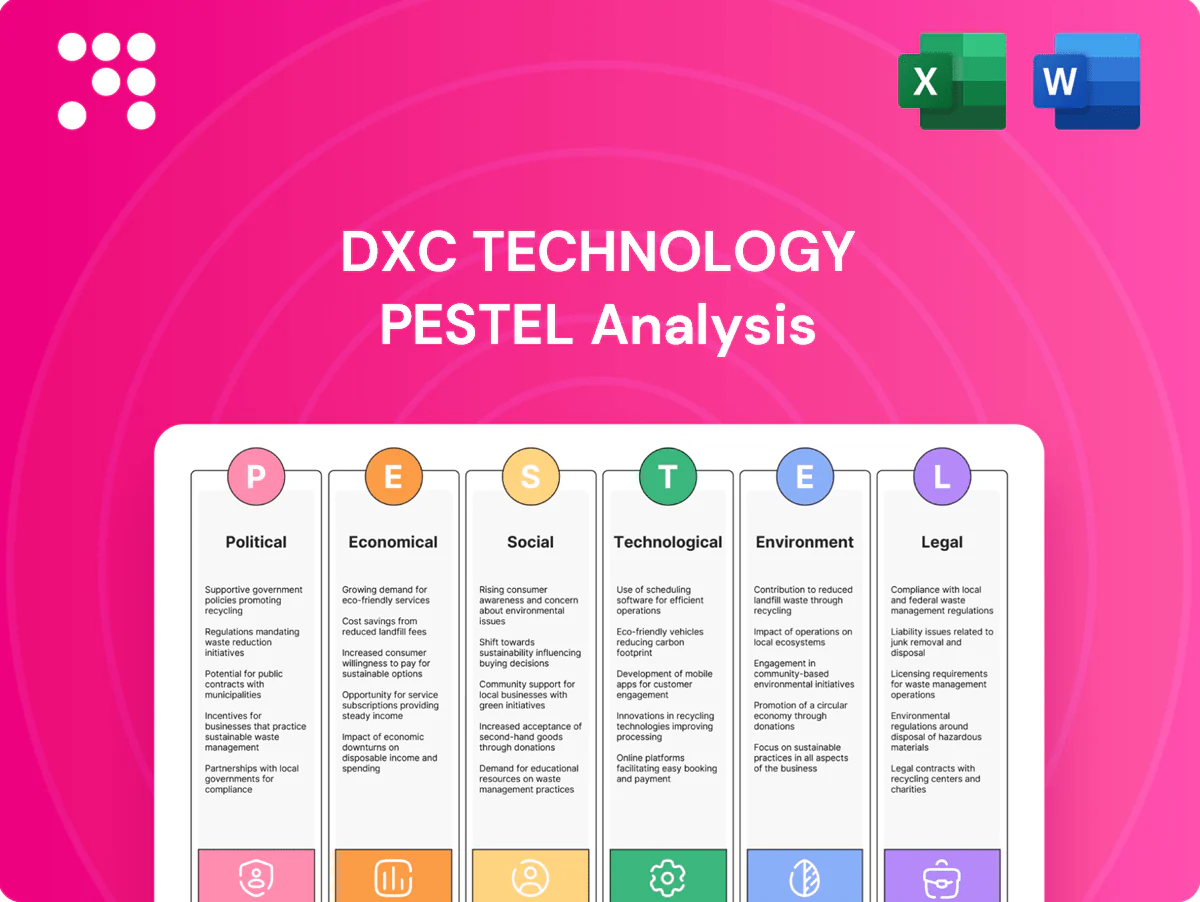
DXC Technology PESTLE Analysis

Skip the Research. Get the Strategy.
Unlock strategic clarity with our PESTLE Analysis of DXC Technology—three-paragraph precision that reveals how political, economic, social, technological, legal, and environmental forces will shape DXC’s trajectory. Use these insights to anticipate risks, spot growth opportunities, and strengthen your investment or strategic plan. Purchase the full report for a detailed, ready-to-use breakdown and actionable recommendations.
Political factors

Geopolitical stability and conflict exposure
DXC’s delivery footprint across 70+ countries exposes projects to disruptions from wars, sanctions and political unrest, as seen since the 2022 Russia-Ukraine conflict. Shifts in diplomatic relations can constrain cross-border team deployment and vendor access. Mitigation requires diversified delivery centers and robust continuity plans. Clients increasingly favor partners with proven crisis execution.
Government IT modernization agendas
Government IT modernization programs drive multi-year outsourcing and cloud transformation deals, with US federal IT spending near $99 billion in 2024 and the global public cloud services market at about $591 billion in 2023, highlighting large addressable demand. Budget cycles and shifting policy priorities can accelerate or delay awards, making timing critical. Robust compliance and security credentials are essential to capture this pipeline. DXC can leverage references in regulated environments to expand share.

Trade policy, tariffs, and supply chain
Export controls (US semiconductor export limits rolled out 2022–23) and Section 301 tariffs on China (generally 7.5%–25%) lift hardware costs and extend lead times for hybrid cloud builds. Restrictions on specific vendors have already reshaped partner ecosystems and vendor roadmaps. Nearshoring and multi‑vendor sourcing lower policy shock risk. DXC must continuously reassess approved supplier lists and reference architectures.

Data sovereignty and localization mandates
National rules in over 60 jurisdictions now mandate in-country storage/processing for sensitive workloads, forcing cloud architecture, vendor selection and pricing adjustments; DXC’s hybrid and sovereign-cloud stack can convert compliance into a sales differentiator by hosting controlled environments close to customers. Consistent governance frameworks enable repeatable, auditable deployments across jurisdictions, reducing time-to-market and compliance cost variance.
- Impact: in-country requirements raise TCO and limit hyperscaler options
- DXC strength: sovereign-cloud + hybrid deployments for regulated clients
- Governance: repeatable templates speed regional rollouts and audits
Cybersecurity as national priority
States elevate cyber defense as a national priority, driving demand for managed security services and zero-trust; the global cybersecurity market is forecast around $300B by 2026, underpinning larger contracts and recurring revenue. Grant funding and mandates expand project scopes while certification requirements raise entry barriers, favoring established players. DXC can bundle security with modernization to win complex deals.
- Demand: managed security & zero-trust
- Market: ~300B by 2026
- Grants/mandates expand scope
- Certifications raise barriers; incumbents advantaged
- DXC strategy: bundle security + modernization
Global IT services face geopolitical disruptions; government cloud and cybersecurity drive demand
DXC’s 70+ country footprint faces disruption risk from wars, sanctions and export controls, requiring diversified delivery centers and continuity plans. Government IT modernization (US federal IT ~$99B in 2024; public cloud ~$591B in 2023) and sovereign-cloud rules create large, regulated demand. Rising cyber spend (~$300B market by 2026) favors bundled security offerings and certified incumbents.
| Metric | Value | Implication |
|---|---|---|
| DXC footprint | 70+ countries | Exposure to political risk |
| US federal IT | $99B (2024) | Large outsourcing pipeline |
| Public cloud | $591B (2023) | Transformation demand |
| Cybersecurity | $300B (2026) | Bundle opportunity |
What is included in the product
 Detailed Word Document
Explores how Political, Economic, Social, Technological, Environmental and Legal factors uniquely affect DXC Technology, with data-backed trends, industry-specific examples and forward-looking insights to support executives, consultants and investors in risk identification, scenario planning and strategy-ready deliverables for reports, pitch decks and funding discussions.

 Customizable Excel Spreadsheet
A concise, visually segmented PESTLE for DXC Technology that distills external risks and market forces into one-share summaries, easing meeting prep, cross-team alignment, and strategic discussions with clear, editable notes for regional or business-line context.
Economic factors

Macro slowdowns and IT budget pressure
Recessions are driving clients to defer discretionary transformation and prioritize cost takeout, with global IT spending roughly $5.4 trillion in 2024 (Gartner), shifting focus to run-cost optimization and managed services. Pricing pressure is intensifying on renewals and RFPs, compressing margins across services. DXC can counter by promoting ROI-backed initiatives and moving toward outcome-based contracts tied to measurable savings.
Currency volatility across delivery hubs
Multi-currency exposure from delivery hubs in India, the Philippines and Poland affects DXC’s revenue translation and local wage costs, while global FX markets saw daily turnover of about $7.5 trillion in the BIS 2022 survey. Active hedging and managing geographic mix are essential to protect margins. Increasingly, clients request local-currency billing to shift FX risk. DXC must align pricing, hedge programs and delivery-location strategy to mitigate volatility.

Labor inflation and talent scarcity
Specialist cloud, cybersecurity and data roles command premium wages, driven by a global cybersecurity workforce gap of about 3.4 million (ISC2, 2023), pushing labor costs higher for DXC in 2024–25.
Wage inflation erodes margins on fixed-price engagements unless contracts include escalation clauses or indexation; labor cost pressure was a key margin headwind in FY2024 industry reporting.
Targeted upskilling, pyramid optimization and role rationalization improve unit economics by shifting work from senior to mid/junior engineers while maintaining delivery quality.
Automation and platform engineering (RPA, AIOps) can materially offset hiring needs, reducing full-time equivalent demand and preserving service levels during talent scarcity.

Client consolidation and vendor rationalization
Enterprises are consolidating supplier bases to cut complexity and costs, with the global IT services market ~1.3 trillion in 2024 driving demand for larger end-to-end partners that win bundled deals.
Performance SLAs and innovation roadmaps dominate vendor selection; DXC, with ~11 billion annual revenue scale, can cross-sell across its Enterprise Technology Stack to lift share of wallet.
AI-driven productivity and pricing models
GenAI and automation can cut delivery costs and cycle times substantially—Accenture estimates up to 40% productivity gains—allowing DXC to share savings with clients, which may compress rates but drive volume and scale. Value-based pricing tied to measurable outcomes (SLA uptime, cost-per-transaction) can protect margins. DXC should codify AI accelerators and templates to standardize and scale benefits across engagements.
- Estimated productivity uplift: up to 40% (Accenture 2023)
- Outcome pricing: protects margins vs. rate pressure
- AI accelerators: standardize delivery, shorten cycle times
Global IT services face geopolitical disruptions; government cloud and cybersecurity drive demand
Macro slowdown shifted client spend to cost takeout; global IT spend ~$5.4T (Gartner 2024) favoring managed services and pricing pressure that compresses margins. FX volatility (BIS daily turnover ~$7.5T) and multi‑currency payrolls require active hedging; DXC revenue ~$11B (FY2024) magnifies translation risk. Talent scarcity (cyber gap ~3.4M ISC2 2023) and wage inflation drove FY2024 margin headwinds; GenAI automation (up to 40% productivity) offsets costs.
| Metric | Value |
|---|---|
| Global IT spend (2024) | $5.4T |
| DXC revenue (FY2024) | $11B |
| Cyber workforce gap | 3.4M |
Same Document Delivered
DXC Technology PESTLE Analysis
The preview shown here is the exact DXC Technology PESTLE Analysis document you’ll receive after purchase—fully formatted and ready to use. It covers Political, Economic, Social, Technological, Legal and Environmental factors with professional structure and no placeholders. After payment you’ll instantly download this same finished file.

Skip the Research. Get the Strategy.
Unlock strategic clarity with our PESTLE Analysis of DXC Technology—three-paragraph precision that reveals how political, economic, social, technological, legal, and environmental forces will shape DXC’s trajectory. Use these insights to anticipate risks, spot growth opportunities, and strengthen your investment or strategic plan. Purchase the full report for a detailed, ready-to-use breakdown and actionable recommendations.
Political factors
Geopolitical stability and conflict exposure
DXC’s delivery footprint across 70+ countries exposes projects to disruptions from wars, sanctions and political unrest, as seen since the 2022 Russia-Ukraine conflict. Shifts in diplomatic relations can constrain cross-border team deployment and vendor access. Mitigation requires diversified delivery centers and robust continuity plans. Clients increasingly favor partners with proven crisis execution.
Government IT modernization agendas
Government IT modernization programs drive multi-year outsourcing and cloud transformation deals, with US federal IT spending near $99 billion in 2024 and the global public cloud services market at about $591 billion in 2023, highlighting large addressable demand. Budget cycles and shifting policy priorities can accelerate or delay awards, making timing critical. Robust compliance and security credentials are essential to capture this pipeline. DXC can leverage references in regulated environments to expand share.
Trade policy, tariffs, and supply chain
Export controls (US semiconductor export limits rolled out 2022–23) and Section 301 tariffs on China (generally 7.5%–25%) lift hardware costs and extend lead times for hybrid cloud builds. Restrictions on specific vendors have already reshaped partner ecosystems and vendor roadmaps. Nearshoring and multi‑vendor sourcing lower policy shock risk. DXC must continuously reassess approved supplier lists and reference architectures.
Data sovereignty and localization mandates
National rules in over 60 jurisdictions now mandate in-country storage/processing for sensitive workloads, forcing cloud architecture, vendor selection and pricing adjustments; DXC’s hybrid and sovereign-cloud stack can convert compliance into a sales differentiator by hosting controlled environments close to customers. Consistent governance frameworks enable repeatable, auditable deployments across jurisdictions, reducing time-to-market and compliance cost variance.
- Impact: in-country requirements raise TCO and limit hyperscaler options
- DXC strength: sovereign-cloud + hybrid deployments for regulated clients
- Governance: repeatable templates speed regional rollouts and audits
Cybersecurity as national priority
States elevate cyber defense as a national priority, driving demand for managed security services and zero-trust; the global cybersecurity market is forecast around $300B by 2026, underpinning larger contracts and recurring revenue. Grant funding and mandates expand project scopes while certification requirements raise entry barriers, favoring established players. DXC can bundle security with modernization to win complex deals.
- Demand: managed security & zero-trust
- Market: ~300B by 2026
- Grants/mandates expand scope
- Certifications raise barriers; incumbents advantaged
- DXC strategy: bundle security + modernization
Global IT services face geopolitical disruptions; government cloud and cybersecurity drive demand
DXC’s 70+ country footprint faces disruption risk from wars, sanctions and export controls, requiring diversified delivery centers and continuity plans. Government IT modernization (US federal IT ~$99B in 2024; public cloud ~$591B in 2023) and sovereign-cloud rules create large, regulated demand. Rising cyber spend (~$300B market by 2026) favors bundled security offerings and certified incumbents.
| Metric | Value | Implication |
|---|---|---|
| DXC footprint | 70+ countries | Exposure to political risk |
| US federal IT | $99B (2024) | Large outsourcing pipeline |
| Public cloud | $591B (2023) | Transformation demand |
| Cybersecurity | $300B (2026) | Bundle opportunity |
What is included in the product
Detailed Word Document
Explores how Political, Economic, Social, Technological, Environmental and Legal factors uniquely affect DXC Technology, with data-backed trends, industry-specific examples and forward-looking insights to support executives, consultants and investors in risk identification, scenario planning and strategy-ready deliverables for reports, pitch decks and funding discussions.
Customizable Excel Spreadsheet
A concise, visually segmented PESTLE for DXC Technology that distills external risks and market forces into one-share summaries, easing meeting prep, cross-team alignment, and strategic discussions with clear, editable notes for regional or business-line context.
Economic factors
Macro slowdowns and IT budget pressure
Recessions are driving clients to defer discretionary transformation and prioritize cost takeout, with global IT spending roughly $5.4 trillion in 2024 (Gartner), shifting focus to run-cost optimization and managed services. Pricing pressure is intensifying on renewals and RFPs, compressing margins across services. DXC can counter by promoting ROI-backed initiatives and moving toward outcome-based contracts tied to measurable savings.
Currency volatility across delivery hubs
Multi-currency exposure from delivery hubs in India, the Philippines and Poland affects DXC’s revenue translation and local wage costs, while global FX markets saw daily turnover of about $7.5 trillion in the BIS 2022 survey. Active hedging and managing geographic mix are essential to protect margins. Increasingly, clients request local-currency billing to shift FX risk. DXC must align pricing, hedge programs and delivery-location strategy to mitigate volatility.
Labor inflation and talent scarcity
Specialist cloud, cybersecurity and data roles command premium wages, driven by a global cybersecurity workforce gap of about 3.4 million (ISC2, 2023), pushing labor costs higher for DXC in 2024–25.
Wage inflation erodes margins on fixed-price engagements unless contracts include escalation clauses or indexation; labor cost pressure was a key margin headwind in FY2024 industry reporting.
Targeted upskilling, pyramid optimization and role rationalization improve unit economics by shifting work from senior to mid/junior engineers while maintaining delivery quality.
Automation and platform engineering (RPA, AIOps) can materially offset hiring needs, reducing full-time equivalent demand and preserving service levels during talent scarcity.
Client consolidation and vendor rationalization
Enterprises are consolidating supplier bases to cut complexity and costs, with the global IT services market ~1.3 trillion in 2024 driving demand for larger end-to-end partners that win bundled deals.
Performance SLAs and innovation roadmaps dominate vendor selection; DXC, with ~11 billion annual revenue scale, can cross-sell across its Enterprise Technology Stack to lift share of wallet.
AI-driven productivity and pricing models
GenAI and automation can cut delivery costs and cycle times substantially—Accenture estimates up to 40% productivity gains—allowing DXC to share savings with clients, which may compress rates but drive volume and scale. Value-based pricing tied to measurable outcomes (SLA uptime, cost-per-transaction) can protect margins. DXC should codify AI accelerators and templates to standardize and scale benefits across engagements.
- Estimated productivity uplift: up to 40% (Accenture 2023)
- Outcome pricing: protects margins vs. rate pressure
- AI accelerators: standardize delivery, shorten cycle times
Global IT services face geopolitical disruptions; government cloud and cybersecurity drive demand
Macro slowdown shifted client spend to cost takeout; global IT spend ~$5.4T (Gartner 2024) favoring managed services and pricing pressure that compresses margins. FX volatility (BIS daily turnover ~$7.5T) and multi‑currency payrolls require active hedging; DXC revenue ~$11B (FY2024) magnifies translation risk. Talent scarcity (cyber gap ~3.4M ISC2 2023) and wage inflation drove FY2024 margin headwinds; GenAI automation (up to 40% productivity) offsets costs.
| Metric | Value |
|---|---|
| Global IT spend (2024) | $5.4T |
| DXC revenue (FY2024) | $11B |
| Cyber workforce gap | 3.4M |
Same Document Delivered
DXC Technology PESTLE Analysis
The preview shown here is the exact DXC Technology PESTLE Analysis document you’ll receive after purchase—fully formatted and ready to use. It covers Political, Economic, Social, Technological, Legal and Environmental factors with professional structure and no placeholders. After payment you’ll instantly download this same finished file.
Description
Skip the Research. Get the Strategy.
Unlock strategic clarity with our PESTLE Analysis of DXC Technology—three-paragraph precision that reveals how political, economic, social, technological, legal, and environmental forces will shape DXC’s trajectory. Use these insights to anticipate risks, spot growth opportunities, and strengthen your investment or strategic plan. Purchase the full report for a detailed, ready-to-use breakdown and actionable recommendations.
Political factors
Geopolitical stability and conflict exposure
DXC’s delivery footprint across 70+ countries exposes projects to disruptions from wars, sanctions and political unrest, as seen since the 2022 Russia-Ukraine conflict. Shifts in diplomatic relations can constrain cross-border team deployment and vendor access. Mitigation requires diversified delivery centers and robust continuity plans. Clients increasingly favor partners with proven crisis execution.
Government IT modernization agendas
Government IT modernization programs drive multi-year outsourcing and cloud transformation deals, with US federal IT spending near $99 billion in 2024 and the global public cloud services market at about $591 billion in 2023, highlighting large addressable demand. Budget cycles and shifting policy priorities can accelerate or delay awards, making timing critical. Robust compliance and security credentials are essential to capture this pipeline. DXC can leverage references in regulated environments to expand share.
Trade policy, tariffs, and supply chain
Export controls (US semiconductor export limits rolled out 2022–23) and Section 301 tariffs on China (generally 7.5%–25%) lift hardware costs and extend lead times for hybrid cloud builds. Restrictions on specific vendors have already reshaped partner ecosystems and vendor roadmaps. Nearshoring and multi‑vendor sourcing lower policy shock risk. DXC must continuously reassess approved supplier lists and reference architectures.
Data sovereignty and localization mandates
National rules in over 60 jurisdictions now mandate in-country storage/processing for sensitive workloads, forcing cloud architecture, vendor selection and pricing adjustments; DXC’s hybrid and sovereign-cloud stack can convert compliance into a sales differentiator by hosting controlled environments close to customers. Consistent governance frameworks enable repeatable, auditable deployments across jurisdictions, reducing time-to-market and compliance cost variance.
- Impact: in-country requirements raise TCO and limit hyperscaler options
- DXC strength: sovereign-cloud + hybrid deployments for regulated clients
- Governance: repeatable templates speed regional rollouts and audits
Cybersecurity as national priority
States elevate cyber defense as a national priority, driving demand for managed security services and zero-trust; the global cybersecurity market is forecast around $300B by 2026, underpinning larger contracts and recurring revenue. Grant funding and mandates expand project scopes while certification requirements raise entry barriers, favoring established players. DXC can bundle security with modernization to win complex deals.
- Demand: managed security & zero-trust
- Market: ~300B by 2026
- Grants/mandates expand scope
- Certifications raise barriers; incumbents advantaged
- DXC strategy: bundle security + modernization
Global IT services face geopolitical disruptions; government cloud and cybersecurity drive demand
DXC’s 70+ country footprint faces disruption risk from wars, sanctions and export controls, requiring diversified delivery centers and continuity plans. Government IT modernization (US federal IT ~$99B in 2024; public cloud ~$591B in 2023) and sovereign-cloud rules create large, regulated demand. Rising cyber spend (~$300B market by 2026) favors bundled security offerings and certified incumbents.
| Metric | Value | Implication |
|---|---|---|
| DXC footprint | 70+ countries | Exposure to political risk |
| US federal IT | $99B (2024) | Large outsourcing pipeline |
| Public cloud | $591B (2023) | Transformation demand |
| Cybersecurity | $300B (2026) | Bundle opportunity |
What is included in the product
Detailed Word Document
Explores how Political, Economic, Social, Technological, Environmental and Legal factors uniquely affect DXC Technology, with data-backed trends, industry-specific examples and forward-looking insights to support executives, consultants and investors in risk identification, scenario planning and strategy-ready deliverables for reports, pitch decks and funding discussions.
Customizable Excel Spreadsheet
A concise, visually segmented PESTLE for DXC Technology that distills external risks and market forces into one-share summaries, easing meeting prep, cross-team alignment, and strategic discussions with clear, editable notes for regional or business-line context.
Economic factors
Macro slowdowns and IT budget pressure
Recessions are driving clients to defer discretionary transformation and prioritize cost takeout, with global IT spending roughly $5.4 trillion in 2024 (Gartner), shifting focus to run-cost optimization and managed services. Pricing pressure is intensifying on renewals and RFPs, compressing margins across services. DXC can counter by promoting ROI-backed initiatives and moving toward outcome-based contracts tied to measurable savings.
Currency volatility across delivery hubs
Multi-currency exposure from delivery hubs in India, the Philippines and Poland affects DXC’s revenue translation and local wage costs, while global FX markets saw daily turnover of about $7.5 trillion in the BIS 2022 survey. Active hedging and managing geographic mix are essential to protect margins. Increasingly, clients request local-currency billing to shift FX risk. DXC must align pricing, hedge programs and delivery-location strategy to mitigate volatility.
Labor inflation and talent scarcity
Specialist cloud, cybersecurity and data roles command premium wages, driven by a global cybersecurity workforce gap of about 3.4 million (ISC2, 2023), pushing labor costs higher for DXC in 2024–25.
Wage inflation erodes margins on fixed-price engagements unless contracts include escalation clauses or indexation; labor cost pressure was a key margin headwind in FY2024 industry reporting.
Targeted upskilling, pyramid optimization and role rationalization improve unit economics by shifting work from senior to mid/junior engineers while maintaining delivery quality.
Automation and platform engineering (RPA, AIOps) can materially offset hiring needs, reducing full-time equivalent demand and preserving service levels during talent scarcity.
Client consolidation and vendor rationalization
Enterprises are consolidating supplier bases to cut complexity and costs, with the global IT services market ~1.3 trillion in 2024 driving demand for larger end-to-end partners that win bundled deals.
Performance SLAs and innovation roadmaps dominate vendor selection; DXC, with ~11 billion annual revenue scale, can cross-sell across its Enterprise Technology Stack to lift share of wallet.
AI-driven productivity and pricing models
GenAI and automation can cut delivery costs and cycle times substantially—Accenture estimates up to 40% productivity gains—allowing DXC to share savings with clients, which may compress rates but drive volume and scale. Value-based pricing tied to measurable outcomes (SLA uptime, cost-per-transaction) can protect margins. DXC should codify AI accelerators and templates to standardize and scale benefits across engagements.
- Estimated productivity uplift: up to 40% (Accenture 2023)
- Outcome pricing: protects margins vs. rate pressure
- AI accelerators: standardize delivery, shorten cycle times
Global IT services face geopolitical disruptions; government cloud and cybersecurity drive demand
Macro slowdown shifted client spend to cost takeout; global IT spend ~$5.4T (Gartner 2024) favoring managed services and pricing pressure that compresses margins. FX volatility (BIS daily turnover ~$7.5T) and multi‑currency payrolls require active hedging; DXC revenue ~$11B (FY2024) magnifies translation risk. Talent scarcity (cyber gap ~3.4M ISC2 2023) and wage inflation drove FY2024 margin headwinds; GenAI automation (up to 40% productivity) offsets costs.
| Metric | Value |
|---|---|
| Global IT spend (2024) | $5.4T |
| DXC revenue (FY2024) | $11B |
| Cyber workforce gap | 3.4M |
Same Document Delivered
DXC Technology PESTLE Analysis
The preview shown here is the exact DXC Technology PESTLE Analysis document you’ll receive after purchase—fully formatted and ready to use. It covers Political, Economic, Social, Technological, Legal and Environmental factors with professional structure and no placeholders. After payment you’ll instantly download this same finished file.











