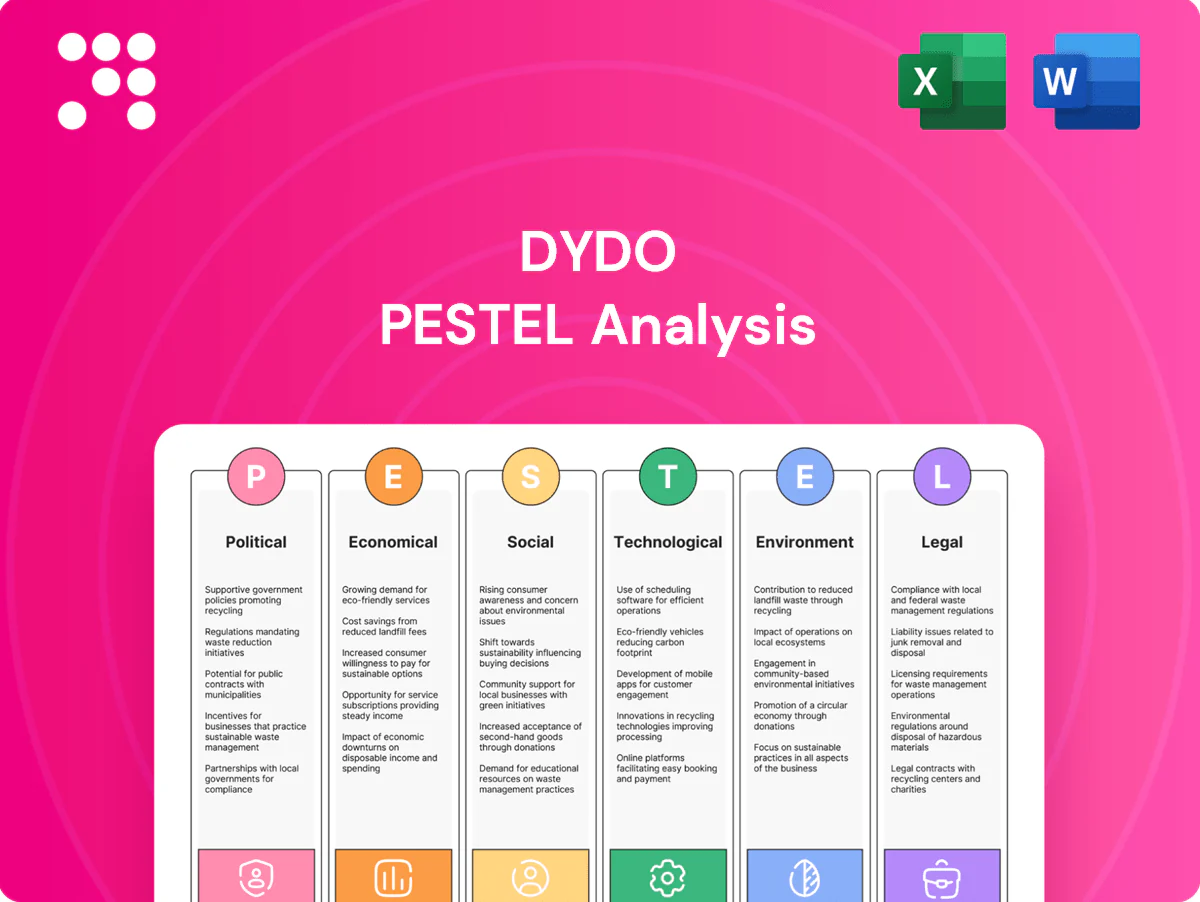
DyDo PESTLE Analysis

Skip the Research. Get the Strategy.
Our DyDo PESTLE Analysis highlights the political, economic, social, technological, legal and environmental forces shaping the company’s prospects. It connects external trends to strategic risks and growth opportunities in clear, actionable terms. Purchase the full report to get the complete deep-dive and ready-to-use insights for investment and planning.
Political factors

Stable Japanese governance
Policy continuity under the Liberal Democratic Party, in power since 2012, supports DyDo’s long-term vending and beverage planning. Stable ministries simplify licensing and compliance for deployment across Japan’s roughly 4 million vending machines. A predictable consumption tax of 10% aids pricing strategies. Local government cooperation remains key for site permissions.
Public health policy pressure
Government campaigns and WHO guidance to limit free sugars to less than 10% of energy and salt reduction initiatives increase pressure on beverage standards; over 40 jurisdictions now levy sugar-sweetened beverage taxes, raising excise risk. Mandatory front-of-pack labeling and potential excise taxes would reshape product portfolios and pricing. DyDo’s existing wellness line aligns with policy goals, and early reformulation reduces exposure to sudden regulatory shocks.

Energy and decarbonization priorities
National energy policy and Japan's carbon-neutral pledge for 2050 — with a 2030 renewables target of 36–38% — directly affect electricity costs for DyDo's vending fleets and can shift regional rates and wholesale volatility (wholesale prices spiked in 2022). Incentives under the GX policy and subsidy programs for efficient equipment accelerate capex refresh cycles and can cut vending opex by up to 30–40% in modern units. Grid stability and politically driven pricing remain key variables that can rapidly alter operating margins and ROI timelines.

Trade and geopolitical supply security
DyDo's coffee beans, tea leaves and packaging are heavily import-dependent, exposing procurement to geopolitical tensions and sanctions that can disrupt supply chains and raise input costs. Japan's trade architecture, including CPTPP (11 members) and the 2019 EU–Japan EPA, offers tariff relief and diversification pathways to secure alternative sourcing. Strategic stockpiles and commodity hedging align with government trade backstops and export-control measures.
- Import-dependent inputs: coffee, tea, packaging
- Geopolitics/sanctions: disruption and cost risk
- Trade pacts: CPTPP, EU–Japan EPA enable diversification
- Mitigants: stockpiles, hedging, policy backstops
Municipal vending regulations
Municipal authorities control placement, hours and aesthetics of DyDo vending machines, shaping availability in urban cores; Japan had about 2.2 million vending machines nationwide (JVMA 2022), so local rules materially affect coverage and unit economics. Public-space policies influence density and revenue per machine, while safety initiatives can add lighting or surveillance costs. Partnerships with municipalities secure high-traffic sites and can boost machine throughput.
- Placement controls — limits on sidewalks, parks
- Operating hours — curfews reduce evening sales
- Safety requirements — adds CAPEX/OPEX for lighting/CCTV
- Municipal partnerships — access to prime locations, higher throughput
Tax, health and green policies steer Japan vending pricing, reformulation and electrification
Political stability under the LDP and a 10% consumption tax support DyDo’s pricing and rollout while municipalities (≈2.2M machines, JVMA 2022) control placement and hours. WHO sugar guidance, 40+ SSB-tax jurisdictions and labeling/excise moves raise reformulation and excise risk. Japan’s 2050 carbon-neutral pledge and 2030 renewables target (36–38%) plus GX incentives drive vending electrification and capex timing.
| Factor | Key data |
|---|---|
| Placement | ≈2.2M machines (JVMA 2022) |
| Tax/Health | 10% consumption tax; 40+ SSB tax jurisdictions |
| Energy/Policy | 2050 carbon-neutral; 2030 renewables 36–38% |
What is included in the product
 Detailed Word Document
Explores how Political, Economic, Social, Technological, Environmental and Legal forces uniquely impact DyDo, using current data and industry-specific examples to reveal risks and opportunities; designed for executives, investors and strategists and formatted for immediate use in plans, decks and scenario planning.

 Customizable Excel Spreadsheet
DyDo PESTLE delivers a clean, visually segmented summary of external risks and opportunities that’s editable for region or product, easily dropped into presentations or shared across teams to streamline planning and align strategy.
Economic factors

Yen volatility and import costs
Currency swings directly raise costs for raw materials and packaging for DyDo as USD/JPY traded near 155–160 in H1 2025; a weaker yen increases COGS and squeezes margins. Vending-price moves must balance demand elasticity and retail competitiveness. Hedging programs and increased local sourcing have been used to partially offset FX exposure.
Inflation and consumer spending
Rising input and logistics costs erode unit economics for DyDo amid Japan's headline CPI near 3% in 2024, squeezing margins on single-serve cans and vending sales.
Modest real wage gains and busy lifestyles keep convenience beverage demand resilient, supporting volume recovery in vending and convenience channels.
Value-tier SKUs and multipacks protect volume by trading down price points, while premium functional lines (energy, wellness) target higher-margin, resilient segments.

Energy prices and vending opex
Electricity is a major operating cost for DyDo’s chilled/heated vending machines, with Japan’s average retail electricity around 31 JPY/kWh in 2024, so price spikes directly compress route-level profitability. Investing in high-efficiency units and dynamic temperature control can cut vending energy use substantially, improving margins. Long-term renewable energy contracts and corporate PPAs help stabilize costs and hedge volatility.

Tourism and foot-traffic cycles
Inbound tourism lifts sales at transport hubs and attractions; Japan received 28.7 million international visitors in 2023 (JNTO) and UNWTO reports global arrivals reached about 88% of 2019 levels in 2023. Economic slowdowns curb mobility and impulse purchases, lowering discretionary spend at kiosks and vending channels. DyDo can use location analytics to rebalance fleets toward resilient nodes and run limited-time regional offerings to capture tourist spend.
- Tourism boost: Japan 28.7M (2023), UNWTO ~88% of 2019
- Slowdowns: reduced mobility → fewer impulse buys
- Analytics: rebalance fleets to high-footfall nodes
- Promotions: limited-time regional SKUs capture tourist spend
Interest rates and capex timing
Rate policy affects financing for machine upgrades and logistics: Japan's short-term policy rate remained around 0.10% and the 10-year JGB yield near 0.90% (June 2025), lowering borrowing costs and favoring accelerated fleet modernization; higher market rates push DyDo toward selective, ROI-driven deployments and shift lease-versus-buy calculus based on funding cost spreads.
- lower-rate environment: faster capex
- higher-rate environment: selective ROI focus
- lease vs buy hinges on funding spread
Tax, health and green policies steer Japan vending pricing, reformulation and electrification
Currency volatility (USD/JPY ~155–160 in H1 2025) raises COGS and compresses margins despite hedging and local sourcing. Inflation (~3% CPI in 2024) and rising input, logistics, and electricity costs (≈31 JPY/kWh in 2024) squeeze unit economics. Tourism recovery (28.7M visitors in 2023) and low yields (10y JGB ~0.90% June 2025) shape volume and capex timing.
| Metric | Value |
|---|---|
| USD/JPY H1 2025 | ~155–160 |
| Japan CPI (2024) | ~3% |
| Electricity (retail 2024) | ≈31 JPY/kWh |
| Tourists (2023) | 28.7M |
| 10y JGB (Jun 2025) | ~0.90% |
Same Document Delivered
DyDo PESTLE Analysis
The preview shown here is the exact DyDo PESTLE Analysis document you’ll receive after purchase—fully formatted and ready to use. The layout, content, and structure visible are exactly what you’ll download immediately after buying. No placeholders or teasers—this is the final, professionally structured file.

Skip the Research. Get the Strategy.
Our DyDo PESTLE Analysis highlights the political, economic, social, technological, legal and environmental forces shaping the company’s prospects. It connects external trends to strategic risks and growth opportunities in clear, actionable terms. Purchase the full report to get the complete deep-dive and ready-to-use insights for investment and planning.
Political factors
Stable Japanese governance
Policy continuity under the Liberal Democratic Party, in power since 2012, supports DyDo’s long-term vending and beverage planning. Stable ministries simplify licensing and compliance for deployment across Japan’s roughly 4 million vending machines. A predictable consumption tax of 10% aids pricing strategies. Local government cooperation remains key for site permissions.
Public health policy pressure
Government campaigns and WHO guidance to limit free sugars to less than 10% of energy and salt reduction initiatives increase pressure on beverage standards; over 40 jurisdictions now levy sugar-sweetened beverage taxes, raising excise risk. Mandatory front-of-pack labeling and potential excise taxes would reshape product portfolios and pricing. DyDo’s existing wellness line aligns with policy goals, and early reformulation reduces exposure to sudden regulatory shocks.
Energy and decarbonization priorities
National energy policy and Japan's carbon-neutral pledge for 2050 — with a 2030 renewables target of 36–38% — directly affect electricity costs for DyDo's vending fleets and can shift regional rates and wholesale volatility (wholesale prices spiked in 2022). Incentives under the GX policy and subsidy programs for efficient equipment accelerate capex refresh cycles and can cut vending opex by up to 30–40% in modern units. Grid stability and politically driven pricing remain key variables that can rapidly alter operating margins and ROI timelines.
Trade and geopolitical supply security
DyDo's coffee beans, tea leaves and packaging are heavily import-dependent, exposing procurement to geopolitical tensions and sanctions that can disrupt supply chains and raise input costs. Japan's trade architecture, including CPTPP (11 members) and the 2019 EU–Japan EPA, offers tariff relief and diversification pathways to secure alternative sourcing. Strategic stockpiles and commodity hedging align with government trade backstops and export-control measures.
- Import-dependent inputs: coffee, tea, packaging
- Geopolitics/sanctions: disruption and cost risk
- Trade pacts: CPTPP, EU–Japan EPA enable diversification
- Mitigants: stockpiles, hedging, policy backstops
Municipal vending regulations
Municipal authorities control placement, hours and aesthetics of DyDo vending machines, shaping availability in urban cores; Japan had about 2.2 million vending machines nationwide (JVMA 2022), so local rules materially affect coverage and unit economics. Public-space policies influence density and revenue per machine, while safety initiatives can add lighting or surveillance costs. Partnerships with municipalities secure high-traffic sites and can boost machine throughput.
- Placement controls — limits on sidewalks, parks
- Operating hours — curfews reduce evening sales
- Safety requirements — adds CAPEX/OPEX for lighting/CCTV
- Municipal partnerships — access to prime locations, higher throughput
Tax, health and green policies steer Japan vending pricing, reformulation and electrification
Political stability under the LDP and a 10% consumption tax support DyDo’s pricing and rollout while municipalities (≈2.2M machines, JVMA 2022) control placement and hours. WHO sugar guidance, 40+ SSB-tax jurisdictions and labeling/excise moves raise reformulation and excise risk. Japan’s 2050 carbon-neutral pledge and 2030 renewables target (36–38%) plus GX incentives drive vending electrification and capex timing.
| Factor | Key data |
|---|---|
| Placement | ≈2.2M machines (JVMA 2022) |
| Tax/Health | 10% consumption tax; 40+ SSB tax jurisdictions |
| Energy/Policy | 2050 carbon-neutral; 2030 renewables 36–38% |
What is included in the product
Detailed Word Document
Explores how Political, Economic, Social, Technological, Environmental and Legal forces uniquely impact DyDo, using current data and industry-specific examples to reveal risks and opportunities; designed for executives, investors and strategists and formatted for immediate use in plans, decks and scenario planning.
Customizable Excel Spreadsheet
DyDo PESTLE delivers a clean, visually segmented summary of external risks and opportunities that’s editable for region or product, easily dropped into presentations or shared across teams to streamline planning and align strategy.
Economic factors
Yen volatility and import costs
Currency swings directly raise costs for raw materials and packaging for DyDo as USD/JPY traded near 155–160 in H1 2025; a weaker yen increases COGS and squeezes margins. Vending-price moves must balance demand elasticity and retail competitiveness. Hedging programs and increased local sourcing have been used to partially offset FX exposure.
Inflation and consumer spending
Rising input and logistics costs erode unit economics for DyDo amid Japan's headline CPI near 3% in 2024, squeezing margins on single-serve cans and vending sales.
Modest real wage gains and busy lifestyles keep convenience beverage demand resilient, supporting volume recovery in vending and convenience channels.
Value-tier SKUs and multipacks protect volume by trading down price points, while premium functional lines (energy, wellness) target higher-margin, resilient segments.
Energy prices and vending opex
Electricity is a major operating cost for DyDo’s chilled/heated vending machines, with Japan’s average retail electricity around 31 JPY/kWh in 2024, so price spikes directly compress route-level profitability. Investing in high-efficiency units and dynamic temperature control can cut vending energy use substantially, improving margins. Long-term renewable energy contracts and corporate PPAs help stabilize costs and hedge volatility.
Tourism and foot-traffic cycles
Inbound tourism lifts sales at transport hubs and attractions; Japan received 28.7 million international visitors in 2023 (JNTO) and UNWTO reports global arrivals reached about 88% of 2019 levels in 2023. Economic slowdowns curb mobility and impulse purchases, lowering discretionary spend at kiosks and vending channels. DyDo can use location analytics to rebalance fleets toward resilient nodes and run limited-time regional offerings to capture tourist spend.
- Tourism boost: Japan 28.7M (2023), UNWTO ~88% of 2019
- Slowdowns: reduced mobility → fewer impulse buys
- Analytics: rebalance fleets to high-footfall nodes
- Promotions: limited-time regional SKUs capture tourist spend
Interest rates and capex timing
Rate policy affects financing for machine upgrades and logistics: Japan's short-term policy rate remained around 0.10% and the 10-year JGB yield near 0.90% (June 2025), lowering borrowing costs and favoring accelerated fleet modernization; higher market rates push DyDo toward selective, ROI-driven deployments and shift lease-versus-buy calculus based on funding cost spreads.
- lower-rate environment: faster capex
- higher-rate environment: selective ROI focus
- lease vs buy hinges on funding spread
Tax, health and green policies steer Japan vending pricing, reformulation and electrification
Currency volatility (USD/JPY ~155–160 in H1 2025) raises COGS and compresses margins despite hedging and local sourcing. Inflation (~3% CPI in 2024) and rising input, logistics, and electricity costs (≈31 JPY/kWh in 2024) squeeze unit economics. Tourism recovery (28.7M visitors in 2023) and low yields (10y JGB ~0.90% June 2025) shape volume and capex timing.
| Metric | Value |
|---|---|
| USD/JPY H1 2025 | ~155–160 |
| Japan CPI (2024) | ~3% |
| Electricity (retail 2024) | ≈31 JPY/kWh |
| Tourists (2023) | 28.7M |
| 10y JGB (Jun 2025) | ~0.90% |
Same Document Delivered
DyDo PESTLE Analysis
The preview shown here is the exact DyDo PESTLE Analysis document you’ll receive after purchase—fully formatted and ready to use. The layout, content, and structure visible are exactly what you’ll download immediately after buying. No placeholders or teasers—this is the final, professionally structured file.
Original: $10.00
-65%$10.00
$3.50Description
Skip the Research. Get the Strategy.
Our DyDo PESTLE Analysis highlights the political, economic, social, technological, legal and environmental forces shaping the company’s prospects. It connects external trends to strategic risks and growth opportunities in clear, actionable terms. Purchase the full report to get the complete deep-dive and ready-to-use insights for investment and planning.
Political factors
Stable Japanese governance
Policy continuity under the Liberal Democratic Party, in power since 2012, supports DyDo’s long-term vending and beverage planning. Stable ministries simplify licensing and compliance for deployment across Japan’s roughly 4 million vending machines. A predictable consumption tax of 10% aids pricing strategies. Local government cooperation remains key for site permissions.
Public health policy pressure
Government campaigns and WHO guidance to limit free sugars to less than 10% of energy and salt reduction initiatives increase pressure on beverage standards; over 40 jurisdictions now levy sugar-sweetened beverage taxes, raising excise risk. Mandatory front-of-pack labeling and potential excise taxes would reshape product portfolios and pricing. DyDo’s existing wellness line aligns with policy goals, and early reformulation reduces exposure to sudden regulatory shocks.
Energy and decarbonization priorities
National energy policy and Japan's carbon-neutral pledge for 2050 — with a 2030 renewables target of 36–38% — directly affect electricity costs for DyDo's vending fleets and can shift regional rates and wholesale volatility (wholesale prices spiked in 2022). Incentives under the GX policy and subsidy programs for efficient equipment accelerate capex refresh cycles and can cut vending opex by up to 30–40% in modern units. Grid stability and politically driven pricing remain key variables that can rapidly alter operating margins and ROI timelines.
Trade and geopolitical supply security
DyDo's coffee beans, tea leaves and packaging are heavily import-dependent, exposing procurement to geopolitical tensions and sanctions that can disrupt supply chains and raise input costs. Japan's trade architecture, including CPTPP (11 members) and the 2019 EU–Japan EPA, offers tariff relief and diversification pathways to secure alternative sourcing. Strategic stockpiles and commodity hedging align with government trade backstops and export-control measures.
- Import-dependent inputs: coffee, tea, packaging
- Geopolitics/sanctions: disruption and cost risk
- Trade pacts: CPTPP, EU–Japan EPA enable diversification
- Mitigants: stockpiles, hedging, policy backstops
Municipal vending regulations
Municipal authorities control placement, hours and aesthetics of DyDo vending machines, shaping availability in urban cores; Japan had about 2.2 million vending machines nationwide (JVMA 2022), so local rules materially affect coverage and unit economics. Public-space policies influence density and revenue per machine, while safety initiatives can add lighting or surveillance costs. Partnerships with municipalities secure high-traffic sites and can boost machine throughput.
- Placement controls — limits on sidewalks, parks
- Operating hours — curfews reduce evening sales
- Safety requirements — adds CAPEX/OPEX for lighting/CCTV
- Municipal partnerships — access to prime locations, higher throughput
Tax, health and green policies steer Japan vending pricing, reformulation and electrification
Political stability under the LDP and a 10% consumption tax support DyDo’s pricing and rollout while municipalities (≈2.2M machines, JVMA 2022) control placement and hours. WHO sugar guidance, 40+ SSB-tax jurisdictions and labeling/excise moves raise reformulation and excise risk. Japan’s 2050 carbon-neutral pledge and 2030 renewables target (36–38%) plus GX incentives drive vending electrification and capex timing.
| Factor | Key data |
|---|---|
| Placement | ≈2.2M machines (JVMA 2022) |
| Tax/Health | 10% consumption tax; 40+ SSB tax jurisdictions |
| Energy/Policy | 2050 carbon-neutral; 2030 renewables 36–38% |
What is included in the product
Detailed Word Document
Explores how Political, Economic, Social, Technological, Environmental and Legal forces uniquely impact DyDo, using current data and industry-specific examples to reveal risks and opportunities; designed for executives, investors and strategists and formatted for immediate use in plans, decks and scenario planning.
Customizable Excel Spreadsheet
DyDo PESTLE delivers a clean, visually segmented summary of external risks and opportunities that’s editable for region or product, easily dropped into presentations or shared across teams to streamline planning and align strategy.
Economic factors
Yen volatility and import costs
Currency swings directly raise costs for raw materials and packaging for DyDo as USD/JPY traded near 155–160 in H1 2025; a weaker yen increases COGS and squeezes margins. Vending-price moves must balance demand elasticity and retail competitiveness. Hedging programs and increased local sourcing have been used to partially offset FX exposure.
Inflation and consumer spending
Rising input and logistics costs erode unit economics for DyDo amid Japan's headline CPI near 3% in 2024, squeezing margins on single-serve cans and vending sales.
Modest real wage gains and busy lifestyles keep convenience beverage demand resilient, supporting volume recovery in vending and convenience channels.
Value-tier SKUs and multipacks protect volume by trading down price points, while premium functional lines (energy, wellness) target higher-margin, resilient segments.
Energy prices and vending opex
Electricity is a major operating cost for DyDo’s chilled/heated vending machines, with Japan’s average retail electricity around 31 JPY/kWh in 2024, so price spikes directly compress route-level profitability. Investing in high-efficiency units and dynamic temperature control can cut vending energy use substantially, improving margins. Long-term renewable energy contracts and corporate PPAs help stabilize costs and hedge volatility.
Tourism and foot-traffic cycles
Inbound tourism lifts sales at transport hubs and attractions; Japan received 28.7 million international visitors in 2023 (JNTO) and UNWTO reports global arrivals reached about 88% of 2019 levels in 2023. Economic slowdowns curb mobility and impulse purchases, lowering discretionary spend at kiosks and vending channels. DyDo can use location analytics to rebalance fleets toward resilient nodes and run limited-time regional offerings to capture tourist spend.
- Tourism boost: Japan 28.7M (2023), UNWTO ~88% of 2019
- Slowdowns: reduced mobility → fewer impulse buys
- Analytics: rebalance fleets to high-footfall nodes
- Promotions: limited-time regional SKUs capture tourist spend
Interest rates and capex timing
Rate policy affects financing for machine upgrades and logistics: Japan's short-term policy rate remained around 0.10% and the 10-year JGB yield near 0.90% (June 2025), lowering borrowing costs and favoring accelerated fleet modernization; higher market rates push DyDo toward selective, ROI-driven deployments and shift lease-versus-buy calculus based on funding cost spreads.
- lower-rate environment: faster capex
- higher-rate environment: selective ROI focus
- lease vs buy hinges on funding spread
Tax, health and green policies steer Japan vending pricing, reformulation and electrification
Currency volatility (USD/JPY ~155–160 in H1 2025) raises COGS and compresses margins despite hedging and local sourcing. Inflation (~3% CPI in 2024) and rising input, logistics, and electricity costs (≈31 JPY/kWh in 2024) squeeze unit economics. Tourism recovery (28.7M visitors in 2023) and low yields (10y JGB ~0.90% June 2025) shape volume and capex timing.
| Metric | Value |
|---|---|
| USD/JPY H1 2025 | ~155–160 |
| Japan CPI (2024) | ~3% |
| Electricity (retail 2024) | ≈31 JPY/kWh |
| Tourists (2023) | 28.7M |
| 10y JGB (Jun 2025) | ~0.90% |
Same Document Delivered
DyDo PESTLE Analysis
The preview shown here is the exact DyDo PESTLE Analysis document you’ll receive after purchase—fully formatted and ready to use. The layout, content, and structure visible are exactly what you’ll download immediately after buying. No placeholders or teasers—this is the final, professionally structured file.











