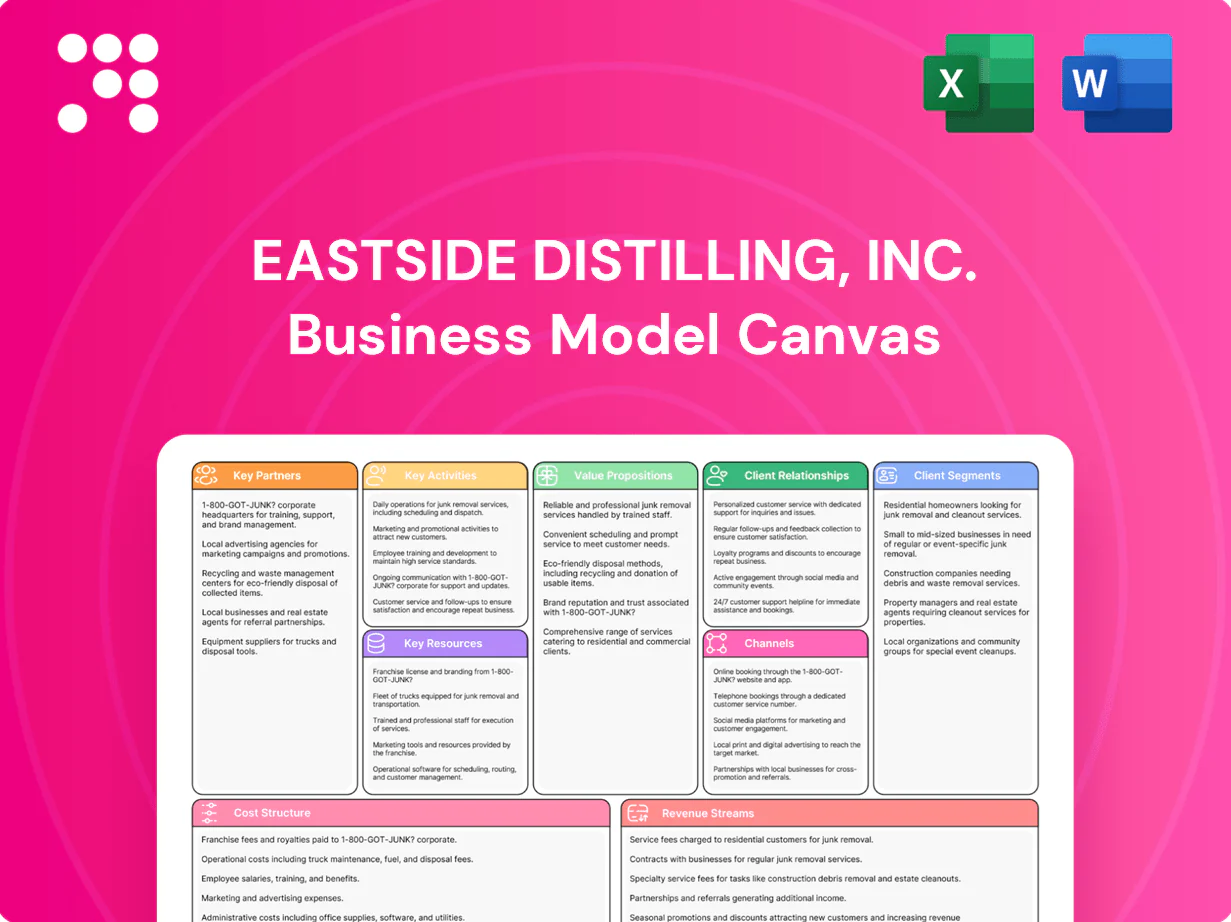
Eastside Distilling, Inc. Business Model Canvas

Craft Spirits Business Model Canvas: DTC Growth, Local Partnerships & Margin Levers
Explore Eastside Distilling, Inc.'s Business Model Canvas to uncover how its craft portfolio, local partnerships, and direct-to-consumer channels create sustainable margins and brand loyalty. This concise preview highlights growth levers—download the full Canvas for actionable strategies, financial implications, and ready-to-use templates for investors and founders.
Partnerships

Local ingredient suppliers
Partner with regional grain, botanicals and barrel suppliers—sourcing within a 150-mile radius—to secure high-quality, consistent inputs and bolster terroir-based origin stories. Use 3–5 year supply contracts to stabilize price and availability amid market swings. Implement joint QA programs to achieve 100% batch-level traceability and regulatory compliance for all incoming materials.
Distributors and wholesalers
Form alliances with state and national distributors across the 50-state three-tier system to access retail and on-premise accounts. Secure placement, programming and POS data sharing to improve velocity and shelf rotation. Align on market-specific pricing, incentives and regulatory compliance, and co-market with distributors to accelerate new product introductions.

Retail and on-premise chains
Partner with 200+ key liquor stores, grocers and 50+ bars/restaurants to secure shelf and menu presence, coordinating promotions, staff trainings and 24+ tasting events annually. Work with category managers on planograms and feature displays to win incremental facings, targeting a 20–30% lift in feature weeks. Use weekly scan data to refine assortments and dynamic pricing, tracking sell-through and gross margin by SKU.

Co-packers and bottling partners
As of 2024, Eastside Distilling uses co-packers and bottling partners to flex capacity for special formats and seasonal runs, maintaining brand consistency through strict SOPs and QC checkpoints to meet retail specs. This approach reduces capex needs while allowing rapid response to demand spikes and diversifies operational risk by keeping vetted backup partners.
- Flex capacity for seasonal/special runs
- SOPs and QC ensure consistency
- Lowers capex, speeds scale-up
- Backup partners diversify risk
Marketing and event partners
Team with festivals, tourism boards, and influencer networks to build brand awareness; influencer marketing market size reached ~$22 billion in 2024.
Activate sampling and education in target markets, with event sampling yielding ~3–5% immediate conversions and 15–25% repeat purchase within 90 days.
Co-create content and limited collaborations and track conversions from events to ongoing sales using POS attribution, promo codes, and CRM retention metrics.
- Partnerships: festivals, tourism boards, influencers
- Sampling: 3–5% immediate conversion
- Collaborations: limited-edition drops
- Measurement: promo codes, POS, CRM
Scale local sourcing and sampling: 150‑mi suppliers, 200+ retailers, 24+ events, 22B influencer
Partner with regional suppliers (150-mile radius) via 3–5 year contracts for traceable inputs; use co-packers for seasonal scale (2024). Align with 200+ retail partners, 50+ on‑premise accounts and state distributors to drive placement; run 24+ tasting events/year. Leverage festivals/influencers (influencer market ~$22B in 2024) with sampling (3–5% immediate, 15–25% 90‑day repeat).
| Metric | 2024 |
|---|---|
| Supplier radius/contracts | 150 mi / 3–5 yr |
| Retail/on‑premise | 200+ / 50+ |
| Events | 24+/yr |
| Sampling conv. | 3–5% / 15–25% |
What is included in the product
 Detailed Word Document
A comprehensive Business Model Canvas tailored to Eastside Distilling, Inc., detailing customer segments, channels, value propositions, revenue streams, cost structure, key partners, activities, resources, and customer relationships in one organized framework. Ideal for investor presentations, funding discussions, and strategic planning, it includes competitive advantages and linked SWOT insights for validation and decision-making.

 Customizable Excel Spreadsheet
High-level Business Model Canvas that clarifies Eastside Distilling’s revenue streams, distribution and cost drivers, saving time on strategy alignment and making pain points actionable and editable for team collaboration.
Activities

Distillation and blending
Operate pot and column stills to produce base spirits and blend to consistent flavor profiles. Optimize mash bills and cut points and proof to target final ABV of 40–47% for each label. Standardize SOPs to scale output while preserving craft quality. Record batch data, lot numbers and GC lab results for full traceability.
Barrel aging management
Eastside Distilling manages barrel inventory, warehouse conditions, and maturation timelines to control quality and cash flow, aligning with industry maturation ranges of 3–12 years and an average angel's share near 2%/yr (2024 industry figure). Staff rotate and sample barrels regularly to hit target flavor profiles and release windows. Staging fills and age statements hedge supply risk. Forecasts model stock levels versus working capital to balance brand needs and liquidity.

Product innovation
Develop new SKUs, finishes, and limited releases aligned to consumer trends and competitive set in a US market with over 2,000 craft distilleries in 2024; prioritize premium positioned SKU economics. Run pilot batches and blinded sensory panels before scaling to validate product-market fit. Maintain a stage-gate process for speed and risk control and secure IP and label compliance early to protect launch investments.

Quality and compliance
Execute end-to-end QA/QC from grain and botanicals through distillation and bottling, maintain TTB and state labeling approvals and COLA compliance, enforce sanitation and OSHA safety protocols, keep recall playbook and traceability ready, and audit suppliers with documented GMP and organic certifications.
- QA/QC: end-to-end testing and batch traceability
- Regulatory: TTB, state, COLA compliance
- Safety: sanitation, OSHA, recall readiness
- Partners: supplier audits, GMP/cert documentation
Sales and channel execution
Manage distributor programming, retail activation, and DTC operations by negotiating placements, pricing, and account-level promotions; industry 2024 benchmarks show DTC channels deliver roughly 25-40% higher gross margins versus wholesale. Train trade, deploy field reps for pull-through, and use CRM plus analytics to prioritize high-ROI accounts and SKUs.
- Distributor programming: account-by-account pricing
- Retail activation: promo cadence and placement
- DTC ops: higher-margin direct sales
- Field force: rep-led pull-through
- CRM/analytics: prioritize top 20% accounts
Operate stills, age 3–12 yr, DTC +≈30%
Operate pot/column stills, manage barrel inventories (3–12 yr maturations; ~2% angel's share/yr in 2024), run QA/QC and TTB/COLA compliance, develop SKUs and scale DTC/wholesale (DTC ≈ +30% gross margin vs wholesale in 2024).
| Activity | Metric | 2024 |
|---|---|---|
| Barrel aging | Range/angel's share | 3–12 yr / ~2% yr |
| DTC vs wholesale | Gross margin lift | ≈30% |
Full Document Unlocks After Purchase
Business Model Canvas
The document you're previewing is the actual Eastside Distilling, Inc. Business Model Canvas, not a mockup or sample. When you purchase, you'll receive this exact file with all sections and content included, ready to edit and apply. The same professional document is delivered instantly in Word and Excel formats for presenting, sharing, and implementation.

Craft Spirits Business Model Canvas: DTC Growth, Local Partnerships & Margin Levers
Explore Eastside Distilling, Inc.'s Business Model Canvas to uncover how its craft portfolio, local partnerships, and direct-to-consumer channels create sustainable margins and brand loyalty. This concise preview highlights growth levers—download the full Canvas for actionable strategies, financial implications, and ready-to-use templates for investors and founders.
Partnerships
Local ingredient suppliers
Partner with regional grain, botanicals and barrel suppliers—sourcing within a 150-mile radius—to secure high-quality, consistent inputs and bolster terroir-based origin stories. Use 3–5 year supply contracts to stabilize price and availability amid market swings. Implement joint QA programs to achieve 100% batch-level traceability and regulatory compliance for all incoming materials.
Distributors and wholesalers
Form alliances with state and national distributors across the 50-state three-tier system to access retail and on-premise accounts. Secure placement, programming and POS data sharing to improve velocity and shelf rotation. Align on market-specific pricing, incentives and regulatory compliance, and co-market with distributors to accelerate new product introductions.
Retail and on-premise chains
Partner with 200+ key liquor stores, grocers and 50+ bars/restaurants to secure shelf and menu presence, coordinating promotions, staff trainings and 24+ tasting events annually. Work with category managers on planograms and feature displays to win incremental facings, targeting a 20–30% lift in feature weeks. Use weekly scan data to refine assortments and dynamic pricing, tracking sell-through and gross margin by SKU.
Co-packers and bottling partners
As of 2024, Eastside Distilling uses co-packers and bottling partners to flex capacity for special formats and seasonal runs, maintaining brand consistency through strict SOPs and QC checkpoints to meet retail specs. This approach reduces capex needs while allowing rapid response to demand spikes and diversifies operational risk by keeping vetted backup partners.
- Flex capacity for seasonal/special runs
- SOPs and QC ensure consistency
- Lowers capex, speeds scale-up
- Backup partners diversify risk
Marketing and event partners
Team with festivals, tourism boards, and influencer networks to build brand awareness; influencer marketing market size reached ~$22 billion in 2024.
Activate sampling and education in target markets, with event sampling yielding ~3–5% immediate conversions and 15–25% repeat purchase within 90 days.
Co-create content and limited collaborations and track conversions from events to ongoing sales using POS attribution, promo codes, and CRM retention metrics.
- Partnerships: festivals, tourism boards, influencers
- Sampling: 3–5% immediate conversion
- Collaborations: limited-edition drops
- Measurement: promo codes, POS, CRM
Scale local sourcing and sampling: 150‑mi suppliers, 200+ retailers, 24+ events, 22B influencer
Partner with regional suppliers (150-mile radius) via 3–5 year contracts for traceable inputs; use co-packers for seasonal scale (2024). Align with 200+ retail partners, 50+ on‑premise accounts and state distributors to drive placement; run 24+ tasting events/year. Leverage festivals/influencers (influencer market ~$22B in 2024) with sampling (3–5% immediate, 15–25% 90‑day repeat).
| Metric | 2024 |
|---|---|
| Supplier radius/contracts | 150 mi / 3–5 yr |
| Retail/on‑premise | 200+ / 50+ |
| Events | 24+/yr |
| Sampling conv. | 3–5% / 15–25% |
What is included in the product
Detailed Word Document
A comprehensive Business Model Canvas tailored to Eastside Distilling, Inc., detailing customer segments, channels, value propositions, revenue streams, cost structure, key partners, activities, resources, and customer relationships in one organized framework. Ideal for investor presentations, funding discussions, and strategic planning, it includes competitive advantages and linked SWOT insights for validation and decision-making.
Customizable Excel Spreadsheet
High-level Business Model Canvas that clarifies Eastside Distilling’s revenue streams, distribution and cost drivers, saving time on strategy alignment and making pain points actionable and editable for team collaboration.
Activities
Distillation and blending
Operate pot and column stills to produce base spirits and blend to consistent flavor profiles. Optimize mash bills and cut points and proof to target final ABV of 40–47% for each label. Standardize SOPs to scale output while preserving craft quality. Record batch data, lot numbers and GC lab results for full traceability.
Barrel aging management
Eastside Distilling manages barrel inventory, warehouse conditions, and maturation timelines to control quality and cash flow, aligning with industry maturation ranges of 3–12 years and an average angel's share near 2%/yr (2024 industry figure). Staff rotate and sample barrels regularly to hit target flavor profiles and release windows. Staging fills and age statements hedge supply risk. Forecasts model stock levels versus working capital to balance brand needs and liquidity.
Product innovation
Develop new SKUs, finishes, and limited releases aligned to consumer trends and competitive set in a US market with over 2,000 craft distilleries in 2024; prioritize premium positioned SKU economics. Run pilot batches and blinded sensory panels before scaling to validate product-market fit. Maintain a stage-gate process for speed and risk control and secure IP and label compliance early to protect launch investments.
Quality and compliance
Execute end-to-end QA/QC from grain and botanicals through distillation and bottling, maintain TTB and state labeling approvals and COLA compliance, enforce sanitation and OSHA safety protocols, keep recall playbook and traceability ready, and audit suppliers with documented GMP and organic certifications.
- QA/QC: end-to-end testing and batch traceability
- Regulatory: TTB, state, COLA compliance
- Safety: sanitation, OSHA, recall readiness
- Partners: supplier audits, GMP/cert documentation
Sales and channel execution
Manage distributor programming, retail activation, and DTC operations by negotiating placements, pricing, and account-level promotions; industry 2024 benchmarks show DTC channels deliver roughly 25-40% higher gross margins versus wholesale. Train trade, deploy field reps for pull-through, and use CRM plus analytics to prioritize high-ROI accounts and SKUs.
- Distributor programming: account-by-account pricing
- Retail activation: promo cadence and placement
- DTC ops: higher-margin direct sales
- Field force: rep-led pull-through
- CRM/analytics: prioritize top 20% accounts
Operate stills, age 3–12 yr, DTC +≈30%
Operate pot/column stills, manage barrel inventories (3–12 yr maturations; ~2% angel's share/yr in 2024), run QA/QC and TTB/COLA compliance, develop SKUs and scale DTC/wholesale (DTC ≈ +30% gross margin vs wholesale in 2024).
| Activity | Metric | 2024 |
|---|---|---|
| Barrel aging | Range/angel's share | 3–12 yr / ~2% yr |
| DTC vs wholesale | Gross margin lift | ≈30% |
Full Document Unlocks After Purchase
Business Model Canvas
The document you're previewing is the actual Eastside Distilling, Inc. Business Model Canvas, not a mockup or sample. When you purchase, you'll receive this exact file with all sections and content included, ready to edit and apply. The same professional document is delivered instantly in Word and Excel formats for presenting, sharing, and implementation.
Original: $10.00
-65%$10.00
$3.50Description
Craft Spirits Business Model Canvas: DTC Growth, Local Partnerships & Margin Levers
Explore Eastside Distilling, Inc.'s Business Model Canvas to uncover how its craft portfolio, local partnerships, and direct-to-consumer channels create sustainable margins and brand loyalty. This concise preview highlights growth levers—download the full Canvas for actionable strategies, financial implications, and ready-to-use templates for investors and founders.
Partnerships
Local ingredient suppliers
Partner with regional grain, botanicals and barrel suppliers—sourcing within a 150-mile radius—to secure high-quality, consistent inputs and bolster terroir-based origin stories. Use 3–5 year supply contracts to stabilize price and availability amid market swings. Implement joint QA programs to achieve 100% batch-level traceability and regulatory compliance for all incoming materials.
Distributors and wholesalers
Form alliances with state and national distributors across the 50-state three-tier system to access retail and on-premise accounts. Secure placement, programming and POS data sharing to improve velocity and shelf rotation. Align on market-specific pricing, incentives and regulatory compliance, and co-market with distributors to accelerate new product introductions.
Retail and on-premise chains
Partner with 200+ key liquor stores, grocers and 50+ bars/restaurants to secure shelf and menu presence, coordinating promotions, staff trainings and 24+ tasting events annually. Work with category managers on planograms and feature displays to win incremental facings, targeting a 20–30% lift in feature weeks. Use weekly scan data to refine assortments and dynamic pricing, tracking sell-through and gross margin by SKU.
Co-packers and bottling partners
As of 2024, Eastside Distilling uses co-packers and bottling partners to flex capacity for special formats and seasonal runs, maintaining brand consistency through strict SOPs and QC checkpoints to meet retail specs. This approach reduces capex needs while allowing rapid response to demand spikes and diversifies operational risk by keeping vetted backup partners.
- Flex capacity for seasonal/special runs
- SOPs and QC ensure consistency
- Lowers capex, speeds scale-up
- Backup partners diversify risk
Marketing and event partners
Team with festivals, tourism boards, and influencer networks to build brand awareness; influencer marketing market size reached ~$22 billion in 2024.
Activate sampling and education in target markets, with event sampling yielding ~3–5% immediate conversions and 15–25% repeat purchase within 90 days.
Co-create content and limited collaborations and track conversions from events to ongoing sales using POS attribution, promo codes, and CRM retention metrics.
- Partnerships: festivals, tourism boards, influencers
- Sampling: 3–5% immediate conversion
- Collaborations: limited-edition drops
- Measurement: promo codes, POS, CRM
Scale local sourcing and sampling: 150‑mi suppliers, 200+ retailers, 24+ events, 22B influencer
Partner with regional suppliers (150-mile radius) via 3–5 year contracts for traceable inputs; use co-packers for seasonal scale (2024). Align with 200+ retail partners, 50+ on‑premise accounts and state distributors to drive placement; run 24+ tasting events/year. Leverage festivals/influencers (influencer market ~$22B in 2024) with sampling (3–5% immediate, 15–25% 90‑day repeat).
| Metric | 2024 |
|---|---|
| Supplier radius/contracts | 150 mi / 3–5 yr |
| Retail/on‑premise | 200+ / 50+ |
| Events | 24+/yr |
| Sampling conv. | 3–5% / 15–25% |
What is included in the product
Detailed Word Document
A comprehensive Business Model Canvas tailored to Eastside Distilling, Inc., detailing customer segments, channels, value propositions, revenue streams, cost structure, key partners, activities, resources, and customer relationships in one organized framework. Ideal for investor presentations, funding discussions, and strategic planning, it includes competitive advantages and linked SWOT insights for validation and decision-making.
Customizable Excel Spreadsheet
High-level Business Model Canvas that clarifies Eastside Distilling’s revenue streams, distribution and cost drivers, saving time on strategy alignment and making pain points actionable and editable for team collaboration.
Activities
Distillation and blending
Operate pot and column stills to produce base spirits and blend to consistent flavor profiles. Optimize mash bills and cut points and proof to target final ABV of 40–47% for each label. Standardize SOPs to scale output while preserving craft quality. Record batch data, lot numbers and GC lab results for full traceability.
Barrel aging management
Eastside Distilling manages barrel inventory, warehouse conditions, and maturation timelines to control quality and cash flow, aligning with industry maturation ranges of 3–12 years and an average angel's share near 2%/yr (2024 industry figure). Staff rotate and sample barrels regularly to hit target flavor profiles and release windows. Staging fills and age statements hedge supply risk. Forecasts model stock levels versus working capital to balance brand needs and liquidity.
Product innovation
Develop new SKUs, finishes, and limited releases aligned to consumer trends and competitive set in a US market with over 2,000 craft distilleries in 2024; prioritize premium positioned SKU economics. Run pilot batches and blinded sensory panels before scaling to validate product-market fit. Maintain a stage-gate process for speed and risk control and secure IP and label compliance early to protect launch investments.
Quality and compliance
Execute end-to-end QA/QC from grain and botanicals through distillation and bottling, maintain TTB and state labeling approvals and COLA compliance, enforce sanitation and OSHA safety protocols, keep recall playbook and traceability ready, and audit suppliers with documented GMP and organic certifications.
- QA/QC: end-to-end testing and batch traceability
- Regulatory: TTB, state, COLA compliance
- Safety: sanitation, OSHA, recall readiness
- Partners: supplier audits, GMP/cert documentation
Sales and channel execution
Manage distributor programming, retail activation, and DTC operations by negotiating placements, pricing, and account-level promotions; industry 2024 benchmarks show DTC channels deliver roughly 25-40% higher gross margins versus wholesale. Train trade, deploy field reps for pull-through, and use CRM plus analytics to prioritize high-ROI accounts and SKUs.
- Distributor programming: account-by-account pricing
- Retail activation: promo cadence and placement
- DTC ops: higher-margin direct sales
- Field force: rep-led pull-through
- CRM/analytics: prioritize top 20% accounts
Operate stills, age 3–12 yr, DTC +≈30%
Operate pot/column stills, manage barrel inventories (3–12 yr maturations; ~2% angel's share/yr in 2024), run QA/QC and TTB/COLA compliance, develop SKUs and scale DTC/wholesale (DTC ≈ +30% gross margin vs wholesale in 2024).
| Activity | Metric | 2024 |
|---|---|---|
| Barrel aging | Range/angel's share | 3–12 yr / ~2% yr |
| DTC vs wholesale | Gross margin lift | ≈30% |
Full Document Unlocks After Purchase
Business Model Canvas
The document you're previewing is the actual Eastside Distilling, Inc. Business Model Canvas, not a mockup or sample. When you purchase, you'll receive this exact file with all sections and content included, ready to edit and apply. The same professional document is delivered instantly in Word and Excel formats for presenting, sharing, and implementation.











