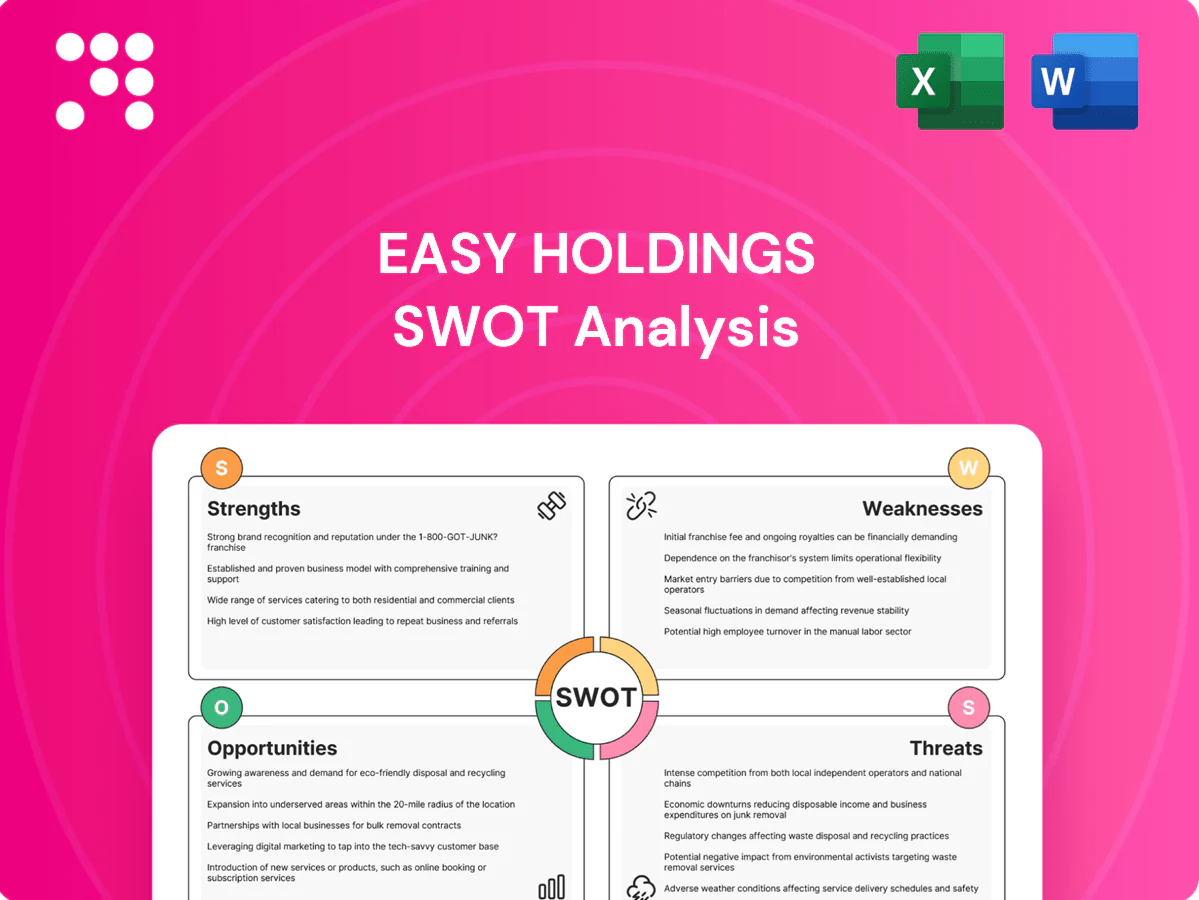
Easy Holdings SWOT Analysis

Go Beyond the Preview—Access the Full Strategic Report
Easy Holdings shows resilient revenue streams, platform-driven growth, and scalable margins, but faces regulatory, competitive, and execution risks that could impact long-term value. Our full SWOT delves into financial context, market threats, and strategic options for investors and managers. Purchase the complete, editable report (Word + Excel) to plan, pitch, or invest with confidence.
Strengths

Biotech-driven feed solutions
Leveraging biotechnology improves feed conversion and animal health, supporting cost-to-performance gains; the global feed additives market was about USD 22.5 billion in 2023 with ~4.2% CAGR to 2028, validating demand for biotech solutions. Differentiated additives (enzymes, probiotics, amino acids) reduce antibiotic reliance and raise yields, enabling premium pricing and sticky customer relationships. Rapid innovation cycles align products with emerging nutrition science, shortening time-to-market.
Integrated agro-livestock value chain
Integrated feed-to-processed-meat operations give Easy Holdings visible internal offtake (often ~30% of production), creating stable demand and faster feedback loops from retail into formulation R&D; integration can lift margins via cost control and byproduct use (typical gross-margin gains 2–5 percentage points) and dampen volatility by balancing opposing feed and meat cycles.

Diversified revenue, including investments
Multiple income streams reduce dependence on a single category, lowering operational risk and stabilizing cash flow. Investment activities provide funding for growth initiatives and smooth earnings through market cycles. Portfolio optionality supports strategic pivots and capability building while enhancing access to capital and partnership opportunities. These strengths improve resilience and strategic flexibility.

Established agro-livestock infrastructure
Easy Holdings leverages established supply, manufacturing, and distribution assets that act as high barriers to entry, enabling scale procurement that secures raw materials and more favorable supplier terms. Reliable logistics improve service levels for farms and processors and the existing footprint supports rapid rollout of new products across contiguous markets.
- Barrier to entry: integrated assets
- Procurement scale: stronger terms
- Logistics: higher service reliability
- Footprint: faster product rollout
Quality and compliance capabilities
Operating in feed and meat demands robust QA/QC and end-to-end traceability; global meat production reached about 340 million tonnes in 2023 (FAO), underscoring scale and risk exposure. Strong compliance reduces recall and regulatory risk, while certifications such as ISO 22000, HACCP and GLOBALG.A.P unlock export and institutional contracts and reinforce brand trust with farmers and retailers.
- 340M t global meat production (FAO 2023)
- Certifications: ISO 22000, HACCP, GLOBALG.A.P
- Mitigates recall/regulatory risk
- Supports exports and institutional supply
Biotech feed additives boost margins, lower costs, global market USD 22.5B
Biotech feed additives drive cost-to-performance gains; global feed additives market ~USD 22.5B (2023), ~4.2% CAGR to 2028. Integrated feed-to-meat offtake ~30% of production, lifting gross margins 2–5 ppt. Strong QA/certifications (ISO 22000, HACCP, GLOBALG.A.P) mitigate recall risk; global meat ~340M t (FAO 2023).
| Metric | Value |
|---|---|
| Feed additives market (2023) | USD 22.5B |
| CAGR to 2028 | ~4.2% |
| Global meat (2023) | 340M t |
| Internal offtake | ~30% |
| Margin uplift | 2–5 ppt |
| Certifications | ISO 22000, HACCP, GLOBALG.A.P |
What is included in the product
 Detailed Word Document
Provides a concise SWOT analysis of Easy Holdings, highlighting internal strengths and weaknesses and external opportunities and threats to assess its competitive position and strategic risks.

 Customizable Excel Spreadsheet
Relieves analysis bottlenecks with a concise, editable SWOT matrix tailored to Easy Holdings for rapid strategic alignment and stakeholder-ready presentations.
Weaknesses

Exposure to commodity input volatility
Grain, oilseed and amino acid price moves materially compress Easy Holdings margins—CBOT corn ~5.80 USD/bu and soybeans ~12.40 USD/bu (July 2025), while feed amino acids such as lysine traded near 1,200 USD/ton, lifting input cost volatility. Hedging mitigates but cannot remove basis and supply shocks; sudden spikes erode pricing power with cost-sensitive farmers. Inflationary upcycles push working capital needs higher as inventory and receivables swell.
High R&D and capex requirements
Biotech-driven products demand sustained research investment; industry R&D intensity runs roughly 20–40% of revenue and bringing a new drug to market can cost up to $2.6 billion (DiMasi et al., 2016). Pilot plants and labs elevate fixed costs—single biologics facilities often entail $50–300 million capex—and regulatory trials extend development 10–15 years. Long, uncertain payback periods and high fixed spend can sharply constrain flexibility during downturns.

Susceptibility to livestock cycles
Herd/flock destocking sharply cuts feed volumes—historic shocks like African swine fever reduced China’s hog herd by over 40% in 2018–19—while disease events and depressed meat prices squeeze farm margins and downstream demand. Large volume swings handicap capacity utilization and forecasting, and recovery timing is often dictated by macro herd cycles and epidemiology beyond Easy Holdings’ control.

Limited global brand recognition
Limited global brand recognition leaves Easy Holdings' equity concentrated in home/regional markets, reducing recall overseas and limiting pricing power; competing multinationals capture premium segments, while distribution gaps slow market entry. Scaling requires higher marketing investment—2024 global ad spend approached 900 billion USD—which can dilute margins during expansion.
- Regional brand equity concentration
- Premium capture limited vs multinationals
- Distribution gaps slow expansion
- Scale-up marketing spend pressures margins
Regulatory complexity across segments
Feed additives and meat processing face stringent, evolving rules (EU Regs 1831/2003, 396/2005; US FDA Title 21 CFR), driving multi-jurisdiction compliance that raises overhead and delays time-to-market; RASFF logged 4,483 notifications in 2023, showing residue/audit scrutiny, and non-compliance can trigger fines and shipment holds.
- Multi-jurisdiction compliance increases costs and timelines
- Labeling, residue limits, audits add operational burden
- Non-compliance risks fines and shipment delays
Input volatility, high R&D/capex compress margins; ASF cut China herd >40%
Input-price volatility (CBOT corn 5.80 USD/bu, soy 12.40 USD/bu, lysine ~1,200 USD/t, Jul 2025) compresses margins and raises working capital. High biotech R&D (20–40% rev) and capex (single biologics plants 50–300M) extend payback. Demand shocks/disease cut volumes (ASF cut China herd >40% 2018–19). Limited global brand and multi-jurisdiction compliance raise expansion costs.
| Risk | Metric |
|---|---|
| Input volatility | corn 5.80, soy 12.40, lysine 1,200 |
| R&D/capex | R&D 20–40% rev; plant 50–300M |
| Compliance/brand | RASFF 4,483 (2023); global ad spend 900B (2024) |
Same Document Delivered
Easy Holdings SWOT Analysis
This is the actual Easy Holdings SWOT analysis document you’ll receive upon purchase—no surprises, just professional quality. The preview below is taken directly from the full report and reflects the same structured, editable content included in your download. Buy now to unlock the entire, detailed version immediately after checkout.

Go Beyond the Preview—Access the Full Strategic Report
Easy Holdings shows resilient revenue streams, platform-driven growth, and scalable margins, but faces regulatory, competitive, and execution risks that could impact long-term value. Our full SWOT delves into financial context, market threats, and strategic options for investors and managers. Purchase the complete, editable report (Word + Excel) to plan, pitch, or invest with confidence.
Strengths
Biotech-driven feed solutions
Leveraging biotechnology improves feed conversion and animal health, supporting cost-to-performance gains; the global feed additives market was about USD 22.5 billion in 2023 with ~4.2% CAGR to 2028, validating demand for biotech solutions. Differentiated additives (enzymes, probiotics, amino acids) reduce antibiotic reliance and raise yields, enabling premium pricing and sticky customer relationships. Rapid innovation cycles align products with emerging nutrition science, shortening time-to-market.
Integrated agro-livestock value chain
Integrated feed-to-processed-meat operations give Easy Holdings visible internal offtake (often ~30% of production), creating stable demand and faster feedback loops from retail into formulation R&D; integration can lift margins via cost control and byproduct use (typical gross-margin gains 2–5 percentage points) and dampen volatility by balancing opposing feed and meat cycles.
Diversified revenue, including investments
Multiple income streams reduce dependence on a single category, lowering operational risk and stabilizing cash flow. Investment activities provide funding for growth initiatives and smooth earnings through market cycles. Portfolio optionality supports strategic pivots and capability building while enhancing access to capital and partnership opportunities. These strengths improve resilience and strategic flexibility.
Established agro-livestock infrastructure
Easy Holdings leverages established supply, manufacturing, and distribution assets that act as high barriers to entry, enabling scale procurement that secures raw materials and more favorable supplier terms. Reliable logistics improve service levels for farms and processors and the existing footprint supports rapid rollout of new products across contiguous markets.
- Barrier to entry: integrated assets
- Procurement scale: stronger terms
- Logistics: higher service reliability
- Footprint: faster product rollout
Quality and compliance capabilities
Operating in feed and meat demands robust QA/QC and end-to-end traceability; global meat production reached about 340 million tonnes in 2023 (FAO), underscoring scale and risk exposure. Strong compliance reduces recall and regulatory risk, while certifications such as ISO 22000, HACCP and GLOBALG.A.P unlock export and institutional contracts and reinforce brand trust with farmers and retailers.
- 340M t global meat production (FAO 2023)
- Certifications: ISO 22000, HACCP, GLOBALG.A.P
- Mitigates recall/regulatory risk
- Supports exports and institutional supply
Biotech feed additives boost margins, lower costs, global market USD 22.5B
Biotech feed additives drive cost-to-performance gains; global feed additives market ~USD 22.5B (2023), ~4.2% CAGR to 2028. Integrated feed-to-meat offtake ~30% of production, lifting gross margins 2–5 ppt. Strong QA/certifications (ISO 22000, HACCP, GLOBALG.A.P) mitigate recall risk; global meat ~340M t (FAO 2023).
| Metric | Value |
|---|---|
| Feed additives market (2023) | USD 22.5B |
| CAGR to 2028 | ~4.2% |
| Global meat (2023) | 340M t |
| Internal offtake | ~30% |
| Margin uplift | 2–5 ppt |
| Certifications | ISO 22000, HACCP, GLOBALG.A.P |
What is included in the product
Detailed Word Document
Provides a concise SWOT analysis of Easy Holdings, highlighting internal strengths and weaknesses and external opportunities and threats to assess its competitive position and strategic risks.
Customizable Excel Spreadsheet
Relieves analysis bottlenecks with a concise, editable SWOT matrix tailored to Easy Holdings for rapid strategic alignment and stakeholder-ready presentations.
Weaknesses
Exposure to commodity input volatility
Grain, oilseed and amino acid price moves materially compress Easy Holdings margins—CBOT corn ~5.80 USD/bu and soybeans ~12.40 USD/bu (July 2025), while feed amino acids such as lysine traded near 1,200 USD/ton, lifting input cost volatility. Hedging mitigates but cannot remove basis and supply shocks; sudden spikes erode pricing power with cost-sensitive farmers. Inflationary upcycles push working capital needs higher as inventory and receivables swell.
High R&D and capex requirements
Biotech-driven products demand sustained research investment; industry R&D intensity runs roughly 20–40% of revenue and bringing a new drug to market can cost up to $2.6 billion (DiMasi et al., 2016). Pilot plants and labs elevate fixed costs—single biologics facilities often entail $50–300 million capex—and regulatory trials extend development 10–15 years. Long, uncertain payback periods and high fixed spend can sharply constrain flexibility during downturns.
Susceptibility to livestock cycles
Herd/flock destocking sharply cuts feed volumes—historic shocks like African swine fever reduced China’s hog herd by over 40% in 2018–19—while disease events and depressed meat prices squeeze farm margins and downstream demand. Large volume swings handicap capacity utilization and forecasting, and recovery timing is often dictated by macro herd cycles and epidemiology beyond Easy Holdings’ control.
Limited global brand recognition
Limited global brand recognition leaves Easy Holdings' equity concentrated in home/regional markets, reducing recall overseas and limiting pricing power; competing multinationals capture premium segments, while distribution gaps slow market entry. Scaling requires higher marketing investment—2024 global ad spend approached 900 billion USD—which can dilute margins during expansion.
- Regional brand equity concentration
- Premium capture limited vs multinationals
- Distribution gaps slow expansion
- Scale-up marketing spend pressures margins
Regulatory complexity across segments
Feed additives and meat processing face stringent, evolving rules (EU Regs 1831/2003, 396/2005; US FDA Title 21 CFR), driving multi-jurisdiction compliance that raises overhead and delays time-to-market; RASFF logged 4,483 notifications in 2023, showing residue/audit scrutiny, and non-compliance can trigger fines and shipment holds.
- Multi-jurisdiction compliance increases costs and timelines
- Labeling, residue limits, audits add operational burden
- Non-compliance risks fines and shipment delays
Input volatility, high R&D/capex compress margins; ASF cut China herd >40%
Input-price volatility (CBOT corn 5.80 USD/bu, soy 12.40 USD/bu, lysine ~1,200 USD/t, Jul 2025) compresses margins and raises working capital. High biotech R&D (20–40% rev) and capex (single biologics plants 50–300M) extend payback. Demand shocks/disease cut volumes (ASF cut China herd >40% 2018–19). Limited global brand and multi-jurisdiction compliance raise expansion costs.
| Risk | Metric |
|---|---|
| Input volatility | corn 5.80, soy 12.40, lysine 1,200 |
| R&D/capex | R&D 20–40% rev; plant 50–300M |
| Compliance/brand | RASFF 4,483 (2023); global ad spend 900B (2024) |
Same Document Delivered
Easy Holdings SWOT Analysis
This is the actual Easy Holdings SWOT analysis document you’ll receive upon purchase—no surprises, just professional quality. The preview below is taken directly from the full report and reflects the same structured, editable content included in your download. Buy now to unlock the entire, detailed version immediately after checkout.
Description
Go Beyond the Preview—Access the Full Strategic Report
Easy Holdings shows resilient revenue streams, platform-driven growth, and scalable margins, but faces regulatory, competitive, and execution risks that could impact long-term value. Our full SWOT delves into financial context, market threats, and strategic options for investors and managers. Purchase the complete, editable report (Word + Excel) to plan, pitch, or invest with confidence.
Strengths
Biotech-driven feed solutions
Leveraging biotechnology improves feed conversion and animal health, supporting cost-to-performance gains; the global feed additives market was about USD 22.5 billion in 2023 with ~4.2% CAGR to 2028, validating demand for biotech solutions. Differentiated additives (enzymes, probiotics, amino acids) reduce antibiotic reliance and raise yields, enabling premium pricing and sticky customer relationships. Rapid innovation cycles align products with emerging nutrition science, shortening time-to-market.
Integrated agro-livestock value chain
Integrated feed-to-processed-meat operations give Easy Holdings visible internal offtake (often ~30% of production), creating stable demand and faster feedback loops from retail into formulation R&D; integration can lift margins via cost control and byproduct use (typical gross-margin gains 2–5 percentage points) and dampen volatility by balancing opposing feed and meat cycles.
Diversified revenue, including investments
Multiple income streams reduce dependence on a single category, lowering operational risk and stabilizing cash flow. Investment activities provide funding for growth initiatives and smooth earnings through market cycles. Portfolio optionality supports strategic pivots and capability building while enhancing access to capital and partnership opportunities. These strengths improve resilience and strategic flexibility.
Established agro-livestock infrastructure
Easy Holdings leverages established supply, manufacturing, and distribution assets that act as high barriers to entry, enabling scale procurement that secures raw materials and more favorable supplier terms. Reliable logistics improve service levels for farms and processors and the existing footprint supports rapid rollout of new products across contiguous markets.
- Barrier to entry: integrated assets
- Procurement scale: stronger terms
- Logistics: higher service reliability
- Footprint: faster product rollout
Quality and compliance capabilities
Operating in feed and meat demands robust QA/QC and end-to-end traceability; global meat production reached about 340 million tonnes in 2023 (FAO), underscoring scale and risk exposure. Strong compliance reduces recall and regulatory risk, while certifications such as ISO 22000, HACCP and GLOBALG.A.P unlock export and institutional contracts and reinforce brand trust with farmers and retailers.
- 340M t global meat production (FAO 2023)
- Certifications: ISO 22000, HACCP, GLOBALG.A.P
- Mitigates recall/regulatory risk
- Supports exports and institutional supply
Biotech feed additives boost margins, lower costs, global market USD 22.5B
Biotech feed additives drive cost-to-performance gains; global feed additives market ~USD 22.5B (2023), ~4.2% CAGR to 2028. Integrated feed-to-meat offtake ~30% of production, lifting gross margins 2–5 ppt. Strong QA/certifications (ISO 22000, HACCP, GLOBALG.A.P) mitigate recall risk; global meat ~340M t (FAO 2023).
| Metric | Value |
|---|---|
| Feed additives market (2023) | USD 22.5B |
| CAGR to 2028 | ~4.2% |
| Global meat (2023) | 340M t |
| Internal offtake | ~30% |
| Margin uplift | 2–5 ppt |
| Certifications | ISO 22000, HACCP, GLOBALG.A.P |
What is included in the product
Detailed Word Document
Provides a concise SWOT analysis of Easy Holdings, highlighting internal strengths and weaknesses and external opportunities and threats to assess its competitive position and strategic risks.
Customizable Excel Spreadsheet
Relieves analysis bottlenecks with a concise, editable SWOT matrix tailored to Easy Holdings for rapid strategic alignment and stakeholder-ready presentations.
Weaknesses
Exposure to commodity input volatility
Grain, oilseed and amino acid price moves materially compress Easy Holdings margins—CBOT corn ~5.80 USD/bu and soybeans ~12.40 USD/bu (July 2025), while feed amino acids such as lysine traded near 1,200 USD/ton, lifting input cost volatility. Hedging mitigates but cannot remove basis and supply shocks; sudden spikes erode pricing power with cost-sensitive farmers. Inflationary upcycles push working capital needs higher as inventory and receivables swell.
High R&D and capex requirements
Biotech-driven products demand sustained research investment; industry R&D intensity runs roughly 20–40% of revenue and bringing a new drug to market can cost up to $2.6 billion (DiMasi et al., 2016). Pilot plants and labs elevate fixed costs—single biologics facilities often entail $50–300 million capex—and regulatory trials extend development 10–15 years. Long, uncertain payback periods and high fixed spend can sharply constrain flexibility during downturns.
Susceptibility to livestock cycles
Herd/flock destocking sharply cuts feed volumes—historic shocks like African swine fever reduced China’s hog herd by over 40% in 2018–19—while disease events and depressed meat prices squeeze farm margins and downstream demand. Large volume swings handicap capacity utilization and forecasting, and recovery timing is often dictated by macro herd cycles and epidemiology beyond Easy Holdings’ control.
Limited global brand recognition
Limited global brand recognition leaves Easy Holdings' equity concentrated in home/regional markets, reducing recall overseas and limiting pricing power; competing multinationals capture premium segments, while distribution gaps slow market entry. Scaling requires higher marketing investment—2024 global ad spend approached 900 billion USD—which can dilute margins during expansion.
- Regional brand equity concentration
- Premium capture limited vs multinationals
- Distribution gaps slow expansion
- Scale-up marketing spend pressures margins
Regulatory complexity across segments
Feed additives and meat processing face stringent, evolving rules (EU Regs 1831/2003, 396/2005; US FDA Title 21 CFR), driving multi-jurisdiction compliance that raises overhead and delays time-to-market; RASFF logged 4,483 notifications in 2023, showing residue/audit scrutiny, and non-compliance can trigger fines and shipment holds.
- Multi-jurisdiction compliance increases costs and timelines
- Labeling, residue limits, audits add operational burden
- Non-compliance risks fines and shipment delays
Input volatility, high R&D/capex compress margins; ASF cut China herd >40%
Input-price volatility (CBOT corn 5.80 USD/bu, soy 12.40 USD/bu, lysine ~1,200 USD/t, Jul 2025) compresses margins and raises working capital. High biotech R&D (20–40% rev) and capex (single biologics plants 50–300M) extend payback. Demand shocks/disease cut volumes (ASF cut China herd >40% 2018–19). Limited global brand and multi-jurisdiction compliance raise expansion costs.
| Risk | Metric |
|---|---|
| Input volatility | corn 5.80, soy 12.40, lysine 1,200 |
| R&D/capex | R&D 20–40% rev; plant 50–300M |
| Compliance/brand | RASFF 4,483 (2023); global ad spend 900B (2024) |
Same Document Delivered
Easy Holdings SWOT Analysis
This is the actual Easy Holdings SWOT analysis document you’ll receive upon purchase—no surprises, just professional quality. The preview below is taken directly from the full report and reflects the same structured, editable content included in your download. Buy now to unlock the entire, detailed version immediately after checkout.











