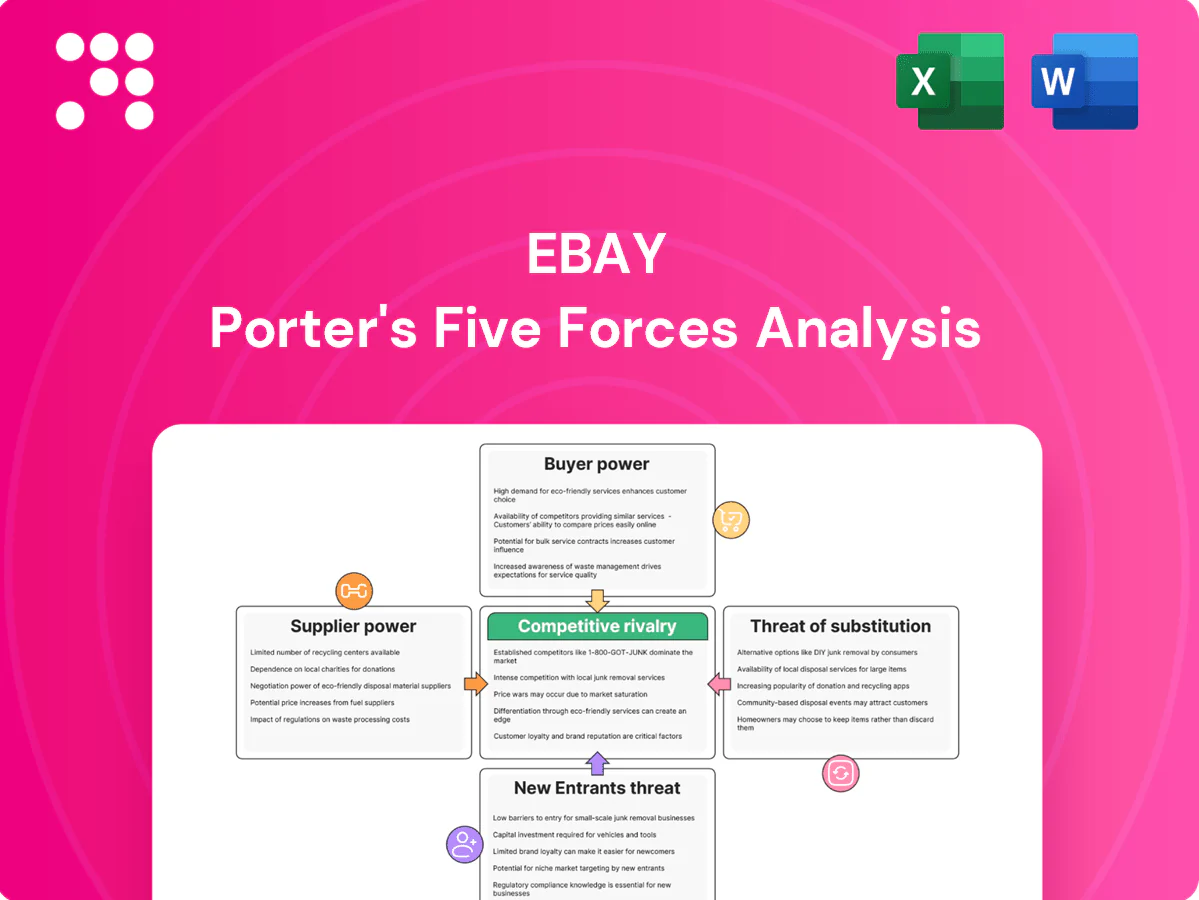
eBay Porter's Five Forces Analysis

Go Beyond the Preview—Access the Full Strategic Report
eBay faces intense rivalry from marketplaces and vertical specialists, moderate buyer power driven by choice, and low supplier power but growing substitute threats from social commerce. Regulatory and tech shifts shape entry barriers and pricing dynamics. This brief snapshot only scratches the surface—unlock the full Porter's Five Forces Analysis to explore eBay’s competitive dynamics in detail.
Suppliers Bargaining Power

Fragmented seller base limits leverage
eBay sources inventory from millions of small and medium sellers—over 17 million sellers—so any single supplier’s influence is modest. High multi-homing among sellers, many listing also on Amazon and Etsy, reduces dependence on eBay. eBay’s ability to tweak fees and policies without losing broad supply is supported by ~151 million active buyers (2024), though churn management remains important. Fragmentation keeps supplier power low.
Power sellers and brands wield influence
Large merchants and iconic brands drive an outsized share of eBay GMV—estimates place that concentration near 25–30%—and eBay reported about 127 million active buyers in 2023, so their ability to negotiate fees, placement, and service terms is material. Their exit could erode category depth and buyer experience. eBay counters with seller tools, analytics and promotional programs to retain them. This segment has moderate to high bargaining power.

Platform dependencies: payments, cloud, app stores
Reliance on payment processors (card fees typically 1.5–3.5% and platform wallets like PayPal ~2.9%+0.30), cloud providers (AWS ~31% global IaaS share in 2023) and mobile app stores (Apple/Google commissions 15–30%) concentrates upstream power; fee or policy shifts can compress eBay margins and raise user acquisition costs. App store rules and payments regulation limit flexibility, creating moderate supplier power.

Logistics and shipping partners influence seller costs
eBay's discounted shipping labels and carrier integrations (UPS, USPS, FedEx) — offering discounts up to 30% for enrolled sellers — enhance marketplace competitiveness. Carrier rate hikes and 2023–24 service disruptions and surcharges (mid-single-digit cost increases) cascade to seller costs, hurting conversion and satisfaction. eBay negotiates programs but does not control delivery networks, so logistics partners hold situational power.
- Discounts up to 30% via carrier integrations
- Carrier surcharges rose mid-single-digits in 2023–24
- eBay negotiates rates but cannot control networks
- Logistics partners exert situational bargaining power
Data, ad-tech, and third-party tools matter
Advertising partners and developer ecosystems boost eBay monetization and seller productivity through promoted listings and integrated tools, supporting platform revenues while improving seller conversion.
Changes in data access, privacy rules, or ad pricing can compress eBay take rates—around 10% in 2024—hitting revenue per GMV if ad spend shifts.
Specialized tool providers influence seller loyalty via deep integrations, giving niche suppliers selective bargaining power.
17M sellers, 151M buyers; 25–30% merchant GMV
Supplier power is overall low due to fragmentation—~17M sellers and ~151M active buyers (2024)—but large merchants (≈25–30% GMV) hold moderate-to-high leverage. Dependence on payment processors (cards 1.5–3.5%, PayPal ~2.9%+0.30), app stores (15–30%) and cloud providers creates situational supplier power. Logistics surcharges rose mid-single-digits in 2023–24, giving carriers episodic influence.
| Metric | Value (2024) |
|---|---|
| Active buyers | 151M |
| Sellers | 17M |
| Large merchants GMV | 25–30% |
| Take rate | ~10% |
What is included in the product
 Detailed Word Document
Analyzes competitive rivalry, buyer/seller power, threat of new entrants and substitutes, and supplier influence on eBay's pricing and margins. Identifies disruptive platforms, network effects, and regulatory or technological barriers that shape eBay's strategic position.

 Customizable Excel Spreadsheet
A concise one-sheet Porter’s Five Forces for eBay—instantly reveal competitive pressure from buyers, sellers, substitutes, new entrants and suppliers to streamline strategic decisions and relieve analysis bottlenecks.
Customers Bargaining Power

Low switching costs for buyers and sellers
Users can list or shop across multiple marketplaces with minimal friction, enabling multi-listing strategies that reduce lock-in. eBay’s transparent search and fee structure—final value fees commonly 5–12% and insertion fees around $0.30—heighten sensitivity to total cost. That transparency forces tight pricing and service discipline. Buyer power on the platform is structurally high.
Network effects temper individual clout
Large, liquid categories on eBay—serving about 128 million active buyers and roughly 19 million sellers—increase matching and diminish single-user bargaining power. If network density falls behind rivals, migration can accelerate despite scale. Sustaining trust, selection and transaction velocity keeps the flywheel. Collective buyer-seller behavior still constrains platform terms.

Fee visibility pressures take rates
Sellers closely track final value fees, ad spend and shipping costs, and eBay reported a 2024 marketplace take rate near 11.5%, so even modest fee hikes can prompt listing cuts or migration to rivals. Historical responses show sellers reduce listings when take-rate pressure rises, forcing eBay to justify fees through conversion-driving tools and higher-quality traffic. Elevated price sensitivity among buyers amplifies their bargaining power and constrains fee upside.

Reputation systems constrain platform latitude
Reputation systems — ratings, returns, and buyer protection — anchor buyer expectations for fast, favorable resolutions; eBay reported about 140 million active buyers in 2023, amplifying the impact of any policy shift that increases complaints or churn. Trust features (guarantees, Resolution Center) add cost but cut dispute friction and support higher transaction volumes, giving users soft bargaining power through reputation and exit threats.
- Ratings drive repeat purchase rates
- Returns/policy shifts → measurable churn risk
- Trust tools raise operating costs but lower disputes
Global choice expands alternatives
Global choice expands alternatives: international buyers and sellers use regional platforms and cross-border options, intensifying comparisons with localized competitors and social commerce; eBay, which serves over 100 million active buyers, must localize fees, payments, and protections to retain share as global optionality boosts user leverage.
- Cross-border reach raises buyer bargaining power
- Localization of fees/payments essential
- Social commerce increases price/feature comparisons
Buyer power high in large marketplace — 128M buyers, 11.5% take rate
Low switching costs and transparent fees (final value fees commonly 5–12%) make buyer power structurally high. eBay scale (128M active buyers, ~19M sellers in 2024) boosts matching but collective buyer-seller responses limit fee increases. Marketplace take rate ~11.5% (2024) makes sellers sensitive to fee hikes, amplifying buyer leverage. Trust tools raise costs but reduce churn and disputes.
| Metric | 2024 |
|---|---|
| Active buyers | 128M |
| Sellers | 19M |
| Marketplace take rate | 11.5% |
| Final value fees | 5–12% |
Preview Before You Purchase
eBay Porter's Five Forces Analysis
This preview shows the exact eBay Porter's Five Forces analysis you'll receive after purchase—no surprises, fully formatted and ready to use. The document covers buyer and supplier power, competitive rivalry, threat of substitutes, and barriers to entry with data‑backed insights and strategic implications. Upon payment you get immediate access to this identical file for download and implementation.

Go Beyond the Preview—Access the Full Strategic Report
eBay faces intense rivalry from marketplaces and vertical specialists, moderate buyer power driven by choice, and low supplier power but growing substitute threats from social commerce. Regulatory and tech shifts shape entry barriers and pricing dynamics. This brief snapshot only scratches the surface—unlock the full Porter's Five Forces Analysis to explore eBay’s competitive dynamics in detail.
Suppliers Bargaining Power
Fragmented seller base limits leverage
eBay sources inventory from millions of small and medium sellers—over 17 million sellers—so any single supplier’s influence is modest. High multi-homing among sellers, many listing also on Amazon and Etsy, reduces dependence on eBay. eBay’s ability to tweak fees and policies without losing broad supply is supported by ~151 million active buyers (2024), though churn management remains important. Fragmentation keeps supplier power low.
Power sellers and brands wield influence
Large merchants and iconic brands drive an outsized share of eBay GMV—estimates place that concentration near 25–30%—and eBay reported about 127 million active buyers in 2023, so their ability to negotiate fees, placement, and service terms is material. Their exit could erode category depth and buyer experience. eBay counters with seller tools, analytics and promotional programs to retain them. This segment has moderate to high bargaining power.
Platform dependencies: payments, cloud, app stores
Reliance on payment processors (card fees typically 1.5–3.5% and platform wallets like PayPal ~2.9%+0.30), cloud providers (AWS ~31% global IaaS share in 2023) and mobile app stores (Apple/Google commissions 15–30%) concentrates upstream power; fee or policy shifts can compress eBay margins and raise user acquisition costs. App store rules and payments regulation limit flexibility, creating moderate supplier power.
Logistics and shipping partners influence seller costs
eBay's discounted shipping labels and carrier integrations (UPS, USPS, FedEx) — offering discounts up to 30% for enrolled sellers — enhance marketplace competitiveness. Carrier rate hikes and 2023–24 service disruptions and surcharges (mid-single-digit cost increases) cascade to seller costs, hurting conversion and satisfaction. eBay negotiates programs but does not control delivery networks, so logistics partners hold situational power.
- Discounts up to 30% via carrier integrations
- Carrier surcharges rose mid-single-digits in 2023–24
- eBay negotiates rates but cannot control networks
- Logistics partners exert situational bargaining power
Data, ad-tech, and third-party tools matter
Advertising partners and developer ecosystems boost eBay monetization and seller productivity through promoted listings and integrated tools, supporting platform revenues while improving seller conversion.
Changes in data access, privacy rules, or ad pricing can compress eBay take rates—around 10% in 2024—hitting revenue per GMV if ad spend shifts.
Specialized tool providers influence seller loyalty via deep integrations, giving niche suppliers selective bargaining power.
17M sellers, 151M buyers; 25–30% merchant GMV
Supplier power is overall low due to fragmentation—~17M sellers and ~151M active buyers (2024)—but large merchants (≈25–30% GMV) hold moderate-to-high leverage. Dependence on payment processors (cards 1.5–3.5%, PayPal ~2.9%+0.30), app stores (15–30%) and cloud providers creates situational supplier power. Logistics surcharges rose mid-single-digits in 2023–24, giving carriers episodic influence.
| Metric | Value (2024) |
|---|---|
| Active buyers | 151M |
| Sellers | 17M |
| Large merchants GMV | 25–30% |
| Take rate | ~10% |
What is included in the product
Detailed Word Document
Analyzes competitive rivalry, buyer/seller power, threat of new entrants and substitutes, and supplier influence on eBay's pricing and margins. Identifies disruptive platforms, network effects, and regulatory or technological barriers that shape eBay's strategic position.
Customizable Excel Spreadsheet
A concise one-sheet Porter’s Five Forces for eBay—instantly reveal competitive pressure from buyers, sellers, substitutes, new entrants and suppliers to streamline strategic decisions and relieve analysis bottlenecks.
Customers Bargaining Power
Low switching costs for buyers and sellers
Users can list or shop across multiple marketplaces with minimal friction, enabling multi-listing strategies that reduce lock-in. eBay’s transparent search and fee structure—final value fees commonly 5–12% and insertion fees around $0.30—heighten sensitivity to total cost. That transparency forces tight pricing and service discipline. Buyer power on the platform is structurally high.
Network effects temper individual clout
Large, liquid categories on eBay—serving about 128 million active buyers and roughly 19 million sellers—increase matching and diminish single-user bargaining power. If network density falls behind rivals, migration can accelerate despite scale. Sustaining trust, selection and transaction velocity keeps the flywheel. Collective buyer-seller behavior still constrains platform terms.
Fee visibility pressures take rates
Sellers closely track final value fees, ad spend and shipping costs, and eBay reported a 2024 marketplace take rate near 11.5%, so even modest fee hikes can prompt listing cuts or migration to rivals. Historical responses show sellers reduce listings when take-rate pressure rises, forcing eBay to justify fees through conversion-driving tools and higher-quality traffic. Elevated price sensitivity among buyers amplifies their bargaining power and constrains fee upside.
Reputation systems constrain platform latitude
Reputation systems — ratings, returns, and buyer protection — anchor buyer expectations for fast, favorable resolutions; eBay reported about 140 million active buyers in 2023, amplifying the impact of any policy shift that increases complaints or churn. Trust features (guarantees, Resolution Center) add cost but cut dispute friction and support higher transaction volumes, giving users soft bargaining power through reputation and exit threats.
- Ratings drive repeat purchase rates
- Returns/policy shifts → measurable churn risk
- Trust tools raise operating costs but lower disputes
Global choice expands alternatives
Global choice expands alternatives: international buyers and sellers use regional platforms and cross-border options, intensifying comparisons with localized competitors and social commerce; eBay, which serves over 100 million active buyers, must localize fees, payments, and protections to retain share as global optionality boosts user leverage.
- Cross-border reach raises buyer bargaining power
- Localization of fees/payments essential
- Social commerce increases price/feature comparisons
Buyer power high in large marketplace — 128M buyers, 11.5% take rate
Low switching costs and transparent fees (final value fees commonly 5–12%) make buyer power structurally high. eBay scale (128M active buyers, ~19M sellers in 2024) boosts matching but collective buyer-seller responses limit fee increases. Marketplace take rate ~11.5% (2024) makes sellers sensitive to fee hikes, amplifying buyer leverage. Trust tools raise costs but reduce churn and disputes.
| Metric | 2024 |
|---|---|
| Active buyers | 128M |
| Sellers | 19M |
| Marketplace take rate | 11.5% |
| Final value fees | 5–12% |
Preview Before You Purchase
eBay Porter's Five Forces Analysis
This preview shows the exact eBay Porter's Five Forces analysis you'll receive after purchase—no surprises, fully formatted and ready to use. The document covers buyer and supplier power, competitive rivalry, threat of substitutes, and barriers to entry with data‑backed insights and strategic implications. Upon payment you get immediate access to this identical file for download and implementation.
Description
Go Beyond the Preview—Access the Full Strategic Report
eBay faces intense rivalry from marketplaces and vertical specialists, moderate buyer power driven by choice, and low supplier power but growing substitute threats from social commerce. Regulatory and tech shifts shape entry barriers and pricing dynamics. This brief snapshot only scratches the surface—unlock the full Porter's Five Forces Analysis to explore eBay’s competitive dynamics in detail.
Suppliers Bargaining Power
Fragmented seller base limits leverage
eBay sources inventory from millions of small and medium sellers—over 17 million sellers—so any single supplier’s influence is modest. High multi-homing among sellers, many listing also on Amazon and Etsy, reduces dependence on eBay. eBay’s ability to tweak fees and policies without losing broad supply is supported by ~151 million active buyers (2024), though churn management remains important. Fragmentation keeps supplier power low.
Power sellers and brands wield influence
Large merchants and iconic brands drive an outsized share of eBay GMV—estimates place that concentration near 25–30%—and eBay reported about 127 million active buyers in 2023, so their ability to negotiate fees, placement, and service terms is material. Their exit could erode category depth and buyer experience. eBay counters with seller tools, analytics and promotional programs to retain them. This segment has moderate to high bargaining power.
Platform dependencies: payments, cloud, app stores
Reliance on payment processors (card fees typically 1.5–3.5% and platform wallets like PayPal ~2.9%+0.30), cloud providers (AWS ~31% global IaaS share in 2023) and mobile app stores (Apple/Google commissions 15–30%) concentrates upstream power; fee or policy shifts can compress eBay margins and raise user acquisition costs. App store rules and payments regulation limit flexibility, creating moderate supplier power.
Logistics and shipping partners influence seller costs
eBay's discounted shipping labels and carrier integrations (UPS, USPS, FedEx) — offering discounts up to 30% for enrolled sellers — enhance marketplace competitiveness. Carrier rate hikes and 2023–24 service disruptions and surcharges (mid-single-digit cost increases) cascade to seller costs, hurting conversion and satisfaction. eBay negotiates programs but does not control delivery networks, so logistics partners hold situational power.
- Discounts up to 30% via carrier integrations
- Carrier surcharges rose mid-single-digits in 2023–24
- eBay negotiates rates but cannot control networks
- Logistics partners exert situational bargaining power
Data, ad-tech, and third-party tools matter
Advertising partners and developer ecosystems boost eBay monetization and seller productivity through promoted listings and integrated tools, supporting platform revenues while improving seller conversion.
Changes in data access, privacy rules, or ad pricing can compress eBay take rates—around 10% in 2024—hitting revenue per GMV if ad spend shifts.
Specialized tool providers influence seller loyalty via deep integrations, giving niche suppliers selective bargaining power.
17M sellers, 151M buyers; 25–30% merchant GMV
Supplier power is overall low due to fragmentation—~17M sellers and ~151M active buyers (2024)—but large merchants (≈25–30% GMV) hold moderate-to-high leverage. Dependence on payment processors (cards 1.5–3.5%, PayPal ~2.9%+0.30), app stores (15–30%) and cloud providers creates situational supplier power. Logistics surcharges rose mid-single-digits in 2023–24, giving carriers episodic influence.
| Metric | Value (2024) |
|---|---|
| Active buyers | 151M |
| Sellers | 17M |
| Large merchants GMV | 25–30% |
| Take rate | ~10% |
What is included in the product
Detailed Word Document
Analyzes competitive rivalry, buyer/seller power, threat of new entrants and substitutes, and supplier influence on eBay's pricing and margins. Identifies disruptive platforms, network effects, and regulatory or technological barriers that shape eBay's strategic position.
Customizable Excel Spreadsheet
A concise one-sheet Porter’s Five Forces for eBay—instantly reveal competitive pressure from buyers, sellers, substitutes, new entrants and suppliers to streamline strategic decisions and relieve analysis bottlenecks.
Customers Bargaining Power
Low switching costs for buyers and sellers
Users can list or shop across multiple marketplaces with minimal friction, enabling multi-listing strategies that reduce lock-in. eBay’s transparent search and fee structure—final value fees commonly 5–12% and insertion fees around $0.30—heighten sensitivity to total cost. That transparency forces tight pricing and service discipline. Buyer power on the platform is structurally high.
Network effects temper individual clout
Large, liquid categories on eBay—serving about 128 million active buyers and roughly 19 million sellers—increase matching and diminish single-user bargaining power. If network density falls behind rivals, migration can accelerate despite scale. Sustaining trust, selection and transaction velocity keeps the flywheel. Collective buyer-seller behavior still constrains platform terms.
Fee visibility pressures take rates
Sellers closely track final value fees, ad spend and shipping costs, and eBay reported a 2024 marketplace take rate near 11.5%, so even modest fee hikes can prompt listing cuts or migration to rivals. Historical responses show sellers reduce listings when take-rate pressure rises, forcing eBay to justify fees through conversion-driving tools and higher-quality traffic. Elevated price sensitivity among buyers amplifies their bargaining power and constrains fee upside.
Reputation systems constrain platform latitude
Reputation systems — ratings, returns, and buyer protection — anchor buyer expectations for fast, favorable resolutions; eBay reported about 140 million active buyers in 2023, amplifying the impact of any policy shift that increases complaints or churn. Trust features (guarantees, Resolution Center) add cost but cut dispute friction and support higher transaction volumes, giving users soft bargaining power through reputation and exit threats.
- Ratings drive repeat purchase rates
- Returns/policy shifts → measurable churn risk
- Trust tools raise operating costs but lower disputes
Global choice expands alternatives
Global choice expands alternatives: international buyers and sellers use regional platforms and cross-border options, intensifying comparisons with localized competitors and social commerce; eBay, which serves over 100 million active buyers, must localize fees, payments, and protections to retain share as global optionality boosts user leverage.
- Cross-border reach raises buyer bargaining power
- Localization of fees/payments essential
- Social commerce increases price/feature comparisons
Buyer power high in large marketplace — 128M buyers, 11.5% take rate
Low switching costs and transparent fees (final value fees commonly 5–12%) make buyer power structurally high. eBay scale (128M active buyers, ~19M sellers in 2024) boosts matching but collective buyer-seller responses limit fee increases. Marketplace take rate ~11.5% (2024) makes sellers sensitive to fee hikes, amplifying buyer leverage. Trust tools raise costs but reduce churn and disputes.
| Metric | 2024 |
|---|---|
| Active buyers | 128M |
| Sellers | 19M |
| Marketplace take rate | 11.5% |
| Final value fees | 5–12% |
Preview Before You Purchase
eBay Porter's Five Forces Analysis
This preview shows the exact eBay Porter's Five Forces analysis you'll receive after purchase—no surprises, fully formatted and ready to use. The document covers buyer and supplier power, competitive rivalry, threat of substitutes, and barriers to entry with data‑backed insights and strategic implications. Upon payment you get immediate access to this identical file for download and implementation.











