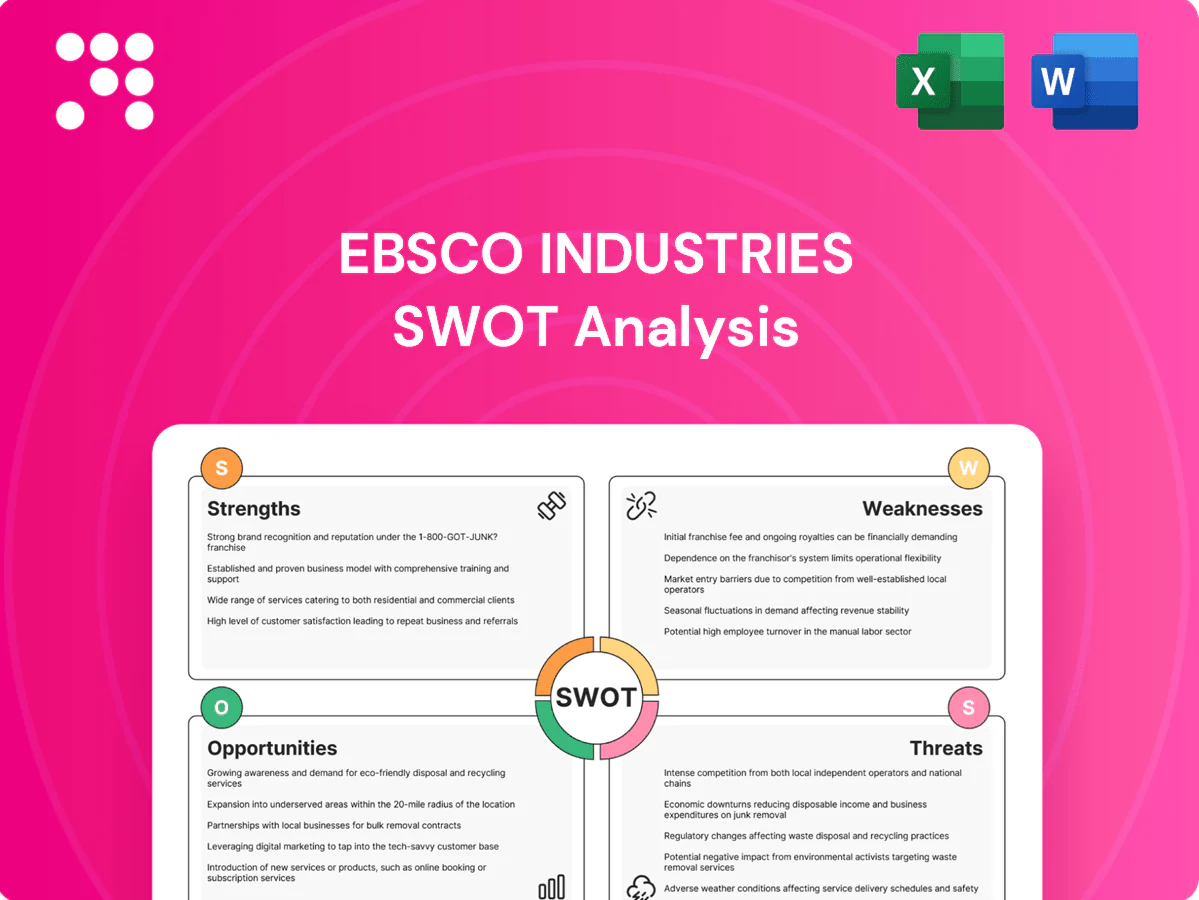
EBSCO Industries SWOT Analysis

Go Beyond the Preview—Access the Full Strategic Report
EBSCO Industries’ SWOT snapshot highlights diversified strengths, niche publishing assets, and potential market risks from digital disruption and regulatory shifts. Our full SWOT uncovers strategic levers, financial context, and actionable recommendations for investors and executives. Purchase the complete, editable SWOT report—Word and Excel deliverables included—to plan, pitch, and invest with confidence.
Strengths

Diversified multi-industry portfolio
EBSCO operates across five sectors — information services, manufacturing, real estate, insurance services, and outdoor products — reducing volatility and cycle risk by spreading exposure across distinct end markets. This multi-industry mix avoids overreliance on a single revenue source, enables cross-subsidizing growth areas in downturns, and provides optionality to redeploy capital toward the best risk-adjusted returns.
Scale in research & library solutions
EBSCO Information Services is a category leader in databases, e-journals and library technology, underpinning EBSCO Industries’ roughly $2.8 billion 2023 revenue and conferring brand credibility and pricing power. Serving over 100,000 libraries and institutions, deep integrations create high switching costs, a recurring subscription/upsell base, and publisher ties that sustain content breadth and relevance.

Recurring subscription revenue
Recurring subscriptions and licenses from EBSCO Information Services produce predictable cash flows with consistently high renewal rates, underpinning operating stability. Contracted, mostly multi-year revenue improves budgeting and expands capacity for targeted investments. This steady income stream cushions short-term budget shocks and strengthens the broader conglomerate’s capital-allocation flexibility.

Private ownership, long-term horizon
As a privately held company (founded 1944) EBSCO can invest through cycles without public market pressure, enabling patient M&A and product development in niche markets; governance flexibility supports entrepreneurship across its 40+ businesses and often enhances employee retention and partner trust.
- Private ownership: long-term capital
- 40+ businesses: diversified entrepreneurship
- Patient M&A: niche focus
- Stronger partner/employee bonds
Global customer reach and ecosystem
EBSCO’s global footprint spans 160+ countries and thousands of institutions, expanding market access across academia, enterprise, and government. Deep integrations—discovery, link resolvers and workflow tools—embed EBSCO in daily research workflows, generating usage data from millions of users that guides product roadmaps. These network effects raise switching costs and strengthen barriers to entry.
- 160+ countries
- thousands of institutions
- millions of end-users
- integrations = higher retention
Diversified info conglomerate with $2.8B revenue, 100,000+ libraries in 160+ countries
EBSCO’s diversified portfolio across five sectors reduces cycle risk and allows capital redeployment; conglomerate revenue was about $2.8B in 2023. EBSCO Information Services is a global leader serving 100,000+ libraries in 160+ countries, creating high switching costs and recurring subscription cash flow. Private ownership enables patient M&A and long-term investment.
| Metric | Value |
|---|---|
| Revenue (2023) | $2.8B |
| Libraries served | 100,000+ |
| Countries | 160+ |
What is included in the product
 Detailed Word Document
Delivers a strategic overview of EBSCO Industries’s internal and external business factors, outlining strengths, weaknesses, opportunities, and threats to assess its competitive position, operational gaps, and key growth drivers shaping future performance.

 Customizable Excel Spreadsheet
Provides a concise SWOT matrix for fast strategic alignment across EBSCO Industries, enabling executives to pinpoint risks and opportunities quickly for streamlined decision-making.
Weaknesses

Conglomerate complexity
Managing 40+ disparate businesses raises coordination costs and slows decision-making across EBSCO’s portfolio. Efforts to align group strategy can dilute focus on the highest-return opportunities within individual units. Centralized shared services may not fully fit specialized business needs, creating inefficiencies. The conglomerate’s complexity can obscure the true performance of underperforming assets, hindering timely corrective action.
Dependence on institutional budgets
Dependence on academic, healthcare and public library budgets exposes EBSCO to fiscal cycles and funding policy shifts; procurement cycles often exceed six months and are price‑pressured, increasing renewal risk when institutions tighten budgets. Concentration in institutional buyers constrains pricing power and slows upsell velocity, making revenue growth sensitive to public and education funding trends.

Limited external transparency
EBSCO Industries’ private status means it makes no SEC filings, limiting financial disclosures and hindering benchmarking and investor discipline. Opacity complicates credit negotiations and partner due diligence, raising borrowing costs and deal friction. Limited visibility can mask underinvestment in specific business units, and stakeholders may perceive higher information risk as a result.

Legacy tech and integration burden
Maintaining and modernizing legacy platforms in information services is resource-intensive and slows feature delivery; IBM reports the average cost of a data breach was 4.45 million USD in 2023, raising stakes for complex integrations. Integration across publisher systems and library tech builds technical debt and compliance overhead, leaving slower user experience versus cloud-native rivals.
- High operational cost
- Rising security/compliance burden (avg breach cost 4.45M USD)
- Technical debt from integrations
- UX gap vs cloud-native competitors
Brand fragmentation beyond EIS
EBSCO Industries is a private, family-owned conglomerate founded in 1944 and headquartered in Ipswich, MA; outside its core EBSCO Information Services unit, brand equity is diffuse across many niche businesses, making cross-selling and portfolio synergies harder to realize.
Marketing efficiency weakens without a unified value proposition, and talent attraction can skew toward better-known units, hampering recruitment for smaller subsidiaries.
- Diffuse branding across divisions
- Reduced cross-sell and synergy capture
- Higher marketing unit costs
- Talent concentration in flagship units
Unify 40+ business units, accelerate >6-month procurement, modernize to reduce $4.45M breach risk
Managing 40+ disparate businesses raises coordination costs and slows decisions; procurement cycles exceed six months, exposing revenue to public funding cycles. Private ownership (founded 1944) means no SEC filings, limiting transparency for partners and lenders. Legacy platform modernization and integrations drive technical debt and security risk (avg breach cost 4.45M USD in 2023).
| Metric | Value |
|---|---|
| Business units | 40+ |
| Procurement cycle | >6 months |
| Avg breach cost (2023) | 4.45M USD |
| Founded | 1944 |
| SEC filings | None (private) |
Same Document Delivered
EBSCO Industries SWOT Analysis
This is the actual EBSCO Industries SWOT analysis document you’ll receive upon purchase—no surprises, just professional quality. The preview below is taken directly from the full report; buying unlocks the complete, editable version. You’re viewing a live excerpt of the final file, structured and ready for immediate use after checkout.

Go Beyond the Preview—Access the Full Strategic Report
EBSCO Industries’ SWOT snapshot highlights diversified strengths, niche publishing assets, and potential market risks from digital disruption and regulatory shifts. Our full SWOT uncovers strategic levers, financial context, and actionable recommendations for investors and executives. Purchase the complete, editable SWOT report—Word and Excel deliverables included—to plan, pitch, and invest with confidence.
Strengths
Diversified multi-industry portfolio
EBSCO operates across five sectors — information services, manufacturing, real estate, insurance services, and outdoor products — reducing volatility and cycle risk by spreading exposure across distinct end markets. This multi-industry mix avoids overreliance on a single revenue source, enables cross-subsidizing growth areas in downturns, and provides optionality to redeploy capital toward the best risk-adjusted returns.
Scale in research & library solutions
EBSCO Information Services is a category leader in databases, e-journals and library technology, underpinning EBSCO Industries’ roughly $2.8 billion 2023 revenue and conferring brand credibility and pricing power. Serving over 100,000 libraries and institutions, deep integrations create high switching costs, a recurring subscription/upsell base, and publisher ties that sustain content breadth and relevance.
Recurring subscription revenue
Recurring subscriptions and licenses from EBSCO Information Services produce predictable cash flows with consistently high renewal rates, underpinning operating stability. Contracted, mostly multi-year revenue improves budgeting and expands capacity for targeted investments. This steady income stream cushions short-term budget shocks and strengthens the broader conglomerate’s capital-allocation flexibility.
Private ownership, long-term horizon
As a privately held company (founded 1944) EBSCO can invest through cycles without public market pressure, enabling patient M&A and product development in niche markets; governance flexibility supports entrepreneurship across its 40+ businesses and often enhances employee retention and partner trust.
- Private ownership: long-term capital
- 40+ businesses: diversified entrepreneurship
- Patient M&A: niche focus
- Stronger partner/employee bonds
Global customer reach and ecosystem
EBSCO’s global footprint spans 160+ countries and thousands of institutions, expanding market access across academia, enterprise, and government. Deep integrations—discovery, link resolvers and workflow tools—embed EBSCO in daily research workflows, generating usage data from millions of users that guides product roadmaps. These network effects raise switching costs and strengthen barriers to entry.
- 160+ countries
- thousands of institutions
- millions of end-users
- integrations = higher retention
Diversified info conglomerate with $2.8B revenue, 100,000+ libraries in 160+ countries
EBSCO’s diversified portfolio across five sectors reduces cycle risk and allows capital redeployment; conglomerate revenue was about $2.8B in 2023. EBSCO Information Services is a global leader serving 100,000+ libraries in 160+ countries, creating high switching costs and recurring subscription cash flow. Private ownership enables patient M&A and long-term investment.
| Metric | Value |
|---|---|
| Revenue (2023) | $2.8B |
| Libraries served | 100,000+ |
| Countries | 160+ |
What is included in the product
Detailed Word Document
Delivers a strategic overview of EBSCO Industries’s internal and external business factors, outlining strengths, weaknesses, opportunities, and threats to assess its competitive position, operational gaps, and key growth drivers shaping future performance.
Customizable Excel Spreadsheet
Provides a concise SWOT matrix for fast strategic alignment across EBSCO Industries, enabling executives to pinpoint risks and opportunities quickly for streamlined decision-making.
Weaknesses
Conglomerate complexity
Managing 40+ disparate businesses raises coordination costs and slows decision-making across EBSCO’s portfolio. Efforts to align group strategy can dilute focus on the highest-return opportunities within individual units. Centralized shared services may not fully fit specialized business needs, creating inefficiencies. The conglomerate’s complexity can obscure the true performance of underperforming assets, hindering timely corrective action.
Dependence on institutional budgets
Dependence on academic, healthcare and public library budgets exposes EBSCO to fiscal cycles and funding policy shifts; procurement cycles often exceed six months and are price‑pressured, increasing renewal risk when institutions tighten budgets. Concentration in institutional buyers constrains pricing power and slows upsell velocity, making revenue growth sensitive to public and education funding trends.
Limited external transparency
EBSCO Industries’ private status means it makes no SEC filings, limiting financial disclosures and hindering benchmarking and investor discipline. Opacity complicates credit negotiations and partner due diligence, raising borrowing costs and deal friction. Limited visibility can mask underinvestment in specific business units, and stakeholders may perceive higher information risk as a result.
Legacy tech and integration burden
Maintaining and modernizing legacy platforms in information services is resource-intensive and slows feature delivery; IBM reports the average cost of a data breach was 4.45 million USD in 2023, raising stakes for complex integrations. Integration across publisher systems and library tech builds technical debt and compliance overhead, leaving slower user experience versus cloud-native rivals.
- High operational cost
- Rising security/compliance burden (avg breach cost 4.45M USD)
- Technical debt from integrations
- UX gap vs cloud-native competitors
Brand fragmentation beyond EIS
EBSCO Industries is a private, family-owned conglomerate founded in 1944 and headquartered in Ipswich, MA; outside its core EBSCO Information Services unit, brand equity is diffuse across many niche businesses, making cross-selling and portfolio synergies harder to realize.
Marketing efficiency weakens without a unified value proposition, and talent attraction can skew toward better-known units, hampering recruitment for smaller subsidiaries.
- Diffuse branding across divisions
- Reduced cross-sell and synergy capture
- Higher marketing unit costs
- Talent concentration in flagship units
Unify 40+ business units, accelerate >6-month procurement, modernize to reduce $4.45M breach risk
Managing 40+ disparate businesses raises coordination costs and slows decisions; procurement cycles exceed six months, exposing revenue to public funding cycles. Private ownership (founded 1944) means no SEC filings, limiting transparency for partners and lenders. Legacy platform modernization and integrations drive technical debt and security risk (avg breach cost 4.45M USD in 2023).
| Metric | Value |
|---|---|
| Business units | 40+ |
| Procurement cycle | >6 months |
| Avg breach cost (2023) | 4.45M USD |
| Founded | 1944 |
| SEC filings | None (private) |
Same Document Delivered
EBSCO Industries SWOT Analysis
This is the actual EBSCO Industries SWOT analysis document you’ll receive upon purchase—no surprises, just professional quality. The preview below is taken directly from the full report; buying unlocks the complete, editable version. You’re viewing a live excerpt of the final file, structured and ready for immediate use after checkout.
Description
Go Beyond the Preview—Access the Full Strategic Report
EBSCO Industries’ SWOT snapshot highlights diversified strengths, niche publishing assets, and potential market risks from digital disruption and regulatory shifts. Our full SWOT uncovers strategic levers, financial context, and actionable recommendations for investors and executives. Purchase the complete, editable SWOT report—Word and Excel deliverables included—to plan, pitch, and invest with confidence.
Strengths
Diversified multi-industry portfolio
EBSCO operates across five sectors — information services, manufacturing, real estate, insurance services, and outdoor products — reducing volatility and cycle risk by spreading exposure across distinct end markets. This multi-industry mix avoids overreliance on a single revenue source, enables cross-subsidizing growth areas in downturns, and provides optionality to redeploy capital toward the best risk-adjusted returns.
Scale in research & library solutions
EBSCO Information Services is a category leader in databases, e-journals and library technology, underpinning EBSCO Industries’ roughly $2.8 billion 2023 revenue and conferring brand credibility and pricing power. Serving over 100,000 libraries and institutions, deep integrations create high switching costs, a recurring subscription/upsell base, and publisher ties that sustain content breadth and relevance.
Recurring subscription revenue
Recurring subscriptions and licenses from EBSCO Information Services produce predictable cash flows with consistently high renewal rates, underpinning operating stability. Contracted, mostly multi-year revenue improves budgeting and expands capacity for targeted investments. This steady income stream cushions short-term budget shocks and strengthens the broader conglomerate’s capital-allocation flexibility.
Private ownership, long-term horizon
As a privately held company (founded 1944) EBSCO can invest through cycles without public market pressure, enabling patient M&A and product development in niche markets; governance flexibility supports entrepreneurship across its 40+ businesses and often enhances employee retention and partner trust.
- Private ownership: long-term capital
- 40+ businesses: diversified entrepreneurship
- Patient M&A: niche focus
- Stronger partner/employee bonds
Global customer reach and ecosystem
EBSCO’s global footprint spans 160+ countries and thousands of institutions, expanding market access across academia, enterprise, and government. Deep integrations—discovery, link resolvers and workflow tools—embed EBSCO in daily research workflows, generating usage data from millions of users that guides product roadmaps. These network effects raise switching costs and strengthen barriers to entry.
- 160+ countries
- thousands of institutions
- millions of end-users
- integrations = higher retention
Diversified info conglomerate with $2.8B revenue, 100,000+ libraries in 160+ countries
EBSCO’s diversified portfolio across five sectors reduces cycle risk and allows capital redeployment; conglomerate revenue was about $2.8B in 2023. EBSCO Information Services is a global leader serving 100,000+ libraries in 160+ countries, creating high switching costs and recurring subscription cash flow. Private ownership enables patient M&A and long-term investment.
| Metric | Value |
|---|---|
| Revenue (2023) | $2.8B |
| Libraries served | 100,000+ |
| Countries | 160+ |
What is included in the product
Detailed Word Document
Delivers a strategic overview of EBSCO Industries’s internal and external business factors, outlining strengths, weaknesses, opportunities, and threats to assess its competitive position, operational gaps, and key growth drivers shaping future performance.
Customizable Excel Spreadsheet
Provides a concise SWOT matrix for fast strategic alignment across EBSCO Industries, enabling executives to pinpoint risks and opportunities quickly for streamlined decision-making.
Weaknesses
Conglomerate complexity
Managing 40+ disparate businesses raises coordination costs and slows decision-making across EBSCO’s portfolio. Efforts to align group strategy can dilute focus on the highest-return opportunities within individual units. Centralized shared services may not fully fit specialized business needs, creating inefficiencies. The conglomerate’s complexity can obscure the true performance of underperforming assets, hindering timely corrective action.
Dependence on institutional budgets
Dependence on academic, healthcare and public library budgets exposes EBSCO to fiscal cycles and funding policy shifts; procurement cycles often exceed six months and are price‑pressured, increasing renewal risk when institutions tighten budgets. Concentration in institutional buyers constrains pricing power and slows upsell velocity, making revenue growth sensitive to public and education funding trends.
Limited external transparency
EBSCO Industries’ private status means it makes no SEC filings, limiting financial disclosures and hindering benchmarking and investor discipline. Opacity complicates credit negotiations and partner due diligence, raising borrowing costs and deal friction. Limited visibility can mask underinvestment in specific business units, and stakeholders may perceive higher information risk as a result.
Legacy tech and integration burden
Maintaining and modernizing legacy platforms in information services is resource-intensive and slows feature delivery; IBM reports the average cost of a data breach was 4.45 million USD in 2023, raising stakes for complex integrations. Integration across publisher systems and library tech builds technical debt and compliance overhead, leaving slower user experience versus cloud-native rivals.
- High operational cost
- Rising security/compliance burden (avg breach cost 4.45M USD)
- Technical debt from integrations
- UX gap vs cloud-native competitors
Brand fragmentation beyond EIS
EBSCO Industries is a private, family-owned conglomerate founded in 1944 and headquartered in Ipswich, MA; outside its core EBSCO Information Services unit, brand equity is diffuse across many niche businesses, making cross-selling and portfolio synergies harder to realize.
Marketing efficiency weakens without a unified value proposition, and talent attraction can skew toward better-known units, hampering recruitment for smaller subsidiaries.
- Diffuse branding across divisions
- Reduced cross-sell and synergy capture
- Higher marketing unit costs
- Talent concentration in flagship units
Unify 40+ business units, accelerate >6-month procurement, modernize to reduce $4.45M breach risk
Managing 40+ disparate businesses raises coordination costs and slows decisions; procurement cycles exceed six months, exposing revenue to public funding cycles. Private ownership (founded 1944) means no SEC filings, limiting transparency for partners and lenders. Legacy platform modernization and integrations drive technical debt and security risk (avg breach cost 4.45M USD in 2023).
| Metric | Value |
|---|---|
| Business units | 40+ |
| Procurement cycle | >6 months |
| Avg breach cost (2023) | 4.45M USD |
| Founded | 1944 |
| SEC filings | None (private) |
Same Document Delivered
EBSCO Industries SWOT Analysis
This is the actual EBSCO Industries SWOT analysis document you’ll receive upon purchase—no surprises, just professional quality. The preview below is taken directly from the full report; buying unlocks the complete, editable version. You’re viewing a live excerpt of the final file, structured and ready for immediate use after checkout.











