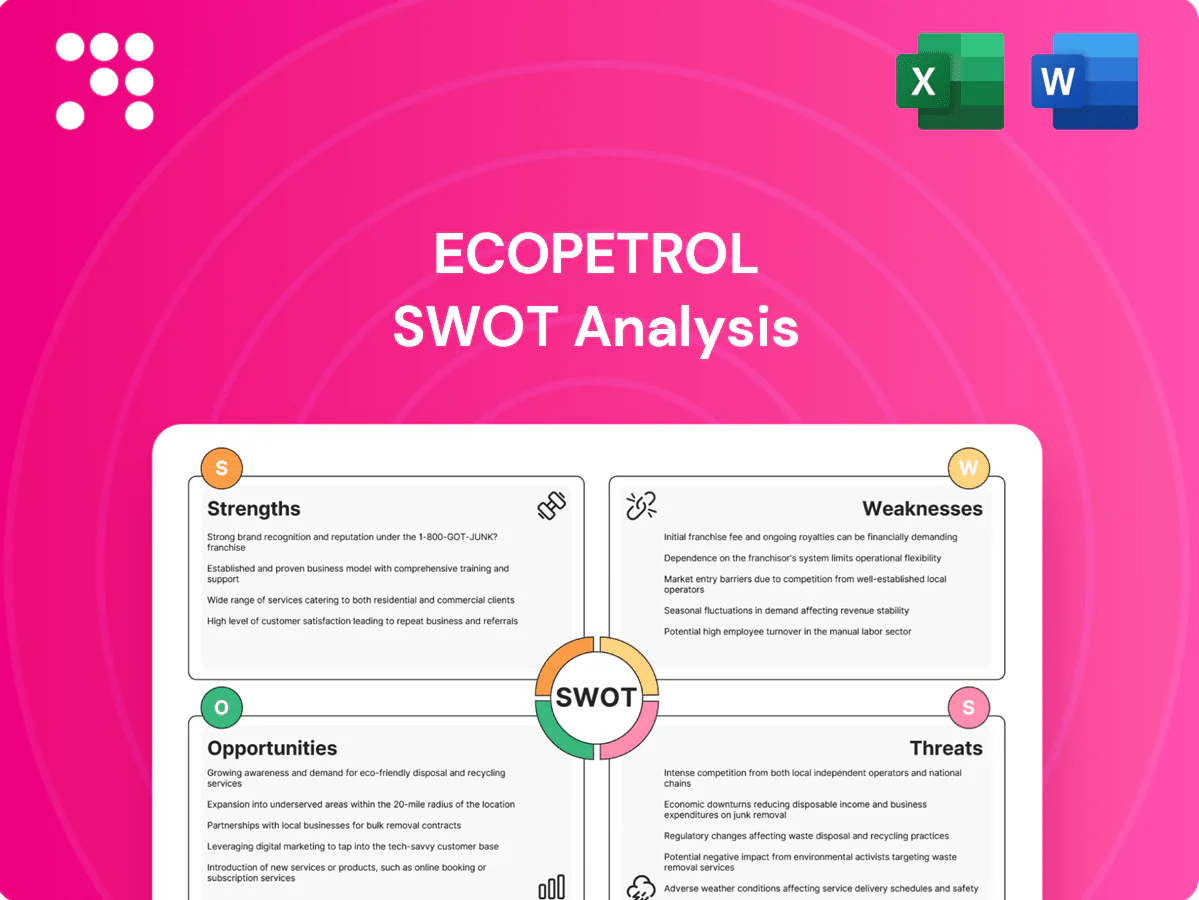
Ecopetrol SWOT Analysis

Elevate Your Analysis with the Complete SWOT Report
Ecopetrol’s SWOT highlights resilient upstream assets, strong domestic market share, and exposure to oil price volatility plus regulatory and ESG transition risks. Want the full strategic picture and financial context? Purchase the complete SWOT to receive a professionally written, editable Word report and Excel matrix for investment or planning.
Strengths

Integrated value chain leadership
Ecopetrol’s integrated value chain—from E&P through midstream, refining and marketing—lets it capture margins end-to-end, supporting ~700 kbpd production and >300 kbpd refining capacity in 2024. Integration cushions volatility by offsetting upstream swings with downstream stability and enables coordinated planning, logistics and regional market access. Scale drives cost efficiencies and stronger negotiating power with suppliers and buyers.
Dominant Colombian market position
As Colombia’s largest company and majority state-owned oil producer (roughly 88% government stake), Ecopetrol commands a strong domestic brand, asset base and political visibility. Its pipeline network of about 8,900 km and refining hubs with ~300 kbpd combined capacity anchor national supply security. Deep domestic fuel and gas markets support stable demand, underpinning resilient cash flows and strategic relevance.

Diversification into power and low-carbon
Ecopetrol is expanding into renewables, grids and low-carbon solutions, broadening earnings beyond oil and reducing exposure to crude price cycles; power and clean-energy investments now target regulated or long-term contracted cash flows (typically 10–20 years). This diversification supports more stable revenue streams, enhances sustainability credentials and increases investor appeal amid rising ESG demand.

Robust logistics and infrastructure
Ecopetrol controls critical pipelines, terminals and the Barrancabermeja and Cartagena refineries, giving it over 11,000 km of pipeline and a combined refining capacity around 330,000 barrels per day; this ownership cuts third‑party transport exposure, lowering logistics costs and bottleneck risk. Direct control enhances export optionality, allows product‑slate optimization and strengthens commercial reliability and margins.
- Infrastructure: >11,000 km pipelines
- Refining capacity: ~330,000 bpd
- Benefits: lower transport costs, better export options, margin resilience
National strategic importance
Ecopetrol, as Colombia's largest energy company and a state-majority enterprise (government stake c. 88.49% as of 2024), functions as a strategic fiscal and energy-security asset that often aligns with national priorities, easing permitting and interagency coordination. Its status underpins long-term domestic supply planning and a managed transition, helping stabilize stakeholder alignment on key projects.
- state-ownership: c. 88.49% (2024)
- national energy security anchor
- facilitates permitting/agency coordination
- supports long-term supply and transition planning
Integrated E&P-to-refining chain secures margins, logistics and export optionality
Ecopetrol’s integrated E&P-to-refining chain (≈700 kbpd prod.; ≈330 kbpd refining) and >11,000 km pipelines secure margins, logistics and export optionality. State majority (≈88.49% in 2024) ensures permitting, national supply role and stable cash flows. Renewables and long‑term contracted power investments (10–20 yr) diversify revenue and lower price exposure.
| Metric | 2024 |
|---|---|
| Production | ≈700 kbpd |
| Refining | ≈330 kbpd |
| Pipelines | >11,000 km |
| State stake | ≈88.49% |
What is included in the product
 Detailed Word Document
Provides a clear SWOT framework for analyzing Ecopetrol’s business strategy, highlighting internal capabilities, operational gaps, key growth drivers and market opportunities alongside regulatory, environmental, and geopolitical threats shaping its competitive position.

 Customizable Excel Spreadsheet
Provides a concise Ecopetrol SWOT matrix for fast strategic alignment, highlighting strengths in reserves and integrated refining, weaknesses from geopolitical and regulatory exposure, opportunities in energy transition and downstream growth, and threats from oil-price volatility and environmental liabilities.
Weaknesses

High exposure to oil price volatility
Ecopetrol’s cash flows and investment capacity remain tightly linked to Brent prices—which swung from about $110/barrel in 2022 to roughly $80/barrel in 2023—so downturns can compress margins and push capex and project timelines. Hedging programs only partially mitigate shocks, historically covering a portion of production and leaving earnings exposed to spot moves. This earnings cyclicality complicates multi-year capital allocation and dividend predictability.
Political and regulatory dependence
Majority state ownership (88.49% government stake) ties Ecopetrol’s strategy to shifting public policies. Changes in licensing, fiscal terms or Colombia’s net-zero-by-2050 commitments can compress returns and raise capital costs. Policy swings may slow exploration pacing or reshape refining economics. This amplifies governance and planning complexity for management and investors.

Aging assets and upgrade needs
Legacy fields and refineries require ongoing maintenance and targeted capex, raising baseline spending needs and reducing flexibility. Steep decline rates and scheduled turnarounds pressure produced volumes and plant uptime, squeezing near-term cash flow. Modernization for efficiency and emissions control is capital intensive, while execution risks on projects can disrupt supply and increase operating costs.

Security and social license risks
Operations have been disrupted by pipeline attacks, protests and localized conflicts, eroding production continuity and increasing project risk.
Rising social and environmental expectations across Colombia and abroad mean community opposition can delay or halt projects, while remediation and enhanced security materially raise operating costs and capital allocation.
- Pipeline disruptions
- Community opposition delays
- Higher security/remediation costs
FX and funding sensitivity
Ecopetrol's revenue-cost mismatches and COP/USD swings materially affect reported results; 2024 peso volatility (around ±15% year) amplified earnings sensitivity and drilling/import costs. Debt servicing and import-heavy capex remain exposed to currency and rate moves, with financing costs rising in stressed markets. Credit ratings continue to track commodity cycles and policy signals.
- Revenue-cost FX gap
- Import-capex exposure
- Debt-service sensitivity
- Ratings tied to oil cycles
State-controlled oil major hit by Brent slump, legacy asset risk and ±15% COP/USD swings
Ecopetrol’s cash flows remain highly correlated with Brent (≈$110/bbl in 2022 → ≈$80/bbl in 2023), exposing margins and capex. State ownership (88.49% government) ties strategy to policy shifts. Legacy asset decline and pipeline attacks raise maintenance, security and restart costs. COP/USD swings (~±15% in 2024) increase debt-service and import-capex risk.
| Metric | Latest |
|---|---|
| Govt stake | 88.49% |
| Brent range 2022–23 | $110 → $80/bbl |
| COP/USD vol (2024) | ≈±15% |
Preview the Actual Deliverable
Ecopetrol SWOT Analysis
This is the actual Ecopetrol SWOT analysis document you’ll receive upon purchase—no surprises, just professional quality. The preview below is taken directly from the full report and highlights key strengths, weaknesses, opportunities and threats. Buy to unlock the complete, editable version for strategy or valuation work.

Elevate Your Analysis with the Complete SWOT Report
Ecopetrol’s SWOT highlights resilient upstream assets, strong domestic market share, and exposure to oil price volatility plus regulatory and ESG transition risks. Want the full strategic picture and financial context? Purchase the complete SWOT to receive a professionally written, editable Word report and Excel matrix for investment or planning.
Strengths
Integrated value chain leadership
Ecopetrol’s integrated value chain—from E&P through midstream, refining and marketing—lets it capture margins end-to-end, supporting ~700 kbpd production and >300 kbpd refining capacity in 2024. Integration cushions volatility by offsetting upstream swings with downstream stability and enables coordinated planning, logistics and regional market access. Scale drives cost efficiencies and stronger negotiating power with suppliers and buyers.
Dominant Colombian market position
As Colombia’s largest company and majority state-owned oil producer (roughly 88% government stake), Ecopetrol commands a strong domestic brand, asset base and political visibility. Its pipeline network of about 8,900 km and refining hubs with ~300 kbpd combined capacity anchor national supply security. Deep domestic fuel and gas markets support stable demand, underpinning resilient cash flows and strategic relevance.
Diversification into power and low-carbon
Ecopetrol is expanding into renewables, grids and low-carbon solutions, broadening earnings beyond oil and reducing exposure to crude price cycles; power and clean-energy investments now target regulated or long-term contracted cash flows (typically 10–20 years). This diversification supports more stable revenue streams, enhances sustainability credentials and increases investor appeal amid rising ESG demand.
Robust logistics and infrastructure
Ecopetrol controls critical pipelines, terminals and the Barrancabermeja and Cartagena refineries, giving it over 11,000 km of pipeline and a combined refining capacity around 330,000 barrels per day; this ownership cuts third‑party transport exposure, lowering logistics costs and bottleneck risk. Direct control enhances export optionality, allows product‑slate optimization and strengthens commercial reliability and margins.
- Infrastructure: >11,000 km pipelines
- Refining capacity: ~330,000 bpd
- Benefits: lower transport costs, better export options, margin resilience
National strategic importance
Ecopetrol, as Colombia's largest energy company and a state-majority enterprise (government stake c. 88.49% as of 2024), functions as a strategic fiscal and energy-security asset that often aligns with national priorities, easing permitting and interagency coordination. Its status underpins long-term domestic supply planning and a managed transition, helping stabilize stakeholder alignment on key projects.
- state-ownership: c. 88.49% (2024)
- national energy security anchor
- facilitates permitting/agency coordination
- supports long-term supply and transition planning
Integrated E&P-to-refining chain secures margins, logistics and export optionality
Ecopetrol’s integrated E&P-to-refining chain (≈700 kbpd prod.; ≈330 kbpd refining) and >11,000 km pipelines secure margins, logistics and export optionality. State majority (≈88.49% in 2024) ensures permitting, national supply role and stable cash flows. Renewables and long‑term contracted power investments (10–20 yr) diversify revenue and lower price exposure.
| Metric | 2024 |
|---|---|
| Production | ≈700 kbpd |
| Refining | ≈330 kbpd |
| Pipelines | >11,000 km |
| State stake | ≈88.49% |
What is included in the product
Detailed Word Document
Provides a clear SWOT framework for analyzing Ecopetrol’s business strategy, highlighting internal capabilities, operational gaps, key growth drivers and market opportunities alongside regulatory, environmental, and geopolitical threats shaping its competitive position.
Customizable Excel Spreadsheet
Provides a concise Ecopetrol SWOT matrix for fast strategic alignment, highlighting strengths in reserves and integrated refining, weaknesses from geopolitical and regulatory exposure, opportunities in energy transition and downstream growth, and threats from oil-price volatility and environmental liabilities.
Weaknesses
High exposure to oil price volatility
Ecopetrol’s cash flows and investment capacity remain tightly linked to Brent prices—which swung from about $110/barrel in 2022 to roughly $80/barrel in 2023—so downturns can compress margins and push capex and project timelines. Hedging programs only partially mitigate shocks, historically covering a portion of production and leaving earnings exposed to spot moves. This earnings cyclicality complicates multi-year capital allocation and dividend predictability.
Political and regulatory dependence
Majority state ownership (88.49% government stake) ties Ecopetrol’s strategy to shifting public policies. Changes in licensing, fiscal terms or Colombia’s net-zero-by-2050 commitments can compress returns and raise capital costs. Policy swings may slow exploration pacing or reshape refining economics. This amplifies governance and planning complexity for management and investors.
Aging assets and upgrade needs
Legacy fields and refineries require ongoing maintenance and targeted capex, raising baseline spending needs and reducing flexibility. Steep decline rates and scheduled turnarounds pressure produced volumes and plant uptime, squeezing near-term cash flow. Modernization for efficiency and emissions control is capital intensive, while execution risks on projects can disrupt supply and increase operating costs.
Security and social license risks
Operations have been disrupted by pipeline attacks, protests and localized conflicts, eroding production continuity and increasing project risk.
Rising social and environmental expectations across Colombia and abroad mean community opposition can delay or halt projects, while remediation and enhanced security materially raise operating costs and capital allocation.
- Pipeline disruptions
- Community opposition delays
- Higher security/remediation costs
FX and funding sensitivity
Ecopetrol's revenue-cost mismatches and COP/USD swings materially affect reported results; 2024 peso volatility (around ±15% year) amplified earnings sensitivity and drilling/import costs. Debt servicing and import-heavy capex remain exposed to currency and rate moves, with financing costs rising in stressed markets. Credit ratings continue to track commodity cycles and policy signals.
- Revenue-cost FX gap
- Import-capex exposure
- Debt-service sensitivity
- Ratings tied to oil cycles
State-controlled oil major hit by Brent slump, legacy asset risk and ±15% COP/USD swings
Ecopetrol’s cash flows remain highly correlated with Brent (≈$110/bbl in 2022 → ≈$80/bbl in 2023), exposing margins and capex. State ownership (88.49% government) ties strategy to policy shifts. Legacy asset decline and pipeline attacks raise maintenance, security and restart costs. COP/USD swings (~±15% in 2024) increase debt-service and import-capex risk.
| Metric | Latest |
|---|---|
| Govt stake | 88.49% |
| Brent range 2022–23 | $110 → $80/bbl |
| COP/USD vol (2024) | ≈±15% |
Preview the Actual Deliverable
Ecopetrol SWOT Analysis
This is the actual Ecopetrol SWOT analysis document you’ll receive upon purchase—no surprises, just professional quality. The preview below is taken directly from the full report and highlights key strengths, weaknesses, opportunities and threats. Buy to unlock the complete, editable version for strategy or valuation work.
Description
Elevate Your Analysis with the Complete SWOT Report
Ecopetrol’s SWOT highlights resilient upstream assets, strong domestic market share, and exposure to oil price volatility plus regulatory and ESG transition risks. Want the full strategic picture and financial context? Purchase the complete SWOT to receive a professionally written, editable Word report and Excel matrix for investment or planning.
Strengths
Integrated value chain leadership
Ecopetrol’s integrated value chain—from E&P through midstream, refining and marketing—lets it capture margins end-to-end, supporting ~700 kbpd production and >300 kbpd refining capacity in 2024. Integration cushions volatility by offsetting upstream swings with downstream stability and enables coordinated planning, logistics and regional market access. Scale drives cost efficiencies and stronger negotiating power with suppliers and buyers.
Dominant Colombian market position
As Colombia’s largest company and majority state-owned oil producer (roughly 88% government stake), Ecopetrol commands a strong domestic brand, asset base and political visibility. Its pipeline network of about 8,900 km and refining hubs with ~300 kbpd combined capacity anchor national supply security. Deep domestic fuel and gas markets support stable demand, underpinning resilient cash flows and strategic relevance.
Diversification into power and low-carbon
Ecopetrol is expanding into renewables, grids and low-carbon solutions, broadening earnings beyond oil and reducing exposure to crude price cycles; power and clean-energy investments now target regulated or long-term contracted cash flows (typically 10–20 years). This diversification supports more stable revenue streams, enhances sustainability credentials and increases investor appeal amid rising ESG demand.
Robust logistics and infrastructure
Ecopetrol controls critical pipelines, terminals and the Barrancabermeja and Cartagena refineries, giving it over 11,000 km of pipeline and a combined refining capacity around 330,000 barrels per day; this ownership cuts third‑party transport exposure, lowering logistics costs and bottleneck risk. Direct control enhances export optionality, allows product‑slate optimization and strengthens commercial reliability and margins.
- Infrastructure: >11,000 km pipelines
- Refining capacity: ~330,000 bpd
- Benefits: lower transport costs, better export options, margin resilience
National strategic importance
Ecopetrol, as Colombia's largest energy company and a state-majority enterprise (government stake c. 88.49% as of 2024), functions as a strategic fiscal and energy-security asset that often aligns with national priorities, easing permitting and interagency coordination. Its status underpins long-term domestic supply planning and a managed transition, helping stabilize stakeholder alignment on key projects.
- state-ownership: c. 88.49% (2024)
- national energy security anchor
- facilitates permitting/agency coordination
- supports long-term supply and transition planning
Integrated E&P-to-refining chain secures margins, logistics and export optionality
Ecopetrol’s integrated E&P-to-refining chain (≈700 kbpd prod.; ≈330 kbpd refining) and >11,000 km pipelines secure margins, logistics and export optionality. State majority (≈88.49% in 2024) ensures permitting, national supply role and stable cash flows. Renewables and long‑term contracted power investments (10–20 yr) diversify revenue and lower price exposure.
| Metric | 2024 |
|---|---|
| Production | ≈700 kbpd |
| Refining | ≈330 kbpd |
| Pipelines | >11,000 km |
| State stake | ≈88.49% |
What is included in the product
Detailed Word Document
Provides a clear SWOT framework for analyzing Ecopetrol’s business strategy, highlighting internal capabilities, operational gaps, key growth drivers and market opportunities alongside regulatory, environmental, and geopolitical threats shaping its competitive position.
Customizable Excel Spreadsheet
Provides a concise Ecopetrol SWOT matrix for fast strategic alignment, highlighting strengths in reserves and integrated refining, weaknesses from geopolitical and regulatory exposure, opportunities in energy transition and downstream growth, and threats from oil-price volatility and environmental liabilities.
Weaknesses
High exposure to oil price volatility
Ecopetrol’s cash flows and investment capacity remain tightly linked to Brent prices—which swung from about $110/barrel in 2022 to roughly $80/barrel in 2023—so downturns can compress margins and push capex and project timelines. Hedging programs only partially mitigate shocks, historically covering a portion of production and leaving earnings exposed to spot moves. This earnings cyclicality complicates multi-year capital allocation and dividend predictability.
Political and regulatory dependence
Majority state ownership (88.49% government stake) ties Ecopetrol’s strategy to shifting public policies. Changes in licensing, fiscal terms or Colombia’s net-zero-by-2050 commitments can compress returns and raise capital costs. Policy swings may slow exploration pacing or reshape refining economics. This amplifies governance and planning complexity for management and investors.
Aging assets and upgrade needs
Legacy fields and refineries require ongoing maintenance and targeted capex, raising baseline spending needs and reducing flexibility. Steep decline rates and scheduled turnarounds pressure produced volumes and plant uptime, squeezing near-term cash flow. Modernization for efficiency and emissions control is capital intensive, while execution risks on projects can disrupt supply and increase operating costs.
Security and social license risks
Operations have been disrupted by pipeline attacks, protests and localized conflicts, eroding production continuity and increasing project risk.
Rising social and environmental expectations across Colombia and abroad mean community opposition can delay or halt projects, while remediation and enhanced security materially raise operating costs and capital allocation.
- Pipeline disruptions
- Community opposition delays
- Higher security/remediation costs
FX and funding sensitivity
Ecopetrol's revenue-cost mismatches and COP/USD swings materially affect reported results; 2024 peso volatility (around ±15% year) amplified earnings sensitivity and drilling/import costs. Debt servicing and import-heavy capex remain exposed to currency and rate moves, with financing costs rising in stressed markets. Credit ratings continue to track commodity cycles and policy signals.
- Revenue-cost FX gap
- Import-capex exposure
- Debt-service sensitivity
- Ratings tied to oil cycles
State-controlled oil major hit by Brent slump, legacy asset risk and ±15% COP/USD swings
Ecopetrol’s cash flows remain highly correlated with Brent (≈$110/bbl in 2022 → ≈$80/bbl in 2023), exposing margins and capex. State ownership (88.49% government) ties strategy to policy shifts. Legacy asset decline and pipeline attacks raise maintenance, security and restart costs. COP/USD swings (~±15% in 2024) increase debt-service and import-capex risk.
| Metric | Latest |
|---|---|
| Govt stake | 88.49% |
| Brent range 2022–23 | $110 → $80/bbl |
| COP/USD vol (2024) | ≈±15% |
Preview the Actual Deliverable
Ecopetrol SWOT Analysis
This is the actual Ecopetrol SWOT analysis document you’ll receive upon purchase—no surprises, just professional quality. The preview below is taken directly from the full report and highlights key strengths, weaknesses, opportunities and threats. Buy to unlock the complete, editable version for strategy or valuation work.











