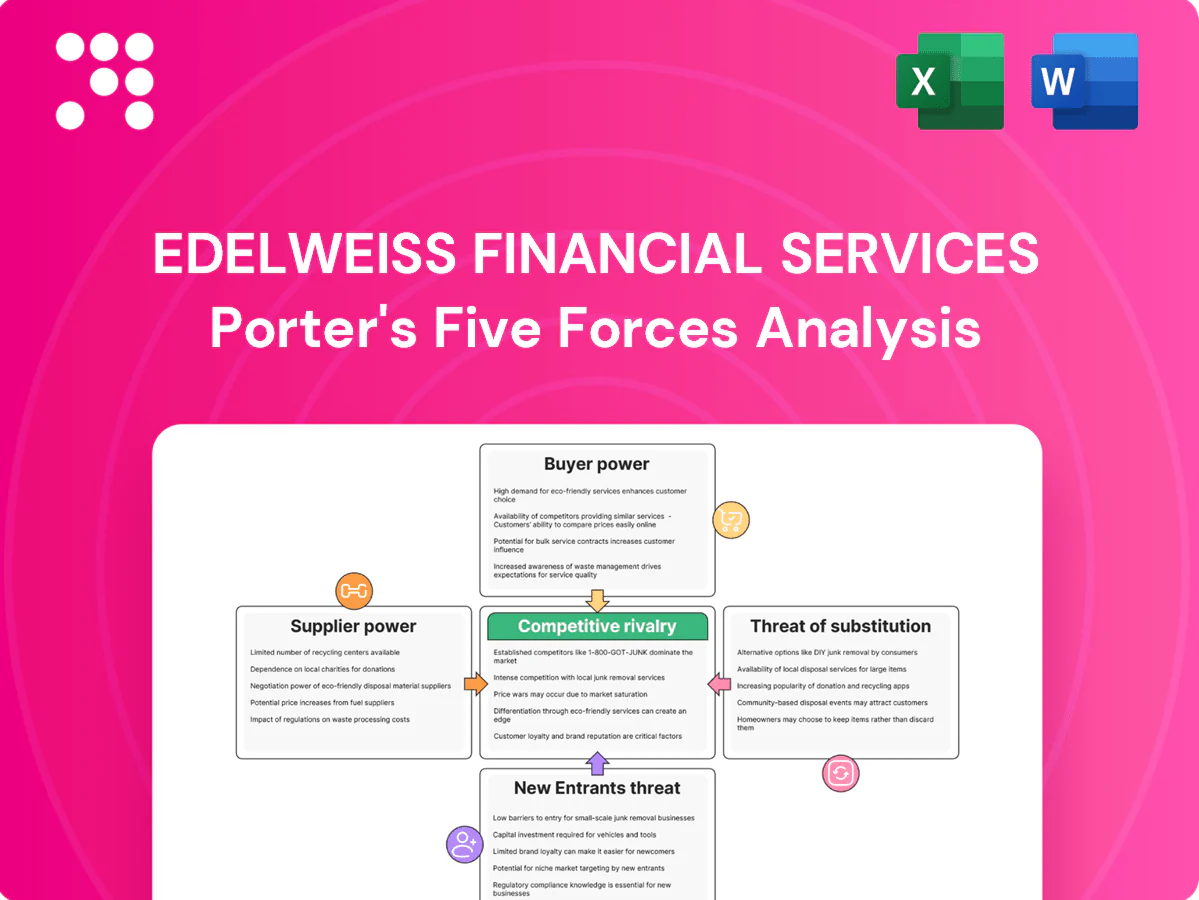
Edelweiss Financial Services Porter's Five Forces Analysis

A Must-Have Tool for Decision-Makers
Edelweiss Financial Services faces moderate buyer power, concentrated supplier channels, and rising regulatory and fintech threats that reshape margins and growth prospects. Our snapshot highlights key competitive pressures and strategic levers for differentiation. This brief only scratches the surface—unlock the full Porter's Five Forces analysis for force-by-force ratings, visuals, and actionable strategy to inform investment or corporate decisions.
Suppliers Bargaining Power

Dependence on wholesale funding
As a diversified NBFC-led platform, Edelweiss depends heavily on bank lines, market borrowings and securitizations, so suppliers control the cost of funds which directly impacts margins and pricing flexibility.
Tight liquidity or heightened risk aversion in wholesale markets can quickly reprice spreads and constrain asset growth and lending capacity.
Robust diversification of funding sources, active asset-liability management, strong credit ratings and high-quality collateral reduce supplier leverage over the firm.
Talent and specialist advisory
Skilled relationship managers, traders and investment professionals are scarce and mobile, giving talent suppliers outsized bargaining power; industry senior-talent turnover often exceeds 20% annually. Compensation cycles and variable pay—which surged in bull markets with total incentive pools growing double digits in 2023–24—elevate cost pressure. Robust culture, clear career paths and equity-linked incentives cut churn, while knowledge codification and tech (RPA, AI) reduce single-employee dependency.

Technology and market infrastructure
Core systems, OMS/RMS, custodians, data vendors and exchanges act as critical suppliers to Edelweiss, creating switching frictions through proprietary integrations and high migration costs that raise operating expenses and time-to-market. Vendor consolidation — e.g., global cloud IaaS share in 2024 with AWS ~33% and Azure ~22% — amplifies lock-in and pricing leverage. Open APIs and modular architectures improve optionality, while strict SLAs and multi-vendor strategies reduce outage and pricing risks.

Product manufacturers and partners
Product manufacturers and partners — AIF/PMS sponsors, AMCs, insurers and structured-product issuers — shape shelf breadth and economics; India’s AIF AUM exceeded INR 6 lakh crore in 2024 and mutual fund industry AUM was ~INR 45 lakh crore, amplifying supplier influence. Exclusive or high-demand products secure higher distributor concessions, but multi-partner curation dilutes single-partner leverage. Co-manufacturing and in-house products help rebalance margins and lower reliance on external sponsors.
- High AUM suppliers (AIFs ~INR 6L cr, MFs ~INR 45L cr) drive shelf terms
- Exclusive products = higher concessions
- Multi-partner curation reduces single-party bargaining power
- Co-manufacturing/in-house products improve margin control
Regulatory and rating ecosystem
Regulators (RBI, SEBI) and the four major SEBI-registered rating agencies (CRISIL, ICRA, CARE, India Ratings) act as suppliers of license and credibility for Edelweiss, shaping capital access and compliance costs; rule changes can reallocate funding channels and alter product viability. Proactive compliance, diversified rating relationships and transparent risk management reduce the likelihood and impact of adverse regulatory or rating actions.
- Regulatory oversight: RBI/SEBI control licensing and capital rules
- Ratings leverage: four principal agencies determine funding spreads
- Mitigation: diversified ratings and clear risk disclosures
Wholesale funding and talent power squeeze margins; diversified funding and ALM reduce risk
Edelweiss faces strong supplier power from wholesale funding (bank lines, securitisation) that reprices margins in tight markets; talent suppliers and key vendors create additional leverage through mobility and lock-in. Diversified funding, ALM, in-house products and multi-vendor strategies reduce this dependence. Regulatory and rating agencies further shape access and costs.
| Metric | 2024 |
|---|---|
| AIF AUM | ~INR 6 lakh crore |
| Mutual Fund AUM | ~INR 45 lakh crore |
| Cloud IaaS share | AWS ~33% / Azure ~22% |
| Talent turnover | >20% pa |
What is included in the product
 Detailed Word Document
Uncovers key drivers of competition, customer influence, supplier power, and market entry risks tailored to Edelweiss Financial Services, identifying disruptive forces, substitutes, and strategic levers that shape its pricing, profitability, and defensive positioning.

 Customizable Excel Spreadsheet
A concise, one-sheet Porter's Five Forces for Edelweiss that instantly visualizes competitive pressure with a spider chart and customizable inputs—easy to drop into pitch decks, adapt for regulatory or new-entrant scenarios, and share across dashboards without macros.
Customers Bargaining Power

Price transparency and fee sensitivity
HNIs, UHNW and institutions routinely compare advisory fees (typically 0.1–2% of AUM), loan rates (roughly 8–12% for retail/NBFC products) and brokerage, pressuring Edelweiss as discount brokers anchor expectations with flat fees as low as Rs 20 per trade. Direct mutual fund plans and discount broking reduced fee benchmarks, making fee sensitivity acute. Clear value articulation, outcome‑linked fees and bundled propositions (credit + advisory + execution) help defend pricing and boost perceived value.
Multi-homing across providers
Clients often split mandates among banks, NBFCs, AMCs and fintechs, increasing buyer leverage and enabling frequent switching and hard negotiation on fees and service SLAs. Deepening share of wallet through integrated wealth-credit-capital markets reduces churn by tying credit and investments. Superior service, relationship management and seamless digital UX are key levers to curb multi-homing and retain client mandates.

Performance and trust dependence
Investment outcomes and risk stewardship drive client retention and pricing power for Edelweiss; consistent alpha led the firm to report AMC AUM above INR 1 trillion by Dec 2024, reinforcing fee negotiation leverage.
Underperformance prompts rapid reallocation: industry data show active fund flows shift within months, pressuring managers with streaks below benchmark.
Robust research, governance, and transparent reporting sustain trust, and sustained risk-adjusted returns (Sharpe ratios above peers in key strategies in 2024) lower buyer bargaining power.

Institutional procurement rigor
Institutional procurement through formal RFPs and heightened due diligence in 2024 has tightened margins for Edelweiss, turning scale and track record into entry qualifiers rather than differentiators. Niche expertise and bespoke solutions remain the main levers to preserve economics, enabling premium pricing on specialized mandates. Long-term institutional contracts stabilize revenue but typically at lower margin bands.
- RFP-led sourcing: compresses fees
- Scale = qualifier, not advantage
- Bespoke expertise preserves margin
- Long contracts = stable, tighter pricing
Digital service expectations
- Real-time access: 24/7 market data and trade execution
- Onboarding: sub-minute KYC and account activation
- Omnichannel: web, mobile, chat, voice support
- Value add: analytics and personalization to defend margins
Fee compression and 114.86bn UPI volumes force real-time UX as AMCs vie for INR 1T
Customers exert high bargaining power via fee compression (discount trades from Rs 20), easy switching and RFPs; AMC AUM > INR 1 trillion (Dec 2024) and rapid active flow shifts raise performance pressure. Digital expectations (114.86bn UPI Txns FY2023–24) push real‑time UX and data analytics as defenses.
| Metric | 2023–24/Dec 2024 |
|---|---|
| AMC AUM | INR 1+ trillion |
| UPI Txns | 114.86 billion |
| Discount trade fee | Rs 20 |
Same Document Delivered
Edelweiss Financial Services Porter's Five Forces Analysis
This preview displays the complete Edelweiss Financial Services Porter’s Five Forces analysis — the exact, professionally formatted document you’ll receive upon purchase. It contains the full competitive assessment ready for immediate download and use. No placeholders, no samples — instant access to the final file after payment.

A Must-Have Tool for Decision-Makers
Edelweiss Financial Services faces moderate buyer power, concentrated supplier channels, and rising regulatory and fintech threats that reshape margins and growth prospects. Our snapshot highlights key competitive pressures and strategic levers for differentiation. This brief only scratches the surface—unlock the full Porter's Five Forces analysis for force-by-force ratings, visuals, and actionable strategy to inform investment or corporate decisions.
Suppliers Bargaining Power
Dependence on wholesale funding
As a diversified NBFC-led platform, Edelweiss depends heavily on bank lines, market borrowings and securitizations, so suppliers control the cost of funds which directly impacts margins and pricing flexibility.
Tight liquidity or heightened risk aversion in wholesale markets can quickly reprice spreads and constrain asset growth and lending capacity.
Robust diversification of funding sources, active asset-liability management, strong credit ratings and high-quality collateral reduce supplier leverage over the firm.
Talent and specialist advisory
Skilled relationship managers, traders and investment professionals are scarce and mobile, giving talent suppliers outsized bargaining power; industry senior-talent turnover often exceeds 20% annually. Compensation cycles and variable pay—which surged in bull markets with total incentive pools growing double digits in 2023–24—elevate cost pressure. Robust culture, clear career paths and equity-linked incentives cut churn, while knowledge codification and tech (RPA, AI) reduce single-employee dependency.
Technology and market infrastructure
Core systems, OMS/RMS, custodians, data vendors and exchanges act as critical suppliers to Edelweiss, creating switching frictions through proprietary integrations and high migration costs that raise operating expenses and time-to-market. Vendor consolidation — e.g., global cloud IaaS share in 2024 with AWS ~33% and Azure ~22% — amplifies lock-in and pricing leverage. Open APIs and modular architectures improve optionality, while strict SLAs and multi-vendor strategies reduce outage and pricing risks.
Product manufacturers and partners
Product manufacturers and partners — AIF/PMS sponsors, AMCs, insurers and structured-product issuers — shape shelf breadth and economics; India’s AIF AUM exceeded INR 6 lakh crore in 2024 and mutual fund industry AUM was ~INR 45 lakh crore, amplifying supplier influence. Exclusive or high-demand products secure higher distributor concessions, but multi-partner curation dilutes single-partner leverage. Co-manufacturing and in-house products help rebalance margins and lower reliance on external sponsors.
- High AUM suppliers (AIFs ~INR 6L cr, MFs ~INR 45L cr) drive shelf terms
- Exclusive products = higher concessions
- Multi-partner curation reduces single-party bargaining power
- Co-manufacturing/in-house products improve margin control
Regulatory and rating ecosystem
Regulators (RBI, SEBI) and the four major SEBI-registered rating agencies (CRISIL, ICRA, CARE, India Ratings) act as suppliers of license and credibility for Edelweiss, shaping capital access and compliance costs; rule changes can reallocate funding channels and alter product viability. Proactive compliance, diversified rating relationships and transparent risk management reduce the likelihood and impact of adverse regulatory or rating actions.
- Regulatory oversight: RBI/SEBI control licensing and capital rules
- Ratings leverage: four principal agencies determine funding spreads
- Mitigation: diversified ratings and clear risk disclosures
Wholesale funding and talent power squeeze margins; diversified funding and ALM reduce risk
Edelweiss faces strong supplier power from wholesale funding (bank lines, securitisation) that reprices margins in tight markets; talent suppliers and key vendors create additional leverage through mobility and lock-in. Diversified funding, ALM, in-house products and multi-vendor strategies reduce this dependence. Regulatory and rating agencies further shape access and costs.
| Metric | 2024 |
|---|---|
| AIF AUM | ~INR 6 lakh crore |
| Mutual Fund AUM | ~INR 45 lakh crore |
| Cloud IaaS share | AWS ~33% / Azure ~22% |
| Talent turnover | >20% pa |
What is included in the product
Detailed Word Document
Uncovers key drivers of competition, customer influence, supplier power, and market entry risks tailored to Edelweiss Financial Services, identifying disruptive forces, substitutes, and strategic levers that shape its pricing, profitability, and defensive positioning.
Customizable Excel Spreadsheet
A concise, one-sheet Porter's Five Forces for Edelweiss that instantly visualizes competitive pressure with a spider chart and customizable inputs—easy to drop into pitch decks, adapt for regulatory or new-entrant scenarios, and share across dashboards without macros.
Customers Bargaining Power
Price transparency and fee sensitivity
HNIs, UHNW and institutions routinely compare advisory fees (typically 0.1–2% of AUM), loan rates (roughly 8–12% for retail/NBFC products) and brokerage, pressuring Edelweiss as discount brokers anchor expectations with flat fees as low as Rs 20 per trade. Direct mutual fund plans and discount broking reduced fee benchmarks, making fee sensitivity acute. Clear value articulation, outcome‑linked fees and bundled propositions (credit + advisory + execution) help defend pricing and boost perceived value.
Multi-homing across providers
Clients often split mandates among banks, NBFCs, AMCs and fintechs, increasing buyer leverage and enabling frequent switching and hard negotiation on fees and service SLAs. Deepening share of wallet through integrated wealth-credit-capital markets reduces churn by tying credit and investments. Superior service, relationship management and seamless digital UX are key levers to curb multi-homing and retain client mandates.
Performance and trust dependence
Investment outcomes and risk stewardship drive client retention and pricing power for Edelweiss; consistent alpha led the firm to report AMC AUM above INR 1 trillion by Dec 2024, reinforcing fee negotiation leverage.
Underperformance prompts rapid reallocation: industry data show active fund flows shift within months, pressuring managers with streaks below benchmark.
Robust research, governance, and transparent reporting sustain trust, and sustained risk-adjusted returns (Sharpe ratios above peers in key strategies in 2024) lower buyer bargaining power.
Institutional procurement rigor
Institutional procurement through formal RFPs and heightened due diligence in 2024 has tightened margins for Edelweiss, turning scale and track record into entry qualifiers rather than differentiators. Niche expertise and bespoke solutions remain the main levers to preserve economics, enabling premium pricing on specialized mandates. Long-term institutional contracts stabilize revenue but typically at lower margin bands.
- RFP-led sourcing: compresses fees
- Scale = qualifier, not advantage
- Bespoke expertise preserves margin
- Long contracts = stable, tighter pricing
Digital service expectations
- Real-time access: 24/7 market data and trade execution
- Onboarding: sub-minute KYC and account activation
- Omnichannel: web, mobile, chat, voice support
- Value add: analytics and personalization to defend margins
Fee compression and 114.86bn UPI volumes force real-time UX as AMCs vie for INR 1T
Customers exert high bargaining power via fee compression (discount trades from Rs 20), easy switching and RFPs; AMC AUM > INR 1 trillion (Dec 2024) and rapid active flow shifts raise performance pressure. Digital expectations (114.86bn UPI Txns FY2023–24) push real‑time UX and data analytics as defenses.
| Metric | 2023–24/Dec 2024 |
|---|---|
| AMC AUM | INR 1+ trillion |
| UPI Txns | 114.86 billion |
| Discount trade fee | Rs 20 |
Same Document Delivered
Edelweiss Financial Services Porter's Five Forces Analysis
This preview displays the complete Edelweiss Financial Services Porter’s Five Forces analysis — the exact, professionally formatted document you’ll receive upon purchase. It contains the full competitive assessment ready for immediate download and use. No placeholders, no samples — instant access to the final file after payment.
Original: $10.00
-65%$10.00
$3.50Description
A Must-Have Tool for Decision-Makers
Edelweiss Financial Services faces moderate buyer power, concentrated supplier channels, and rising regulatory and fintech threats that reshape margins and growth prospects. Our snapshot highlights key competitive pressures and strategic levers for differentiation. This brief only scratches the surface—unlock the full Porter's Five Forces analysis for force-by-force ratings, visuals, and actionable strategy to inform investment or corporate decisions.
Suppliers Bargaining Power
Dependence on wholesale funding
As a diversified NBFC-led platform, Edelweiss depends heavily on bank lines, market borrowings and securitizations, so suppliers control the cost of funds which directly impacts margins and pricing flexibility.
Tight liquidity or heightened risk aversion in wholesale markets can quickly reprice spreads and constrain asset growth and lending capacity.
Robust diversification of funding sources, active asset-liability management, strong credit ratings and high-quality collateral reduce supplier leverage over the firm.
Talent and specialist advisory
Skilled relationship managers, traders and investment professionals are scarce and mobile, giving talent suppliers outsized bargaining power; industry senior-talent turnover often exceeds 20% annually. Compensation cycles and variable pay—which surged in bull markets with total incentive pools growing double digits in 2023–24—elevate cost pressure. Robust culture, clear career paths and equity-linked incentives cut churn, while knowledge codification and tech (RPA, AI) reduce single-employee dependency.
Technology and market infrastructure
Core systems, OMS/RMS, custodians, data vendors and exchanges act as critical suppliers to Edelweiss, creating switching frictions through proprietary integrations and high migration costs that raise operating expenses and time-to-market. Vendor consolidation — e.g., global cloud IaaS share in 2024 with AWS ~33% and Azure ~22% — amplifies lock-in and pricing leverage. Open APIs and modular architectures improve optionality, while strict SLAs and multi-vendor strategies reduce outage and pricing risks.
Product manufacturers and partners
Product manufacturers and partners — AIF/PMS sponsors, AMCs, insurers and structured-product issuers — shape shelf breadth and economics; India’s AIF AUM exceeded INR 6 lakh crore in 2024 and mutual fund industry AUM was ~INR 45 lakh crore, amplifying supplier influence. Exclusive or high-demand products secure higher distributor concessions, but multi-partner curation dilutes single-partner leverage. Co-manufacturing and in-house products help rebalance margins and lower reliance on external sponsors.
- High AUM suppliers (AIFs ~INR 6L cr, MFs ~INR 45L cr) drive shelf terms
- Exclusive products = higher concessions
- Multi-partner curation reduces single-party bargaining power
- Co-manufacturing/in-house products improve margin control
Regulatory and rating ecosystem
Regulators (RBI, SEBI) and the four major SEBI-registered rating agencies (CRISIL, ICRA, CARE, India Ratings) act as suppliers of license and credibility for Edelweiss, shaping capital access and compliance costs; rule changes can reallocate funding channels and alter product viability. Proactive compliance, diversified rating relationships and transparent risk management reduce the likelihood and impact of adverse regulatory or rating actions.
- Regulatory oversight: RBI/SEBI control licensing and capital rules
- Ratings leverage: four principal agencies determine funding spreads
- Mitigation: diversified ratings and clear risk disclosures
Wholesale funding and talent power squeeze margins; diversified funding and ALM reduce risk
Edelweiss faces strong supplier power from wholesale funding (bank lines, securitisation) that reprices margins in tight markets; talent suppliers and key vendors create additional leverage through mobility and lock-in. Diversified funding, ALM, in-house products and multi-vendor strategies reduce this dependence. Regulatory and rating agencies further shape access and costs.
| Metric | 2024 |
|---|---|
| AIF AUM | ~INR 6 lakh crore |
| Mutual Fund AUM | ~INR 45 lakh crore |
| Cloud IaaS share | AWS ~33% / Azure ~22% |
| Talent turnover | >20% pa |
What is included in the product
Detailed Word Document
Uncovers key drivers of competition, customer influence, supplier power, and market entry risks tailored to Edelweiss Financial Services, identifying disruptive forces, substitutes, and strategic levers that shape its pricing, profitability, and defensive positioning.
Customizable Excel Spreadsheet
A concise, one-sheet Porter's Five Forces for Edelweiss that instantly visualizes competitive pressure with a spider chart and customizable inputs—easy to drop into pitch decks, adapt for regulatory or new-entrant scenarios, and share across dashboards without macros.
Customers Bargaining Power
Price transparency and fee sensitivity
HNIs, UHNW and institutions routinely compare advisory fees (typically 0.1–2% of AUM), loan rates (roughly 8–12% for retail/NBFC products) and brokerage, pressuring Edelweiss as discount brokers anchor expectations with flat fees as low as Rs 20 per trade. Direct mutual fund plans and discount broking reduced fee benchmarks, making fee sensitivity acute. Clear value articulation, outcome‑linked fees and bundled propositions (credit + advisory + execution) help defend pricing and boost perceived value.
Multi-homing across providers
Clients often split mandates among banks, NBFCs, AMCs and fintechs, increasing buyer leverage and enabling frequent switching and hard negotiation on fees and service SLAs. Deepening share of wallet through integrated wealth-credit-capital markets reduces churn by tying credit and investments. Superior service, relationship management and seamless digital UX are key levers to curb multi-homing and retain client mandates.
Performance and trust dependence
Investment outcomes and risk stewardship drive client retention and pricing power for Edelweiss; consistent alpha led the firm to report AMC AUM above INR 1 trillion by Dec 2024, reinforcing fee negotiation leverage.
Underperformance prompts rapid reallocation: industry data show active fund flows shift within months, pressuring managers with streaks below benchmark.
Robust research, governance, and transparent reporting sustain trust, and sustained risk-adjusted returns (Sharpe ratios above peers in key strategies in 2024) lower buyer bargaining power.
Institutional procurement rigor
Institutional procurement through formal RFPs and heightened due diligence in 2024 has tightened margins for Edelweiss, turning scale and track record into entry qualifiers rather than differentiators. Niche expertise and bespoke solutions remain the main levers to preserve economics, enabling premium pricing on specialized mandates. Long-term institutional contracts stabilize revenue but typically at lower margin bands.
- RFP-led sourcing: compresses fees
- Scale = qualifier, not advantage
- Bespoke expertise preserves margin
- Long contracts = stable, tighter pricing
Digital service expectations
- Real-time access: 24/7 market data and trade execution
- Onboarding: sub-minute KYC and account activation
- Omnichannel: web, mobile, chat, voice support
- Value add: analytics and personalization to defend margins
Fee compression and 114.86bn UPI volumes force real-time UX as AMCs vie for INR 1T
Customers exert high bargaining power via fee compression (discount trades from Rs 20), easy switching and RFPs; AMC AUM > INR 1 trillion (Dec 2024) and rapid active flow shifts raise performance pressure. Digital expectations (114.86bn UPI Txns FY2023–24) push real‑time UX and data analytics as defenses.
| Metric | 2023–24/Dec 2024 |
|---|---|
| AMC AUM | INR 1+ trillion |
| UPI Txns | 114.86 billion |
| Discount trade fee | Rs 20 |
Same Document Delivered
Edelweiss Financial Services Porter's Five Forces Analysis
This preview displays the complete Edelweiss Financial Services Porter’s Five Forces analysis — the exact, professionally formatted document you’ll receive upon purchase. It contains the full competitive assessment ready for immediate download and use. No placeholders, no samples — instant access to the final file after payment.











