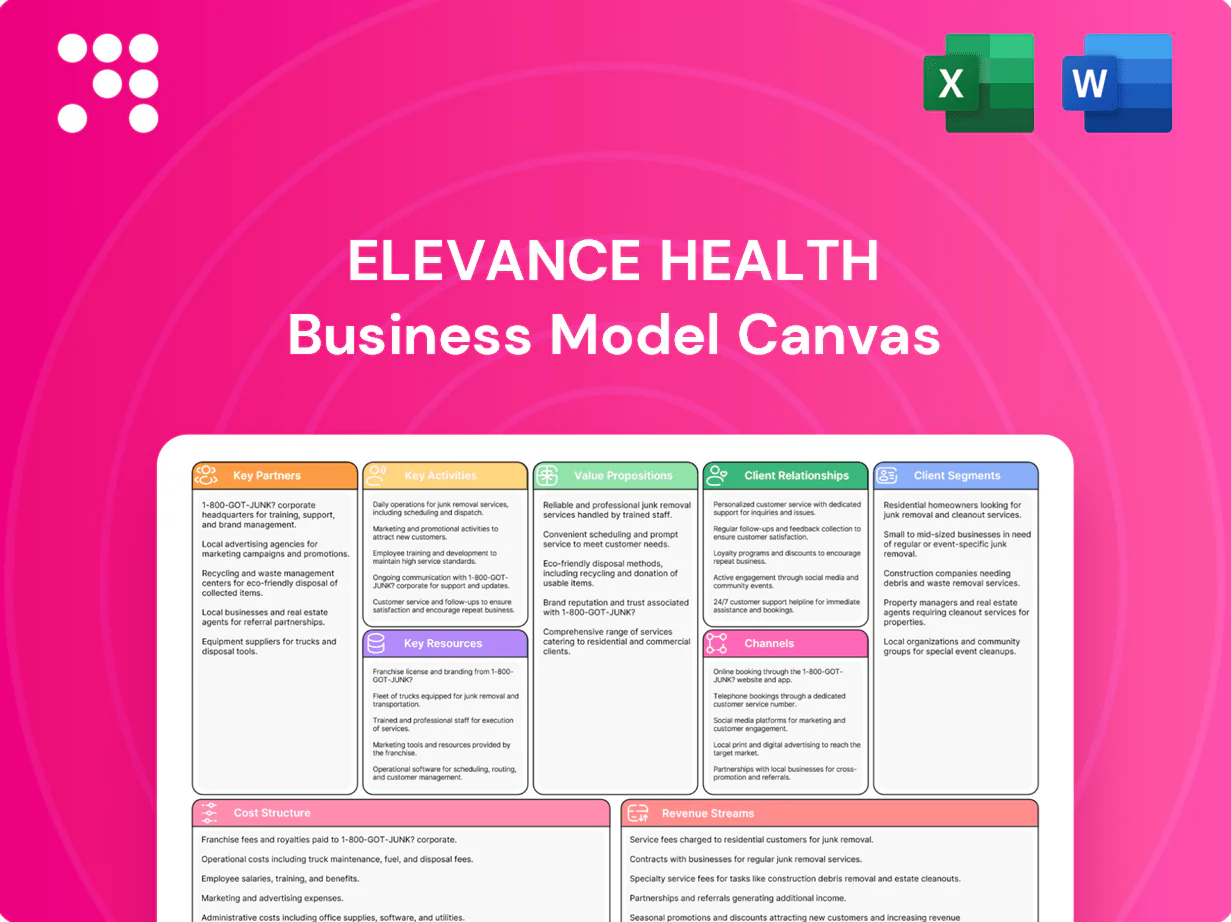
Elevance Health Business Model Canvas

Unlock the Business Model Canvas for a leading health insurer: value, scale, monetize care
Unlock the full strategic blueprint behind Elevance Health with our Business Model Canvas—three to five actionable insights that explain how the company creates value, scales membership, and monetizes care management. Ideal for investors, consultants, and executives seeking a ready-to-use, downloadable template to benchmark strategy and accelerate decisions. Purchase the full Canvas for section-by-section depth and editable Word/Excel files.
Partnerships

Provider networks
Collaborations with hospitals, physicians and clinics secure broad access and favorable reimbursement rates for Elevance, supporting a network that serves ≈47 million members (2024). Tiered networks and growing value‑based contracts align incentives for quality and cost, underpinning network adequacy and member satisfaction. Strong provider data integration enables real‑time care coordination and referral management.
Pharmacy benefit managers
Alliances with PBMs optimize formulary design, drug pricing, and utilization management to contain costs and steer patients to value-based therapies. Rebates and negotiated rates help manage specialty drug spend, with specialty medicines accounting for about 54% of US drug spend while representing under 2% of prescriptions. Integration supports mail order and specialty pharmacy services and data sharing enables adherence and outcomes programs.

Behavioral health vendors
Behavioral health vendors deliver mental health, substance-use, and EAP services at scale to Elevance’s ~48 million members, supporting the company’s FY2023 revenue base of about $150 billion. Coordinated care models integrate physical and behavioral benefits to lower total cost of care and reduce readmissions. Tele-mental health adoption—surging since 2020—expands access and reduces stigma, while measurement-based care enables outcomes tracking and value-based contracts.

Government and regulators
Medicare (about 65 million beneficiaries in 2024), Medicaid (roughly 83 million enrollees in 2024) and state exchanges are core distribution channels and stakeholders for Elevance Health, driving membership and revenue mix.
Compliance partnerships secure plan certification, audits and CMS quality ratings (Star Ratings) that affect payments; policy engagement influences reimbursement and risk-adjustment rules; public-private programs extend coverage and social impact.
- Channels: Medicare • Medicaid • State exchanges
- Compliance: plan certification, audits, CMS Star Ratings
- Policy: reimbursement, risk adjustment
- Impact: public-private programs expand coverage
Technology and data partners
Technology and data partners—cloud, analytics, and interoperability vendors—power Elevance Health’s digital experiences and insights, supporting operations for over 48 million members and a 2024 revenue base exceeding $150 billion.
Health information exchanges and APIs improve care coordination across providers; AI partners accelerate prior authorization, fraud detection, and member outreach; cybersecurity alliances protect PHI and ensure operational resilience.
- Members: ~48 million
- 2024 revenue: >$150B
- Focus: cloud, analytics, HIEs, AI, cybersecurity
Provider alliances secure ≈48M members and manage specialty ≈54% drug spend
Strategic provider alliances secure access and favorable reimbursement for ≈48M members (2024), leveraging value‑based contracts to improve quality and control costs. PBM and pharmacy partners manage formularies and specialty drug spend (specialty ≈54% of US drug spend). Tech, HIEs and AI vendors enable care coordination, prior auth automation and PHI security, supporting >$150B revenue scale.
| Metric | Value (2024) |
|---|---|
| Members | ≈48M |
| Revenue base | >$150B (FY2023) |
| Medicare beneficiaries | ≈65M |
| Medicaid enrollees | ≈83M |
| Specialty drug share | ≈54% of US drug spend |
What is included in the product
 Detailed Word Document
A comprehensive Business Model Canvas for Elevance Health outlining customer segments, channels, value propositions, key partners, activities, resources, cost structure, and revenue streams aligned with its insurer+care-integrator strategy; ideal for presentations, investor discussions, and strategic analysis with linked SWOT insights.

 Customizable Excel Spreadsheet
High-level one-page snapshot of Elevance Health’s business model with editable cells—quickly identifies core components, condenses strategy for executive review, and saves hours formatting while enabling collaborative adaptation for boardrooms and teams.
Activities

Plan design and pricing
Developing HMOs, PPOs and managed-care products tailored to employer, Medicaid and individual segments is core, servicing about 40 million members in 2024. Actuarial modeling sets premiums and benefits within regulatory guardrails, using predictive models to price risk and control reserve ratios. Network tiering and formulary design manage costs and utilization. Continuous iteration adjusts rates and benefits in response to utilization trends and competitor moves.
Network management
Contracting, credentialing, and performance oversight secure access and quality across Elevance Healths network serving about 48 million members in 2024, aligning provider standards with payer requirements.
Value-based arrangements shift incentives toward outcomes and managing total cost trends, with Elevance expanding risk-based programs to steer care toward high-value providers.
Disruption management preserves member continuity during provider exits while analytics drive referral patterns and clinical steerage using claims and outcomes data.

Care and disease management
Programs for chronic conditions, complex care and transitions use targeted case management, utilization review and prior authorization to balance quality and spend across Elevance Health’s ~48 million medical members in 2024. Digital care pathways and remote monitoring drive adherence and reduced readmissions. Social determinants interventions focus on high-risk cohorts to lower total cost of care.

Pharmacy management
Pharmacy management at Elevance Health leverages formulary optimization and step therapy to control drug costs for its ~48 million members (2024), while specialty pharmacy coordination improves outcomes and care continuity for high-cost therapies; medication therapy management increases adherence and reduces avoidable utilization; robust rebate administration and transparency reinforce pricing integrity and net-cost management.
- Formulary optimization & step therapy: cost control
- Specialty pharmacy coordination: outcomes for high-cost drugs
- Medication therapy management: adherence gains
- Rebate administration & transparency: pricing integrity
Sales, service, and compliance
Broker enablement, employer sales, and active ACA exchange participation drive Elevance Health’s growth across commercial and individual lines.
Member services, appeals, and grievances sustain retention for about 51 million members (2024), reducing churn and improving lifetime value.
Regulatory reporting, audits, risk adjustment and targeted brand, marketing, and community outreach ensure compliance and trust.
- Broker enablement
- Employer sales
- Exchange participation
- Member services & appeals
- Regulatory reporting & audits
- Brand & community outreach
Value-based care and actuarial-driven plans optimizing cost and outcomes for ~51M members
Core activities center on product design, actuarial pricing, network management and value‑based contracting serving ~51 million members in 2024. Care management, chronic programs, pharmacy optimization and disruption handling reduce utilization and total cost of care. Sales, broker enablement, member services and regulatory compliance sustain growth and retention.
| Metric | 2024 |
|---|---|
| Total members | ~51,000,000 |
| Medical members | ~48,000,000 |
What You See Is What You Get
Business Model Canvas
The document you're previewing is the exact Elevance Health Business Model Canvas you'll receive—no mockup or sample. Upon purchase you'll get this same fully formatted, editable file ready for use in Word and Excel. What you see is what you'll download, complete and ready to present or edit.

Unlock the Business Model Canvas for a leading health insurer: value, scale, monetize care
Unlock the full strategic blueprint behind Elevance Health with our Business Model Canvas—three to five actionable insights that explain how the company creates value, scales membership, and monetizes care management. Ideal for investors, consultants, and executives seeking a ready-to-use, downloadable template to benchmark strategy and accelerate decisions. Purchase the full Canvas for section-by-section depth and editable Word/Excel files.
Partnerships
Provider networks
Collaborations with hospitals, physicians and clinics secure broad access and favorable reimbursement rates for Elevance, supporting a network that serves ≈47 million members (2024). Tiered networks and growing value‑based contracts align incentives for quality and cost, underpinning network adequacy and member satisfaction. Strong provider data integration enables real‑time care coordination and referral management.
Pharmacy benefit managers
Alliances with PBMs optimize formulary design, drug pricing, and utilization management to contain costs and steer patients to value-based therapies. Rebates and negotiated rates help manage specialty drug spend, with specialty medicines accounting for about 54% of US drug spend while representing under 2% of prescriptions. Integration supports mail order and specialty pharmacy services and data sharing enables adherence and outcomes programs.
Behavioral health vendors
Behavioral health vendors deliver mental health, substance-use, and EAP services at scale to Elevance’s ~48 million members, supporting the company’s FY2023 revenue base of about $150 billion. Coordinated care models integrate physical and behavioral benefits to lower total cost of care and reduce readmissions. Tele-mental health adoption—surging since 2020—expands access and reduces stigma, while measurement-based care enables outcomes tracking and value-based contracts.
Government and regulators
Medicare (about 65 million beneficiaries in 2024), Medicaid (roughly 83 million enrollees in 2024) and state exchanges are core distribution channels and stakeholders for Elevance Health, driving membership and revenue mix.
Compliance partnerships secure plan certification, audits and CMS quality ratings (Star Ratings) that affect payments; policy engagement influences reimbursement and risk-adjustment rules; public-private programs extend coverage and social impact.
- Channels: Medicare • Medicaid • State exchanges
- Compliance: plan certification, audits, CMS Star Ratings
- Policy: reimbursement, risk adjustment
- Impact: public-private programs expand coverage
Technology and data partners
Technology and data partners—cloud, analytics, and interoperability vendors—power Elevance Health’s digital experiences and insights, supporting operations for over 48 million members and a 2024 revenue base exceeding $150 billion.
Health information exchanges and APIs improve care coordination across providers; AI partners accelerate prior authorization, fraud detection, and member outreach; cybersecurity alliances protect PHI and ensure operational resilience.
- Members: ~48 million
- 2024 revenue: >$150B
- Focus: cloud, analytics, HIEs, AI, cybersecurity
Provider alliances secure ≈48M members and manage specialty ≈54% drug spend
Strategic provider alliances secure access and favorable reimbursement for ≈48M members (2024), leveraging value‑based contracts to improve quality and control costs. PBM and pharmacy partners manage formularies and specialty drug spend (specialty ≈54% of US drug spend). Tech, HIEs and AI vendors enable care coordination, prior auth automation and PHI security, supporting >$150B revenue scale.
| Metric | Value (2024) |
|---|---|
| Members | ≈48M |
| Revenue base | >$150B (FY2023) |
| Medicare beneficiaries | ≈65M |
| Medicaid enrollees | ≈83M |
| Specialty drug share | ≈54% of US drug spend |
What is included in the product
Detailed Word Document
A comprehensive Business Model Canvas for Elevance Health outlining customer segments, channels, value propositions, key partners, activities, resources, cost structure, and revenue streams aligned with its insurer+care-integrator strategy; ideal for presentations, investor discussions, and strategic analysis with linked SWOT insights.
Customizable Excel Spreadsheet
High-level one-page snapshot of Elevance Health’s business model with editable cells—quickly identifies core components, condenses strategy for executive review, and saves hours formatting while enabling collaborative adaptation for boardrooms and teams.
Activities
Plan design and pricing
Developing HMOs, PPOs and managed-care products tailored to employer, Medicaid and individual segments is core, servicing about 40 million members in 2024. Actuarial modeling sets premiums and benefits within regulatory guardrails, using predictive models to price risk and control reserve ratios. Network tiering and formulary design manage costs and utilization. Continuous iteration adjusts rates and benefits in response to utilization trends and competitor moves.
Network management
Contracting, credentialing, and performance oversight secure access and quality across Elevance Healths network serving about 48 million members in 2024, aligning provider standards with payer requirements.
Value-based arrangements shift incentives toward outcomes and managing total cost trends, with Elevance expanding risk-based programs to steer care toward high-value providers.
Disruption management preserves member continuity during provider exits while analytics drive referral patterns and clinical steerage using claims and outcomes data.
Care and disease management
Programs for chronic conditions, complex care and transitions use targeted case management, utilization review and prior authorization to balance quality and spend across Elevance Health’s ~48 million medical members in 2024. Digital care pathways and remote monitoring drive adherence and reduced readmissions. Social determinants interventions focus on high-risk cohorts to lower total cost of care.
Pharmacy management
Pharmacy management at Elevance Health leverages formulary optimization and step therapy to control drug costs for its ~48 million members (2024), while specialty pharmacy coordination improves outcomes and care continuity for high-cost therapies; medication therapy management increases adherence and reduces avoidable utilization; robust rebate administration and transparency reinforce pricing integrity and net-cost management.
- Formulary optimization & step therapy: cost control
- Specialty pharmacy coordination: outcomes for high-cost drugs
- Medication therapy management: adherence gains
- Rebate administration & transparency: pricing integrity
Sales, service, and compliance
Broker enablement, employer sales, and active ACA exchange participation drive Elevance Health’s growth across commercial and individual lines.
Member services, appeals, and grievances sustain retention for about 51 million members (2024), reducing churn and improving lifetime value.
Regulatory reporting, audits, risk adjustment and targeted brand, marketing, and community outreach ensure compliance and trust.
- Broker enablement
- Employer sales
- Exchange participation
- Member services & appeals
- Regulatory reporting & audits
- Brand & community outreach
Value-based care and actuarial-driven plans optimizing cost and outcomes for ~51M members
Core activities center on product design, actuarial pricing, network management and value‑based contracting serving ~51 million members in 2024. Care management, chronic programs, pharmacy optimization and disruption handling reduce utilization and total cost of care. Sales, broker enablement, member services and regulatory compliance sustain growth and retention.
| Metric | 2024 |
|---|---|
| Total members | ~51,000,000 |
| Medical members | ~48,000,000 |
What You See Is What You Get
Business Model Canvas
The document you're previewing is the exact Elevance Health Business Model Canvas you'll receive—no mockup or sample. Upon purchase you'll get this same fully formatted, editable file ready for use in Word and Excel. What you see is what you'll download, complete and ready to present or edit.
Original: $10.00
-65%$10.00
$3.50Description
Unlock the Business Model Canvas for a leading health insurer: value, scale, monetize care
Unlock the full strategic blueprint behind Elevance Health with our Business Model Canvas—three to five actionable insights that explain how the company creates value, scales membership, and monetizes care management. Ideal for investors, consultants, and executives seeking a ready-to-use, downloadable template to benchmark strategy and accelerate decisions. Purchase the full Canvas for section-by-section depth and editable Word/Excel files.
Partnerships
Provider networks
Collaborations with hospitals, physicians and clinics secure broad access and favorable reimbursement rates for Elevance, supporting a network that serves ≈47 million members (2024). Tiered networks and growing value‑based contracts align incentives for quality and cost, underpinning network adequacy and member satisfaction. Strong provider data integration enables real‑time care coordination and referral management.
Pharmacy benefit managers
Alliances with PBMs optimize formulary design, drug pricing, and utilization management to contain costs and steer patients to value-based therapies. Rebates and negotiated rates help manage specialty drug spend, with specialty medicines accounting for about 54% of US drug spend while representing under 2% of prescriptions. Integration supports mail order and specialty pharmacy services and data sharing enables adherence and outcomes programs.
Behavioral health vendors
Behavioral health vendors deliver mental health, substance-use, and EAP services at scale to Elevance’s ~48 million members, supporting the company’s FY2023 revenue base of about $150 billion. Coordinated care models integrate physical and behavioral benefits to lower total cost of care and reduce readmissions. Tele-mental health adoption—surging since 2020—expands access and reduces stigma, while measurement-based care enables outcomes tracking and value-based contracts.
Government and regulators
Medicare (about 65 million beneficiaries in 2024), Medicaid (roughly 83 million enrollees in 2024) and state exchanges are core distribution channels and stakeholders for Elevance Health, driving membership and revenue mix.
Compliance partnerships secure plan certification, audits and CMS quality ratings (Star Ratings) that affect payments; policy engagement influences reimbursement and risk-adjustment rules; public-private programs extend coverage and social impact.
- Channels: Medicare • Medicaid • State exchanges
- Compliance: plan certification, audits, CMS Star Ratings
- Policy: reimbursement, risk adjustment
- Impact: public-private programs expand coverage
Technology and data partners
Technology and data partners—cloud, analytics, and interoperability vendors—power Elevance Health’s digital experiences and insights, supporting operations for over 48 million members and a 2024 revenue base exceeding $150 billion.
Health information exchanges and APIs improve care coordination across providers; AI partners accelerate prior authorization, fraud detection, and member outreach; cybersecurity alliances protect PHI and ensure operational resilience.
- Members: ~48 million
- 2024 revenue: >$150B
- Focus: cloud, analytics, HIEs, AI, cybersecurity
Provider alliances secure ≈48M members and manage specialty ≈54% drug spend
Strategic provider alliances secure access and favorable reimbursement for ≈48M members (2024), leveraging value‑based contracts to improve quality and control costs. PBM and pharmacy partners manage formularies and specialty drug spend (specialty ≈54% of US drug spend). Tech, HIEs and AI vendors enable care coordination, prior auth automation and PHI security, supporting >$150B revenue scale.
| Metric | Value (2024) |
|---|---|
| Members | ≈48M |
| Revenue base | >$150B (FY2023) |
| Medicare beneficiaries | ≈65M |
| Medicaid enrollees | ≈83M |
| Specialty drug share | ≈54% of US drug spend |
What is included in the product
Detailed Word Document
A comprehensive Business Model Canvas for Elevance Health outlining customer segments, channels, value propositions, key partners, activities, resources, cost structure, and revenue streams aligned with its insurer+care-integrator strategy; ideal for presentations, investor discussions, and strategic analysis with linked SWOT insights.
Customizable Excel Spreadsheet
High-level one-page snapshot of Elevance Health’s business model with editable cells—quickly identifies core components, condenses strategy for executive review, and saves hours formatting while enabling collaborative adaptation for boardrooms and teams.
Activities
Plan design and pricing
Developing HMOs, PPOs and managed-care products tailored to employer, Medicaid and individual segments is core, servicing about 40 million members in 2024. Actuarial modeling sets premiums and benefits within regulatory guardrails, using predictive models to price risk and control reserve ratios. Network tiering and formulary design manage costs and utilization. Continuous iteration adjusts rates and benefits in response to utilization trends and competitor moves.
Network management
Contracting, credentialing, and performance oversight secure access and quality across Elevance Healths network serving about 48 million members in 2024, aligning provider standards with payer requirements.
Value-based arrangements shift incentives toward outcomes and managing total cost trends, with Elevance expanding risk-based programs to steer care toward high-value providers.
Disruption management preserves member continuity during provider exits while analytics drive referral patterns and clinical steerage using claims and outcomes data.
Care and disease management
Programs for chronic conditions, complex care and transitions use targeted case management, utilization review and prior authorization to balance quality and spend across Elevance Health’s ~48 million medical members in 2024. Digital care pathways and remote monitoring drive adherence and reduced readmissions. Social determinants interventions focus on high-risk cohorts to lower total cost of care.
Pharmacy management
Pharmacy management at Elevance Health leverages formulary optimization and step therapy to control drug costs for its ~48 million members (2024), while specialty pharmacy coordination improves outcomes and care continuity for high-cost therapies; medication therapy management increases adherence and reduces avoidable utilization; robust rebate administration and transparency reinforce pricing integrity and net-cost management.
- Formulary optimization & step therapy: cost control
- Specialty pharmacy coordination: outcomes for high-cost drugs
- Medication therapy management: adherence gains
- Rebate administration & transparency: pricing integrity
Sales, service, and compliance
Broker enablement, employer sales, and active ACA exchange participation drive Elevance Health’s growth across commercial and individual lines.
Member services, appeals, and grievances sustain retention for about 51 million members (2024), reducing churn and improving lifetime value.
Regulatory reporting, audits, risk adjustment and targeted brand, marketing, and community outreach ensure compliance and trust.
- Broker enablement
- Employer sales
- Exchange participation
- Member services & appeals
- Regulatory reporting & audits
- Brand & community outreach
Value-based care and actuarial-driven plans optimizing cost and outcomes for ~51M members
Core activities center on product design, actuarial pricing, network management and value‑based contracting serving ~51 million members in 2024. Care management, chronic programs, pharmacy optimization and disruption handling reduce utilization and total cost of care. Sales, broker enablement, member services and regulatory compliance sustain growth and retention.
| Metric | 2024 |
|---|---|
| Total members | ~51,000,000 |
| Medical members | ~48,000,000 |
What You See Is What You Get
Business Model Canvas
The document you're previewing is the exact Elevance Health Business Model Canvas you'll receive—no mockup or sample. Upon purchase you'll get this same fully formatted, editable file ready for use in Word and Excel. What you see is what you'll download, complete and ready to present or edit.











