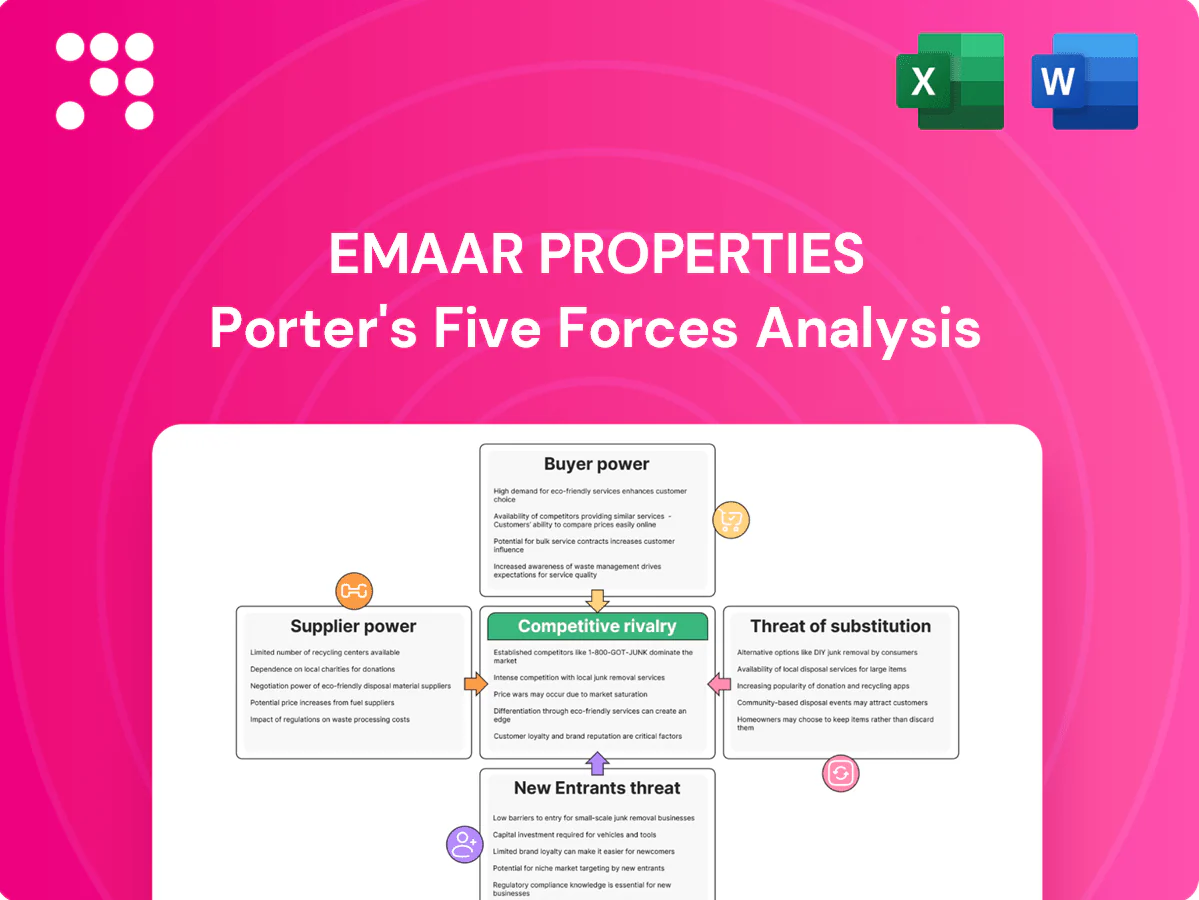
Emaar Properties Porter's Five Forces Analysis

A Must-Have Tool for Decision-Makers
Emaar Properties faces intense industry rivalry and significant regulatory and capital barriers that limit new entrants, while buyer bargaining is moderate given high-ticket purchases and brand loyalty; supplier power is manageable but land and construction costs can squeeze margins, and substitute threats are limited. This brief snapshot only scratches the surface. Unlock the full Porter's Five Forces Analysis to explore Emaar Properties’s competitive dynamics in detail.
Suppliers Bargaining Power

Specialized materials and tech inputs
Iconic, high-spec Emaar projects rely on premium steel, specialty glass, façades, elevators and smart-building systems sourced from a concentrated global supplier pool; the top five elevator manufacturers account for roughly 80–85% of market share (2024). Scarcity, certification and bespoke specs can extend lead times to 6–12 months and raise switching costs. Emaar’s scale and brand give pricing leverage and priority allocation. Long-term framework agreements partly insulate against price volatility and shortages.
Contractors and skilled labor dependency
EPC contractors, MEP specialists and master planners exert leverage on Emaar due to high project complexity and reliance on skilled expatriate labor—UAE expatriates comprise about 88% of the workforce—making tight GCC labor markets and visa constraints a driver of cost inflation and delay risk. Emaar mitigates via multi-bid sourcing, performance bonds and phased packages. Its brand continues to attract top-tier partners, balancing supplier bargaining power.

Land acquisition and government-linked inputs
Prime land supply in UAE and other Emaar markets remains concentrated with state entities and a few holders, giving suppliers strong leverage; Dubai land allocations and masterplans often steer availability. Emaar’s strategic land bank and partnerships (supporting projects worth >AED 100bn development pipeline) lower but do not eliminate exposure. Policy shifts can rapidly change pricing and approvals, and Emaar’s access reflects both commercial terms and public development objectives.

Hospitality and retail supply ecosystems
Hospitality and retail supply ecosystems for Emaar depend on specialized suppliers for hotel FFE/OS&E, luxury-brand fit-outs and curated mall tenant mixes. Anchor brands and global hotel vendors can negotiate favorable package terms, but Emaar leverages portfolio scale to secure cross-asset synergies and exclusivity. Co-marketing, turnover rents and integrated leasing align interests and moderate supplier power.
- Specialized FFE/OS&E
- Anchor brand leverage
- Portfolio synergies & exclusivity
Logistics and commodity price volatility
Shipping constraints and commodity cycles in 2024 continued to affect input availability and costs for Emaar, with periodic spikes in steel and cement prices compressing margins on fixed-price contracts; the company offsets this via hedging, bulk procurement and alternative specifications. Large project pipelines provide timing flexibility and inventory strategies, but sudden transport or commodity shocks can still erode 2–5% project margins on affected phases.
Supplier concentration 80-85% and 6-12m lead times risk margins 2-5%
Supplier concentration (elevators 80–85% market share in 2024) and bespoke inputs drive 6–12 month lead times and higher switching costs. Emaar’s scale, brand and long-term frameworks give pricing leverage and priority allocation. Labor reliance (UAE expatriates ~88%) and commodity/transport shocks can still trim 2–5% project margins.
| Metric | 2024 |
|---|---|
| Elevator market share (top 5) | 80–85% |
| Lead times | 6–12 months |
| UAE expatriate workforce | ~88% |
| Development pipeline | >AED 100bn |
| Margin hit from shocks | 2–5% |
What is included in the product
 Detailed Word Document
Concise Porter's Five Forces analysis of Emaar Properties, revealing competitive intensity, buyer/supplier power, entry barriers, substitutes and industry threats, with strategic insights on how these forces shape Emaar's pricing, margins and market positioning.

 Customizable Excel Spreadsheet
Clear, one-sheet Porter's Five Forces for Emaar Properties that distills competitive pressures (buyers, suppliers, entrants, substitutes, rivalry) into an actionable spider chart—customizable pressures and clean layout ready for pitch decks or strategic updates.
Customers Bargaining Power

Diverse buyer base across segments
Buyers span luxury, mid-market, hospitality operators and retail tenants, diluting individual bargaining power while Emaar’s presence across 36 markets and diverse segments spreads demand. Pre-sales dynamics give buyers choices across Dubai and global projects, yet Emaar’s brand, premium amenities and structured after-sales service support pricing power. Flexible payment plans and targeted incentives are routinely used to sustain absorption and reduce churn.
Information transparency and comparability
Market data, online portals and influencer brokers have increased price transparency, listing thousands of units and comparable KPIs; buyers now benchmark by location, handover risk and yields, which in Dubai averaged about 5–7% in 2024. Emaar leverages a 27‑year track record and master‑planned communities like Downtown and Dubai Marina to differentiate. Its property management and after‑sales services shift negotiations away from pure price toward service value.

Institutional tenants and anchors
Anchor tenants in Emaar malls and hotel operators strongly negotiate rent, fit-out allowances and revenue-share clauses because their footfall and brand pull are pivotal to scheme performance. Emaar routinely grants concessions—short-term rent relief or marketing support—in exchange for long-term leases that stabilize cash flow and drive traffic. The group’s multi-asset portfolio strengthens its bargaining position in package deals across retail, hospitality and mixed-use projects.

Foreign buyers and financing conditions
Foreign buyers of Emaar are highly sensitive to FX, mortgage availability and visa incentives; UAE property investors above AED 1,000,000 can qualify for long‑term residency, which raises buyer quality. Tight credit or higher rates push buyers to demand payment flexibility; Emaar responds with staged plans, escrow protection and developer financing or post‑handover schemes.
- FX & credit sensitivity
- Escrow & staged payments
- Residency link (AED 1,000,000)
After-sales and community services expectations
Buyers now demand strong facilities management, consistent service quality, and clear resale liquidity; lapses often spark service-fee disputes and measurable drops in NPS, eroding resale values and buyer confidence.
Emaar’s integrated FM, warranty programs and digital touchpoints (owner portals, apps) are designed to defend loyalty; higher post-sale satisfaction reduces churn and future price haggling in subsequent phases.
- FM reliability
- Service quality → NPS
- Resale liquidity
- Digital portals defend loyalty
Mod buyers 36, Dubai 5-7%, residency AED1M
Buyers’ power is moderate: diversified buyer mix across 36 markets and Emaar’s brand reduce price pressure, but transparency and portals raise comparison (Dubai yields 5–7% in 2024). Flexible payment plans, escrow and residency links (AED 1,000,000) shift negotiations to terms and service rather than price.
| Metric | 2024 |
|---|---|
| Markets | 36 |
| Dubai yields | 5–7% |
| Residency threshold | AED 1,000,000 |
Preview Before You Purchase
Emaar Properties Porter's Five Forces Analysis
This preview is the exact Emaar Properties Porter's Five Forces analysis you'll receive—no placeholders or samples. It covers competitive rivalry, supplier and buyer power, threat of new entrants and substitutes, and strategic implications. Purchase grants immediate access to this fully formatted document.

A Must-Have Tool for Decision-Makers
Emaar Properties faces intense industry rivalry and significant regulatory and capital barriers that limit new entrants, while buyer bargaining is moderate given high-ticket purchases and brand loyalty; supplier power is manageable but land and construction costs can squeeze margins, and substitute threats are limited. This brief snapshot only scratches the surface. Unlock the full Porter's Five Forces Analysis to explore Emaar Properties’s competitive dynamics in detail.
Suppliers Bargaining Power
Specialized materials and tech inputs
Iconic, high-spec Emaar projects rely on premium steel, specialty glass, façades, elevators and smart-building systems sourced from a concentrated global supplier pool; the top five elevator manufacturers account for roughly 80–85% of market share (2024). Scarcity, certification and bespoke specs can extend lead times to 6–12 months and raise switching costs. Emaar’s scale and brand give pricing leverage and priority allocation. Long-term framework agreements partly insulate against price volatility and shortages.
Contractors and skilled labor dependency
EPC contractors, MEP specialists and master planners exert leverage on Emaar due to high project complexity and reliance on skilled expatriate labor—UAE expatriates comprise about 88% of the workforce—making tight GCC labor markets and visa constraints a driver of cost inflation and delay risk. Emaar mitigates via multi-bid sourcing, performance bonds and phased packages. Its brand continues to attract top-tier partners, balancing supplier bargaining power.
Land acquisition and government-linked inputs
Prime land supply in UAE and other Emaar markets remains concentrated with state entities and a few holders, giving suppliers strong leverage; Dubai land allocations and masterplans often steer availability. Emaar’s strategic land bank and partnerships (supporting projects worth >AED 100bn development pipeline) lower but do not eliminate exposure. Policy shifts can rapidly change pricing and approvals, and Emaar’s access reflects both commercial terms and public development objectives.
Hospitality and retail supply ecosystems
Hospitality and retail supply ecosystems for Emaar depend on specialized suppliers for hotel FFE/OS&E, luxury-brand fit-outs and curated mall tenant mixes. Anchor brands and global hotel vendors can negotiate favorable package terms, but Emaar leverages portfolio scale to secure cross-asset synergies and exclusivity. Co-marketing, turnover rents and integrated leasing align interests and moderate supplier power.
- Specialized FFE/OS&E
- Anchor brand leverage
- Portfolio synergies & exclusivity
Logistics and commodity price volatility
Shipping constraints and commodity cycles in 2024 continued to affect input availability and costs for Emaar, with periodic spikes in steel and cement prices compressing margins on fixed-price contracts; the company offsets this via hedging, bulk procurement and alternative specifications. Large project pipelines provide timing flexibility and inventory strategies, but sudden transport or commodity shocks can still erode 2–5% project margins on affected phases.
Supplier concentration 80-85% and 6-12m lead times risk margins 2-5%
Supplier concentration (elevators 80–85% market share in 2024) and bespoke inputs drive 6–12 month lead times and higher switching costs. Emaar’s scale, brand and long-term frameworks give pricing leverage and priority allocation. Labor reliance (UAE expatriates ~88%) and commodity/transport shocks can still trim 2–5% project margins.
| Metric | 2024 |
|---|---|
| Elevator market share (top 5) | 80–85% |
| Lead times | 6–12 months |
| UAE expatriate workforce | ~88% |
| Development pipeline | >AED 100bn |
| Margin hit from shocks | 2–5% |
What is included in the product
Detailed Word Document
Concise Porter's Five Forces analysis of Emaar Properties, revealing competitive intensity, buyer/supplier power, entry barriers, substitutes and industry threats, with strategic insights on how these forces shape Emaar's pricing, margins and market positioning.
Customizable Excel Spreadsheet
Clear, one-sheet Porter's Five Forces for Emaar Properties that distills competitive pressures (buyers, suppliers, entrants, substitutes, rivalry) into an actionable spider chart—customizable pressures and clean layout ready for pitch decks or strategic updates.
Customers Bargaining Power
Diverse buyer base across segments
Buyers span luxury, mid-market, hospitality operators and retail tenants, diluting individual bargaining power while Emaar’s presence across 36 markets and diverse segments spreads demand. Pre-sales dynamics give buyers choices across Dubai and global projects, yet Emaar’s brand, premium amenities and structured after-sales service support pricing power. Flexible payment plans and targeted incentives are routinely used to sustain absorption and reduce churn.
Information transparency and comparability
Market data, online portals and influencer brokers have increased price transparency, listing thousands of units and comparable KPIs; buyers now benchmark by location, handover risk and yields, which in Dubai averaged about 5–7% in 2024. Emaar leverages a 27‑year track record and master‑planned communities like Downtown and Dubai Marina to differentiate. Its property management and after‑sales services shift negotiations away from pure price toward service value.
Institutional tenants and anchors
Anchor tenants in Emaar malls and hotel operators strongly negotiate rent, fit-out allowances and revenue-share clauses because their footfall and brand pull are pivotal to scheme performance. Emaar routinely grants concessions—short-term rent relief or marketing support—in exchange for long-term leases that stabilize cash flow and drive traffic. The group’s multi-asset portfolio strengthens its bargaining position in package deals across retail, hospitality and mixed-use projects.
Foreign buyers and financing conditions
Foreign buyers of Emaar are highly sensitive to FX, mortgage availability and visa incentives; UAE property investors above AED 1,000,000 can qualify for long‑term residency, which raises buyer quality. Tight credit or higher rates push buyers to demand payment flexibility; Emaar responds with staged plans, escrow protection and developer financing or post‑handover schemes.
- FX & credit sensitivity
- Escrow & staged payments
- Residency link (AED 1,000,000)
After-sales and community services expectations
Buyers now demand strong facilities management, consistent service quality, and clear resale liquidity; lapses often spark service-fee disputes and measurable drops in NPS, eroding resale values and buyer confidence.
Emaar’s integrated FM, warranty programs and digital touchpoints (owner portals, apps) are designed to defend loyalty; higher post-sale satisfaction reduces churn and future price haggling in subsequent phases.
- FM reliability
- Service quality → NPS
- Resale liquidity
- Digital portals defend loyalty
Mod buyers 36, Dubai 5-7%, residency AED1M
Buyers’ power is moderate: diversified buyer mix across 36 markets and Emaar’s brand reduce price pressure, but transparency and portals raise comparison (Dubai yields 5–7% in 2024). Flexible payment plans, escrow and residency links (AED 1,000,000) shift negotiations to terms and service rather than price.
| Metric | 2024 |
|---|---|
| Markets | 36 |
| Dubai yields | 5–7% |
| Residency threshold | AED 1,000,000 |
Preview Before You Purchase
Emaar Properties Porter's Five Forces Analysis
This preview is the exact Emaar Properties Porter's Five Forces analysis you'll receive—no placeholders or samples. It covers competitive rivalry, supplier and buyer power, threat of new entrants and substitutes, and strategic implications. Purchase grants immediate access to this fully formatted document.
Original: $10.00
-65%$10.00
$3.50Description
A Must-Have Tool for Decision-Makers
Emaar Properties faces intense industry rivalry and significant regulatory and capital barriers that limit new entrants, while buyer bargaining is moderate given high-ticket purchases and brand loyalty; supplier power is manageable but land and construction costs can squeeze margins, and substitute threats are limited. This brief snapshot only scratches the surface. Unlock the full Porter's Five Forces Analysis to explore Emaar Properties’s competitive dynamics in detail.
Suppliers Bargaining Power
Specialized materials and tech inputs
Iconic, high-spec Emaar projects rely on premium steel, specialty glass, façades, elevators and smart-building systems sourced from a concentrated global supplier pool; the top five elevator manufacturers account for roughly 80–85% of market share (2024). Scarcity, certification and bespoke specs can extend lead times to 6–12 months and raise switching costs. Emaar’s scale and brand give pricing leverage and priority allocation. Long-term framework agreements partly insulate against price volatility and shortages.
Contractors and skilled labor dependency
EPC contractors, MEP specialists and master planners exert leverage on Emaar due to high project complexity and reliance on skilled expatriate labor—UAE expatriates comprise about 88% of the workforce—making tight GCC labor markets and visa constraints a driver of cost inflation and delay risk. Emaar mitigates via multi-bid sourcing, performance bonds and phased packages. Its brand continues to attract top-tier partners, balancing supplier bargaining power.
Land acquisition and government-linked inputs
Prime land supply in UAE and other Emaar markets remains concentrated with state entities and a few holders, giving suppliers strong leverage; Dubai land allocations and masterplans often steer availability. Emaar’s strategic land bank and partnerships (supporting projects worth >AED 100bn development pipeline) lower but do not eliminate exposure. Policy shifts can rapidly change pricing and approvals, and Emaar’s access reflects both commercial terms and public development objectives.
Hospitality and retail supply ecosystems
Hospitality and retail supply ecosystems for Emaar depend on specialized suppliers for hotel FFE/OS&E, luxury-brand fit-outs and curated mall tenant mixes. Anchor brands and global hotel vendors can negotiate favorable package terms, but Emaar leverages portfolio scale to secure cross-asset synergies and exclusivity. Co-marketing, turnover rents and integrated leasing align interests and moderate supplier power.
- Specialized FFE/OS&E
- Anchor brand leverage
- Portfolio synergies & exclusivity
Logistics and commodity price volatility
Shipping constraints and commodity cycles in 2024 continued to affect input availability and costs for Emaar, with periodic spikes in steel and cement prices compressing margins on fixed-price contracts; the company offsets this via hedging, bulk procurement and alternative specifications. Large project pipelines provide timing flexibility and inventory strategies, but sudden transport or commodity shocks can still erode 2–5% project margins on affected phases.
Supplier concentration 80-85% and 6-12m lead times risk margins 2-5%
Supplier concentration (elevators 80–85% market share in 2024) and bespoke inputs drive 6–12 month lead times and higher switching costs. Emaar’s scale, brand and long-term frameworks give pricing leverage and priority allocation. Labor reliance (UAE expatriates ~88%) and commodity/transport shocks can still trim 2–5% project margins.
| Metric | 2024 |
|---|---|
| Elevator market share (top 5) | 80–85% |
| Lead times | 6–12 months |
| UAE expatriate workforce | ~88% |
| Development pipeline | >AED 100bn |
| Margin hit from shocks | 2–5% |
What is included in the product
Detailed Word Document
Concise Porter's Five Forces analysis of Emaar Properties, revealing competitive intensity, buyer/supplier power, entry barriers, substitutes and industry threats, with strategic insights on how these forces shape Emaar's pricing, margins and market positioning.
Customizable Excel Spreadsheet
Clear, one-sheet Porter's Five Forces for Emaar Properties that distills competitive pressures (buyers, suppliers, entrants, substitutes, rivalry) into an actionable spider chart—customizable pressures and clean layout ready for pitch decks or strategic updates.
Customers Bargaining Power
Diverse buyer base across segments
Buyers span luxury, mid-market, hospitality operators and retail tenants, diluting individual bargaining power while Emaar’s presence across 36 markets and diverse segments spreads demand. Pre-sales dynamics give buyers choices across Dubai and global projects, yet Emaar’s brand, premium amenities and structured after-sales service support pricing power. Flexible payment plans and targeted incentives are routinely used to sustain absorption and reduce churn.
Information transparency and comparability
Market data, online portals and influencer brokers have increased price transparency, listing thousands of units and comparable KPIs; buyers now benchmark by location, handover risk and yields, which in Dubai averaged about 5–7% in 2024. Emaar leverages a 27‑year track record and master‑planned communities like Downtown and Dubai Marina to differentiate. Its property management and after‑sales services shift negotiations away from pure price toward service value.
Institutional tenants and anchors
Anchor tenants in Emaar malls and hotel operators strongly negotiate rent, fit-out allowances and revenue-share clauses because their footfall and brand pull are pivotal to scheme performance. Emaar routinely grants concessions—short-term rent relief or marketing support—in exchange for long-term leases that stabilize cash flow and drive traffic. The group’s multi-asset portfolio strengthens its bargaining position in package deals across retail, hospitality and mixed-use projects.
Foreign buyers and financing conditions
Foreign buyers of Emaar are highly sensitive to FX, mortgage availability and visa incentives; UAE property investors above AED 1,000,000 can qualify for long‑term residency, which raises buyer quality. Tight credit or higher rates push buyers to demand payment flexibility; Emaar responds with staged plans, escrow protection and developer financing or post‑handover schemes.
- FX & credit sensitivity
- Escrow & staged payments
- Residency link (AED 1,000,000)
After-sales and community services expectations
Buyers now demand strong facilities management, consistent service quality, and clear resale liquidity; lapses often spark service-fee disputes and measurable drops in NPS, eroding resale values and buyer confidence.
Emaar’s integrated FM, warranty programs and digital touchpoints (owner portals, apps) are designed to defend loyalty; higher post-sale satisfaction reduces churn and future price haggling in subsequent phases.
- FM reliability
- Service quality → NPS
- Resale liquidity
- Digital portals defend loyalty
Mod buyers 36, Dubai 5-7%, residency AED1M
Buyers’ power is moderate: diversified buyer mix across 36 markets and Emaar’s brand reduce price pressure, but transparency and portals raise comparison (Dubai yields 5–7% in 2024). Flexible payment plans, escrow and residency links (AED 1,000,000) shift negotiations to terms and service rather than price.
| Metric | 2024 |
|---|---|
| Markets | 36 |
| Dubai yields | 5–7% |
| Residency threshold | AED 1,000,000 |
Preview Before You Purchase
Emaar Properties Porter's Five Forces Analysis
This preview is the exact Emaar Properties Porter's Five Forces analysis you'll receive—no placeholders or samples. It covers competitive rivalry, supplier and buyer power, threat of new entrants and substitutes, and strategic implications. Purchase grants immediate access to this fully formatted document.











