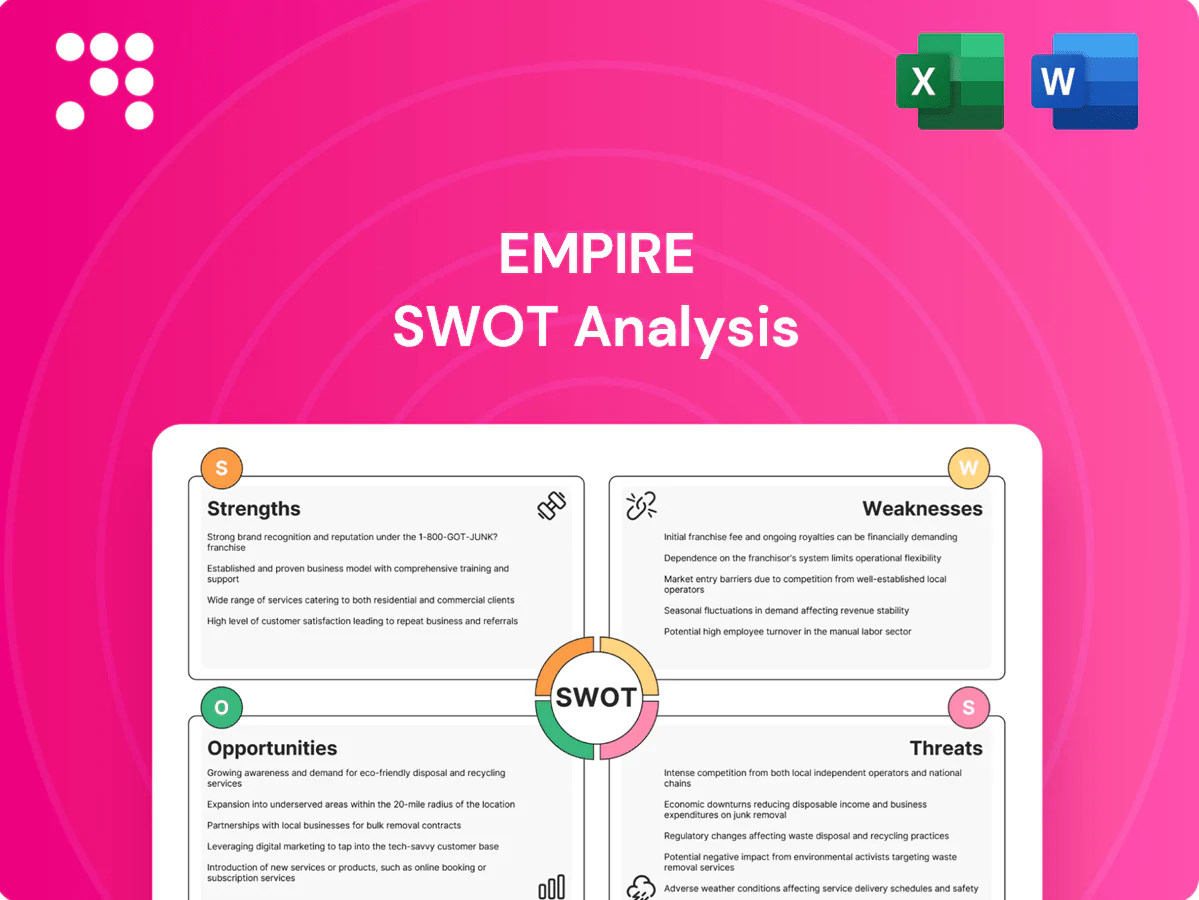
Empire SWOT Analysis

Elevate Your Analysis with the Complete SWOT Report
Empire SWOT Analysis highlights the company’s core strengths, market vulnerabilities, and strategic growth opportunities. This preview outlines key risks and differentiators, but the full report provides data-driven context, financial implications, and tactical recommendations. Ideal for investors, advisors, and executives seeking clarity. Purchase the complete SWOT to receive editable Word and Excel deliverables and act with confidence.
Strengths

National grocery scale
Empire, via Sobeys, is Canada’s #2 grocer with coast-to-coast coverage across multiple banners including Sobeys, Safeway and IGA, giving national reach and diversification of regional demand shocks. That scale drives purchasing power and supply‑chain leverage versus independents, lowering costs. Broad assortment and dense distribution improve in‑stock levels and product freshness across markets.
Diverse banners & formats
Empire’s multi-banner portfolio—Sobeys, Safeway, IGA, FreshCo, Farm Boy and Foodland—targets distinct segments and price points, enabling tailored value propositions from discount (FreshCo) to premium fresh (Farm Boy). Format flexibility lets the company respond market-by-market and pursue targeted competitive moves. With over 1,500 stores and roughly $29 billion in fiscal 2024 revenue, Empire can prune or convert assets to optimize returns.

Ocado-powered e-commerce
Voilà’s Ocado-powered centralized fulfillment centres and last-mile orchestration deliver high pick accuracy (reported by Ocado technologies at around 99%+) and superior freshness versus store-pick, reducing substitution and spoilage. This model drives higher quality and lower substitution rates compared with traditional click-and-collect. As penetration grows, increased route density can materially improve unit economics. Digital capability strengthens loyalty and generates richer shopper data for personalization.

Strategic real estate via Crombie REIT
Empire’s strategic stake in Crombie REIT secures direct access to capital recycling and joint development opportunities, while grocery-anchored Crombie sites drive steady traffic and resilient rents that support Empire’s margins. Intensification projects around existing stores enable mixed-use uplifts and density captures, adding value through condo/retail or residential redevelopment near transit corridors. Real estate optionality reduces relocation risk and smooths network upgrades by providing leasing and development levers.
- Capital recycling via Crombie partnerships
- Grocery-anchored sites = stable traffic and rent resilience
- Intensification unlocks mixed-use value
- Optionality de-risks relocations and upgrades
Private label & loyalty assets
Private brands like Compliments boost gross margins by about 200 bps and increase shopper stickiness, while the Scene+ loyalty partnership (over 7 million members by 2024) deepens engagement and enables data-driven, personalized promotions that lift basket sizes and visit frequency. These tools blunt price competition and preserve mix through targeted offers and higher-margin SKUs.
- Private label margin lift ~200 bps
- Scene+ membership >7M (2024)
- Personalized offers: +7% basket, +4% frequency
- Mitigates price wars; protects product mix
Canada’s #2 grocer — ~1,500 stores, $29B revenue
Empire is Canada’s #2 grocer with ~1,500 stores and $29B fiscal 2024 revenue, enabling national scale, purchasing power and supply‑chain leverage. Multi‑banner mix (FreshCo, Sobeys, Safeway, IGA, Farm Boy) captures discounters to premium fresh; private label adds ~200 bps margin lift. Voilà Ocado fulfilment reports ~99% pick accuracy; Scene+ membership >7M (2024) drives personalization and higher baskets.
| Metric | Value |
|---|---|
| Stores | ~1,500 |
| Revenue FY24 | $29B |
| Private label margin lift | ~200 bps |
| Voilà pick accuracy | ~99% |
| Scene+ members | >7M (2024) |
What is included in the product
 Detailed Word Document
Provides a concise SWOT analysis of Empire, outlining internal strengths and weaknesses and external opportunities and threats to assess its competitive position, growth drivers, and strategic risks.

 Customizable Excel Spreadsheet
Delivers a concise, visual SWOT matrix tailored to Empire for rapid strategic alignment and executive snapshots, streamlining stakeholder briefings.
Weaknesses

Sub-scale vs top rival
Loblaw’s national ecosystem—over 2,400 stores plus pharmacy, Joe Fresh and PC Financial—gives it stronger supplier bargaining power than Empire’s roughly 1,500-store footprint, limiting Empire’s promotional flexibility in price wars; lower scale and less efficient national media/tech spend can compress Empire’s margins during competitive flare-ups.
Complex banner footprint
Operating more than 1,500 stores across banners (Sobeys, FreshCo, Safeway, IGA, Farm Boy, Thrifty Foods, Foodland) raises marketing, IT and supply‑chain complexity and costs.
Brand overlap risks local cannibalization unless segmentation is precise; conversion programs require substantial capital and can temporarily depress sales.
Execution missteps during conversions erode local brand equity and customer loyalty, especially in markets with strong regional preferences.

E-commerce economics ramp
CFC build-outs are capital intensive—industry estimates for micro-fulfillment sites range roughly 10–30 million CAD per site—requiring high scale to amortize fixed costs. Delivery fees and picking costs commonly push combined variable cost per online grocery order above ~15 CAD, pressuring margins at low density. Demand volatility (weekly e‑commerce swings often 20–30%) complicates labor and fleet utilization and can stretch payback periods from typical 3–7 years to 7–10 in softer macro conditions.

Integration and change risk
Unionized labor exposure
High union penetration at Empire increases wage rigidity and strike risk; contract negotiations have historically added cost uncertainty, while limited scheduling flexibility during peaks raises operating strain. Canadian average hourly wages rose about 3.8% in 2024, directly squeezing store-level margins and compounding labor inflation pressure.
- Wage rigidity — higher fixed labor costs
- Strike risk — operational disruption
- Contract uncertainty — margin volatility
- Scheduling limits — peak labor strain
- Labor inflation — ~3.8% avg hourly wage growth in 2024
~1,500 stores vs ~2,400 peer; >CAD25B revenue, CAD10-30M CFC capex, wages +3.8%
Empire’s ~1,500-store scale vs Loblaw ~2,400 limits supplier leverage and promo flexibility; fiscal 2024 revenue >CAD25B magnifies execution risk on conversions. CFCs cost ~CAD10–30M each and online orders often >CAD15 variable cost, while 2024 wage growth ~3.8% raises margin pressure.
| Metric | Value |
|---|---|
| Stores | ~1,500 |
| Peer (Loblaw) | ~2,400 |
| Revenue FY2024 | >CAD25B |
| CFC capex/site | CAD10–30M |
| Online order cost | >CAD15 |
| Wage growth 2024 | ~3.8% |
What You See Is What You Get
Empire SWOT Analysis
This is the actual SWOT analysis document you’ll receive upon purchase—no surprises, just professional quality. The preview below is taken directly from the full report and reflects the complete structure and findings. Purchase unlocks the editable, full-version file.

Elevate Your Analysis with the Complete SWOT Report
Empire SWOT Analysis highlights the company’s core strengths, market vulnerabilities, and strategic growth opportunities. This preview outlines key risks and differentiators, but the full report provides data-driven context, financial implications, and tactical recommendations. Ideal for investors, advisors, and executives seeking clarity. Purchase the complete SWOT to receive editable Word and Excel deliverables and act with confidence.
Strengths
National grocery scale
Empire, via Sobeys, is Canada’s #2 grocer with coast-to-coast coverage across multiple banners including Sobeys, Safeway and IGA, giving national reach and diversification of regional demand shocks. That scale drives purchasing power and supply‑chain leverage versus independents, lowering costs. Broad assortment and dense distribution improve in‑stock levels and product freshness across markets.
Diverse banners & formats
Empire’s multi-banner portfolio—Sobeys, Safeway, IGA, FreshCo, Farm Boy and Foodland—targets distinct segments and price points, enabling tailored value propositions from discount (FreshCo) to premium fresh (Farm Boy). Format flexibility lets the company respond market-by-market and pursue targeted competitive moves. With over 1,500 stores and roughly $29 billion in fiscal 2024 revenue, Empire can prune or convert assets to optimize returns.
Ocado-powered e-commerce
Voilà’s Ocado-powered centralized fulfillment centres and last-mile orchestration deliver high pick accuracy (reported by Ocado technologies at around 99%+) and superior freshness versus store-pick, reducing substitution and spoilage. This model drives higher quality and lower substitution rates compared with traditional click-and-collect. As penetration grows, increased route density can materially improve unit economics. Digital capability strengthens loyalty and generates richer shopper data for personalization.
Strategic real estate via Crombie REIT
Empire’s strategic stake in Crombie REIT secures direct access to capital recycling and joint development opportunities, while grocery-anchored Crombie sites drive steady traffic and resilient rents that support Empire’s margins. Intensification projects around existing stores enable mixed-use uplifts and density captures, adding value through condo/retail or residential redevelopment near transit corridors. Real estate optionality reduces relocation risk and smooths network upgrades by providing leasing and development levers.
- Capital recycling via Crombie partnerships
- Grocery-anchored sites = stable traffic and rent resilience
- Intensification unlocks mixed-use value
- Optionality de-risks relocations and upgrades
Private label & loyalty assets
Private brands like Compliments boost gross margins by about 200 bps and increase shopper stickiness, while the Scene+ loyalty partnership (over 7 million members by 2024) deepens engagement and enables data-driven, personalized promotions that lift basket sizes and visit frequency. These tools blunt price competition and preserve mix through targeted offers and higher-margin SKUs.
- Private label margin lift ~200 bps
- Scene+ membership >7M (2024)
- Personalized offers: +7% basket, +4% frequency
- Mitigates price wars; protects product mix
Canada’s #2 grocer — ~1,500 stores, $29B revenue
Empire is Canada’s #2 grocer with ~1,500 stores and $29B fiscal 2024 revenue, enabling national scale, purchasing power and supply‑chain leverage. Multi‑banner mix (FreshCo, Sobeys, Safeway, IGA, Farm Boy) captures discounters to premium fresh; private label adds ~200 bps margin lift. Voilà Ocado fulfilment reports ~99% pick accuracy; Scene+ membership >7M (2024) drives personalization and higher baskets.
| Metric | Value |
|---|---|
| Stores | ~1,500 |
| Revenue FY24 | $29B |
| Private label margin lift | ~200 bps |
| Voilà pick accuracy | ~99% |
| Scene+ members | >7M (2024) |
What is included in the product
Detailed Word Document
Provides a concise SWOT analysis of Empire, outlining internal strengths and weaknesses and external opportunities and threats to assess its competitive position, growth drivers, and strategic risks.
Customizable Excel Spreadsheet
Delivers a concise, visual SWOT matrix tailored to Empire for rapid strategic alignment and executive snapshots, streamlining stakeholder briefings.
Weaknesses
Sub-scale vs top rival
Loblaw’s national ecosystem—over 2,400 stores plus pharmacy, Joe Fresh and PC Financial—gives it stronger supplier bargaining power than Empire’s roughly 1,500-store footprint, limiting Empire’s promotional flexibility in price wars; lower scale and less efficient national media/tech spend can compress Empire’s margins during competitive flare-ups.
Complex banner footprint
Operating more than 1,500 stores across banners (Sobeys, FreshCo, Safeway, IGA, Farm Boy, Thrifty Foods, Foodland) raises marketing, IT and supply‑chain complexity and costs.
Brand overlap risks local cannibalization unless segmentation is precise; conversion programs require substantial capital and can temporarily depress sales.
Execution missteps during conversions erode local brand equity and customer loyalty, especially in markets with strong regional preferences.
E-commerce economics ramp
CFC build-outs are capital intensive—industry estimates for micro-fulfillment sites range roughly 10–30 million CAD per site—requiring high scale to amortize fixed costs. Delivery fees and picking costs commonly push combined variable cost per online grocery order above ~15 CAD, pressuring margins at low density. Demand volatility (weekly e‑commerce swings often 20–30%) complicates labor and fleet utilization and can stretch payback periods from typical 3–7 years to 7–10 in softer macro conditions.
Integration and change risk
Unionized labor exposure
High union penetration at Empire increases wage rigidity and strike risk; contract negotiations have historically added cost uncertainty, while limited scheduling flexibility during peaks raises operating strain. Canadian average hourly wages rose about 3.8% in 2024, directly squeezing store-level margins and compounding labor inflation pressure.
- Wage rigidity — higher fixed labor costs
- Strike risk — operational disruption
- Contract uncertainty — margin volatility
- Scheduling limits — peak labor strain
- Labor inflation — ~3.8% avg hourly wage growth in 2024
~1,500 stores vs ~2,400 peer; >CAD25B revenue, CAD10-30M CFC capex, wages +3.8%
Empire’s ~1,500-store scale vs Loblaw ~2,400 limits supplier leverage and promo flexibility; fiscal 2024 revenue >CAD25B magnifies execution risk on conversions. CFCs cost ~CAD10–30M each and online orders often >CAD15 variable cost, while 2024 wage growth ~3.8% raises margin pressure.
| Metric | Value |
|---|---|
| Stores | ~1,500 |
| Peer (Loblaw) | ~2,400 |
| Revenue FY2024 | >CAD25B |
| CFC capex/site | CAD10–30M |
| Online order cost | >CAD15 |
| Wage growth 2024 | ~3.8% |
What You See Is What You Get
Empire SWOT Analysis
This is the actual SWOT analysis document you’ll receive upon purchase—no surprises, just professional quality. The preview below is taken directly from the full report and reflects the complete structure and findings. Purchase unlocks the editable, full-version file.
Original: $10.00
-65%$10.00
$3.50Description
Elevate Your Analysis with the Complete SWOT Report
Empire SWOT Analysis highlights the company’s core strengths, market vulnerabilities, and strategic growth opportunities. This preview outlines key risks and differentiators, but the full report provides data-driven context, financial implications, and tactical recommendations. Ideal for investors, advisors, and executives seeking clarity. Purchase the complete SWOT to receive editable Word and Excel deliverables and act with confidence.
Strengths
National grocery scale
Empire, via Sobeys, is Canada’s #2 grocer with coast-to-coast coverage across multiple banners including Sobeys, Safeway and IGA, giving national reach and diversification of regional demand shocks. That scale drives purchasing power and supply‑chain leverage versus independents, lowering costs. Broad assortment and dense distribution improve in‑stock levels and product freshness across markets.
Diverse banners & formats
Empire’s multi-banner portfolio—Sobeys, Safeway, IGA, FreshCo, Farm Boy and Foodland—targets distinct segments and price points, enabling tailored value propositions from discount (FreshCo) to premium fresh (Farm Boy). Format flexibility lets the company respond market-by-market and pursue targeted competitive moves. With over 1,500 stores and roughly $29 billion in fiscal 2024 revenue, Empire can prune or convert assets to optimize returns.
Ocado-powered e-commerce
Voilà’s Ocado-powered centralized fulfillment centres and last-mile orchestration deliver high pick accuracy (reported by Ocado technologies at around 99%+) and superior freshness versus store-pick, reducing substitution and spoilage. This model drives higher quality and lower substitution rates compared with traditional click-and-collect. As penetration grows, increased route density can materially improve unit economics. Digital capability strengthens loyalty and generates richer shopper data for personalization.
Strategic real estate via Crombie REIT
Empire’s strategic stake in Crombie REIT secures direct access to capital recycling and joint development opportunities, while grocery-anchored Crombie sites drive steady traffic and resilient rents that support Empire’s margins. Intensification projects around existing stores enable mixed-use uplifts and density captures, adding value through condo/retail or residential redevelopment near transit corridors. Real estate optionality reduces relocation risk and smooths network upgrades by providing leasing and development levers.
- Capital recycling via Crombie partnerships
- Grocery-anchored sites = stable traffic and rent resilience
- Intensification unlocks mixed-use value
- Optionality de-risks relocations and upgrades
Private label & loyalty assets
Private brands like Compliments boost gross margins by about 200 bps and increase shopper stickiness, while the Scene+ loyalty partnership (over 7 million members by 2024) deepens engagement and enables data-driven, personalized promotions that lift basket sizes and visit frequency. These tools blunt price competition and preserve mix through targeted offers and higher-margin SKUs.
- Private label margin lift ~200 bps
- Scene+ membership >7M (2024)
- Personalized offers: +7% basket, +4% frequency
- Mitigates price wars; protects product mix
Canada’s #2 grocer — ~1,500 stores, $29B revenue
Empire is Canada’s #2 grocer with ~1,500 stores and $29B fiscal 2024 revenue, enabling national scale, purchasing power and supply‑chain leverage. Multi‑banner mix (FreshCo, Sobeys, Safeway, IGA, Farm Boy) captures discounters to premium fresh; private label adds ~200 bps margin lift. Voilà Ocado fulfilment reports ~99% pick accuracy; Scene+ membership >7M (2024) drives personalization and higher baskets.
| Metric | Value |
|---|---|
| Stores | ~1,500 |
| Revenue FY24 | $29B |
| Private label margin lift | ~200 bps |
| Voilà pick accuracy | ~99% |
| Scene+ members | >7M (2024) |
What is included in the product
Detailed Word Document
Provides a concise SWOT analysis of Empire, outlining internal strengths and weaknesses and external opportunities and threats to assess its competitive position, growth drivers, and strategic risks.
Customizable Excel Spreadsheet
Delivers a concise, visual SWOT matrix tailored to Empire for rapid strategic alignment and executive snapshots, streamlining stakeholder briefings.
Weaknesses
Sub-scale vs top rival
Loblaw’s national ecosystem—over 2,400 stores plus pharmacy, Joe Fresh and PC Financial—gives it stronger supplier bargaining power than Empire’s roughly 1,500-store footprint, limiting Empire’s promotional flexibility in price wars; lower scale and less efficient national media/tech spend can compress Empire’s margins during competitive flare-ups.
Complex banner footprint
Operating more than 1,500 stores across banners (Sobeys, FreshCo, Safeway, IGA, Farm Boy, Thrifty Foods, Foodland) raises marketing, IT and supply‑chain complexity and costs.
Brand overlap risks local cannibalization unless segmentation is precise; conversion programs require substantial capital and can temporarily depress sales.
Execution missteps during conversions erode local brand equity and customer loyalty, especially in markets with strong regional preferences.
E-commerce economics ramp
CFC build-outs are capital intensive—industry estimates for micro-fulfillment sites range roughly 10–30 million CAD per site—requiring high scale to amortize fixed costs. Delivery fees and picking costs commonly push combined variable cost per online grocery order above ~15 CAD, pressuring margins at low density. Demand volatility (weekly e‑commerce swings often 20–30%) complicates labor and fleet utilization and can stretch payback periods from typical 3–7 years to 7–10 in softer macro conditions.
Integration and change risk
Unionized labor exposure
High union penetration at Empire increases wage rigidity and strike risk; contract negotiations have historically added cost uncertainty, while limited scheduling flexibility during peaks raises operating strain. Canadian average hourly wages rose about 3.8% in 2024, directly squeezing store-level margins and compounding labor inflation pressure.
- Wage rigidity — higher fixed labor costs
- Strike risk — operational disruption
- Contract uncertainty — margin volatility
- Scheduling limits — peak labor strain
- Labor inflation — ~3.8% avg hourly wage growth in 2024
~1,500 stores vs ~2,400 peer; >CAD25B revenue, CAD10-30M CFC capex, wages +3.8%
Empire’s ~1,500-store scale vs Loblaw ~2,400 limits supplier leverage and promo flexibility; fiscal 2024 revenue >CAD25B magnifies execution risk on conversions. CFCs cost ~CAD10–30M each and online orders often >CAD15 variable cost, while 2024 wage growth ~3.8% raises margin pressure.
| Metric | Value |
|---|---|
| Stores | ~1,500 |
| Peer (Loblaw) | ~2,400 |
| Revenue FY2024 | >CAD25B |
| CFC capex/site | CAD10–30M |
| Online order cost | >CAD15 |
| Wage growth 2024 | ~3.8% |
What You See Is What You Get
Empire SWOT Analysis
This is the actual SWOT analysis document you’ll receive upon purchase—no surprises, just professional quality. The preview below is taken directly from the full report and reflects the complete structure and findings. Purchase unlocks the editable, full-version file.











