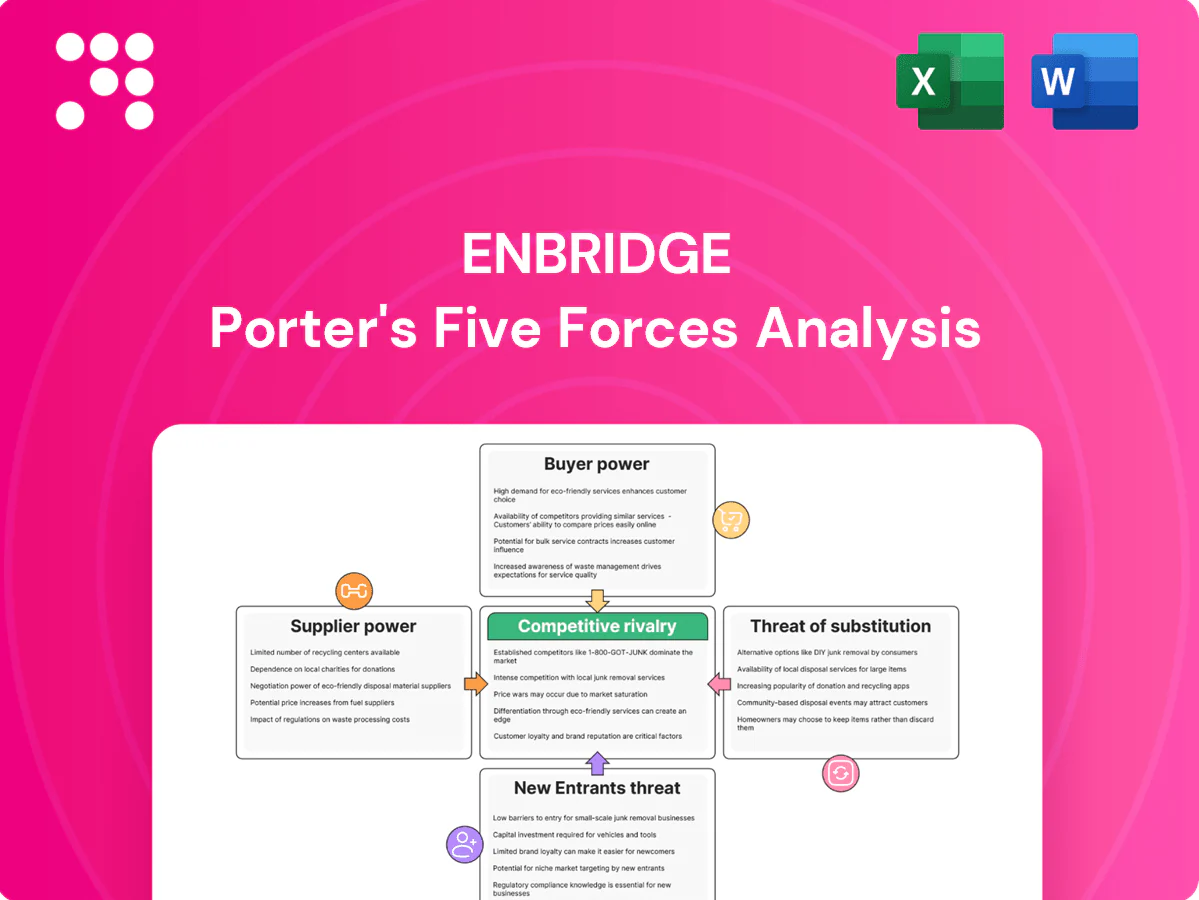
Enbridge Porter's Five Forces Analysis

Don't Miss the Bigger Picture
Enbridge faces moderate buyer power, high regulatory barriers, and limited substitute threats, while pipeline scale and long-term contracts strengthen its position. Competitive rivalry hinges on capacity expansions and energy-transition pressures that could reshape margins. This brief snapshot only scratches the surface — unlock the full Porter's Five Forces Analysis for force-by-force ratings, visuals, and actionable strategy insights.
Suppliers Bargaining Power

Limited pipe steel sources
Large-diameter, high-spec line pipe is produced by a small set of qualified mills—dozens globally—concentrating bargaining leverage and often creating 6–12 month lead times. Capacity cycles and measures such as the 25% Section 232 steel tariff have tightened availability and pushed prices higher in 2024. Enbridge mitigates risk with long-term supply contracts, vendor qualification programs and diversified sourcing, but project timing remains sensitive to mill lead times.
Specialized equipment and services
Compression, pumps, valves, SCADA and integrity services for Enbridge are supplied by specialized vendors, creating high switching costs and OEM lock-in; Enbridge noted supplier dependency in its 2024 disclosures. Framework agreements and multi-year maintenance deals cap price volatility, but outages and major upgrades can still be driven by vendor lead times and scheduling constraints.

Right-of-way and land access
Landowners, indigenous communities, and municipalities control right-of-way access, shaping terms and timelines and forcing negotiators to address ownership and consent. Negotiations over easements and consent often add tens of millions of dollars and can reroute projects, changing capital allocation. Strong engagement, benefit-sharing agreements, and transparent consultation reduce friction and legal risk. Localized holdout power still delays projects by months to over a year.

Labor and skilled trades
Pipelining relies on unionized, region-specific skilled trades, creating pockets of scarcity that drove construction wage inflation of about 5% year-over-year in 2024, raising Enbridge project costs. Wage escalation and restrictive work rules increase maintenance and build expenses, while workforce agreements and training pipelines partially mitigate shortages. Peak build seasons amplify labor supplier power and schedule risk.
Upstream producers as flow suppliers
Upstream producers supply the volumes that fill Enbridge capacity and, through multi-year volume commitments, indirectly shape tariff economics; Canadian crude production rose to about 4.9 million b/d in 2024, tightening market leverage for shippers in tight basins. When basin output is constrained shippers can push on contract terms, but Enbridge’s take-or-pay protections—typically covering the majority of contracted capacity—buffer revenue against volume swings, and basin diversity reduces single-supplier risk.
- 2024 Canadian production ~4.9 mb/d
- Take-or-pay covers majority of contracted capacity
- Basin diversity lowers single-supplier exposure
Supply squeeze: 6-12 months pipe lead times, 25% tariff, ~5% wage inflation
Suppliers of large-diameter pipe (dozens qualified mills) create 6–12 month lead times and price pressure, amplified by capacity cycles and the 25% Section 232 steel tariff in 2024. Specialized equipment and OEMs produce high switching costs; Enbridge uses long-term contracts and framework agreements to mitigate. Unionized labor drove ~5% y/y wage inflation in 2024, raising construction costs. Upstream supply (Canada ~4.9 mb/d in 2024) affects tariff economics; take-or-pay protects revenue.
| Metric | 2024 Value |
|---|---|
| Pipe lead times | 6–12 months |
| Section 232 tariff | 25% |
| Wage inflation | ~5% y/y |
| Canadian crude prod. | ~4.9 mb/d |
What is included in the product
 Detailed Word Document
Tailored Porter's Five Forces analysis for Enbridge that uncovers key competitive drivers, supplier and buyer power, entry barriers and substitute threats, with strategic commentary on regulatory and infrastructure advantages that protect incumbency. Ideal for investor reports, strategy decks or academic use and fully editable for customization.

 Customizable Excel Spreadsheet
A concise, one-sheet Porter's Five Forces for Enbridge that visualizes regulatory, supplier, buyer, entrant and substitute pressures with a radar chart—customizable to reflect pipeline tariffs, commodity swings and policy shifts for quick board-level decisions.
Customers Bargaining Power

Concentrated shipper base
As of 2024 Enbridge's shipper base remains relatively concentrated, composed mainly of major oil and gas producers, marketers, and utilities, allowing large shippers to negotiate favorable commercial terms and capacity priority. Long-term contracts prevalent across Enbridge's liquids and gas businesses reduce renegotiation frequency but do not diminish initial bargaining leverage. Creditworthy anchor customers can and do secure tailored service, operational priority, and specific credit terms.
Contracted take-or-pay dynamics
Firm take-or-pay reservations on Enbridge's liquids system, which has roughly 2.85 million barrels per day of takeaway capacity, mute daily buyer leverage by locking volume and revenues. Renewal windows and open seasons become focal bargaining moments where shippers can push for concessions. Buyers also use alternative routes or storage to press pricing during those windows. Long contract tenors and escalators—commonly spanning a decade or more—allocate cycle risk between parties.

Access to alternative routes
Competing pipelines, rail and marine give buyers leverage in corridors with alternatives; Enbridge's Mainline capacity (~2.85 million bpd) means where it dominates buyer power is low. Regional bottlenecks and regulatory limits (e.g., constrained export terminals) shift bargaining over time. Blended logistics—shippers using ~200 kbpd rail/marine in 2024—strengthen negotiation positions.

Utility LDCs in gas distribution
Renewables offtakers
Renewables offtakers sign long-term power purchase agreements, typically 10–25 years (median tenor ~15 years), with defined pricing that anchors project economics; creditworthy offtakers can dictate contract structures and push risk toward developers, while competitive PPA markets (rising corporate procurement in 2022–24) limit generators’ pricing power; nevertheless contracted revenue stabilizes cash flows and improves bankability.
- Tenor: 10–25 years (median ~15)
- Credit risk: offtaker-driven contract terms
- Market pressure: competitive corporate PPA growth 2022–24
- Benefit: stabilized contracted cash flows
Mainline ≈2.85m bpd limits customers' leverage; alternatives ≈200 kbpd
In 2024 Enbridge customers—major producers, utilities and investment-grade LDCs (BBB+–AA)—have moderate bargaining power: Mainline dominance (≈2.85m bpd) and firm take-or-pay reduce leverage, while ~200 kbpd rail/marine alternatives and <10% annual switching raise negotiation points. Long tenors (PPAs median ≈15 yrs) stabilize pricing but create renewal leverage.
| Metric | 2024 |
|---|---|
| Mainline capacity | ≈2.85m bpd |
| Rail/marine alternatives | ≈200 kbpd |
| Switching rate | <10% |
| PPA tenor (median) | ≈15 yrs |
| LDC credit | BBB+–AA |
Preview Before You Purchase
Enbridge Porter's Five Forces Analysis
This preview shows the exact Enbridge Porter’s Five Forces analysis you'll receive after purchase—no placeholders or mockups. The full document is professionally formatted, ready for download and immediate use. What you see here is the complete deliverable, identical to the purchased file.

Don't Miss the Bigger Picture
Enbridge faces moderate buyer power, high regulatory barriers, and limited substitute threats, while pipeline scale and long-term contracts strengthen its position. Competitive rivalry hinges on capacity expansions and energy-transition pressures that could reshape margins. This brief snapshot only scratches the surface — unlock the full Porter's Five Forces Analysis for force-by-force ratings, visuals, and actionable strategy insights.
Suppliers Bargaining Power
Limited pipe steel sources
Large-diameter, high-spec line pipe is produced by a small set of qualified mills—dozens globally—concentrating bargaining leverage and often creating 6–12 month lead times. Capacity cycles and measures such as the 25% Section 232 steel tariff have tightened availability and pushed prices higher in 2024. Enbridge mitigates risk with long-term supply contracts, vendor qualification programs and diversified sourcing, but project timing remains sensitive to mill lead times.
Specialized equipment and services
Compression, pumps, valves, SCADA and integrity services for Enbridge are supplied by specialized vendors, creating high switching costs and OEM lock-in; Enbridge noted supplier dependency in its 2024 disclosures. Framework agreements and multi-year maintenance deals cap price volatility, but outages and major upgrades can still be driven by vendor lead times and scheduling constraints.
Right-of-way and land access
Landowners, indigenous communities, and municipalities control right-of-way access, shaping terms and timelines and forcing negotiators to address ownership and consent. Negotiations over easements and consent often add tens of millions of dollars and can reroute projects, changing capital allocation. Strong engagement, benefit-sharing agreements, and transparent consultation reduce friction and legal risk. Localized holdout power still delays projects by months to over a year.
Labor and skilled trades
Pipelining relies on unionized, region-specific skilled trades, creating pockets of scarcity that drove construction wage inflation of about 5% year-over-year in 2024, raising Enbridge project costs. Wage escalation and restrictive work rules increase maintenance and build expenses, while workforce agreements and training pipelines partially mitigate shortages. Peak build seasons amplify labor supplier power and schedule risk.
Upstream producers as flow suppliers
Upstream producers supply the volumes that fill Enbridge capacity and, through multi-year volume commitments, indirectly shape tariff economics; Canadian crude production rose to about 4.9 million b/d in 2024, tightening market leverage for shippers in tight basins. When basin output is constrained shippers can push on contract terms, but Enbridge’s take-or-pay protections—typically covering the majority of contracted capacity—buffer revenue against volume swings, and basin diversity reduces single-supplier risk.
- 2024 Canadian production ~4.9 mb/d
- Take-or-pay covers majority of contracted capacity
- Basin diversity lowers single-supplier exposure
Supply squeeze: 6-12 months pipe lead times, 25% tariff, ~5% wage inflation
Suppliers of large-diameter pipe (dozens qualified mills) create 6–12 month lead times and price pressure, amplified by capacity cycles and the 25% Section 232 steel tariff in 2024. Specialized equipment and OEMs produce high switching costs; Enbridge uses long-term contracts and framework agreements to mitigate. Unionized labor drove ~5% y/y wage inflation in 2024, raising construction costs. Upstream supply (Canada ~4.9 mb/d in 2024) affects tariff economics; take-or-pay protects revenue.
| Metric | 2024 Value |
|---|---|
| Pipe lead times | 6–12 months |
| Section 232 tariff | 25% |
| Wage inflation | ~5% y/y |
| Canadian crude prod. | ~4.9 mb/d |
What is included in the product
Detailed Word Document
Tailored Porter's Five Forces analysis for Enbridge that uncovers key competitive drivers, supplier and buyer power, entry barriers and substitute threats, with strategic commentary on regulatory and infrastructure advantages that protect incumbency. Ideal for investor reports, strategy decks or academic use and fully editable for customization.
Customizable Excel Spreadsheet
A concise, one-sheet Porter's Five Forces for Enbridge that visualizes regulatory, supplier, buyer, entrant and substitute pressures with a radar chart—customizable to reflect pipeline tariffs, commodity swings and policy shifts for quick board-level decisions.
Customers Bargaining Power
Concentrated shipper base
As of 2024 Enbridge's shipper base remains relatively concentrated, composed mainly of major oil and gas producers, marketers, and utilities, allowing large shippers to negotiate favorable commercial terms and capacity priority. Long-term contracts prevalent across Enbridge's liquids and gas businesses reduce renegotiation frequency but do not diminish initial bargaining leverage. Creditworthy anchor customers can and do secure tailored service, operational priority, and specific credit terms.
Contracted take-or-pay dynamics
Firm take-or-pay reservations on Enbridge's liquids system, which has roughly 2.85 million barrels per day of takeaway capacity, mute daily buyer leverage by locking volume and revenues. Renewal windows and open seasons become focal bargaining moments where shippers can push for concessions. Buyers also use alternative routes or storage to press pricing during those windows. Long contract tenors and escalators—commonly spanning a decade or more—allocate cycle risk between parties.
Access to alternative routes
Competing pipelines, rail and marine give buyers leverage in corridors with alternatives; Enbridge's Mainline capacity (~2.85 million bpd) means where it dominates buyer power is low. Regional bottlenecks and regulatory limits (e.g., constrained export terminals) shift bargaining over time. Blended logistics—shippers using ~200 kbpd rail/marine in 2024—strengthen negotiation positions.
Utility LDCs in gas distribution
Renewables offtakers
Renewables offtakers sign long-term power purchase agreements, typically 10–25 years (median tenor ~15 years), with defined pricing that anchors project economics; creditworthy offtakers can dictate contract structures and push risk toward developers, while competitive PPA markets (rising corporate procurement in 2022–24) limit generators’ pricing power; nevertheless contracted revenue stabilizes cash flows and improves bankability.
- Tenor: 10–25 years (median ~15)
- Credit risk: offtaker-driven contract terms
- Market pressure: competitive corporate PPA growth 2022–24
- Benefit: stabilized contracted cash flows
Mainline ≈2.85m bpd limits customers' leverage; alternatives ≈200 kbpd
In 2024 Enbridge customers—major producers, utilities and investment-grade LDCs (BBB+–AA)—have moderate bargaining power: Mainline dominance (≈2.85m bpd) and firm take-or-pay reduce leverage, while ~200 kbpd rail/marine alternatives and <10% annual switching raise negotiation points. Long tenors (PPAs median ≈15 yrs) stabilize pricing but create renewal leverage.
| Metric | 2024 |
|---|---|
| Mainline capacity | ≈2.85m bpd |
| Rail/marine alternatives | ≈200 kbpd |
| Switching rate | <10% |
| PPA tenor (median) | ≈15 yrs |
| LDC credit | BBB+–AA |
Preview Before You Purchase
Enbridge Porter's Five Forces Analysis
This preview shows the exact Enbridge Porter’s Five Forces analysis you'll receive after purchase—no placeholders or mockups. The full document is professionally formatted, ready for download and immediate use. What you see here is the complete deliverable, identical to the purchased file.
Description
Don't Miss the Bigger Picture
Enbridge faces moderate buyer power, high regulatory barriers, and limited substitute threats, while pipeline scale and long-term contracts strengthen its position. Competitive rivalry hinges on capacity expansions and energy-transition pressures that could reshape margins. This brief snapshot only scratches the surface — unlock the full Porter's Five Forces Analysis for force-by-force ratings, visuals, and actionable strategy insights.
Suppliers Bargaining Power
Limited pipe steel sources
Large-diameter, high-spec line pipe is produced by a small set of qualified mills—dozens globally—concentrating bargaining leverage and often creating 6–12 month lead times. Capacity cycles and measures such as the 25% Section 232 steel tariff have tightened availability and pushed prices higher in 2024. Enbridge mitigates risk with long-term supply contracts, vendor qualification programs and diversified sourcing, but project timing remains sensitive to mill lead times.
Specialized equipment and services
Compression, pumps, valves, SCADA and integrity services for Enbridge are supplied by specialized vendors, creating high switching costs and OEM lock-in; Enbridge noted supplier dependency in its 2024 disclosures. Framework agreements and multi-year maintenance deals cap price volatility, but outages and major upgrades can still be driven by vendor lead times and scheduling constraints.
Right-of-way and land access
Landowners, indigenous communities, and municipalities control right-of-way access, shaping terms and timelines and forcing negotiators to address ownership and consent. Negotiations over easements and consent often add tens of millions of dollars and can reroute projects, changing capital allocation. Strong engagement, benefit-sharing agreements, and transparent consultation reduce friction and legal risk. Localized holdout power still delays projects by months to over a year.
Labor and skilled trades
Pipelining relies on unionized, region-specific skilled trades, creating pockets of scarcity that drove construction wage inflation of about 5% year-over-year in 2024, raising Enbridge project costs. Wage escalation and restrictive work rules increase maintenance and build expenses, while workforce agreements and training pipelines partially mitigate shortages. Peak build seasons amplify labor supplier power and schedule risk.
Upstream producers as flow suppliers
Upstream producers supply the volumes that fill Enbridge capacity and, through multi-year volume commitments, indirectly shape tariff economics; Canadian crude production rose to about 4.9 million b/d in 2024, tightening market leverage for shippers in tight basins. When basin output is constrained shippers can push on contract terms, but Enbridge’s take-or-pay protections—typically covering the majority of contracted capacity—buffer revenue against volume swings, and basin diversity reduces single-supplier risk.
- 2024 Canadian production ~4.9 mb/d
- Take-or-pay covers majority of contracted capacity
- Basin diversity lowers single-supplier exposure
Supply squeeze: 6-12 months pipe lead times, 25% tariff, ~5% wage inflation
Suppliers of large-diameter pipe (dozens qualified mills) create 6–12 month lead times and price pressure, amplified by capacity cycles and the 25% Section 232 steel tariff in 2024. Specialized equipment and OEMs produce high switching costs; Enbridge uses long-term contracts and framework agreements to mitigate. Unionized labor drove ~5% y/y wage inflation in 2024, raising construction costs. Upstream supply (Canada ~4.9 mb/d in 2024) affects tariff economics; take-or-pay protects revenue.
| Metric | 2024 Value |
|---|---|
| Pipe lead times | 6–12 months |
| Section 232 tariff | 25% |
| Wage inflation | ~5% y/y |
| Canadian crude prod. | ~4.9 mb/d |
What is included in the product
Detailed Word Document
Tailored Porter's Five Forces analysis for Enbridge that uncovers key competitive drivers, supplier and buyer power, entry barriers and substitute threats, with strategic commentary on regulatory and infrastructure advantages that protect incumbency. Ideal for investor reports, strategy decks or academic use and fully editable for customization.
Customizable Excel Spreadsheet
A concise, one-sheet Porter's Five Forces for Enbridge that visualizes regulatory, supplier, buyer, entrant and substitute pressures with a radar chart—customizable to reflect pipeline tariffs, commodity swings and policy shifts for quick board-level decisions.
Customers Bargaining Power
Concentrated shipper base
As of 2024 Enbridge's shipper base remains relatively concentrated, composed mainly of major oil and gas producers, marketers, and utilities, allowing large shippers to negotiate favorable commercial terms and capacity priority. Long-term contracts prevalent across Enbridge's liquids and gas businesses reduce renegotiation frequency but do not diminish initial bargaining leverage. Creditworthy anchor customers can and do secure tailored service, operational priority, and specific credit terms.
Contracted take-or-pay dynamics
Firm take-or-pay reservations on Enbridge's liquids system, which has roughly 2.85 million barrels per day of takeaway capacity, mute daily buyer leverage by locking volume and revenues. Renewal windows and open seasons become focal bargaining moments where shippers can push for concessions. Buyers also use alternative routes or storage to press pricing during those windows. Long contract tenors and escalators—commonly spanning a decade or more—allocate cycle risk between parties.
Access to alternative routes
Competing pipelines, rail and marine give buyers leverage in corridors with alternatives; Enbridge's Mainline capacity (~2.85 million bpd) means where it dominates buyer power is low. Regional bottlenecks and regulatory limits (e.g., constrained export terminals) shift bargaining over time. Blended logistics—shippers using ~200 kbpd rail/marine in 2024—strengthen negotiation positions.
Utility LDCs in gas distribution
Renewables offtakers
Renewables offtakers sign long-term power purchase agreements, typically 10–25 years (median tenor ~15 years), with defined pricing that anchors project economics; creditworthy offtakers can dictate contract structures and push risk toward developers, while competitive PPA markets (rising corporate procurement in 2022–24) limit generators’ pricing power; nevertheless contracted revenue stabilizes cash flows and improves bankability.
- Tenor: 10–25 years (median ~15)
- Credit risk: offtaker-driven contract terms
- Market pressure: competitive corporate PPA growth 2022–24
- Benefit: stabilized contracted cash flows
Mainline ≈2.85m bpd limits customers' leverage; alternatives ≈200 kbpd
In 2024 Enbridge customers—major producers, utilities and investment-grade LDCs (BBB+–AA)—have moderate bargaining power: Mainline dominance (≈2.85m bpd) and firm take-or-pay reduce leverage, while ~200 kbpd rail/marine alternatives and <10% annual switching raise negotiation points. Long tenors (PPAs median ≈15 yrs) stabilize pricing but create renewal leverage.
| Metric | 2024 |
|---|---|
| Mainline capacity | ≈2.85m bpd |
| Rail/marine alternatives | ≈200 kbpd |
| Switching rate | <10% |
| PPA tenor (median) | ≈15 yrs |
| LDC credit | BBB+–AA |
Preview Before You Purchase
Enbridge Porter's Five Forces Analysis
This preview shows the exact Enbridge Porter’s Five Forces analysis you'll receive after purchase—no placeholders or mockups. The full document is professionally formatted, ready for download and immediate use. What you see here is the complete deliverable, identical to the purchased file.











