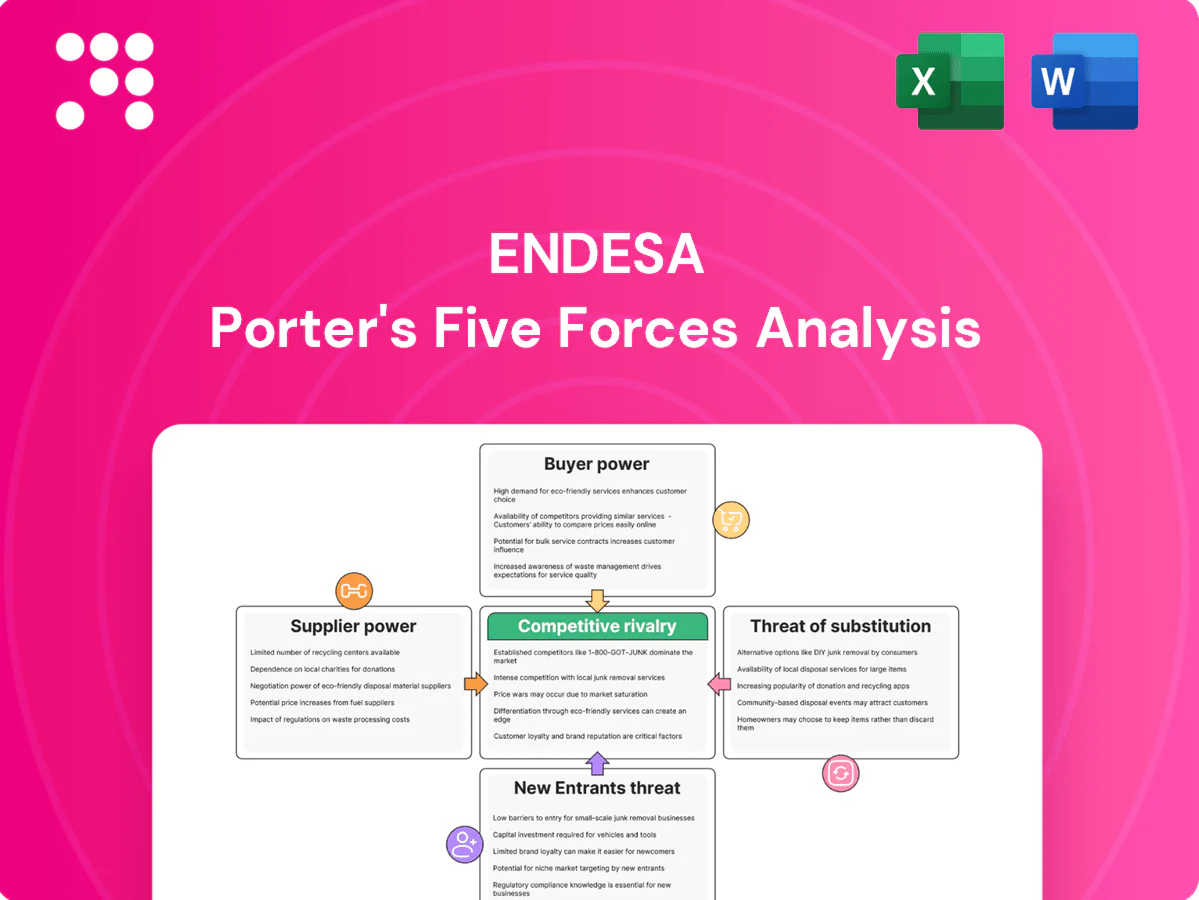
Endesa Porter's Five Forces Analysis

Elevate Your Analysis with the Complete Porter's Five Forces Analysis
Endesa faces moderate buyer power and regulatory pressures, while supplier leverage is tempered by scale and vertical integration; rivalry is intense among Iberian and EU utilities as decarbonization shifts cost structures. Threats from new entrants and substitutes are rising with distributed renewables and storage innovations. This snapshot only scratches the surface—unlock the full Porter's Five Forces Analysis to access force-by-force ratings, visuals, and actionable strategy guidance.
Suppliers Bargaining Power

Concentrated fuel suppliers
Endesa relies on a limited set of global suppliers and traders for gas and residual coal, exposing it to concentrated supplier leverage. Top five LNG exporters supplied roughly 75% of global LNG trade in 2023, tightening negotiation room and transmitting price volatility. Long-term contracts and hedging reduce but do not remove supplier bargaining power. Iberia imports nearly 100% of its gas and limited regional import infrastructure, mirrored in parts of LatAm, amplifies supplier influence.
OEM and grid equipment dependence
OEM concentration — top turbine and grid-equipment suppliers (Siemens Energy, Vestas/SGRE, GE/Hydro, Hitachi ABB) supply roughly two-thirds of capacity, and 2024 lead times stretched to about 12–30 months for turbines and 9–18 months for transformers. Scarce components and multi-year order backlogs give vendors clear pricing and delivery leverage; bespoke grid specifications reduce switching despite some standardization. Inflation-indexed supply contracts further lock Endesa into rising input costs.

Renewables EPC and PPA counterparties
Renewable build-out for Endesa relies heavily on EPC firms and IPPs for PPAs and asset sourcing, and in 2024 heightened demand for quality EPCs and scarce interconnection slots allowed suppliers to negotiate tighter margins, reportedly lifting EPC bid premiums by several percentage points. Bottlenecks in permitting and grid access further increased supplier leverage, slowing project delivery. Co-development and framework agreements have partially rebalanced power by securing capacity and pre-agreed commercial terms.

Labor and specialized contractors
Skilled engineers, digital specialists and high-voltage technicians remained scarce in 2024, pushing wage pressure and union negotiations that raised operating costs for Endesa; reliance on outsourced maintenance created leverage during peak cycles while company training pipelines and expanding in-house capabilities moderated supplier power.
- Scarce specialized talent — 2024
- Wage and union cost pressure
- Outsourced providers leverage in peaks
- Training/in-house reduces exposure
Financial capital providers
Large capex and project finance expose Endesa to lenders’ covenants and pricing; rising rates — ECB policy rate around 4% in 2024 — and ESG-linked conditions push up debt costs and tighten structures.
- Green bonds/sustainability-linked loans: alternative funding with KPI constraints
- Parent Enel stake ~70.1% (2024): improves access but preserves lender negotiation power
Iberian utility faces concentrated LNG/OEM leverage, extended turbine/transformer lead times
Endesa faces concentrated supplier leverage for gas/LNG (top 5 exporters ~75% of trade in 2023) and OEMs (two-thirds capacity from Siemens/GE/Vestas/Hitachi) with 2024 turbine lead times ~12–30m and transformers 9–18m, elevating price/delivery risk. Limited Iberian gas self-supply, scarce EPCs and skilled technicians in 2024 raise input costs; long-term contracts, hedges and Enel majority (≈70.1% 2024) partially mitigate power.
| Metric | 2024/2023 |
|---|---|
| Top-5 LNG share | ~75% (2023) |
| Turbine lead time | 12–30 months (2024) |
| Transformers | 9–18 months (2024) |
| Enel stake | ~70.1% (2024) |
What is included in the product
 Detailed Word Document
Uncovers key drivers of competition, buyer and supplier power, entry barriers and substitution risk for Endesa, highlighting regulatory pressure and renewable-energy disruption that shape its pricing power and long-term profitability.

 Customizable Excel Spreadsheet
A concise, one-sheet Porter's Five Forces for Endesa—rapidly highlights competitive pressures with customizable scores and an instant radar chart for clear strategic decisions. Ready to copy into decks, tweak for scenarios, and integrate into broader financial reports.
Customers Bargaining Power

Liberalized retail market
Household and SME customers in Spain and Portugal can freely switch suppliers, and Endesa served about 11.2 million retail customers in 2024, exposing it to active customer movement. Price transparency and online comparators have raised buyer power, increasing visibility of cheaper offers and contract terms. Churn risk forces Endesa to offer competitive tariffs and service incentives; brand strength and bundled services mitigate but do not eliminate pricing pressure.
Large industrial off-takers
Large industrial off-takers secure bespoke PPAs with discounts and flexibility, often contracting blocks in the 50–200 MW range with tenors commonly of 10–15 years. Their scale and predictable load profiles—industry accounts for about 20% of Spain’s electricity consumption (Eurostat 2023)—enable Endesa to offer more favorable pricing and volume certainty. Embedded demand response capabilities further strengthen their bargaining position by shaving peak costs and accessing ancillary revenues. Long tenors trade lower prices for guaranteed volumes, reducing offtaker and generator market risk.

Public sector and regulated clients
Tenders for municipalities and agencies are highly competitive and price-driven, with EU public procurement representing about 14% of GDP in 2024, compressing margins. Strict procurement rules and long-term frameworks increase contract stickiness but limit upside. Service-level penalties transfer performance and financial risk to Endesa, squeezing profitability further.

LatAm customer dynamics
- currency risk: high
- collective bargaining: strong
- subsidy impact: material
- local competition: intense
Prosumer and energy community growth
Rooftop PV and energy communities in 2024 let customers self-supply a growing share of demand, reducing volume dependence on Endesa and raising buyer leverage. Net metering and behind-the-meter storage expand arbitrage and resilience options, increasing switching power. Utilities counter with buyback tariffs, aggregation of prosumers and bundled service offers to retain revenue and margins.
Retail switching, price transparency and large PPAs strengthen buyer power over utilities
Retail switching and price transparency raise buyer power vs Endesa; the company served about 11.2 million retail customers in 2024. Large industrial off-takers (typical PPAs 50–200 MW, tenors 10–15 years) and industry consuming ~20% of Spain’s electricity strengthen negotiation leverage. EU public procurement (~14% of GDP in 2024), Latin American currency/subsidy risk and rising prosumers further compress pricing power.
| Metric | Value |
|---|---|
| Retail customers (2024) | 11.2 million |
| Industry share | ~20% (Eurostat 2023) |
| PPA size / tenor | 50–200 MW / 10–15 yrs |
| EU public procurement (2024) | ~14% of GDP |
Full Version Awaits
Endesa Porter's Five Forces Analysis
This preview shows the exact Endesa Porter’s Five Forces analysis you’ll receive after purchase—no mockups, no placeholders. The document is fully formatted, professionally written and ready for immediate download and use. What you see here is precisely the deliverable available instantly upon payment.

Elevate Your Analysis with the Complete Porter's Five Forces Analysis
Endesa faces moderate buyer power and regulatory pressures, while supplier leverage is tempered by scale and vertical integration; rivalry is intense among Iberian and EU utilities as decarbonization shifts cost structures. Threats from new entrants and substitutes are rising with distributed renewables and storage innovations. This snapshot only scratches the surface—unlock the full Porter's Five Forces Analysis to access force-by-force ratings, visuals, and actionable strategy guidance.
Suppliers Bargaining Power
Concentrated fuel suppliers
Endesa relies on a limited set of global suppliers and traders for gas and residual coal, exposing it to concentrated supplier leverage. Top five LNG exporters supplied roughly 75% of global LNG trade in 2023, tightening negotiation room and transmitting price volatility. Long-term contracts and hedging reduce but do not remove supplier bargaining power. Iberia imports nearly 100% of its gas and limited regional import infrastructure, mirrored in parts of LatAm, amplifies supplier influence.
OEM and grid equipment dependence
OEM concentration — top turbine and grid-equipment suppliers (Siemens Energy, Vestas/SGRE, GE/Hydro, Hitachi ABB) supply roughly two-thirds of capacity, and 2024 lead times stretched to about 12–30 months for turbines and 9–18 months for transformers. Scarce components and multi-year order backlogs give vendors clear pricing and delivery leverage; bespoke grid specifications reduce switching despite some standardization. Inflation-indexed supply contracts further lock Endesa into rising input costs.
Renewables EPC and PPA counterparties
Renewable build-out for Endesa relies heavily on EPC firms and IPPs for PPAs and asset sourcing, and in 2024 heightened demand for quality EPCs and scarce interconnection slots allowed suppliers to negotiate tighter margins, reportedly lifting EPC bid premiums by several percentage points. Bottlenecks in permitting and grid access further increased supplier leverage, slowing project delivery. Co-development and framework agreements have partially rebalanced power by securing capacity and pre-agreed commercial terms.
Labor and specialized contractors
Skilled engineers, digital specialists and high-voltage technicians remained scarce in 2024, pushing wage pressure and union negotiations that raised operating costs for Endesa; reliance on outsourced maintenance created leverage during peak cycles while company training pipelines and expanding in-house capabilities moderated supplier power.
- Scarce specialized talent — 2024
- Wage and union cost pressure
- Outsourced providers leverage in peaks
- Training/in-house reduces exposure
Financial capital providers
Large capex and project finance expose Endesa to lenders’ covenants and pricing; rising rates — ECB policy rate around 4% in 2024 — and ESG-linked conditions push up debt costs and tighten structures.
- Green bonds/sustainability-linked loans: alternative funding with KPI constraints
- Parent Enel stake ~70.1% (2024): improves access but preserves lender negotiation power
Iberian utility faces concentrated LNG/OEM leverage, extended turbine/transformer lead times
Endesa faces concentrated supplier leverage for gas/LNG (top 5 exporters ~75% of trade in 2023) and OEMs (two-thirds capacity from Siemens/GE/Vestas/Hitachi) with 2024 turbine lead times ~12–30m and transformers 9–18m, elevating price/delivery risk. Limited Iberian gas self-supply, scarce EPCs and skilled technicians in 2024 raise input costs; long-term contracts, hedges and Enel majority (≈70.1% 2024) partially mitigate power.
| Metric | 2024/2023 |
|---|---|
| Top-5 LNG share | ~75% (2023) |
| Turbine lead time | 12–30 months (2024) |
| Transformers | 9–18 months (2024) |
| Enel stake | ~70.1% (2024) |
What is included in the product
Detailed Word Document
Uncovers key drivers of competition, buyer and supplier power, entry barriers and substitution risk for Endesa, highlighting regulatory pressure and renewable-energy disruption that shape its pricing power and long-term profitability.
Customizable Excel Spreadsheet
A concise, one-sheet Porter's Five Forces for Endesa—rapidly highlights competitive pressures with customizable scores and an instant radar chart for clear strategic decisions. Ready to copy into decks, tweak for scenarios, and integrate into broader financial reports.
Customers Bargaining Power
Liberalized retail market
Household and SME customers in Spain and Portugal can freely switch suppliers, and Endesa served about 11.2 million retail customers in 2024, exposing it to active customer movement. Price transparency and online comparators have raised buyer power, increasing visibility of cheaper offers and contract terms. Churn risk forces Endesa to offer competitive tariffs and service incentives; brand strength and bundled services mitigate but do not eliminate pricing pressure.
Large industrial off-takers
Large industrial off-takers secure bespoke PPAs with discounts and flexibility, often contracting blocks in the 50–200 MW range with tenors commonly of 10–15 years. Their scale and predictable load profiles—industry accounts for about 20% of Spain’s electricity consumption (Eurostat 2023)—enable Endesa to offer more favorable pricing and volume certainty. Embedded demand response capabilities further strengthen their bargaining position by shaving peak costs and accessing ancillary revenues. Long tenors trade lower prices for guaranteed volumes, reducing offtaker and generator market risk.
Public sector and regulated clients
Tenders for municipalities and agencies are highly competitive and price-driven, with EU public procurement representing about 14% of GDP in 2024, compressing margins. Strict procurement rules and long-term frameworks increase contract stickiness but limit upside. Service-level penalties transfer performance and financial risk to Endesa, squeezing profitability further.
LatAm customer dynamics
- currency risk: high
- collective bargaining: strong
- subsidy impact: material
- local competition: intense
Prosumer and energy community growth
Rooftop PV and energy communities in 2024 let customers self-supply a growing share of demand, reducing volume dependence on Endesa and raising buyer leverage. Net metering and behind-the-meter storage expand arbitrage and resilience options, increasing switching power. Utilities counter with buyback tariffs, aggregation of prosumers and bundled service offers to retain revenue and margins.
Retail switching, price transparency and large PPAs strengthen buyer power over utilities
Retail switching and price transparency raise buyer power vs Endesa; the company served about 11.2 million retail customers in 2024. Large industrial off-takers (typical PPAs 50–200 MW, tenors 10–15 years) and industry consuming ~20% of Spain’s electricity strengthen negotiation leverage. EU public procurement (~14% of GDP in 2024), Latin American currency/subsidy risk and rising prosumers further compress pricing power.
| Metric | Value |
|---|---|
| Retail customers (2024) | 11.2 million |
| Industry share | ~20% (Eurostat 2023) |
| PPA size / tenor | 50–200 MW / 10–15 yrs |
| EU public procurement (2024) | ~14% of GDP |
Full Version Awaits
Endesa Porter's Five Forces Analysis
This preview shows the exact Endesa Porter’s Five Forces analysis you’ll receive after purchase—no mockups, no placeholders. The document is fully formatted, professionally written and ready for immediate download and use. What you see here is precisely the deliverable available instantly upon payment.
Description
Elevate Your Analysis with the Complete Porter's Five Forces Analysis
Endesa faces moderate buyer power and regulatory pressures, while supplier leverage is tempered by scale and vertical integration; rivalry is intense among Iberian and EU utilities as decarbonization shifts cost structures. Threats from new entrants and substitutes are rising with distributed renewables and storage innovations. This snapshot only scratches the surface—unlock the full Porter's Five Forces Analysis to access force-by-force ratings, visuals, and actionable strategy guidance.
Suppliers Bargaining Power
Concentrated fuel suppliers
Endesa relies on a limited set of global suppliers and traders for gas and residual coal, exposing it to concentrated supplier leverage. Top five LNG exporters supplied roughly 75% of global LNG trade in 2023, tightening negotiation room and transmitting price volatility. Long-term contracts and hedging reduce but do not remove supplier bargaining power. Iberia imports nearly 100% of its gas and limited regional import infrastructure, mirrored in parts of LatAm, amplifies supplier influence.
OEM and grid equipment dependence
OEM concentration — top turbine and grid-equipment suppliers (Siemens Energy, Vestas/SGRE, GE/Hydro, Hitachi ABB) supply roughly two-thirds of capacity, and 2024 lead times stretched to about 12–30 months for turbines and 9–18 months for transformers. Scarce components and multi-year order backlogs give vendors clear pricing and delivery leverage; bespoke grid specifications reduce switching despite some standardization. Inflation-indexed supply contracts further lock Endesa into rising input costs.
Renewables EPC and PPA counterparties
Renewable build-out for Endesa relies heavily on EPC firms and IPPs for PPAs and asset sourcing, and in 2024 heightened demand for quality EPCs and scarce interconnection slots allowed suppliers to negotiate tighter margins, reportedly lifting EPC bid premiums by several percentage points. Bottlenecks in permitting and grid access further increased supplier leverage, slowing project delivery. Co-development and framework agreements have partially rebalanced power by securing capacity and pre-agreed commercial terms.
Labor and specialized contractors
Skilled engineers, digital specialists and high-voltage technicians remained scarce in 2024, pushing wage pressure and union negotiations that raised operating costs for Endesa; reliance on outsourced maintenance created leverage during peak cycles while company training pipelines and expanding in-house capabilities moderated supplier power.
- Scarce specialized talent — 2024
- Wage and union cost pressure
- Outsourced providers leverage in peaks
- Training/in-house reduces exposure
Financial capital providers
Large capex and project finance expose Endesa to lenders’ covenants and pricing; rising rates — ECB policy rate around 4% in 2024 — and ESG-linked conditions push up debt costs and tighten structures.
- Green bonds/sustainability-linked loans: alternative funding with KPI constraints
- Parent Enel stake ~70.1% (2024): improves access but preserves lender negotiation power
Iberian utility faces concentrated LNG/OEM leverage, extended turbine/transformer lead times
Endesa faces concentrated supplier leverage for gas/LNG (top 5 exporters ~75% of trade in 2023) and OEMs (two-thirds capacity from Siemens/GE/Vestas/Hitachi) with 2024 turbine lead times ~12–30m and transformers 9–18m, elevating price/delivery risk. Limited Iberian gas self-supply, scarce EPCs and skilled technicians in 2024 raise input costs; long-term contracts, hedges and Enel majority (≈70.1% 2024) partially mitigate power.
| Metric | 2024/2023 |
|---|---|
| Top-5 LNG share | ~75% (2023) |
| Turbine lead time | 12–30 months (2024) |
| Transformers | 9–18 months (2024) |
| Enel stake | ~70.1% (2024) |
What is included in the product
Detailed Word Document
Uncovers key drivers of competition, buyer and supplier power, entry barriers and substitution risk for Endesa, highlighting regulatory pressure and renewable-energy disruption that shape its pricing power and long-term profitability.
Customizable Excel Spreadsheet
A concise, one-sheet Porter's Five Forces for Endesa—rapidly highlights competitive pressures with customizable scores and an instant radar chart for clear strategic decisions. Ready to copy into decks, tweak for scenarios, and integrate into broader financial reports.
Customers Bargaining Power
Liberalized retail market
Household and SME customers in Spain and Portugal can freely switch suppliers, and Endesa served about 11.2 million retail customers in 2024, exposing it to active customer movement. Price transparency and online comparators have raised buyer power, increasing visibility of cheaper offers and contract terms. Churn risk forces Endesa to offer competitive tariffs and service incentives; brand strength and bundled services mitigate but do not eliminate pricing pressure.
Large industrial off-takers
Large industrial off-takers secure bespoke PPAs with discounts and flexibility, often contracting blocks in the 50–200 MW range with tenors commonly of 10–15 years. Their scale and predictable load profiles—industry accounts for about 20% of Spain’s electricity consumption (Eurostat 2023)—enable Endesa to offer more favorable pricing and volume certainty. Embedded demand response capabilities further strengthen their bargaining position by shaving peak costs and accessing ancillary revenues. Long tenors trade lower prices for guaranteed volumes, reducing offtaker and generator market risk.
Public sector and regulated clients
Tenders for municipalities and agencies are highly competitive and price-driven, with EU public procurement representing about 14% of GDP in 2024, compressing margins. Strict procurement rules and long-term frameworks increase contract stickiness but limit upside. Service-level penalties transfer performance and financial risk to Endesa, squeezing profitability further.
LatAm customer dynamics
- currency risk: high
- collective bargaining: strong
- subsidy impact: material
- local competition: intense
Prosumer and energy community growth
Rooftop PV and energy communities in 2024 let customers self-supply a growing share of demand, reducing volume dependence on Endesa and raising buyer leverage. Net metering and behind-the-meter storage expand arbitrage and resilience options, increasing switching power. Utilities counter with buyback tariffs, aggregation of prosumers and bundled service offers to retain revenue and margins.
Retail switching, price transparency and large PPAs strengthen buyer power over utilities
Retail switching and price transparency raise buyer power vs Endesa; the company served about 11.2 million retail customers in 2024. Large industrial off-takers (typical PPAs 50–200 MW, tenors 10–15 years) and industry consuming ~20% of Spain’s electricity strengthen negotiation leverage. EU public procurement (~14% of GDP in 2024), Latin American currency/subsidy risk and rising prosumers further compress pricing power.
| Metric | Value |
|---|---|
| Retail customers (2024) | 11.2 million |
| Industry share | ~20% (Eurostat 2023) |
| PPA size / tenor | 50–200 MW / 10–15 yrs |
| EU public procurement (2024) | ~14% of GDP |
Full Version Awaits
Endesa Porter's Five Forces Analysis
This preview shows the exact Endesa Porter’s Five Forces analysis you’ll receive after purchase—no mockups, no placeholders. The document is fully formatted, professionally written and ready for immediate download and use. What you see here is precisely the deliverable available instantly upon payment.











