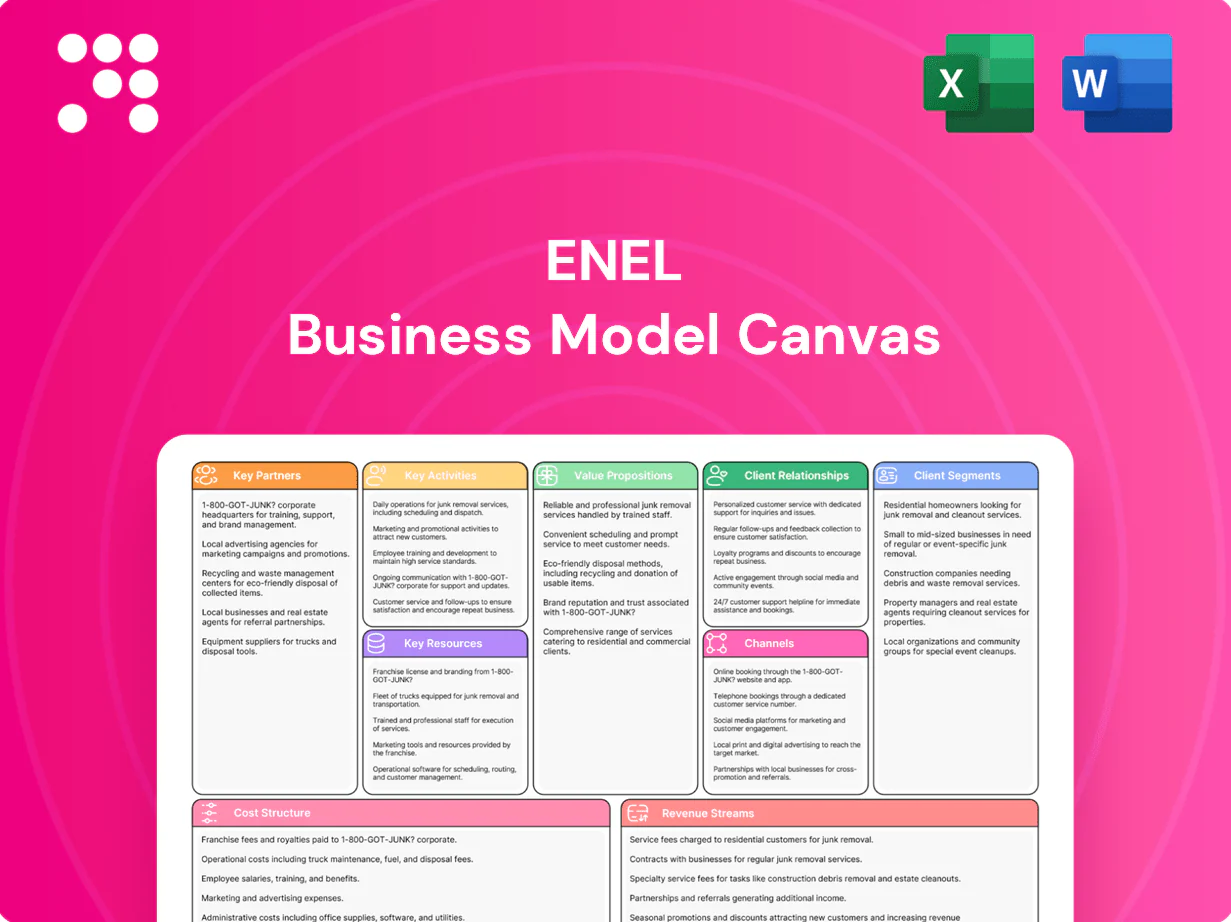
Enel Business Model Canvas

Business Model Canvas: Global energy leader — generation, grids, customer solutions
Explore Enel’s Business Model Canvas to see how the energy giant creates value across generation, grids, and customer solutions. This concise snapshot highlights customer segments, key partners, and revenue streams that drive scale. Purchase the full, editable Canvas to access detailed analysis, financial implications, and ready-to-use Word and Excel files for benchmarking or investor presentations.
Partnerships

Renewable equipment suppliers
Partnerships with turbine, panel, inverter and storage manufacturers secure long-term technology supply, volume discounts and warranty support—panels typically carry 25-year performance warranties, turbines 20–25-year service frameworks, inverters 5–12 years and batteries up to 10 years (2024 market norms).
They shorten lead times and lower total cost of ownership through pooled procurement and logistics coordination, while joint planning aligns equipment specs to site conditions and grid codes.
Co-innovation pilots with suppliers accelerate performance and reliability gains via field validation, firmware updates and O&M optimizations, de-risking scale-up.
Grid OEMs and engineering firms
Alliances with substation, HV equipment and smart meter providers ensure interoperability and safety across Enel’s global footprint, supporting operations in 30 countries and about 74 million customers in 2024. EPC partners deliver complex grid upgrades at scale, enabling rapid deployment of capacity expansions. Long-term service agreements (often 10+ years) boost uptime, while shared operational data drives predictive maintenance and extends asset life.

Governments, regulators, and TSOs/DSOs
Governments, regulators and TSOs/DSOs enable permits, incentives and stable frameworks that underpin Enel projects across ~30 countries and for over 74 million customers (2024). Tight coordination with grid operators is essential for interconnection and balancing as variable renewables scale. Regulatory pilot sandboxes in 2023–24 advanced flexibility and prosumer models. Ongoing compliance collaboration reduces regulatory risk and shortens permit timelines.

Financial institutions and PPA offtakers
Banks, multilaterals and investors provide project finance and green bonds—Enel tapped ~€3bn of green debt in 2024 and targets €29bn capex for 2024–26 to scale renewables and grids.
Corporate offtakers lock long-term PPAs to de-risk cash flows, hedging counterparties manage market volatility, and structured deals align ESG goals with capital efficiency.
- Banks: project finance, loan tenors
- Green bonds: €3bn issued 2024
- Capex: €29bn (2024–26)
- PPAs: long-term cash-flow stability
- Hedging: volatility management
- Structured deals: ESG + capital efficiency
Technology alliances and startups
Technology alliances in digital, AI, DER orchestration and cybersecurity accelerate Enel X product roadmaps, blending Enel scale (operating in over 30 countries as of 2024) with startup agility to deliver novel customer experiences. Open innovation labs validate scalability and compliance before roll‑out, while APIs enable ecosystem integration for new services and partner monetization.
- Partnerships: speed product roadmaps
- Startups: agility & novel CX
- Labs: scalability & compliance testing
- APIs: ecosystem integration & services
Utility secures equipment, grid and finance across 30 countries and ~74M customers
Enel leverages suppliers, EPCs, financiers, govts/TSOs and tech partners to secure equipment, grid access, project finance and digital services across ~30 countries and ~74M customers (2024). Key 2024 metrics: €3bn green bonds, €29bn capex (2024–26) and long-term PPAs hedging cash flows. Partnerships shorten lead times, lower TCO and enable scalability via co‑innovation and data sharing.
| Partner | Role | 2024 metric |
|---|---|---|
| Suppliers/EPC | Equipment & build | Warranty norms: panel 25y, turbine 20–25y |
| Financiers | Project finance | €3bn green bonds |
| Governments/TSO | Permits & grid | 30 countries |
What is included in the product
 Detailed Word Document
A comprehensive, pre-written Business Model Canvas for Enel detailing customer segments, channels, value propositions, revenue streams, key resources and partners across generation, networks and retail, with emphasis on renewables and digitalization. Ideal for presentations and funding discussions, it includes SWOT-linked insights, competitive advantages and practical validation using real company data.

 Customizable Excel Spreadsheet
High-level view of Enel’s business model with editable cells—quickly identify core components like generation mix, grid services, and customer segments for fast strategic decisions and team collaboration.
Activities

Renewable project development
Site scouting, permitting, interconnection and EPC management are core to Enel's renewable project development, supporting its global fleet of over 55 GW of renewables in 2024. Rigorous resource assessment and LCOE optimization drive competitiveness and lower bid prices. Proactive community engagement accelerates social acceptance. Structured commissioning and ramp-up secure safe, timely COD.
Grid modernization and operations
Smart grid deployment at Enel improves reliability and flexibility, supporting over 61 million end users and enabling real-time monitoring that cuts outage duration and frequency through advanced outage management systems. Asset management platforms extend asset lifecycles and can defer capital expenditure, complementing grid investments (Enel Group network capex ~€7bn in 2024). Integration of distributed energy resources and storage enhances system stability and peak balancing.

Retail energy and customer solutions
Pricing, billing, and customer care underpin Enel’s mass-market operations, supporting a retail base of about 74 million customers in 2024 and digital billing that reduced operational costs and churn. Bundled offers combine green tariffs, rooftop PV leases, heat pumps, and home energy management, driving average ARPU uplift for bundled clients. Business customers receive tailored demand-side services and flexibility solutions; digital journeys and apps increased online self-service adoption, boosting retention and NPS in 2024.

Energy trading and risk management
Energy trading and risk management covers wholesale procurement, hedging, and scheduling of balanced portfolios to secure supply and margin across day-ahead, intraday, and ancillary markets, while credit and market risk frameworks protect cash flows.
Advanced data and analytics drive dispatch decisions and contract optimization, improving market capture and reducing imbalance costs.
- wholesale procurement
- hedging & scheduling
- day-ahead, intraday, ancillary markets
- credit & market risk frameworks
- data-driven dispatch & contracting
R&D and digital platform development
R&D focuses on efficiency, storage, flexibility and EV charging, with Enel scaling pilots in grid storage and smart chargers; digital platforms integrate meters, sensors and customer apps to manage networks and demand. AI/ML enhances forecasting and predictive maintenance, improving outage prediction and asset utilization, while cybersecurity protects critical infrastructure and OT networks.
- R&D targets: efficiency, storage, flexibility, EV charging
- Data platforms: meters, sensors, customer apps
- AI/ML: forecasting, predictive maintenance
- Cybersecurity: OT and grid protection
Site-to-supply integration powers 55 GW renewables and 61M users
Site development, permitting, interconnection and EPC management underpin Enel’s 55 GW renewables (2024) and drive LCOE reductions; smart grids and asset management support 61M end users with ~€7bn grid capex (2024). Retail billing, bundled offerings and digital care serve ~74M customers, boosting ARPU and retention. Trading, hedging and data-driven dispatch secure supply and margins.
| Metric | 2024 |
|---|---|
| Renewable capacity | 55 GW |
| End users | 61 M |
| Retail customers | 74 M |
| Network capex | ~€7 bn |
Full Version Awaits
Business Model Canvas
The document you're previewing is the actual Enel Business Model Canvas, not a mockup—showing key blocks like value propositions, customer segments, channels and revenue streams. When you purchase, you’ll receive this exact file with full content and formatting. The deliverable is ready-to-edit in Word and Excel so you can present, adapt, and apply it immediately.

Business Model Canvas: Global energy leader — generation, grids, customer solutions
Explore Enel’s Business Model Canvas to see how the energy giant creates value across generation, grids, and customer solutions. This concise snapshot highlights customer segments, key partners, and revenue streams that drive scale. Purchase the full, editable Canvas to access detailed analysis, financial implications, and ready-to-use Word and Excel files for benchmarking or investor presentations.
Partnerships
Renewable equipment suppliers
Partnerships with turbine, panel, inverter and storage manufacturers secure long-term technology supply, volume discounts and warranty support—panels typically carry 25-year performance warranties, turbines 20–25-year service frameworks, inverters 5–12 years and batteries up to 10 years (2024 market norms).
They shorten lead times and lower total cost of ownership through pooled procurement and logistics coordination, while joint planning aligns equipment specs to site conditions and grid codes.
Co-innovation pilots with suppliers accelerate performance and reliability gains via field validation, firmware updates and O&M optimizations, de-risking scale-up.
Grid OEMs and engineering firms
Alliances with substation, HV equipment and smart meter providers ensure interoperability and safety across Enel’s global footprint, supporting operations in 30 countries and about 74 million customers in 2024. EPC partners deliver complex grid upgrades at scale, enabling rapid deployment of capacity expansions. Long-term service agreements (often 10+ years) boost uptime, while shared operational data drives predictive maintenance and extends asset life.
Governments, regulators, and TSOs/DSOs
Governments, regulators and TSOs/DSOs enable permits, incentives and stable frameworks that underpin Enel projects across ~30 countries and for over 74 million customers (2024). Tight coordination with grid operators is essential for interconnection and balancing as variable renewables scale. Regulatory pilot sandboxes in 2023–24 advanced flexibility and prosumer models. Ongoing compliance collaboration reduces regulatory risk and shortens permit timelines.
Financial institutions and PPA offtakers
Banks, multilaterals and investors provide project finance and green bonds—Enel tapped ~€3bn of green debt in 2024 and targets €29bn capex for 2024–26 to scale renewables and grids.
Corporate offtakers lock long-term PPAs to de-risk cash flows, hedging counterparties manage market volatility, and structured deals align ESG goals with capital efficiency.
- Banks: project finance, loan tenors
- Green bonds: €3bn issued 2024
- Capex: €29bn (2024–26)
- PPAs: long-term cash-flow stability
- Hedging: volatility management
- Structured deals: ESG + capital efficiency
Technology alliances and startups
Technology alliances in digital, AI, DER orchestration and cybersecurity accelerate Enel X product roadmaps, blending Enel scale (operating in over 30 countries as of 2024) with startup agility to deliver novel customer experiences. Open innovation labs validate scalability and compliance before roll‑out, while APIs enable ecosystem integration for new services and partner monetization.
- Partnerships: speed product roadmaps
- Startups: agility & novel CX
- Labs: scalability & compliance testing
- APIs: ecosystem integration & services
Utility secures equipment, grid and finance across 30 countries and ~74M customers
Enel leverages suppliers, EPCs, financiers, govts/TSOs and tech partners to secure equipment, grid access, project finance and digital services across ~30 countries and ~74M customers (2024). Key 2024 metrics: €3bn green bonds, €29bn capex (2024–26) and long-term PPAs hedging cash flows. Partnerships shorten lead times, lower TCO and enable scalability via co‑innovation and data sharing.
| Partner | Role | 2024 metric |
|---|---|---|
| Suppliers/EPC | Equipment & build | Warranty norms: panel 25y, turbine 20–25y |
| Financiers | Project finance | €3bn green bonds |
| Governments/TSO | Permits & grid | 30 countries |
What is included in the product
Detailed Word Document
A comprehensive, pre-written Business Model Canvas for Enel detailing customer segments, channels, value propositions, revenue streams, key resources and partners across generation, networks and retail, with emphasis on renewables and digitalization. Ideal for presentations and funding discussions, it includes SWOT-linked insights, competitive advantages and practical validation using real company data.
Customizable Excel Spreadsheet
High-level view of Enel’s business model with editable cells—quickly identify core components like generation mix, grid services, and customer segments for fast strategic decisions and team collaboration.
Activities
Renewable project development
Site scouting, permitting, interconnection and EPC management are core to Enel's renewable project development, supporting its global fleet of over 55 GW of renewables in 2024. Rigorous resource assessment and LCOE optimization drive competitiveness and lower bid prices. Proactive community engagement accelerates social acceptance. Structured commissioning and ramp-up secure safe, timely COD.
Grid modernization and operations
Smart grid deployment at Enel improves reliability and flexibility, supporting over 61 million end users and enabling real-time monitoring that cuts outage duration and frequency through advanced outage management systems. Asset management platforms extend asset lifecycles and can defer capital expenditure, complementing grid investments (Enel Group network capex ~€7bn in 2024). Integration of distributed energy resources and storage enhances system stability and peak balancing.
Retail energy and customer solutions
Pricing, billing, and customer care underpin Enel’s mass-market operations, supporting a retail base of about 74 million customers in 2024 and digital billing that reduced operational costs and churn. Bundled offers combine green tariffs, rooftop PV leases, heat pumps, and home energy management, driving average ARPU uplift for bundled clients. Business customers receive tailored demand-side services and flexibility solutions; digital journeys and apps increased online self-service adoption, boosting retention and NPS in 2024.
Energy trading and risk management
Energy trading and risk management covers wholesale procurement, hedging, and scheduling of balanced portfolios to secure supply and margin across day-ahead, intraday, and ancillary markets, while credit and market risk frameworks protect cash flows.
Advanced data and analytics drive dispatch decisions and contract optimization, improving market capture and reducing imbalance costs.
- wholesale procurement
- hedging & scheduling
- day-ahead, intraday, ancillary markets
- credit & market risk frameworks
- data-driven dispatch & contracting
R&D and digital platform development
R&D focuses on efficiency, storage, flexibility and EV charging, with Enel scaling pilots in grid storage and smart chargers; digital platforms integrate meters, sensors and customer apps to manage networks and demand. AI/ML enhances forecasting and predictive maintenance, improving outage prediction and asset utilization, while cybersecurity protects critical infrastructure and OT networks.
- R&D targets: efficiency, storage, flexibility, EV charging
- Data platforms: meters, sensors, customer apps
- AI/ML: forecasting, predictive maintenance
- Cybersecurity: OT and grid protection
Site-to-supply integration powers 55 GW renewables and 61M users
Site development, permitting, interconnection and EPC management underpin Enel’s 55 GW renewables (2024) and drive LCOE reductions; smart grids and asset management support 61M end users with ~€7bn grid capex (2024). Retail billing, bundled offerings and digital care serve ~74M customers, boosting ARPU and retention. Trading, hedging and data-driven dispatch secure supply and margins.
| Metric | 2024 |
|---|---|
| Renewable capacity | 55 GW |
| End users | 61 M |
| Retail customers | 74 M |
| Network capex | ~€7 bn |
Full Version Awaits
Business Model Canvas
The document you're previewing is the actual Enel Business Model Canvas, not a mockup—showing key blocks like value propositions, customer segments, channels and revenue streams. When you purchase, you’ll receive this exact file with full content and formatting. The deliverable is ready-to-edit in Word and Excel so you can present, adapt, and apply it immediately.
Description
Business Model Canvas: Global energy leader — generation, grids, customer solutions
Explore Enel’s Business Model Canvas to see how the energy giant creates value across generation, grids, and customer solutions. This concise snapshot highlights customer segments, key partners, and revenue streams that drive scale. Purchase the full, editable Canvas to access detailed analysis, financial implications, and ready-to-use Word and Excel files for benchmarking or investor presentations.
Partnerships
Renewable equipment suppliers
Partnerships with turbine, panel, inverter and storage manufacturers secure long-term technology supply, volume discounts and warranty support—panels typically carry 25-year performance warranties, turbines 20–25-year service frameworks, inverters 5–12 years and batteries up to 10 years (2024 market norms).
They shorten lead times and lower total cost of ownership through pooled procurement and logistics coordination, while joint planning aligns equipment specs to site conditions and grid codes.
Co-innovation pilots with suppliers accelerate performance and reliability gains via field validation, firmware updates and O&M optimizations, de-risking scale-up.
Grid OEMs and engineering firms
Alliances with substation, HV equipment and smart meter providers ensure interoperability and safety across Enel’s global footprint, supporting operations in 30 countries and about 74 million customers in 2024. EPC partners deliver complex grid upgrades at scale, enabling rapid deployment of capacity expansions. Long-term service agreements (often 10+ years) boost uptime, while shared operational data drives predictive maintenance and extends asset life.
Governments, regulators, and TSOs/DSOs
Governments, regulators and TSOs/DSOs enable permits, incentives and stable frameworks that underpin Enel projects across ~30 countries and for over 74 million customers (2024). Tight coordination with grid operators is essential for interconnection and balancing as variable renewables scale. Regulatory pilot sandboxes in 2023–24 advanced flexibility and prosumer models. Ongoing compliance collaboration reduces regulatory risk and shortens permit timelines.
Financial institutions and PPA offtakers
Banks, multilaterals and investors provide project finance and green bonds—Enel tapped ~€3bn of green debt in 2024 and targets €29bn capex for 2024–26 to scale renewables and grids.
Corporate offtakers lock long-term PPAs to de-risk cash flows, hedging counterparties manage market volatility, and structured deals align ESG goals with capital efficiency.
- Banks: project finance, loan tenors
- Green bonds: €3bn issued 2024
- Capex: €29bn (2024–26)
- PPAs: long-term cash-flow stability
- Hedging: volatility management
- Structured deals: ESG + capital efficiency
Technology alliances and startups
Technology alliances in digital, AI, DER orchestration and cybersecurity accelerate Enel X product roadmaps, blending Enel scale (operating in over 30 countries as of 2024) with startup agility to deliver novel customer experiences. Open innovation labs validate scalability and compliance before roll‑out, while APIs enable ecosystem integration for new services and partner monetization.
- Partnerships: speed product roadmaps
- Startups: agility & novel CX
- Labs: scalability & compliance testing
- APIs: ecosystem integration & services
Utility secures equipment, grid and finance across 30 countries and ~74M customers
Enel leverages suppliers, EPCs, financiers, govts/TSOs and tech partners to secure equipment, grid access, project finance and digital services across ~30 countries and ~74M customers (2024). Key 2024 metrics: €3bn green bonds, €29bn capex (2024–26) and long-term PPAs hedging cash flows. Partnerships shorten lead times, lower TCO and enable scalability via co‑innovation and data sharing.
| Partner | Role | 2024 metric |
|---|---|---|
| Suppliers/EPC | Equipment & build | Warranty norms: panel 25y, turbine 20–25y |
| Financiers | Project finance | €3bn green bonds |
| Governments/TSO | Permits & grid | 30 countries |
What is included in the product
Detailed Word Document
A comprehensive, pre-written Business Model Canvas for Enel detailing customer segments, channels, value propositions, revenue streams, key resources and partners across generation, networks and retail, with emphasis on renewables and digitalization. Ideal for presentations and funding discussions, it includes SWOT-linked insights, competitive advantages and practical validation using real company data.
Customizable Excel Spreadsheet
High-level view of Enel’s business model with editable cells—quickly identify core components like generation mix, grid services, and customer segments for fast strategic decisions and team collaboration.
Activities
Renewable project development
Site scouting, permitting, interconnection and EPC management are core to Enel's renewable project development, supporting its global fleet of over 55 GW of renewables in 2024. Rigorous resource assessment and LCOE optimization drive competitiveness and lower bid prices. Proactive community engagement accelerates social acceptance. Structured commissioning and ramp-up secure safe, timely COD.
Grid modernization and operations
Smart grid deployment at Enel improves reliability and flexibility, supporting over 61 million end users and enabling real-time monitoring that cuts outage duration and frequency through advanced outage management systems. Asset management platforms extend asset lifecycles and can defer capital expenditure, complementing grid investments (Enel Group network capex ~€7bn in 2024). Integration of distributed energy resources and storage enhances system stability and peak balancing.
Retail energy and customer solutions
Pricing, billing, and customer care underpin Enel’s mass-market operations, supporting a retail base of about 74 million customers in 2024 and digital billing that reduced operational costs and churn. Bundled offers combine green tariffs, rooftop PV leases, heat pumps, and home energy management, driving average ARPU uplift for bundled clients. Business customers receive tailored demand-side services and flexibility solutions; digital journeys and apps increased online self-service adoption, boosting retention and NPS in 2024.
Energy trading and risk management
Energy trading and risk management covers wholesale procurement, hedging, and scheduling of balanced portfolios to secure supply and margin across day-ahead, intraday, and ancillary markets, while credit and market risk frameworks protect cash flows.
Advanced data and analytics drive dispatch decisions and contract optimization, improving market capture and reducing imbalance costs.
- wholesale procurement
- hedging & scheduling
- day-ahead, intraday, ancillary markets
- credit & market risk frameworks
- data-driven dispatch & contracting
R&D and digital platform development
R&D focuses on efficiency, storage, flexibility and EV charging, with Enel scaling pilots in grid storage and smart chargers; digital platforms integrate meters, sensors and customer apps to manage networks and demand. AI/ML enhances forecasting and predictive maintenance, improving outage prediction and asset utilization, while cybersecurity protects critical infrastructure and OT networks.
- R&D targets: efficiency, storage, flexibility, EV charging
- Data platforms: meters, sensors, customer apps
- AI/ML: forecasting, predictive maintenance
- Cybersecurity: OT and grid protection
Site-to-supply integration powers 55 GW renewables and 61M users
Site development, permitting, interconnection and EPC management underpin Enel’s 55 GW renewables (2024) and drive LCOE reductions; smart grids and asset management support 61M end users with ~€7bn grid capex (2024). Retail billing, bundled offerings and digital care serve ~74M customers, boosting ARPU and retention. Trading, hedging and data-driven dispatch secure supply and margins.
| Metric | 2024 |
|---|---|
| Renewable capacity | 55 GW |
| End users | 61 M |
| Retail customers | 74 M |
| Network capex | ~€7 bn |
Full Version Awaits
Business Model Canvas
The document you're previewing is the actual Enel Business Model Canvas, not a mockup—showing key blocks like value propositions, customer segments, channels and revenue streams. When you purchase, you’ll receive this exact file with full content and formatting. The deliverable is ready-to-edit in Word and Excel so you can present, adapt, and apply it immediately.











