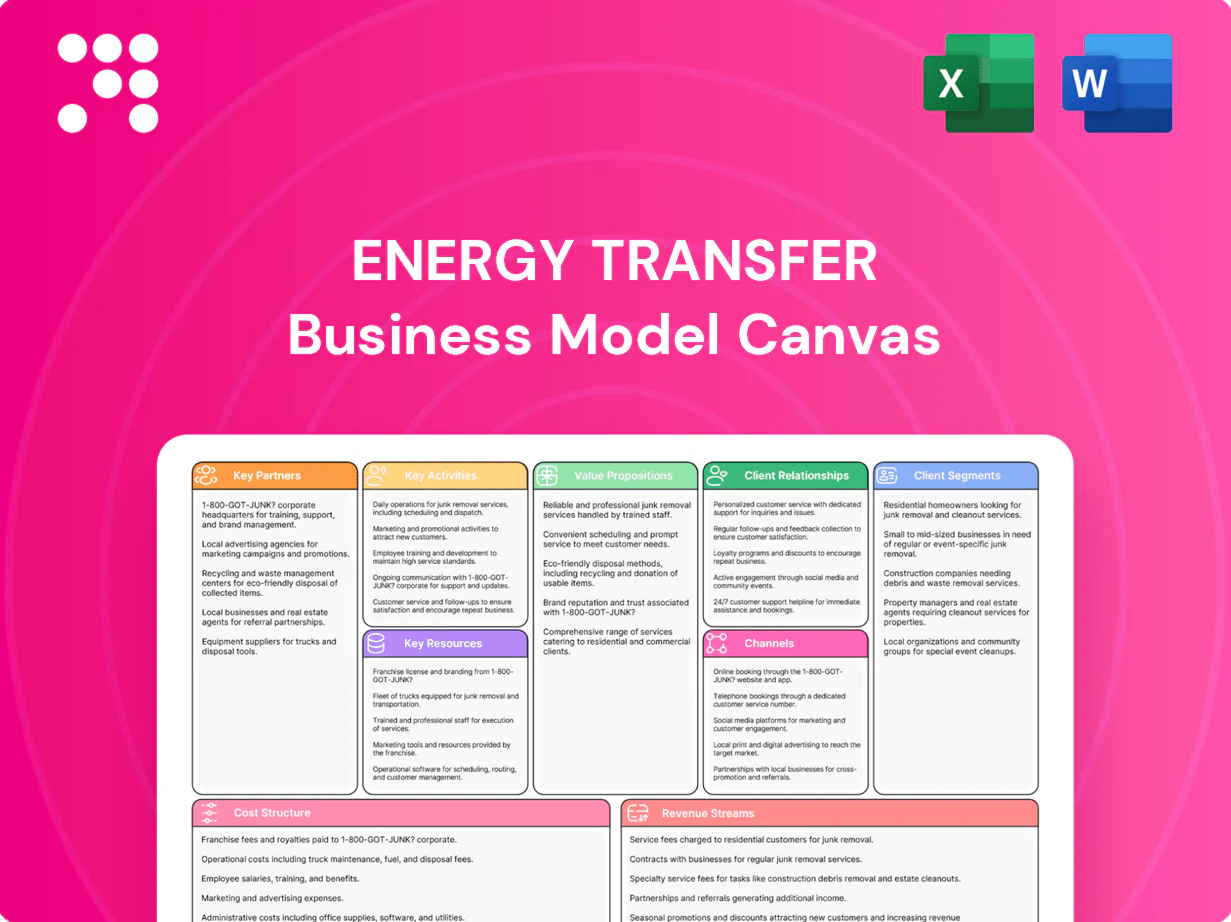
Energy Transfer Business Model Canvas

Midstream energy Business Model Canvas: scale, network assets, fee-based revenue
Explore Energy Transfer’s strategic engine with a concise Business Model Canvas that maps customers, revenue streams, key partners and cost drivers. This snapshot reveals how scale, network assets, and fee-based contracts fuel value creation. Purchase the full, editable Canvas for a complete section-by-section playbook ideal for investors and strategists.
Partnerships

Upstream E&P producers
Upstream E&P producers anchor volumes that keep Energy Transfer pipelines, plants and fractionators utilized, typically via multi-year offtake and acreage dedication arrangements. Energy Transfer collaborates on gathering connections and takeaway solutions to tie production into its systems. These partnerships commonly feature long-duration contracts (often 5–20 years) with coordinated development schedules. Such alignment reduces volumetric risk and supports disciplined capital allocation.
Refiners and petrochemical companies
Refiners and petrochemical partners rely on Energy Transfer for steady crude, gas and NGL feedstock flows, secured through long-term transportation, storage and fractionation arrangements; US operable refinery capacity was about 18.9 million b/d in 2024 with average utilization near 88% (EIA). Joint planning with customers optimizes turnarounds and inventory positioning, ensuring reliable supply that supports plant utilization and margin capture.

Joint ventures and terminal/port partners
Alliances with joint ventures and terminal/port partners expand Energy Transfer’s footprint across export docks, storage hubs, and strategic corridors, leveraging its roughly 120,000 miles of pipeline network to reach global markets. Shared capital structures lower project risk and accelerate market access for crude and NGL exports by co-funding terminals and expansions. Governance frameworks align throughput targets and operational standards across partners. These relationships enable access to premium global pricing and greater commercial flexibility.

Engineering, EPC, and equipment OEMs
Trusted EPC and OEM partners enable Energy Transfer to deliver on-time, on-budget expansions and integrity projects, supporting the company’s >$2 billion 2024 capex program and preserving asset value.
Access to compressors, pumps, meters, and controls drives system reliability and uptime, with standardized designs reducing lifecycle costs and accelerating permitting.
Close collaboration improves safety metrics and operational availability across the network.
- On-time delivery
- Standardized designs
- Critical spares access
- Safety & uptime
Regulators, landowners, and right-of-way stakeholders
Permitting and right-of-way access are mission-critical for construction and operations, supporting Energy Transfer’s approximately 120,000 miles of pipeline network (2024). Constructive relationships with regulators, landowners, and ROW stakeholders speed approvals and minimize costly disruptions to schedule and throughput. Transparent engagement builds community trust, ensures compliance, and secures long-term easements that protect network continuity and expansion options.
- Regulatory approvals: critical path for projects
- Community trust: reduces opposition and delays
- Long-term easements: preserve expansion flexibility
Partners secure 5-20 year offtakes and co-funded terminals across ~120,000 miles
Energy Transfer’s key partners—E&P producers, refiners/petrochemicals, JV terminal owners, EPC/OEMs and ROW stakeholders—secure long-duration (5–20 year) offtakes, co-funded terminals and on-time project delivery that reduce volumetric and execution risk. These alliances support utilization across ~120,000 pipeline miles and a >$2 billion 2024 capex program, enabling reliable feedstock flows and export access.
| Metric | 2024 |
|---|---|
| Pipeline network | ~120,000 miles |
| Capex | > $2 billion |
| Contract terms | 5–20 years |
| US refinery capacity (context) | 18.9M b/d (88% util) |
What is included in the product
 Detailed Word Document
A comprehensive Business Model Canvas for Energy Transfer that maps customer segments, channels, value propositions and the nine BMC blocks to reflect real-world midstream operations, capital structure and growth plans; ideal for investors and lenders with integrated SWOT and competitive-advantage insights to support funding and strategic decisions.

 Customizable Excel Spreadsheet
High-level view of Energy Transfer’s business model with editable cells, quickly surfacing midstream assets, cash flows, contract structures and regulatory risks to relieve due-diligence and strategic planning pain points.
Activities

Pipeline and facility operations
Operate gathering, transmission, and fractionation assets safely and efficiently across an integrated network of approximately 120,000 miles of pipelines (2024). Balance flows, pressures, and product quality in real time to support multi-product batching and custody integrity. Coordinate nominations, batch scheduling, and custody transfer with shippers and terminals to optimize utilization. Maintain service continuity through weather events and peak demand using redundant routes and emergency response protocols.
Asset integrity and maintenance
Execute regular inline inspection (ILI) runs, corrosion control programs and targeted repairs across Energy Transfer’s ~120,000 miles of pipeline network, applying risk-based maintenance to prioritize critical segments and rotating equipment. Update safety instrumented systems and implement Pipeline Safety Management System best practices company-wide. Focus on minimizing downtime while meeting PHMSA and state regulatory standards.

Commercial contracting and optimization
Structure take-or-pay, MVC and fee-based contracts to secure baseline cashflows (Energy Transfer reported roughly $10.0B adjusted EBITDA in 2024) while optimizing tariffs, storage cycles and fractionation spreads to capture seasonal value. Manage capacity allocations and blending to maximize margins and meet specs; use blended nominations and stacking to improve utilization. Hedge commodity and basis exposures and align pricing mechanisms to customer risk profiles and demand patterns.

Capital projects and expansions
Capital projects focus on developing new laterals, debottlenecks and fractionation trains while managing permitting, procurement and construction schedules; Energy Transfer targeted approximately $3.5 billion of consolidated capital expenditures in 2024 to fund these efforts. Investments are staged against anchored commitments and expected returns, with prioritized brownfield projects and phased greenfield starts. Acquired assets are rapidly integrated and operations standardized to capture synergies and accelerate uptime.
- Develop laterals, debottlenecks, fractionation trains
- Manage permitting, procurement, construction schedules
- Stage investments on anchored commitments/returns
- Integrate acquisitions, standardize operations
Compliance, safety, and ESG reporting
Energy Transfer meets PHMSA, FERC and environmental requirements across jurisdictions, coordinating permit compliance for its ~120,000 miles of pipelines as of 2024. The company conducts regular audits, emergency drills and continuous-improvement programs to reduce incidents. It tracks emissions, flaring volumes and community engagement metrics and reports them to stakeholders. Communication with investors is maintained through transparent ESG disclosures and regulatory filings.
- Compliance: PHMSA/FERC across jurisdictions
- Safety: audits, drills, CI programs
- ESG metrics: emissions, flaring, community
- Transparency: ESG disclosures to investors
Operate 120,000 miles pipeline, real-time custody, $3.5B capex, $10.0B EBITDA
Operate and maintain ~120,000 miles of pipelines (2024) with real-time flow and custody management, risk-based ILI and corrosion programs, and emergency response to ensure continuity. Execute capital projects and integrate acquisitions—~$3.5B consolidated capex targeted in 2024—while securing cashflows via take-or-pay/MVC contracts and hedges. Maintain PHMSA/FERC compliance, ESG reporting and ~10.0B adjusted EBITDA (2024).
| Metric | 2024 |
|---|---|
| Pipeline miles | ~120,000 |
| Adjusted EBITDA | $10.0B |
| Consolidated CapEx | $3.5B |
Full Document Unlocks After Purchase
Business Model Canvas
The document you're previewing is the actual Energy Transfer Business Model Canvas, not a mockup. When you purchase, you’ll receive this exact file with all sections included, ready to edit and present in Word and Excel. The preview reflects the final deliverable—no hidden pages or placeholders. Buy with confidence: what you see is what you’ll get.

Midstream energy Business Model Canvas: scale, network assets, fee-based revenue
Explore Energy Transfer’s strategic engine with a concise Business Model Canvas that maps customers, revenue streams, key partners and cost drivers. This snapshot reveals how scale, network assets, and fee-based contracts fuel value creation. Purchase the full, editable Canvas for a complete section-by-section playbook ideal for investors and strategists.
Partnerships
Upstream E&P producers
Upstream E&P producers anchor volumes that keep Energy Transfer pipelines, plants and fractionators utilized, typically via multi-year offtake and acreage dedication arrangements. Energy Transfer collaborates on gathering connections and takeaway solutions to tie production into its systems. These partnerships commonly feature long-duration contracts (often 5–20 years) with coordinated development schedules. Such alignment reduces volumetric risk and supports disciplined capital allocation.
Refiners and petrochemical companies
Refiners and petrochemical partners rely on Energy Transfer for steady crude, gas and NGL feedstock flows, secured through long-term transportation, storage and fractionation arrangements; US operable refinery capacity was about 18.9 million b/d in 2024 with average utilization near 88% (EIA). Joint planning with customers optimizes turnarounds and inventory positioning, ensuring reliable supply that supports plant utilization and margin capture.
Joint ventures and terminal/port partners
Alliances with joint ventures and terminal/port partners expand Energy Transfer’s footprint across export docks, storage hubs, and strategic corridors, leveraging its roughly 120,000 miles of pipeline network to reach global markets. Shared capital structures lower project risk and accelerate market access for crude and NGL exports by co-funding terminals and expansions. Governance frameworks align throughput targets and operational standards across partners. These relationships enable access to premium global pricing and greater commercial flexibility.
Engineering, EPC, and equipment OEMs
Trusted EPC and OEM partners enable Energy Transfer to deliver on-time, on-budget expansions and integrity projects, supporting the company’s >$2 billion 2024 capex program and preserving asset value.
Access to compressors, pumps, meters, and controls drives system reliability and uptime, with standardized designs reducing lifecycle costs and accelerating permitting.
Close collaboration improves safety metrics and operational availability across the network.
- On-time delivery
- Standardized designs
- Critical spares access
- Safety & uptime
Regulators, landowners, and right-of-way stakeholders
Permitting and right-of-way access are mission-critical for construction and operations, supporting Energy Transfer’s approximately 120,000 miles of pipeline network (2024). Constructive relationships with regulators, landowners, and ROW stakeholders speed approvals and minimize costly disruptions to schedule and throughput. Transparent engagement builds community trust, ensures compliance, and secures long-term easements that protect network continuity and expansion options.
- Regulatory approvals: critical path for projects
- Community trust: reduces opposition and delays
- Long-term easements: preserve expansion flexibility
Partners secure 5-20 year offtakes and co-funded terminals across ~120,000 miles
Energy Transfer’s key partners—E&P producers, refiners/petrochemicals, JV terminal owners, EPC/OEMs and ROW stakeholders—secure long-duration (5–20 year) offtakes, co-funded terminals and on-time project delivery that reduce volumetric and execution risk. These alliances support utilization across ~120,000 pipeline miles and a >$2 billion 2024 capex program, enabling reliable feedstock flows and export access.
| Metric | 2024 |
|---|---|
| Pipeline network | ~120,000 miles |
| Capex | > $2 billion |
| Contract terms | 5–20 years |
| US refinery capacity (context) | 18.9M b/d (88% util) |
What is included in the product
Detailed Word Document
A comprehensive Business Model Canvas for Energy Transfer that maps customer segments, channels, value propositions and the nine BMC blocks to reflect real-world midstream operations, capital structure and growth plans; ideal for investors and lenders with integrated SWOT and competitive-advantage insights to support funding and strategic decisions.
Customizable Excel Spreadsheet
High-level view of Energy Transfer’s business model with editable cells, quickly surfacing midstream assets, cash flows, contract structures and regulatory risks to relieve due-diligence and strategic planning pain points.
Activities
Pipeline and facility operations
Operate gathering, transmission, and fractionation assets safely and efficiently across an integrated network of approximately 120,000 miles of pipelines (2024). Balance flows, pressures, and product quality in real time to support multi-product batching and custody integrity. Coordinate nominations, batch scheduling, and custody transfer with shippers and terminals to optimize utilization. Maintain service continuity through weather events and peak demand using redundant routes and emergency response protocols.
Asset integrity and maintenance
Execute regular inline inspection (ILI) runs, corrosion control programs and targeted repairs across Energy Transfer’s ~120,000 miles of pipeline network, applying risk-based maintenance to prioritize critical segments and rotating equipment. Update safety instrumented systems and implement Pipeline Safety Management System best practices company-wide. Focus on minimizing downtime while meeting PHMSA and state regulatory standards.
Commercial contracting and optimization
Structure take-or-pay, MVC and fee-based contracts to secure baseline cashflows (Energy Transfer reported roughly $10.0B adjusted EBITDA in 2024) while optimizing tariffs, storage cycles and fractionation spreads to capture seasonal value. Manage capacity allocations and blending to maximize margins and meet specs; use blended nominations and stacking to improve utilization. Hedge commodity and basis exposures and align pricing mechanisms to customer risk profiles and demand patterns.
Capital projects and expansions
Capital projects focus on developing new laterals, debottlenecks and fractionation trains while managing permitting, procurement and construction schedules; Energy Transfer targeted approximately $3.5 billion of consolidated capital expenditures in 2024 to fund these efforts. Investments are staged against anchored commitments and expected returns, with prioritized brownfield projects and phased greenfield starts. Acquired assets are rapidly integrated and operations standardized to capture synergies and accelerate uptime.
- Develop laterals, debottlenecks, fractionation trains
- Manage permitting, procurement, construction schedules
- Stage investments on anchored commitments/returns
- Integrate acquisitions, standardize operations
Compliance, safety, and ESG reporting
Energy Transfer meets PHMSA, FERC and environmental requirements across jurisdictions, coordinating permit compliance for its ~120,000 miles of pipelines as of 2024. The company conducts regular audits, emergency drills and continuous-improvement programs to reduce incidents. It tracks emissions, flaring volumes and community engagement metrics and reports them to stakeholders. Communication with investors is maintained through transparent ESG disclosures and regulatory filings.
- Compliance: PHMSA/FERC across jurisdictions
- Safety: audits, drills, CI programs
- ESG metrics: emissions, flaring, community
- Transparency: ESG disclosures to investors
Operate 120,000 miles pipeline, real-time custody, $3.5B capex, $10.0B EBITDA
Operate and maintain ~120,000 miles of pipelines (2024) with real-time flow and custody management, risk-based ILI and corrosion programs, and emergency response to ensure continuity. Execute capital projects and integrate acquisitions—~$3.5B consolidated capex targeted in 2024—while securing cashflows via take-or-pay/MVC contracts and hedges. Maintain PHMSA/FERC compliance, ESG reporting and ~10.0B adjusted EBITDA (2024).
| Metric | 2024 |
|---|---|
| Pipeline miles | ~120,000 |
| Adjusted EBITDA | $10.0B |
| Consolidated CapEx | $3.5B |
Full Document Unlocks After Purchase
Business Model Canvas
The document you're previewing is the actual Energy Transfer Business Model Canvas, not a mockup. When you purchase, you’ll receive this exact file with all sections included, ready to edit and present in Word and Excel. The preview reflects the final deliverable—no hidden pages or placeholders. Buy with confidence: what you see is what you’ll get.
Original: $10.00
-65%$10.00
$3.50Description
Midstream energy Business Model Canvas: scale, network assets, fee-based revenue
Explore Energy Transfer’s strategic engine with a concise Business Model Canvas that maps customers, revenue streams, key partners and cost drivers. This snapshot reveals how scale, network assets, and fee-based contracts fuel value creation. Purchase the full, editable Canvas for a complete section-by-section playbook ideal for investors and strategists.
Partnerships
Upstream E&P producers
Upstream E&P producers anchor volumes that keep Energy Transfer pipelines, plants and fractionators utilized, typically via multi-year offtake and acreage dedication arrangements. Energy Transfer collaborates on gathering connections and takeaway solutions to tie production into its systems. These partnerships commonly feature long-duration contracts (often 5–20 years) with coordinated development schedules. Such alignment reduces volumetric risk and supports disciplined capital allocation.
Refiners and petrochemical companies
Refiners and petrochemical partners rely on Energy Transfer for steady crude, gas and NGL feedstock flows, secured through long-term transportation, storage and fractionation arrangements; US operable refinery capacity was about 18.9 million b/d in 2024 with average utilization near 88% (EIA). Joint planning with customers optimizes turnarounds and inventory positioning, ensuring reliable supply that supports plant utilization and margin capture.
Joint ventures and terminal/port partners
Alliances with joint ventures and terminal/port partners expand Energy Transfer’s footprint across export docks, storage hubs, and strategic corridors, leveraging its roughly 120,000 miles of pipeline network to reach global markets. Shared capital structures lower project risk and accelerate market access for crude and NGL exports by co-funding terminals and expansions. Governance frameworks align throughput targets and operational standards across partners. These relationships enable access to premium global pricing and greater commercial flexibility.
Engineering, EPC, and equipment OEMs
Trusted EPC and OEM partners enable Energy Transfer to deliver on-time, on-budget expansions and integrity projects, supporting the company’s >$2 billion 2024 capex program and preserving asset value.
Access to compressors, pumps, meters, and controls drives system reliability and uptime, with standardized designs reducing lifecycle costs and accelerating permitting.
Close collaboration improves safety metrics and operational availability across the network.
- On-time delivery
- Standardized designs
- Critical spares access
- Safety & uptime
Regulators, landowners, and right-of-way stakeholders
Permitting and right-of-way access are mission-critical for construction and operations, supporting Energy Transfer’s approximately 120,000 miles of pipeline network (2024). Constructive relationships with regulators, landowners, and ROW stakeholders speed approvals and minimize costly disruptions to schedule and throughput. Transparent engagement builds community trust, ensures compliance, and secures long-term easements that protect network continuity and expansion options.
- Regulatory approvals: critical path for projects
- Community trust: reduces opposition and delays
- Long-term easements: preserve expansion flexibility
Partners secure 5-20 year offtakes and co-funded terminals across ~120,000 miles
Energy Transfer’s key partners—E&P producers, refiners/petrochemicals, JV terminal owners, EPC/OEMs and ROW stakeholders—secure long-duration (5–20 year) offtakes, co-funded terminals and on-time project delivery that reduce volumetric and execution risk. These alliances support utilization across ~120,000 pipeline miles and a >$2 billion 2024 capex program, enabling reliable feedstock flows and export access.
| Metric | 2024 |
|---|---|
| Pipeline network | ~120,000 miles |
| Capex | > $2 billion |
| Contract terms | 5–20 years |
| US refinery capacity (context) | 18.9M b/d (88% util) |
What is included in the product
Detailed Word Document
A comprehensive Business Model Canvas for Energy Transfer that maps customer segments, channels, value propositions and the nine BMC blocks to reflect real-world midstream operations, capital structure and growth plans; ideal for investors and lenders with integrated SWOT and competitive-advantage insights to support funding and strategic decisions.
Customizable Excel Spreadsheet
High-level view of Energy Transfer’s business model with editable cells, quickly surfacing midstream assets, cash flows, contract structures and regulatory risks to relieve due-diligence and strategic planning pain points.
Activities
Pipeline and facility operations
Operate gathering, transmission, and fractionation assets safely and efficiently across an integrated network of approximately 120,000 miles of pipelines (2024). Balance flows, pressures, and product quality in real time to support multi-product batching and custody integrity. Coordinate nominations, batch scheduling, and custody transfer with shippers and terminals to optimize utilization. Maintain service continuity through weather events and peak demand using redundant routes and emergency response protocols.
Asset integrity and maintenance
Execute regular inline inspection (ILI) runs, corrosion control programs and targeted repairs across Energy Transfer’s ~120,000 miles of pipeline network, applying risk-based maintenance to prioritize critical segments and rotating equipment. Update safety instrumented systems and implement Pipeline Safety Management System best practices company-wide. Focus on minimizing downtime while meeting PHMSA and state regulatory standards.
Commercial contracting and optimization
Structure take-or-pay, MVC and fee-based contracts to secure baseline cashflows (Energy Transfer reported roughly $10.0B adjusted EBITDA in 2024) while optimizing tariffs, storage cycles and fractionation spreads to capture seasonal value. Manage capacity allocations and blending to maximize margins and meet specs; use blended nominations and stacking to improve utilization. Hedge commodity and basis exposures and align pricing mechanisms to customer risk profiles and demand patterns.
Capital projects and expansions
Capital projects focus on developing new laterals, debottlenecks and fractionation trains while managing permitting, procurement and construction schedules; Energy Transfer targeted approximately $3.5 billion of consolidated capital expenditures in 2024 to fund these efforts. Investments are staged against anchored commitments and expected returns, with prioritized brownfield projects and phased greenfield starts. Acquired assets are rapidly integrated and operations standardized to capture synergies and accelerate uptime.
- Develop laterals, debottlenecks, fractionation trains
- Manage permitting, procurement, construction schedules
- Stage investments on anchored commitments/returns
- Integrate acquisitions, standardize operations
Compliance, safety, and ESG reporting
Energy Transfer meets PHMSA, FERC and environmental requirements across jurisdictions, coordinating permit compliance for its ~120,000 miles of pipelines as of 2024. The company conducts regular audits, emergency drills and continuous-improvement programs to reduce incidents. It tracks emissions, flaring volumes and community engagement metrics and reports them to stakeholders. Communication with investors is maintained through transparent ESG disclosures and regulatory filings.
- Compliance: PHMSA/FERC across jurisdictions
- Safety: audits, drills, CI programs
- ESG metrics: emissions, flaring, community
- Transparency: ESG disclosures to investors
Operate 120,000 miles pipeline, real-time custody, $3.5B capex, $10.0B EBITDA
Operate and maintain ~120,000 miles of pipelines (2024) with real-time flow and custody management, risk-based ILI and corrosion programs, and emergency response to ensure continuity. Execute capital projects and integrate acquisitions—~$3.5B consolidated capex targeted in 2024—while securing cashflows via take-or-pay/MVC contracts and hedges. Maintain PHMSA/FERC compliance, ESG reporting and ~10.0B adjusted EBITDA (2024).
| Metric | 2024 |
|---|---|
| Pipeline miles | ~120,000 |
| Adjusted EBITDA | $10.0B |
| Consolidated CapEx | $3.5B |
Full Document Unlocks After Purchase
Business Model Canvas
The document you're previewing is the actual Energy Transfer Business Model Canvas, not a mockup. When you purchase, you’ll receive this exact file with all sections included, ready to edit and present in Word and Excel. The preview reflects the final deliverable—no hidden pages or placeholders. Buy with confidence: what you see is what you’ll get.











