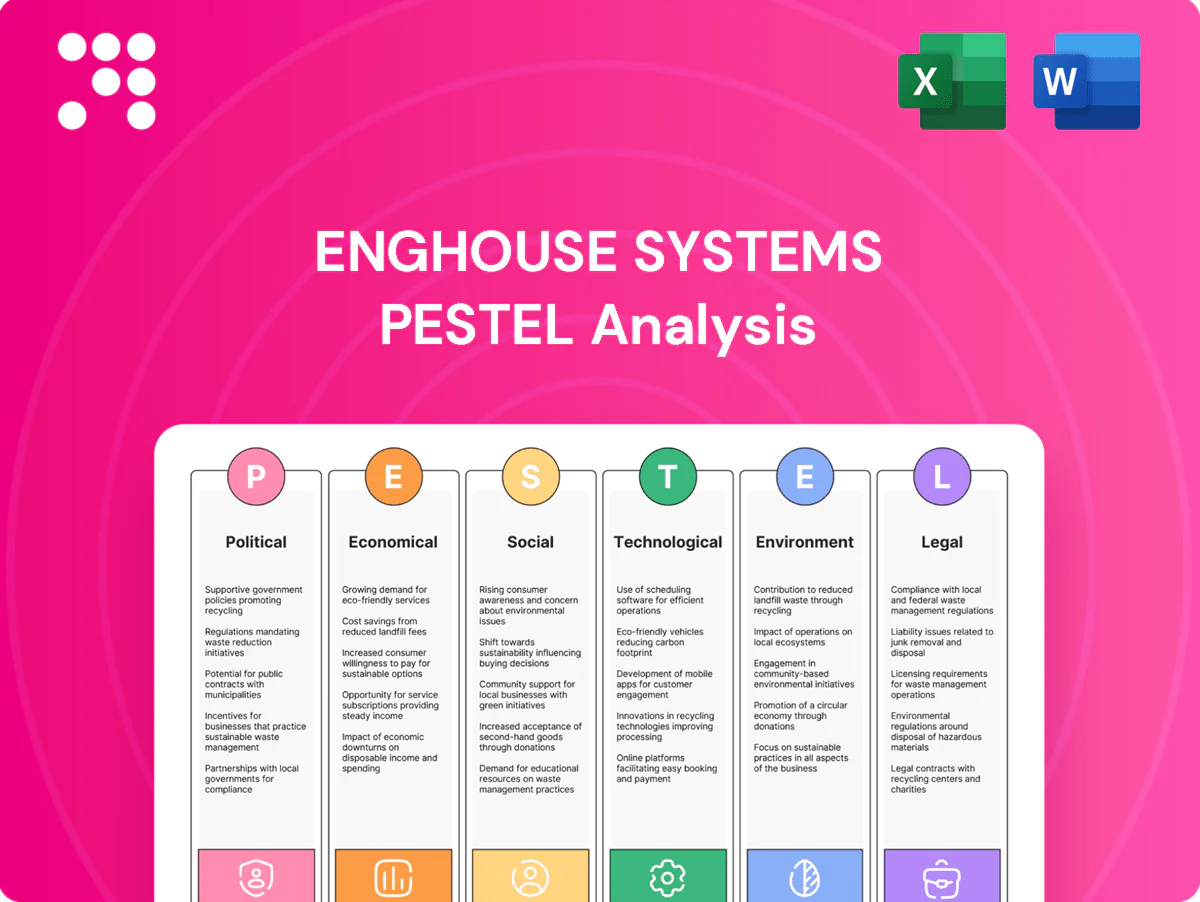
Enghouse Systems PESTLE Analysis

Your Competitive Advantage Starts with This Report
Gain a competitive edge with our tailored PESTLE Analysis of Enghouse Systems—three to five concise insights show how political, economic, social, technological, legal, and environmental forces shape strategy and valuation. Ideal for investors and planners, the full, editable report provides actionable intelligence; purchase now to download the complete analysis and make smarter decisions.
Political factors

Cross-border policy shifts
Enghouse Systems (TSX: ENGH), a Canada-based global software vendor, faces cross-border policy shifts that lengthen sales cycles and complicate delivery across multiple jurisdictions. US and allied export controls on communications and video tech (BIS/EAR updates since 2023) can restrict features and markets. Shifts in government procurement priorities materially alter large bid opportunities, while political instability delays public safety and transport deployments.
Public-sector spending
Enghouse’s suites for public safety, healthcare and transport depend on politically set budgets, so election cycles often shift RFP timing and contract continuity. Major stimulus programs—US Bipartisan Infrastructure Law (~1.2 trillion USD) and EU NextGenerationEU (750 billion EUR)—have accelerated digital modernization projects. Conversely, austerity measures in municipalities can freeze upgrades and lengthen renewals.

Data sovereignty mandates
Governments increasingly require local data hosting and routing, with more than 60 jurisdictions having introduced localization measures by 2024, pushing Enghouse to design region-specific cloud architectures. This drives partner selection toward local IaaS and managed-service providers and can increase hosting and compliance costs—often cited up to 20% higher—while limiting scale efficiencies. In regulated markets, documented compliance acts as a commercial differentiator for Enghouse.

Telecom regulation
Telecom regulation directly affects Enghouse Systems because its contact centre and telco solutions depend on licensed carriers and interconnect rules; changes to net neutrality, spectrum allocation or universal service policies can reshape demand amid a global market with about 5.5 billion unique mobile subscribers and ~8.6 billion connections (GSMA 2024). Regulated tariffs and interoperability standards constrain pricing and product integration, so active engagement with regulators helps anticipate shifts and protect recurring revenue.
- Carrier dependence: licensed interconnect rules
- Policy risk: net neutrality, spectrum, universal service
- Pricing: regulated tariffs, interoperability standards
- Mitigation: regulator engagement, monitoring market shifts
Geopolitical risk and sanctions
Geopolitical risk and sanctions reshape Enghouse Systems addressable markets and channel relationships as sanctioned jurisdictions are cut off and resellers face compliance hurdles. Tensions can disrupt supply chains for infrastructure components and hosting, pushing customers toward vendors with neutral footprints to reduce operational risk. Robust screening, OFAC/Global sanctions checks and contingency plans mitigate exposure and preserve contract continuity.
- Sanctions shrink market access and partner networks
- Supply-chain interruptions for hosting and hardware
- Customer preference for neutral vendors
- Mandatory robust screening and contingency planning
Cross-border controls and data-localization extend sales cycles despite $1.2T/€750B stimulus
Enghouse faces longer sales cycles from cross-border export controls and procurement shifts, with 60+ data‑localization laws by 2024 and hosting costs cited up to 20% higher. Infrastructure stimulus (US $1.2T, EU €750B) fuels public-sector demand but election cycles and austerity create timing risk. Telecom rules affect pricing amid ~5.5B mobile users and ~8.6B connections (GSMA 2024), while sanctions/OFAC checks constrain channels.
| Risk | Metric/Fact |
|---|---|
| Data localization | 60+ jurisdictions (2024); hosting +20% cost |
| Stimulus | US $1.2T; EU €750B |
| Telco scale | 5.5B users / 8.6B connections (GSMA 2024) |
What is included in the product
 Detailed Word Document
Explores how Political, Economic, Social, Technological, Environmental and Legal forces uniquely affect Enghouse Systems, with data-driven trends and region-specific regulatory context; designed for executives and advisors to identify risks, opportunities and scenario-driven actions. Each dimension includes detailed sub-points and forward-looking insights ready for decks, plans and investor discussion.

 Customizable Excel Spreadsheet
A concise, visually segmented PESTLE summary for Enghouse Systems that’s easily dropped into presentations or shared across teams, helping streamline external risk discussions and strategic planning; editable notes let users adapt insights to region or product line nuances.
Economic factors

IT spending cycles
Software budgets expand in growth periods and compress in downturns; Gartner estimated global IT spending at about $4.7 trillion in 2024, underscoring cyclical volatility. Contact center modernization and CX projects are often delayed when demand weakens, though the contact center software market maintained roughly a 7% CAGR into 2024. Mission-critical workloads stay resilient, and pricing flexibility plus clear ROI proof points support customer retention for Enghouse.
Interest rates and M&A
Enghouse’s acquisitive model is sensitive to financing costs; with major policy rates near 5% in 2024 (Bank of Canada ~5.00%, US Fed funds 5.25–5.50%), higher rates raise required hurdle returns and compress valuation multiples for targets. Market slowdowns driven by tighter credit can create buying windows and lower prices for strategic targets. Rigorous integration discipline is crucial to preserve projected value gains post-acquisition.

Currency fluctuations
Enghouse Systems, headquartered in Canada with significant international sales, faces material FX volatility as a stronger CAD reduces reported foreign revenue; CAD averaged about 0.74–0.76 USD in 2024. The company applies hedging policies and leverages natural currency offsets across operations to stabilize margins. Pricing localization and local-currency contracts further cut transaction risk and protect reported results.

Labor market dynamics
Competition for engineers and product specialists drives wage inflation (tech wages rose roughly 6–9% in 2023–24), while remote work—now ~35% of tech roles—broadens talent pools but increases cross‑jurisdiction compliance and payroll complexity. Productivity tools and nearshore hubs (costs often 20–30% below onshore) help balance cost and quality. Post‑acquisition retention programs reduce turnover and protect domain knowledge.
- Wage inflation: 6–9%
- Remote roles: ~35%
- Nearshore savings: 20–30%
- Retention cuts turnover, preserves IP
Customer consolidation
Telecom and enterprise customers are consolidating, concentrating buying power and intensifying pricing pressure and vendor rationalization; the global telecom services market was about USD 1.8 trillion in 2023. Enghouse can defend share via multi-product bundles and long-term contracts, while strong support and clear migration paths cut churn risk.
- Fewer, larger buyers → pricing pressure
- Vendor rationalization → need for broad portfolios
- Bundles + long contracts → defend share
- Support/migration → lower churn
Cross-border controls and data-localization extend sales cycles despite $1.2T/€750B stimulus
Software spend cyclical: global IT spend ~$4.7T (2024); contact‑center software ~7% CAGR to 2024, supporting Enghouse recurring revenue. Policy rates ~5% (2024) raise acquisition costs but create buying windows; strong cash flow aids M&A. FX: CAD ~0.74–0.76 USD (2024) with hedging; wage inflation 6–9% and nearshore saves 20–30%.
| Metric | Value |
|---|---|
| Global IT spend (2024) | $4.7T |
| Contact‑center CAGR | ~7% |
| Policy rates (2024) | ~5% |
| CAD/USD (2024) | 0.74–0.76 |
| Wage inflation | 6–9% |
| Nearshore savings | 20–30% |
| Telecom market (2023) | $1.8T |
What You See Is What You Get
Enghouse Systems PESTLE Analysis
The preview shown here is the exact Enghouse Systems PESTLE Analysis you’ll receive after purchase—fully formatted and ready to use. It contains the complete political, economic, social, technological, legal and environmental assessment as displayed. No placeholders or teasers—this is the final file, ready to download immediately after payment.

Your Competitive Advantage Starts with This Report
Gain a competitive edge with our tailored PESTLE Analysis of Enghouse Systems—three to five concise insights show how political, economic, social, technological, legal, and environmental forces shape strategy and valuation. Ideal for investors and planners, the full, editable report provides actionable intelligence; purchase now to download the complete analysis and make smarter decisions.
Political factors
Cross-border policy shifts
Enghouse Systems (TSX: ENGH), a Canada-based global software vendor, faces cross-border policy shifts that lengthen sales cycles and complicate delivery across multiple jurisdictions. US and allied export controls on communications and video tech (BIS/EAR updates since 2023) can restrict features and markets. Shifts in government procurement priorities materially alter large bid opportunities, while political instability delays public safety and transport deployments.
Public-sector spending
Enghouse’s suites for public safety, healthcare and transport depend on politically set budgets, so election cycles often shift RFP timing and contract continuity. Major stimulus programs—US Bipartisan Infrastructure Law (~1.2 trillion USD) and EU NextGenerationEU (750 billion EUR)—have accelerated digital modernization projects. Conversely, austerity measures in municipalities can freeze upgrades and lengthen renewals.
Data sovereignty mandates
Governments increasingly require local data hosting and routing, with more than 60 jurisdictions having introduced localization measures by 2024, pushing Enghouse to design region-specific cloud architectures. This drives partner selection toward local IaaS and managed-service providers and can increase hosting and compliance costs—often cited up to 20% higher—while limiting scale efficiencies. In regulated markets, documented compliance acts as a commercial differentiator for Enghouse.
Telecom regulation
Telecom regulation directly affects Enghouse Systems because its contact centre and telco solutions depend on licensed carriers and interconnect rules; changes to net neutrality, spectrum allocation or universal service policies can reshape demand amid a global market with about 5.5 billion unique mobile subscribers and ~8.6 billion connections (GSMA 2024). Regulated tariffs and interoperability standards constrain pricing and product integration, so active engagement with regulators helps anticipate shifts and protect recurring revenue.
- Carrier dependence: licensed interconnect rules
- Policy risk: net neutrality, spectrum, universal service
- Pricing: regulated tariffs, interoperability standards
- Mitigation: regulator engagement, monitoring market shifts
Geopolitical risk and sanctions
Geopolitical risk and sanctions reshape Enghouse Systems addressable markets and channel relationships as sanctioned jurisdictions are cut off and resellers face compliance hurdles. Tensions can disrupt supply chains for infrastructure components and hosting, pushing customers toward vendors with neutral footprints to reduce operational risk. Robust screening, OFAC/Global sanctions checks and contingency plans mitigate exposure and preserve contract continuity.
- Sanctions shrink market access and partner networks
- Supply-chain interruptions for hosting and hardware
- Customer preference for neutral vendors
- Mandatory robust screening and contingency planning
Cross-border controls and data-localization extend sales cycles despite $1.2T/€750B stimulus
Enghouse faces longer sales cycles from cross-border export controls and procurement shifts, with 60+ data‑localization laws by 2024 and hosting costs cited up to 20% higher. Infrastructure stimulus (US $1.2T, EU €750B) fuels public-sector demand but election cycles and austerity create timing risk. Telecom rules affect pricing amid ~5.5B mobile users and ~8.6B connections (GSMA 2024), while sanctions/OFAC checks constrain channels.
| Risk | Metric/Fact |
|---|---|
| Data localization | 60+ jurisdictions (2024); hosting +20% cost |
| Stimulus | US $1.2T; EU €750B |
| Telco scale | 5.5B users / 8.6B connections (GSMA 2024) |
What is included in the product
Detailed Word Document
Explores how Political, Economic, Social, Technological, Environmental and Legal forces uniquely affect Enghouse Systems, with data-driven trends and region-specific regulatory context; designed for executives and advisors to identify risks, opportunities and scenario-driven actions. Each dimension includes detailed sub-points and forward-looking insights ready for decks, plans and investor discussion.
Customizable Excel Spreadsheet
A concise, visually segmented PESTLE summary for Enghouse Systems that’s easily dropped into presentations or shared across teams, helping streamline external risk discussions and strategic planning; editable notes let users adapt insights to region or product line nuances.
Economic factors
IT spending cycles
Software budgets expand in growth periods and compress in downturns; Gartner estimated global IT spending at about $4.7 trillion in 2024, underscoring cyclical volatility. Contact center modernization and CX projects are often delayed when demand weakens, though the contact center software market maintained roughly a 7% CAGR into 2024. Mission-critical workloads stay resilient, and pricing flexibility plus clear ROI proof points support customer retention for Enghouse.
Interest rates and M&A
Enghouse’s acquisitive model is sensitive to financing costs; with major policy rates near 5% in 2024 (Bank of Canada ~5.00%, US Fed funds 5.25–5.50%), higher rates raise required hurdle returns and compress valuation multiples for targets. Market slowdowns driven by tighter credit can create buying windows and lower prices for strategic targets. Rigorous integration discipline is crucial to preserve projected value gains post-acquisition.
Currency fluctuations
Enghouse Systems, headquartered in Canada with significant international sales, faces material FX volatility as a stronger CAD reduces reported foreign revenue; CAD averaged about 0.74–0.76 USD in 2024. The company applies hedging policies and leverages natural currency offsets across operations to stabilize margins. Pricing localization and local-currency contracts further cut transaction risk and protect reported results.
Labor market dynamics
Competition for engineers and product specialists drives wage inflation (tech wages rose roughly 6–9% in 2023–24), while remote work—now ~35% of tech roles—broadens talent pools but increases cross‑jurisdiction compliance and payroll complexity. Productivity tools and nearshore hubs (costs often 20–30% below onshore) help balance cost and quality. Post‑acquisition retention programs reduce turnover and protect domain knowledge.
- Wage inflation: 6–9%
- Remote roles: ~35%
- Nearshore savings: 20–30%
- Retention cuts turnover, preserves IP
Customer consolidation
Telecom and enterprise customers are consolidating, concentrating buying power and intensifying pricing pressure and vendor rationalization; the global telecom services market was about USD 1.8 trillion in 2023. Enghouse can defend share via multi-product bundles and long-term contracts, while strong support and clear migration paths cut churn risk.
- Fewer, larger buyers → pricing pressure
- Vendor rationalization → need for broad portfolios
- Bundles + long contracts → defend share
- Support/migration → lower churn
Cross-border controls and data-localization extend sales cycles despite $1.2T/€750B stimulus
Software spend cyclical: global IT spend ~$4.7T (2024); contact‑center software ~7% CAGR to 2024, supporting Enghouse recurring revenue. Policy rates ~5% (2024) raise acquisition costs but create buying windows; strong cash flow aids M&A. FX: CAD ~0.74–0.76 USD (2024) with hedging; wage inflation 6–9% and nearshore saves 20–30%.
| Metric | Value |
|---|---|
| Global IT spend (2024) | $4.7T |
| Contact‑center CAGR | ~7% |
| Policy rates (2024) | ~5% |
| CAD/USD (2024) | 0.74–0.76 |
| Wage inflation | 6–9% |
| Nearshore savings | 20–30% |
| Telecom market (2023) | $1.8T |
What You See Is What You Get
Enghouse Systems PESTLE Analysis
The preview shown here is the exact Enghouse Systems PESTLE Analysis you’ll receive after purchase—fully formatted and ready to use. It contains the complete political, economic, social, technological, legal and environmental assessment as displayed. No placeholders or teasers—this is the final file, ready to download immediately after payment.
Original: $10.00
-65%$10.00
$3.50Description
Your Competitive Advantage Starts with This Report
Gain a competitive edge with our tailored PESTLE Analysis of Enghouse Systems—three to five concise insights show how political, economic, social, technological, legal, and environmental forces shape strategy and valuation. Ideal for investors and planners, the full, editable report provides actionable intelligence; purchase now to download the complete analysis and make smarter decisions.
Political factors
Cross-border policy shifts
Enghouse Systems (TSX: ENGH), a Canada-based global software vendor, faces cross-border policy shifts that lengthen sales cycles and complicate delivery across multiple jurisdictions. US and allied export controls on communications and video tech (BIS/EAR updates since 2023) can restrict features and markets. Shifts in government procurement priorities materially alter large bid opportunities, while political instability delays public safety and transport deployments.
Public-sector spending
Enghouse’s suites for public safety, healthcare and transport depend on politically set budgets, so election cycles often shift RFP timing and contract continuity. Major stimulus programs—US Bipartisan Infrastructure Law (~1.2 trillion USD) and EU NextGenerationEU (750 billion EUR)—have accelerated digital modernization projects. Conversely, austerity measures in municipalities can freeze upgrades and lengthen renewals.
Data sovereignty mandates
Governments increasingly require local data hosting and routing, with more than 60 jurisdictions having introduced localization measures by 2024, pushing Enghouse to design region-specific cloud architectures. This drives partner selection toward local IaaS and managed-service providers and can increase hosting and compliance costs—often cited up to 20% higher—while limiting scale efficiencies. In regulated markets, documented compliance acts as a commercial differentiator for Enghouse.
Telecom regulation
Telecom regulation directly affects Enghouse Systems because its contact centre and telco solutions depend on licensed carriers and interconnect rules; changes to net neutrality, spectrum allocation or universal service policies can reshape demand amid a global market with about 5.5 billion unique mobile subscribers and ~8.6 billion connections (GSMA 2024). Regulated tariffs and interoperability standards constrain pricing and product integration, so active engagement with regulators helps anticipate shifts and protect recurring revenue.
- Carrier dependence: licensed interconnect rules
- Policy risk: net neutrality, spectrum, universal service
- Pricing: regulated tariffs, interoperability standards
- Mitigation: regulator engagement, monitoring market shifts
Geopolitical risk and sanctions
Geopolitical risk and sanctions reshape Enghouse Systems addressable markets and channel relationships as sanctioned jurisdictions are cut off and resellers face compliance hurdles. Tensions can disrupt supply chains for infrastructure components and hosting, pushing customers toward vendors with neutral footprints to reduce operational risk. Robust screening, OFAC/Global sanctions checks and contingency plans mitigate exposure and preserve contract continuity.
- Sanctions shrink market access and partner networks
- Supply-chain interruptions for hosting and hardware
- Customer preference for neutral vendors
- Mandatory robust screening and contingency planning
Cross-border controls and data-localization extend sales cycles despite $1.2T/€750B stimulus
Enghouse faces longer sales cycles from cross-border export controls and procurement shifts, with 60+ data‑localization laws by 2024 and hosting costs cited up to 20% higher. Infrastructure stimulus (US $1.2T, EU €750B) fuels public-sector demand but election cycles and austerity create timing risk. Telecom rules affect pricing amid ~5.5B mobile users and ~8.6B connections (GSMA 2024), while sanctions/OFAC checks constrain channels.
| Risk | Metric/Fact |
|---|---|
| Data localization | 60+ jurisdictions (2024); hosting +20% cost |
| Stimulus | US $1.2T; EU €750B |
| Telco scale | 5.5B users / 8.6B connections (GSMA 2024) |
What is included in the product
Detailed Word Document
Explores how Political, Economic, Social, Technological, Environmental and Legal forces uniquely affect Enghouse Systems, with data-driven trends and region-specific regulatory context; designed for executives and advisors to identify risks, opportunities and scenario-driven actions. Each dimension includes detailed sub-points and forward-looking insights ready for decks, plans and investor discussion.
Customizable Excel Spreadsheet
A concise, visually segmented PESTLE summary for Enghouse Systems that’s easily dropped into presentations or shared across teams, helping streamline external risk discussions and strategic planning; editable notes let users adapt insights to region or product line nuances.
Economic factors
IT spending cycles
Software budgets expand in growth periods and compress in downturns; Gartner estimated global IT spending at about $4.7 trillion in 2024, underscoring cyclical volatility. Contact center modernization and CX projects are often delayed when demand weakens, though the contact center software market maintained roughly a 7% CAGR into 2024. Mission-critical workloads stay resilient, and pricing flexibility plus clear ROI proof points support customer retention for Enghouse.
Interest rates and M&A
Enghouse’s acquisitive model is sensitive to financing costs; with major policy rates near 5% in 2024 (Bank of Canada ~5.00%, US Fed funds 5.25–5.50%), higher rates raise required hurdle returns and compress valuation multiples for targets. Market slowdowns driven by tighter credit can create buying windows and lower prices for strategic targets. Rigorous integration discipline is crucial to preserve projected value gains post-acquisition.
Currency fluctuations
Enghouse Systems, headquartered in Canada with significant international sales, faces material FX volatility as a stronger CAD reduces reported foreign revenue; CAD averaged about 0.74–0.76 USD in 2024. The company applies hedging policies and leverages natural currency offsets across operations to stabilize margins. Pricing localization and local-currency contracts further cut transaction risk and protect reported results.
Labor market dynamics
Competition for engineers and product specialists drives wage inflation (tech wages rose roughly 6–9% in 2023–24), while remote work—now ~35% of tech roles—broadens talent pools but increases cross‑jurisdiction compliance and payroll complexity. Productivity tools and nearshore hubs (costs often 20–30% below onshore) help balance cost and quality. Post‑acquisition retention programs reduce turnover and protect domain knowledge.
- Wage inflation: 6–9%
- Remote roles: ~35%
- Nearshore savings: 20–30%
- Retention cuts turnover, preserves IP
Customer consolidation
Telecom and enterprise customers are consolidating, concentrating buying power and intensifying pricing pressure and vendor rationalization; the global telecom services market was about USD 1.8 trillion in 2023. Enghouse can defend share via multi-product bundles and long-term contracts, while strong support and clear migration paths cut churn risk.
- Fewer, larger buyers → pricing pressure
- Vendor rationalization → need for broad portfolios
- Bundles + long contracts → defend share
- Support/migration → lower churn
Cross-border controls and data-localization extend sales cycles despite $1.2T/€750B stimulus
Software spend cyclical: global IT spend ~$4.7T (2024); contact‑center software ~7% CAGR to 2024, supporting Enghouse recurring revenue. Policy rates ~5% (2024) raise acquisition costs but create buying windows; strong cash flow aids M&A. FX: CAD ~0.74–0.76 USD (2024) with hedging; wage inflation 6–9% and nearshore saves 20–30%.
| Metric | Value |
|---|---|
| Global IT spend (2024) | $4.7T |
| Contact‑center CAGR | ~7% |
| Policy rates (2024) | ~5% |
| CAD/USD (2024) | 0.74–0.76 |
| Wage inflation | 6–9% |
| Nearshore savings | 20–30% |
| Telecom market (2023) | $1.8T |
What You See Is What You Get
Enghouse Systems PESTLE Analysis
The preview shown here is the exact Enghouse Systems PESTLE Analysis you’ll receive after purchase—fully formatted and ready to use. It contains the complete political, economic, social, technological, legal and environmental assessment as displayed. No placeholders or teasers—this is the final file, ready to download immediately after payment.











