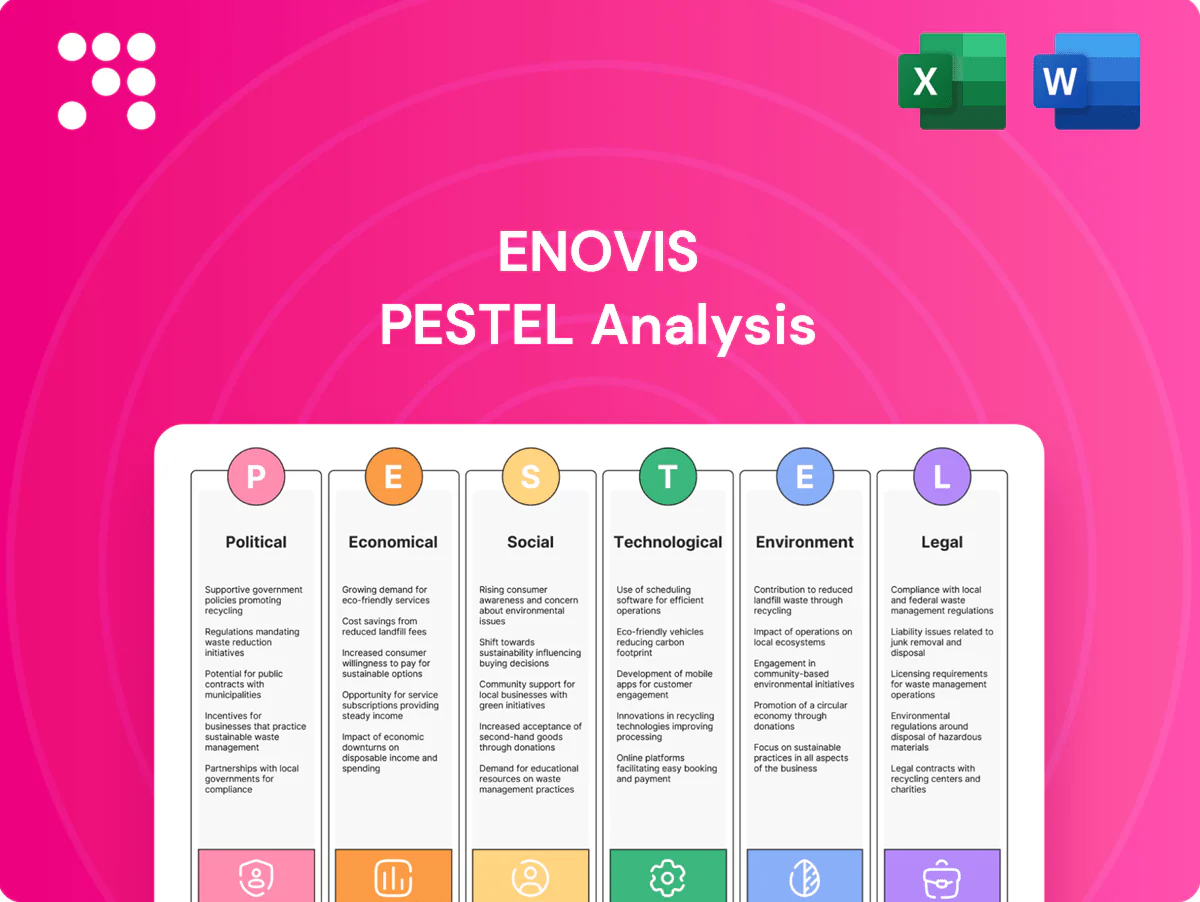
Enovis PESTLE Analysis

Your Competitive Advantage Starts with This Report
Discover how political, economic, social, technological, legal, and environmental forces are shaping Enovis's strategic outlook in our concise PESTLE snapshot—ideal for investors and strategists. Buy the full analysis to access detailed risks, opportunities, and actionable recommendations ready for immediate use.
Political factors

Healthcare policy shifts
Reimbursement and coverage decisions by governments directly shape demand for Enovis orthopedic devices, with public payers and DRG changes able to accelerate or delay procurement and adoption. With global 65+ population near 10.6% in 2024 and US joint replacements exceeding 1.5 million annually, national aging and mobility priorities matter for product alignment. Proactive policy engagement stabilizes tender pipelines and reduces reimbursement uncertainty.
Trade and tariffs
Orthopedic components routinely cross borders, exposing Enovis to tariffs and customs delays that can compress margins and disrupt delivery timelines.
Shifts in U.S.-China trade measures (Section 301 tariffs up to 25%) and U.S. Section 232 steel/aluminum duties (25%/10%) directly raise input costs and complicate pricing across supply chains.
Diversified sourcing, regionalized manufacturing and advanced trade-compliance systems reduce volatility and create a durable competitive moat.

Procurement and tenders
Public hospital systems increasingly use centralized tenders that prioritize price and demonstrable outcomes, with public procurement representing about 12% of global GDP according to the World Bank. Political pressure to curb healthcare spending intensifies price competition and drives use of value-based purchasing. Strong health-economic evidence and real-world outcomes materially improve tender success rates. Local partnerships help navigate country-specific procurement rules and compliance.

Geopolitical stability
Geopolitical instability (conflict, sanctions) can disrupt Enovis supply chains and sales access in affected regions; over 30 countries faced major trade sanctions in 2024, raising logistics risk and market closures.
Currency controls and import restrictions have delayed product availability, prompting many medtech firms to hold 30–60 days of inventory and map risks to limit outages.
Regional distribution redundancy and inventory buffers improve resilience and reduce service interruptions, cutting recovery time from weeks to days in several industry case studies.
- Supply shocks: 30+ sanctioned countries (2024)
- Inventory buffer: 30–60 days
- Mitigation: risk maps + regional redundancy
Government incentives
Grants and tax credits reduce medtech R&D cost — the US alternative simplified R&D credit equals 14% of qualified research expense increases — lowering effective innovation spend. Policies such as the $52 billion CHIPS and domestic incentives drive nearshoring, improving Enovis supply-chain resilience. FDA priority pathways like the Breakthrough Devices Program (over 800 designations by 2024) speed market entry; monitoring programs optimizes capital allocation.
- R&D credit: 14% alternative simplified credit
- Manufacturing incentives: CHIPS Act $52B example
- Regulatory speed: Breakthrough Devices >800 by 2024
- Action: monitor incentives to reallocate capex
Tariffs, policy and aging reshape orthopedics; 65+ tailwinds
Government reimbursement, procurement rules and trade policy materially affect Enovis demand, pricing and margins; aging populations (65+ 10.6% in 2024) and >1.5M US joint replacements create steady market tailwinds. Tariffs (up to 25%) and sanctions raise input costs and logistics risk; regional sourcing and 30–60 day buffers improve resilience. Incentives (R&D credit 14%, CHIPS $52B) and FDA Breakthrough (800+ by 2024) speed innovation.
| Metric | Value (2024/2025) |
|---|---|
| 65+ population | 10.6% |
| US joint replacements | >1.5M/year |
| Tariff peak | 25% |
| Inventory buffer | 30–60 days |
| R&D credit | 14% |
| CHIPS | $52B |
| Breakthrough designations | >800 |
What is included in the product
 Detailed Word Document
Explores how macro-environmental factors uniquely affect Enovis across Political, Economic, Social, Technological, Environmental and Legal dimensions, with data-driven trends and industry-specific examples. Designed for executives and investors, it highlights actionable risks and opportunities, includes forward-looking insights for scenario planning, and is formatted for direct use in reports and decks.

 Customizable Excel Spreadsheet
Concise, visually segmented Enovis PESTLE summary for quick reference in meetings or slide decks, enabling teams to spot regulatory, technological, and market risks fast and add context-specific notes for regional or product-line planning.
Economic factors

Macroeconomic cycles
Elective orthopedic procedures can fall sharply in downturns—volumes dropped about 30% in 2020 and recovered to near 2019 levels by 2023—pressuring Enovis revenues, while trauma and urgent surgeries remain relatively stable. Premium implants show higher demand elasticity versus routine bracing, which is more resilient. Scenario planning lets Enovis align production and inventory with these demand swings to protect margins.
Healthcare spending
Rising global health spending — roughly $10 trillion worldwide and about $4.6 trillion in US National Health Expenditure in 2023 — underpins long‑term device demand for Enovis. Payer cost containment and tougher rebate/pricing pressures from Medicare, Medicaid and large insurers compress margins. Expansion of value‑based care (≈40% of US payments tied to alternative/value models in 2023) shifts commercial reward to outcomes and total cost reduction. Demonstrable clinical efficacy and cost‑savings data therefore become direct revenue levers.

FX and inflation
Enovis faces translation risk as multi-currency revenues are exposed to a stronger dollar (DXY ~103 in 2024) and input cost inflation—US CPI averaged about 3.4% in 2024—pressuring margins. Hedging strategies and contractual price escalators have been used to protect margins and limit FX volatility. Active supplier negotiations and design-to-cost initiatives offset raw-material spikes. Local pricing strategies cushion performance in volatile markets.

Hospital finances
Provider capital constraints are delaying hospital implant conversions and major capital equipment purchases, squeezing budgets as US health spending exceeded 4 trillion dollars in 2023 (CMS). Growth of outpatient and ASC settings shifts purchasing toward lower-cost disposables; bundled-payment models reward efficient, lower-cost solutions, forcing sales models to target ASC administrators and physician-led buying groups.
- Capital constraints: delays to upgrades
- Outpatient/ASC: shifted buying patterns
- Bundled payments: favor low-cost efficiency
- Sales model: pivot to ASC decision-makers
Demographic tailwinds
Aging populations raise musculoskeletal disease prevalence — global 65+ population rose from 727 million in 2020 to an expected ~1.5 billion by 2050 (UN). Rising obesity (US adult obesity 41.9% in 2017–2020, CDC) elevates joint and spine procedure volumes; the US performs ~1.5 million hip/knee replacements annually. Broader active lifestyles boost sports-medicine demand and give long-run visibility supporting capacity investments.
- Demographics: global 65+ → ~1.5B by 2050
- Obesity: US adult rate 41.9% (2017–2020)
- Procedures: ~1.5M US hip/knee replacements/year
Tariffs, policy and aging reshape orthopedics; 65+ tailwinds
Elective volumes fell ~30% in 2020, recovering to near‑2019 by 2023, but remain cyclical—trauma stays stable. Global health spend ~10T (2023) and US NHE ~$4.6T (2023) support long‑term device demand while payer cost control and value‑based models (≈40% US tied to alternative payments in 2023) pressure pricing. FX (DXY ≈103 in 2024) and 3.4% US CPI (2024) squeeze margins; hedging and design‑to‑cost mitigate risk.
| Metric | Value |
|---|---|
| Global health spend (2023) | $10T |
| US NHE (2023) | $4.6T |
| US alt/value payments (2023) | ≈40% |
| DXY (2024) | ≈103 |
| US CPI (2024) | 3.4% |
What You See Is What You Get
Enovis PESTLE Analysis
The preview shown here is the exact Enovis PESTLE Analysis document you’ll receive after purchase—fully formatted and ready to use. The layout, content, and structure visible are identical to the downloadable file. No placeholders or teasers; this is the final, professionally structured report you’ll get immediately after checkout.

Your Competitive Advantage Starts with This Report
Discover how political, economic, social, technological, legal, and environmental forces are shaping Enovis's strategic outlook in our concise PESTLE snapshot—ideal for investors and strategists. Buy the full analysis to access detailed risks, opportunities, and actionable recommendations ready for immediate use.
Political factors
Healthcare policy shifts
Reimbursement and coverage decisions by governments directly shape demand for Enovis orthopedic devices, with public payers and DRG changes able to accelerate or delay procurement and adoption. With global 65+ population near 10.6% in 2024 and US joint replacements exceeding 1.5 million annually, national aging and mobility priorities matter for product alignment. Proactive policy engagement stabilizes tender pipelines and reduces reimbursement uncertainty.
Trade and tariffs
Orthopedic components routinely cross borders, exposing Enovis to tariffs and customs delays that can compress margins and disrupt delivery timelines.
Shifts in U.S.-China trade measures (Section 301 tariffs up to 25%) and U.S. Section 232 steel/aluminum duties (25%/10%) directly raise input costs and complicate pricing across supply chains.
Diversified sourcing, regionalized manufacturing and advanced trade-compliance systems reduce volatility and create a durable competitive moat.
Procurement and tenders
Public hospital systems increasingly use centralized tenders that prioritize price and demonstrable outcomes, with public procurement representing about 12% of global GDP according to the World Bank. Political pressure to curb healthcare spending intensifies price competition and drives use of value-based purchasing. Strong health-economic evidence and real-world outcomes materially improve tender success rates. Local partnerships help navigate country-specific procurement rules and compliance.
Geopolitical stability
Geopolitical instability (conflict, sanctions) can disrupt Enovis supply chains and sales access in affected regions; over 30 countries faced major trade sanctions in 2024, raising logistics risk and market closures.
Currency controls and import restrictions have delayed product availability, prompting many medtech firms to hold 30–60 days of inventory and map risks to limit outages.
Regional distribution redundancy and inventory buffers improve resilience and reduce service interruptions, cutting recovery time from weeks to days in several industry case studies.
- Supply shocks: 30+ sanctioned countries (2024)
- Inventory buffer: 30–60 days
- Mitigation: risk maps + regional redundancy
Government incentives
Grants and tax credits reduce medtech R&D cost — the US alternative simplified R&D credit equals 14% of qualified research expense increases — lowering effective innovation spend. Policies such as the $52 billion CHIPS and domestic incentives drive nearshoring, improving Enovis supply-chain resilience. FDA priority pathways like the Breakthrough Devices Program (over 800 designations by 2024) speed market entry; monitoring programs optimizes capital allocation.
- R&D credit: 14% alternative simplified credit
- Manufacturing incentives: CHIPS Act $52B example
- Regulatory speed: Breakthrough Devices >800 by 2024
- Action: monitor incentives to reallocate capex
Tariffs, policy and aging reshape orthopedics; 65+ tailwinds
Government reimbursement, procurement rules and trade policy materially affect Enovis demand, pricing and margins; aging populations (65+ 10.6% in 2024) and >1.5M US joint replacements create steady market tailwinds. Tariffs (up to 25%) and sanctions raise input costs and logistics risk; regional sourcing and 30–60 day buffers improve resilience. Incentives (R&D credit 14%, CHIPS $52B) and FDA Breakthrough (800+ by 2024) speed innovation.
| Metric | Value (2024/2025) |
|---|---|
| 65+ population | 10.6% |
| US joint replacements | >1.5M/year |
| Tariff peak | 25% |
| Inventory buffer | 30–60 days |
| R&D credit | 14% |
| CHIPS | $52B |
| Breakthrough designations | >800 |
What is included in the product
Detailed Word Document
Explores how macro-environmental factors uniquely affect Enovis across Political, Economic, Social, Technological, Environmental and Legal dimensions, with data-driven trends and industry-specific examples. Designed for executives and investors, it highlights actionable risks and opportunities, includes forward-looking insights for scenario planning, and is formatted for direct use in reports and decks.
Customizable Excel Spreadsheet
Concise, visually segmented Enovis PESTLE summary for quick reference in meetings or slide decks, enabling teams to spot regulatory, technological, and market risks fast and add context-specific notes for regional or product-line planning.
Economic factors
Macroeconomic cycles
Elective orthopedic procedures can fall sharply in downturns—volumes dropped about 30% in 2020 and recovered to near 2019 levels by 2023—pressuring Enovis revenues, while trauma and urgent surgeries remain relatively stable. Premium implants show higher demand elasticity versus routine bracing, which is more resilient. Scenario planning lets Enovis align production and inventory with these demand swings to protect margins.
Healthcare spending
Rising global health spending — roughly $10 trillion worldwide and about $4.6 trillion in US National Health Expenditure in 2023 — underpins long‑term device demand for Enovis. Payer cost containment and tougher rebate/pricing pressures from Medicare, Medicaid and large insurers compress margins. Expansion of value‑based care (≈40% of US payments tied to alternative/value models in 2023) shifts commercial reward to outcomes and total cost reduction. Demonstrable clinical efficacy and cost‑savings data therefore become direct revenue levers.
FX and inflation
Enovis faces translation risk as multi-currency revenues are exposed to a stronger dollar (DXY ~103 in 2024) and input cost inflation—US CPI averaged about 3.4% in 2024—pressuring margins. Hedging strategies and contractual price escalators have been used to protect margins and limit FX volatility. Active supplier negotiations and design-to-cost initiatives offset raw-material spikes. Local pricing strategies cushion performance in volatile markets.
Hospital finances
Provider capital constraints are delaying hospital implant conversions and major capital equipment purchases, squeezing budgets as US health spending exceeded 4 trillion dollars in 2023 (CMS). Growth of outpatient and ASC settings shifts purchasing toward lower-cost disposables; bundled-payment models reward efficient, lower-cost solutions, forcing sales models to target ASC administrators and physician-led buying groups.
- Capital constraints: delays to upgrades
- Outpatient/ASC: shifted buying patterns
- Bundled payments: favor low-cost efficiency
- Sales model: pivot to ASC decision-makers
Demographic tailwinds
Aging populations raise musculoskeletal disease prevalence — global 65+ population rose from 727 million in 2020 to an expected ~1.5 billion by 2050 (UN). Rising obesity (US adult obesity 41.9% in 2017–2020, CDC) elevates joint and spine procedure volumes; the US performs ~1.5 million hip/knee replacements annually. Broader active lifestyles boost sports-medicine demand and give long-run visibility supporting capacity investments.
- Demographics: global 65+ → ~1.5B by 2050
- Obesity: US adult rate 41.9% (2017–2020)
- Procedures: ~1.5M US hip/knee replacements/year
Tariffs, policy and aging reshape orthopedics; 65+ tailwinds
Elective volumes fell ~30% in 2020, recovering to near‑2019 by 2023, but remain cyclical—trauma stays stable. Global health spend ~10T (2023) and US NHE ~$4.6T (2023) support long‑term device demand while payer cost control and value‑based models (≈40% US tied to alternative payments in 2023) pressure pricing. FX (DXY ≈103 in 2024) and 3.4% US CPI (2024) squeeze margins; hedging and design‑to‑cost mitigate risk.
| Metric | Value |
|---|---|
| Global health spend (2023) | $10T |
| US NHE (2023) | $4.6T |
| US alt/value payments (2023) | ≈40% |
| DXY (2024) | ≈103 |
| US CPI (2024) | 3.4% |
What You See Is What You Get
Enovis PESTLE Analysis
The preview shown here is the exact Enovis PESTLE Analysis document you’ll receive after purchase—fully formatted and ready to use. The layout, content, and structure visible are identical to the downloadable file. No placeholders or teasers; this is the final, professionally structured report you’ll get immediately after checkout.
Description
Your Competitive Advantage Starts with This Report
Discover how political, economic, social, technological, legal, and environmental forces are shaping Enovis's strategic outlook in our concise PESTLE snapshot—ideal for investors and strategists. Buy the full analysis to access detailed risks, opportunities, and actionable recommendations ready for immediate use.
Political factors
Healthcare policy shifts
Reimbursement and coverage decisions by governments directly shape demand for Enovis orthopedic devices, with public payers and DRG changes able to accelerate or delay procurement and adoption. With global 65+ population near 10.6% in 2024 and US joint replacements exceeding 1.5 million annually, national aging and mobility priorities matter for product alignment. Proactive policy engagement stabilizes tender pipelines and reduces reimbursement uncertainty.
Trade and tariffs
Orthopedic components routinely cross borders, exposing Enovis to tariffs and customs delays that can compress margins and disrupt delivery timelines.
Shifts in U.S.-China trade measures (Section 301 tariffs up to 25%) and U.S. Section 232 steel/aluminum duties (25%/10%) directly raise input costs and complicate pricing across supply chains.
Diversified sourcing, regionalized manufacturing and advanced trade-compliance systems reduce volatility and create a durable competitive moat.
Procurement and tenders
Public hospital systems increasingly use centralized tenders that prioritize price and demonstrable outcomes, with public procurement representing about 12% of global GDP according to the World Bank. Political pressure to curb healthcare spending intensifies price competition and drives use of value-based purchasing. Strong health-economic evidence and real-world outcomes materially improve tender success rates. Local partnerships help navigate country-specific procurement rules and compliance.
Geopolitical stability
Geopolitical instability (conflict, sanctions) can disrupt Enovis supply chains and sales access in affected regions; over 30 countries faced major trade sanctions in 2024, raising logistics risk and market closures.
Currency controls and import restrictions have delayed product availability, prompting many medtech firms to hold 30–60 days of inventory and map risks to limit outages.
Regional distribution redundancy and inventory buffers improve resilience and reduce service interruptions, cutting recovery time from weeks to days in several industry case studies.
- Supply shocks: 30+ sanctioned countries (2024)
- Inventory buffer: 30–60 days
- Mitigation: risk maps + regional redundancy
Government incentives
Grants and tax credits reduce medtech R&D cost — the US alternative simplified R&D credit equals 14% of qualified research expense increases — lowering effective innovation spend. Policies such as the $52 billion CHIPS and domestic incentives drive nearshoring, improving Enovis supply-chain resilience. FDA priority pathways like the Breakthrough Devices Program (over 800 designations by 2024) speed market entry; monitoring programs optimizes capital allocation.
- R&D credit: 14% alternative simplified credit
- Manufacturing incentives: CHIPS Act $52B example
- Regulatory speed: Breakthrough Devices >800 by 2024
- Action: monitor incentives to reallocate capex
Tariffs, policy and aging reshape orthopedics; 65+ tailwinds
Government reimbursement, procurement rules and trade policy materially affect Enovis demand, pricing and margins; aging populations (65+ 10.6% in 2024) and >1.5M US joint replacements create steady market tailwinds. Tariffs (up to 25%) and sanctions raise input costs and logistics risk; regional sourcing and 30–60 day buffers improve resilience. Incentives (R&D credit 14%, CHIPS $52B) and FDA Breakthrough (800+ by 2024) speed innovation.
| Metric | Value (2024/2025) |
|---|---|
| 65+ population | 10.6% |
| US joint replacements | >1.5M/year |
| Tariff peak | 25% |
| Inventory buffer | 30–60 days |
| R&D credit | 14% |
| CHIPS | $52B |
| Breakthrough designations | >800 |
What is included in the product
Detailed Word Document
Explores how macro-environmental factors uniquely affect Enovis across Political, Economic, Social, Technological, Environmental and Legal dimensions, with data-driven trends and industry-specific examples. Designed for executives and investors, it highlights actionable risks and opportunities, includes forward-looking insights for scenario planning, and is formatted for direct use in reports and decks.
Customizable Excel Spreadsheet
Concise, visually segmented Enovis PESTLE summary for quick reference in meetings or slide decks, enabling teams to spot regulatory, technological, and market risks fast and add context-specific notes for regional or product-line planning.
Economic factors
Macroeconomic cycles
Elective orthopedic procedures can fall sharply in downturns—volumes dropped about 30% in 2020 and recovered to near 2019 levels by 2023—pressuring Enovis revenues, while trauma and urgent surgeries remain relatively stable. Premium implants show higher demand elasticity versus routine bracing, which is more resilient. Scenario planning lets Enovis align production and inventory with these demand swings to protect margins.
Healthcare spending
Rising global health spending — roughly $10 trillion worldwide and about $4.6 trillion in US National Health Expenditure in 2023 — underpins long‑term device demand for Enovis. Payer cost containment and tougher rebate/pricing pressures from Medicare, Medicaid and large insurers compress margins. Expansion of value‑based care (≈40% of US payments tied to alternative/value models in 2023) shifts commercial reward to outcomes and total cost reduction. Demonstrable clinical efficacy and cost‑savings data therefore become direct revenue levers.
FX and inflation
Enovis faces translation risk as multi-currency revenues are exposed to a stronger dollar (DXY ~103 in 2024) and input cost inflation—US CPI averaged about 3.4% in 2024—pressuring margins. Hedging strategies and contractual price escalators have been used to protect margins and limit FX volatility. Active supplier negotiations and design-to-cost initiatives offset raw-material spikes. Local pricing strategies cushion performance in volatile markets.
Hospital finances
Provider capital constraints are delaying hospital implant conversions and major capital equipment purchases, squeezing budgets as US health spending exceeded 4 trillion dollars in 2023 (CMS). Growth of outpatient and ASC settings shifts purchasing toward lower-cost disposables; bundled-payment models reward efficient, lower-cost solutions, forcing sales models to target ASC administrators and physician-led buying groups.
- Capital constraints: delays to upgrades
- Outpatient/ASC: shifted buying patterns
- Bundled payments: favor low-cost efficiency
- Sales model: pivot to ASC decision-makers
Demographic tailwinds
Aging populations raise musculoskeletal disease prevalence — global 65+ population rose from 727 million in 2020 to an expected ~1.5 billion by 2050 (UN). Rising obesity (US adult obesity 41.9% in 2017–2020, CDC) elevates joint and spine procedure volumes; the US performs ~1.5 million hip/knee replacements annually. Broader active lifestyles boost sports-medicine demand and give long-run visibility supporting capacity investments.
- Demographics: global 65+ → ~1.5B by 2050
- Obesity: US adult rate 41.9% (2017–2020)
- Procedures: ~1.5M US hip/knee replacements/year
Tariffs, policy and aging reshape orthopedics; 65+ tailwinds
Elective volumes fell ~30% in 2020, recovering to near‑2019 by 2023, but remain cyclical—trauma stays stable. Global health spend ~10T (2023) and US NHE ~$4.6T (2023) support long‑term device demand while payer cost control and value‑based models (≈40% US tied to alternative payments in 2023) pressure pricing. FX (DXY ≈103 in 2024) and 3.4% US CPI (2024) squeeze margins; hedging and design‑to‑cost mitigate risk.
| Metric | Value |
|---|---|
| Global health spend (2023) | $10T |
| US NHE (2023) | $4.6T |
| US alt/value payments (2023) | ≈40% |
| DXY (2024) | ≈103 |
| US CPI (2024) | 3.4% |
What You See Is What You Get
Enovis PESTLE Analysis
The preview shown here is the exact Enovis PESTLE Analysis document you’ll receive after purchase—fully formatted and ready to use. The layout, content, and structure visible are identical to the downloadable file. No placeholders or teasers; this is the final, professionally structured report you’ll get immediately after checkout.











