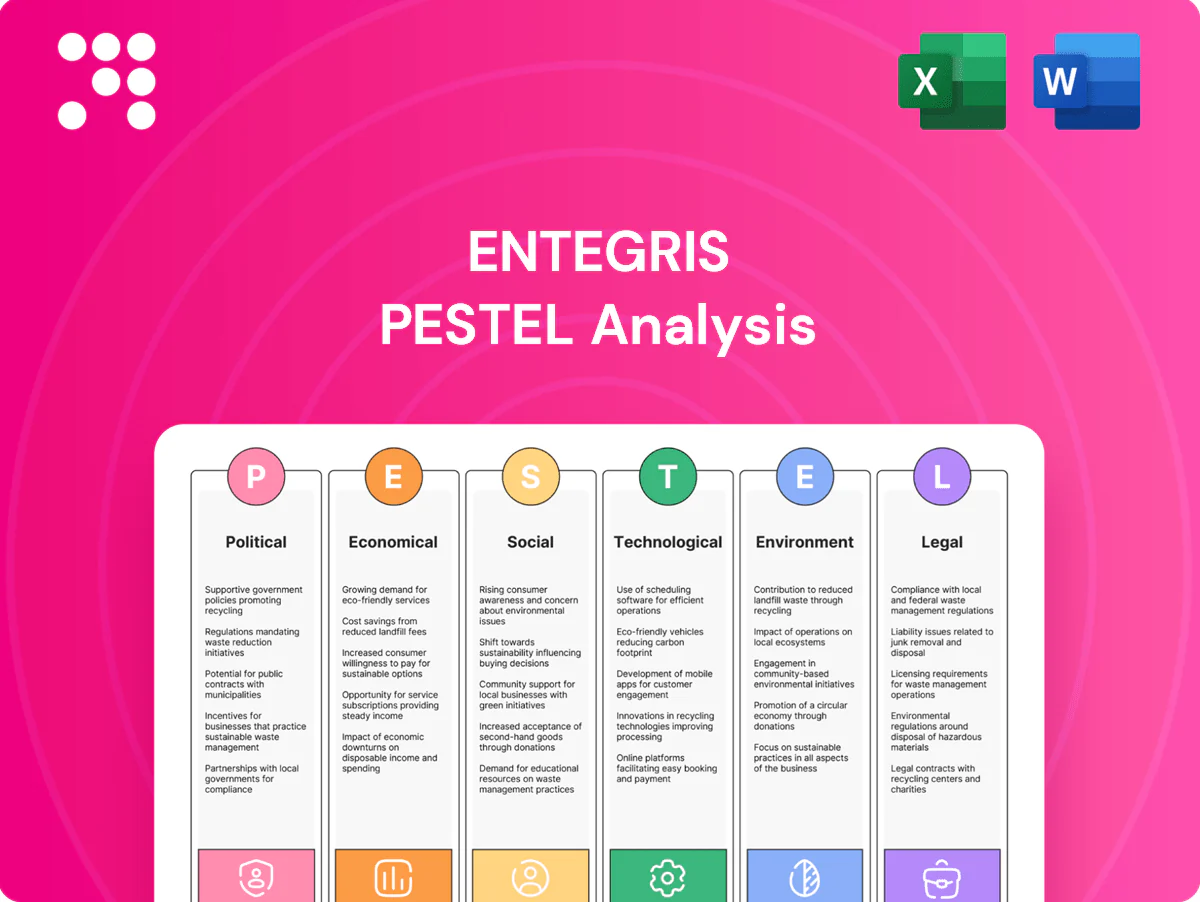
Entegris PESTLE Analysis

Plan Smarter. Present Sharper. Compete Stronger.
Our PESTLE analysis for Entegris maps political, economic, social, technological, legal and environmental forces shaping its semiconductor materials leadership. Use these insights to anticipate risks, spot growth levers, and refine investment or strategic plans. Purchase the full report for an immediately actionable, editable deep-dive.
Political factors

Export controls and geopolitics
US-China export curbs since 2022 on advanced tools and materials shrink Entegris’ addressable market and complicate support to Chinese fabs; Taiwan and South Korea account for roughly half of global advanced-node capacity, concentrating customer risk. Licensing adds weeks–months to lead times and raises compliance costs, while tensions in the Taiwan Strait or Korea-Japan disputes threaten supply chains. Proactive compliance and multi-country fulfillment are essential to sustain growth.
Industrial policy and subsidies
US CHIPS Act's $52.7B and the EU Chips Act mobilizing up to €43B are reshaping fab siting, with Japan and Korea also rolling large subsidy packages and tax credits that accelerate timing and capacity for Entegris. Grants and investment tax credits cut effective capex, while local‑content rules force parallel footprints, increasing complexity and cost. Aligning plant siting with subsidized customer expansions helps lock multi‑year supply contracts.

Trade policy and tariffs
Tariff volatility on specialty chemicals, fluoropolymers and components can swing input costs materially—WTO data shows average MFN tariffs on chemicals around 4% in 2022–23 while targeted measures can reach up to 25% on specific lines. Country-of-origin rules (USMCA/FTA compliance) increasingly force bill-of-materials redesign and supplier shifts to preserve duty-free access. Preferential trade agreements can unlock 0% tariff margins if leveraged; dynamic tariff optimization and currency/commodity hedges help stabilize delivery and margins.

Regulatory harmonization gaps
Regulatory harmonization gaps across the US, EU and APAC raise testing, labeling and certification burdens for Entegris, contributing to multi-market compliance costs that accompany the company’s ~USD 3.3B FY2024 revenue base. Inconsistent hazardous material transport and storage rules complicate logistics and can extend cross-border lead times. Harmonizing quality systems to satisfy multiple regimes and deploying local regulatory teams shortens approval cycles and reduces delay risk.
Government procurement and national security
Defense-related semiconductor programs driven by the CHIPS and Science Act (about $52 billion in incentives) prioritize trusted supply chains, imposing rigorous qualification hurdles that favor vendors with proven security and compliance records.
- Trusted supply chains: raises entry barriers
- Incumbent advantage: compliance = win
- On-site staff: higher data governance needs
- Secure facilities: unlocks resilient, government-backed demand
Export controls, CHIPS subsidies and geopolitics concentrate chemical supply risk in TW/KR
Export controls, CHIPS‑era subsidies and geopolitics concentrate Entegris risk in Taiwan/SK (~50% advanced-node capacity) and add licensing delays and compliance costs; US CHIPS $52.7B and EU up to €43B redirect fab spending; tariffs (avg MFN ~4%) and hazmat regulatory divergence raise input and logistics costs; trusted‑supply rules raise qualification barriers but favor compliant incumbents.
| Metric | Value |
|---|---|
| FY2024 revenue | USD 3.3B |
| US CHIPS | USD 52.7B |
| EU Chips | up to €43B |
| Advanced-node capacity (TW+KR) | ~50% |
| Avg MFN tariffs (chemicals) | ~4% |
What is included in the product
 Detailed Word Document
Explores how macro-environmental factors uniquely affect Entegris across Political, Economic, Social, Technological, Environmental, and Legal dimensions, with data-driven trends and industry-specific examples; designed for executives and investors to identify threats, opportunities, and forward-looking scenarios tied to semiconductor supply chains and regulatory shifts.

 Customizable Excel Spreadsheet
A concise, visually segmented PESTLE summary of Entegris that can be dropped into presentations or shared across teams for quick alignment and to support planning discussions on external risks and market positioning.
Economic factors

Semiconductor cycle sensitivity
Entegris’ revenue closely follows wafer starts and capex cycles across logic, memory and foundry, with fiscal 2024 revenue about $3.8 billion reflecting end-market cyclicality. Downcycles compress volumes but accelerate customer process qualifications, positioning Entegris for the next upturn. Rising AI, HBM and automotive content helps stabilize product mix even if unit shipments fall. Scenario planning aligns inventory and preserves cash flow through cycles.
Input cost inflation and availability
Specialty gases, solvents and fluorinated precursors have shown periodic price swings and shortages that pressure margins; Entegris reported $5.13 billion revenue in fiscal 2024, underscoring exposure to input-cost volatility. Energy and transport cost swings directly affect gross margins and delivery reliability across global fabs. Multi-sourcing and long-term contracts are deployed to stabilize supply. Value-based pricing tied to customer yield gains helps offset inflation.

Currency exposure
Entegris faces currency exposure from global sales and costs in USD, EUR, JPY, KRW and TWD, with FX swings affecting reported revenue and competitiveness versus local suppliers. Translation and transaction impacts can compress margins and distort quarterly results. Natural hedges in local sourcing and derivatives programs are used to reduce volatility. Contracts with pricing clauses indexed to FX improve revenue predictability.

M&A integration and synergies
Entegris’s $6.5 billion acquisition of CMC Materials expanded portfolio breadth and scale economies but requires disciplined integration; procurement, manufacturing footprint and R&D consolidation are primary levers for margin lift, while cultural and systems alignment are critical to unlock cross-selling and realize expected synergies; clear milestone tracking preserves deal value.
- Deal: CMC Materials $6.5B
- Levers: procurement, manufacturing, R&D
- Risks: culture, systems
Customer concentration and pricing power
Large fabs and IDMs like TSMC, Samsung and Intel exert strong bargaining leverage on qualifications and terms, while sticky design-ins and high switching costs sustain recurring revenue and long product lifecycles. Performance‑linked contracts allow Entegris to sustain premium pricing; the company expanded its portfolio via the $6.5 billion CMC Materials acquisition (2023) to reduce reliance on cyclical semiconductor demand. Diversifying into life sciences and advanced packaging lowers revenue cyclicality and supports margin resilience.
- Customer concentration: major fabs drive procurement decisions
- Recurring revenue: design‑ins + switching costs
- Pricing: performance‑linked contracts enable premiums
- Diversification: CMC deal (2023) + life sciences reduces cyclicality
Export controls, CHIPS subsidies and geopolitics concentrate chemical supply risk in TW/KR
Entegris revenue tracks wafer starts and capex cycles, with fiscal 2024 revenue $5.13 billion and downcycles compressing volumes but accelerating qualifications. Input-cost swings in specialty gases and energy pressure margins; multi-sourcing and value‑based pricing mitigate impact. The $6.5 billion CMC Materials acquisition broadens portfolio and targets procurement/R&D synergies while FX exposure (USD, EUR, JPY, KRW, TWD) remains material.
| Metric | Value |
|---|---|
| Fiscal 2024 revenue | $5.13B |
| CMC Materials deal | $6.5B (2023) |
| Key customers | TSMC, Samsung, Intel |
| Major FX | USD, EUR, JPY, KRW, TWD |
Full Version Awaits
Entegris PESTLE Analysis
The preview shown here is the exact Entegris PESTLE document you’ll receive after purchase—fully formatted and ready to use. It contains the same content, structure, and professional layout visible now, with no placeholders or teasers. After payment you’ll instantly download this identical, finished file for immediate use.

Plan Smarter. Present Sharper. Compete Stronger.
Our PESTLE analysis for Entegris maps political, economic, social, technological, legal and environmental forces shaping its semiconductor materials leadership. Use these insights to anticipate risks, spot growth levers, and refine investment or strategic plans. Purchase the full report for an immediately actionable, editable deep-dive.
Political factors
Export controls and geopolitics
US-China export curbs since 2022 on advanced tools and materials shrink Entegris’ addressable market and complicate support to Chinese fabs; Taiwan and South Korea account for roughly half of global advanced-node capacity, concentrating customer risk. Licensing adds weeks–months to lead times and raises compliance costs, while tensions in the Taiwan Strait or Korea-Japan disputes threaten supply chains. Proactive compliance and multi-country fulfillment are essential to sustain growth.
Industrial policy and subsidies
US CHIPS Act's $52.7B and the EU Chips Act mobilizing up to €43B are reshaping fab siting, with Japan and Korea also rolling large subsidy packages and tax credits that accelerate timing and capacity for Entegris. Grants and investment tax credits cut effective capex, while local‑content rules force parallel footprints, increasing complexity and cost. Aligning plant siting with subsidized customer expansions helps lock multi‑year supply contracts.
Trade policy and tariffs
Tariff volatility on specialty chemicals, fluoropolymers and components can swing input costs materially—WTO data shows average MFN tariffs on chemicals around 4% in 2022–23 while targeted measures can reach up to 25% on specific lines. Country-of-origin rules (USMCA/FTA compliance) increasingly force bill-of-materials redesign and supplier shifts to preserve duty-free access. Preferential trade agreements can unlock 0% tariff margins if leveraged; dynamic tariff optimization and currency/commodity hedges help stabilize delivery and margins.
Regulatory harmonization gaps
Regulatory harmonization gaps across the US, EU and APAC raise testing, labeling and certification burdens for Entegris, contributing to multi-market compliance costs that accompany the company’s ~USD 3.3B FY2024 revenue base. Inconsistent hazardous material transport and storage rules complicate logistics and can extend cross-border lead times. Harmonizing quality systems to satisfy multiple regimes and deploying local regulatory teams shortens approval cycles and reduces delay risk.
Government procurement and national security
Defense-related semiconductor programs driven by the CHIPS and Science Act (about $52 billion in incentives) prioritize trusted supply chains, imposing rigorous qualification hurdles that favor vendors with proven security and compliance records.
- Trusted supply chains: raises entry barriers
- Incumbent advantage: compliance = win
- On-site staff: higher data governance needs
- Secure facilities: unlocks resilient, government-backed demand
Export controls, CHIPS subsidies and geopolitics concentrate chemical supply risk in TW/KR
Export controls, CHIPS‑era subsidies and geopolitics concentrate Entegris risk in Taiwan/SK (~50% advanced-node capacity) and add licensing delays and compliance costs; US CHIPS $52.7B and EU up to €43B redirect fab spending; tariffs (avg MFN ~4%) and hazmat regulatory divergence raise input and logistics costs; trusted‑supply rules raise qualification barriers but favor compliant incumbents.
| Metric | Value |
|---|---|
| FY2024 revenue | USD 3.3B |
| US CHIPS | USD 52.7B |
| EU Chips | up to €43B |
| Advanced-node capacity (TW+KR) | ~50% |
| Avg MFN tariffs (chemicals) | ~4% |
What is included in the product
Detailed Word Document
Explores how macro-environmental factors uniquely affect Entegris across Political, Economic, Social, Technological, Environmental, and Legal dimensions, with data-driven trends and industry-specific examples; designed for executives and investors to identify threats, opportunities, and forward-looking scenarios tied to semiconductor supply chains and regulatory shifts.
Customizable Excel Spreadsheet
A concise, visually segmented PESTLE summary of Entegris that can be dropped into presentations or shared across teams for quick alignment and to support planning discussions on external risks and market positioning.
Economic factors
Semiconductor cycle sensitivity
Entegris’ revenue closely follows wafer starts and capex cycles across logic, memory and foundry, with fiscal 2024 revenue about $3.8 billion reflecting end-market cyclicality. Downcycles compress volumes but accelerate customer process qualifications, positioning Entegris for the next upturn. Rising AI, HBM and automotive content helps stabilize product mix even if unit shipments fall. Scenario planning aligns inventory and preserves cash flow through cycles.
Input cost inflation and availability
Specialty gases, solvents and fluorinated precursors have shown periodic price swings and shortages that pressure margins; Entegris reported $5.13 billion revenue in fiscal 2024, underscoring exposure to input-cost volatility. Energy and transport cost swings directly affect gross margins and delivery reliability across global fabs. Multi-sourcing and long-term contracts are deployed to stabilize supply. Value-based pricing tied to customer yield gains helps offset inflation.
Currency exposure
Entegris faces currency exposure from global sales and costs in USD, EUR, JPY, KRW and TWD, with FX swings affecting reported revenue and competitiveness versus local suppliers. Translation and transaction impacts can compress margins and distort quarterly results. Natural hedges in local sourcing and derivatives programs are used to reduce volatility. Contracts with pricing clauses indexed to FX improve revenue predictability.
M&A integration and synergies
Entegris’s $6.5 billion acquisition of CMC Materials expanded portfolio breadth and scale economies but requires disciplined integration; procurement, manufacturing footprint and R&D consolidation are primary levers for margin lift, while cultural and systems alignment are critical to unlock cross-selling and realize expected synergies; clear milestone tracking preserves deal value.
- Deal: CMC Materials $6.5B
- Levers: procurement, manufacturing, R&D
- Risks: culture, systems
Customer concentration and pricing power
Large fabs and IDMs like TSMC, Samsung and Intel exert strong bargaining leverage on qualifications and terms, while sticky design-ins and high switching costs sustain recurring revenue and long product lifecycles. Performance‑linked contracts allow Entegris to sustain premium pricing; the company expanded its portfolio via the $6.5 billion CMC Materials acquisition (2023) to reduce reliance on cyclical semiconductor demand. Diversifying into life sciences and advanced packaging lowers revenue cyclicality and supports margin resilience.
- Customer concentration: major fabs drive procurement decisions
- Recurring revenue: design‑ins + switching costs
- Pricing: performance‑linked contracts enable premiums
- Diversification: CMC deal (2023) + life sciences reduces cyclicality
Export controls, CHIPS subsidies and geopolitics concentrate chemical supply risk in TW/KR
Entegris revenue tracks wafer starts and capex cycles, with fiscal 2024 revenue $5.13 billion and downcycles compressing volumes but accelerating qualifications. Input-cost swings in specialty gases and energy pressure margins; multi-sourcing and value‑based pricing mitigate impact. The $6.5 billion CMC Materials acquisition broadens portfolio and targets procurement/R&D synergies while FX exposure (USD, EUR, JPY, KRW, TWD) remains material.
| Metric | Value |
|---|---|
| Fiscal 2024 revenue | $5.13B |
| CMC Materials deal | $6.5B (2023) |
| Key customers | TSMC, Samsung, Intel |
| Major FX | USD, EUR, JPY, KRW, TWD |
Full Version Awaits
Entegris PESTLE Analysis
The preview shown here is the exact Entegris PESTLE document you’ll receive after purchase—fully formatted and ready to use. It contains the same content, structure, and professional layout visible now, with no placeholders or teasers. After payment you’ll instantly download this identical, finished file for immediate use.
Original: $10.00
-65%$10.00
$3.50Description
Plan Smarter. Present Sharper. Compete Stronger.
Our PESTLE analysis for Entegris maps political, economic, social, technological, legal and environmental forces shaping its semiconductor materials leadership. Use these insights to anticipate risks, spot growth levers, and refine investment or strategic plans. Purchase the full report for an immediately actionable, editable deep-dive.
Political factors
Export controls and geopolitics
US-China export curbs since 2022 on advanced tools and materials shrink Entegris’ addressable market and complicate support to Chinese fabs; Taiwan and South Korea account for roughly half of global advanced-node capacity, concentrating customer risk. Licensing adds weeks–months to lead times and raises compliance costs, while tensions in the Taiwan Strait or Korea-Japan disputes threaten supply chains. Proactive compliance and multi-country fulfillment are essential to sustain growth.
Industrial policy and subsidies
US CHIPS Act's $52.7B and the EU Chips Act mobilizing up to €43B are reshaping fab siting, with Japan and Korea also rolling large subsidy packages and tax credits that accelerate timing and capacity for Entegris. Grants and investment tax credits cut effective capex, while local‑content rules force parallel footprints, increasing complexity and cost. Aligning plant siting with subsidized customer expansions helps lock multi‑year supply contracts.
Trade policy and tariffs
Tariff volatility on specialty chemicals, fluoropolymers and components can swing input costs materially—WTO data shows average MFN tariffs on chemicals around 4% in 2022–23 while targeted measures can reach up to 25% on specific lines. Country-of-origin rules (USMCA/FTA compliance) increasingly force bill-of-materials redesign and supplier shifts to preserve duty-free access. Preferential trade agreements can unlock 0% tariff margins if leveraged; dynamic tariff optimization and currency/commodity hedges help stabilize delivery and margins.
Regulatory harmonization gaps
Regulatory harmonization gaps across the US, EU and APAC raise testing, labeling and certification burdens for Entegris, contributing to multi-market compliance costs that accompany the company’s ~USD 3.3B FY2024 revenue base. Inconsistent hazardous material transport and storage rules complicate logistics and can extend cross-border lead times. Harmonizing quality systems to satisfy multiple regimes and deploying local regulatory teams shortens approval cycles and reduces delay risk.
Government procurement and national security
Defense-related semiconductor programs driven by the CHIPS and Science Act (about $52 billion in incentives) prioritize trusted supply chains, imposing rigorous qualification hurdles that favor vendors with proven security and compliance records.
- Trusted supply chains: raises entry barriers
- Incumbent advantage: compliance = win
- On-site staff: higher data governance needs
- Secure facilities: unlocks resilient, government-backed demand
Export controls, CHIPS subsidies and geopolitics concentrate chemical supply risk in TW/KR
Export controls, CHIPS‑era subsidies and geopolitics concentrate Entegris risk in Taiwan/SK (~50% advanced-node capacity) and add licensing delays and compliance costs; US CHIPS $52.7B and EU up to €43B redirect fab spending; tariffs (avg MFN ~4%) and hazmat regulatory divergence raise input and logistics costs; trusted‑supply rules raise qualification barriers but favor compliant incumbents.
| Metric | Value |
|---|---|
| FY2024 revenue | USD 3.3B |
| US CHIPS | USD 52.7B |
| EU Chips | up to €43B |
| Advanced-node capacity (TW+KR) | ~50% |
| Avg MFN tariffs (chemicals) | ~4% |
What is included in the product
Detailed Word Document
Explores how macro-environmental factors uniquely affect Entegris across Political, Economic, Social, Technological, Environmental, and Legal dimensions, with data-driven trends and industry-specific examples; designed for executives and investors to identify threats, opportunities, and forward-looking scenarios tied to semiconductor supply chains and regulatory shifts.
Customizable Excel Spreadsheet
A concise, visually segmented PESTLE summary of Entegris that can be dropped into presentations or shared across teams for quick alignment and to support planning discussions on external risks and market positioning.
Economic factors
Semiconductor cycle sensitivity
Entegris’ revenue closely follows wafer starts and capex cycles across logic, memory and foundry, with fiscal 2024 revenue about $3.8 billion reflecting end-market cyclicality. Downcycles compress volumes but accelerate customer process qualifications, positioning Entegris for the next upturn. Rising AI, HBM and automotive content helps stabilize product mix even if unit shipments fall. Scenario planning aligns inventory and preserves cash flow through cycles.
Input cost inflation and availability
Specialty gases, solvents and fluorinated precursors have shown periodic price swings and shortages that pressure margins; Entegris reported $5.13 billion revenue in fiscal 2024, underscoring exposure to input-cost volatility. Energy and transport cost swings directly affect gross margins and delivery reliability across global fabs. Multi-sourcing and long-term contracts are deployed to stabilize supply. Value-based pricing tied to customer yield gains helps offset inflation.
Currency exposure
Entegris faces currency exposure from global sales and costs in USD, EUR, JPY, KRW and TWD, with FX swings affecting reported revenue and competitiveness versus local suppliers. Translation and transaction impacts can compress margins and distort quarterly results. Natural hedges in local sourcing and derivatives programs are used to reduce volatility. Contracts with pricing clauses indexed to FX improve revenue predictability.
M&A integration and synergies
Entegris’s $6.5 billion acquisition of CMC Materials expanded portfolio breadth and scale economies but requires disciplined integration; procurement, manufacturing footprint and R&D consolidation are primary levers for margin lift, while cultural and systems alignment are critical to unlock cross-selling and realize expected synergies; clear milestone tracking preserves deal value.
- Deal: CMC Materials $6.5B
- Levers: procurement, manufacturing, R&D
- Risks: culture, systems
Customer concentration and pricing power
Large fabs and IDMs like TSMC, Samsung and Intel exert strong bargaining leverage on qualifications and terms, while sticky design-ins and high switching costs sustain recurring revenue and long product lifecycles. Performance‑linked contracts allow Entegris to sustain premium pricing; the company expanded its portfolio via the $6.5 billion CMC Materials acquisition (2023) to reduce reliance on cyclical semiconductor demand. Diversifying into life sciences and advanced packaging lowers revenue cyclicality and supports margin resilience.
- Customer concentration: major fabs drive procurement decisions
- Recurring revenue: design‑ins + switching costs
- Pricing: performance‑linked contracts enable premiums
- Diversification: CMC deal (2023) + life sciences reduces cyclicality
Export controls, CHIPS subsidies and geopolitics concentrate chemical supply risk in TW/KR
Entegris revenue tracks wafer starts and capex cycles, with fiscal 2024 revenue $5.13 billion and downcycles compressing volumes but accelerating qualifications. Input-cost swings in specialty gases and energy pressure margins; multi-sourcing and value‑based pricing mitigate impact. The $6.5 billion CMC Materials acquisition broadens portfolio and targets procurement/R&D synergies while FX exposure (USD, EUR, JPY, KRW, TWD) remains material.
| Metric | Value |
|---|---|
| Fiscal 2024 revenue | $5.13B |
| CMC Materials deal | $6.5B (2023) |
| Key customers | TSMC, Samsung, Intel |
| Major FX | USD, EUR, JPY, KRW, TWD |
Full Version Awaits
Entegris PESTLE Analysis
The preview shown here is the exact Entegris PESTLE document you’ll receive after purchase—fully formatted and ready to use. It contains the same content, structure, and professional layout visible now, with no placeholders or teasers. After payment you’ll instantly download this identical, finished file for immediate use.











