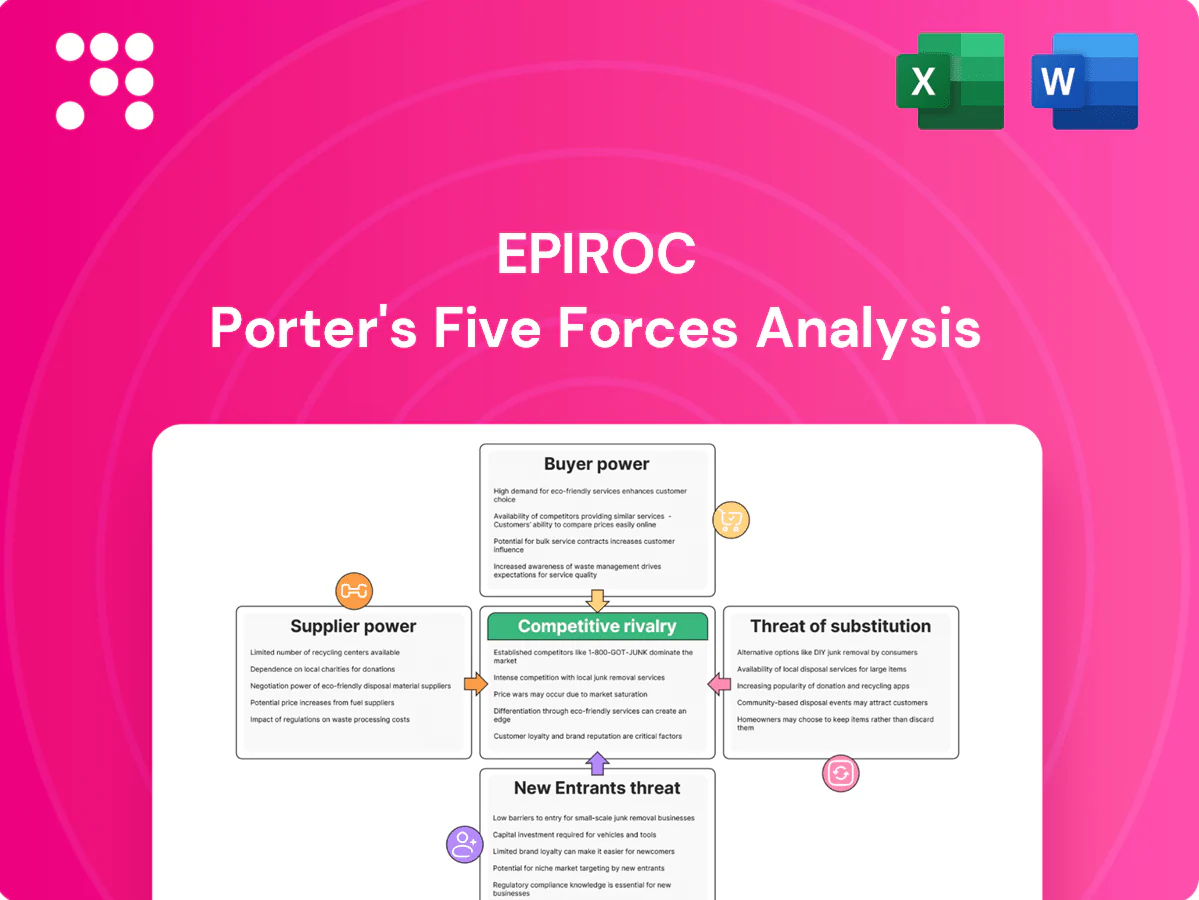
Epiroc Porter's Five Forces Analysis

A Must-Have Tool for Decision-Makers
Epiroc operates in a capital‑intensive, innovation-driven mining equipment market where supplier concentration, buyer bargaining, and aftermarket services shape profitability; substitutes and regulatory shifts add pressure while scale and service networks bolster defense. This snapshot teases key dynamics—unlock the full Porter’s Five Forces Analysis for force-by-force ratings, visuals, and strategic recommendations.
Suppliers Bargaining Power

Specialized component dependency
In 2024 Epiroc relies on specialized inputs like hydraulics, sensors, tungsten carbide and battery systems from a limited set of qualified suppliers, giving niche vendors pricing and delivery leverage. Epiroc’s global scale and 2024 procurement strategy enabled multisourcing and long-term contracts to reduce exposure. Qualification programs and design-to-value initiatives in 2024 broaden the supplier base over time.
Battery-electric and automation modules
Electrification and autonomy require high-spec batteries, BMS, LiDAR and control units often from tech-focused suppliers; battery pack prices averaged ~110 USD/kWh in 2024 and LiDAR unit costs trended toward 1,000–5,000 USD, concentrating supplier power.
Switching is costly due to integration, safety certification and software lock-in, often increasing replacement and validation costs by an estimated 15–25%.
Epiroc co-develops modules to reduce dependency and secure supplier roadmaps; backward integration in software has materially reduced third-party bargaining power and accelerated product cycles.

Commodity inputs volatility
Steel markets remain pivotal—global crude steel output was about 1.8 billion tonnes in 2024 and Brent averaged roughly 85 USD/b, so swings in steel, alloys and energy can quickly worsen supplier terms for Epiroc.
Hedging, indexed contracts and global sourcing (regional dual suppliers) have cut cost-shock exposure, while lead-time buffers of several weeks lower disruption risk.
Designing consumables and tools for material efficiency reduces steel/alloy intensity and softens supplier bargaining power.

Aftermarket parts co-makership
Co-engineered wear parts and assemblies create mutual dependence: suppliers secure repeat volumes while facing stringent KPIs (typical industry OTIF targets >98% and ppm defect targets often <50), and Epiroc’s global installed base and service network (strongest in mining and infrastructure) provides price and selective-exclusivity leverage; vendor-managed inventory and consignment programs cut working-capital needs.
- Mutual dependence
- Stable volumes vs strict KPIs
- Epiroc pricing leverage
- VMI/consignment lowers WC
Logistics and geopolitical exposure
Shipping constraints, export controls and regional risks increase bargaining power of logistics and local suppliers, raising freight and lead-time volatility for Epiroc; Epiroc operates in 150+ countries with ~17,000 employees (2024) and mitigates exposure by diversifying manufacturing and nearshoring critical components. Framework agreements cap freight surcharges and prioritize capacity, while compliance programs sustain continuity in sensitive markets.
- Diversified footprint: 150+ countries, ~17,000 staff (2024)
- Nearshoring: reduces lead times and tariff risk
- Frameworks: caps on surcharges, priority capacity
- Compliance: continuity in restricted markets
Concentrated battery and LiDAR suppliers boost pricing; global scale cushions steel/energy shocks
Epiroc faces concentrated suppliers for batteries, LiDAR and tungsten carbide (battery ≈110 USD/kWh, LiDAR 1,000–5,000 USD in 2024), giving niche vendors pricing/delivery leverage; switching costs are ~15–25%. Global scale (150+ countries; ~17,000 employees, 2024) and long-term contracts, hedging and co‑engineering reduce exposure, while steel/energy swings (global steel ~1.8bn t; Brent ≈85 USD/b, 2024) remain a tail risk.
| Metric | 2024 Value |
|---|---|
| Battery cost | ~110 USD/kWh |
| LiDAR cost | 1,000–5,000 USD |
| Switching cost | 15–25% |
| Steel output | ~1.8bn t |
| Brent | ~85 USD/b |
| Footprint | 150+ countries, ~17,000 staff |
What is included in the product
 Detailed Word Document
Concise Porter's Five Forces assessment of Epiroc highlighting competitive rivalry, supplier and buyer power, barriers to entry, and threats from substitutes and new entrants, with strategic implications for market positioning.

 Customizable Excel Spreadsheet
A concise one-sheet Porter's Five Forces for Epiroc that visualizes competitive pressure with an editable spider chart, letting you adjust threat levels for new entrants, suppliers, buyers or substitutes—clean, slide-ready and easy to swap in your data for fast strategic decisions.
Customers Bargaining Power

Concentrated mining majors
Concentrated mining majors buy fleets via competitive tenders and demand volume discounts, shifting bargaining power on price and service; the global mining equipment market was about USD 127 billion in 2024, reinforcing fleet-scale purchasing leverage. Epiroc counters by selling lifecycle value, availability guarantees and performance-based contracts to protect margins. Proven site references and long-term reliability reduce pure price focus and support premium service terms.
High switching costs and installed base
Integration with Epiroc digital platforms, operator training and stocked spare parts create high switching costs and lock in customers; switching risks uptime loss and higher TCO while Epiroc keeps accounts via compatibility and clear upgrade paths. McKinsey estimates digital mining solutions can cut downtime/costs by roughly 20–30%, and Epiroc’s 2024 focus on service and software increases customer stickiness, though open interfaces and data portability ease adoption.

TCO and sustainability demands
Buyers now prioritize total cost per ton, energy efficiency and 2024 decarbonization targets, shifting negotiations toward productivity, energy and emissions guarantees. Epiroc’s battery-electric and automation offerings meet ESG-linked procurement criteria and in 2024 supported deployments at over 10 mine sites. Outcome-based pricing and performance guarantees align incentives and reduce pure price pressure. This increases customer bargaining power but reinforces value-based contracts.

Aftermarket leverage
Customers increasingly source non-OEM parts or independent service to cut costs, but OEM diagnostics, certified software updates and warranty coverage keep OEM service compelling; Epiroc emphasizes bundled service, uptime commitments and remote monitoring to defend share.
- Aftermarket substitution lowers short-term OPEX
- OEM software/warranty preserves long-term value
- Multi-year SLAs trade price for reliability
Cyclical purchasing behavior
Cyclical purchasing behavior raises buyer power: downcycles in 2024 amplified price sensitivity and order deferrals, while upcycles shifted customer priority to delivery speed and availability. Epiroc mitigates swings with flexible financing, rental solutions and equipment rebuilds to preserve revenue and reduce buyers' capex pressure. Collaborative forecasting and parts consignment lower downtime risk for customers.
- Downcycle: higher deferrals, price pressure
- Upcycle: focus on delivery, capacity constraints
- Epiroc tools: financing, rentals, rebuilds
- Risk reduction: forecast collaboration, parts consignment
Concentrated miners boost leverage; mining equipment market USD 127B in 2024
Concentrated miners drive price leverage; global mining equipment market ~USD 127B in 2024. Epiroc defends with lifecycle contracts, digital lock‑in (McKinsey: 20–30% downtime reduction) and >10 BEV/automation site deployments in 2024, shifting negotiations toward TCO, energy and availability guarantees.
| Metric | 2024 | Impact |
|---|---|---|
| Market size | USD 127B | Buyer leverage |
| Downtime reduction | 20–30% | Stickiness |
| Epiroc BEV sites | >10 | ESG procurement |
Full Version Awaits
Epiroc Porter's Five Forces Analysis
This preview shows the exact Epiroc Porter's Five Forces analysis you'll receive upon purchase—fully formatted and ready to use. The document covers competitive rivalry, supplier and buyer power, threat of substitutes, and barriers to entry with actionable insights. No placeholders or sample text; instant download after payment.

A Must-Have Tool for Decision-Makers
Epiroc operates in a capital‑intensive, innovation-driven mining equipment market where supplier concentration, buyer bargaining, and aftermarket services shape profitability; substitutes and regulatory shifts add pressure while scale and service networks bolster defense. This snapshot teases key dynamics—unlock the full Porter’s Five Forces Analysis for force-by-force ratings, visuals, and strategic recommendations.
Suppliers Bargaining Power
Specialized component dependency
In 2024 Epiroc relies on specialized inputs like hydraulics, sensors, tungsten carbide and battery systems from a limited set of qualified suppliers, giving niche vendors pricing and delivery leverage. Epiroc’s global scale and 2024 procurement strategy enabled multisourcing and long-term contracts to reduce exposure. Qualification programs and design-to-value initiatives in 2024 broaden the supplier base over time.
Battery-electric and automation modules
Electrification and autonomy require high-spec batteries, BMS, LiDAR and control units often from tech-focused suppliers; battery pack prices averaged ~110 USD/kWh in 2024 and LiDAR unit costs trended toward 1,000–5,000 USD, concentrating supplier power.
Switching is costly due to integration, safety certification and software lock-in, often increasing replacement and validation costs by an estimated 15–25%.
Epiroc co-develops modules to reduce dependency and secure supplier roadmaps; backward integration in software has materially reduced third-party bargaining power and accelerated product cycles.
Commodity inputs volatility
Steel markets remain pivotal—global crude steel output was about 1.8 billion tonnes in 2024 and Brent averaged roughly 85 USD/b, so swings in steel, alloys and energy can quickly worsen supplier terms for Epiroc.
Hedging, indexed contracts and global sourcing (regional dual suppliers) have cut cost-shock exposure, while lead-time buffers of several weeks lower disruption risk.
Designing consumables and tools for material efficiency reduces steel/alloy intensity and softens supplier bargaining power.
Aftermarket parts co-makership
Co-engineered wear parts and assemblies create mutual dependence: suppliers secure repeat volumes while facing stringent KPIs (typical industry OTIF targets >98% and ppm defect targets often <50), and Epiroc’s global installed base and service network (strongest in mining and infrastructure) provides price and selective-exclusivity leverage; vendor-managed inventory and consignment programs cut working-capital needs.
- Mutual dependence
- Stable volumes vs strict KPIs
- Epiroc pricing leverage
- VMI/consignment lowers WC
Logistics and geopolitical exposure
Shipping constraints, export controls and regional risks increase bargaining power of logistics and local suppliers, raising freight and lead-time volatility for Epiroc; Epiroc operates in 150+ countries with ~17,000 employees (2024) and mitigates exposure by diversifying manufacturing and nearshoring critical components. Framework agreements cap freight surcharges and prioritize capacity, while compliance programs sustain continuity in sensitive markets.
- Diversified footprint: 150+ countries, ~17,000 staff (2024)
- Nearshoring: reduces lead times and tariff risk
- Frameworks: caps on surcharges, priority capacity
- Compliance: continuity in restricted markets
Concentrated battery and LiDAR suppliers boost pricing; global scale cushions steel/energy shocks
Epiroc faces concentrated suppliers for batteries, LiDAR and tungsten carbide (battery ≈110 USD/kWh, LiDAR 1,000–5,000 USD in 2024), giving niche vendors pricing/delivery leverage; switching costs are ~15–25%. Global scale (150+ countries; ~17,000 employees, 2024) and long-term contracts, hedging and co‑engineering reduce exposure, while steel/energy swings (global steel ~1.8bn t; Brent ≈85 USD/b, 2024) remain a tail risk.
| Metric | 2024 Value |
|---|---|
| Battery cost | ~110 USD/kWh |
| LiDAR cost | 1,000–5,000 USD |
| Switching cost | 15–25% |
| Steel output | ~1.8bn t |
| Brent | ~85 USD/b |
| Footprint | 150+ countries, ~17,000 staff |
What is included in the product
Detailed Word Document
Concise Porter's Five Forces assessment of Epiroc highlighting competitive rivalry, supplier and buyer power, barriers to entry, and threats from substitutes and new entrants, with strategic implications for market positioning.
Customizable Excel Spreadsheet
A concise one-sheet Porter's Five Forces for Epiroc that visualizes competitive pressure with an editable spider chart, letting you adjust threat levels for new entrants, suppliers, buyers or substitutes—clean, slide-ready and easy to swap in your data for fast strategic decisions.
Customers Bargaining Power
Concentrated mining majors
Concentrated mining majors buy fleets via competitive tenders and demand volume discounts, shifting bargaining power on price and service; the global mining equipment market was about USD 127 billion in 2024, reinforcing fleet-scale purchasing leverage. Epiroc counters by selling lifecycle value, availability guarantees and performance-based contracts to protect margins. Proven site references and long-term reliability reduce pure price focus and support premium service terms.
High switching costs and installed base
Integration with Epiroc digital platforms, operator training and stocked spare parts create high switching costs and lock in customers; switching risks uptime loss and higher TCO while Epiroc keeps accounts via compatibility and clear upgrade paths. McKinsey estimates digital mining solutions can cut downtime/costs by roughly 20–30%, and Epiroc’s 2024 focus on service and software increases customer stickiness, though open interfaces and data portability ease adoption.
TCO and sustainability demands
Buyers now prioritize total cost per ton, energy efficiency and 2024 decarbonization targets, shifting negotiations toward productivity, energy and emissions guarantees. Epiroc’s battery-electric and automation offerings meet ESG-linked procurement criteria and in 2024 supported deployments at over 10 mine sites. Outcome-based pricing and performance guarantees align incentives and reduce pure price pressure. This increases customer bargaining power but reinforces value-based contracts.
Aftermarket leverage
Customers increasingly source non-OEM parts or independent service to cut costs, but OEM diagnostics, certified software updates and warranty coverage keep OEM service compelling; Epiroc emphasizes bundled service, uptime commitments and remote monitoring to defend share.
- Aftermarket substitution lowers short-term OPEX
- OEM software/warranty preserves long-term value
- Multi-year SLAs trade price for reliability
Cyclical purchasing behavior
Cyclical purchasing behavior raises buyer power: downcycles in 2024 amplified price sensitivity and order deferrals, while upcycles shifted customer priority to delivery speed and availability. Epiroc mitigates swings with flexible financing, rental solutions and equipment rebuilds to preserve revenue and reduce buyers' capex pressure. Collaborative forecasting and parts consignment lower downtime risk for customers.
- Downcycle: higher deferrals, price pressure
- Upcycle: focus on delivery, capacity constraints
- Epiroc tools: financing, rentals, rebuilds
- Risk reduction: forecast collaboration, parts consignment
Concentrated miners boost leverage; mining equipment market USD 127B in 2024
Concentrated miners drive price leverage; global mining equipment market ~USD 127B in 2024. Epiroc defends with lifecycle contracts, digital lock‑in (McKinsey: 20–30% downtime reduction) and >10 BEV/automation site deployments in 2024, shifting negotiations toward TCO, energy and availability guarantees.
| Metric | 2024 | Impact |
|---|---|---|
| Market size | USD 127B | Buyer leverage |
| Downtime reduction | 20–30% | Stickiness |
| Epiroc BEV sites | >10 | ESG procurement |
Full Version Awaits
Epiroc Porter's Five Forces Analysis
This preview shows the exact Epiroc Porter's Five Forces analysis you'll receive upon purchase—fully formatted and ready to use. The document covers competitive rivalry, supplier and buyer power, threat of substitutes, and barriers to entry with actionable insights. No placeholders or sample text; instant download after payment.
Description
A Must-Have Tool for Decision-Makers
Epiroc operates in a capital‑intensive, innovation-driven mining equipment market where supplier concentration, buyer bargaining, and aftermarket services shape profitability; substitutes and regulatory shifts add pressure while scale and service networks bolster defense. This snapshot teases key dynamics—unlock the full Porter’s Five Forces Analysis for force-by-force ratings, visuals, and strategic recommendations.
Suppliers Bargaining Power
Specialized component dependency
In 2024 Epiroc relies on specialized inputs like hydraulics, sensors, tungsten carbide and battery systems from a limited set of qualified suppliers, giving niche vendors pricing and delivery leverage. Epiroc’s global scale and 2024 procurement strategy enabled multisourcing and long-term contracts to reduce exposure. Qualification programs and design-to-value initiatives in 2024 broaden the supplier base over time.
Battery-electric and automation modules
Electrification and autonomy require high-spec batteries, BMS, LiDAR and control units often from tech-focused suppliers; battery pack prices averaged ~110 USD/kWh in 2024 and LiDAR unit costs trended toward 1,000–5,000 USD, concentrating supplier power.
Switching is costly due to integration, safety certification and software lock-in, often increasing replacement and validation costs by an estimated 15–25%.
Epiroc co-develops modules to reduce dependency and secure supplier roadmaps; backward integration in software has materially reduced third-party bargaining power and accelerated product cycles.
Commodity inputs volatility
Steel markets remain pivotal—global crude steel output was about 1.8 billion tonnes in 2024 and Brent averaged roughly 85 USD/b, so swings in steel, alloys and energy can quickly worsen supplier terms for Epiroc.
Hedging, indexed contracts and global sourcing (regional dual suppliers) have cut cost-shock exposure, while lead-time buffers of several weeks lower disruption risk.
Designing consumables and tools for material efficiency reduces steel/alloy intensity and softens supplier bargaining power.
Aftermarket parts co-makership
Co-engineered wear parts and assemblies create mutual dependence: suppliers secure repeat volumes while facing stringent KPIs (typical industry OTIF targets >98% and ppm defect targets often <50), and Epiroc’s global installed base and service network (strongest in mining and infrastructure) provides price and selective-exclusivity leverage; vendor-managed inventory and consignment programs cut working-capital needs.
- Mutual dependence
- Stable volumes vs strict KPIs
- Epiroc pricing leverage
- VMI/consignment lowers WC
Logistics and geopolitical exposure
Shipping constraints, export controls and regional risks increase bargaining power of logistics and local suppliers, raising freight and lead-time volatility for Epiroc; Epiroc operates in 150+ countries with ~17,000 employees (2024) and mitigates exposure by diversifying manufacturing and nearshoring critical components. Framework agreements cap freight surcharges and prioritize capacity, while compliance programs sustain continuity in sensitive markets.
- Diversified footprint: 150+ countries, ~17,000 staff (2024)
- Nearshoring: reduces lead times and tariff risk
- Frameworks: caps on surcharges, priority capacity
- Compliance: continuity in restricted markets
Concentrated battery and LiDAR suppliers boost pricing; global scale cushions steel/energy shocks
Epiroc faces concentrated suppliers for batteries, LiDAR and tungsten carbide (battery ≈110 USD/kWh, LiDAR 1,000–5,000 USD in 2024), giving niche vendors pricing/delivery leverage; switching costs are ~15–25%. Global scale (150+ countries; ~17,000 employees, 2024) and long-term contracts, hedging and co‑engineering reduce exposure, while steel/energy swings (global steel ~1.8bn t; Brent ≈85 USD/b, 2024) remain a tail risk.
| Metric | 2024 Value |
|---|---|
| Battery cost | ~110 USD/kWh |
| LiDAR cost | 1,000–5,000 USD |
| Switching cost | 15–25% |
| Steel output | ~1.8bn t |
| Brent | ~85 USD/b |
| Footprint | 150+ countries, ~17,000 staff |
What is included in the product
Detailed Word Document
Concise Porter's Five Forces assessment of Epiroc highlighting competitive rivalry, supplier and buyer power, barriers to entry, and threats from substitutes and new entrants, with strategic implications for market positioning.
Customizable Excel Spreadsheet
A concise one-sheet Porter's Five Forces for Epiroc that visualizes competitive pressure with an editable spider chart, letting you adjust threat levels for new entrants, suppliers, buyers or substitutes—clean, slide-ready and easy to swap in your data for fast strategic decisions.
Customers Bargaining Power
Concentrated mining majors
Concentrated mining majors buy fleets via competitive tenders and demand volume discounts, shifting bargaining power on price and service; the global mining equipment market was about USD 127 billion in 2024, reinforcing fleet-scale purchasing leverage. Epiroc counters by selling lifecycle value, availability guarantees and performance-based contracts to protect margins. Proven site references and long-term reliability reduce pure price focus and support premium service terms.
High switching costs and installed base
Integration with Epiroc digital platforms, operator training and stocked spare parts create high switching costs and lock in customers; switching risks uptime loss and higher TCO while Epiroc keeps accounts via compatibility and clear upgrade paths. McKinsey estimates digital mining solutions can cut downtime/costs by roughly 20–30%, and Epiroc’s 2024 focus on service and software increases customer stickiness, though open interfaces and data portability ease adoption.
TCO and sustainability demands
Buyers now prioritize total cost per ton, energy efficiency and 2024 decarbonization targets, shifting negotiations toward productivity, energy and emissions guarantees. Epiroc’s battery-electric and automation offerings meet ESG-linked procurement criteria and in 2024 supported deployments at over 10 mine sites. Outcome-based pricing and performance guarantees align incentives and reduce pure price pressure. This increases customer bargaining power but reinforces value-based contracts.
Aftermarket leverage
Customers increasingly source non-OEM parts or independent service to cut costs, but OEM diagnostics, certified software updates and warranty coverage keep OEM service compelling; Epiroc emphasizes bundled service, uptime commitments and remote monitoring to defend share.
- Aftermarket substitution lowers short-term OPEX
- OEM software/warranty preserves long-term value
- Multi-year SLAs trade price for reliability
Cyclical purchasing behavior
Cyclical purchasing behavior raises buyer power: downcycles in 2024 amplified price sensitivity and order deferrals, while upcycles shifted customer priority to delivery speed and availability. Epiroc mitigates swings with flexible financing, rental solutions and equipment rebuilds to preserve revenue and reduce buyers' capex pressure. Collaborative forecasting and parts consignment lower downtime risk for customers.
- Downcycle: higher deferrals, price pressure
- Upcycle: focus on delivery, capacity constraints
- Epiroc tools: financing, rentals, rebuilds
- Risk reduction: forecast collaboration, parts consignment
Concentrated miners boost leverage; mining equipment market USD 127B in 2024
Concentrated miners drive price leverage; global mining equipment market ~USD 127B in 2024. Epiroc defends with lifecycle contracts, digital lock‑in (McKinsey: 20–30% downtime reduction) and >10 BEV/automation site deployments in 2024, shifting negotiations toward TCO, energy and availability guarantees.
| Metric | 2024 | Impact |
|---|---|---|
| Market size | USD 127B | Buyer leverage |
| Downtime reduction | 20–30% | Stickiness |
| Epiroc BEV sites | >10 | ESG procurement |
Full Version Awaits
Epiroc Porter's Five Forces Analysis
This preview shows the exact Epiroc Porter's Five Forces analysis you'll receive upon purchase—fully formatted and ready to use. The document covers competitive rivalry, supplier and buyer power, threat of substitutes, and barriers to entry with actionable insights. No placeholders or sample text; instant download after payment.











