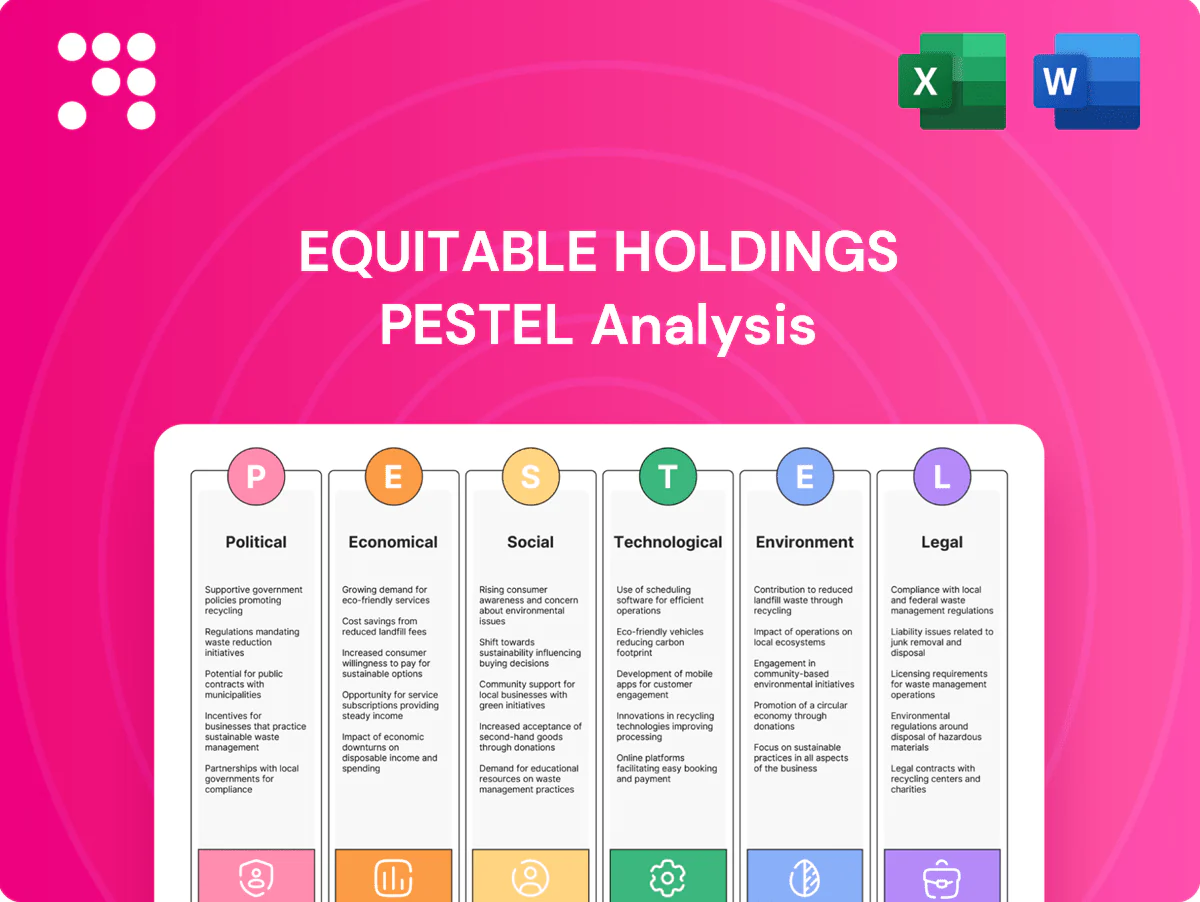
Equitable Holdings PESTLE Analysis

Your Shortcut to Market Insight Starts Here
Discover how political shifts, economic cycles, and regulatory trends are reshaping Equitable Holdings’ outlook in our concise PESTLE snapshot—essential for investors and strategists seeking actionable context. For the complete, fully referenced analysis with tactical recommendations, purchase the full PESTLE report now.
Political factors

Regulatory oversight and policy direction
Financial regulators’ priorities shift with administrations, altering capital standards, suitability rules and fiduciary expectations; Equitable must track these changes as US retirement assets reached about 36.6 trillion in 2024 (ICI). Equitable adapts product design and distribution to policy goals on consumer protection and retirement security, while heightened scrutiny of annuities and life products can change sales practices. Stable policy reduces compliance friction and supports multi-year growth planning.
Tax policy on insurance and retirement products
Tax advantages underpin demand for annuities, life insurance cash value, and qualified plans, supporting persistency and premium flows for Equitable; U.S. retirement assets topped roughly $36 trillion at end-2024. Legislative shifts such as SECURE Act 2.0 (raising RMD age to 73 in 2023 and to 75 in 2033) and changes to deferral or estate-tax rules can rapidly alter product attractiveness. Adverse tax changes would pressure margins and force swift repricing.

Public retirement policy and Social Security reform
Public debates over Social Security solvency (2024 Trustees project combined OASDI reserves depleting in 2033, implying roughly a 21% shortfall absent reform) drive interest in private annuities and guaranteed-income solutions. State-run auto-IRAs now exist in about 14 states plus DC, covering over 6 million enrollees and boosting demand for portable, advisory services. Richer public benefits could dampen private uptake, but Equitable can market products as complements to public systems.

Geopolitical stability and capital markets
Geopolitical sanctions, conflicts and political tensions increase market volatility, forcing Equitable to adjust asset-liability management as spread and credit shocks affect fixed-income portfolios and reserve valuations. Policy responses—sanctions, central-bank interventions and liquidity measures—shift yield curves and funding conditions, compressing or widening spreads. Robust risk governance and scenario frameworks are essential to navigate sudden regime shifts and preserve solvency.
- Sanctions and conflicts → higher volatility and credit spread risk
- Policy responses → altered yields, liquidity and funding conditions
- Insurers’ portfolios → exposure to spread/credit shocks
- Risk governance → crucial for regime-shift resilience
Government healthcare and long-term care initiatives
Policy support for long-term care or hybrid solutions can expand protection markets as the 65+ US population nears 20% by 2030, increasing demand; subsidies or mandatory standards would reshape pricing and underwriting economics. Coordination with Medicare/Medicaid—Medicaid funds roughly 62% of nursing home spending—strongly influences product design, so clear positioning mitigates political uncertainty around care funding.
- Market expansion: aging demographics to 2030
- Pricing risk: subsidies/standards alter loss costs
- Regulatory link: Medicaid covers ~62% of nursing home costs
- Strategy: clear product positioning reduces policy risk
Regulatory shift lifts annuity demand as US retirement assets $36.6T
Regulatory, tax and retirement-policy shifts alter Equitable’s product demand, capital and compliance; US retirement assets $36.6T (2024). Social Security solvency concerns (OASDI reserves projected depletion 2033) and SECURE Act 2.0 boost private annuity demand; 14 states+DC auto‑IRAs cover ~6M. Aging (65+ ~20% by 2030) and Medicaid funding (~62% nursing‑home) reshape long‑term care markets.
| Metric | Value |
|---|---|
| US retirement assets (2024) | $36.6T |
| OASDI reserve depletion | 2033 |
| Auto‑IRA reach | 14 states+DC; ~6M |
| 65+ share by 2030 | ~20% |
| Medicaid nursing‑home share | ~62% |
What is included in the product
 Detailed Word Document
Explores how macro-environmental factors uniquely impact Equitable Holdings across Political, Economic, Social, Technological, Environmental and Legal dimensions, with data-driven trends and forward-looking scenarios to identify risks and opportunities; designed for executives, investors and strategists to inform planning, compliance and capital decisions.

 Customizable Excel Spreadsheet
A concise, PESTLE-segmented summary of Equitable Holdings that’s easily dropped into presentations or shared across teams, enabling quick alignment on regulatory, economic and competitive risks while allowing users to add context-specific notes for their region or business line.
Economic factors

Interest rate levels and yield curve
Net investment income and annuity spreads for Equitable hinge on interest-rate levels and yield-curve shape: with the fed funds target at 5.25–5.50% (mid‑2025) and the 10‑yr near 4.2%, new-money yields have risen but legacy guaranteed blocks remain pressured. Prior 2‑10 inversions (about ‑70 bps in 2023) complicate ALM and crediting strategies, making dynamic hedging and rapid product repricing critical.
Equity market performance and volatility
Fee revenue in wealth management tracks asset values, while variable annuities with living benefits expose Equitable to market risk; periods of high equity volatility raise hedging costs and regulatory capital requirements, while sustained bull markets increase AUM and advice flows, and diversification across fee-based wealth management and spread-based insurance businesses helps stabilize earnings.

Labor market and household income
US unemployment held near 3.7% in 2024 with average hourly earnings up roughly 4% year-over-year, supporting premium capacity, savings and higher 401(k) contributions; strong labor markets boost retirement-plan contributions and advisory uptake. Conversely labor weakness raises lapses and reduces new sales. Tailored small-business solutions can capture employer-driven demand for benefits and advice.

Credit cycle and issuer fundamentals
Insurer portfolios at Equitable rely heavily on corporate and structured credit performance; with roughly $400bn in invested assets, downgrades widen spreads, pressuring capital and other comprehensive income (OCI) through markdowns. Prudent sector allocation and rigorous stress testing have reduced potential drawdowns, while US economic resilience in 2024 supported relatively stable investment income streams.
- credit-risk: downgrades widen spreads
- capital-impact: OCI sensitivity
- mitigation: sector allocation & stress tests
- macro: 2024 economic resilience supported income
Inflation and consumer confidence
Inflation erodes real returns and pressures policyholder budgets—US CPI was about 3.4% y/y in June 2025 while the fed funds rate sat at 5.25–5.50% (July 2025), forcing Equitable to adjust pricing and crediting rates to reflect higher cost dynamics and forward expectations. Consumer confidence shifts long-duration annuity demand, so clear value communication is vital to sustain persistency.
- Inflation: CPI ~3.4% y/y (Jun 2025)
- Rates: fed funds 5.25–5.50% (Jul 2025)
- Impact: pricing/crediting must adapt
- Opportunity: communication boosts persistency
Regulatory shift lifts annuity demand as US retirement assets $36.6T
Rates (fed funds 5.25–5.50%, 10y ~4.2%) drive net investment income and annuity spreads; volatility raises hedging costs and capital needs. CPI ~3.4% (Jun 2025) pressures real returns and pricing; unemployment ~3.7% supports premiums and 401(k) flows. Invested assets ~$400bn; downgrades widen spreads—sector allocation and stress tests mitigate risk.
| Metric | Value |
|---|---|
| Fed funds | 5.25–5.50% |
| 10‑yr | ~4.2% |
| CPI | 3.4% (Jun 2025) |
| Unemployment | 3.7% |
| Invested assets | $400bn |
Preview Before You Purchase
Equitable Holdings PESTLE Analysis
The Equitable Holdings PESTLE Analysis preview shown here is the exact document you’ll receive after purchase—fully formatted, professionally structured, and ready to use. This is a real screenshot of the product you’re buying, delivered exactly as shown with no placeholders or surprises. After payment you’ll be able to download this exact file immediately.

Your Shortcut to Market Insight Starts Here
Discover how political shifts, economic cycles, and regulatory trends are reshaping Equitable Holdings’ outlook in our concise PESTLE snapshot—essential for investors and strategists seeking actionable context. For the complete, fully referenced analysis with tactical recommendations, purchase the full PESTLE report now.
Political factors
Regulatory oversight and policy direction
Financial regulators’ priorities shift with administrations, altering capital standards, suitability rules and fiduciary expectations; Equitable must track these changes as US retirement assets reached about 36.6 trillion in 2024 (ICI). Equitable adapts product design and distribution to policy goals on consumer protection and retirement security, while heightened scrutiny of annuities and life products can change sales practices. Stable policy reduces compliance friction and supports multi-year growth planning.
Tax policy on insurance and retirement products
Tax advantages underpin demand for annuities, life insurance cash value, and qualified plans, supporting persistency and premium flows for Equitable; U.S. retirement assets topped roughly $36 trillion at end-2024. Legislative shifts such as SECURE Act 2.0 (raising RMD age to 73 in 2023 and to 75 in 2033) and changes to deferral or estate-tax rules can rapidly alter product attractiveness. Adverse tax changes would pressure margins and force swift repricing.
Public retirement policy and Social Security reform
Public debates over Social Security solvency (2024 Trustees project combined OASDI reserves depleting in 2033, implying roughly a 21% shortfall absent reform) drive interest in private annuities and guaranteed-income solutions. State-run auto-IRAs now exist in about 14 states plus DC, covering over 6 million enrollees and boosting demand for portable, advisory services. Richer public benefits could dampen private uptake, but Equitable can market products as complements to public systems.
Geopolitical stability and capital markets
Geopolitical sanctions, conflicts and political tensions increase market volatility, forcing Equitable to adjust asset-liability management as spread and credit shocks affect fixed-income portfolios and reserve valuations. Policy responses—sanctions, central-bank interventions and liquidity measures—shift yield curves and funding conditions, compressing or widening spreads. Robust risk governance and scenario frameworks are essential to navigate sudden regime shifts and preserve solvency.
- Sanctions and conflicts → higher volatility and credit spread risk
- Policy responses → altered yields, liquidity and funding conditions
- Insurers’ portfolios → exposure to spread/credit shocks
- Risk governance → crucial for regime-shift resilience
Government healthcare and long-term care initiatives
Policy support for long-term care or hybrid solutions can expand protection markets as the 65+ US population nears 20% by 2030, increasing demand; subsidies or mandatory standards would reshape pricing and underwriting economics. Coordination with Medicare/Medicaid—Medicaid funds roughly 62% of nursing home spending—strongly influences product design, so clear positioning mitigates political uncertainty around care funding.
- Market expansion: aging demographics to 2030
- Pricing risk: subsidies/standards alter loss costs
- Regulatory link: Medicaid covers ~62% of nursing home costs
- Strategy: clear product positioning reduces policy risk
Regulatory shift lifts annuity demand as US retirement assets $36.6T
Regulatory, tax and retirement-policy shifts alter Equitable’s product demand, capital and compliance; US retirement assets $36.6T (2024). Social Security solvency concerns (OASDI reserves projected depletion 2033) and SECURE Act 2.0 boost private annuity demand; 14 states+DC auto‑IRAs cover ~6M. Aging (65+ ~20% by 2030) and Medicaid funding (~62% nursing‑home) reshape long‑term care markets.
| Metric | Value |
|---|---|
| US retirement assets (2024) | $36.6T |
| OASDI reserve depletion | 2033 |
| Auto‑IRA reach | 14 states+DC; ~6M |
| 65+ share by 2030 | ~20% |
| Medicaid nursing‑home share | ~62% |
What is included in the product
Detailed Word Document
Explores how macro-environmental factors uniquely impact Equitable Holdings across Political, Economic, Social, Technological, Environmental and Legal dimensions, with data-driven trends and forward-looking scenarios to identify risks and opportunities; designed for executives, investors and strategists to inform planning, compliance and capital decisions.
Customizable Excel Spreadsheet
A concise, PESTLE-segmented summary of Equitable Holdings that’s easily dropped into presentations or shared across teams, enabling quick alignment on regulatory, economic and competitive risks while allowing users to add context-specific notes for their region or business line.
Economic factors
Interest rate levels and yield curve
Net investment income and annuity spreads for Equitable hinge on interest-rate levels and yield-curve shape: with the fed funds target at 5.25–5.50% (mid‑2025) and the 10‑yr near 4.2%, new-money yields have risen but legacy guaranteed blocks remain pressured. Prior 2‑10 inversions (about ‑70 bps in 2023) complicate ALM and crediting strategies, making dynamic hedging and rapid product repricing critical.
Equity market performance and volatility
Fee revenue in wealth management tracks asset values, while variable annuities with living benefits expose Equitable to market risk; periods of high equity volatility raise hedging costs and regulatory capital requirements, while sustained bull markets increase AUM and advice flows, and diversification across fee-based wealth management and spread-based insurance businesses helps stabilize earnings.
Labor market and household income
US unemployment held near 3.7% in 2024 with average hourly earnings up roughly 4% year-over-year, supporting premium capacity, savings and higher 401(k) contributions; strong labor markets boost retirement-plan contributions and advisory uptake. Conversely labor weakness raises lapses and reduces new sales. Tailored small-business solutions can capture employer-driven demand for benefits and advice.
Credit cycle and issuer fundamentals
Insurer portfolios at Equitable rely heavily on corporate and structured credit performance; with roughly $400bn in invested assets, downgrades widen spreads, pressuring capital and other comprehensive income (OCI) through markdowns. Prudent sector allocation and rigorous stress testing have reduced potential drawdowns, while US economic resilience in 2024 supported relatively stable investment income streams.
- credit-risk: downgrades widen spreads
- capital-impact: OCI sensitivity
- mitigation: sector allocation & stress tests
- macro: 2024 economic resilience supported income
Inflation and consumer confidence
Inflation erodes real returns and pressures policyholder budgets—US CPI was about 3.4% y/y in June 2025 while the fed funds rate sat at 5.25–5.50% (July 2025), forcing Equitable to adjust pricing and crediting rates to reflect higher cost dynamics and forward expectations. Consumer confidence shifts long-duration annuity demand, so clear value communication is vital to sustain persistency.
- Inflation: CPI ~3.4% y/y (Jun 2025)
- Rates: fed funds 5.25–5.50% (Jul 2025)
- Impact: pricing/crediting must adapt
- Opportunity: communication boosts persistency
Regulatory shift lifts annuity demand as US retirement assets $36.6T
Rates (fed funds 5.25–5.50%, 10y ~4.2%) drive net investment income and annuity spreads; volatility raises hedging costs and capital needs. CPI ~3.4% (Jun 2025) pressures real returns and pricing; unemployment ~3.7% supports premiums and 401(k) flows. Invested assets ~$400bn; downgrades widen spreads—sector allocation and stress tests mitigate risk.
| Metric | Value |
|---|---|
| Fed funds | 5.25–5.50% |
| 10‑yr | ~4.2% |
| CPI | 3.4% (Jun 2025) |
| Unemployment | 3.7% |
| Invested assets | $400bn |
Preview Before You Purchase
Equitable Holdings PESTLE Analysis
The Equitable Holdings PESTLE Analysis preview shown here is the exact document you’ll receive after purchase—fully formatted, professionally structured, and ready to use. This is a real screenshot of the product you’re buying, delivered exactly as shown with no placeholders or surprises. After payment you’ll be able to download this exact file immediately.
Original: $10.00
-65%$10.00
$3.50Description
Your Shortcut to Market Insight Starts Here
Discover how political shifts, economic cycles, and regulatory trends are reshaping Equitable Holdings’ outlook in our concise PESTLE snapshot—essential for investors and strategists seeking actionable context. For the complete, fully referenced analysis with tactical recommendations, purchase the full PESTLE report now.
Political factors
Regulatory oversight and policy direction
Financial regulators’ priorities shift with administrations, altering capital standards, suitability rules and fiduciary expectations; Equitable must track these changes as US retirement assets reached about 36.6 trillion in 2024 (ICI). Equitable adapts product design and distribution to policy goals on consumer protection and retirement security, while heightened scrutiny of annuities and life products can change sales practices. Stable policy reduces compliance friction and supports multi-year growth planning.
Tax policy on insurance and retirement products
Tax advantages underpin demand for annuities, life insurance cash value, and qualified plans, supporting persistency and premium flows for Equitable; U.S. retirement assets topped roughly $36 trillion at end-2024. Legislative shifts such as SECURE Act 2.0 (raising RMD age to 73 in 2023 and to 75 in 2033) and changes to deferral or estate-tax rules can rapidly alter product attractiveness. Adverse tax changes would pressure margins and force swift repricing.
Public retirement policy and Social Security reform
Public debates over Social Security solvency (2024 Trustees project combined OASDI reserves depleting in 2033, implying roughly a 21% shortfall absent reform) drive interest in private annuities and guaranteed-income solutions. State-run auto-IRAs now exist in about 14 states plus DC, covering over 6 million enrollees and boosting demand for portable, advisory services. Richer public benefits could dampen private uptake, but Equitable can market products as complements to public systems.
Geopolitical stability and capital markets
Geopolitical sanctions, conflicts and political tensions increase market volatility, forcing Equitable to adjust asset-liability management as spread and credit shocks affect fixed-income portfolios and reserve valuations. Policy responses—sanctions, central-bank interventions and liquidity measures—shift yield curves and funding conditions, compressing or widening spreads. Robust risk governance and scenario frameworks are essential to navigate sudden regime shifts and preserve solvency.
- Sanctions and conflicts → higher volatility and credit spread risk
- Policy responses → altered yields, liquidity and funding conditions
- Insurers’ portfolios → exposure to spread/credit shocks
- Risk governance → crucial for regime-shift resilience
Government healthcare and long-term care initiatives
Policy support for long-term care or hybrid solutions can expand protection markets as the 65+ US population nears 20% by 2030, increasing demand; subsidies or mandatory standards would reshape pricing and underwriting economics. Coordination with Medicare/Medicaid—Medicaid funds roughly 62% of nursing home spending—strongly influences product design, so clear positioning mitigates political uncertainty around care funding.
- Market expansion: aging demographics to 2030
- Pricing risk: subsidies/standards alter loss costs
- Regulatory link: Medicaid covers ~62% of nursing home costs
- Strategy: clear product positioning reduces policy risk
Regulatory shift lifts annuity demand as US retirement assets $36.6T
Regulatory, tax and retirement-policy shifts alter Equitable’s product demand, capital and compliance; US retirement assets $36.6T (2024). Social Security solvency concerns (OASDI reserves projected depletion 2033) and SECURE Act 2.0 boost private annuity demand; 14 states+DC auto‑IRAs cover ~6M. Aging (65+ ~20% by 2030) and Medicaid funding (~62% nursing‑home) reshape long‑term care markets.
| Metric | Value |
|---|---|
| US retirement assets (2024) | $36.6T |
| OASDI reserve depletion | 2033 |
| Auto‑IRA reach | 14 states+DC; ~6M |
| 65+ share by 2030 | ~20% |
| Medicaid nursing‑home share | ~62% |
What is included in the product
Detailed Word Document
Explores how macro-environmental factors uniquely impact Equitable Holdings across Political, Economic, Social, Technological, Environmental and Legal dimensions, with data-driven trends and forward-looking scenarios to identify risks and opportunities; designed for executives, investors and strategists to inform planning, compliance and capital decisions.
Customizable Excel Spreadsheet
A concise, PESTLE-segmented summary of Equitable Holdings that’s easily dropped into presentations or shared across teams, enabling quick alignment on regulatory, economic and competitive risks while allowing users to add context-specific notes for their region or business line.
Economic factors
Interest rate levels and yield curve
Net investment income and annuity spreads for Equitable hinge on interest-rate levels and yield-curve shape: with the fed funds target at 5.25–5.50% (mid‑2025) and the 10‑yr near 4.2%, new-money yields have risen but legacy guaranteed blocks remain pressured. Prior 2‑10 inversions (about ‑70 bps in 2023) complicate ALM and crediting strategies, making dynamic hedging and rapid product repricing critical.
Equity market performance and volatility
Fee revenue in wealth management tracks asset values, while variable annuities with living benefits expose Equitable to market risk; periods of high equity volatility raise hedging costs and regulatory capital requirements, while sustained bull markets increase AUM and advice flows, and diversification across fee-based wealth management and spread-based insurance businesses helps stabilize earnings.
Labor market and household income
US unemployment held near 3.7% in 2024 with average hourly earnings up roughly 4% year-over-year, supporting premium capacity, savings and higher 401(k) contributions; strong labor markets boost retirement-plan contributions and advisory uptake. Conversely labor weakness raises lapses and reduces new sales. Tailored small-business solutions can capture employer-driven demand for benefits and advice.
Credit cycle and issuer fundamentals
Insurer portfolios at Equitable rely heavily on corporate and structured credit performance; with roughly $400bn in invested assets, downgrades widen spreads, pressuring capital and other comprehensive income (OCI) through markdowns. Prudent sector allocation and rigorous stress testing have reduced potential drawdowns, while US economic resilience in 2024 supported relatively stable investment income streams.
- credit-risk: downgrades widen spreads
- capital-impact: OCI sensitivity
- mitigation: sector allocation & stress tests
- macro: 2024 economic resilience supported income
Inflation and consumer confidence
Inflation erodes real returns and pressures policyholder budgets—US CPI was about 3.4% y/y in June 2025 while the fed funds rate sat at 5.25–5.50% (July 2025), forcing Equitable to adjust pricing and crediting rates to reflect higher cost dynamics and forward expectations. Consumer confidence shifts long-duration annuity demand, so clear value communication is vital to sustain persistency.
- Inflation: CPI ~3.4% y/y (Jun 2025)
- Rates: fed funds 5.25–5.50% (Jul 2025)
- Impact: pricing/crediting must adapt
- Opportunity: communication boosts persistency
Regulatory shift lifts annuity demand as US retirement assets $36.6T
Rates (fed funds 5.25–5.50%, 10y ~4.2%) drive net investment income and annuity spreads; volatility raises hedging costs and capital needs. CPI ~3.4% (Jun 2025) pressures real returns and pricing; unemployment ~3.7% supports premiums and 401(k) flows. Invested assets ~$400bn; downgrades widen spreads—sector allocation and stress tests mitigate risk.
| Metric | Value |
|---|---|
| Fed funds | 5.25–5.50% |
| 10‑yr | ~4.2% |
| CPI | 3.4% (Jun 2025) |
| Unemployment | 3.7% |
| Invested assets | $400bn |
Preview Before You Purchase
Equitable Holdings PESTLE Analysis
The Equitable Holdings PESTLE Analysis preview shown here is the exact document you’ll receive after purchase—fully formatted, professionally structured, and ready to use. This is a real screenshot of the product you’re buying, delivered exactly as shown with no placeholders or surprises. After payment you’ll be able to download this exact file immediately.











