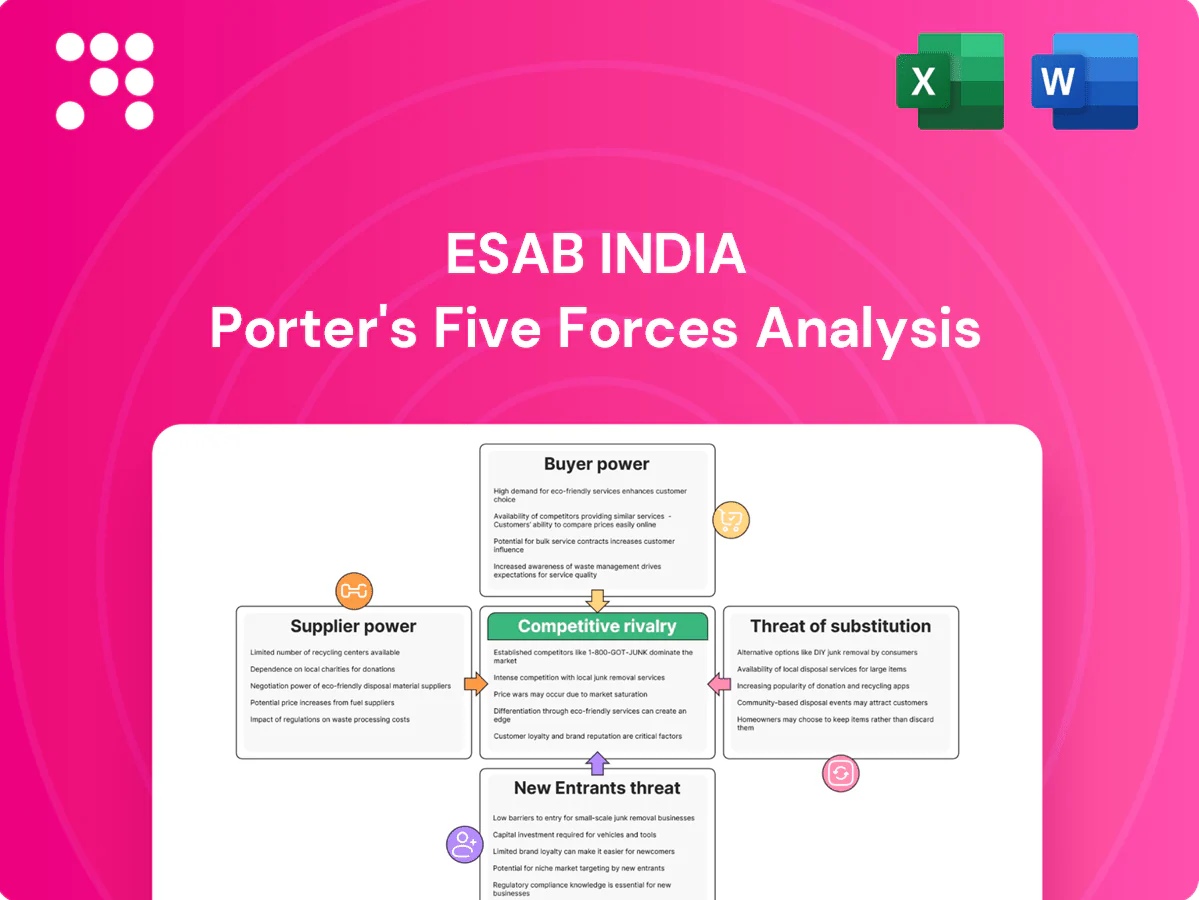
ESAB India Porter's Five Forces Analysis

Go Beyond the Preview—Access the Full Strategic Report
ESAB India’s Porter's Five Forces snapshot highlights supplier leverage, buyer sensitivity, rival intensity, entrant threats, and substitute risks shaping its welding and cutting market. This concise view reveals strategic pressures and opportunity areas for margin protection and growth. Want the full force-by-force ratings, visuals, and actionable recommendations? Unlock the complete Porter's Five Forces Analysis to inform investment and strategy decisions.
Suppliers Bargaining Power

Critical raw materials concentration
Core inputs for ESAB India include steel wires, fluxes, alloy powders, copper and power‑electronics components, and in 2024 supplier concentration for several high‑spec inputs remains tight. Limited high‑spec suppliers increase dependency and quality risk, while commodity volatility can compress margins. ESAB mitigates these risks through multi‑sourcing and global procurement strategies.
Specs-driven supplier stickiness
Consumables must meet strict metallurgical and code requirements, so ESAB India relies on qualified vendor lists that raise switching costs and protect incumbent suppliers. Requalification cycles for welding consumables and electrodes introduce multi-month approval processes that slow changeovers. These factors temper but do not eliminate supplier leverage, leaving suppliers with moderate bargaining power.

Imported components exposure
Advanced inverters, semiconductors and torches used by ESAB India are often imported, exposing the company to FX swings and logistics lead times that averaged 12–16 weeks in 2024. India relied on imports for over 80% of semiconductor demand in 2024, while duties and trade-policy shifts added landed-cost variability often in the 5–15% range. Diversified sourcing and growing local value-add, with domestic content moving toward mid-30s in 2024, help offset supplier power.

Scale and long-term contracts
ESAB India’s scale drives negotiated discounts and multi-year frame agreements—in 2024 the company emphasized 12–24 month supplier contracts to stabilize pricing and supply for welding consumables and electrodes. Active supplier development programs in 2024 improved on-time delivery and quality, partially neutralizing individual supplier leverage.
- Scale reduces per-unit supplier margins
- Frame agreements smooth pricing/volumes
- Supplier development raises reliability
- Scale only partly offsets key supplier dependence
Logistics and energy dependencies
Gas cutting depends on a broad industrial-gases and cylinders ecosystem, with oxygen/acetylene supply chains critical to operations; disruptions raise short-term supplier leverage as seen in 2024 oxygen spot tightness in some regions.
Electrode baking and welding consumable production are electricity-intensive; Indian industrial tariffs averaging about INR 8–9/kWh in 2024 materially affect unit costs.
Transport reliability influences on-time delivery and inventory buffers; logistics bottlenecks transiently elevate supplier influence during peak disruptions.
- Supply concentration: cylinders and bulk gases
- Energy share: electricity-driven baking costs
- Logistics risk: delivery timeliness
High-spec inputs, 12-16wk lead times and 5-15% duties boost supplier leverage
Supplier power is moderate: high‑spec inputs concentrated, lead times 12–16 weeks and duties 5–15% in 2024 raise leverage.
ESAB offsets via multi‑sourcing, 12–24 month frame agreements and supplier development; domestic content ~mid‑30s in 2024.
Energy (INR 8–9/kWh) and gas cylinders create pockets of short‑term supplier strength.
| Metric | 2024 |
|---|---|
| Semiconductor imports | 80%+ |
| Lead time | 12–16 wks |
| Electricity price | INR 8–9/kWh |
What is included in the product
 Detailed Word Document
Comprehensive Porter's Five Forces analysis tailored to ESAB India, uncovering competitive intensity, supplier and buyer power, threat of substitutes, and entry barriers to assess profitability and strategic risks.

 Customizable Excel Spreadsheet
A one-sheet Porter's Five Forces for ESAB India that highlights supplier, buyer, and competitive pressures—ideal for quick strategic fixes and board decisions. Editable radar chart and simple layout let non-experts adjust scenarios and copy into decks without macros.
Customers Bargaining Power

Diverse end-markets
ESAB India serves fabrication, construction, shipbuilding and infrastructure end-markets, spreading demand across sectors and reducing dependence on any single buyer. This diversification weakens customer bargaining power despite sector-specific cyclicality. Cyclical swings in shipbuilding or construction can be offset by reallocating sales mix towards stronger verticals. The company’s ability to rebalance mix supports margin defense.
Large tenders and EPCs
Large EPC tenders from shipyards, rail and oil & gas often bundle volumes exceeding $50m, intensifying price competition; tendering typically compresses margins by 3–5%. Multi-year contracts (3–5 years) demand strict SLAs and robust aftermarket support. Buyers leverage rivalry among branded players to extract volume discounts and tighter payment terms.

Consumables price sensitivity
Welding electrodes and wires are high-frequency purchases for industrial buyers, so even small price shifts compound across repeat volumes. Buyers push hard on price for standard grades, using volume contracts and competitive tenders to extract margins. Demand for value-added and specialty alloys reduces pure price pressure by shifting focus to performance and total cost of ownership. This dynamic amplifies customer bargaining power in commodities segments.

Qualification and switching costs
WPS/PQR approvals and code compliance create regulatory lock-in for ESAB India, making buyers dependent on certified consumables and equipment; switching mandates trials, requalification under ASME/ISO regimes and operational downtime. Required requalification and trial phases increase procurement cost and delay, while ESAB’s after-sales support, field training and certification assistance deepen customer stickiness and lower effective buyer bargaining power.
- WPS/PQR approvals: regulatory lock-in
- Switching cost: trials + requalification + downtime
- After-sales & training: increased retention
- Net effect: reduced buyer bargaining power
Service and uptime expectations
Equipment buyers prioritize reliability and rapid service resolution, making ESAB Indias channel strength and spares availability decisive in purchase choices; superior service levels permit premium pricing while weak regional coverage increases buyer leverage and price sensitivity.
- Service reliability drives purchases
- Fast RMA/spares reduces downtime risk
- Service premium justified
- Poor coverage = higher customer bargaining power
Large EPC tenders (> $50m) force margin squeeze of 3-5%
ESAB India’s sector diversification reduces dependence on single buyers, but large EPC tenders (> $50m) and standard-grade volume contracts compress margins ~3–5%. High-frequency consumable purchases amplify buyer price sensitivity, while WPS/PQR requalification and strong after-sales support raise switching costs and defend margins. Service coverage drives willingness to pay premiums; weak regional service increases buyer leverage.
| Factor | Metric |
|---|---|
| Tender size | > $50m |
| Margin compression | 3–5% |
| Contract length | 3–5 years |
What You See Is What You Get
ESAB India Porter's Five Forces Analysis
This preview shows the exact ESAB India Porter's Five Forces Analysis you'll receive immediately after purchase—no placeholders or mockups. The document displayed here is the fully formatted, professional analysis ready for download and use the moment you buy. You’re viewing the final version; purchase grants instant access to this same file.

Go Beyond the Preview—Access the Full Strategic Report
ESAB India’s Porter's Five Forces snapshot highlights supplier leverage, buyer sensitivity, rival intensity, entrant threats, and substitute risks shaping its welding and cutting market. This concise view reveals strategic pressures and opportunity areas for margin protection and growth. Want the full force-by-force ratings, visuals, and actionable recommendations? Unlock the complete Porter's Five Forces Analysis to inform investment and strategy decisions.
Suppliers Bargaining Power
Critical raw materials concentration
Core inputs for ESAB India include steel wires, fluxes, alloy powders, copper and power‑electronics components, and in 2024 supplier concentration for several high‑spec inputs remains tight. Limited high‑spec suppliers increase dependency and quality risk, while commodity volatility can compress margins. ESAB mitigates these risks through multi‑sourcing and global procurement strategies.
Specs-driven supplier stickiness
Consumables must meet strict metallurgical and code requirements, so ESAB India relies on qualified vendor lists that raise switching costs and protect incumbent suppliers. Requalification cycles for welding consumables and electrodes introduce multi-month approval processes that slow changeovers. These factors temper but do not eliminate supplier leverage, leaving suppliers with moderate bargaining power.
Imported components exposure
Advanced inverters, semiconductors and torches used by ESAB India are often imported, exposing the company to FX swings and logistics lead times that averaged 12–16 weeks in 2024. India relied on imports for over 80% of semiconductor demand in 2024, while duties and trade-policy shifts added landed-cost variability often in the 5–15% range. Diversified sourcing and growing local value-add, with domestic content moving toward mid-30s in 2024, help offset supplier power.
Scale and long-term contracts
ESAB India’s scale drives negotiated discounts and multi-year frame agreements—in 2024 the company emphasized 12–24 month supplier contracts to stabilize pricing and supply for welding consumables and electrodes. Active supplier development programs in 2024 improved on-time delivery and quality, partially neutralizing individual supplier leverage.
- Scale reduces per-unit supplier margins
- Frame agreements smooth pricing/volumes
- Supplier development raises reliability
- Scale only partly offsets key supplier dependence
Logistics and energy dependencies
Gas cutting depends on a broad industrial-gases and cylinders ecosystem, with oxygen/acetylene supply chains critical to operations; disruptions raise short-term supplier leverage as seen in 2024 oxygen spot tightness in some regions.
Electrode baking and welding consumable production are electricity-intensive; Indian industrial tariffs averaging about INR 8–9/kWh in 2024 materially affect unit costs.
Transport reliability influences on-time delivery and inventory buffers; logistics bottlenecks transiently elevate supplier influence during peak disruptions.
- Supply concentration: cylinders and bulk gases
- Energy share: electricity-driven baking costs
- Logistics risk: delivery timeliness
High-spec inputs, 12-16wk lead times and 5-15% duties boost supplier leverage
Supplier power is moderate: high‑spec inputs concentrated, lead times 12–16 weeks and duties 5–15% in 2024 raise leverage.
ESAB offsets via multi‑sourcing, 12–24 month frame agreements and supplier development; domestic content ~mid‑30s in 2024.
Energy (INR 8–9/kWh) and gas cylinders create pockets of short‑term supplier strength.
| Metric | 2024 |
|---|---|
| Semiconductor imports | 80%+ |
| Lead time | 12–16 wks |
| Electricity price | INR 8–9/kWh |
What is included in the product
Detailed Word Document
Comprehensive Porter's Five Forces analysis tailored to ESAB India, uncovering competitive intensity, supplier and buyer power, threat of substitutes, and entry barriers to assess profitability and strategic risks.
Customizable Excel Spreadsheet
A one-sheet Porter's Five Forces for ESAB India that highlights supplier, buyer, and competitive pressures—ideal for quick strategic fixes and board decisions. Editable radar chart and simple layout let non-experts adjust scenarios and copy into decks without macros.
Customers Bargaining Power
Diverse end-markets
ESAB India serves fabrication, construction, shipbuilding and infrastructure end-markets, spreading demand across sectors and reducing dependence on any single buyer. This diversification weakens customer bargaining power despite sector-specific cyclicality. Cyclical swings in shipbuilding or construction can be offset by reallocating sales mix towards stronger verticals. The company’s ability to rebalance mix supports margin defense.
Large tenders and EPCs
Large EPC tenders from shipyards, rail and oil & gas often bundle volumes exceeding $50m, intensifying price competition; tendering typically compresses margins by 3–5%. Multi-year contracts (3–5 years) demand strict SLAs and robust aftermarket support. Buyers leverage rivalry among branded players to extract volume discounts and tighter payment terms.
Consumables price sensitivity
Welding electrodes and wires are high-frequency purchases for industrial buyers, so even small price shifts compound across repeat volumes. Buyers push hard on price for standard grades, using volume contracts and competitive tenders to extract margins. Demand for value-added and specialty alloys reduces pure price pressure by shifting focus to performance and total cost of ownership. This dynamic amplifies customer bargaining power in commodities segments.
Qualification and switching costs
WPS/PQR approvals and code compliance create regulatory lock-in for ESAB India, making buyers dependent on certified consumables and equipment; switching mandates trials, requalification under ASME/ISO regimes and operational downtime. Required requalification and trial phases increase procurement cost and delay, while ESAB’s after-sales support, field training and certification assistance deepen customer stickiness and lower effective buyer bargaining power.
- WPS/PQR approvals: regulatory lock-in
- Switching cost: trials + requalification + downtime
- After-sales & training: increased retention
- Net effect: reduced buyer bargaining power
Service and uptime expectations
Equipment buyers prioritize reliability and rapid service resolution, making ESAB Indias channel strength and spares availability decisive in purchase choices; superior service levels permit premium pricing while weak regional coverage increases buyer leverage and price sensitivity.
- Service reliability drives purchases
- Fast RMA/spares reduces downtime risk
- Service premium justified
- Poor coverage = higher customer bargaining power
Large EPC tenders (> $50m) force margin squeeze of 3-5%
ESAB India’s sector diversification reduces dependence on single buyers, but large EPC tenders (> $50m) and standard-grade volume contracts compress margins ~3–5%. High-frequency consumable purchases amplify buyer price sensitivity, while WPS/PQR requalification and strong after-sales support raise switching costs and defend margins. Service coverage drives willingness to pay premiums; weak regional service increases buyer leverage.
| Factor | Metric |
|---|---|
| Tender size | > $50m |
| Margin compression | 3–5% |
| Contract length | 3–5 years |
What You See Is What You Get
ESAB India Porter's Five Forces Analysis
This preview shows the exact ESAB India Porter's Five Forces Analysis you'll receive immediately after purchase—no placeholders or mockups. The document displayed here is the fully formatted, professional analysis ready for download and use the moment you buy. You’re viewing the final version; purchase grants instant access to this same file.
Description
Go Beyond the Preview—Access the Full Strategic Report
ESAB India’s Porter's Five Forces snapshot highlights supplier leverage, buyer sensitivity, rival intensity, entrant threats, and substitute risks shaping its welding and cutting market. This concise view reveals strategic pressures and opportunity areas for margin protection and growth. Want the full force-by-force ratings, visuals, and actionable recommendations? Unlock the complete Porter's Five Forces Analysis to inform investment and strategy decisions.
Suppliers Bargaining Power
Critical raw materials concentration
Core inputs for ESAB India include steel wires, fluxes, alloy powders, copper and power‑electronics components, and in 2024 supplier concentration for several high‑spec inputs remains tight. Limited high‑spec suppliers increase dependency and quality risk, while commodity volatility can compress margins. ESAB mitigates these risks through multi‑sourcing and global procurement strategies.
Specs-driven supplier stickiness
Consumables must meet strict metallurgical and code requirements, so ESAB India relies on qualified vendor lists that raise switching costs and protect incumbent suppliers. Requalification cycles for welding consumables and electrodes introduce multi-month approval processes that slow changeovers. These factors temper but do not eliminate supplier leverage, leaving suppliers with moderate bargaining power.
Imported components exposure
Advanced inverters, semiconductors and torches used by ESAB India are often imported, exposing the company to FX swings and logistics lead times that averaged 12–16 weeks in 2024. India relied on imports for over 80% of semiconductor demand in 2024, while duties and trade-policy shifts added landed-cost variability often in the 5–15% range. Diversified sourcing and growing local value-add, with domestic content moving toward mid-30s in 2024, help offset supplier power.
Scale and long-term contracts
ESAB India’s scale drives negotiated discounts and multi-year frame agreements—in 2024 the company emphasized 12–24 month supplier contracts to stabilize pricing and supply for welding consumables and electrodes. Active supplier development programs in 2024 improved on-time delivery and quality, partially neutralizing individual supplier leverage.
- Scale reduces per-unit supplier margins
- Frame agreements smooth pricing/volumes
- Supplier development raises reliability
- Scale only partly offsets key supplier dependence
Logistics and energy dependencies
Gas cutting depends on a broad industrial-gases and cylinders ecosystem, with oxygen/acetylene supply chains critical to operations; disruptions raise short-term supplier leverage as seen in 2024 oxygen spot tightness in some regions.
Electrode baking and welding consumable production are electricity-intensive; Indian industrial tariffs averaging about INR 8–9/kWh in 2024 materially affect unit costs.
Transport reliability influences on-time delivery and inventory buffers; logistics bottlenecks transiently elevate supplier influence during peak disruptions.
- Supply concentration: cylinders and bulk gases
- Energy share: electricity-driven baking costs
- Logistics risk: delivery timeliness
High-spec inputs, 12-16wk lead times and 5-15% duties boost supplier leverage
Supplier power is moderate: high‑spec inputs concentrated, lead times 12–16 weeks and duties 5–15% in 2024 raise leverage.
ESAB offsets via multi‑sourcing, 12–24 month frame agreements and supplier development; domestic content ~mid‑30s in 2024.
Energy (INR 8–9/kWh) and gas cylinders create pockets of short‑term supplier strength.
| Metric | 2024 |
|---|---|
| Semiconductor imports | 80%+ |
| Lead time | 12–16 wks |
| Electricity price | INR 8–9/kWh |
What is included in the product
Detailed Word Document
Comprehensive Porter's Five Forces analysis tailored to ESAB India, uncovering competitive intensity, supplier and buyer power, threat of substitutes, and entry barriers to assess profitability and strategic risks.
Customizable Excel Spreadsheet
A one-sheet Porter's Five Forces for ESAB India that highlights supplier, buyer, and competitive pressures—ideal for quick strategic fixes and board decisions. Editable radar chart and simple layout let non-experts adjust scenarios and copy into decks without macros.
Customers Bargaining Power
Diverse end-markets
ESAB India serves fabrication, construction, shipbuilding and infrastructure end-markets, spreading demand across sectors and reducing dependence on any single buyer. This diversification weakens customer bargaining power despite sector-specific cyclicality. Cyclical swings in shipbuilding or construction can be offset by reallocating sales mix towards stronger verticals. The company’s ability to rebalance mix supports margin defense.
Large tenders and EPCs
Large EPC tenders from shipyards, rail and oil & gas often bundle volumes exceeding $50m, intensifying price competition; tendering typically compresses margins by 3–5%. Multi-year contracts (3–5 years) demand strict SLAs and robust aftermarket support. Buyers leverage rivalry among branded players to extract volume discounts and tighter payment terms.
Consumables price sensitivity
Welding electrodes and wires are high-frequency purchases for industrial buyers, so even small price shifts compound across repeat volumes. Buyers push hard on price for standard grades, using volume contracts and competitive tenders to extract margins. Demand for value-added and specialty alloys reduces pure price pressure by shifting focus to performance and total cost of ownership. This dynamic amplifies customer bargaining power in commodities segments.
Qualification and switching costs
WPS/PQR approvals and code compliance create regulatory lock-in for ESAB India, making buyers dependent on certified consumables and equipment; switching mandates trials, requalification under ASME/ISO regimes and operational downtime. Required requalification and trial phases increase procurement cost and delay, while ESAB’s after-sales support, field training and certification assistance deepen customer stickiness and lower effective buyer bargaining power.
- WPS/PQR approvals: regulatory lock-in
- Switching cost: trials + requalification + downtime
- After-sales & training: increased retention
- Net effect: reduced buyer bargaining power
Service and uptime expectations
Equipment buyers prioritize reliability and rapid service resolution, making ESAB Indias channel strength and spares availability decisive in purchase choices; superior service levels permit premium pricing while weak regional coverage increases buyer leverage and price sensitivity.
- Service reliability drives purchases
- Fast RMA/spares reduces downtime risk
- Service premium justified
- Poor coverage = higher customer bargaining power
Large EPC tenders (> $50m) force margin squeeze of 3-5%
ESAB India’s sector diversification reduces dependence on single buyers, but large EPC tenders (> $50m) and standard-grade volume contracts compress margins ~3–5%. High-frequency consumable purchases amplify buyer price sensitivity, while WPS/PQR requalification and strong after-sales support raise switching costs and defend margins. Service coverage drives willingness to pay premiums; weak regional service increases buyer leverage.
| Factor | Metric |
|---|---|
| Tender size | > $50m |
| Margin compression | 3–5% |
| Contract length | 3–5 years |
What You See Is What You Get
ESAB India Porter's Five Forces Analysis
This preview shows the exact ESAB India Porter's Five Forces Analysis you'll receive immediately after purchase—no placeholders or mockups. The document displayed here is the fully formatted, professional analysis ready for download and use the moment you buy. You’re viewing the final version; purchase grants instant access to this same file.











