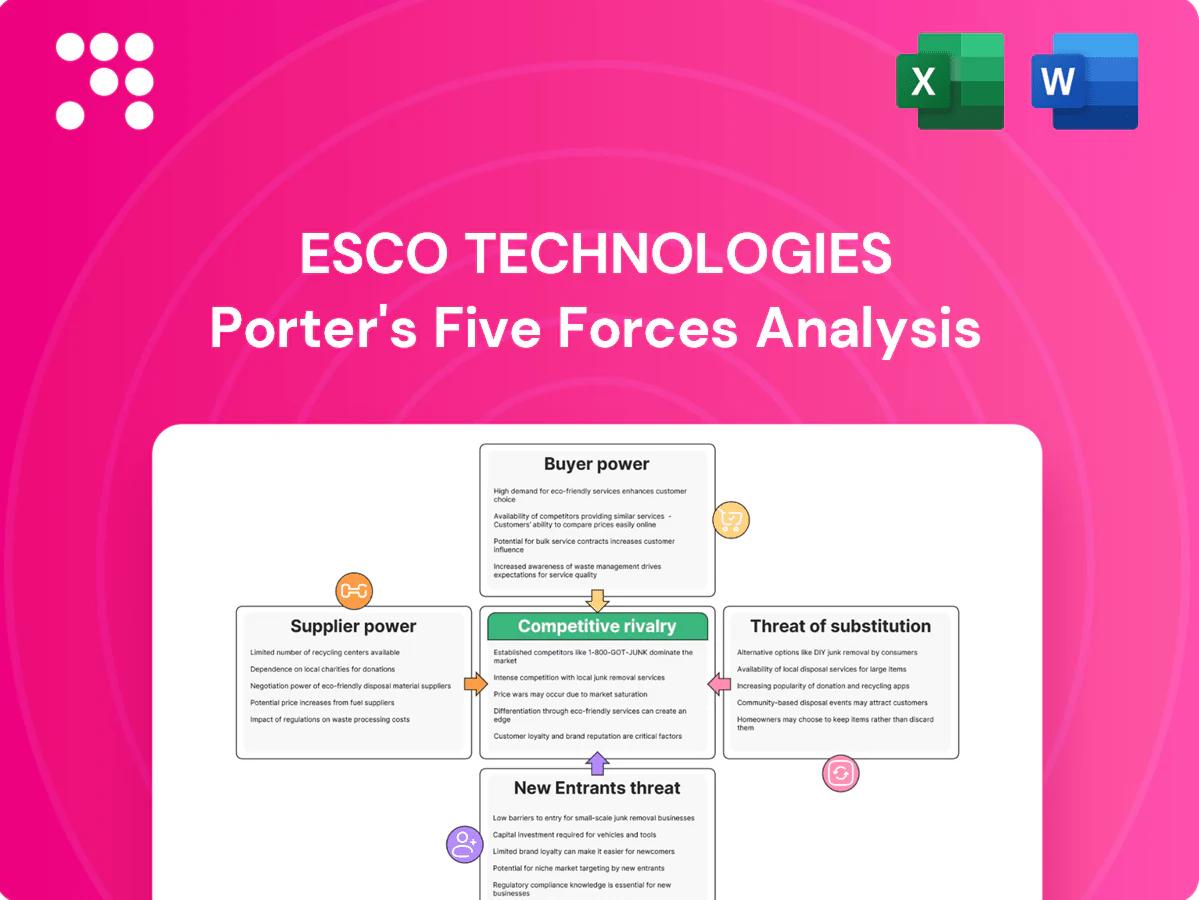
ESCO Technologies Porter's Five Forces Analysis

Go Beyond the Preview—Access the Full Strategic Report
ESCO Technologies faces moderate supplier power due to specialized components, while buyer power is tempered by its niche service offerings and long-standing contracts. Competitive rivalry is steady with peers in testing and measurement, and barriers to entry remain high because of regulatory standards and capital intensity. This brief snapshot only scratches the surface — unlock the full Porter's Five Forces Analysis to explore ESCO Technologies’s competitive dynamics in detail.
Suppliers Bargaining Power

Specialized, limited qualified suppliers
ESCO depends on niche inputs—advanced alloys, membranes, precision electronics and RF components—sourcing from a relatively small AS9100/ITAR/utility-grade qualified pool; industry reports show specialized RF/precision part lead times averaged 20+ weeks in 2024, increasing supplier leverage and lead-time risk, with qualification constraints especially amplifying dependency in aerospace/defense and utility segments.
High switching and requalification costs
Changing suppliers often triggers costly requalification, validation testing and regulatory reviews that commonly add 3–12 months and can cost up to $1M+ per component, deterring supplier changes. Program delays and retesting risks elevate schedule and warranty exposure, raising switching risk premiums. Utilities and aerospace primes frequently require approved source lists, embedding incumbent vendors and increasing supplier bargaining power.

Mitigation via dual-sourcing and LTAs
ESCO Technologies (NYSE:ESE) blunts supplier power via dual-sourcing and long-term agreements with volume commitments and VMI, while design-for-supply reduces single-source exposure. Strategic sourcing across its ~40 global facilities (as of 2024) builds scale and bargaining heft. These levers lower input cost volatility and improve visibility, but true second sources remain absent for some critical, specialized components.

Exposure to capacity and geopolitical shocks
- electronics_cycles
- specialty_resins_chemicals
- precision_machining_lead_times_12w+
- geopolitical_export_controls
- nearshoring_partial_hedge
Supplier innovation influence
Upstream advances in filtration media, sensors and cybersecurity chips materially shape ESCO’s product roadmaps; ESCO Technologies reported approximately $1.09 billion revenue in fiscal 2024, highlighting scale-sensitive supplier choices. Suppliers with unique IP can command premium pricing, while early-access programs and co-development deals—sometimes requiring exclusivity—increase mutual dependence and supplier bargaining leverage.
- IP premium: raises supplier leverage
- Early-access: accelerates roadmap, may need exclusivity
- Co-development: deepens mutual dependence
- 2024 revenue: ~$1.09B (ESCO)
20+ week RF lead times and costly requalification empower suppliers despite $1.09B revenue
ESCO relies on niche RF, precision and specialty-chem inputs with RF lead times 20+ weeks (2024), costly requalification (3–12 months, up to $1M+), and some true second sources absent, giving suppliers leverage; ESCO uses dual-sourcing, long-term contracts and DfS yet supplier power remains for critical components; 2024 revenue ~$1.09B underscores scale-sourcing tradeoffs.
| Metric | 2024 Value |
|---|---|
| Revenue | $1.09B |
| RF lead times | 20+ weeks |
| Requalification | 3–12 months / $1M+ |
| Precision lead times | 12+ weeks |
What is included in the product
 Detailed Word Document
Tailored Porter’s Five Forces for ESCO Technologies that uncovers competitive rivalry, supplier and buyer power, threat of substitutes and new entrants, and highlights disruptive risks, pricing leverage, and strategic defenses.

 Customizable Excel Spreadsheet
A clear, one-sheet summary of ESCO Technologies' Five Forces—instantly pinpoint competitive pressures and relieve strategic uncertainty for faster, confident decisions.
Customers Bargaining Power

Concentrated, sophisticated customers
Utilities, aerospace primes and defense agencies purchase at scale via formal RFPs, with U.S. DoD FY2024 funding near $842 billion and U.S. electric utility capex roughly $120 billion in 2024, concentrating demand and leverage. Rigorous procurement processes and vendor scorecards put sustained price pressure and favor suppliers who demonstrate measurable savings. Buying centers insist on full lifecycle cost transparency, and their technical sophistication materially elevates bargaining power.
High switching costs and installed-base lock-in
ESCO products are embedded in certified utility systems and grid infrastructure, so requalification, interoperability checks and the risk of costly downtime create high switching costs that deter customers from changing suppliers. Robust aftermarket and MRO support generate annuity-like ties that lock buyers into in-service platforms. These factors materially dampen buyer bargaining power for installed-base equipment.

Spec- and compliance-driven demand
Performance, standards, and regulatory compliance narrow acceptable choices for ESCO Technologies because MIL/DO/IEC requirements prioritize reliability and certified traceability over lowest cost. With U.S. defense spending exceeding 800 billion dollars in 2024, buyers favor vendors with proven certifications, reducing commoditization. This emphasis on certification and reliability limits direct price comparability and supports premium pricing for compliant suppliers.

Budget cycles and rate-case dynamics
Utility capex (EEI projected roughly $128B in 2024) and defense spending (US defense budget ~ $858B in 2024) drive timing and volume leverage for ESCO, concentrating buyer power around budget windows.
Buyers can defer orders or bundle volumes to extract price concessions, pressuring margins on large detector and communications contracts.
Multi-year programs stabilize pricing but often require upfront concessions or volume guarantees that dilute per-unit pricing.
Macro cycles — rate-case outcomes, inflation, and capex pacing — shift negotiation stance, with tighter cycles increasing buyer leverage.
- Budget timing concentrates leverage
- Bundling enables discounts
- Multi-year deals stabilize but cost concessions
- Macro cycles alter negotiation power
Data, service, and SLA expectations
Customers now demand digital diagnostics, built-in cybersecurity, and uptime SLAs commonly at or above 99.9%, raising expectations for ESCO’s field service and remote monitoring capabilities. Delivering value-added analytics reduces customer price sensitivity and churn risk by improving operational visibility and ROI. Weak service delivery amplifies bargaining power of buyers; superior, responsive support strengthens ESCO’s negotiating position.
- Digital diagnostics
- Cybersecurity
- 99.9%+ SLA
- Analytics reduces price sensitivity
- Service quality = negotiating leverage
Buyer concentration grants timing leverage; digital SLAs and cybersecurity boost supplier power
Large utilities and defense buyers concentrate demand (US electric utility capex ~$128B 2024; DoD budget ~$858B 2024), giving timing and volume leverage via RFPs. High switching costs from certifications and installed-base MRO reduce buyer mobility, though buyers extract concessions through bundling and budget timing. Digital SLAs (99.9%+), cybersecurity and analytics shift leverage to suppliers who deliver measurable lifecycle savings.
| Factor | Metric (2024) | Impact |
|---|---|---|
| Buyer concentration | DoD $858B; Utility capex $128B | High leverage |
| Switching costs | Requalification, MRO annuities | Locks buyers |
| Service/SLA | 99.9%+ uptime | Supplier advantage |
Same Document Delivered
ESCO Technologies Porter's Five Forces Analysis
This preview shows the exact ESCO Technologies Porter’s Five Forces analysis you’ll receive immediately after purchase—no surprises, no placeholders. It includes competitive rivalry, supplier and buyer power, threat of entrants and substitutes, fully formatted and ready for download and use.

Go Beyond the Preview—Access the Full Strategic Report
ESCO Technologies faces moderate supplier power due to specialized components, while buyer power is tempered by its niche service offerings and long-standing contracts. Competitive rivalry is steady with peers in testing and measurement, and barriers to entry remain high because of regulatory standards and capital intensity. This brief snapshot only scratches the surface — unlock the full Porter's Five Forces Analysis to explore ESCO Technologies’s competitive dynamics in detail.
Suppliers Bargaining Power
Specialized, limited qualified suppliers
ESCO depends on niche inputs—advanced alloys, membranes, precision electronics and RF components—sourcing from a relatively small AS9100/ITAR/utility-grade qualified pool; industry reports show specialized RF/precision part lead times averaged 20+ weeks in 2024, increasing supplier leverage and lead-time risk, with qualification constraints especially amplifying dependency in aerospace/defense and utility segments.
High switching and requalification costs
Changing suppliers often triggers costly requalification, validation testing and regulatory reviews that commonly add 3–12 months and can cost up to $1M+ per component, deterring supplier changes. Program delays and retesting risks elevate schedule and warranty exposure, raising switching risk premiums. Utilities and aerospace primes frequently require approved source lists, embedding incumbent vendors and increasing supplier bargaining power.
Mitigation via dual-sourcing and LTAs
ESCO Technologies (NYSE:ESE) blunts supplier power via dual-sourcing and long-term agreements with volume commitments and VMI, while design-for-supply reduces single-source exposure. Strategic sourcing across its ~40 global facilities (as of 2024) builds scale and bargaining heft. These levers lower input cost volatility and improve visibility, but true second sources remain absent for some critical, specialized components.
Exposure to capacity and geopolitical shocks
- electronics_cycles
- specialty_resins_chemicals
- precision_machining_lead_times_12w+
- geopolitical_export_controls
- nearshoring_partial_hedge
Supplier innovation influence
Upstream advances in filtration media, sensors and cybersecurity chips materially shape ESCO’s product roadmaps; ESCO Technologies reported approximately $1.09 billion revenue in fiscal 2024, highlighting scale-sensitive supplier choices. Suppliers with unique IP can command premium pricing, while early-access programs and co-development deals—sometimes requiring exclusivity—increase mutual dependence and supplier bargaining leverage.
- IP premium: raises supplier leverage
- Early-access: accelerates roadmap, may need exclusivity
- Co-development: deepens mutual dependence
- 2024 revenue: ~$1.09B (ESCO)
20+ week RF lead times and costly requalification empower suppliers despite $1.09B revenue
ESCO relies on niche RF, precision and specialty-chem inputs with RF lead times 20+ weeks (2024), costly requalification (3–12 months, up to $1M+), and some true second sources absent, giving suppliers leverage; ESCO uses dual-sourcing, long-term contracts and DfS yet supplier power remains for critical components; 2024 revenue ~$1.09B underscores scale-sourcing tradeoffs.
| Metric | 2024 Value |
|---|---|
| Revenue | $1.09B |
| RF lead times | 20+ weeks |
| Requalification | 3–12 months / $1M+ |
| Precision lead times | 12+ weeks |
What is included in the product
Detailed Word Document
Tailored Porter’s Five Forces for ESCO Technologies that uncovers competitive rivalry, supplier and buyer power, threat of substitutes and new entrants, and highlights disruptive risks, pricing leverage, and strategic defenses.
Customizable Excel Spreadsheet
A clear, one-sheet summary of ESCO Technologies' Five Forces—instantly pinpoint competitive pressures and relieve strategic uncertainty for faster, confident decisions.
Customers Bargaining Power
Concentrated, sophisticated customers
Utilities, aerospace primes and defense agencies purchase at scale via formal RFPs, with U.S. DoD FY2024 funding near $842 billion and U.S. electric utility capex roughly $120 billion in 2024, concentrating demand and leverage. Rigorous procurement processes and vendor scorecards put sustained price pressure and favor suppliers who demonstrate measurable savings. Buying centers insist on full lifecycle cost transparency, and their technical sophistication materially elevates bargaining power.
High switching costs and installed-base lock-in
ESCO products are embedded in certified utility systems and grid infrastructure, so requalification, interoperability checks and the risk of costly downtime create high switching costs that deter customers from changing suppliers. Robust aftermarket and MRO support generate annuity-like ties that lock buyers into in-service platforms. These factors materially dampen buyer bargaining power for installed-base equipment.
Spec- and compliance-driven demand
Performance, standards, and regulatory compliance narrow acceptable choices for ESCO Technologies because MIL/DO/IEC requirements prioritize reliability and certified traceability over lowest cost. With U.S. defense spending exceeding 800 billion dollars in 2024, buyers favor vendors with proven certifications, reducing commoditization. This emphasis on certification and reliability limits direct price comparability and supports premium pricing for compliant suppliers.
Budget cycles and rate-case dynamics
Utility capex (EEI projected roughly $128B in 2024) and defense spending (US defense budget ~ $858B in 2024) drive timing and volume leverage for ESCO, concentrating buyer power around budget windows.
Buyers can defer orders or bundle volumes to extract price concessions, pressuring margins on large detector and communications contracts.
Multi-year programs stabilize pricing but often require upfront concessions or volume guarantees that dilute per-unit pricing.
Macro cycles — rate-case outcomes, inflation, and capex pacing — shift negotiation stance, with tighter cycles increasing buyer leverage.
- Budget timing concentrates leverage
- Bundling enables discounts
- Multi-year deals stabilize but cost concessions
- Macro cycles alter negotiation power
Data, service, and SLA expectations
Customers now demand digital diagnostics, built-in cybersecurity, and uptime SLAs commonly at or above 99.9%, raising expectations for ESCO’s field service and remote monitoring capabilities. Delivering value-added analytics reduces customer price sensitivity and churn risk by improving operational visibility and ROI. Weak service delivery amplifies bargaining power of buyers; superior, responsive support strengthens ESCO’s negotiating position.
- Digital diagnostics
- Cybersecurity
- 99.9%+ SLA
- Analytics reduces price sensitivity
- Service quality = negotiating leverage
Buyer concentration grants timing leverage; digital SLAs and cybersecurity boost supplier power
Large utilities and defense buyers concentrate demand (US electric utility capex ~$128B 2024; DoD budget ~$858B 2024), giving timing and volume leverage via RFPs. High switching costs from certifications and installed-base MRO reduce buyer mobility, though buyers extract concessions through bundling and budget timing. Digital SLAs (99.9%+), cybersecurity and analytics shift leverage to suppliers who deliver measurable lifecycle savings.
| Factor | Metric (2024) | Impact |
|---|---|---|
| Buyer concentration | DoD $858B; Utility capex $128B | High leverage |
| Switching costs | Requalification, MRO annuities | Locks buyers |
| Service/SLA | 99.9%+ uptime | Supplier advantage |
Same Document Delivered
ESCO Technologies Porter's Five Forces Analysis
This preview shows the exact ESCO Technologies Porter’s Five Forces analysis you’ll receive immediately after purchase—no surprises, no placeholders. It includes competitive rivalry, supplier and buyer power, threat of entrants and substitutes, fully formatted and ready for download and use.
Original: $10.00
-65%$10.00
$3.50Description
Go Beyond the Preview—Access the Full Strategic Report
ESCO Technologies faces moderate supplier power due to specialized components, while buyer power is tempered by its niche service offerings and long-standing contracts. Competitive rivalry is steady with peers in testing and measurement, and barriers to entry remain high because of regulatory standards and capital intensity. This brief snapshot only scratches the surface — unlock the full Porter's Five Forces Analysis to explore ESCO Technologies’s competitive dynamics in detail.
Suppliers Bargaining Power
Specialized, limited qualified suppliers
ESCO depends on niche inputs—advanced alloys, membranes, precision electronics and RF components—sourcing from a relatively small AS9100/ITAR/utility-grade qualified pool; industry reports show specialized RF/precision part lead times averaged 20+ weeks in 2024, increasing supplier leverage and lead-time risk, with qualification constraints especially amplifying dependency in aerospace/defense and utility segments.
High switching and requalification costs
Changing suppliers often triggers costly requalification, validation testing and regulatory reviews that commonly add 3–12 months and can cost up to $1M+ per component, deterring supplier changes. Program delays and retesting risks elevate schedule and warranty exposure, raising switching risk premiums. Utilities and aerospace primes frequently require approved source lists, embedding incumbent vendors and increasing supplier bargaining power.
Mitigation via dual-sourcing and LTAs
ESCO Technologies (NYSE:ESE) blunts supplier power via dual-sourcing and long-term agreements with volume commitments and VMI, while design-for-supply reduces single-source exposure. Strategic sourcing across its ~40 global facilities (as of 2024) builds scale and bargaining heft. These levers lower input cost volatility and improve visibility, but true second sources remain absent for some critical, specialized components.
Exposure to capacity and geopolitical shocks
- electronics_cycles
- specialty_resins_chemicals
- precision_machining_lead_times_12w+
- geopolitical_export_controls
- nearshoring_partial_hedge
Supplier innovation influence
Upstream advances in filtration media, sensors and cybersecurity chips materially shape ESCO’s product roadmaps; ESCO Technologies reported approximately $1.09 billion revenue in fiscal 2024, highlighting scale-sensitive supplier choices. Suppliers with unique IP can command premium pricing, while early-access programs and co-development deals—sometimes requiring exclusivity—increase mutual dependence and supplier bargaining leverage.
- IP premium: raises supplier leverage
- Early-access: accelerates roadmap, may need exclusivity
- Co-development: deepens mutual dependence
- 2024 revenue: ~$1.09B (ESCO)
20+ week RF lead times and costly requalification empower suppliers despite $1.09B revenue
ESCO relies on niche RF, precision and specialty-chem inputs with RF lead times 20+ weeks (2024), costly requalification (3–12 months, up to $1M+), and some true second sources absent, giving suppliers leverage; ESCO uses dual-sourcing, long-term contracts and DfS yet supplier power remains for critical components; 2024 revenue ~$1.09B underscores scale-sourcing tradeoffs.
| Metric | 2024 Value |
|---|---|
| Revenue | $1.09B |
| RF lead times | 20+ weeks |
| Requalification | 3–12 months / $1M+ |
| Precision lead times | 12+ weeks |
What is included in the product
Detailed Word Document
Tailored Porter’s Five Forces for ESCO Technologies that uncovers competitive rivalry, supplier and buyer power, threat of substitutes and new entrants, and highlights disruptive risks, pricing leverage, and strategic defenses.
Customizable Excel Spreadsheet
A clear, one-sheet summary of ESCO Technologies' Five Forces—instantly pinpoint competitive pressures and relieve strategic uncertainty for faster, confident decisions.
Customers Bargaining Power
Concentrated, sophisticated customers
Utilities, aerospace primes and defense agencies purchase at scale via formal RFPs, with U.S. DoD FY2024 funding near $842 billion and U.S. electric utility capex roughly $120 billion in 2024, concentrating demand and leverage. Rigorous procurement processes and vendor scorecards put sustained price pressure and favor suppliers who demonstrate measurable savings. Buying centers insist on full lifecycle cost transparency, and their technical sophistication materially elevates bargaining power.
High switching costs and installed-base lock-in
ESCO products are embedded in certified utility systems and grid infrastructure, so requalification, interoperability checks and the risk of costly downtime create high switching costs that deter customers from changing suppliers. Robust aftermarket and MRO support generate annuity-like ties that lock buyers into in-service platforms. These factors materially dampen buyer bargaining power for installed-base equipment.
Spec- and compliance-driven demand
Performance, standards, and regulatory compliance narrow acceptable choices for ESCO Technologies because MIL/DO/IEC requirements prioritize reliability and certified traceability over lowest cost. With U.S. defense spending exceeding 800 billion dollars in 2024, buyers favor vendors with proven certifications, reducing commoditization. This emphasis on certification and reliability limits direct price comparability and supports premium pricing for compliant suppliers.
Budget cycles and rate-case dynamics
Utility capex (EEI projected roughly $128B in 2024) and defense spending (US defense budget ~ $858B in 2024) drive timing and volume leverage for ESCO, concentrating buyer power around budget windows.
Buyers can defer orders or bundle volumes to extract price concessions, pressuring margins on large detector and communications contracts.
Multi-year programs stabilize pricing but often require upfront concessions or volume guarantees that dilute per-unit pricing.
Macro cycles — rate-case outcomes, inflation, and capex pacing — shift negotiation stance, with tighter cycles increasing buyer leverage.
- Budget timing concentrates leverage
- Bundling enables discounts
- Multi-year deals stabilize but cost concessions
- Macro cycles alter negotiation power
Data, service, and SLA expectations
Customers now demand digital diagnostics, built-in cybersecurity, and uptime SLAs commonly at or above 99.9%, raising expectations for ESCO’s field service and remote monitoring capabilities. Delivering value-added analytics reduces customer price sensitivity and churn risk by improving operational visibility and ROI. Weak service delivery amplifies bargaining power of buyers; superior, responsive support strengthens ESCO’s negotiating position.
- Digital diagnostics
- Cybersecurity
- 99.9%+ SLA
- Analytics reduces price sensitivity
- Service quality = negotiating leverage
Buyer concentration grants timing leverage; digital SLAs and cybersecurity boost supplier power
Large utilities and defense buyers concentrate demand (US electric utility capex ~$128B 2024; DoD budget ~$858B 2024), giving timing and volume leverage via RFPs. High switching costs from certifications and installed-base MRO reduce buyer mobility, though buyers extract concessions through bundling and budget timing. Digital SLAs (99.9%+), cybersecurity and analytics shift leverage to suppliers who deliver measurable lifecycle savings.
| Factor | Metric (2024) | Impact |
|---|---|---|
| Buyer concentration | DoD $858B; Utility capex $128B | High leverage |
| Switching costs | Requalification, MRO annuities | Locks buyers |
| Service/SLA | 99.9%+ uptime | Supplier advantage |
Same Document Delivered
ESCO Technologies Porter's Five Forces Analysis
This preview shows the exact ESCO Technologies Porter’s Five Forces analysis you’ll receive immediately after purchase—no surprises, no placeholders. It includes competitive rivalry, supplier and buyer power, threat of entrants and substitutes, fully formatted and ready for download and use.











