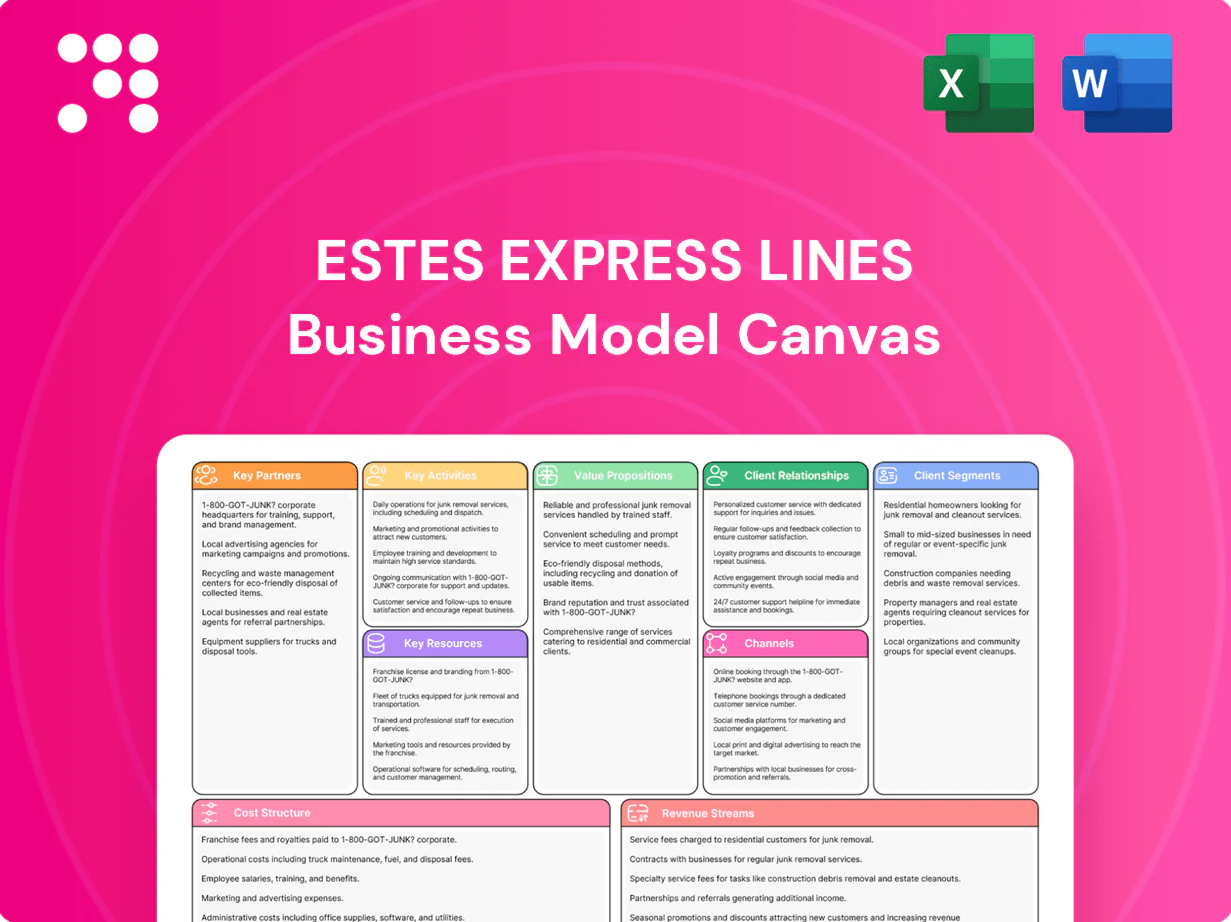
Estes Express Lines Business Model Canvas

Business Model Canvas: 3-5 insights into a top LTL logistics carrier
Unlock the strategic playbook behind Estes Express Lines with our concise Business Model Canvas—three to five core insights into how the company creates value, optimizes logistics, and sustains competitive advantage. This snapshot highlights customer segments, key partnerships, and revenue levers. Want the full, editable canvas (Word & Excel) with section-by-section analysis and practical takeaways? Purchase the complete file to benchmark, plan, and act with confidence.
Partnerships

Interline and carrier partnerships
Estes, a top-10 U.S. LTL carrier in 2024, leverages interline and regional/international carrier partnerships to extend service beyond its owned network and enable seamless door-to-door moves into remote zones.
These partnerships help balance capacity, reduce empty miles and uphold service standards in thin lanes, with contracts specifying service levels, liability and data-sharing protocols.
Technology and data solution partners
Partnerships with TMS, visibility, telematics, and routing-optimization providers power Estes planning and real-time tracking, enabling tighter route density and fuel efficiency. API/EDI connectivity partners streamline order intake and automated status updates across the network. Data vendors supply pricing inputs, network analytics, and predictive ETAs; cybersecurity and cloud providers ensure uptime and data protection for the family-owned carrier founded in 1931.

Equipment, maintenance, and OEM suppliers
OEMs and lessors supply tractors, trailers and specialized gear like liftgates and pup trailers, forming the backbone of Estes Express Lines fleet operations. National maintenance networks and tire vendors keep uptime high and safety compliant, while partners help manage total cost of ownership and regulatory compliance. As of 2024, Estes remains one of the largest privately held U.S. LTL carriers, enabling rapid scaling and fleet modernization through these alliances.

Fuel and energy suppliers
Fuel providers and card networks lock in supply and terminal pricing to limit spot exposure. Diesel additive and DEF suppliers support emissions systems and uptime. Energy partners supply yard power, backup systems and alt-fuel pilots; U.S. average on‑road diesel was about 3.96/gal in 2024 (EIA), so these ties help mitigate operating cost volatility.
- Terminal pricing agreements
- DEF/additive compliance supply
- Yard power & backup systems
- Alt-fuel pilot partnerships
3PLs, freight brokers, and final-mile alliances
Strategic alliances with 3PLs and freight brokers drove incremental volume for Estes in 2024 as the global 3PL market was estimated at about $1.5 trillion, enabling integrated LTL and managed-logistics solutions. Final-mile partners expanded residential and specialized delivery capability, supporting bundled services for complex supply chains and extending customer reach and convenience.
- 3PL market 2024: $1.5T
- Final-mile cost share: ~40%
- Bundled LTL + last-mile adoption rising
Partnerships and tech cut empty miles, tighten ETAs and control fuel risk in 2024
Estes leverages interline/regional carriers, TMS/telematics, OEMs/lessors, fuel suppliers and 3PLs to extend reach, improve utilization and control costs; partnerships reduced empty miles and supported service in thin lanes in 2024. API/EDI and visibility vendors enabled tighter route density and predictive ETAs. Fuel and DEF contracts mitigated exposure to 2024 US diesel ~3.96/gal and supported alt‑fuel pilots.
| Partner Type | 2024 Metric |
|---|---|
| 3PLs market | $1.5T |
| US diesel avg | $3.96/gal |
| Final-mile cost share | ~40% |
What is included in the product
 Detailed Word Document
A comprehensive Business Model Canvas for Estes Express Lines outlining customer segments, channels, value propositions, key partners, and cost/revenue structures that reflect its LTL and logistics operations; ideal for presentations, investor discussions, and strategic decision-making with SWOT-linked insights.

 Customizable Excel Spreadsheet
High-level view of Estes Express Lines’ business model in an editable canvas that quickly highlights network, fleet, and cost pain points. Perfect for teams to pinpoint operational bottlenecks, streamline routes, and align service offerings without reinventing the format.
Activities

Linehaul and P&D operations
Core daily linehaul and P&D operations move freight between terminals and perform local pickups and deliveries, reflecting Estes Express Lines' 93-year history in 2024. Scheduling optimizes driver hours and equipment utilization to maximize load factors and on-time performance. Standardized terminal processes reduce dwell time and boost reliability, while strict safety protocols govern every movement.
Cross-docking and terminal consolidation
As of 2024 Estes operates over 240 terminals nationwide where cross-docking and terminal consolidation sort and consolidate LTL shipments for optimal routing. Efficient dock flows are designed to minimize handling and damage, reducing touchpoints and claims exposure. Scan events at each transfer maintain chain-of-custody and real-time visibility for shippers. Continuous lean practices improve turn times and increase terminal capacity.

Network planning and optimization
Engineers design lanes, schedules, and trailer builds to balance cost and service, using data models that guide hub-and-spoke flows and seasonality adjustments. Continuous improvement targets empty miles, cube utilization, and on-time performance, while scenario planning prepares operations for weather, demand spikes, and carrier disruptions. Systems link telemetry and booking data to optimize real-time reflows.

Customer service, claims, and account management
Customer service teams at Estes manage bookings, exceptions, and proof-of-delivery requests while using proactive communication to resolve delays and accessorial needs; claims are handled with emphasis on speed, fairness, and preventing root causes, and account managers align service to shipper KPIs to maintain performance targets.
- Bookings, PODs, exceptions
- Proactive delay & accessorial resolution
- Claims: fast, fair, preventive
- Account managers align to shipper KPIs
Technology development and integration
Estes advances TMS enhancements, API/EDI integrations and mobile apps to speed load tendering and routing, while telematics and sensor data provide real-time visibility into network flows. Machine learning-backed analytics refine pricing, demand forecasting and ETA accuracy, and layered cybersecurity safeguards operations and customer data.
- Implement TMS, API/EDI, mobile apps
- Telematics/sensors for live tracking
- Analytics for pricing, forecasting, ETAs
- Robust cybersecurity
240+ terminal network optimizes linehaul, P&D, ML pricing and on-time performance
Core linehaul and P&D operations move freight across a 240+ terminal network in 2024, leveraging standardized terminal processes and strict safety protocols. Scheduling and lane engineering optimize driver hours, cube utilization and on-time performance. ML-backed analytics and telematics refine pricing, ETAs and demand forecasting. Customer service handles bookings, PODs, exceptions and fast claims resolution to meet shipper KPIs.
| Metric | 2024 |
|---|---|
| Terminals | 240+ |
| Years operating | 93 |
| Core activities | Linehaul, P&D, cross-dock, TMS |
Full Document Unlocks After Purchase
Business Model Canvas
The document you're previewing is the exact Estes Express Lines Business Model Canvas you'll receive after purchase. It's not a mockup—this live preview reflects the full, editable deliverable. Upon payment you'll download the complete file formatted for immediate use. No surprises; what you see is what you get.

Business Model Canvas: 3-5 insights into a top LTL logistics carrier
Unlock the strategic playbook behind Estes Express Lines with our concise Business Model Canvas—three to five core insights into how the company creates value, optimizes logistics, and sustains competitive advantage. This snapshot highlights customer segments, key partnerships, and revenue levers. Want the full, editable canvas (Word & Excel) with section-by-section analysis and practical takeaways? Purchase the complete file to benchmark, plan, and act with confidence.
Partnerships
Interline and carrier partnerships
Estes, a top-10 U.S. LTL carrier in 2024, leverages interline and regional/international carrier partnerships to extend service beyond its owned network and enable seamless door-to-door moves into remote zones.
These partnerships help balance capacity, reduce empty miles and uphold service standards in thin lanes, with contracts specifying service levels, liability and data-sharing protocols.
Technology and data solution partners
Partnerships with TMS, visibility, telematics, and routing-optimization providers power Estes planning and real-time tracking, enabling tighter route density and fuel efficiency. API/EDI connectivity partners streamline order intake and automated status updates across the network. Data vendors supply pricing inputs, network analytics, and predictive ETAs; cybersecurity and cloud providers ensure uptime and data protection for the family-owned carrier founded in 1931.
Equipment, maintenance, and OEM suppliers
OEMs and lessors supply tractors, trailers and specialized gear like liftgates and pup trailers, forming the backbone of Estes Express Lines fleet operations. National maintenance networks and tire vendors keep uptime high and safety compliant, while partners help manage total cost of ownership and regulatory compliance. As of 2024, Estes remains one of the largest privately held U.S. LTL carriers, enabling rapid scaling and fleet modernization through these alliances.
Fuel and energy suppliers
Fuel providers and card networks lock in supply and terminal pricing to limit spot exposure. Diesel additive and DEF suppliers support emissions systems and uptime. Energy partners supply yard power, backup systems and alt-fuel pilots; U.S. average on‑road diesel was about 3.96/gal in 2024 (EIA), so these ties help mitigate operating cost volatility.
- Terminal pricing agreements
- DEF/additive compliance supply
- Yard power & backup systems
- Alt-fuel pilot partnerships
3PLs, freight brokers, and final-mile alliances
Strategic alliances with 3PLs and freight brokers drove incremental volume for Estes in 2024 as the global 3PL market was estimated at about $1.5 trillion, enabling integrated LTL and managed-logistics solutions. Final-mile partners expanded residential and specialized delivery capability, supporting bundled services for complex supply chains and extending customer reach and convenience.
- 3PL market 2024: $1.5T
- Final-mile cost share: ~40%
- Bundled LTL + last-mile adoption rising
Partnerships and tech cut empty miles, tighten ETAs and control fuel risk in 2024
Estes leverages interline/regional carriers, TMS/telematics, OEMs/lessors, fuel suppliers and 3PLs to extend reach, improve utilization and control costs; partnerships reduced empty miles and supported service in thin lanes in 2024. API/EDI and visibility vendors enabled tighter route density and predictive ETAs. Fuel and DEF contracts mitigated exposure to 2024 US diesel ~3.96/gal and supported alt‑fuel pilots.
| Partner Type | 2024 Metric |
|---|---|
| 3PLs market | $1.5T |
| US diesel avg | $3.96/gal |
| Final-mile cost share | ~40% |
What is included in the product
Detailed Word Document
A comprehensive Business Model Canvas for Estes Express Lines outlining customer segments, channels, value propositions, key partners, and cost/revenue structures that reflect its LTL and logistics operations; ideal for presentations, investor discussions, and strategic decision-making with SWOT-linked insights.
Customizable Excel Spreadsheet
High-level view of Estes Express Lines’ business model in an editable canvas that quickly highlights network, fleet, and cost pain points. Perfect for teams to pinpoint operational bottlenecks, streamline routes, and align service offerings without reinventing the format.
Activities
Linehaul and P&D operations
Core daily linehaul and P&D operations move freight between terminals and perform local pickups and deliveries, reflecting Estes Express Lines' 93-year history in 2024. Scheduling optimizes driver hours and equipment utilization to maximize load factors and on-time performance. Standardized terminal processes reduce dwell time and boost reliability, while strict safety protocols govern every movement.
Cross-docking and terminal consolidation
As of 2024 Estes operates over 240 terminals nationwide where cross-docking and terminal consolidation sort and consolidate LTL shipments for optimal routing. Efficient dock flows are designed to minimize handling and damage, reducing touchpoints and claims exposure. Scan events at each transfer maintain chain-of-custody and real-time visibility for shippers. Continuous lean practices improve turn times and increase terminal capacity.
Network planning and optimization
Engineers design lanes, schedules, and trailer builds to balance cost and service, using data models that guide hub-and-spoke flows and seasonality adjustments. Continuous improvement targets empty miles, cube utilization, and on-time performance, while scenario planning prepares operations for weather, demand spikes, and carrier disruptions. Systems link telemetry and booking data to optimize real-time reflows.
Customer service, claims, and account management
Customer service teams at Estes manage bookings, exceptions, and proof-of-delivery requests while using proactive communication to resolve delays and accessorial needs; claims are handled with emphasis on speed, fairness, and preventing root causes, and account managers align service to shipper KPIs to maintain performance targets.
- Bookings, PODs, exceptions
- Proactive delay & accessorial resolution
- Claims: fast, fair, preventive
- Account managers align to shipper KPIs
Technology development and integration
Estes advances TMS enhancements, API/EDI integrations and mobile apps to speed load tendering and routing, while telematics and sensor data provide real-time visibility into network flows. Machine learning-backed analytics refine pricing, demand forecasting and ETA accuracy, and layered cybersecurity safeguards operations and customer data.
- Implement TMS, API/EDI, mobile apps
- Telematics/sensors for live tracking
- Analytics for pricing, forecasting, ETAs
- Robust cybersecurity
240+ terminal network optimizes linehaul, P&D, ML pricing and on-time performance
Core linehaul and P&D operations move freight across a 240+ terminal network in 2024, leveraging standardized terminal processes and strict safety protocols. Scheduling and lane engineering optimize driver hours, cube utilization and on-time performance. ML-backed analytics and telematics refine pricing, ETAs and demand forecasting. Customer service handles bookings, PODs, exceptions and fast claims resolution to meet shipper KPIs.
| Metric | 2024 |
|---|---|
| Terminals | 240+ |
| Years operating | 93 |
| Core activities | Linehaul, P&D, cross-dock, TMS |
Full Document Unlocks After Purchase
Business Model Canvas
The document you're previewing is the exact Estes Express Lines Business Model Canvas you'll receive after purchase. It's not a mockup—this live preview reflects the full, editable deliverable. Upon payment you'll download the complete file formatted for immediate use. No surprises; what you see is what you get.
Description
Business Model Canvas: 3-5 insights into a top LTL logistics carrier
Unlock the strategic playbook behind Estes Express Lines with our concise Business Model Canvas—three to five core insights into how the company creates value, optimizes logistics, and sustains competitive advantage. This snapshot highlights customer segments, key partnerships, and revenue levers. Want the full, editable canvas (Word & Excel) with section-by-section analysis and practical takeaways? Purchase the complete file to benchmark, plan, and act with confidence.
Partnerships
Interline and carrier partnerships
Estes, a top-10 U.S. LTL carrier in 2024, leverages interline and regional/international carrier partnerships to extend service beyond its owned network and enable seamless door-to-door moves into remote zones.
These partnerships help balance capacity, reduce empty miles and uphold service standards in thin lanes, with contracts specifying service levels, liability and data-sharing protocols.
Technology and data solution partners
Partnerships with TMS, visibility, telematics, and routing-optimization providers power Estes planning and real-time tracking, enabling tighter route density and fuel efficiency. API/EDI connectivity partners streamline order intake and automated status updates across the network. Data vendors supply pricing inputs, network analytics, and predictive ETAs; cybersecurity and cloud providers ensure uptime and data protection for the family-owned carrier founded in 1931.
Equipment, maintenance, and OEM suppliers
OEMs and lessors supply tractors, trailers and specialized gear like liftgates and pup trailers, forming the backbone of Estes Express Lines fleet operations. National maintenance networks and tire vendors keep uptime high and safety compliant, while partners help manage total cost of ownership and regulatory compliance. As of 2024, Estes remains one of the largest privately held U.S. LTL carriers, enabling rapid scaling and fleet modernization through these alliances.
Fuel and energy suppliers
Fuel providers and card networks lock in supply and terminal pricing to limit spot exposure. Diesel additive and DEF suppliers support emissions systems and uptime. Energy partners supply yard power, backup systems and alt-fuel pilots; U.S. average on‑road diesel was about 3.96/gal in 2024 (EIA), so these ties help mitigate operating cost volatility.
- Terminal pricing agreements
- DEF/additive compliance supply
- Yard power & backup systems
- Alt-fuel pilot partnerships
3PLs, freight brokers, and final-mile alliances
Strategic alliances with 3PLs and freight brokers drove incremental volume for Estes in 2024 as the global 3PL market was estimated at about $1.5 trillion, enabling integrated LTL and managed-logistics solutions. Final-mile partners expanded residential and specialized delivery capability, supporting bundled services for complex supply chains and extending customer reach and convenience.
- 3PL market 2024: $1.5T
- Final-mile cost share: ~40%
- Bundled LTL + last-mile adoption rising
Partnerships and tech cut empty miles, tighten ETAs and control fuel risk in 2024
Estes leverages interline/regional carriers, TMS/telematics, OEMs/lessors, fuel suppliers and 3PLs to extend reach, improve utilization and control costs; partnerships reduced empty miles and supported service in thin lanes in 2024. API/EDI and visibility vendors enabled tighter route density and predictive ETAs. Fuel and DEF contracts mitigated exposure to 2024 US diesel ~3.96/gal and supported alt‑fuel pilots.
| Partner Type | 2024 Metric |
|---|---|
| 3PLs market | $1.5T |
| US diesel avg | $3.96/gal |
| Final-mile cost share | ~40% |
What is included in the product
Detailed Word Document
A comprehensive Business Model Canvas for Estes Express Lines outlining customer segments, channels, value propositions, key partners, and cost/revenue structures that reflect its LTL and logistics operations; ideal for presentations, investor discussions, and strategic decision-making with SWOT-linked insights.
Customizable Excel Spreadsheet
High-level view of Estes Express Lines’ business model in an editable canvas that quickly highlights network, fleet, and cost pain points. Perfect for teams to pinpoint operational bottlenecks, streamline routes, and align service offerings without reinventing the format.
Activities
Linehaul and P&D operations
Core daily linehaul and P&D operations move freight between terminals and perform local pickups and deliveries, reflecting Estes Express Lines' 93-year history in 2024. Scheduling optimizes driver hours and equipment utilization to maximize load factors and on-time performance. Standardized terminal processes reduce dwell time and boost reliability, while strict safety protocols govern every movement.
Cross-docking and terminal consolidation
As of 2024 Estes operates over 240 terminals nationwide where cross-docking and terminal consolidation sort and consolidate LTL shipments for optimal routing. Efficient dock flows are designed to minimize handling and damage, reducing touchpoints and claims exposure. Scan events at each transfer maintain chain-of-custody and real-time visibility for shippers. Continuous lean practices improve turn times and increase terminal capacity.
Network planning and optimization
Engineers design lanes, schedules, and trailer builds to balance cost and service, using data models that guide hub-and-spoke flows and seasonality adjustments. Continuous improvement targets empty miles, cube utilization, and on-time performance, while scenario planning prepares operations for weather, demand spikes, and carrier disruptions. Systems link telemetry and booking data to optimize real-time reflows.
Customer service, claims, and account management
Customer service teams at Estes manage bookings, exceptions, and proof-of-delivery requests while using proactive communication to resolve delays and accessorial needs; claims are handled with emphasis on speed, fairness, and preventing root causes, and account managers align service to shipper KPIs to maintain performance targets.
- Bookings, PODs, exceptions
- Proactive delay & accessorial resolution
- Claims: fast, fair, preventive
- Account managers align to shipper KPIs
Technology development and integration
Estes advances TMS enhancements, API/EDI integrations and mobile apps to speed load tendering and routing, while telematics and sensor data provide real-time visibility into network flows. Machine learning-backed analytics refine pricing, demand forecasting and ETA accuracy, and layered cybersecurity safeguards operations and customer data.
- Implement TMS, API/EDI, mobile apps
- Telematics/sensors for live tracking
- Analytics for pricing, forecasting, ETAs
- Robust cybersecurity
240+ terminal network optimizes linehaul, P&D, ML pricing and on-time performance
Core linehaul and P&D operations move freight across a 240+ terminal network in 2024, leveraging standardized terminal processes and strict safety protocols. Scheduling and lane engineering optimize driver hours, cube utilization and on-time performance. ML-backed analytics and telematics refine pricing, ETAs and demand forecasting. Customer service handles bookings, PODs, exceptions and fast claims resolution to meet shipper KPIs.
| Metric | 2024 |
|---|---|
| Terminals | 240+ |
| Years operating | 93 |
| Core activities | Linehaul, P&D, cross-dock, TMS |
Full Document Unlocks After Purchase
Business Model Canvas
The document you're previewing is the exact Estes Express Lines Business Model Canvas you'll receive after purchase. It's not a mockup—this live preview reflects the full, editable deliverable. Upon payment you'll download the complete file formatted for immediate use. No surprises; what you see is what you get.











