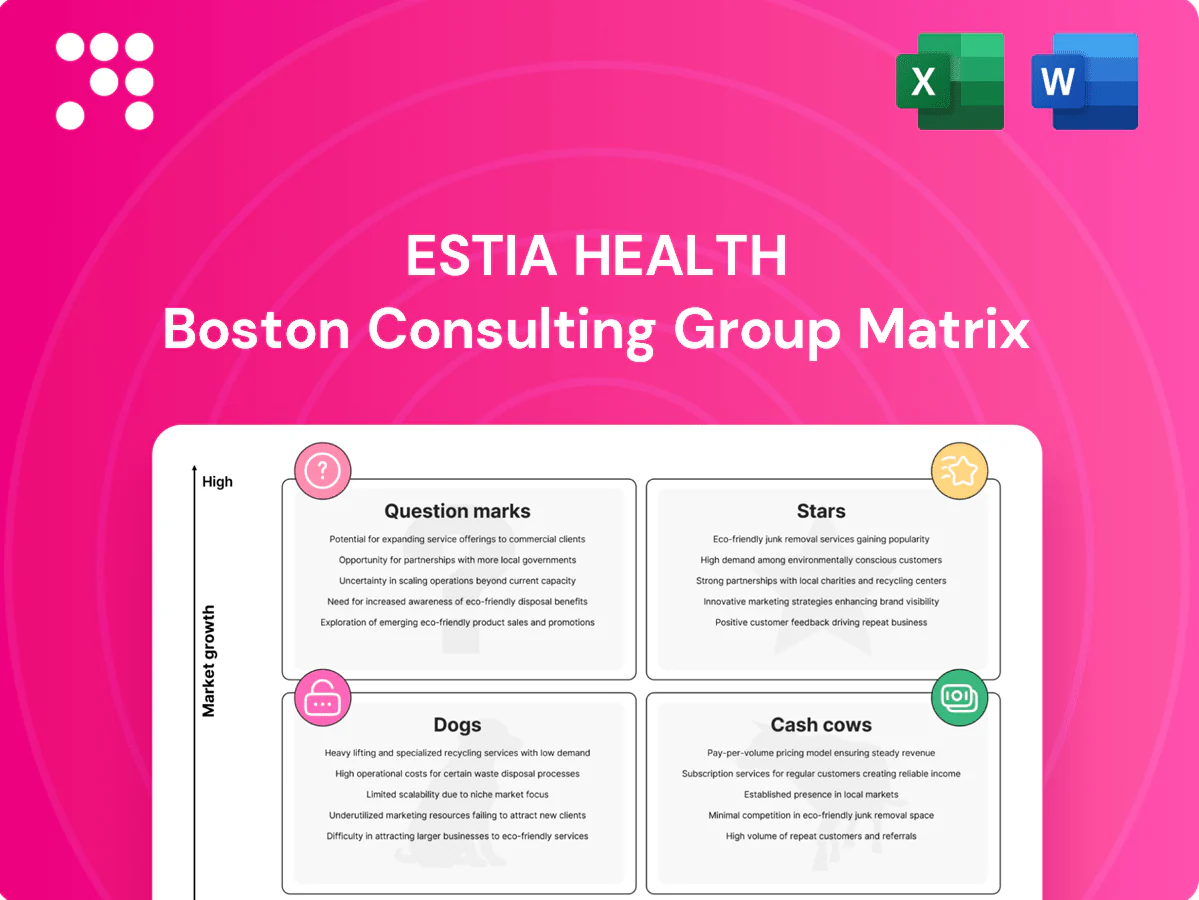
Estia Health Boston Consulting Group Matrix

Unlock Strategic Clarity
Curious where Estia Health’s services fall—Stars, Cash Cows, Dogs or Question Marks? This snapshot teases the story; buy the full BCG Matrix for quadrant-by-quadrant placement, data-driven recommendations, and a clear plan to optimize portfolio and capital. Purchase now for an editable Word report and high-level Excel summary you can use in board decks and strategy sessions.
Stars

Flagship metro residential homes
Flagship metro residential homes
High-growth catchments with 2024 average occupancy ~95% and waitlists of ~25 residents per site set the pace for Estia Health. They attract a premium resident mix, keeping beds full with minimal downtime and driving higher revenue per bed (reported uplift ~8% vs portfolio average in 2024). Continued investment in staff, refurbishments and community partnerships is required to defend share. As regional growth normalises these sites will convert to cash-cow status.
Specialist dementia care programs
Demand for specialist dementia care is rising with over 400,000 Australians living with dementia in 2024 (Dementia Australia), and Estia’s clinical depth positions it to capture outcomes-driven share. Families select proven clinical outcomes, not just a bed, translating to higher occupancy and premium pricing. Programs are resource-hungry—intensive training, secure environments and higher staffing ratios—yet deliver higher lifetime revenue per resident. Sustain quality and scale selectively to protect reputation and margins.

Hospital-linked clinical pathways
Estia’s hospital-linked clinical pathways drive steady admissions via strong referral ties and step-down care, leveraging a market where Australian hospital separations topped roughly 12 million in 2023–24 (AIHW) as hospitals push throughput. Estia has gained share by being reliable and fast, reflected in improving referral volumes in 2024. Ongoing investment in care coordination and interoperable data platforms is required to protect and compound these pipelines.

Brand and referral network strength
In aged care, reputation and GP/allied endorsements are the moat; Estia converts because families trust the badge. As at June 2024 Estia operated 64 homes with average occupancy around 89%, underlining referral-led growth. PR and community outreach aren’t cheap, so keep amplifying clinical outcomes and family testimonials to lock in leadership.
- Trust badge: GP/allied referrals drive admissions
- Scale: 64 homes (June 2024), ~89% occupancy
- Action: amplify clinical outcomes, family proof points
Respite-to-permanent conversion engine
High respite turn with strong conversion positions Estia as a Stars engine: frequent short-stay intake feeds a growing permanent-care pipeline while ongoing 2024 aged‑care reforms increase demand for supported residential transitions; maintaining staffed short-stay beds is cost-heavy but justified by lifetime resident value once conversion flywheel spins.
- High turnover → growing market share
- Staffing and bed‑costs increase OPEX
- Conversion raises LTV, offsets upfront spend
- Maintain capacity and upgrade experience to remain top choice
Flagship metros: ~95% occ, ~25 waitlist, dementia demand ~8% uplift, OPEX risk
Flagship metro homes: ~95% occupancy (2024), ~25 waitlist per site, ~8% revenue uplift vs portfolio. Dementia care: 400,000 Australians living with dementia (2024) driving premium demand. Hospital referrals and respite conversion lift lifetime value but raise OPEX from staffing and short-stay capacity.
| Metric | Value (2024) |
|---|---|
| Flagship occupancy | ~95% |
| Waitlist/site | ~25 |
| Homes | 64 |
| Dementia prevalence | ~400,000 |
What is included in the product
 Detailed Word Document
BCG Matrix for Estia Health: maps Stars, Cash Cows, Question Marks, Dogs and recommends invest, hold or divest per unit.

 Customizable Excel Spreadsheet
One-page Estia Health BCG Matrix quickly spots portfolio gaps and high-potential units—ready to export into PowerPoint or print.
Cash Cows

Mature suburban permanent care beds
Mature suburban permanent care beds form Estia Healths cash cows: roughly 70 homes with ~6,500 beds delivering predictable 90%+ occupancy amid stable 65+ demographic growth. Entrenched reputation and low incremental marketing lower acquisition costs while operations discipline and tight maintenance/staffing sustain margins (EBITDA margin ~18% reported in recent years). Milk cashflows, avoid gold-plating capital spend.
Established homes with >90% occupancy
Established Estia homes with >90% occupancy generate steady cash once ramped; in 2024 these units continue to deliver predictable operating cashflows. Processes are proven, families know the team and resident churn is low, shortening vacancy cycles. Small capex and rostering tweaks reliably boost yield—prioritize maintain, don’t reinvent.

Government-funded care streams (AN-ACC)
Government-funded AN-ACC, rolled out nationally in October 2022 and still the primary funding mechanism in 2024, delivers classification-based, predictable per-resident payments that allow Estia Health to plan capex and staffing. Accurate clinical assessments, documentation, and acuity management lift AN-ACC revenue without large capital outlays. A one-time investment in coding excellence and staff training compounds over years, stabilising margins. Reliable AN-ACC cashflow funds strategic growth and riskier service bets.

Centralised support services (catering, laundry)
Centralised support services (catering, laundry) in Estia Health scale to lower unit costs and improve consistency; Estia operates 71 homes in 2024, making these functions high-volume reliability drivers that sustain margins. Incremental automation typically pays back within 12–24 months, so keep sweating the assets to protect cash flow.
- scale: 71 homes (2024)
- margin driver: steady, low volatility
- automation ROI: 12–24 months
Allied health delivered in-house
In-house allied health at Estia Health is a cash cow: high utilization from embedded teams and repeatable clinical protocols drive strong outcomes and high family satisfaction, enabling minimal marketing spend. Margins improve materially with scheduling discipline and optimized throughput, supporting steady hold-and-optimize strategy.
- High utilization
- Embedded teams
- Repeatable protocols
- Minimal marketing
- Strong outcomes, happy families
- Margins up with scheduling
Mature suburban aged-care: 71 homes, 18% EBITDA
Estia's mature suburban permanent-care beds are cash cows: 71 homes (~6,500 beds) with 90%+ occupancy and ~18% EBITDA margin in 2024. AN-ACC (national since Oct 2022) provides predictable per-resident funding, enabling low capex and steady cashflow. Centralised services and allied-health yield high utilization; automation ROI 12–24 months.
| Metric | 2024 |
|---|---|
| Homes | 71 |
| Beds | ~6,500 |
| Occupancy | 90%+ |
| EBITDA margin | ~18% |
Full Transparency, Always
Estia Health BCG Matrix
The file you're previewing is the exact BCG Matrix report you'll receive after purchase—no watermarks, no demo text, just the finished, fully formatted document. Built by strategy experts for clarity and action, it’s ready to plug into your planning or decks. After buying you get the full file instantly—editable, printable, and presentation-ready. No surprises, no extra steps.

Unlock Strategic Clarity
Curious where Estia Health’s services fall—Stars, Cash Cows, Dogs or Question Marks? This snapshot teases the story; buy the full BCG Matrix for quadrant-by-quadrant placement, data-driven recommendations, and a clear plan to optimize portfolio and capital. Purchase now for an editable Word report and high-level Excel summary you can use in board decks and strategy sessions.
Stars
Flagship metro residential homes
Flagship metro residential homes
High-growth catchments with 2024 average occupancy ~95% and waitlists of ~25 residents per site set the pace for Estia Health. They attract a premium resident mix, keeping beds full with minimal downtime and driving higher revenue per bed (reported uplift ~8% vs portfolio average in 2024). Continued investment in staff, refurbishments and community partnerships is required to defend share. As regional growth normalises these sites will convert to cash-cow status.
Specialist dementia care programs
Demand for specialist dementia care is rising with over 400,000 Australians living with dementia in 2024 (Dementia Australia), and Estia’s clinical depth positions it to capture outcomes-driven share. Families select proven clinical outcomes, not just a bed, translating to higher occupancy and premium pricing. Programs are resource-hungry—intensive training, secure environments and higher staffing ratios—yet deliver higher lifetime revenue per resident. Sustain quality and scale selectively to protect reputation and margins.
Hospital-linked clinical pathways
Estia’s hospital-linked clinical pathways drive steady admissions via strong referral ties and step-down care, leveraging a market where Australian hospital separations topped roughly 12 million in 2023–24 (AIHW) as hospitals push throughput. Estia has gained share by being reliable and fast, reflected in improving referral volumes in 2024. Ongoing investment in care coordination and interoperable data platforms is required to protect and compound these pipelines.
Brand and referral network strength
In aged care, reputation and GP/allied endorsements are the moat; Estia converts because families trust the badge. As at June 2024 Estia operated 64 homes with average occupancy around 89%, underlining referral-led growth. PR and community outreach aren’t cheap, so keep amplifying clinical outcomes and family testimonials to lock in leadership.
- Trust badge: GP/allied referrals drive admissions
- Scale: 64 homes (June 2024), ~89% occupancy
- Action: amplify clinical outcomes, family proof points
Respite-to-permanent conversion engine
High respite turn with strong conversion positions Estia as a Stars engine: frequent short-stay intake feeds a growing permanent-care pipeline while ongoing 2024 aged‑care reforms increase demand for supported residential transitions; maintaining staffed short-stay beds is cost-heavy but justified by lifetime resident value once conversion flywheel spins.
- High turnover → growing market share
- Staffing and bed‑costs increase OPEX
- Conversion raises LTV, offsets upfront spend
- Maintain capacity and upgrade experience to remain top choice
Flagship metros: ~95% occ, ~25 waitlist, dementia demand ~8% uplift, OPEX risk
Flagship metro homes: ~95% occupancy (2024), ~25 waitlist per site, ~8% revenue uplift vs portfolio. Dementia care: 400,000 Australians living with dementia (2024) driving premium demand. Hospital referrals and respite conversion lift lifetime value but raise OPEX from staffing and short-stay capacity.
| Metric | Value (2024) |
|---|---|
| Flagship occupancy | ~95% |
| Waitlist/site | ~25 |
| Homes | 64 |
| Dementia prevalence | ~400,000 |
What is included in the product
Detailed Word Document
BCG Matrix for Estia Health: maps Stars, Cash Cows, Question Marks, Dogs and recommends invest, hold or divest per unit.
Customizable Excel Spreadsheet
One-page Estia Health BCG Matrix quickly spots portfolio gaps and high-potential units—ready to export into PowerPoint or print.
Cash Cows
Mature suburban permanent care beds
Mature suburban permanent care beds form Estia Healths cash cows: roughly 70 homes with ~6,500 beds delivering predictable 90%+ occupancy amid stable 65+ demographic growth. Entrenched reputation and low incremental marketing lower acquisition costs while operations discipline and tight maintenance/staffing sustain margins (EBITDA margin ~18% reported in recent years). Milk cashflows, avoid gold-plating capital spend.
Established homes with >90% occupancy
Established Estia homes with >90% occupancy generate steady cash once ramped; in 2024 these units continue to deliver predictable operating cashflows. Processes are proven, families know the team and resident churn is low, shortening vacancy cycles. Small capex and rostering tweaks reliably boost yield—prioritize maintain, don’t reinvent.
Government-funded care streams (AN-ACC)
Government-funded AN-ACC, rolled out nationally in October 2022 and still the primary funding mechanism in 2024, delivers classification-based, predictable per-resident payments that allow Estia Health to plan capex and staffing. Accurate clinical assessments, documentation, and acuity management lift AN-ACC revenue without large capital outlays. A one-time investment in coding excellence and staff training compounds over years, stabilising margins. Reliable AN-ACC cashflow funds strategic growth and riskier service bets.
Centralised support services (catering, laundry)
Centralised support services (catering, laundry) in Estia Health scale to lower unit costs and improve consistency; Estia operates 71 homes in 2024, making these functions high-volume reliability drivers that sustain margins. Incremental automation typically pays back within 12–24 months, so keep sweating the assets to protect cash flow.
- scale: 71 homes (2024)
- margin driver: steady, low volatility
- automation ROI: 12–24 months
Allied health delivered in-house
In-house allied health at Estia Health is a cash cow: high utilization from embedded teams and repeatable clinical protocols drive strong outcomes and high family satisfaction, enabling minimal marketing spend. Margins improve materially with scheduling discipline and optimized throughput, supporting steady hold-and-optimize strategy.
- High utilization
- Embedded teams
- Repeatable protocols
- Minimal marketing
- Strong outcomes, happy families
- Margins up with scheduling
Mature suburban aged-care: 71 homes, 18% EBITDA
Estia's mature suburban permanent-care beds are cash cows: 71 homes (~6,500 beds) with 90%+ occupancy and ~18% EBITDA margin in 2024. AN-ACC (national since Oct 2022) provides predictable per-resident funding, enabling low capex and steady cashflow. Centralised services and allied-health yield high utilization; automation ROI 12–24 months.
| Metric | 2024 |
|---|---|
| Homes | 71 |
| Beds | ~6,500 |
| Occupancy | 90%+ |
| EBITDA margin | ~18% |
Full Transparency, Always
Estia Health BCG Matrix
The file you're previewing is the exact BCG Matrix report you'll receive after purchase—no watermarks, no demo text, just the finished, fully formatted document. Built by strategy experts for clarity and action, it’s ready to plug into your planning or decks. After buying you get the full file instantly—editable, printable, and presentation-ready. No surprises, no extra steps.
Description
Unlock Strategic Clarity
Curious where Estia Health’s services fall—Stars, Cash Cows, Dogs or Question Marks? This snapshot teases the story; buy the full BCG Matrix for quadrant-by-quadrant placement, data-driven recommendations, and a clear plan to optimize portfolio and capital. Purchase now for an editable Word report and high-level Excel summary you can use in board decks and strategy sessions.
Stars
Flagship metro residential homes
Flagship metro residential homes
High-growth catchments with 2024 average occupancy ~95% and waitlists of ~25 residents per site set the pace for Estia Health. They attract a premium resident mix, keeping beds full with minimal downtime and driving higher revenue per bed (reported uplift ~8% vs portfolio average in 2024). Continued investment in staff, refurbishments and community partnerships is required to defend share. As regional growth normalises these sites will convert to cash-cow status.
Specialist dementia care programs
Demand for specialist dementia care is rising with over 400,000 Australians living with dementia in 2024 (Dementia Australia), and Estia’s clinical depth positions it to capture outcomes-driven share. Families select proven clinical outcomes, not just a bed, translating to higher occupancy and premium pricing. Programs are resource-hungry—intensive training, secure environments and higher staffing ratios—yet deliver higher lifetime revenue per resident. Sustain quality and scale selectively to protect reputation and margins.
Hospital-linked clinical pathways
Estia’s hospital-linked clinical pathways drive steady admissions via strong referral ties and step-down care, leveraging a market where Australian hospital separations topped roughly 12 million in 2023–24 (AIHW) as hospitals push throughput. Estia has gained share by being reliable and fast, reflected in improving referral volumes in 2024. Ongoing investment in care coordination and interoperable data platforms is required to protect and compound these pipelines.
Brand and referral network strength
In aged care, reputation and GP/allied endorsements are the moat; Estia converts because families trust the badge. As at June 2024 Estia operated 64 homes with average occupancy around 89%, underlining referral-led growth. PR and community outreach aren’t cheap, so keep amplifying clinical outcomes and family testimonials to lock in leadership.
- Trust badge: GP/allied referrals drive admissions
- Scale: 64 homes (June 2024), ~89% occupancy
- Action: amplify clinical outcomes, family proof points
Respite-to-permanent conversion engine
High respite turn with strong conversion positions Estia as a Stars engine: frequent short-stay intake feeds a growing permanent-care pipeline while ongoing 2024 aged‑care reforms increase demand for supported residential transitions; maintaining staffed short-stay beds is cost-heavy but justified by lifetime resident value once conversion flywheel spins.
- High turnover → growing market share
- Staffing and bed‑costs increase OPEX
- Conversion raises LTV, offsets upfront spend
- Maintain capacity and upgrade experience to remain top choice
Flagship metros: ~95% occ, ~25 waitlist, dementia demand ~8% uplift, OPEX risk
Flagship metro homes: ~95% occupancy (2024), ~25 waitlist per site, ~8% revenue uplift vs portfolio. Dementia care: 400,000 Australians living with dementia (2024) driving premium demand. Hospital referrals and respite conversion lift lifetime value but raise OPEX from staffing and short-stay capacity.
| Metric | Value (2024) |
|---|---|
| Flagship occupancy | ~95% |
| Waitlist/site | ~25 |
| Homes | 64 |
| Dementia prevalence | ~400,000 |
What is included in the product
Detailed Word Document
BCG Matrix for Estia Health: maps Stars, Cash Cows, Question Marks, Dogs and recommends invest, hold or divest per unit.
Customizable Excel Spreadsheet
One-page Estia Health BCG Matrix quickly spots portfolio gaps and high-potential units—ready to export into PowerPoint or print.
Cash Cows
Mature suburban permanent care beds
Mature suburban permanent care beds form Estia Healths cash cows: roughly 70 homes with ~6,500 beds delivering predictable 90%+ occupancy amid stable 65+ demographic growth. Entrenched reputation and low incremental marketing lower acquisition costs while operations discipline and tight maintenance/staffing sustain margins (EBITDA margin ~18% reported in recent years). Milk cashflows, avoid gold-plating capital spend.
Established homes with >90% occupancy
Established Estia homes with >90% occupancy generate steady cash once ramped; in 2024 these units continue to deliver predictable operating cashflows. Processes are proven, families know the team and resident churn is low, shortening vacancy cycles. Small capex and rostering tweaks reliably boost yield—prioritize maintain, don’t reinvent.
Government-funded care streams (AN-ACC)
Government-funded AN-ACC, rolled out nationally in October 2022 and still the primary funding mechanism in 2024, delivers classification-based, predictable per-resident payments that allow Estia Health to plan capex and staffing. Accurate clinical assessments, documentation, and acuity management lift AN-ACC revenue without large capital outlays. A one-time investment in coding excellence and staff training compounds over years, stabilising margins. Reliable AN-ACC cashflow funds strategic growth and riskier service bets.
Centralised support services (catering, laundry)
Centralised support services (catering, laundry) in Estia Health scale to lower unit costs and improve consistency; Estia operates 71 homes in 2024, making these functions high-volume reliability drivers that sustain margins. Incremental automation typically pays back within 12–24 months, so keep sweating the assets to protect cash flow.
- scale: 71 homes (2024)
- margin driver: steady, low volatility
- automation ROI: 12–24 months
Allied health delivered in-house
In-house allied health at Estia Health is a cash cow: high utilization from embedded teams and repeatable clinical protocols drive strong outcomes and high family satisfaction, enabling minimal marketing spend. Margins improve materially with scheduling discipline and optimized throughput, supporting steady hold-and-optimize strategy.
- High utilization
- Embedded teams
- Repeatable protocols
- Minimal marketing
- Strong outcomes, happy families
- Margins up with scheduling
Mature suburban aged-care: 71 homes, 18% EBITDA
Estia's mature suburban permanent-care beds are cash cows: 71 homes (~6,500 beds) with 90%+ occupancy and ~18% EBITDA margin in 2024. AN-ACC (national since Oct 2022) provides predictable per-resident funding, enabling low capex and steady cashflow. Centralised services and allied-health yield high utilization; automation ROI 12–24 months.
| Metric | 2024 |
|---|---|
| Homes | 71 |
| Beds | ~6,500 |
| Occupancy | 90%+ |
| EBITDA margin | ~18% |
Full Transparency, Always
Estia Health BCG Matrix
The file you're previewing is the exact BCG Matrix report you'll receive after purchase—no watermarks, no demo text, just the finished, fully formatted document. Built by strategy experts for clarity and action, it’s ready to plug into your planning or decks. After buying you get the full file instantly—editable, printable, and presentation-ready. No surprises, no extra steps.











