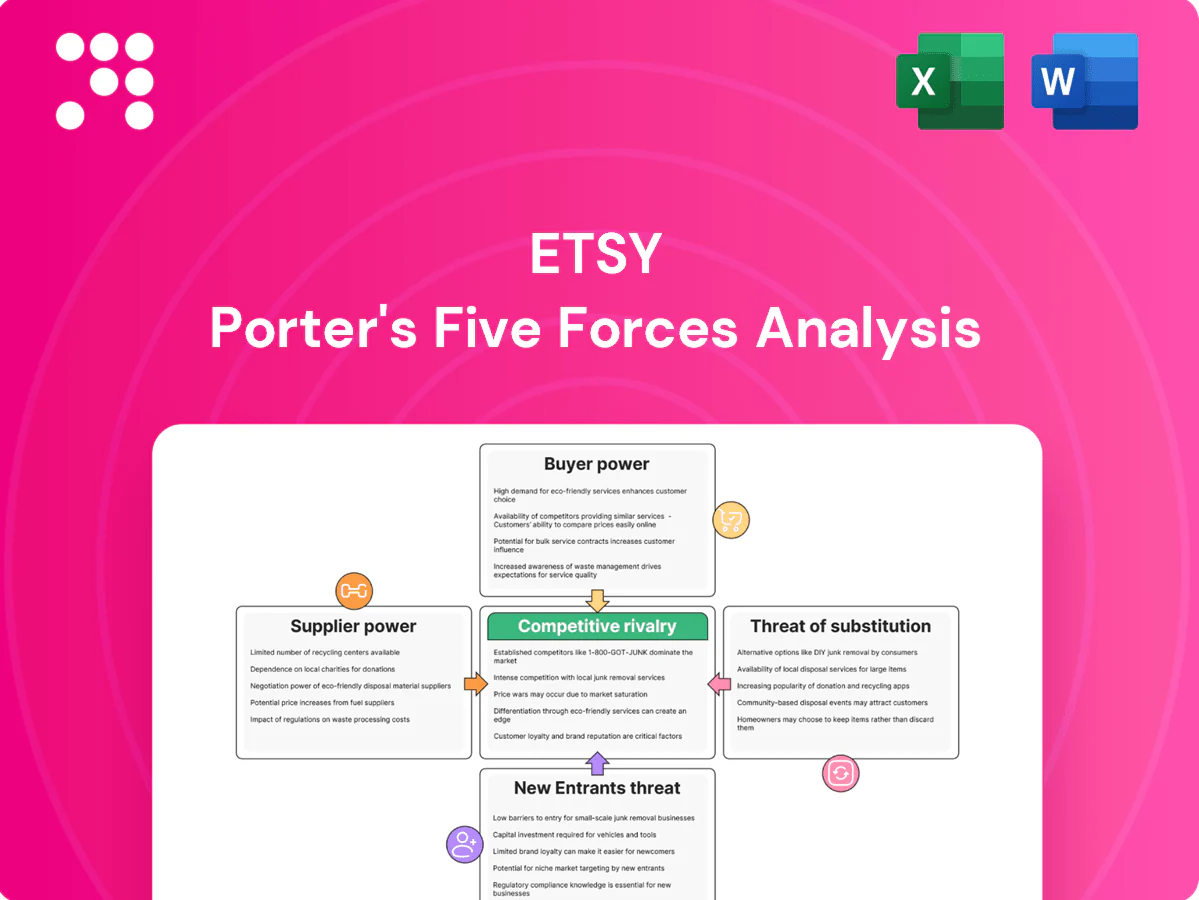
Etsy Porter's Five Forces Analysis

Don't Miss the Bigger Picture
Etsy faces moderate buyer power and growing substitution risks from mass-market platforms, while niche suppliers and platform differentiation temper supplier threats; network effects and regulatory shifts shape entry barriers. This snapshot highlights strategic pressure points but only scratches the surface. Unlock the full Porter's Five Forces Analysis for force-by-force ratings, visuals, and actionable insights to inform investment or strategy.
Suppliers Bargaining Power

Fragmented artisan base
Most Etsy sellers are independent artisans and micro-businesses, creating a highly fragmented supplier base of over 7 million sellers as of 2024. This fragmentation limits collective bargaining and helps sustain Etsy’s effective take rate of roughly 11–13%. Individual sellers have minimal leverage to negotiate fees or policies, so Etsy can standardize terms and enforce platform rules with limited pushback.
Platform dependency
Platform dependency: many of Etsy's roughly 7.3 million active sellers and 90.7 million active buyers in 2024 rely on Etsy for discovery, payments and traffic, raising switching costs and reducing seller bargaining power. Despite periodic complaints about fees and policy changes, sellers' dependence on Etsy exposure means losing placement can materially cut sales. This reliance gives Etsy leverage to enforce standards and expand monetization.

Low product standardization
Handmade and vintage listings are highly differentiated, letting individual sellers charge premiums, but at category level sellers are substitutable; Etsy hosted over 7 million active sellers in 2024, so departed shops are often replaced by similar offerings. Aggregation on a platform with millions of listings dilutes any one seller’s bargaining power with Etsy.

Multi-homing options
Sellers can multi-home to Shopify (about 1.75M merchants in 2024), Amazon Handmade, eBay or social platforms, creating potential leverage over Etsy. Managing multiple channels raises costs and operational complexity, diluting that leverage. Etsy’s large built-in audience and brand trust keep many sellers from fully switching, so multi-homing tempers but does not overturn Etsy’s advantage.
- Multi-homing increases seller options
- Operational costs reduce effective bargaining power
- Etsy’s audience/trust sustain platform stickiness
Input cost and logistics constraints
Suppliers face rising materials, shipping, and fulfillment costs independent of Etsy, with US postal rate increases in Jan 2024 adding roughly 4–5% to small‑parcel prices and global freight remaining above pre‑pandemic norms.
These pressures limit suppliers' ability to absorb platform fee changes, yet Etsy cannot control raw materials or carrier pricing, keeping negotiations centered on fees and seller tools.
Sellers remain fragmented—many are micro‑entrepreneurs—so supplier bargaining power is moderate to low despite cost inflation.
- Jan 2024 USPS rate hike ~4–5%
- Global freight > pre‑pandemic averages
- Seller base highly fragmented—reduces supplier leverage
Fragmented sellers cap supplier power despite 11–13% fees, rising shipping
Supplier power is low–moderate: Etsy’s 7.3M sellers (2024) are highly fragmented, limiting collective bargaining and sustaining an ~11–13% take rate. Seller dependence on Etsy’s 90.7M buyers raises switching costs despite multi‑homing options like Shopify (1.75M merchants). Rising input/shipping costs (USPS +4–5% Jan 2024) constrain sellers’ ability to absorb fee hikes.
| Metric | 2024 Value |
|---|---|
| Active sellers | 7.3M |
| Active buyers | 90.7M |
| Etsy take rate | 11–13% |
| Shopify merchants | 1.75M |
| USPS rate change | +4–5% (Jan 2024) |
What is included in the product
 Detailed Word Document
Tailored Porter’s Five Forces analysis of Etsy uncovering competitive rivalry, buyer and supplier power, entry barriers, substitute threats, and strategic levers—highlighting marketplace disruption, niche differentiation, and implications for pricing, margins, and growth.

 Customizable Excel Spreadsheet
A concise one-sheet Porter's Five Forces for Etsy—instantly reveal seller competition, buyer power, substitute threats and supplier risks to guide rapid strategic decisions.
Customers Bargaining Power

High price transparency
High price transparency lets buyers compare price, quality, and shipping across listings and platforms, and with Etsy reporting over 90 million active buyers in 2024 this comparison power scales platform-wide. Transparent search elevates buyer bargaining power on price and perceived value, pushing sellers to match peers or lose conversion. Reviews and ratings (used by a clear majority of buyers) discipline seller behavior, making discounts and free shipping key levers to win sales.
Low switching costs
Low switching costs let buyers substitute Etsy with Amazon, eBay, Shopify stores and social commerce with little friction, enabling quick moves when price or lead times disappoint; Etsy reported roughly 72 million active buyers in 2023, so retention matters. Maintaining trust, assortment and UX is critical, and loyalty programs plus personalization aim to reduce churn and raise lifetime value.

Niche demand sensitivity
Buyers on Etsy prioritize unique, personalized goods with emotional value, reducing pure price sensitivity even as Etsy reported about 86.8 million active buyers and roughly $11.5B GMS in 2024; budget limits and shipping times still constrain purchases. Customization requests give buyers negotiating leverage over individual sellers. Perceived authenticity and ethical sourcing strongly influence choice and willingness to pay premium prices.

Review and dispute mechanisms
Platform feedback, returns, and buyer protection institutionalize buyer power at the point of sale: Etsy reported roughly 90 million active buyers and about 7 million sellers in 2024, with 2023 GMS near 12.7 billion USD, so negative reviews or disputes can materially reduce shop traffic and sales. Sellers and Etsy prioritize customer satisfaction to preserve ratings and repeat business, making buyers leverage operationally significant.
- Platform feedback amplifies buyer influence on visibility
- Returns and buyer protection raise dispute-driven churn risk
- ~90M buyers vs ~7M sellers in 2024 centralizes bargaining power
- Negative reviews materially impact search ranking and GMV
Global reach, local expectations
Global reach, local expectations raise customer leverage: international buyers (about 95 million active in 2024) demand clear taxes, fast localized shipping and familiar payments, and any checkout friction shifts demand to alternatives; Etsy must invest in logistics transparency and payments to retain cross-border GMV, while regional marketplaces and local sellers intensify buyer bargaining power.
- Localized shipping speed
- Taxes clarity at checkout
- Local payment options
- Friction shifts demand
Buyer power rises with platform scale ($11.5B GMS, ~90M buyers)
High price transparency and reviews boost buyer leverage, forcing sellers to match peers on price, shipping and quality; low switching costs to Amazon/eBay/shopify increase churn risk. Buyer protection, returns and ratings institutionalize power, and Etsy’s scale (~90M active buyers, ~7M sellers, $11.5B GMS in 2024) concentrates bargaining influence.
| Metric | 2024 |
|---|---|
| Active buyers | ~90M |
| Sellers | ~7M |
| Gross Merchandise Sales (GMS) | $11.5B |
Preview Before You Purchase
Etsy Porter's Five Forces Analysis
This preview shows the exact Porter's Five Forces analysis of Etsy you'll receive immediately after purchase—fully formatted and ready for download. No placeholders or mockups; the document displayed is the final deliverable. Use it instantly for strategic insight, valuation, or research.

Don't Miss the Bigger Picture
Etsy faces moderate buyer power and growing substitution risks from mass-market platforms, while niche suppliers and platform differentiation temper supplier threats; network effects and regulatory shifts shape entry barriers. This snapshot highlights strategic pressure points but only scratches the surface. Unlock the full Porter's Five Forces Analysis for force-by-force ratings, visuals, and actionable insights to inform investment or strategy.
Suppliers Bargaining Power
Fragmented artisan base
Most Etsy sellers are independent artisans and micro-businesses, creating a highly fragmented supplier base of over 7 million sellers as of 2024. This fragmentation limits collective bargaining and helps sustain Etsy’s effective take rate of roughly 11–13%. Individual sellers have minimal leverage to negotiate fees or policies, so Etsy can standardize terms and enforce platform rules with limited pushback.
Platform dependency
Platform dependency: many of Etsy's roughly 7.3 million active sellers and 90.7 million active buyers in 2024 rely on Etsy for discovery, payments and traffic, raising switching costs and reducing seller bargaining power. Despite periodic complaints about fees and policy changes, sellers' dependence on Etsy exposure means losing placement can materially cut sales. This reliance gives Etsy leverage to enforce standards and expand monetization.
Low product standardization
Handmade and vintage listings are highly differentiated, letting individual sellers charge premiums, but at category level sellers are substitutable; Etsy hosted over 7 million active sellers in 2024, so departed shops are often replaced by similar offerings. Aggregation on a platform with millions of listings dilutes any one seller’s bargaining power with Etsy.
Multi-homing options
Sellers can multi-home to Shopify (about 1.75M merchants in 2024), Amazon Handmade, eBay or social platforms, creating potential leverage over Etsy. Managing multiple channels raises costs and operational complexity, diluting that leverage. Etsy’s large built-in audience and brand trust keep many sellers from fully switching, so multi-homing tempers but does not overturn Etsy’s advantage.
- Multi-homing increases seller options
- Operational costs reduce effective bargaining power
- Etsy’s audience/trust sustain platform stickiness
Input cost and logistics constraints
Suppliers face rising materials, shipping, and fulfillment costs independent of Etsy, with US postal rate increases in Jan 2024 adding roughly 4–5% to small‑parcel prices and global freight remaining above pre‑pandemic norms.
These pressures limit suppliers' ability to absorb platform fee changes, yet Etsy cannot control raw materials or carrier pricing, keeping negotiations centered on fees and seller tools.
Sellers remain fragmented—many are micro‑entrepreneurs—so supplier bargaining power is moderate to low despite cost inflation.
- Jan 2024 USPS rate hike ~4–5%
- Global freight > pre‑pandemic averages
- Seller base highly fragmented—reduces supplier leverage
Fragmented sellers cap supplier power despite 11–13% fees, rising shipping
Supplier power is low–moderate: Etsy’s 7.3M sellers (2024) are highly fragmented, limiting collective bargaining and sustaining an ~11–13% take rate. Seller dependence on Etsy’s 90.7M buyers raises switching costs despite multi‑homing options like Shopify (1.75M merchants). Rising input/shipping costs (USPS +4–5% Jan 2024) constrain sellers’ ability to absorb fee hikes.
| Metric | 2024 Value |
|---|---|
| Active sellers | 7.3M |
| Active buyers | 90.7M |
| Etsy take rate | 11–13% |
| Shopify merchants | 1.75M |
| USPS rate change | +4–5% (Jan 2024) |
What is included in the product
Detailed Word Document
Tailored Porter’s Five Forces analysis of Etsy uncovering competitive rivalry, buyer and supplier power, entry barriers, substitute threats, and strategic levers—highlighting marketplace disruption, niche differentiation, and implications for pricing, margins, and growth.
Customizable Excel Spreadsheet
A concise one-sheet Porter's Five Forces for Etsy—instantly reveal seller competition, buyer power, substitute threats and supplier risks to guide rapid strategic decisions.
Customers Bargaining Power
High price transparency
High price transparency lets buyers compare price, quality, and shipping across listings and platforms, and with Etsy reporting over 90 million active buyers in 2024 this comparison power scales platform-wide. Transparent search elevates buyer bargaining power on price and perceived value, pushing sellers to match peers or lose conversion. Reviews and ratings (used by a clear majority of buyers) discipline seller behavior, making discounts and free shipping key levers to win sales.
Low switching costs
Low switching costs let buyers substitute Etsy with Amazon, eBay, Shopify stores and social commerce with little friction, enabling quick moves when price or lead times disappoint; Etsy reported roughly 72 million active buyers in 2023, so retention matters. Maintaining trust, assortment and UX is critical, and loyalty programs plus personalization aim to reduce churn and raise lifetime value.
Niche demand sensitivity
Buyers on Etsy prioritize unique, personalized goods with emotional value, reducing pure price sensitivity even as Etsy reported about 86.8 million active buyers and roughly $11.5B GMS in 2024; budget limits and shipping times still constrain purchases. Customization requests give buyers negotiating leverage over individual sellers. Perceived authenticity and ethical sourcing strongly influence choice and willingness to pay premium prices.
Review and dispute mechanisms
Platform feedback, returns, and buyer protection institutionalize buyer power at the point of sale: Etsy reported roughly 90 million active buyers and about 7 million sellers in 2024, with 2023 GMS near 12.7 billion USD, so negative reviews or disputes can materially reduce shop traffic and sales. Sellers and Etsy prioritize customer satisfaction to preserve ratings and repeat business, making buyers leverage operationally significant.
- Platform feedback amplifies buyer influence on visibility
- Returns and buyer protection raise dispute-driven churn risk
- ~90M buyers vs ~7M sellers in 2024 centralizes bargaining power
- Negative reviews materially impact search ranking and GMV
Global reach, local expectations
Global reach, local expectations raise customer leverage: international buyers (about 95 million active in 2024) demand clear taxes, fast localized shipping and familiar payments, and any checkout friction shifts demand to alternatives; Etsy must invest in logistics transparency and payments to retain cross-border GMV, while regional marketplaces and local sellers intensify buyer bargaining power.
- Localized shipping speed
- Taxes clarity at checkout
- Local payment options
- Friction shifts demand
Buyer power rises with platform scale ($11.5B GMS, ~90M buyers)
High price transparency and reviews boost buyer leverage, forcing sellers to match peers on price, shipping and quality; low switching costs to Amazon/eBay/shopify increase churn risk. Buyer protection, returns and ratings institutionalize power, and Etsy’s scale (~90M active buyers, ~7M sellers, $11.5B GMS in 2024) concentrates bargaining influence.
| Metric | 2024 |
|---|---|
| Active buyers | ~90M |
| Sellers | ~7M |
| Gross Merchandise Sales (GMS) | $11.5B |
Preview Before You Purchase
Etsy Porter's Five Forces Analysis
This preview shows the exact Porter's Five Forces analysis of Etsy you'll receive immediately after purchase—fully formatted and ready for download. No placeholders or mockups; the document displayed is the final deliverable. Use it instantly for strategic insight, valuation, or research.
Description
Don't Miss the Bigger Picture
Etsy faces moderate buyer power and growing substitution risks from mass-market platforms, while niche suppliers and platform differentiation temper supplier threats; network effects and regulatory shifts shape entry barriers. This snapshot highlights strategic pressure points but only scratches the surface. Unlock the full Porter's Five Forces Analysis for force-by-force ratings, visuals, and actionable insights to inform investment or strategy.
Suppliers Bargaining Power
Fragmented artisan base
Most Etsy sellers are independent artisans and micro-businesses, creating a highly fragmented supplier base of over 7 million sellers as of 2024. This fragmentation limits collective bargaining and helps sustain Etsy’s effective take rate of roughly 11–13%. Individual sellers have minimal leverage to negotiate fees or policies, so Etsy can standardize terms and enforce platform rules with limited pushback.
Platform dependency
Platform dependency: many of Etsy's roughly 7.3 million active sellers and 90.7 million active buyers in 2024 rely on Etsy for discovery, payments and traffic, raising switching costs and reducing seller bargaining power. Despite periodic complaints about fees and policy changes, sellers' dependence on Etsy exposure means losing placement can materially cut sales. This reliance gives Etsy leverage to enforce standards and expand monetization.
Low product standardization
Handmade and vintage listings are highly differentiated, letting individual sellers charge premiums, but at category level sellers are substitutable; Etsy hosted over 7 million active sellers in 2024, so departed shops are often replaced by similar offerings. Aggregation on a platform with millions of listings dilutes any one seller’s bargaining power with Etsy.
Multi-homing options
Sellers can multi-home to Shopify (about 1.75M merchants in 2024), Amazon Handmade, eBay or social platforms, creating potential leverage over Etsy. Managing multiple channels raises costs and operational complexity, diluting that leverage. Etsy’s large built-in audience and brand trust keep many sellers from fully switching, so multi-homing tempers but does not overturn Etsy’s advantage.
- Multi-homing increases seller options
- Operational costs reduce effective bargaining power
- Etsy’s audience/trust sustain platform stickiness
Input cost and logistics constraints
Suppliers face rising materials, shipping, and fulfillment costs independent of Etsy, with US postal rate increases in Jan 2024 adding roughly 4–5% to small‑parcel prices and global freight remaining above pre‑pandemic norms.
These pressures limit suppliers' ability to absorb platform fee changes, yet Etsy cannot control raw materials or carrier pricing, keeping negotiations centered on fees and seller tools.
Sellers remain fragmented—many are micro‑entrepreneurs—so supplier bargaining power is moderate to low despite cost inflation.
- Jan 2024 USPS rate hike ~4–5%
- Global freight > pre‑pandemic averages
- Seller base highly fragmented—reduces supplier leverage
Fragmented sellers cap supplier power despite 11–13% fees, rising shipping
Supplier power is low–moderate: Etsy’s 7.3M sellers (2024) are highly fragmented, limiting collective bargaining and sustaining an ~11–13% take rate. Seller dependence on Etsy’s 90.7M buyers raises switching costs despite multi‑homing options like Shopify (1.75M merchants). Rising input/shipping costs (USPS +4–5% Jan 2024) constrain sellers’ ability to absorb fee hikes.
| Metric | 2024 Value |
|---|---|
| Active sellers | 7.3M |
| Active buyers | 90.7M |
| Etsy take rate | 11–13% |
| Shopify merchants | 1.75M |
| USPS rate change | +4–5% (Jan 2024) |
What is included in the product
Detailed Word Document
Tailored Porter’s Five Forces analysis of Etsy uncovering competitive rivalry, buyer and supplier power, entry barriers, substitute threats, and strategic levers—highlighting marketplace disruption, niche differentiation, and implications for pricing, margins, and growth.
Customizable Excel Spreadsheet
A concise one-sheet Porter's Five Forces for Etsy—instantly reveal seller competition, buyer power, substitute threats and supplier risks to guide rapid strategic decisions.
Customers Bargaining Power
High price transparency
High price transparency lets buyers compare price, quality, and shipping across listings and platforms, and with Etsy reporting over 90 million active buyers in 2024 this comparison power scales platform-wide. Transparent search elevates buyer bargaining power on price and perceived value, pushing sellers to match peers or lose conversion. Reviews and ratings (used by a clear majority of buyers) discipline seller behavior, making discounts and free shipping key levers to win sales.
Low switching costs
Low switching costs let buyers substitute Etsy with Amazon, eBay, Shopify stores and social commerce with little friction, enabling quick moves when price or lead times disappoint; Etsy reported roughly 72 million active buyers in 2023, so retention matters. Maintaining trust, assortment and UX is critical, and loyalty programs plus personalization aim to reduce churn and raise lifetime value.
Niche demand sensitivity
Buyers on Etsy prioritize unique, personalized goods with emotional value, reducing pure price sensitivity even as Etsy reported about 86.8 million active buyers and roughly $11.5B GMS in 2024; budget limits and shipping times still constrain purchases. Customization requests give buyers negotiating leverage over individual sellers. Perceived authenticity and ethical sourcing strongly influence choice and willingness to pay premium prices.
Review and dispute mechanisms
Platform feedback, returns, and buyer protection institutionalize buyer power at the point of sale: Etsy reported roughly 90 million active buyers and about 7 million sellers in 2024, with 2023 GMS near 12.7 billion USD, so negative reviews or disputes can materially reduce shop traffic and sales. Sellers and Etsy prioritize customer satisfaction to preserve ratings and repeat business, making buyers leverage operationally significant.
- Platform feedback amplifies buyer influence on visibility
- Returns and buyer protection raise dispute-driven churn risk
- ~90M buyers vs ~7M sellers in 2024 centralizes bargaining power
- Negative reviews materially impact search ranking and GMV
Global reach, local expectations
Global reach, local expectations raise customer leverage: international buyers (about 95 million active in 2024) demand clear taxes, fast localized shipping and familiar payments, and any checkout friction shifts demand to alternatives; Etsy must invest in logistics transparency and payments to retain cross-border GMV, while regional marketplaces and local sellers intensify buyer bargaining power.
- Localized shipping speed
- Taxes clarity at checkout
- Local payment options
- Friction shifts demand
Buyer power rises with platform scale ($11.5B GMS, ~90M buyers)
High price transparency and reviews boost buyer leverage, forcing sellers to match peers on price, shipping and quality; low switching costs to Amazon/eBay/shopify increase churn risk. Buyer protection, returns and ratings institutionalize power, and Etsy’s scale (~90M active buyers, ~7M sellers, $11.5B GMS in 2024) concentrates bargaining influence.
| Metric | 2024 |
|---|---|
| Active buyers | ~90M |
| Sellers | ~7M |
| Gross Merchandise Sales (GMS) | $11.5B |
Preview Before You Purchase
Etsy Porter's Five Forces Analysis
This preview shows the exact Porter's Five Forces analysis of Etsy you'll receive immediately after purchase—fully formatted and ready for download. No placeholders or mockups; the document displayed is the final deliverable. Use it instantly for strategic insight, valuation, or research.











