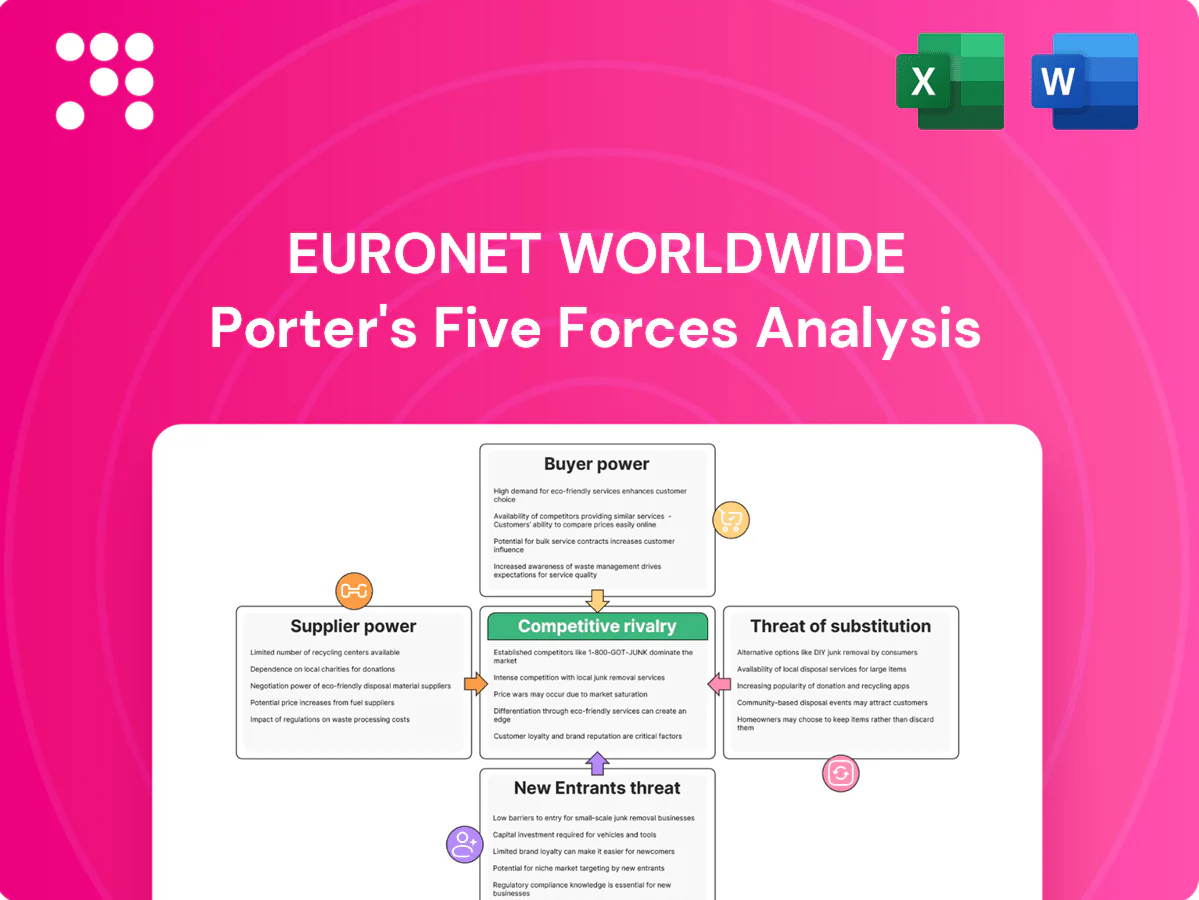
Euronet Worldwide Porter's Five Forces Analysis

From Overview to Strategy Blueprint
Euronet Worldwide faces moderate buyer power, intense fintech competition, supplier leverage in network infrastructure, and regulatory plus substitution risks across payments and ATM services. These forces squeeze margins but underscore advantages from scale, partnerships and diversified revenue. This preview is just the beginning. The full analysis provides a complete strategic snapshot with force-by-force ratings, visuals, and business implications tailored to Euronet Worldwide.
Suppliers Bargaining Power

Card schemes & bank networks
Euronet depends on Visa, Mastercard and UnionPay rails and host-bank networks for authorization and settlement, giving these schemes leverage over fees and operational rules.
Scheme compliance changes can raise costs or constrain product features; Visa and Mastercard together account for roughly 80%+ of global card processing, concentrating bargaining power.
Euronet’s multi-scheme connectivity, presence in over 50 countries and transaction scale support negotiation of incentives with longstanding partners.
Telecom & digital channels
Epay relies on mobile operators, app stores and digital distribution APIs for prepaid content access, giving carriers and platform owners leverage to change commissions or impose exclusivity. Carriers can materially impact margins by altering fee schedules or routing. Euronet reduces supplier power through a broad catalog across multiple MNOs and digital content providers. Diversification across retailers and online channels limits single-supplier exposure.

Cash logistics & site landlords
EFT operations require cash-in-transit providers and premium retailer/landlord locations that can command higher rents and service fees, especially for scarce urban high-traffic sites, increasing supplier bargaining power. Euronet, active in about 170 countries, mitigates pressure via multi-year leases, site clustering and dynamic deployment of ATMs. Vertical integration of cash logistics and maintenance further tempers dependency.

FX liquidity & correspondent banks
Money transfer corridors rely on correspondent banks and FX liquidity for pay-outs, giving correspondents leverage over spreads and float; volatile FX and de-risking can tighten terms. Euronet’s multi-bank relationships and in-house treasury tools mitigate costs and liquidity risk, while scale (>$4bn annual revenue in 2024) secures better pricing and access.
- Correspondent leverage: spreads & float
- Risk drivers: FX volatility, de‑risking
- Mitigants: multi-bank + treasury tools
- Scale benefit: >$4bn revenue improves pricing
Compliance tech & cloud vendors
Compliance tech, KYC/AML data and cloud infrastructure are mission-critical for uptime and regulatory adherence, raising switching costs; leading cloud providers held ~65% market share in 2024 (AWS 31%, Microsoft 23%, Google 11%), concentrating supplier power. Vendor price hikes or outages can materially affect service quality and regulatory reporting; Euronet mitigates by multi-sourcing, proprietary controls, certifications and redundancy contracts.
- Sanctions screening & KYC/AML: core regulatory dependency
- Cloud share 2024: AWS 31% / MSFT 23% / GCP 11%
- Risk mitigants: multi-sourcing, in‑house controls, certifications, redundancy SLAs
Concentrated card, cloud and bank suppliers squeeze margins; scale and multi-sourcing relieve
Euronet faces concentrated supplier power from card schemes (Visa/Mastercard/UnionPay ~80%+ rails), cloud providers (2024 share: AWS 31%/MSFT 23%/GCP 11%) and correspondent banks affecting FX spreads.
Cash logistics, landlords and mobile carriers can raise fees for prime locations or distribution, squeezing margins.
Scale (>$4bn revenue in 2024), multi‑sourcing, vertical integration and in‑house treasury reduce supplier leverage.
| Supplier | 2024 metric | Impact | Mitigant |
|---|---|---|---|
| Card schemes | ~80%+ market share | Fee/rule leverage | Multi‑scheme connectivity |
| Cloud | AWS31/MSFT23/GCP11% | Uptime/cost risk | Multi‑cloud + redundancy |
| Correspondents | FX spreads/float | Liquidity cost | Multi‑bank + treasury |
What is included in the product
 Detailed Word Document
Concise Porter's Five Forces assessment of Euronet Worldwide, detailing competitive rivalry, buyer/supplier power, threat of new entrants and substitutes, and emerging disruptive risks to its payments and ATM ecosystem.

 Customizable Excel Spreadsheet
A concise one-sheet Porter's Five Forces for Euronet Worldwide that highlights competitive pressures and relieves strategic blind spots, with customizable force levels and a ready-to-use radar chart for quick inclusion in decks and reports.
Customers Bargaining Power

Large banks & enterprises
Major banks and enterprises source EFT processing and epay distribution via competitive RFPs, leveraging scale to extract pricing concessions and increasing buyer concentration and power; Euronet reported fiscal 2024 revenue of about $4.0 billion, underscoring exposure to large accounts. Multi-year contracts stabilize volumes but are keenly priced and can compress margins. Euronet defends margin through stringent SLAs, global coverage and product innovation.
Money transfer consumers
Remittance senders are highly price sensitive and can compare fees and FX instantly, raising bargaining power; global remittances exceeded 800 billion dollars in 2023 per World Bank. Low switching costs via digital apps amplify this pressure. Euronet offsets with broad corridors, dense cash-payout networks, targeted promotions and loyalty features; faster payouts help reduce churn.

Retailers & POS aggregators
Retailers and POS aggregators exert strong bargaining power, negotiating commissions and shelf space and able to switch to competing prepaid aggregators to secure better terms. Euronet, operating in 170+ countries (2024), counters by offering broad content assortments, real-time settlement and in-store activation tech that raise switching costs. Its data-driven category management and shopper insights deepen retailer ties and improve margin capture.

Digital partners & wallets
Distribution via super-apps, wallets and marketplaces gives those partners leverage over integration priority and economics, and they often multi-home with rivals; Euronet, operating in 170 countries, counters this by offering global reach, compliance and reliable APIs to remain embedded in partner stacks.
- 2024: >4 billion global digital wallet accounts
- Euronet presence: 170 countries
- Co-marketing + performance SLAs sustain placement
corridor concentration
Corridor concentration gives payout partners and price-sensitive senders leverage in dominant lanes, prompting aggressive price and promo competition during peak seasons; Euronet offsets this by expanding corridors and payout options while using tiered pricing and instant-delivery features to protect market share.
- Dominant lanes empower partners
- Seasonal promos raise competition
- Corridor expansion diversifies mix
- Tiered pricing + instant delivery retain share
Scale vs price pressure: $4.0B, remittances >$800B, wallets >4B
Major banks/enterprises use RFPs to extract pricing; Euronet FY2024 revenue ~$4.0B shows exposure. Remittance senders are price-sensitive; global remittances >$800B (2023) and >4B digital wallet accounts (2024) raise switching power. Retailers, wallets and dominant corridors wield leverage; Euronet in 170 countries uses tiered pricing, SLAs and product depth to mitigate.
| Factor | 2024 Data | Impact |
|---|---|---|
| Revenue | $4.0B | Large-account exposure |
| Presence | 170 countries | Scale defense |
| Remittances | >$800B (2023) | Price pressure |
| Wallets | >4B accounts (2024) | Low switching costs |
Full Version Awaits
Euronet Worldwide Porter's Five Forces Analysis
This Euronet Worldwide Porter’s Five Forces analysis preview is the exact document you’ll receive after purchase—fully written and formatted. It covers competitive rivalry, supplier and buyer power, threat of entrants and substitutes with actionable insights. No samples or placeholders are shown here. Buy and download the same ready-to-use file instantly.

From Overview to Strategy Blueprint
Euronet Worldwide faces moderate buyer power, intense fintech competition, supplier leverage in network infrastructure, and regulatory plus substitution risks across payments and ATM services. These forces squeeze margins but underscore advantages from scale, partnerships and diversified revenue. This preview is just the beginning. The full analysis provides a complete strategic snapshot with force-by-force ratings, visuals, and business implications tailored to Euronet Worldwide.
Suppliers Bargaining Power
Card schemes & bank networks
Euronet depends on Visa, Mastercard and UnionPay rails and host-bank networks for authorization and settlement, giving these schemes leverage over fees and operational rules.
Scheme compliance changes can raise costs or constrain product features; Visa and Mastercard together account for roughly 80%+ of global card processing, concentrating bargaining power.
Euronet’s multi-scheme connectivity, presence in over 50 countries and transaction scale support negotiation of incentives with longstanding partners.
Telecom & digital channels
Epay relies on mobile operators, app stores and digital distribution APIs for prepaid content access, giving carriers and platform owners leverage to change commissions or impose exclusivity. Carriers can materially impact margins by altering fee schedules or routing. Euronet reduces supplier power through a broad catalog across multiple MNOs and digital content providers. Diversification across retailers and online channels limits single-supplier exposure.
Cash logistics & site landlords
EFT operations require cash-in-transit providers and premium retailer/landlord locations that can command higher rents and service fees, especially for scarce urban high-traffic sites, increasing supplier bargaining power. Euronet, active in about 170 countries, mitigates pressure via multi-year leases, site clustering and dynamic deployment of ATMs. Vertical integration of cash logistics and maintenance further tempers dependency.
FX liquidity & correspondent banks
Money transfer corridors rely on correspondent banks and FX liquidity for pay-outs, giving correspondents leverage over spreads and float; volatile FX and de-risking can tighten terms. Euronet’s multi-bank relationships and in-house treasury tools mitigate costs and liquidity risk, while scale (>$4bn annual revenue in 2024) secures better pricing and access.
- Correspondent leverage: spreads & float
- Risk drivers: FX volatility, de‑risking
- Mitigants: multi-bank + treasury tools
- Scale benefit: >$4bn revenue improves pricing
Compliance tech & cloud vendors
Compliance tech, KYC/AML data and cloud infrastructure are mission-critical for uptime and regulatory adherence, raising switching costs; leading cloud providers held ~65% market share in 2024 (AWS 31%, Microsoft 23%, Google 11%), concentrating supplier power. Vendor price hikes or outages can materially affect service quality and regulatory reporting; Euronet mitigates by multi-sourcing, proprietary controls, certifications and redundancy contracts.
- Sanctions screening & KYC/AML: core regulatory dependency
- Cloud share 2024: AWS 31% / MSFT 23% / GCP 11%
- Risk mitigants: multi-sourcing, in‑house controls, certifications, redundancy SLAs
Concentrated card, cloud and bank suppliers squeeze margins; scale and multi-sourcing relieve
Euronet faces concentrated supplier power from card schemes (Visa/Mastercard/UnionPay ~80%+ rails), cloud providers (2024 share: AWS 31%/MSFT 23%/GCP 11%) and correspondent banks affecting FX spreads.
Cash logistics, landlords and mobile carriers can raise fees for prime locations or distribution, squeezing margins.
Scale (>$4bn revenue in 2024), multi‑sourcing, vertical integration and in‑house treasury reduce supplier leverage.
| Supplier | 2024 metric | Impact | Mitigant |
|---|---|---|---|
| Card schemes | ~80%+ market share | Fee/rule leverage | Multi‑scheme connectivity |
| Cloud | AWS31/MSFT23/GCP11% | Uptime/cost risk | Multi‑cloud + redundancy |
| Correspondents | FX spreads/float | Liquidity cost | Multi‑bank + treasury |
What is included in the product
Detailed Word Document
Concise Porter's Five Forces assessment of Euronet Worldwide, detailing competitive rivalry, buyer/supplier power, threat of new entrants and substitutes, and emerging disruptive risks to its payments and ATM ecosystem.
Customizable Excel Spreadsheet
A concise one-sheet Porter's Five Forces for Euronet Worldwide that highlights competitive pressures and relieves strategic blind spots, with customizable force levels and a ready-to-use radar chart for quick inclusion in decks and reports.
Customers Bargaining Power
Large banks & enterprises
Major banks and enterprises source EFT processing and epay distribution via competitive RFPs, leveraging scale to extract pricing concessions and increasing buyer concentration and power; Euronet reported fiscal 2024 revenue of about $4.0 billion, underscoring exposure to large accounts. Multi-year contracts stabilize volumes but are keenly priced and can compress margins. Euronet defends margin through stringent SLAs, global coverage and product innovation.
Money transfer consumers
Remittance senders are highly price sensitive and can compare fees and FX instantly, raising bargaining power; global remittances exceeded 800 billion dollars in 2023 per World Bank. Low switching costs via digital apps amplify this pressure. Euronet offsets with broad corridors, dense cash-payout networks, targeted promotions and loyalty features; faster payouts help reduce churn.
Retailers & POS aggregators
Retailers and POS aggregators exert strong bargaining power, negotiating commissions and shelf space and able to switch to competing prepaid aggregators to secure better terms. Euronet, operating in 170+ countries (2024), counters by offering broad content assortments, real-time settlement and in-store activation tech that raise switching costs. Its data-driven category management and shopper insights deepen retailer ties and improve margin capture.
Digital partners & wallets
Distribution via super-apps, wallets and marketplaces gives those partners leverage over integration priority and economics, and they often multi-home with rivals; Euronet, operating in 170 countries, counters this by offering global reach, compliance and reliable APIs to remain embedded in partner stacks.
- 2024: >4 billion global digital wallet accounts
- Euronet presence: 170 countries
- Co-marketing + performance SLAs sustain placement
corridor concentration
Corridor concentration gives payout partners and price-sensitive senders leverage in dominant lanes, prompting aggressive price and promo competition during peak seasons; Euronet offsets this by expanding corridors and payout options while using tiered pricing and instant-delivery features to protect market share.
- Dominant lanes empower partners
- Seasonal promos raise competition
- Corridor expansion diversifies mix
- Tiered pricing + instant delivery retain share
Scale vs price pressure: $4.0B, remittances >$800B, wallets >4B
Major banks/enterprises use RFPs to extract pricing; Euronet FY2024 revenue ~$4.0B shows exposure. Remittance senders are price-sensitive; global remittances >$800B (2023) and >4B digital wallet accounts (2024) raise switching power. Retailers, wallets and dominant corridors wield leverage; Euronet in 170 countries uses tiered pricing, SLAs and product depth to mitigate.
| Factor | 2024 Data | Impact |
|---|---|---|
| Revenue | $4.0B | Large-account exposure |
| Presence | 170 countries | Scale defense |
| Remittances | >$800B (2023) | Price pressure |
| Wallets | >4B accounts (2024) | Low switching costs |
Full Version Awaits
Euronet Worldwide Porter's Five Forces Analysis
This Euronet Worldwide Porter’s Five Forces analysis preview is the exact document you’ll receive after purchase—fully written and formatted. It covers competitive rivalry, supplier and buyer power, threat of entrants and substitutes with actionable insights. No samples or placeholders are shown here. Buy and download the same ready-to-use file instantly.
Original: $10.00
-65%$10.00
$3.50Description
From Overview to Strategy Blueprint
Euronet Worldwide faces moderate buyer power, intense fintech competition, supplier leverage in network infrastructure, and regulatory plus substitution risks across payments and ATM services. These forces squeeze margins but underscore advantages from scale, partnerships and diversified revenue. This preview is just the beginning. The full analysis provides a complete strategic snapshot with force-by-force ratings, visuals, and business implications tailored to Euronet Worldwide.
Suppliers Bargaining Power
Card schemes & bank networks
Euronet depends on Visa, Mastercard and UnionPay rails and host-bank networks for authorization and settlement, giving these schemes leverage over fees and operational rules.
Scheme compliance changes can raise costs or constrain product features; Visa and Mastercard together account for roughly 80%+ of global card processing, concentrating bargaining power.
Euronet’s multi-scheme connectivity, presence in over 50 countries and transaction scale support negotiation of incentives with longstanding partners.
Telecom & digital channels
Epay relies on mobile operators, app stores and digital distribution APIs for prepaid content access, giving carriers and platform owners leverage to change commissions or impose exclusivity. Carriers can materially impact margins by altering fee schedules or routing. Euronet reduces supplier power through a broad catalog across multiple MNOs and digital content providers. Diversification across retailers and online channels limits single-supplier exposure.
Cash logistics & site landlords
EFT operations require cash-in-transit providers and premium retailer/landlord locations that can command higher rents and service fees, especially for scarce urban high-traffic sites, increasing supplier bargaining power. Euronet, active in about 170 countries, mitigates pressure via multi-year leases, site clustering and dynamic deployment of ATMs. Vertical integration of cash logistics and maintenance further tempers dependency.
FX liquidity & correspondent banks
Money transfer corridors rely on correspondent banks and FX liquidity for pay-outs, giving correspondents leverage over spreads and float; volatile FX and de-risking can tighten terms. Euronet’s multi-bank relationships and in-house treasury tools mitigate costs and liquidity risk, while scale (>$4bn annual revenue in 2024) secures better pricing and access.
- Correspondent leverage: spreads & float
- Risk drivers: FX volatility, de‑risking
- Mitigants: multi-bank + treasury tools
- Scale benefit: >$4bn revenue improves pricing
Compliance tech & cloud vendors
Compliance tech, KYC/AML data and cloud infrastructure are mission-critical for uptime and regulatory adherence, raising switching costs; leading cloud providers held ~65% market share in 2024 (AWS 31%, Microsoft 23%, Google 11%), concentrating supplier power. Vendor price hikes or outages can materially affect service quality and regulatory reporting; Euronet mitigates by multi-sourcing, proprietary controls, certifications and redundancy contracts.
- Sanctions screening & KYC/AML: core regulatory dependency
- Cloud share 2024: AWS 31% / MSFT 23% / GCP 11%
- Risk mitigants: multi-sourcing, in‑house controls, certifications, redundancy SLAs
Concentrated card, cloud and bank suppliers squeeze margins; scale and multi-sourcing relieve
Euronet faces concentrated supplier power from card schemes (Visa/Mastercard/UnionPay ~80%+ rails), cloud providers (2024 share: AWS 31%/MSFT 23%/GCP 11%) and correspondent banks affecting FX spreads.
Cash logistics, landlords and mobile carriers can raise fees for prime locations or distribution, squeezing margins.
Scale (>$4bn revenue in 2024), multi‑sourcing, vertical integration and in‑house treasury reduce supplier leverage.
| Supplier | 2024 metric | Impact | Mitigant |
|---|---|---|---|
| Card schemes | ~80%+ market share | Fee/rule leverage | Multi‑scheme connectivity |
| Cloud | AWS31/MSFT23/GCP11% | Uptime/cost risk | Multi‑cloud + redundancy |
| Correspondents | FX spreads/float | Liquidity cost | Multi‑bank + treasury |
What is included in the product
Detailed Word Document
Concise Porter's Five Forces assessment of Euronet Worldwide, detailing competitive rivalry, buyer/supplier power, threat of new entrants and substitutes, and emerging disruptive risks to its payments and ATM ecosystem.
Customizable Excel Spreadsheet
A concise one-sheet Porter's Five Forces for Euronet Worldwide that highlights competitive pressures and relieves strategic blind spots, with customizable force levels and a ready-to-use radar chart for quick inclusion in decks and reports.
Customers Bargaining Power
Large banks & enterprises
Major banks and enterprises source EFT processing and epay distribution via competitive RFPs, leveraging scale to extract pricing concessions and increasing buyer concentration and power; Euronet reported fiscal 2024 revenue of about $4.0 billion, underscoring exposure to large accounts. Multi-year contracts stabilize volumes but are keenly priced and can compress margins. Euronet defends margin through stringent SLAs, global coverage and product innovation.
Money transfer consumers
Remittance senders are highly price sensitive and can compare fees and FX instantly, raising bargaining power; global remittances exceeded 800 billion dollars in 2023 per World Bank. Low switching costs via digital apps amplify this pressure. Euronet offsets with broad corridors, dense cash-payout networks, targeted promotions and loyalty features; faster payouts help reduce churn.
Retailers & POS aggregators
Retailers and POS aggregators exert strong bargaining power, negotiating commissions and shelf space and able to switch to competing prepaid aggregators to secure better terms. Euronet, operating in 170+ countries (2024), counters by offering broad content assortments, real-time settlement and in-store activation tech that raise switching costs. Its data-driven category management and shopper insights deepen retailer ties and improve margin capture.
Digital partners & wallets
Distribution via super-apps, wallets and marketplaces gives those partners leverage over integration priority and economics, and they often multi-home with rivals; Euronet, operating in 170 countries, counters this by offering global reach, compliance and reliable APIs to remain embedded in partner stacks.
- 2024: >4 billion global digital wallet accounts
- Euronet presence: 170 countries
- Co-marketing + performance SLAs sustain placement
corridor concentration
Corridor concentration gives payout partners and price-sensitive senders leverage in dominant lanes, prompting aggressive price and promo competition during peak seasons; Euronet offsets this by expanding corridors and payout options while using tiered pricing and instant-delivery features to protect market share.
- Dominant lanes empower partners
- Seasonal promos raise competition
- Corridor expansion diversifies mix
- Tiered pricing + instant delivery retain share
Scale vs price pressure: $4.0B, remittances >$800B, wallets >4B
Major banks/enterprises use RFPs to extract pricing; Euronet FY2024 revenue ~$4.0B shows exposure. Remittance senders are price-sensitive; global remittances >$800B (2023) and >4B digital wallet accounts (2024) raise switching power. Retailers, wallets and dominant corridors wield leverage; Euronet in 170 countries uses tiered pricing, SLAs and product depth to mitigate.
| Factor | 2024 Data | Impact |
|---|---|---|
| Revenue | $4.0B | Large-account exposure |
| Presence | 170 countries | Scale defense |
| Remittances | >$800B (2023) | Price pressure |
| Wallets | >4B accounts (2024) | Low switching costs |
Full Version Awaits
Euronet Worldwide Porter's Five Forces Analysis
This Euronet Worldwide Porter’s Five Forces analysis preview is the exact document you’ll receive after purchase—fully written and formatted. It covers competitive rivalry, supplier and buyer power, threat of entrants and substitutes with actionable insights. No samples or placeholders are shown here. Buy and download the same ready-to-use file instantly.











