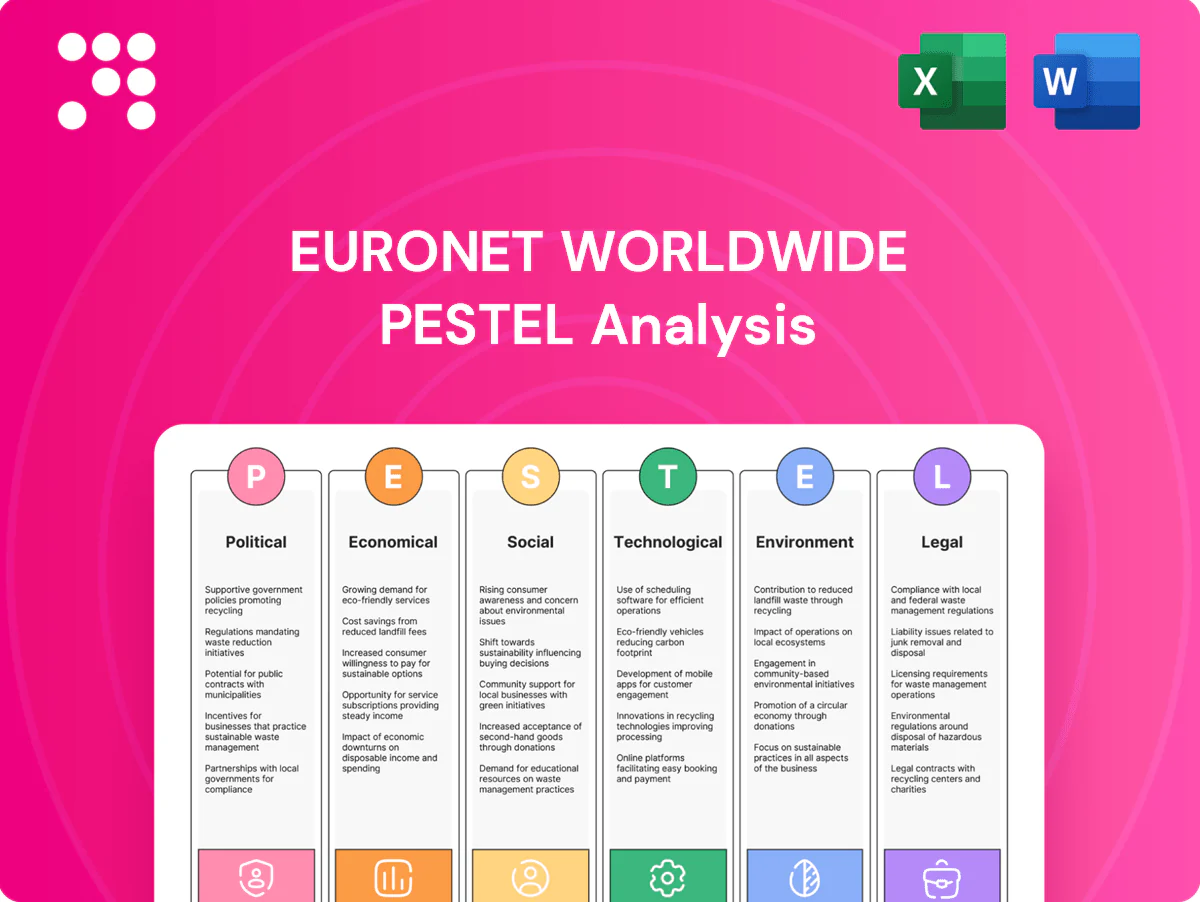
Euronet Worldwide PESTLE Analysis

Your Competitive Advantage Starts with This Report
Unlock how political, economic, social, technological, legal, and environmental forces are reshaping Euronet Worldwide and pinpoint the risks and opportunities that matter most. This concise PESTLE snapshot highlights strategic implications for investors and managers. Purchase the full analysis for the complete, actionable briefing and downloadable templates.
Political factors

Cross-border policy and sanctions
Remittance and card settlement routes rely on geopolitical stability and sanction regimes; Ria operates in 160+ countries while global remittances to low‑ and middle‑income countries hit about $621 billion in 2023 (World Bank), underscoring corridor importance. Changes in OFAC, EU or UK sanctions can abruptly close corridors used by Ria and EFT partners, forcing Euronet to re‑route flows and update screening continuously. Political shifts in emerging markets can also disrupt agent networks and ATM deployments, increasing operational risk and compliance costs.
Central bank oversight of payments
Monetary authorities license ATMs, money transfer operators and prepaid issuers, and regulatory priorities such as cash-availability mandates or fee caps directly shape Euronet’s EFT margins; for example the EU Interchange Fee Regulation caps interchange at 0.2% for debit and 0.3% for credit. Engagement with central banks is essential for network expansion approvals, especially as over 120 central banks were exploring CBDC workstreams by 2024. Policy tightening can delay product launches or force costly system changes and compliance upgrades.

Government digitization agendas
State pushes for cashless economies shrink ATM density while boosting epay demand; India’s UPI ecosystem topped about 12.3 billion monthly transactions in late 2023, illustrating scale governments can create. Public initiatives for instant payments and digital IDs can complement Euronet’s switch and processing services but also compete if state-backed rails expand. Partnering on government disbursements can drive volumes, yet state rails can compress margins for private processors.

Trade relations and labor migration
Bilateral relations shape labor migration and thus remittance flows for Ria; World Bank data show remittances to low- and middle-income countries reached $643 billion in 2023, underscoring corridor importance. Visa rules and employment accords can re-route or suppress sending/receiving flows, reducing corridor liquidity and agent viability. Pro-migration policies catalyze corridor growth and support new market entry.
- Policy risk: restrictive visas reduce corridor volume and agent density
- Growth lever: friendly agreements expand corridors and remittance inflows
- Scale: $643B global remittances (2023) signal market opportunity for Ria
Public security and stability
Civil unrest raises physical risk to Euronet’s network—operating in 170+ countries with over 50,000 ATMs and agents increases exposure to vandalism and cash-in-transit attacks; governments imposing curfews or capital controls (seen in several markets in 2024) can sharply reduce cash access and transactions. Political instability pushed insurance and operating costs higher, with global commercial insurance rates rising about 15% in 2024, while stable regions support network uptime and customer confidence.
- Exposure: 170+ countries, 50,000+ ATMs/agents
- Operational impact: curfews/capital controls reduce cash flows
- Cost pressure: insurance ~+15% in 2024
- Benefit: stability improves uptime and customer trust
Remittances under pressure: $643B flows, insurance +15%
Geopolitical shifts and sanctions can abruptly close Ria corridors, forcing reroutes—global remittances to low‑/middle‑income countries were $643B in 2023. Regulatory changes (EU interchange 0.2%/0.3%) and 120+ central banks exploring CBDCs by 2024 raise compliance and upgrade costs. Civil unrest/curfews elevate physical risk across 170+ countries and 50,000+ ATMs/agents; insurance rose ~15% in 2024.
| Metric | Value |
|---|---|
| Remittances (LMICs, 2023) | $643B |
| Countries/ATMs | 170+ / 50,000+ |
| Interchange cap (EU) | Debit 0.2% / Credit 0.3% |
| Central banks exploring CBDC (by 2024) | 120+ |
| Insurance cost change (2024) | ≈+15% |
What is included in the product
 Detailed Word Document
Explores how macro-environmental factors uniquely affect Euronet Worldwide across Political, Economic, Social, Technological, Environmental and Legal dimensions, with data-driven subpoints and sector-specific examples.
Designed for executives and investors, it delivers forward-looking insights to identify risks, opportunities and strategic responses ready for reports or pitch decks.

 Customizable Excel Spreadsheet
A concise, visually segmented PESTLE summary of Euronet Worldwide, ready to drop into presentations, modifiable with notes and easily shared across teams to streamline external risk discussions and strategic planning.
Economic factors

FX volatility and corridor economics
Euronet’s revenues are highly sensitive to FX swings between settlement and reporting currencies, with cross-border payments and remittances driving material translation exposure; management noted FX was a key driver in 2024 revenue variability. FX moves alter remittance pricing, compress margins and change consumer send/receive behavior; hedging programs reduce earnings volatility but add hedging costs (management indicated hedges cut reported FX P&L swings materially in 2024). Sudden devaluations historically spike volumes short-term while stressing local liquidity and working capital.
Interest rates and float income
Rate cycles materially affect Euronet's settlement floats and working capital yields; global policy rates were elevated in mid-2024 (US fed funds 5.25–5.50%, ECB deposit 4.00%, BoE 5.25%), which can bolster net revenue in EFT and money transfer operations. Rate cuts compress float yields and intensify price competition, while higher borrowing costs reduce ROI on network expansion and M&A.

Consumer spending and travel
Tourism and cross-border commerce drive ATM withdrawals and POS activity; UNWTO reported international tourist arrivals recovered to about 87% of 2019 levels in 2023, underpinning cross-border transactions. Economic slowdowns curb discretionary travel and prepaid top-ups, with IMF projecting global growth of 3.2% in 2024. Recoveries lift transaction counts and surcharge income. Seasonality and macro shocks cause marked volume variability.

Inflation and operating costs
- Higher input costs: labor, rent, cash logistics, energy
- Pricing constrained by competition and regulation
- Demand mix: downtrading hits prepaid/small transfers
- Mitigation: efficiency, contract repricing
Remittance resilience and employment
- Correlation: migrant employment → remittance volumes
- Tight labor markets sustain Ria fees
- Recessions/slowdowns cut sends
- Diversified corridors reduce volatility
Remittances under pressure: $643B flows, insurance +15%
Euronet faces material FX and translation risk (hedges cut 2024 FX P&L swings), interest-rate sensitivity with mid-2024 policy rates (US 5.25–5.50%, ECB 4.00%) affecting float yields, tourism recovery (UNWTO 87% of 2019 arrivals) driving ATM/POS volumes, and cost pressure from elevated input inflation (US CPI ~3.4% in 2024) while remittances remained resilient (World Bank $741bn in 2023).
| Factor | Key 2023–24/25 Data |
|---|---|
| FX exposure | Hedges materially reduced 2024 FX P&L swings |
| Rates | Fed 5.25–5.50%, ECB 4.00% (mid‑2024) |
| Tourism | Arrivals ~87% of 2019 (UNWTO) |
| Remittances | $741bn (World Bank 2023) |
| Inflation | US CPI ~3.4% (2024) |
What You See Is What You Get
Euronet Worldwide PESTLE Analysis
The preview shown here is the exact Euronet Worldwide PESTLE Analysis document you’ll receive after purchase—fully formatted and ready to use. This screenshot reflects the final file with complete content, structure, and professional layout. After payment you’ll instantly download this same, ready-to-use report.

Your Competitive Advantage Starts with This Report
Unlock how political, economic, social, technological, legal, and environmental forces are reshaping Euronet Worldwide and pinpoint the risks and opportunities that matter most. This concise PESTLE snapshot highlights strategic implications for investors and managers. Purchase the full analysis for the complete, actionable briefing and downloadable templates.
Political factors
Cross-border policy and sanctions
Remittance and card settlement routes rely on geopolitical stability and sanction regimes; Ria operates in 160+ countries while global remittances to low‑ and middle‑income countries hit about $621 billion in 2023 (World Bank), underscoring corridor importance. Changes in OFAC, EU or UK sanctions can abruptly close corridors used by Ria and EFT partners, forcing Euronet to re‑route flows and update screening continuously. Political shifts in emerging markets can also disrupt agent networks and ATM deployments, increasing operational risk and compliance costs.
Central bank oversight of payments
Monetary authorities license ATMs, money transfer operators and prepaid issuers, and regulatory priorities such as cash-availability mandates or fee caps directly shape Euronet’s EFT margins; for example the EU Interchange Fee Regulation caps interchange at 0.2% for debit and 0.3% for credit. Engagement with central banks is essential for network expansion approvals, especially as over 120 central banks were exploring CBDC workstreams by 2024. Policy tightening can delay product launches or force costly system changes and compliance upgrades.
Government digitization agendas
State pushes for cashless economies shrink ATM density while boosting epay demand; India’s UPI ecosystem topped about 12.3 billion monthly transactions in late 2023, illustrating scale governments can create. Public initiatives for instant payments and digital IDs can complement Euronet’s switch and processing services but also compete if state-backed rails expand. Partnering on government disbursements can drive volumes, yet state rails can compress margins for private processors.
Trade relations and labor migration
Bilateral relations shape labor migration and thus remittance flows for Ria; World Bank data show remittances to low- and middle-income countries reached $643 billion in 2023, underscoring corridor importance. Visa rules and employment accords can re-route or suppress sending/receiving flows, reducing corridor liquidity and agent viability. Pro-migration policies catalyze corridor growth and support new market entry.
- Policy risk: restrictive visas reduce corridor volume and agent density
- Growth lever: friendly agreements expand corridors and remittance inflows
- Scale: $643B global remittances (2023) signal market opportunity for Ria
Public security and stability
Civil unrest raises physical risk to Euronet’s network—operating in 170+ countries with over 50,000 ATMs and agents increases exposure to vandalism and cash-in-transit attacks; governments imposing curfews or capital controls (seen in several markets in 2024) can sharply reduce cash access and transactions. Political instability pushed insurance and operating costs higher, with global commercial insurance rates rising about 15% in 2024, while stable regions support network uptime and customer confidence.
- Exposure: 170+ countries, 50,000+ ATMs/agents
- Operational impact: curfews/capital controls reduce cash flows
- Cost pressure: insurance ~+15% in 2024
- Benefit: stability improves uptime and customer trust
Remittances under pressure: $643B flows, insurance +15%
Geopolitical shifts and sanctions can abruptly close Ria corridors, forcing reroutes—global remittances to low‑/middle‑income countries were $643B in 2023. Regulatory changes (EU interchange 0.2%/0.3%) and 120+ central banks exploring CBDCs by 2024 raise compliance and upgrade costs. Civil unrest/curfews elevate physical risk across 170+ countries and 50,000+ ATMs/agents; insurance rose ~15% in 2024.
| Metric | Value |
|---|---|
| Remittances (LMICs, 2023) | $643B |
| Countries/ATMs | 170+ / 50,000+ |
| Interchange cap (EU) | Debit 0.2% / Credit 0.3% |
| Central banks exploring CBDC (by 2024) | 120+ |
| Insurance cost change (2024) | ≈+15% |
What is included in the product
Detailed Word Document
Explores how macro-environmental factors uniquely affect Euronet Worldwide across Political, Economic, Social, Technological, Environmental and Legal dimensions, with data-driven subpoints and sector-specific examples.
Designed for executives and investors, it delivers forward-looking insights to identify risks, opportunities and strategic responses ready for reports or pitch decks.
Customizable Excel Spreadsheet
A concise, visually segmented PESTLE summary of Euronet Worldwide, ready to drop into presentations, modifiable with notes and easily shared across teams to streamline external risk discussions and strategic planning.
Economic factors
FX volatility and corridor economics
Euronet’s revenues are highly sensitive to FX swings between settlement and reporting currencies, with cross-border payments and remittances driving material translation exposure; management noted FX was a key driver in 2024 revenue variability. FX moves alter remittance pricing, compress margins and change consumer send/receive behavior; hedging programs reduce earnings volatility but add hedging costs (management indicated hedges cut reported FX P&L swings materially in 2024). Sudden devaluations historically spike volumes short-term while stressing local liquidity and working capital.
Interest rates and float income
Rate cycles materially affect Euronet's settlement floats and working capital yields; global policy rates were elevated in mid-2024 (US fed funds 5.25–5.50%, ECB deposit 4.00%, BoE 5.25%), which can bolster net revenue in EFT and money transfer operations. Rate cuts compress float yields and intensify price competition, while higher borrowing costs reduce ROI on network expansion and M&A.
Consumer spending and travel
Tourism and cross-border commerce drive ATM withdrawals and POS activity; UNWTO reported international tourist arrivals recovered to about 87% of 2019 levels in 2023, underpinning cross-border transactions. Economic slowdowns curb discretionary travel and prepaid top-ups, with IMF projecting global growth of 3.2% in 2024. Recoveries lift transaction counts and surcharge income. Seasonality and macro shocks cause marked volume variability.
Inflation and operating costs
- Higher input costs: labor, rent, cash logistics, energy
- Pricing constrained by competition and regulation
- Demand mix: downtrading hits prepaid/small transfers
- Mitigation: efficiency, contract repricing
Remittance resilience and employment
- Correlation: migrant employment → remittance volumes
- Tight labor markets sustain Ria fees
- Recessions/slowdowns cut sends
- Diversified corridors reduce volatility
Remittances under pressure: $643B flows, insurance +15%
Euronet faces material FX and translation risk (hedges cut 2024 FX P&L swings), interest-rate sensitivity with mid-2024 policy rates (US 5.25–5.50%, ECB 4.00%) affecting float yields, tourism recovery (UNWTO 87% of 2019 arrivals) driving ATM/POS volumes, and cost pressure from elevated input inflation (US CPI ~3.4% in 2024) while remittances remained resilient (World Bank $741bn in 2023).
| Factor | Key 2023–24/25 Data |
|---|---|
| FX exposure | Hedges materially reduced 2024 FX P&L swings |
| Rates | Fed 5.25–5.50%, ECB 4.00% (mid‑2024) |
| Tourism | Arrivals ~87% of 2019 (UNWTO) |
| Remittances | $741bn (World Bank 2023) |
| Inflation | US CPI ~3.4% (2024) |
What You See Is What You Get
Euronet Worldwide PESTLE Analysis
The preview shown here is the exact Euronet Worldwide PESTLE Analysis document you’ll receive after purchase—fully formatted and ready to use. This screenshot reflects the final file with complete content, structure, and professional layout. After payment you’ll instantly download this same, ready-to-use report.
Original: $10.00
-65%$10.00
$3.50Description
Your Competitive Advantage Starts with This Report
Unlock how political, economic, social, technological, legal, and environmental forces are reshaping Euronet Worldwide and pinpoint the risks and opportunities that matter most. This concise PESTLE snapshot highlights strategic implications for investors and managers. Purchase the full analysis for the complete, actionable briefing and downloadable templates.
Political factors
Cross-border policy and sanctions
Remittance and card settlement routes rely on geopolitical stability and sanction regimes; Ria operates in 160+ countries while global remittances to low‑ and middle‑income countries hit about $621 billion in 2023 (World Bank), underscoring corridor importance. Changes in OFAC, EU or UK sanctions can abruptly close corridors used by Ria and EFT partners, forcing Euronet to re‑route flows and update screening continuously. Political shifts in emerging markets can also disrupt agent networks and ATM deployments, increasing operational risk and compliance costs.
Central bank oversight of payments
Monetary authorities license ATMs, money transfer operators and prepaid issuers, and regulatory priorities such as cash-availability mandates or fee caps directly shape Euronet’s EFT margins; for example the EU Interchange Fee Regulation caps interchange at 0.2% for debit and 0.3% for credit. Engagement with central banks is essential for network expansion approvals, especially as over 120 central banks were exploring CBDC workstreams by 2024. Policy tightening can delay product launches or force costly system changes and compliance upgrades.
Government digitization agendas
State pushes for cashless economies shrink ATM density while boosting epay demand; India’s UPI ecosystem topped about 12.3 billion monthly transactions in late 2023, illustrating scale governments can create. Public initiatives for instant payments and digital IDs can complement Euronet’s switch and processing services but also compete if state-backed rails expand. Partnering on government disbursements can drive volumes, yet state rails can compress margins for private processors.
Trade relations and labor migration
Bilateral relations shape labor migration and thus remittance flows for Ria; World Bank data show remittances to low- and middle-income countries reached $643 billion in 2023, underscoring corridor importance. Visa rules and employment accords can re-route or suppress sending/receiving flows, reducing corridor liquidity and agent viability. Pro-migration policies catalyze corridor growth and support new market entry.
- Policy risk: restrictive visas reduce corridor volume and agent density
- Growth lever: friendly agreements expand corridors and remittance inflows
- Scale: $643B global remittances (2023) signal market opportunity for Ria
Public security and stability
Civil unrest raises physical risk to Euronet’s network—operating in 170+ countries with over 50,000 ATMs and agents increases exposure to vandalism and cash-in-transit attacks; governments imposing curfews or capital controls (seen in several markets in 2024) can sharply reduce cash access and transactions. Political instability pushed insurance and operating costs higher, with global commercial insurance rates rising about 15% in 2024, while stable regions support network uptime and customer confidence.
- Exposure: 170+ countries, 50,000+ ATMs/agents
- Operational impact: curfews/capital controls reduce cash flows
- Cost pressure: insurance ~+15% in 2024
- Benefit: stability improves uptime and customer trust
Remittances under pressure: $643B flows, insurance +15%
Geopolitical shifts and sanctions can abruptly close Ria corridors, forcing reroutes—global remittances to low‑/middle‑income countries were $643B in 2023. Regulatory changes (EU interchange 0.2%/0.3%) and 120+ central banks exploring CBDCs by 2024 raise compliance and upgrade costs. Civil unrest/curfews elevate physical risk across 170+ countries and 50,000+ ATMs/agents; insurance rose ~15% in 2024.
| Metric | Value |
|---|---|
| Remittances (LMICs, 2023) | $643B |
| Countries/ATMs | 170+ / 50,000+ |
| Interchange cap (EU) | Debit 0.2% / Credit 0.3% |
| Central banks exploring CBDC (by 2024) | 120+ |
| Insurance cost change (2024) | ≈+15% |
What is included in the product
Detailed Word Document
Explores how macro-environmental factors uniquely affect Euronet Worldwide across Political, Economic, Social, Technological, Environmental and Legal dimensions, with data-driven subpoints and sector-specific examples.
Designed for executives and investors, it delivers forward-looking insights to identify risks, opportunities and strategic responses ready for reports or pitch decks.
Customizable Excel Spreadsheet
A concise, visually segmented PESTLE summary of Euronet Worldwide, ready to drop into presentations, modifiable with notes and easily shared across teams to streamline external risk discussions and strategic planning.
Economic factors
FX volatility and corridor economics
Euronet’s revenues are highly sensitive to FX swings between settlement and reporting currencies, with cross-border payments and remittances driving material translation exposure; management noted FX was a key driver in 2024 revenue variability. FX moves alter remittance pricing, compress margins and change consumer send/receive behavior; hedging programs reduce earnings volatility but add hedging costs (management indicated hedges cut reported FX P&L swings materially in 2024). Sudden devaluations historically spike volumes short-term while stressing local liquidity and working capital.
Interest rates and float income
Rate cycles materially affect Euronet's settlement floats and working capital yields; global policy rates were elevated in mid-2024 (US fed funds 5.25–5.50%, ECB deposit 4.00%, BoE 5.25%), which can bolster net revenue in EFT and money transfer operations. Rate cuts compress float yields and intensify price competition, while higher borrowing costs reduce ROI on network expansion and M&A.
Consumer spending and travel
Tourism and cross-border commerce drive ATM withdrawals and POS activity; UNWTO reported international tourist arrivals recovered to about 87% of 2019 levels in 2023, underpinning cross-border transactions. Economic slowdowns curb discretionary travel and prepaid top-ups, with IMF projecting global growth of 3.2% in 2024. Recoveries lift transaction counts and surcharge income. Seasonality and macro shocks cause marked volume variability.
Inflation and operating costs
- Higher input costs: labor, rent, cash logistics, energy
- Pricing constrained by competition and regulation
- Demand mix: downtrading hits prepaid/small transfers
- Mitigation: efficiency, contract repricing
Remittance resilience and employment
- Correlation: migrant employment → remittance volumes
- Tight labor markets sustain Ria fees
- Recessions/slowdowns cut sends
- Diversified corridors reduce volatility
Remittances under pressure: $643B flows, insurance +15%
Euronet faces material FX and translation risk (hedges cut 2024 FX P&L swings), interest-rate sensitivity with mid-2024 policy rates (US 5.25–5.50%, ECB 4.00%) affecting float yields, tourism recovery (UNWTO 87% of 2019 arrivals) driving ATM/POS volumes, and cost pressure from elevated input inflation (US CPI ~3.4% in 2024) while remittances remained resilient (World Bank $741bn in 2023).
| Factor | Key 2023–24/25 Data |
|---|---|
| FX exposure | Hedges materially reduced 2024 FX P&L swings |
| Rates | Fed 5.25–5.50%, ECB 4.00% (mid‑2024) |
| Tourism | Arrivals ~87% of 2019 (UNWTO) |
| Remittances | $741bn (World Bank 2023) |
| Inflation | US CPI ~3.4% (2024) |
What You See Is What You Get
Euronet Worldwide PESTLE Analysis
The preview shown here is the exact Euronet Worldwide PESTLE Analysis document you’ll receive after purchase—fully formatted and ready to use. This screenshot reflects the final file with complete content, structure, and professional layout. After payment you’ll instantly download this same, ready-to-use report.











