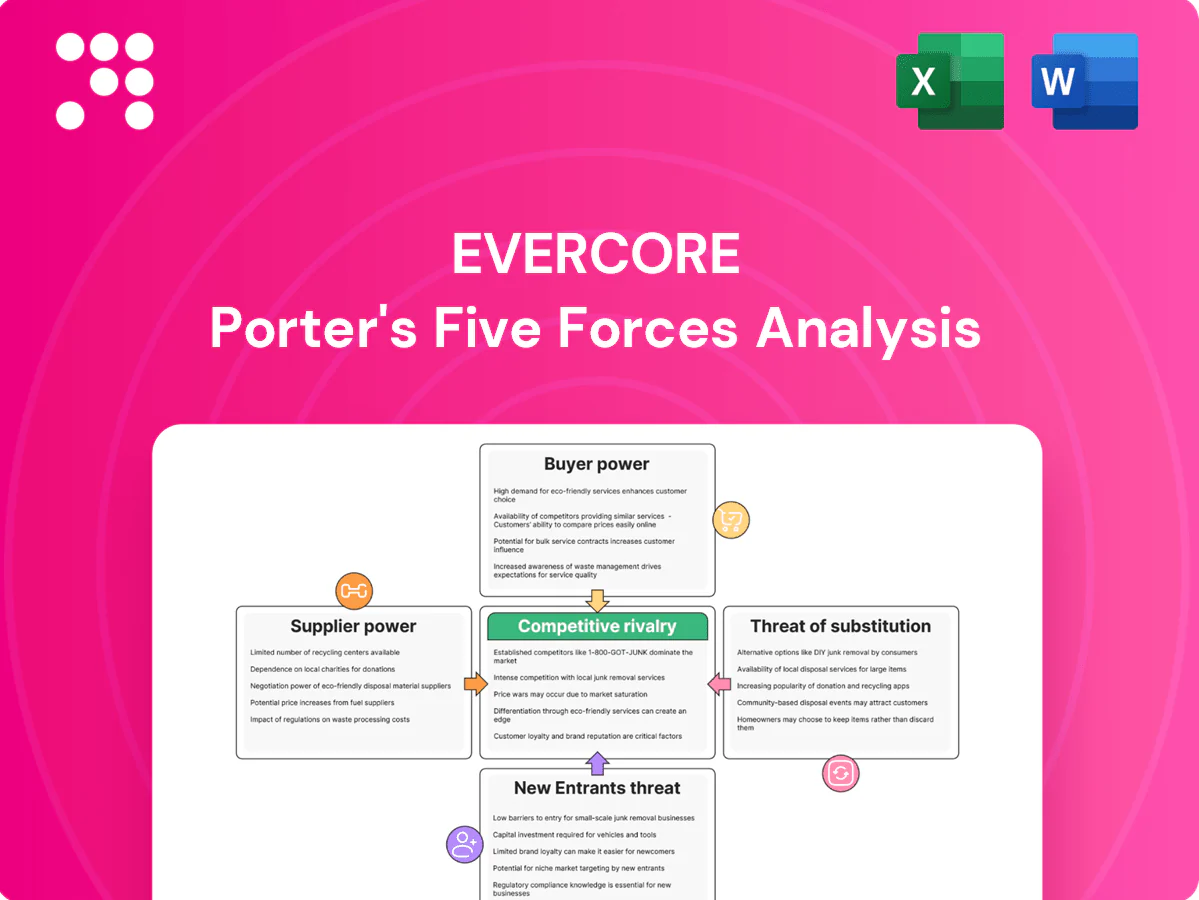
Evercore Porter's Five Forces Analysis

From Overview to Strategy Blueprint
Evercore operates in a complex advisory landscape where buyer power, competitive rivalry, and regulatory pressure shape margins and growth prospects; our snapshot highlights these dynamics and key strategic levers. This brief only scratches the surface—unlock the full Porter’s Five Forces Analysis for force-by-force ratings, visuals, and actionable insights to inform investments or strategy.
Suppliers Bargaining Power

Star banker talent concentration
Senior rainmakers are scarce and highly portable, often commanding total pay packages exceeding $1m, giving them outsized leverage over pay and platform decisions; Evercore reported net revenue of about $2.7bn in 2023, so losing or hiring a handful of partners can materially shift franchise strength. Retention costs and deferred comp tend to rise in tight markets, forcing Evercore to balance culture with competitive compensation.
Data and market intel vendors
Reliance on vendors like Bloomberg (about 325,000 terminals globally) and Refinitiv gives moderate supplier power through high annual subscription fees (Bloomberg ~27,000 USD/year) that compress margins for firms like Evercore.
Switching is feasible but costly due to workflow integration, data mapping and training, so multi-sourcing and enterprise agreements are used to reduce lock-in.
Contractual pricing escalators and modular add-ons (real‑time feeds, analytics) can still drive recurring cost increases and margin pressure.

Legal, compliance, and tech stack
Specialized compliance tools, deal rooms and cybersecurity providers hold leverage for Evercore due to regulatory mandates and a global cybersecurity market that exceeded $200 billion in 2024, but competitive bidding remains strong given a broad ecosystem of dozens of specialized vendors. Integration complexity and custom connectors can raise switching costs materially, while widespread cloud adoption—94% of enterprises used cloud in 2024—drives standardization and lowers dependency over time.

Referral and network intermediaries
Law firms, accountants and fund sponsors channel mandates to Evercore, shaping access to deal flow through relationship networks rather than enforceable contracts; their influence is situational and driven by referral history and trust.
- Reciprocity and cross-referrals often equalize bargaining power
- Diversified origination channels reduce concentration risk
- Relationship strength, not formal terms, determines intermediary influence
University and recruiting pipelines
Top-tier schools and MBA programs remain primary sources of analyst and associate talent for Evercore, with GMAC reporting MBA application growth in 2024 that replenished elite pipelines; competition among elite banks has driven richer offer terms and signing incentives. Evercore’s brand, rigorous training and deal exposure reduce supplier power by attracting self-selecting candidates, while expanded lateral hiring in 2024 broadened sourcing beyond campuses.
- Top-tier schools: primary feeder
- Competitive offers: elevate compensation
- Evercore brand: lowers supplier leverage
- Lateral hiring 2024: diversifies talent sources
Senior rainmakers sway >US$1m pay, swing US$2.7bn
Senior rainmakers command >$1m packages and can swing Evercore’s US$2.7bn 2023 revenue materially; vendor fees (Bloomberg ~US$27,000/terminal; 325,000 terminals globally) and rising cybersecurity spend (>US$200bn in 2024) exert moderate supplier pressure. Multi‑sourcing, cloud (94% enterprise use in 2024) and strong brand mitigate but raise switching costs.
| Item | Metric |
|---|---|
| Evercore revenue (2023) | US$2.7bn |
| Senior pay | >US$1m |
| Bloomberg fee | ~US$27,000/yr |
| Cybersecurity market (2024) | >US$200bn |
What is included in the product
 Detailed Word Document
Comprehensive Porter's Five Forces analysis tailored to Evercore that uncovers competitive drivers, supplier and buyer influence on pricing and profitability, and market entry barriers protecting incumbents; highlights disruptive threats, substitutes, and strategic implications for investor materials, internal strategy decks, or academic use in an editable Word format.

 Customizable Excel Spreadsheet
A concise Evercore Porter's Five Forces one-sheet that clarifies competitive pressures, offers customizable pressure levels and a ready-to-use radar chart—ideal for fast strategic decisions, pitch decks, and seamless integration into reports without macros.
Customers Bargaining Power

Sophisticated corporate clients
Sophisticated corporate clients run competitive beauty contests that intensify fee and term pressure and often split mandates among banks to extract value; according to Refinitiv, global M&A announced value was about $1.9 trillion in 2024, keeping deal competition high. Switching costs are low pre-mandate, but proven execution and relationship trust create post-award stickiness. Evercore’s reputation and sector expertise materially counterbalance this buyer power.
Financial sponsors’ fee sensitivity
Private equity firms are repeat buyers with strict price discipline and standardized engagement terms, benchmarking advisor fees and leveraging deal volume; Preqin reports PE dry powder >$2.0 trillion in 2024, amplifying negotiating leverage. Speed and execution certainty can command premium fees, yet long-term relationships remain contestable on a deal-by-deal basis.

Sovereign and government clients
Sovereign and government clients exert high bargaining power as public procurement rules and transparency mandates (public procurement ≈12% of GDP globally) force competitive tendering and strict compliance. Political scrutiny often compresses fees and lengthens timelines; US federal procurements totaled about $800B in FY2023, tightening pricing. Evercore accepts lower economics for prestige mandates, and a strong track record in policy sectors materially raises win rates.

Outcome-driven compensation
Success-based fees tie Evercore revenue to deal completion and, per Evercore's 2024 Form 10-K disclosures, shift measurable risk to the firm; clients increasingly demand capped retainers and contingent structures. Complex, multi-track processes can expand scope without proportional pay, so clear scoping, milestone fees and fixed retainers are used to protect economics.
- Outcome fees: align pay with closing
- Capped retainers: limit client upfront
- Scope creep: expands unpaid work
- Milestone fees: protect margins
Global optionality and alternatives
Clients can choose independents, the roughly top 10 bulge-bracket banks, or growing in-house teams, and global optionality — with cross-border deals making up about one-third of M&A in 2024 — intensifies competition for Evercore on international mandates. Differentiated insights and senior banker attention reduce perceived substitutability, while Evercore's unique sector coverage limits buyer leverage.
- Competitors: independents, top 10 bulge brackets, in-house
- Cross-border share 2024: ~33%
- Senior attention lowers switching
- Sector specialization reduces buyer power
Buyers control deals: $1.9T M&A, PE dry powder > $2.0T, cross-border ~33%
Buyers wield strong leverage: 2024 global M&A ~$1.9T and PE dry powder >$2.0T compress fees and terms, with repeat PE buyers driving standardized demands. Sovereign/public mandates force competitive tendering and lower economics; cross-border deals ~33% of M&A increase supplier options. Evercore’s execution, sector focus and senior coverage counterbalance but do not eliminate client bargaining power.
| Metric | 2024 |
|---|---|
| Global M&A announced | $1.9T |
| PE dry powder | >$2.0T |
| Cross-border share | ~33% |
Preview the Actual Deliverable
Evercore Porter's Five Forces Analysis
This preview shows the exact Evercore Porter's Five Forces Analysis you'll receive immediately after purchase—fully formatted, professionally written, and ready to use. No placeholders or mockups appear here; the downloadable file is this same complete document. Purchase grants instant access to this final deliverable for immediate use.

From Overview to Strategy Blueprint
Evercore operates in a complex advisory landscape where buyer power, competitive rivalry, and regulatory pressure shape margins and growth prospects; our snapshot highlights these dynamics and key strategic levers. This brief only scratches the surface—unlock the full Porter’s Five Forces Analysis for force-by-force ratings, visuals, and actionable insights to inform investments or strategy.
Suppliers Bargaining Power
Star banker talent concentration
Senior rainmakers are scarce and highly portable, often commanding total pay packages exceeding $1m, giving them outsized leverage over pay and platform decisions; Evercore reported net revenue of about $2.7bn in 2023, so losing or hiring a handful of partners can materially shift franchise strength. Retention costs and deferred comp tend to rise in tight markets, forcing Evercore to balance culture with competitive compensation.
Data and market intel vendors
Reliance on vendors like Bloomberg (about 325,000 terminals globally) and Refinitiv gives moderate supplier power through high annual subscription fees (Bloomberg ~27,000 USD/year) that compress margins for firms like Evercore.
Switching is feasible but costly due to workflow integration, data mapping and training, so multi-sourcing and enterprise agreements are used to reduce lock-in.
Contractual pricing escalators and modular add-ons (real‑time feeds, analytics) can still drive recurring cost increases and margin pressure.
Legal, compliance, and tech stack
Specialized compliance tools, deal rooms and cybersecurity providers hold leverage for Evercore due to regulatory mandates and a global cybersecurity market that exceeded $200 billion in 2024, but competitive bidding remains strong given a broad ecosystem of dozens of specialized vendors. Integration complexity and custom connectors can raise switching costs materially, while widespread cloud adoption—94% of enterprises used cloud in 2024—drives standardization and lowers dependency over time.
Referral and network intermediaries
Law firms, accountants and fund sponsors channel mandates to Evercore, shaping access to deal flow through relationship networks rather than enforceable contracts; their influence is situational and driven by referral history and trust.
- Reciprocity and cross-referrals often equalize bargaining power
- Diversified origination channels reduce concentration risk
- Relationship strength, not formal terms, determines intermediary influence
University and recruiting pipelines
Top-tier schools and MBA programs remain primary sources of analyst and associate talent for Evercore, with GMAC reporting MBA application growth in 2024 that replenished elite pipelines; competition among elite banks has driven richer offer terms and signing incentives. Evercore’s brand, rigorous training and deal exposure reduce supplier power by attracting self-selecting candidates, while expanded lateral hiring in 2024 broadened sourcing beyond campuses.
- Top-tier schools: primary feeder
- Competitive offers: elevate compensation
- Evercore brand: lowers supplier leverage
- Lateral hiring 2024: diversifies talent sources
Senior rainmakers sway >US$1m pay, swing US$2.7bn
Senior rainmakers command >$1m packages and can swing Evercore’s US$2.7bn 2023 revenue materially; vendor fees (Bloomberg ~US$27,000/terminal; 325,000 terminals globally) and rising cybersecurity spend (>US$200bn in 2024) exert moderate supplier pressure. Multi‑sourcing, cloud (94% enterprise use in 2024) and strong brand mitigate but raise switching costs.
| Item | Metric |
|---|---|
| Evercore revenue (2023) | US$2.7bn |
| Senior pay | >US$1m |
| Bloomberg fee | ~US$27,000/yr |
| Cybersecurity market (2024) | >US$200bn |
What is included in the product
Detailed Word Document
Comprehensive Porter's Five Forces analysis tailored to Evercore that uncovers competitive drivers, supplier and buyer influence on pricing and profitability, and market entry barriers protecting incumbents; highlights disruptive threats, substitutes, and strategic implications for investor materials, internal strategy decks, or academic use in an editable Word format.
Customizable Excel Spreadsheet
A concise Evercore Porter's Five Forces one-sheet that clarifies competitive pressures, offers customizable pressure levels and a ready-to-use radar chart—ideal for fast strategic decisions, pitch decks, and seamless integration into reports without macros.
Customers Bargaining Power
Sophisticated corporate clients
Sophisticated corporate clients run competitive beauty contests that intensify fee and term pressure and often split mandates among banks to extract value; according to Refinitiv, global M&A announced value was about $1.9 trillion in 2024, keeping deal competition high. Switching costs are low pre-mandate, but proven execution and relationship trust create post-award stickiness. Evercore’s reputation and sector expertise materially counterbalance this buyer power.
Financial sponsors’ fee sensitivity
Private equity firms are repeat buyers with strict price discipline and standardized engagement terms, benchmarking advisor fees and leveraging deal volume; Preqin reports PE dry powder >$2.0 trillion in 2024, amplifying negotiating leverage. Speed and execution certainty can command premium fees, yet long-term relationships remain contestable on a deal-by-deal basis.
Sovereign and government clients
Sovereign and government clients exert high bargaining power as public procurement rules and transparency mandates (public procurement ≈12% of GDP globally) force competitive tendering and strict compliance. Political scrutiny often compresses fees and lengthens timelines; US federal procurements totaled about $800B in FY2023, tightening pricing. Evercore accepts lower economics for prestige mandates, and a strong track record in policy sectors materially raises win rates.
Outcome-driven compensation
Success-based fees tie Evercore revenue to deal completion and, per Evercore's 2024 Form 10-K disclosures, shift measurable risk to the firm; clients increasingly demand capped retainers and contingent structures. Complex, multi-track processes can expand scope without proportional pay, so clear scoping, milestone fees and fixed retainers are used to protect economics.
- Outcome fees: align pay with closing
- Capped retainers: limit client upfront
- Scope creep: expands unpaid work
- Milestone fees: protect margins
Global optionality and alternatives
Clients can choose independents, the roughly top 10 bulge-bracket banks, or growing in-house teams, and global optionality — with cross-border deals making up about one-third of M&A in 2024 — intensifies competition for Evercore on international mandates. Differentiated insights and senior banker attention reduce perceived substitutability, while Evercore's unique sector coverage limits buyer leverage.
- Competitors: independents, top 10 bulge brackets, in-house
- Cross-border share 2024: ~33%
- Senior attention lowers switching
- Sector specialization reduces buyer power
Buyers control deals: $1.9T M&A, PE dry powder > $2.0T, cross-border ~33%
Buyers wield strong leverage: 2024 global M&A ~$1.9T and PE dry powder >$2.0T compress fees and terms, with repeat PE buyers driving standardized demands. Sovereign/public mandates force competitive tendering and lower economics; cross-border deals ~33% of M&A increase supplier options. Evercore’s execution, sector focus and senior coverage counterbalance but do not eliminate client bargaining power.
| Metric | 2024 |
|---|---|
| Global M&A announced | $1.9T |
| PE dry powder | >$2.0T |
| Cross-border share | ~33% |
Preview the Actual Deliverable
Evercore Porter's Five Forces Analysis
This preview shows the exact Evercore Porter's Five Forces Analysis you'll receive immediately after purchase—fully formatted, professionally written, and ready to use. No placeholders or mockups appear here; the downloadable file is this same complete document. Purchase grants instant access to this final deliverable for immediate use.
Original: $10.00
-65%$10.00
$3.50Description
From Overview to Strategy Blueprint
Evercore operates in a complex advisory landscape where buyer power, competitive rivalry, and regulatory pressure shape margins and growth prospects; our snapshot highlights these dynamics and key strategic levers. This brief only scratches the surface—unlock the full Porter’s Five Forces Analysis for force-by-force ratings, visuals, and actionable insights to inform investments or strategy.
Suppliers Bargaining Power
Star banker talent concentration
Senior rainmakers are scarce and highly portable, often commanding total pay packages exceeding $1m, giving them outsized leverage over pay and platform decisions; Evercore reported net revenue of about $2.7bn in 2023, so losing or hiring a handful of partners can materially shift franchise strength. Retention costs and deferred comp tend to rise in tight markets, forcing Evercore to balance culture with competitive compensation.
Data and market intel vendors
Reliance on vendors like Bloomberg (about 325,000 terminals globally) and Refinitiv gives moderate supplier power through high annual subscription fees (Bloomberg ~27,000 USD/year) that compress margins for firms like Evercore.
Switching is feasible but costly due to workflow integration, data mapping and training, so multi-sourcing and enterprise agreements are used to reduce lock-in.
Contractual pricing escalators and modular add-ons (real‑time feeds, analytics) can still drive recurring cost increases and margin pressure.
Legal, compliance, and tech stack
Specialized compliance tools, deal rooms and cybersecurity providers hold leverage for Evercore due to regulatory mandates and a global cybersecurity market that exceeded $200 billion in 2024, but competitive bidding remains strong given a broad ecosystem of dozens of specialized vendors. Integration complexity and custom connectors can raise switching costs materially, while widespread cloud adoption—94% of enterprises used cloud in 2024—drives standardization and lowers dependency over time.
Referral and network intermediaries
Law firms, accountants and fund sponsors channel mandates to Evercore, shaping access to deal flow through relationship networks rather than enforceable contracts; their influence is situational and driven by referral history and trust.
- Reciprocity and cross-referrals often equalize bargaining power
- Diversified origination channels reduce concentration risk
- Relationship strength, not formal terms, determines intermediary influence
University and recruiting pipelines
Top-tier schools and MBA programs remain primary sources of analyst and associate talent for Evercore, with GMAC reporting MBA application growth in 2024 that replenished elite pipelines; competition among elite banks has driven richer offer terms and signing incentives. Evercore’s brand, rigorous training and deal exposure reduce supplier power by attracting self-selecting candidates, while expanded lateral hiring in 2024 broadened sourcing beyond campuses.
- Top-tier schools: primary feeder
- Competitive offers: elevate compensation
- Evercore brand: lowers supplier leverage
- Lateral hiring 2024: diversifies talent sources
Senior rainmakers sway >US$1m pay, swing US$2.7bn
Senior rainmakers command >$1m packages and can swing Evercore’s US$2.7bn 2023 revenue materially; vendor fees (Bloomberg ~US$27,000/terminal; 325,000 terminals globally) and rising cybersecurity spend (>US$200bn in 2024) exert moderate supplier pressure. Multi‑sourcing, cloud (94% enterprise use in 2024) and strong brand mitigate but raise switching costs.
| Item | Metric |
|---|---|
| Evercore revenue (2023) | US$2.7bn |
| Senior pay | >US$1m |
| Bloomberg fee | ~US$27,000/yr |
| Cybersecurity market (2024) | >US$200bn |
What is included in the product
Detailed Word Document
Comprehensive Porter's Five Forces analysis tailored to Evercore that uncovers competitive drivers, supplier and buyer influence on pricing and profitability, and market entry barriers protecting incumbents; highlights disruptive threats, substitutes, and strategic implications for investor materials, internal strategy decks, or academic use in an editable Word format.
Customizable Excel Spreadsheet
A concise Evercore Porter's Five Forces one-sheet that clarifies competitive pressures, offers customizable pressure levels and a ready-to-use radar chart—ideal for fast strategic decisions, pitch decks, and seamless integration into reports without macros.
Customers Bargaining Power
Sophisticated corporate clients
Sophisticated corporate clients run competitive beauty contests that intensify fee and term pressure and often split mandates among banks to extract value; according to Refinitiv, global M&A announced value was about $1.9 trillion in 2024, keeping deal competition high. Switching costs are low pre-mandate, but proven execution and relationship trust create post-award stickiness. Evercore’s reputation and sector expertise materially counterbalance this buyer power.
Financial sponsors’ fee sensitivity
Private equity firms are repeat buyers with strict price discipline and standardized engagement terms, benchmarking advisor fees and leveraging deal volume; Preqin reports PE dry powder >$2.0 trillion in 2024, amplifying negotiating leverage. Speed and execution certainty can command premium fees, yet long-term relationships remain contestable on a deal-by-deal basis.
Sovereign and government clients
Sovereign and government clients exert high bargaining power as public procurement rules and transparency mandates (public procurement ≈12% of GDP globally) force competitive tendering and strict compliance. Political scrutiny often compresses fees and lengthens timelines; US federal procurements totaled about $800B in FY2023, tightening pricing. Evercore accepts lower economics for prestige mandates, and a strong track record in policy sectors materially raises win rates.
Outcome-driven compensation
Success-based fees tie Evercore revenue to deal completion and, per Evercore's 2024 Form 10-K disclosures, shift measurable risk to the firm; clients increasingly demand capped retainers and contingent structures. Complex, multi-track processes can expand scope without proportional pay, so clear scoping, milestone fees and fixed retainers are used to protect economics.
- Outcome fees: align pay with closing
- Capped retainers: limit client upfront
- Scope creep: expands unpaid work
- Milestone fees: protect margins
Global optionality and alternatives
Clients can choose independents, the roughly top 10 bulge-bracket banks, or growing in-house teams, and global optionality — with cross-border deals making up about one-third of M&A in 2024 — intensifies competition for Evercore on international mandates. Differentiated insights and senior banker attention reduce perceived substitutability, while Evercore's unique sector coverage limits buyer leverage.
- Competitors: independents, top 10 bulge brackets, in-house
- Cross-border share 2024: ~33%
- Senior attention lowers switching
- Sector specialization reduces buyer power
Buyers control deals: $1.9T M&A, PE dry powder > $2.0T, cross-border ~33%
Buyers wield strong leverage: 2024 global M&A ~$1.9T and PE dry powder >$2.0T compress fees and terms, with repeat PE buyers driving standardized demands. Sovereign/public mandates force competitive tendering and lower economics; cross-border deals ~33% of M&A increase supplier options. Evercore’s execution, sector focus and senior coverage counterbalance but do not eliminate client bargaining power.
| Metric | 2024 |
|---|---|
| Global M&A announced | $1.9T |
| PE dry powder | >$2.0T |
| Cross-border share | ~33% |
Preview the Actual Deliverable
Evercore Porter's Five Forces Analysis
This preview shows the exact Evercore Porter's Five Forces Analysis you'll receive immediately after purchase—fully formatted, professionally written, and ready to use. No placeholders or mockups appear here; the downloadable file is this same complete document. Purchase grants instant access to this final deliverable for immediate use.











